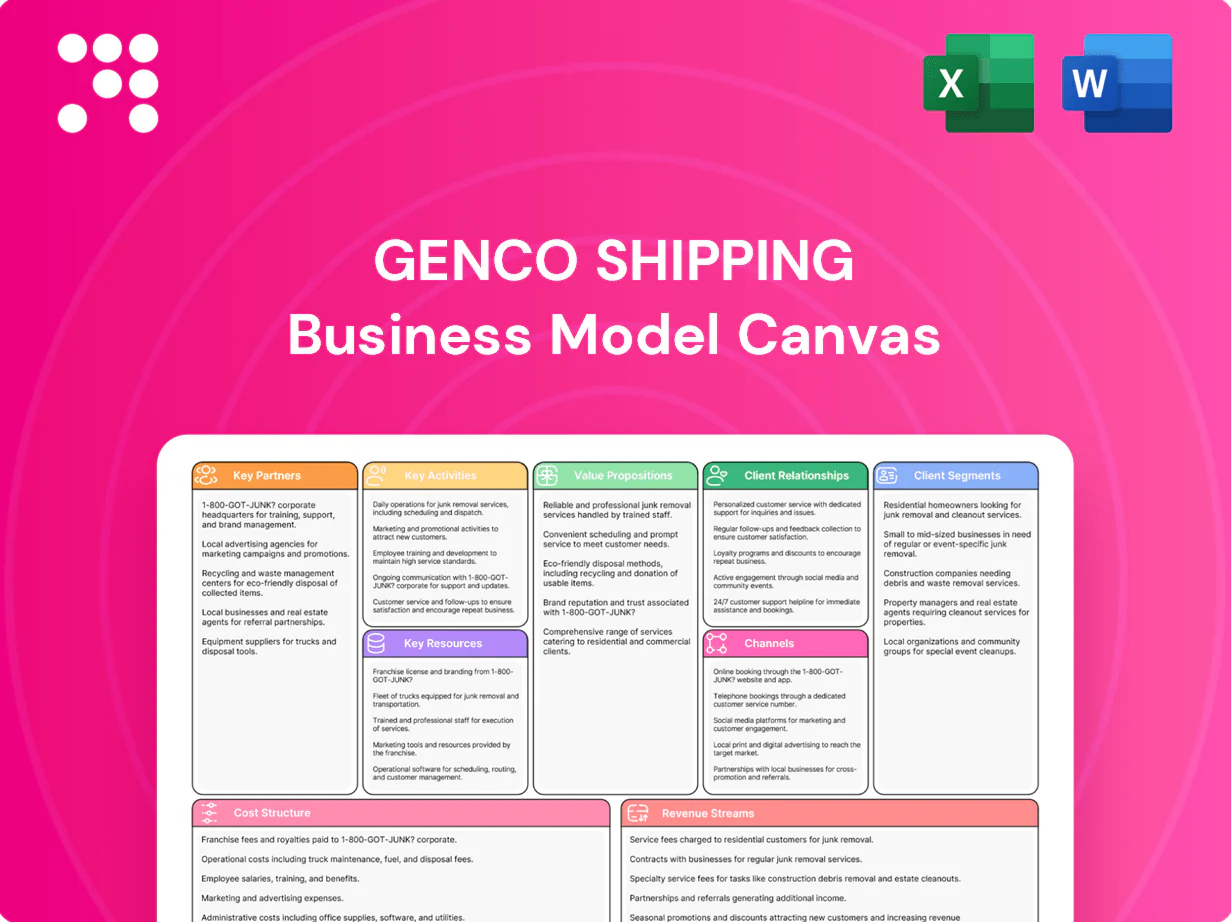
Genco Shipping Business Model Canvas

Unlock an actionable Business Model Canvas for maritime investors and strategists
Unlock the full strategic blueprint behind Genco Shipping’s business model in a concise, actionable Business Model Canvas. This deep-dive maps value propositions, customer segments, key partners, and cost/revenue levers. Ideal for investors, analysts, and strategists seeking competitive edge. Download the complete Word and Excel files to apply the canvas directly to your research or presentations.
Partnerships

Commodity producers & traders
Partnerships with miners, agribusinesses and trading houses secure steady cargo flows for iron ore (~1.6bn t seaborne 2024), coal (~1.2bn t) and grains (~430m t), improving fleet utilization and cutting ballast days. Joint planning aligns vessel availability with export windows, raising utilization by several percentage points versus spot-only deployment. Multi-year frameworks smooth revenue, reducing cycle volatility for Genco.
Chartering brokers & agents
Global shipbrokers give Genco market access, fixtures and 2024 freight intelligence from the drybulk market, shortening negotiation cycles and improving rate capture. Local port agents coordinate paperwork and local ops to minimize port delays and turnaround. Together they expand commercial reach while keeping internal sales costs lower than running larger in‑house commercial teams.

Port terminals & stevedores
Strong ties with port terminals and stevedores enable Genco to achieve efficient loading and discharge, contributing to lower turnaround times; Genco operated a fleet of 52 drybulk vessels in 2024, so berth priority is material to utilization. Preferred berthing and skilled stevedores reduce laytime and demurrage, boosting voyage revenue. Operational alignment improves schedule reliability across trade lanes and coordinated planning enhances safety and cargo care.

Shipyards, OEMs & technical service providers
Shipyards, OEMs and technical service providers enable Genco’s drydockings, retrofits and class surveys, supplying OEM spare parts and specialist engineering to preserve high uptime and regulatory compliance in 2024.
Efficiency upgrades delivered through these partners reduce fuel burn and emissions while integrated service networks lower total lifecycle costs across the fleet.
- Yard support: drydockings & retrofits
- OEMs: spare parts & technical expertise
- Efficiency upgrades: fuel & emissions reduction
- Service networks: lower lifecycle costs
Insurers, P&I clubs & classification societies
Insurers and P&I clubs (International Group covering about 95% of world tonnage in 2024) mitigate operational and liability risks for Genco, while class societies certify compliance with SOLAS, MARPOL and flag-state rules. Risk-management guidance from these partners strengthens onboard safety culture and incident response. Their support during casualties protects customers, limits claims and preserves the Genco brand.
- Insurance: liability & hull protection
- P&I: pooled cover ~95% world tonnage (2024)
- Class societies: statutory compliance SOLAS/MARPOL
- Risk mgmt: safety culture & incident support
Partners secure iron ore ~1.6bn t, coal ~1.2bn t, grains ~430m t and lift utilization
Genco’s key partners — cargo owners, brokers, ports, shipyards/OEMs and P&I/insurers — secure steady volumes (seaborne iron ore ~1.6bn t, coal ~1.2bn t, grains ~430m t in 2024), improve utilization (fleet 52 vessels in 2024) and reduce operational, regulatory and financial risk. Multi‑year contracts and preferred berthing cut ballast/turnaround, boosting voyage revenue and lowering lifecycle costs.
| Partner | Role | 2024 metric |
|---|---|---|
| Cargo owners | Volume supply | iron ore 1.6bn t |
| Brokers | Market access | fixtures intel |
| P&I/Insurers | Risk cover | IG ~95% tonnage |
What is included in the product
 Detailed Word Document
A comprehensive, pre-written Business Model Canvas tailored to Genco Shipping’s drybulk fleet and chartering strategy, covering customer segments, channels, value propositions, revenue streams, and cost structure. Reflects real-world operations, competitive advantages, fleet optimization, and risks for investor presentations and strategic planning.

 Customizable Excel Spreadsheet
High-level one-page snapshot of Genco Shipping’s business model with editable cells to quickly pinpoint strengths, routes, and cost drivers; perfect for brainstorming, team collaboration, or boardroom briefs and saves hours of formatting while keeping structure adaptable for new market insights.
Activities

Fleet operations & voyage planning
Genco (NYSE: GNK) plans routes, speeds and bunkering to minimize fuel burn and port time, noting fuel typically represents 40–60% of voyage costs. Port-call coordination and weather routing are timed for punctuality and reduced idle fuel. Stowage and draft limits are managed to maximize cargo per voyage within safety margins. Vessel performance is monitored live to adjust speed, trim and bunkering in real time.
Chartering & commercial management
Chartering & commercial management secures spot, time-charter and COA fixtures to balance downside risk and upside return, with Genco operating about 50 drybulk vessels across Capesize, Ultramax and Supramax in 2024. Teams negotiate terms, manage laytime, handle BIMCO documentation and laytime claims, and vet counterparties. Cargo-vessel matching optimizes utilization across size segments. Maintaining continuous market presence captures 2024 rate upswings reflected in Baltic index gains.

Maintenance, drydocking & reliability
Execute planned maintenance to maximize vessel availability across Genco’s 35-vessel fleet (GNK, 2024), aligning work scopes to reduce unscheduled downtime. Schedule drydockings during weak market windows to minimize off-hire and revenue loss. Implement condition monitoring and OEM best practices to enhance reliability and extend economic life. Preserve asset value and regulatory compliance with up-to-date class and IMO requirements.

Safety, compliance & risk control
- ISM/ISPS/environmental standards: fleetwide implementation
- Regular crew training & audits
- Proactive vettings & PSC management
- Objective: reduce incidents, protect lives, cargo, reputation
Fuel procurement & emissions management
Source compliant fuels and manage bunker logistics to secure supply and control cost volatility; global commercial fleet comprises about 60,000 ships, driving large-scale bunker coordination. Deploy energy-saving devices and operational efficiencies to improve EEXI/CII performance, track carbon intensity metrics continuously, and align with IMO requirements enforced since 2023. Prepare for evolving carbon pricing—EU ETS averaged near 90 EUR/t in 2024—and rising customer ESG demands.
- compliance: IMO CII/EEXI monitoring
- bunkering: fleet-wide logistics
- efficiency: energy-saving tech rollout
- pricing: EU ETS ~90 EUR/t (2024)
Optimize routing & bunkering to cut 40–60% voyage fuel costs; chartering ~50 vessels
Genco plans routes/speed/bunkering to cut fuel (40–60% voyage cost), charters ~50 vessels across Capesize/Ultramax/Supramax (2024), runs maintenance/drydocks to keep 34–35 vessels operational, and enforces ISM/ISPS/IMO compliance with CII/EEXI monitoring (EU ETS ~90 EUR/t 2024).
| Activity | Metric | 2024 |
|---|---|---|
| Fleet size | Operated | 34–35 vessels |
| Chartering | Commercial fleet | ~50 vessels |
| Fuel cost | Voyage % | 40–60% |
| Carbon price | EU ETS | ~90 EUR/t |
Full Document Unlocks After Purchase
Business Model Canvas
The Genco Shipping Business Model Canvas you’re previewing is the authentic deliverable, not a mockup or sample. When you purchase, you’ll receive this same document in full—formatted and ready to edit. The complete file will be instantly downloadable and suitable for presenting or sharing. No surprises: what you see is what you’ll own.

Unlock an actionable Business Model Canvas for maritime investors and strategists
Unlock the full strategic blueprint behind Genco Shipping’s business model in a concise, actionable Business Model Canvas. This deep-dive maps value propositions, customer segments, key partners, and cost/revenue levers. Ideal for investors, analysts, and strategists seeking competitive edge. Download the complete Word and Excel files to apply the canvas directly to your research or presentations.
Partnerships
Commodity producers & traders
Partnerships with miners, agribusinesses and trading houses secure steady cargo flows for iron ore (~1.6bn t seaborne 2024), coal (~1.2bn t) and grains (~430m t), improving fleet utilization and cutting ballast days. Joint planning aligns vessel availability with export windows, raising utilization by several percentage points versus spot-only deployment. Multi-year frameworks smooth revenue, reducing cycle volatility for Genco.
Chartering brokers & agents
Global shipbrokers give Genco market access, fixtures and 2024 freight intelligence from the drybulk market, shortening negotiation cycles and improving rate capture. Local port agents coordinate paperwork and local ops to minimize port delays and turnaround. Together they expand commercial reach while keeping internal sales costs lower than running larger in‑house commercial teams.
Port terminals & stevedores
Strong ties with port terminals and stevedores enable Genco to achieve efficient loading and discharge, contributing to lower turnaround times; Genco operated a fleet of 52 drybulk vessels in 2024, so berth priority is material to utilization. Preferred berthing and skilled stevedores reduce laytime and demurrage, boosting voyage revenue. Operational alignment improves schedule reliability across trade lanes and coordinated planning enhances safety and cargo care.
Shipyards, OEMs & technical service providers
Shipyards, OEMs and technical service providers enable Genco’s drydockings, retrofits and class surveys, supplying OEM spare parts and specialist engineering to preserve high uptime and regulatory compliance in 2024.
Efficiency upgrades delivered through these partners reduce fuel burn and emissions while integrated service networks lower total lifecycle costs across the fleet.
- Yard support: drydockings & retrofits
- OEMs: spare parts & technical expertise
- Efficiency upgrades: fuel & emissions reduction
- Service networks: lower lifecycle costs
Insurers, P&I clubs & classification societies
Insurers and P&I clubs (International Group covering about 95% of world tonnage in 2024) mitigate operational and liability risks for Genco, while class societies certify compliance with SOLAS, MARPOL and flag-state rules. Risk-management guidance from these partners strengthens onboard safety culture and incident response. Their support during casualties protects customers, limits claims and preserves the Genco brand.
- Insurance: liability & hull protection
- P&I: pooled cover ~95% world tonnage (2024)
- Class societies: statutory compliance SOLAS/MARPOL
- Risk mgmt: safety culture & incident support
Partners secure iron ore ~1.6bn t, coal ~1.2bn t, grains ~430m t and lift utilization
Genco’s key partners — cargo owners, brokers, ports, shipyards/OEMs and P&I/insurers — secure steady volumes (seaborne iron ore ~1.6bn t, coal ~1.2bn t, grains ~430m t in 2024), improve utilization (fleet 52 vessels in 2024) and reduce operational, regulatory and financial risk. Multi‑year contracts and preferred berthing cut ballast/turnaround, boosting voyage revenue and lowering lifecycle costs.
| Partner | Role | 2024 metric |
|---|---|---|
| Cargo owners | Volume supply | iron ore 1.6bn t |
| Brokers | Market access | fixtures intel |
| P&I/Insurers | Risk cover | IG ~95% tonnage |
What is included in the product
Detailed Word Document
A comprehensive, pre-written Business Model Canvas tailored to Genco Shipping’s drybulk fleet and chartering strategy, covering customer segments, channels, value propositions, revenue streams, and cost structure. Reflects real-world operations, competitive advantages, fleet optimization, and risks for investor presentations and strategic planning.
Customizable Excel Spreadsheet
High-level one-page snapshot of Genco Shipping’s business model with editable cells to quickly pinpoint strengths, routes, and cost drivers; perfect for brainstorming, team collaboration, or boardroom briefs and saves hours of formatting while keeping structure adaptable for new market insights.
Activities
Fleet operations & voyage planning
Genco (NYSE: GNK) plans routes, speeds and bunkering to minimize fuel burn and port time, noting fuel typically represents 40–60% of voyage costs. Port-call coordination and weather routing are timed for punctuality and reduced idle fuel. Stowage and draft limits are managed to maximize cargo per voyage within safety margins. Vessel performance is monitored live to adjust speed, trim and bunkering in real time.
Chartering & commercial management
Chartering & commercial management secures spot, time-charter and COA fixtures to balance downside risk and upside return, with Genco operating about 50 drybulk vessels across Capesize, Ultramax and Supramax in 2024. Teams negotiate terms, manage laytime, handle BIMCO documentation and laytime claims, and vet counterparties. Cargo-vessel matching optimizes utilization across size segments. Maintaining continuous market presence captures 2024 rate upswings reflected in Baltic index gains.
Maintenance, drydocking & reliability
Execute planned maintenance to maximize vessel availability across Genco’s 35-vessel fleet (GNK, 2024), aligning work scopes to reduce unscheduled downtime. Schedule drydockings during weak market windows to minimize off-hire and revenue loss. Implement condition monitoring and OEM best practices to enhance reliability and extend economic life. Preserve asset value and regulatory compliance with up-to-date class and IMO requirements.
Safety, compliance & risk control
- ISM/ISPS/environmental standards: fleetwide implementation
- Regular crew training & audits
- Proactive vettings & PSC management
- Objective: reduce incidents, protect lives, cargo, reputation
Fuel procurement & emissions management
Source compliant fuels and manage bunker logistics to secure supply and control cost volatility; global commercial fleet comprises about 60,000 ships, driving large-scale bunker coordination. Deploy energy-saving devices and operational efficiencies to improve EEXI/CII performance, track carbon intensity metrics continuously, and align with IMO requirements enforced since 2023. Prepare for evolving carbon pricing—EU ETS averaged near 90 EUR/t in 2024—and rising customer ESG demands.
- compliance: IMO CII/EEXI monitoring
- bunkering: fleet-wide logistics
- efficiency: energy-saving tech rollout
- pricing: EU ETS ~90 EUR/t (2024)
Optimize routing & bunkering to cut 40–60% voyage fuel costs; chartering ~50 vessels
Genco plans routes/speed/bunkering to cut fuel (40–60% voyage cost), charters ~50 vessels across Capesize/Ultramax/Supramax (2024), runs maintenance/drydocks to keep 34–35 vessels operational, and enforces ISM/ISPS/IMO compliance with CII/EEXI monitoring (EU ETS ~90 EUR/t 2024).
| Activity | Metric | 2024 |
|---|---|---|
| Fleet size | Operated | 34–35 vessels |
| Chartering | Commercial fleet | ~50 vessels |
| Fuel cost | Voyage % | 40–60% |
| Carbon price | EU ETS | ~90 EUR/t |
Full Document Unlocks After Purchase
Business Model Canvas
The Genco Shipping Business Model Canvas you’re previewing is the authentic deliverable, not a mockup or sample. When you purchase, you’ll receive this same document in full—formatted and ready to edit. The complete file will be instantly downloadable and suitable for presenting or sharing. No surprises: what you see is what you’ll own.
Original: $10.00
-65%$10.00
$3.50Description
Unlock an actionable Business Model Canvas for maritime investors and strategists
Unlock the full strategic blueprint behind Genco Shipping’s business model in a concise, actionable Business Model Canvas. This deep-dive maps value propositions, customer segments, key partners, and cost/revenue levers. Ideal for investors, analysts, and strategists seeking competitive edge. Download the complete Word and Excel files to apply the canvas directly to your research or presentations.
Partnerships
Commodity producers & traders
Partnerships with miners, agribusinesses and trading houses secure steady cargo flows for iron ore (~1.6bn t seaborne 2024), coal (~1.2bn t) and grains (~430m t), improving fleet utilization and cutting ballast days. Joint planning aligns vessel availability with export windows, raising utilization by several percentage points versus spot-only deployment. Multi-year frameworks smooth revenue, reducing cycle volatility for Genco.
Chartering brokers & agents
Global shipbrokers give Genco market access, fixtures and 2024 freight intelligence from the drybulk market, shortening negotiation cycles and improving rate capture. Local port agents coordinate paperwork and local ops to minimize port delays and turnaround. Together they expand commercial reach while keeping internal sales costs lower than running larger in‑house commercial teams.
Port terminals & stevedores
Strong ties with port terminals and stevedores enable Genco to achieve efficient loading and discharge, contributing to lower turnaround times; Genco operated a fleet of 52 drybulk vessels in 2024, so berth priority is material to utilization. Preferred berthing and skilled stevedores reduce laytime and demurrage, boosting voyage revenue. Operational alignment improves schedule reliability across trade lanes and coordinated planning enhances safety and cargo care.
Shipyards, OEMs & technical service providers
Shipyards, OEMs and technical service providers enable Genco’s drydockings, retrofits and class surveys, supplying OEM spare parts and specialist engineering to preserve high uptime and regulatory compliance in 2024.
Efficiency upgrades delivered through these partners reduce fuel burn and emissions while integrated service networks lower total lifecycle costs across the fleet.
- Yard support: drydockings & retrofits
- OEMs: spare parts & technical expertise
- Efficiency upgrades: fuel & emissions reduction
- Service networks: lower lifecycle costs
Insurers, P&I clubs & classification societies
Insurers and P&I clubs (International Group covering about 95% of world tonnage in 2024) mitigate operational and liability risks for Genco, while class societies certify compliance with SOLAS, MARPOL and flag-state rules. Risk-management guidance from these partners strengthens onboard safety culture and incident response. Their support during casualties protects customers, limits claims and preserves the Genco brand.
- Insurance: liability & hull protection
- P&I: pooled cover ~95% world tonnage (2024)
- Class societies: statutory compliance SOLAS/MARPOL
- Risk mgmt: safety culture & incident support
Partners secure iron ore ~1.6bn t, coal ~1.2bn t, grains ~430m t and lift utilization
Genco’s key partners — cargo owners, brokers, ports, shipyards/OEMs and P&I/insurers — secure steady volumes (seaborne iron ore ~1.6bn t, coal ~1.2bn t, grains ~430m t in 2024), improve utilization (fleet 52 vessels in 2024) and reduce operational, regulatory and financial risk. Multi‑year contracts and preferred berthing cut ballast/turnaround, boosting voyage revenue and lowering lifecycle costs.
| Partner | Role | 2024 metric |
|---|---|---|
| Cargo owners | Volume supply | iron ore 1.6bn t |
| Brokers | Market access | fixtures intel |
| P&I/Insurers | Risk cover | IG ~95% tonnage |
What is included in the product
Detailed Word Document
A comprehensive, pre-written Business Model Canvas tailored to Genco Shipping’s drybulk fleet and chartering strategy, covering customer segments, channels, value propositions, revenue streams, and cost structure. Reflects real-world operations, competitive advantages, fleet optimization, and risks for investor presentations and strategic planning.
Customizable Excel Spreadsheet
High-level one-page snapshot of Genco Shipping’s business model with editable cells to quickly pinpoint strengths, routes, and cost drivers; perfect for brainstorming, team collaboration, or boardroom briefs and saves hours of formatting while keeping structure adaptable for new market insights.
Activities
Fleet operations & voyage planning
Genco (NYSE: GNK) plans routes, speeds and bunkering to minimize fuel burn and port time, noting fuel typically represents 40–60% of voyage costs. Port-call coordination and weather routing are timed for punctuality and reduced idle fuel. Stowage and draft limits are managed to maximize cargo per voyage within safety margins. Vessel performance is monitored live to adjust speed, trim and bunkering in real time.
Chartering & commercial management
Chartering & commercial management secures spot, time-charter and COA fixtures to balance downside risk and upside return, with Genco operating about 50 drybulk vessels across Capesize, Ultramax and Supramax in 2024. Teams negotiate terms, manage laytime, handle BIMCO documentation and laytime claims, and vet counterparties. Cargo-vessel matching optimizes utilization across size segments. Maintaining continuous market presence captures 2024 rate upswings reflected in Baltic index gains.
Maintenance, drydocking & reliability
Execute planned maintenance to maximize vessel availability across Genco’s 35-vessel fleet (GNK, 2024), aligning work scopes to reduce unscheduled downtime. Schedule drydockings during weak market windows to minimize off-hire and revenue loss. Implement condition monitoring and OEM best practices to enhance reliability and extend economic life. Preserve asset value and regulatory compliance with up-to-date class and IMO requirements.
Safety, compliance & risk control
- ISM/ISPS/environmental standards: fleetwide implementation
- Regular crew training & audits
- Proactive vettings & PSC management
- Objective: reduce incidents, protect lives, cargo, reputation
Fuel procurement & emissions management
Source compliant fuels and manage bunker logistics to secure supply and control cost volatility; global commercial fleet comprises about 60,000 ships, driving large-scale bunker coordination. Deploy energy-saving devices and operational efficiencies to improve EEXI/CII performance, track carbon intensity metrics continuously, and align with IMO requirements enforced since 2023. Prepare for evolving carbon pricing—EU ETS averaged near 90 EUR/t in 2024—and rising customer ESG demands.
- compliance: IMO CII/EEXI monitoring
- bunkering: fleet-wide logistics
- efficiency: energy-saving tech rollout
- pricing: EU ETS ~90 EUR/t (2024)
Optimize routing & bunkering to cut 40–60% voyage fuel costs; chartering ~50 vessels
Genco plans routes/speed/bunkering to cut fuel (40–60% voyage cost), charters ~50 vessels across Capesize/Ultramax/Supramax (2024), runs maintenance/drydocks to keep 34–35 vessels operational, and enforces ISM/ISPS/IMO compliance with CII/EEXI monitoring (EU ETS ~90 EUR/t 2024).
| Activity | Metric | 2024 |
|---|---|---|
| Fleet size | Operated | 34–35 vessels |
| Chartering | Commercial fleet | ~50 vessels |
| Fuel cost | Voyage % | 40–60% |
| Carbon price | EU ETS | ~90 EUR/t |
Full Document Unlocks After Purchase
Business Model Canvas
The Genco Shipping Business Model Canvas you’re previewing is the authentic deliverable, not a mockup or sample. When you purchase, you’ll receive this same document in full—formatted and ready to edit. The complete file will be instantly downloadable and suitable for presenting or sharing. No surprises: what you see is what you’ll own.











