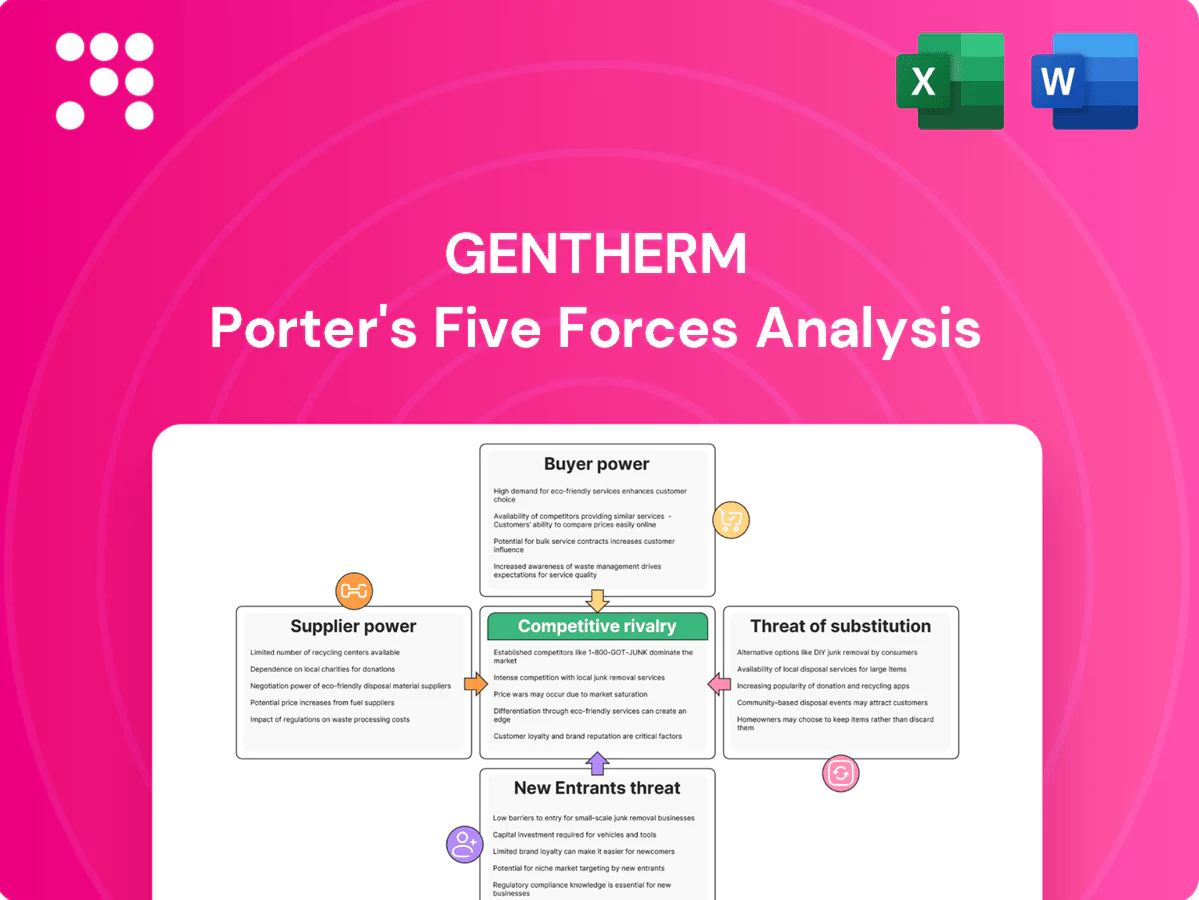
Gentherm Porter's Five Forces Analysis

Don't Miss the Bigger Picture
Gentherm faces moderate supplier leverage, evolving buyer demands, and growing rivalry as electrification and automotive thermal trends shift industry dynamics. Substitutes and new entrants present emerging threats while scale and IP offer defensive advantages. This snapshot highlights key tensions and strategic levers. Unlock the full Porter's Five Forces Analysis to explore Gentherm’s competitive dynamics, market pressures, and strategic advantages in detail.
Suppliers Bargaining Power

Specialized component dependence
Gentherm depends on niche inputs—thermoelectric modules, sensors, compressors and advanced polymers—that have few qualified suppliers, elevating supplier leverage in pricing and allocation. With fiscal 2024 revenue of about $1.86 billion and tightly scheduled OEM programs, any supplier disruption or quality issue can ripple through production and margins.
Tooling and qualification lock-in
Automotive PPAP/APQP and tooling investments—commonly $0.5–5M per program—create strong switching frictions once a supplier is validated, and re-qualification timelines of 3–9 months can jeopardize OEM launch schedules, constraining Gentherm’s negotiating flexibility. Suppliers aware of program criticality often resist mid-cycle cost-downs, using schedule risk to maintain margins. This structural lock-in therefore elevates supplier bargaining power.

Commodity and energy cost pass-through
Inputs like copper (~$9,500/t LME 2024), aluminum (~$2,400/t 2024) and resin/energy costs (Brent ~82 $/bbl 2024) were volatile in 2024; suppliers therefore increasingly seek pass-through clauses to shift inflation risk upstream to Gentherm. When OEM contracts lock pricing, incomplete pass-through causes margin compression for Gentherm. This asymmetry amplifies supplier bargaining power during inflationary periods.

Geopolitical and regional exposure
Global supply bases expose Gentherm to logistics, tariff and export-control risks; China accounts for ~28% of global manufacturing output in 2024, so shocks there, in the EU or US can sharply affect availability and cost.
- Policy shocks in China/EU/US raise input costs
- Dual-/near-shoring reduces risk but adds lead time
- Constrained lanes amplify supplier leverage
IP and process know-how of vendors
Vendors owning proprietary chemistries, coatings or process IP hold outsized leverage over Gentherm when those inputs drive thermal comfort performance; vendor-specific yields and reliability shift bargaining power toward suppliers and raise switching costs. Co-development agreements during 2024 often locked component roadmaps to single vendors, entrenching dependence across product lifecycles and limiting Gentherm’s sourcing flexibility.
- Proprietary IP increases supplier leverage
- Vendor-specific yields raise switching costs
- Co-development entrenches long-term dependence
Supplier power, program lock-in and commodity volatility risk $1.86B revenue
Gentherm faces elevated supplier power due to few qualified suppliers for thermoelectric modules, sensors and polymers, program lock-in (PPAP/tooling ~$0.5–5M) and fiscal 2024 revenue of $1.86B making disruptions high-impact. 2024 commodity volatility (copper $9,500/t, aluminum $2,400/t, Brent $82/bbl) and China’s ~28% manufacturing share amplify pass-through demands and switching costs.
| Factor | 2024 Data |
|---|---|
| Revenue | $1.86B |
| Tooling/PPAP | $0.5–5M |
| Copper | $9,500/t |
| Aluminum | $2,400/t |
| Brent | $82/bbl |
| China output | ~28% |
What is included in the product
 Detailed Word Document
Tailored Porter's Five Forces analysis for Gentherm that uncovers key drivers of competition, buyer and supplier influence on pricing and profitability, entry and substitute threats, and emerging disruptive forces impacting its market position.

 Customizable Excel Spreadsheet
A concise one-sheet Porter's Five Forces for Gentherm that maps supplier, buyer, entrant, substitute and rivalry pressures into a customizable radar—instantly highlighting strategic pain points and actionable responses; no macros, easy to drop into decks or dashboards.
Customers Bargaining Power

Concentrated automotive OEM base
Global automakers and tier-1 seat/system integrators form a concentrated buyer base that drove roughly 79 million light-vehicle units of global production in 2024, concentrating purchasing power among a few large OEMs. Their scale, procurement sophistication, and multi-year platform sourcing events push aggressive pricing and long lead-time negotiations. Platform-level awards can swing supplier volumes dramatically, giving buyers pronounced negotiating leverage over suppliers like Gentherm.
Design-in stickiness vs cost-downs
Gentherm’s climate-control modules gain strong design-in stickiness after early validation, but OEMs enforce annual cost-down targets—commonly 3–5%—plus benchmarking and dual-sourcing to extract concessions; suppliers face repeated price pressure rather than immediate displacement, producing moderate functional stickiness but high buyer power over pricing and margins.

Performance, warranty, and delivery demands
Automotive and medical OEMs impose strict quality, warranty and delivery clauses that shift risk to suppliers; for Gentherm — with reported 2024 revenue of about $1.5 billion — industry-standard warranty reserves near 2% of revenue (≈$30 million) and contractual penalty clauses for field failures or late deliveries materially affect margins. These risks give buyers leverage to demand price concessions and tighter terms, strengthening customer bargaining power.

Option content and take-rate variability
Seat heating, ventilation and zonal thermal features are frequently optional and OEMs routinely alter or remove them to meet trim price targets; take-rates can swing by 10–40 percentage points across regions and segments in 2024, giving fleet buyers leverage to trade features for lower unit cost.
Volume uncertainty from OEM order cadence and model mix in 2024 compressed supplier pricing, with Gentherm’s automotive exposure making revenue per vehicle sensitive to option penetration shifts.
- Take-rate variability: 10–40 pp (2024)
- OEM leverage: feature trade-offs to hit price points
- Volume pressure: order mix volatility compresses supplier margins
- Gentherm sensitivity: automotive option penetration drives revenue
Diverse channel dynamics in medical/industrial
Hospitals and distributors increasingly purchase via transparent tenders, pushing comparable medical/industrial heat-therapy and temperature-control products into price competition; 2024 procurement reports cited average tender-driven price reductions near 12%. Clinical equivalence claims intensify price sensitivity, while lower switching barriers versus automotive raise buyer bargaining power. Service and total-cost considerations mitigate but do not erase pricing pressure.
- tender transparency: ~12% average price reduction (2024)
- clinical equivalence: raises commoditization risk
- switching barriers: lower than automotive, increasing buyer leverage
- service/total cost: moderating factor, not elimination
OEM platform awards and 3–5% cost-downs squeeze margins; warranty ~2%, med tenders ~12%
Concentrated OEM buyers (≈79M light vehicles 2024) exert high price leverage via platform awards and 3–5% annual cost-downs; Gentherm’s $1.5B 2024 revenue faces margin risk from ~2% warranty reserves (~$30M) and 10–40 pp take-rate swings. Medical tenders cut prices ~12% (2024), lowering switching barriers and raising buyer power despite service-based differentiation.
| Metric | 2024 |
|---|---|
| Global LV production | 79M units |
| Gentherm revenue | $1.5B |
| Warranty reserve | ~2% (~$30M) |
| OEM cost-downs | 3–5% |
| Take-rate variability | 10–40 pp |
| Tender price cuts (medical) | ~12% |
Preview the Actual Deliverable
Gentherm Porter's Five Forces Analysis
This preview shows the exact Gentherm Porter's Five Forces analysis you'll receive immediately after purchase—no placeholders or mockups. The document provides a professional, fully formatted evaluation of competitive rivalry, supplier and buyer power, and threats from substitutes and new entrants, with clear strategic implications. Completing your purchase grants instant access to this same ready-to-use file.

Don't Miss the Bigger Picture
Gentherm faces moderate supplier leverage, evolving buyer demands, and growing rivalry as electrification and automotive thermal trends shift industry dynamics. Substitutes and new entrants present emerging threats while scale and IP offer defensive advantages. This snapshot highlights key tensions and strategic levers. Unlock the full Porter's Five Forces Analysis to explore Gentherm’s competitive dynamics, market pressures, and strategic advantages in detail.
Suppliers Bargaining Power
Specialized component dependence
Gentherm depends on niche inputs—thermoelectric modules, sensors, compressors and advanced polymers—that have few qualified suppliers, elevating supplier leverage in pricing and allocation. With fiscal 2024 revenue of about $1.86 billion and tightly scheduled OEM programs, any supplier disruption or quality issue can ripple through production and margins.
Tooling and qualification lock-in
Automotive PPAP/APQP and tooling investments—commonly $0.5–5M per program—create strong switching frictions once a supplier is validated, and re-qualification timelines of 3–9 months can jeopardize OEM launch schedules, constraining Gentherm’s negotiating flexibility. Suppliers aware of program criticality often resist mid-cycle cost-downs, using schedule risk to maintain margins. This structural lock-in therefore elevates supplier bargaining power.
Commodity and energy cost pass-through
Inputs like copper (~$9,500/t LME 2024), aluminum (~$2,400/t 2024) and resin/energy costs (Brent ~82 $/bbl 2024) were volatile in 2024; suppliers therefore increasingly seek pass-through clauses to shift inflation risk upstream to Gentherm. When OEM contracts lock pricing, incomplete pass-through causes margin compression for Gentherm. This asymmetry amplifies supplier bargaining power during inflationary periods.
Geopolitical and regional exposure
Global supply bases expose Gentherm to logistics, tariff and export-control risks; China accounts for ~28% of global manufacturing output in 2024, so shocks there, in the EU or US can sharply affect availability and cost.
- Policy shocks in China/EU/US raise input costs
- Dual-/near-shoring reduces risk but adds lead time
- Constrained lanes amplify supplier leverage
IP and process know-how of vendors
Vendors owning proprietary chemistries, coatings or process IP hold outsized leverage over Gentherm when those inputs drive thermal comfort performance; vendor-specific yields and reliability shift bargaining power toward suppliers and raise switching costs. Co-development agreements during 2024 often locked component roadmaps to single vendors, entrenching dependence across product lifecycles and limiting Gentherm’s sourcing flexibility.
- Proprietary IP increases supplier leverage
- Vendor-specific yields raise switching costs
- Co-development entrenches long-term dependence
Supplier power, program lock-in and commodity volatility risk $1.86B revenue
Gentherm faces elevated supplier power due to few qualified suppliers for thermoelectric modules, sensors and polymers, program lock-in (PPAP/tooling ~$0.5–5M) and fiscal 2024 revenue of $1.86B making disruptions high-impact. 2024 commodity volatility (copper $9,500/t, aluminum $2,400/t, Brent $82/bbl) and China’s ~28% manufacturing share amplify pass-through demands and switching costs.
| Factor | 2024 Data |
|---|---|
| Revenue | $1.86B |
| Tooling/PPAP | $0.5–5M |
| Copper | $9,500/t |
| Aluminum | $2,400/t |
| Brent | $82/bbl |
| China output | ~28% |
What is included in the product
Detailed Word Document
Tailored Porter's Five Forces analysis for Gentherm that uncovers key drivers of competition, buyer and supplier influence on pricing and profitability, entry and substitute threats, and emerging disruptive forces impacting its market position.
Customizable Excel Spreadsheet
A concise one-sheet Porter's Five Forces for Gentherm that maps supplier, buyer, entrant, substitute and rivalry pressures into a customizable radar—instantly highlighting strategic pain points and actionable responses; no macros, easy to drop into decks or dashboards.
Customers Bargaining Power
Concentrated automotive OEM base
Global automakers and tier-1 seat/system integrators form a concentrated buyer base that drove roughly 79 million light-vehicle units of global production in 2024, concentrating purchasing power among a few large OEMs. Their scale, procurement sophistication, and multi-year platform sourcing events push aggressive pricing and long lead-time negotiations. Platform-level awards can swing supplier volumes dramatically, giving buyers pronounced negotiating leverage over suppliers like Gentherm.
Design-in stickiness vs cost-downs
Gentherm’s climate-control modules gain strong design-in stickiness after early validation, but OEMs enforce annual cost-down targets—commonly 3–5%—plus benchmarking and dual-sourcing to extract concessions; suppliers face repeated price pressure rather than immediate displacement, producing moderate functional stickiness but high buyer power over pricing and margins.
Performance, warranty, and delivery demands
Automotive and medical OEMs impose strict quality, warranty and delivery clauses that shift risk to suppliers; for Gentherm — with reported 2024 revenue of about $1.5 billion — industry-standard warranty reserves near 2% of revenue (≈$30 million) and contractual penalty clauses for field failures or late deliveries materially affect margins. These risks give buyers leverage to demand price concessions and tighter terms, strengthening customer bargaining power.
Option content and take-rate variability
Seat heating, ventilation and zonal thermal features are frequently optional and OEMs routinely alter or remove them to meet trim price targets; take-rates can swing by 10–40 percentage points across regions and segments in 2024, giving fleet buyers leverage to trade features for lower unit cost.
Volume uncertainty from OEM order cadence and model mix in 2024 compressed supplier pricing, with Gentherm’s automotive exposure making revenue per vehicle sensitive to option penetration shifts.
- Take-rate variability: 10–40 pp (2024)
- OEM leverage: feature trade-offs to hit price points
- Volume pressure: order mix volatility compresses supplier margins
- Gentherm sensitivity: automotive option penetration drives revenue
Diverse channel dynamics in medical/industrial
Hospitals and distributors increasingly purchase via transparent tenders, pushing comparable medical/industrial heat-therapy and temperature-control products into price competition; 2024 procurement reports cited average tender-driven price reductions near 12%. Clinical equivalence claims intensify price sensitivity, while lower switching barriers versus automotive raise buyer bargaining power. Service and total-cost considerations mitigate but do not erase pricing pressure.
- tender transparency: ~12% average price reduction (2024)
- clinical equivalence: raises commoditization risk
- switching barriers: lower than automotive, increasing buyer leverage
- service/total cost: moderating factor, not elimination
OEM platform awards and 3–5% cost-downs squeeze margins; warranty ~2%, med tenders ~12%
Concentrated OEM buyers (≈79M light vehicles 2024) exert high price leverage via platform awards and 3–5% annual cost-downs; Gentherm’s $1.5B 2024 revenue faces margin risk from ~2% warranty reserves (~$30M) and 10–40 pp take-rate swings. Medical tenders cut prices ~12% (2024), lowering switching barriers and raising buyer power despite service-based differentiation.
| Metric | 2024 |
|---|---|
| Global LV production | 79M units |
| Gentherm revenue | $1.5B |
| Warranty reserve | ~2% (~$30M) |
| OEM cost-downs | 3–5% |
| Take-rate variability | 10–40 pp |
| Tender price cuts (medical) | ~12% |
Preview the Actual Deliverable
Gentherm Porter's Five Forces Analysis
This preview shows the exact Gentherm Porter's Five Forces analysis you'll receive immediately after purchase—no placeholders or mockups. The document provides a professional, fully formatted evaluation of competitive rivalry, supplier and buyer power, and threats from substitutes and new entrants, with clear strategic implications. Completing your purchase grants instant access to this same ready-to-use file.
Original: $10.00
-65%$10.00
$3.50Description
Don't Miss the Bigger Picture
Gentherm faces moderate supplier leverage, evolving buyer demands, and growing rivalry as electrification and automotive thermal trends shift industry dynamics. Substitutes and new entrants present emerging threats while scale and IP offer defensive advantages. This snapshot highlights key tensions and strategic levers. Unlock the full Porter's Five Forces Analysis to explore Gentherm’s competitive dynamics, market pressures, and strategic advantages in detail.
Suppliers Bargaining Power
Specialized component dependence
Gentherm depends on niche inputs—thermoelectric modules, sensors, compressors and advanced polymers—that have few qualified suppliers, elevating supplier leverage in pricing and allocation. With fiscal 2024 revenue of about $1.86 billion and tightly scheduled OEM programs, any supplier disruption or quality issue can ripple through production and margins.
Tooling and qualification lock-in
Automotive PPAP/APQP and tooling investments—commonly $0.5–5M per program—create strong switching frictions once a supplier is validated, and re-qualification timelines of 3–9 months can jeopardize OEM launch schedules, constraining Gentherm’s negotiating flexibility. Suppliers aware of program criticality often resist mid-cycle cost-downs, using schedule risk to maintain margins. This structural lock-in therefore elevates supplier bargaining power.
Commodity and energy cost pass-through
Inputs like copper (~$9,500/t LME 2024), aluminum (~$2,400/t 2024) and resin/energy costs (Brent ~82 $/bbl 2024) were volatile in 2024; suppliers therefore increasingly seek pass-through clauses to shift inflation risk upstream to Gentherm. When OEM contracts lock pricing, incomplete pass-through causes margin compression for Gentherm. This asymmetry amplifies supplier bargaining power during inflationary periods.
Geopolitical and regional exposure
Global supply bases expose Gentherm to logistics, tariff and export-control risks; China accounts for ~28% of global manufacturing output in 2024, so shocks there, in the EU or US can sharply affect availability and cost.
- Policy shocks in China/EU/US raise input costs
- Dual-/near-shoring reduces risk but adds lead time
- Constrained lanes amplify supplier leverage
IP and process know-how of vendors
Vendors owning proprietary chemistries, coatings or process IP hold outsized leverage over Gentherm when those inputs drive thermal comfort performance; vendor-specific yields and reliability shift bargaining power toward suppliers and raise switching costs. Co-development agreements during 2024 often locked component roadmaps to single vendors, entrenching dependence across product lifecycles and limiting Gentherm’s sourcing flexibility.
- Proprietary IP increases supplier leverage
- Vendor-specific yields raise switching costs
- Co-development entrenches long-term dependence
Supplier power, program lock-in and commodity volatility risk $1.86B revenue
Gentherm faces elevated supplier power due to few qualified suppliers for thermoelectric modules, sensors and polymers, program lock-in (PPAP/tooling ~$0.5–5M) and fiscal 2024 revenue of $1.86B making disruptions high-impact. 2024 commodity volatility (copper $9,500/t, aluminum $2,400/t, Brent $82/bbl) and China’s ~28% manufacturing share amplify pass-through demands and switching costs.
| Factor | 2024 Data |
|---|---|
| Revenue | $1.86B |
| Tooling/PPAP | $0.5–5M |
| Copper | $9,500/t |
| Aluminum | $2,400/t |
| Brent | $82/bbl |
| China output | ~28% |
What is included in the product
Detailed Word Document
Tailored Porter's Five Forces analysis for Gentherm that uncovers key drivers of competition, buyer and supplier influence on pricing and profitability, entry and substitute threats, and emerging disruptive forces impacting its market position.
Customizable Excel Spreadsheet
A concise one-sheet Porter's Five Forces for Gentherm that maps supplier, buyer, entrant, substitute and rivalry pressures into a customizable radar—instantly highlighting strategic pain points and actionable responses; no macros, easy to drop into decks or dashboards.
Customers Bargaining Power
Concentrated automotive OEM base
Global automakers and tier-1 seat/system integrators form a concentrated buyer base that drove roughly 79 million light-vehicle units of global production in 2024, concentrating purchasing power among a few large OEMs. Their scale, procurement sophistication, and multi-year platform sourcing events push aggressive pricing and long lead-time negotiations. Platform-level awards can swing supplier volumes dramatically, giving buyers pronounced negotiating leverage over suppliers like Gentherm.
Design-in stickiness vs cost-downs
Gentherm’s climate-control modules gain strong design-in stickiness after early validation, but OEMs enforce annual cost-down targets—commonly 3–5%—plus benchmarking and dual-sourcing to extract concessions; suppliers face repeated price pressure rather than immediate displacement, producing moderate functional stickiness but high buyer power over pricing and margins.
Performance, warranty, and delivery demands
Automotive and medical OEMs impose strict quality, warranty and delivery clauses that shift risk to suppliers; for Gentherm — with reported 2024 revenue of about $1.5 billion — industry-standard warranty reserves near 2% of revenue (≈$30 million) and contractual penalty clauses for field failures or late deliveries materially affect margins. These risks give buyers leverage to demand price concessions and tighter terms, strengthening customer bargaining power.
Option content and take-rate variability
Seat heating, ventilation and zonal thermal features are frequently optional and OEMs routinely alter or remove them to meet trim price targets; take-rates can swing by 10–40 percentage points across regions and segments in 2024, giving fleet buyers leverage to trade features for lower unit cost.
Volume uncertainty from OEM order cadence and model mix in 2024 compressed supplier pricing, with Gentherm’s automotive exposure making revenue per vehicle sensitive to option penetration shifts.
- Take-rate variability: 10–40 pp (2024)
- OEM leverage: feature trade-offs to hit price points
- Volume pressure: order mix volatility compresses supplier margins
- Gentherm sensitivity: automotive option penetration drives revenue
Diverse channel dynamics in medical/industrial
Hospitals and distributors increasingly purchase via transparent tenders, pushing comparable medical/industrial heat-therapy and temperature-control products into price competition; 2024 procurement reports cited average tender-driven price reductions near 12%. Clinical equivalence claims intensify price sensitivity, while lower switching barriers versus automotive raise buyer bargaining power. Service and total-cost considerations mitigate but do not erase pricing pressure.
- tender transparency: ~12% average price reduction (2024)
- clinical equivalence: raises commoditization risk
- switching barriers: lower than automotive, increasing buyer leverage
- service/total cost: moderating factor, not elimination
OEM platform awards and 3–5% cost-downs squeeze margins; warranty ~2%, med tenders ~12%
Concentrated OEM buyers (≈79M light vehicles 2024) exert high price leverage via platform awards and 3–5% annual cost-downs; Gentherm’s $1.5B 2024 revenue faces margin risk from ~2% warranty reserves (~$30M) and 10–40 pp take-rate swings. Medical tenders cut prices ~12% (2024), lowering switching barriers and raising buyer power despite service-based differentiation.
| Metric | 2024 |
|---|---|
| Global LV production | 79M units |
| Gentherm revenue | $1.5B |
| Warranty reserve | ~2% (~$30M) |
| OEM cost-downs | 3–5% |
| Take-rate variability | 10–40 pp |
| Tender price cuts (medical) | ~12% |
Preview the Actual Deliverable
Gentherm Porter's Five Forces Analysis
This preview shows the exact Gentherm Porter's Five Forces analysis you'll receive immediately after purchase—no placeholders or mockups. The document provides a professional, fully formatted evaluation of competitive rivalry, supplier and buyer power, and threats from substitutes and new entrants, with clear strategic implications. Completing your purchase grants instant access to this same ready-to-use file.











