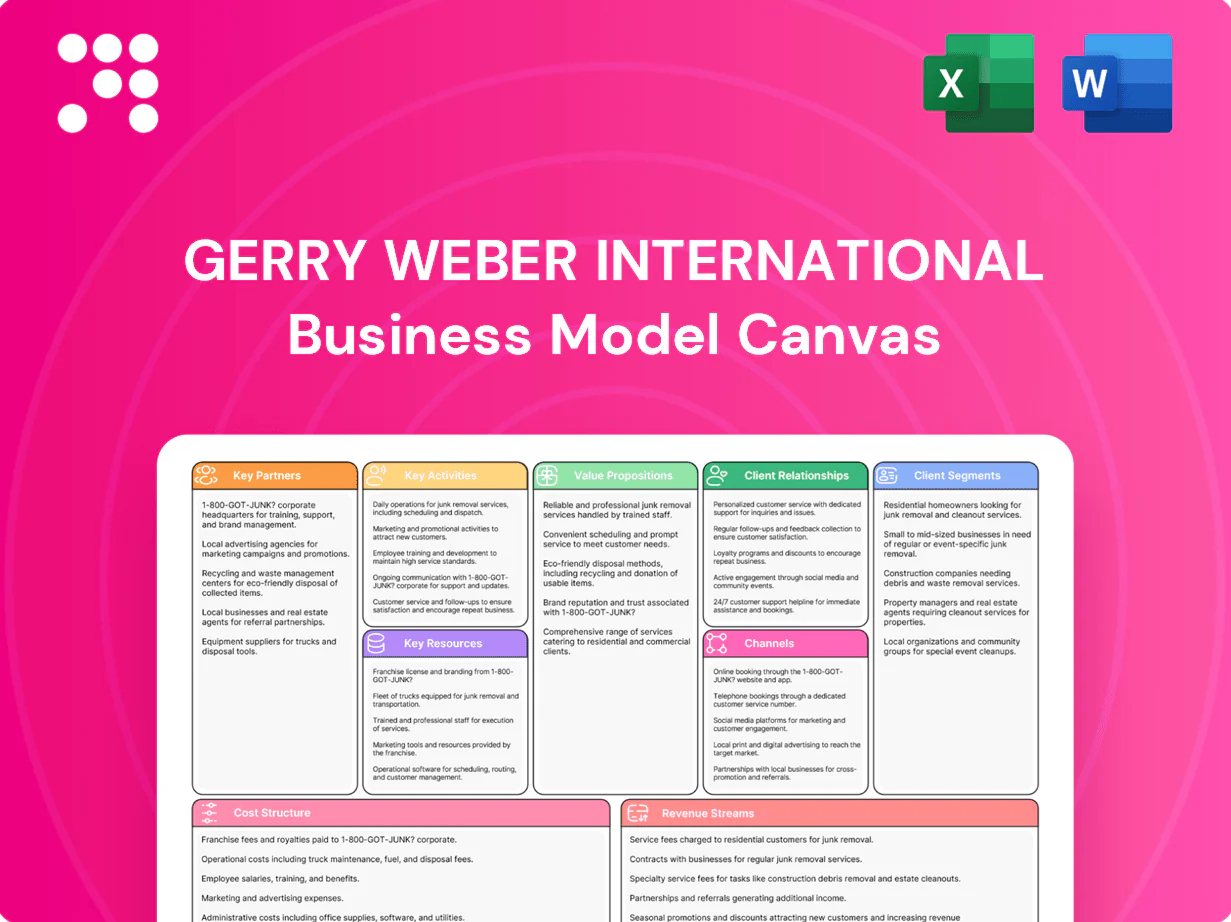
GERRY WEBER International Business Model Canvas

Business Model Canvas Snapshot: Value, Channels, Cost Structure, Revenue & Loyalty
Discover the strategic core of GERRY WEBER International with our Business Model Canvas—three to five clear sections condensed into a practical, actionable snapshot of value propositions, channels, and revenue streams. This concise analysis reveals how the brand scales, manages costs, and captures customer loyalty. Purchase the full Canvas (editable Word & Excel) to unlock detailed insights for benchmarking, planning, or investment decisions.
Partnerships

Fabric & trim suppliers
Trusted textile mills and accessory suppliers ensure consistent quality and availability of core fabrics, prints and trims for GERRY WEBER. Long-term relationships deliver typical procurement savings of 5–12% and priority allocation during peak seasons. Compliance-aligned partners enable traceability and sustainability reporting in line with 2024 EU textile strategy and regular supplier audits.
Manufacturing partners
Specialized cut-make-trim factories deliver scalable production across apparel, accessories and shoes, enabling season runs from small-batch drops to wholesale volumes. Nearshore partners in Europe and North Africa and offshore partners in Asia balance speed-to-market with cost efficiency, with Asia supplying about two-thirds of global apparel production in 2024. Quality control collaborations enforce consistent fit and construction standards across Gerry Weber brands through vendor audits and inline inspections.

Logistics & fulfillment
3PLs, carriers and warehouse providers underpin GERRY WEBER’s timely replenishment across retail, wholesale and e-commerce by enabling scalable inbound/outbound flows and reducing stockouts. Integrated fulfillment platforms in 2024 support ship-from-store and click-and-collect to cut delivery times and lower last‑mile costs. Dedicated returns processing partners shorten return-to-shelf cycles and recover value, critical as online apparel returns remained about 20–30% in 2024.

Wholesale & retail partners
Department stores, specialty boutiques and key accounts extend GERRY WEBERs brand reach through multi-channel shelf presence and national networks; shop-in-shop operators and franchise-like partners secure consistent in-store presentation and brand standards. Joint planning with wholesale partners drives sell-through via co-op marketing, shared markdown strategies and optimized assortments aligned to regional demand.
- Wholesale channel diversification
- Shop-in-shop consistency
- Co-op marketing & assortment planning
Digital & marketing platforms
Mills cut costs 5–12%; Asia ~66%; CDP adoption 67%
Trusted mills deliver 5–12% procurement savings and traceability for 2024 compliance. Cut-make-trim partners: Asia supplies ~66% of apparel production in 2024, nearshore balances speed/cost. 3PLs and returns partners cut stockouts as online returns remained 20–30% in 2024; CDP adoption ~67% supports omnichannel fulfillment.
| Metric | 2024 |
|---|---|
| Procurement savings | 5–12% |
| Asia production share | ~66% |
| Online returns | 20–30% |
| CDP adoption | 67% |
What is included in the product
 Detailed Word Document
GERRY WEBER International Business Model Canvas is a comprehensive, pre-written model reflecting the company's real-world operations and strategic plans across the nine classic BMC blocks with full narratives on customer segments, channels, and value propositions. Ideal for investor presentations, it includes SWOT-linked insights and competitive advantage analysis to support decision-making.

 Customizable Excel Spreadsheet
High-level, editable Business Model Canvas for GERRY WEBER that condenses strategy into a one-page snapshot, speeding up boardroom prep, collaboration and comparison while saving hours of formatting.
Activities

Design & merchandising
Trend research, assortment planning and fit development shape each GERRY WEBER collection, using consumer insights and market signals to define silhouettes and sizing. Line architecture balances core essentials with seasonal statements to protect full-price sell-through. Rigorous sample management and regular line reviews align product to brand DNA and retail KPIs; German apparel market ≈ €66 billion in 2023 provides context for assortment scale.
Sourcing & production
Material procurement (≈65% sourced from Asia) and selective vendor contracts with 3–6 month capacity booking drive on-time delivery; costing and quarterly compliance audits protect margins (reducing leakage by ~2–4%) and ensure standards; real-time production tracking cuts late shipments by ~30% and shortens lead-time variability, supporting inventory turns and gross-margin stability in 2024.

Omnichannel retailing
Store operations, visual merchandising and staff training are optimized to boost conversion rates and average basket size through tailored assortments and guided selling.
Centralized inventory orchestration enables reliable BOPIS and ship-from-store fulfillment, reducing delivery times and stockouts.
CRM-driven clienteling personalizes outreach, increases repeat purchase frequency and strengthens loyalty through targeted offers and service.

E-commerce operations
E-commerce operations for GERRY WEBER prioritize site merchandising, frequent content updates and UX optimization to boost conversion; industry averages in 2024 show apparel e-commerce conversion rates of about 2–3% and return rates of 20–30%, so order fulfillment and smooth returns workflows are critical to preserve NPS and repeat purchase. Performance marketing and SEO capture demand efficiently, often driving 40–60% of online traffic in fashion retail.
- site merchandising: dynamic category/product placement
- content & UX: A/B testing, personalization
- acquisition: performance marketing + SEO (40–60% traffic)
- fulfillment & returns: mitigate 20–30% return rates
Wholesale management
DE apparel: align assortments, cut late shipments -30%
Trend research, assortment planning and sampling align collections to German market signals (€66bn apparel 2023). Procurement (≈65% Asia) and production tracking cut late shipments ~30% and protect margins. Store ops, BOPIS and CRM lift conversion; e‑commerce conversion ~2–3% with returns ~20–30% and performance marketing driving ~50% online traffic.
| Metric | Value |
|---|---|
| DE apparel market 2023 | €66bn |
| Sourcing Asia | ≈65% |
| Late shipments | -30% |
| e‑comm conv | 2–3% |
| Returns | 20–30% |
| Perf. marketing traffic | 40–60% |
Delivered as Displayed
Business Model Canvas
The document previewed here is the actual GERRY WEBER International Business Model Canvas, not a mockup. When you purchase, you’ll receive this exact file with all content and pages included, ready to edit and present. Delivered in editable Word and Excel formats, what you see is what you’ll download instantly after payment.

Business Model Canvas Snapshot: Value, Channels, Cost Structure, Revenue & Loyalty
Discover the strategic core of GERRY WEBER International with our Business Model Canvas—three to five clear sections condensed into a practical, actionable snapshot of value propositions, channels, and revenue streams. This concise analysis reveals how the brand scales, manages costs, and captures customer loyalty. Purchase the full Canvas (editable Word & Excel) to unlock detailed insights for benchmarking, planning, or investment decisions.
Partnerships
Fabric & trim suppliers
Trusted textile mills and accessory suppliers ensure consistent quality and availability of core fabrics, prints and trims for GERRY WEBER. Long-term relationships deliver typical procurement savings of 5–12% and priority allocation during peak seasons. Compliance-aligned partners enable traceability and sustainability reporting in line with 2024 EU textile strategy and regular supplier audits.
Manufacturing partners
Specialized cut-make-trim factories deliver scalable production across apparel, accessories and shoes, enabling season runs from small-batch drops to wholesale volumes. Nearshore partners in Europe and North Africa and offshore partners in Asia balance speed-to-market with cost efficiency, with Asia supplying about two-thirds of global apparel production in 2024. Quality control collaborations enforce consistent fit and construction standards across Gerry Weber brands through vendor audits and inline inspections.
Logistics & fulfillment
3PLs, carriers and warehouse providers underpin GERRY WEBER’s timely replenishment across retail, wholesale and e-commerce by enabling scalable inbound/outbound flows and reducing stockouts. Integrated fulfillment platforms in 2024 support ship-from-store and click-and-collect to cut delivery times and lower last‑mile costs. Dedicated returns processing partners shorten return-to-shelf cycles and recover value, critical as online apparel returns remained about 20–30% in 2024.
Wholesale & retail partners
Department stores, specialty boutiques and key accounts extend GERRY WEBERs brand reach through multi-channel shelf presence and national networks; shop-in-shop operators and franchise-like partners secure consistent in-store presentation and brand standards. Joint planning with wholesale partners drives sell-through via co-op marketing, shared markdown strategies and optimized assortments aligned to regional demand.
- Wholesale channel diversification
- Shop-in-shop consistency
- Co-op marketing & assortment planning
Digital & marketing platforms
Mills cut costs 5–12%; Asia ~66%; CDP adoption 67%
Trusted mills deliver 5–12% procurement savings and traceability for 2024 compliance. Cut-make-trim partners: Asia supplies ~66% of apparel production in 2024, nearshore balances speed/cost. 3PLs and returns partners cut stockouts as online returns remained 20–30% in 2024; CDP adoption ~67% supports omnichannel fulfillment.
| Metric | 2024 |
|---|---|
| Procurement savings | 5–12% |
| Asia production share | ~66% |
| Online returns | 20–30% |
| CDP adoption | 67% |
What is included in the product
Detailed Word Document
GERRY WEBER International Business Model Canvas is a comprehensive, pre-written model reflecting the company's real-world operations and strategic plans across the nine classic BMC blocks with full narratives on customer segments, channels, and value propositions. Ideal for investor presentations, it includes SWOT-linked insights and competitive advantage analysis to support decision-making.
Customizable Excel Spreadsheet
High-level, editable Business Model Canvas for GERRY WEBER that condenses strategy into a one-page snapshot, speeding up boardroom prep, collaboration and comparison while saving hours of formatting.
Activities
Design & merchandising
Trend research, assortment planning and fit development shape each GERRY WEBER collection, using consumer insights and market signals to define silhouettes and sizing. Line architecture balances core essentials with seasonal statements to protect full-price sell-through. Rigorous sample management and regular line reviews align product to brand DNA and retail KPIs; German apparel market ≈ €66 billion in 2023 provides context for assortment scale.
Sourcing & production
Material procurement (≈65% sourced from Asia) and selective vendor contracts with 3–6 month capacity booking drive on-time delivery; costing and quarterly compliance audits protect margins (reducing leakage by ~2–4%) and ensure standards; real-time production tracking cuts late shipments by ~30% and shortens lead-time variability, supporting inventory turns and gross-margin stability in 2024.
Omnichannel retailing
Store operations, visual merchandising and staff training are optimized to boost conversion rates and average basket size through tailored assortments and guided selling.
Centralized inventory orchestration enables reliable BOPIS and ship-from-store fulfillment, reducing delivery times and stockouts.
CRM-driven clienteling personalizes outreach, increases repeat purchase frequency and strengthens loyalty through targeted offers and service.
E-commerce operations
E-commerce operations for GERRY WEBER prioritize site merchandising, frequent content updates and UX optimization to boost conversion; industry averages in 2024 show apparel e-commerce conversion rates of about 2–3% and return rates of 20–30%, so order fulfillment and smooth returns workflows are critical to preserve NPS and repeat purchase. Performance marketing and SEO capture demand efficiently, often driving 40–60% of online traffic in fashion retail.
- site merchandising: dynamic category/product placement
- content & UX: A/B testing, personalization
- acquisition: performance marketing + SEO (40–60% traffic)
- fulfillment & returns: mitigate 20–30% return rates
Wholesale management
DE apparel: align assortments, cut late shipments -30%
Trend research, assortment planning and sampling align collections to German market signals (€66bn apparel 2023). Procurement (≈65% Asia) and production tracking cut late shipments ~30% and protect margins. Store ops, BOPIS and CRM lift conversion; e‑commerce conversion ~2–3% with returns ~20–30% and performance marketing driving ~50% online traffic.
| Metric | Value |
|---|---|
| DE apparel market 2023 | €66bn |
| Sourcing Asia | ≈65% |
| Late shipments | -30% |
| e‑comm conv | 2–3% |
| Returns | 20–30% |
| Perf. marketing traffic | 40–60% |
Delivered as Displayed
Business Model Canvas
The document previewed here is the actual GERRY WEBER International Business Model Canvas, not a mockup. When you purchase, you’ll receive this exact file with all content and pages included, ready to edit and present. Delivered in editable Word and Excel formats, what you see is what you’ll download instantly after payment.
Description
Business Model Canvas Snapshot: Value, Channels, Cost Structure, Revenue & Loyalty
Discover the strategic core of GERRY WEBER International with our Business Model Canvas—three to five clear sections condensed into a practical, actionable snapshot of value propositions, channels, and revenue streams. This concise analysis reveals how the brand scales, manages costs, and captures customer loyalty. Purchase the full Canvas (editable Word & Excel) to unlock detailed insights for benchmarking, planning, or investment decisions.
Partnerships
Fabric & trim suppliers
Trusted textile mills and accessory suppliers ensure consistent quality and availability of core fabrics, prints and trims for GERRY WEBER. Long-term relationships deliver typical procurement savings of 5–12% and priority allocation during peak seasons. Compliance-aligned partners enable traceability and sustainability reporting in line with 2024 EU textile strategy and regular supplier audits.
Manufacturing partners
Specialized cut-make-trim factories deliver scalable production across apparel, accessories and shoes, enabling season runs from small-batch drops to wholesale volumes. Nearshore partners in Europe and North Africa and offshore partners in Asia balance speed-to-market with cost efficiency, with Asia supplying about two-thirds of global apparel production in 2024. Quality control collaborations enforce consistent fit and construction standards across Gerry Weber brands through vendor audits and inline inspections.
Logistics & fulfillment
3PLs, carriers and warehouse providers underpin GERRY WEBER’s timely replenishment across retail, wholesale and e-commerce by enabling scalable inbound/outbound flows and reducing stockouts. Integrated fulfillment platforms in 2024 support ship-from-store and click-and-collect to cut delivery times and lower last‑mile costs. Dedicated returns processing partners shorten return-to-shelf cycles and recover value, critical as online apparel returns remained about 20–30% in 2024.
Wholesale & retail partners
Department stores, specialty boutiques and key accounts extend GERRY WEBERs brand reach through multi-channel shelf presence and national networks; shop-in-shop operators and franchise-like partners secure consistent in-store presentation and brand standards. Joint planning with wholesale partners drives sell-through via co-op marketing, shared markdown strategies and optimized assortments aligned to regional demand.
- Wholesale channel diversification
- Shop-in-shop consistency
- Co-op marketing & assortment planning
Digital & marketing platforms
Mills cut costs 5–12%; Asia ~66%; CDP adoption 67%
Trusted mills deliver 5–12% procurement savings and traceability for 2024 compliance. Cut-make-trim partners: Asia supplies ~66% of apparel production in 2024, nearshore balances speed/cost. 3PLs and returns partners cut stockouts as online returns remained 20–30% in 2024; CDP adoption ~67% supports omnichannel fulfillment.
| Metric | 2024 |
|---|---|
| Procurement savings | 5–12% |
| Asia production share | ~66% |
| Online returns | 20–30% |
| CDP adoption | 67% |
What is included in the product
Detailed Word Document
GERRY WEBER International Business Model Canvas is a comprehensive, pre-written model reflecting the company's real-world operations and strategic plans across the nine classic BMC blocks with full narratives on customer segments, channels, and value propositions. Ideal for investor presentations, it includes SWOT-linked insights and competitive advantage analysis to support decision-making.
Customizable Excel Spreadsheet
High-level, editable Business Model Canvas for GERRY WEBER that condenses strategy into a one-page snapshot, speeding up boardroom prep, collaboration and comparison while saving hours of formatting.
Activities
Design & merchandising
Trend research, assortment planning and fit development shape each GERRY WEBER collection, using consumer insights and market signals to define silhouettes and sizing. Line architecture balances core essentials with seasonal statements to protect full-price sell-through. Rigorous sample management and regular line reviews align product to brand DNA and retail KPIs; German apparel market ≈ €66 billion in 2023 provides context for assortment scale.
Sourcing & production
Material procurement (≈65% sourced from Asia) and selective vendor contracts with 3–6 month capacity booking drive on-time delivery; costing and quarterly compliance audits protect margins (reducing leakage by ~2–4%) and ensure standards; real-time production tracking cuts late shipments by ~30% and shortens lead-time variability, supporting inventory turns and gross-margin stability in 2024.
Omnichannel retailing
Store operations, visual merchandising and staff training are optimized to boost conversion rates and average basket size through tailored assortments and guided selling.
Centralized inventory orchestration enables reliable BOPIS and ship-from-store fulfillment, reducing delivery times and stockouts.
CRM-driven clienteling personalizes outreach, increases repeat purchase frequency and strengthens loyalty through targeted offers and service.
E-commerce operations
E-commerce operations for GERRY WEBER prioritize site merchandising, frequent content updates and UX optimization to boost conversion; industry averages in 2024 show apparel e-commerce conversion rates of about 2–3% and return rates of 20–30%, so order fulfillment and smooth returns workflows are critical to preserve NPS and repeat purchase. Performance marketing and SEO capture demand efficiently, often driving 40–60% of online traffic in fashion retail.
- site merchandising: dynamic category/product placement
- content & UX: A/B testing, personalization
- acquisition: performance marketing + SEO (40–60% traffic)
- fulfillment & returns: mitigate 20–30% return rates
Wholesale management
DE apparel: align assortments, cut late shipments -30%
Trend research, assortment planning and sampling align collections to German market signals (€66bn apparel 2023). Procurement (≈65% Asia) and production tracking cut late shipments ~30% and protect margins. Store ops, BOPIS and CRM lift conversion; e‑commerce conversion ~2–3% with returns ~20–30% and performance marketing driving ~50% online traffic.
| Metric | Value |
|---|---|
| DE apparel market 2023 | €66bn |
| Sourcing Asia | ≈65% |
| Late shipments | -30% |
| e‑comm conv | 2–3% |
| Returns | 20–30% |
| Perf. marketing traffic | 40–60% |
Delivered as Displayed
Business Model Canvas
The document previewed here is the actual GERRY WEBER International Business Model Canvas, not a mockup. When you purchase, you’ll receive this exact file with all content and pages included, ready to edit and present. Delivered in editable Word and Excel formats, what you see is what you’ll download instantly after payment.











