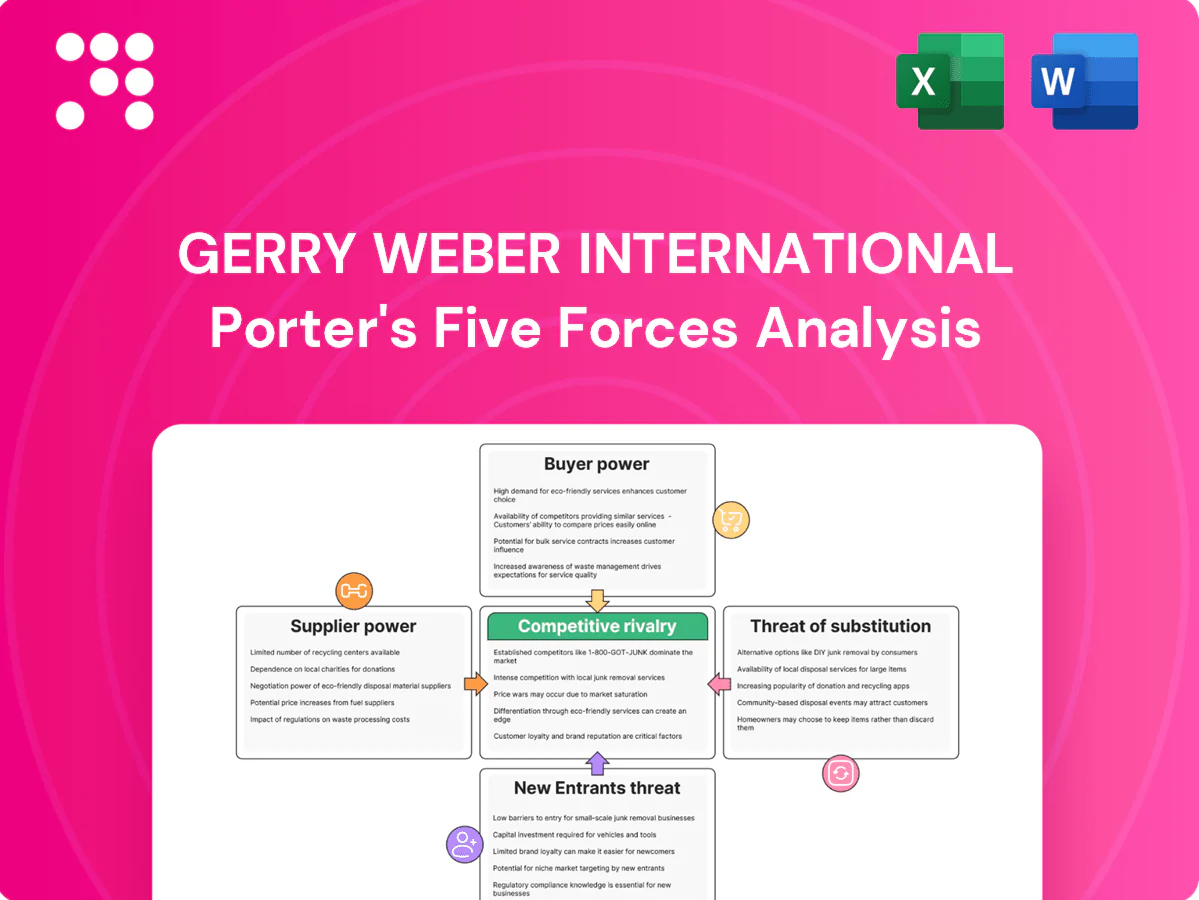
GERRY WEBER International Porter's Five Forces Analysis

A Must-Have Tool for Decision-Makers
GERRY WEBER International faces moderate buyer power, intense rivalry from fast-fashion and premium brands, supplier leverage on textiles, manageable threat of new entrants due to branding costs, and growing substitution from online channels. This snapshot highlights critical pressures but omits force-by-force ratings and visuals. Unlock the full Porter's Five Forces Analysis to access detailed ratings, strategic implications, and ready-to-use slides for decision-making.
Suppliers Bargaining Power

Diverse global sourcing base
GERRY WEBER benefits from a diverse global sourcing base—China, Bangladesh, Vietnam and Turkey remain core manufacturing hubs and China accounted for about one-third of global apparel exports in 2023, giving the group alternatives among factories and fabric mills. This breadth reduces individual supplier leverage, though specialty fabrics, trims and small-lot runs narrow options. Strategic dual-sourcing and vendor scorecards keep terms favorable.
Moderate switching costs
Changing suppliers for Gerry Weber involves quality approvals, compliance checks and resetting typical lead times of 8–12 weeks, creating switching friction. Standardized apparel processes mean less lock-in than in specialized industries, keeping supplier power moderate. Framework agreements and modular designs cover large portions of sourcing, and digital tech packs can cut onboarding and approval cycles by roughly 30–40%.

Quality and compliance requirements
Premium positioning demands consistent quality, social compliance and sustainability standards, and suppliers meeting these criteria can command roughly 5–10% higher margins in apparel supply chains in 2024. Mandatory audits and certifications (BSCI, SA8000, GRS) raise the effective bar and lead brands to consolidate spend with capable partners. This often concentrates sourcing: top 20% of vetted vendors can supply around 60–70% of orders, increasing dependence on tier‑one suppliers.

Input price volatility
Input costs for cotton, synthetics, energy and freight remain volatile—USDA estimated world cotton production at about 114 million bales in 2023/24 while Brent averaged near $85/bbl in 2024—giving suppliers periodic leverage over GERRY WEBER. Hedging and calendarized buys smooth but do not remove spikes; longer lead times increase exposure and inventory carrying costs. Closer collaboration on fabric commitments can secure better pricing and reduce volatility pass-through.
- cotton: 114 million bales (2023/24)
- energy: Brent ≈ $85/bbl (2024)
- mitigation: hedging, calendar buys, fabric commitments
Capacity and lead-time constraints
- Peak utilization >90%
- Lead times 2-4 weeks
- Reliable suppliers gain price/priority
- Tier-2 materials = primary bottleneck
Retailer: moderate supplier power amid diverse sourcing, fast-fashion cycles, high utilization
GERRY WEBER’s diverse sourcing (China ~33% of apparel exports in 2023) limits single-supplier leverage, but specialty fabrics/trims raise dependence. Switching needs 8–12 week approvals; peak utilization >90% and 2–4 week fast-fashion cycles give reliable suppliers pricing/priority power. Top 20% vendors supply ~60–70%; input volatility (cotton 114m bales 2023/24; Brent ~$85/bbl 2024) keeps supplier power moderate.
| Metric | Value |
|---|---|
| China export share | ~33% (2023) |
| Cotton | 114m bales (2023/24) |
| Brent | ≈ $85/bbl (2024) |
| Lead times | 8–12 wk (switch); 2–4 wk (fast) |
| Peak utilization | >90% |
| Top vendor share | 60–70% |
What is included in the product
 Detailed Word Document
Uncovers key competitive drivers for GERRY WEBER International, detailing buyer/supplier power, threats from substitutes and new entrants, and disruptive trends that impact pricing and market share, with strategic commentary and an editable Word-ready format for investor decks, business plans, or internal strategy use.

 Customizable Excel Spreadsheet
One-sheet Porter’s Five Forces for GERRY WEBER International—instant visualization of competitive pressures with customizable scores and spider chart, ready to drop into pitch decks or strategic reports.
Customers Bargaining Power

Wholesale partners’ volume influence
Wholesale partners concentrate purchasing power, so key accounts negotiate price, payment terms and markdown support driven by order concentration, directly pressuring margins through chargebacks and returns.
Their shelf-space and assortment decisions materially affect GERRY WEBER brand visibility and sell-through, amplifying downstream inventory risk.
Deeper partnerships and sharing of POS sell-through data help rebalance power by enabling joint replenishment, targeted promotions and reduced markdowns.
End-consumer price transparency
Online platforms let GERRY WEBER shoppers compare prices and promotions instantly, and with global e-commerce accounting for about 24% of retail sales in 2024 this elevates price elasticity and discount expectations. Heightened transparency drives faster clearance cycles and margin pressure. Loyalty programs and differentiated fits/styles can reduce pure price competition. Clear value messaging sustains higher full-price sell-through.

High return rates in e-commerce
Apparel fit uncertainty pushes fashion return rates to about 25–30% in 2024, versus ~16% for overall e-commerce, shifting fulfillment and restocking costs back to GERRY WEBER and enhancing buyer bargaining power. Free returns policies further strengthen leverage by lowering purchase risk. Improved size guides and fit analytics have trimmed returns by up to 5–10pp, while click-and-collect and exchange options can retain sales and cut net return losses.

Brand loyalty in target segment
Women’s modern-classic buyers show repeat purchasing when fit and fabric quality are consistent; loyal cohorts at Gerry Weber historically drive higher retention but loyalty fragments across competing labels, especially in mid-price European womenswear. Continuous seasonal refreshes anchored by core essentials sustain retention and reduce churn.
- repeat purchase driven by fit and quality
- loyal cohorts lower price sensitivity
- loyalty fragments across competitors
- style refresh + core essentials sustain retention
Multi-channel choice sets
Customers can buy GERRY WEBER via own stores, e-commerce and wholesale partners, increasing options and contributing to an industry-wide online apparel share near 30% in 2024; channel switching raises bargaining power on price and service, pressuring margins. Unified inventory and consistent pricing reduce leakage across channels, while exclusive channel capsules (wholesale- or web-only) can rebalance power by creating scarcity and margin protection.
- Multi-channel presence: increases customer choice and leverage
- Unified inventory/pricing: limits cross-channel cannibalization
- Exclusive capsules: tool to shift bargaining dynamics
Wholesale buying power, e-commerce growth and high apparel returns squeeze margins
Wholesale partners concentrate buying power, pressuring margins via price, payment and markdown demands; order concentration amplifies chargebacks and returns. Online channels (global e-commerce ~24% of retail; apparel online ~30% in 2024) increase price transparency and elasticity, deepening discount expectations. High apparel return rates (25–30% vs ~16% overall e-commerce) shift costs back to GERRY WEBER; better fit data and loyalty reduce pure price bargaining.
| Metric | 2024 Value | Impact |
|---|---|---|
| Global e-commerce share | ~24% | Higher price transparency |
| Online apparel share | ~30% | Elevated elasticity |
| Apparel return rate | 25–30% | Increases fulfillment cost |
| Overall e‑commerce returns | ~16% | Benchmark for excess returns |
Full Version Awaits
GERRY WEBER International Porter's Five Forces Analysis
This preview shows the exact Porter’s Five Forces analysis for GERRY WEBER International you’ll receive after purchase—no placeholders, no summaries. The document is fully formatted, professionally written, and ready for immediate download and use the moment you complete payment.

A Must-Have Tool for Decision-Makers
GERRY WEBER International faces moderate buyer power, intense rivalry from fast-fashion and premium brands, supplier leverage on textiles, manageable threat of new entrants due to branding costs, and growing substitution from online channels. This snapshot highlights critical pressures but omits force-by-force ratings and visuals. Unlock the full Porter's Five Forces Analysis to access detailed ratings, strategic implications, and ready-to-use slides for decision-making.
Suppliers Bargaining Power
Diverse global sourcing base
GERRY WEBER benefits from a diverse global sourcing base—China, Bangladesh, Vietnam and Turkey remain core manufacturing hubs and China accounted for about one-third of global apparel exports in 2023, giving the group alternatives among factories and fabric mills. This breadth reduces individual supplier leverage, though specialty fabrics, trims and small-lot runs narrow options. Strategic dual-sourcing and vendor scorecards keep terms favorable.
Moderate switching costs
Changing suppliers for Gerry Weber involves quality approvals, compliance checks and resetting typical lead times of 8–12 weeks, creating switching friction. Standardized apparel processes mean less lock-in than in specialized industries, keeping supplier power moderate. Framework agreements and modular designs cover large portions of sourcing, and digital tech packs can cut onboarding and approval cycles by roughly 30–40%.
Quality and compliance requirements
Premium positioning demands consistent quality, social compliance and sustainability standards, and suppliers meeting these criteria can command roughly 5–10% higher margins in apparel supply chains in 2024. Mandatory audits and certifications (BSCI, SA8000, GRS) raise the effective bar and lead brands to consolidate spend with capable partners. This often concentrates sourcing: top 20% of vetted vendors can supply around 60–70% of orders, increasing dependence on tier‑one suppliers.
Input price volatility
Input costs for cotton, synthetics, energy and freight remain volatile—USDA estimated world cotton production at about 114 million bales in 2023/24 while Brent averaged near $85/bbl in 2024—giving suppliers periodic leverage over GERRY WEBER. Hedging and calendarized buys smooth but do not remove spikes; longer lead times increase exposure and inventory carrying costs. Closer collaboration on fabric commitments can secure better pricing and reduce volatility pass-through.
- cotton: 114 million bales (2023/24)
- energy: Brent ≈ $85/bbl (2024)
- mitigation: hedging, calendar buys, fabric commitments
Capacity and lead-time constraints
- Peak utilization >90%
- Lead times 2-4 weeks
- Reliable suppliers gain price/priority
- Tier-2 materials = primary bottleneck
Retailer: moderate supplier power amid diverse sourcing, fast-fashion cycles, high utilization
GERRY WEBER’s diverse sourcing (China ~33% of apparel exports in 2023) limits single-supplier leverage, but specialty fabrics/trims raise dependence. Switching needs 8–12 week approvals; peak utilization >90% and 2–4 week fast-fashion cycles give reliable suppliers pricing/priority power. Top 20% vendors supply ~60–70%; input volatility (cotton 114m bales 2023/24; Brent ~$85/bbl 2024) keeps supplier power moderate.
| Metric | Value |
|---|---|
| China export share | ~33% (2023) |
| Cotton | 114m bales (2023/24) |
| Brent | ≈ $85/bbl (2024) |
| Lead times | 8–12 wk (switch); 2–4 wk (fast) |
| Peak utilization | >90% |
| Top vendor share | 60–70% |
What is included in the product
Detailed Word Document
Uncovers key competitive drivers for GERRY WEBER International, detailing buyer/supplier power, threats from substitutes and new entrants, and disruptive trends that impact pricing and market share, with strategic commentary and an editable Word-ready format for investor decks, business plans, or internal strategy use.
Customizable Excel Spreadsheet
One-sheet Porter’s Five Forces for GERRY WEBER International—instant visualization of competitive pressures with customizable scores and spider chart, ready to drop into pitch decks or strategic reports.
Customers Bargaining Power
Wholesale partners’ volume influence
Wholesale partners concentrate purchasing power, so key accounts negotiate price, payment terms and markdown support driven by order concentration, directly pressuring margins through chargebacks and returns.
Their shelf-space and assortment decisions materially affect GERRY WEBER brand visibility and sell-through, amplifying downstream inventory risk.
Deeper partnerships and sharing of POS sell-through data help rebalance power by enabling joint replenishment, targeted promotions and reduced markdowns.
End-consumer price transparency
Online platforms let GERRY WEBER shoppers compare prices and promotions instantly, and with global e-commerce accounting for about 24% of retail sales in 2024 this elevates price elasticity and discount expectations. Heightened transparency drives faster clearance cycles and margin pressure. Loyalty programs and differentiated fits/styles can reduce pure price competition. Clear value messaging sustains higher full-price sell-through.
High return rates in e-commerce
Apparel fit uncertainty pushes fashion return rates to about 25–30% in 2024, versus ~16% for overall e-commerce, shifting fulfillment and restocking costs back to GERRY WEBER and enhancing buyer bargaining power. Free returns policies further strengthen leverage by lowering purchase risk. Improved size guides and fit analytics have trimmed returns by up to 5–10pp, while click-and-collect and exchange options can retain sales and cut net return losses.
Brand loyalty in target segment
Women’s modern-classic buyers show repeat purchasing when fit and fabric quality are consistent; loyal cohorts at Gerry Weber historically drive higher retention but loyalty fragments across competing labels, especially in mid-price European womenswear. Continuous seasonal refreshes anchored by core essentials sustain retention and reduce churn.
- repeat purchase driven by fit and quality
- loyal cohorts lower price sensitivity
- loyalty fragments across competitors
- style refresh + core essentials sustain retention
Multi-channel choice sets
Customers can buy GERRY WEBER via own stores, e-commerce and wholesale partners, increasing options and contributing to an industry-wide online apparel share near 30% in 2024; channel switching raises bargaining power on price and service, pressuring margins. Unified inventory and consistent pricing reduce leakage across channels, while exclusive channel capsules (wholesale- or web-only) can rebalance power by creating scarcity and margin protection.
- Multi-channel presence: increases customer choice and leverage
- Unified inventory/pricing: limits cross-channel cannibalization
- Exclusive capsules: tool to shift bargaining dynamics
Wholesale buying power, e-commerce growth and high apparel returns squeeze margins
Wholesale partners concentrate buying power, pressuring margins via price, payment and markdown demands; order concentration amplifies chargebacks and returns. Online channels (global e-commerce ~24% of retail; apparel online ~30% in 2024) increase price transparency and elasticity, deepening discount expectations. High apparel return rates (25–30% vs ~16% overall e-commerce) shift costs back to GERRY WEBER; better fit data and loyalty reduce pure price bargaining.
| Metric | 2024 Value | Impact |
|---|---|---|
| Global e-commerce share | ~24% | Higher price transparency |
| Online apparel share | ~30% | Elevated elasticity |
| Apparel return rate | 25–30% | Increases fulfillment cost |
| Overall e‑commerce returns | ~16% | Benchmark for excess returns |
Full Version Awaits
GERRY WEBER International Porter's Five Forces Analysis
This preview shows the exact Porter’s Five Forces analysis for GERRY WEBER International you’ll receive after purchase—no placeholders, no summaries. The document is fully formatted, professionally written, and ready for immediate download and use the moment you complete payment.
Description
A Must-Have Tool for Decision-Makers
GERRY WEBER International faces moderate buyer power, intense rivalry from fast-fashion and premium brands, supplier leverage on textiles, manageable threat of new entrants due to branding costs, and growing substitution from online channels. This snapshot highlights critical pressures but omits force-by-force ratings and visuals. Unlock the full Porter's Five Forces Analysis to access detailed ratings, strategic implications, and ready-to-use slides for decision-making.
Suppliers Bargaining Power
Diverse global sourcing base
GERRY WEBER benefits from a diverse global sourcing base—China, Bangladesh, Vietnam and Turkey remain core manufacturing hubs and China accounted for about one-third of global apparel exports in 2023, giving the group alternatives among factories and fabric mills. This breadth reduces individual supplier leverage, though specialty fabrics, trims and small-lot runs narrow options. Strategic dual-sourcing and vendor scorecards keep terms favorable.
Moderate switching costs
Changing suppliers for Gerry Weber involves quality approvals, compliance checks and resetting typical lead times of 8–12 weeks, creating switching friction. Standardized apparel processes mean less lock-in than in specialized industries, keeping supplier power moderate. Framework agreements and modular designs cover large portions of sourcing, and digital tech packs can cut onboarding and approval cycles by roughly 30–40%.
Quality and compliance requirements
Premium positioning demands consistent quality, social compliance and sustainability standards, and suppliers meeting these criteria can command roughly 5–10% higher margins in apparel supply chains in 2024. Mandatory audits and certifications (BSCI, SA8000, GRS) raise the effective bar and lead brands to consolidate spend with capable partners. This often concentrates sourcing: top 20% of vetted vendors can supply around 60–70% of orders, increasing dependence on tier‑one suppliers.
Input price volatility
Input costs for cotton, synthetics, energy and freight remain volatile—USDA estimated world cotton production at about 114 million bales in 2023/24 while Brent averaged near $85/bbl in 2024—giving suppliers periodic leverage over GERRY WEBER. Hedging and calendarized buys smooth but do not remove spikes; longer lead times increase exposure and inventory carrying costs. Closer collaboration on fabric commitments can secure better pricing and reduce volatility pass-through.
- cotton: 114 million bales (2023/24)
- energy: Brent ≈ $85/bbl (2024)
- mitigation: hedging, calendar buys, fabric commitments
Capacity and lead-time constraints
- Peak utilization >90%
- Lead times 2-4 weeks
- Reliable suppliers gain price/priority
- Tier-2 materials = primary bottleneck
Retailer: moderate supplier power amid diverse sourcing, fast-fashion cycles, high utilization
GERRY WEBER’s diverse sourcing (China ~33% of apparel exports in 2023) limits single-supplier leverage, but specialty fabrics/trims raise dependence. Switching needs 8–12 week approvals; peak utilization >90% and 2–4 week fast-fashion cycles give reliable suppliers pricing/priority power. Top 20% vendors supply ~60–70%; input volatility (cotton 114m bales 2023/24; Brent ~$85/bbl 2024) keeps supplier power moderate.
| Metric | Value |
|---|---|
| China export share | ~33% (2023) |
| Cotton | 114m bales (2023/24) |
| Brent | ≈ $85/bbl (2024) |
| Lead times | 8–12 wk (switch); 2–4 wk (fast) |
| Peak utilization | >90% |
| Top vendor share | 60–70% |
What is included in the product
Detailed Word Document
Uncovers key competitive drivers for GERRY WEBER International, detailing buyer/supplier power, threats from substitutes and new entrants, and disruptive trends that impact pricing and market share, with strategic commentary and an editable Word-ready format for investor decks, business plans, or internal strategy use.
Customizable Excel Spreadsheet
One-sheet Porter’s Five Forces for GERRY WEBER International—instant visualization of competitive pressures with customizable scores and spider chart, ready to drop into pitch decks or strategic reports.
Customers Bargaining Power
Wholesale partners’ volume influence
Wholesale partners concentrate purchasing power, so key accounts negotiate price, payment terms and markdown support driven by order concentration, directly pressuring margins through chargebacks and returns.
Their shelf-space and assortment decisions materially affect GERRY WEBER brand visibility and sell-through, amplifying downstream inventory risk.
Deeper partnerships and sharing of POS sell-through data help rebalance power by enabling joint replenishment, targeted promotions and reduced markdowns.
End-consumer price transparency
Online platforms let GERRY WEBER shoppers compare prices and promotions instantly, and with global e-commerce accounting for about 24% of retail sales in 2024 this elevates price elasticity and discount expectations. Heightened transparency drives faster clearance cycles and margin pressure. Loyalty programs and differentiated fits/styles can reduce pure price competition. Clear value messaging sustains higher full-price sell-through.
High return rates in e-commerce
Apparel fit uncertainty pushes fashion return rates to about 25–30% in 2024, versus ~16% for overall e-commerce, shifting fulfillment and restocking costs back to GERRY WEBER and enhancing buyer bargaining power. Free returns policies further strengthen leverage by lowering purchase risk. Improved size guides and fit analytics have trimmed returns by up to 5–10pp, while click-and-collect and exchange options can retain sales and cut net return losses.
Brand loyalty in target segment
Women’s modern-classic buyers show repeat purchasing when fit and fabric quality are consistent; loyal cohorts at Gerry Weber historically drive higher retention but loyalty fragments across competing labels, especially in mid-price European womenswear. Continuous seasonal refreshes anchored by core essentials sustain retention and reduce churn.
- repeat purchase driven by fit and quality
- loyal cohorts lower price sensitivity
- loyalty fragments across competitors
- style refresh + core essentials sustain retention
Multi-channel choice sets
Customers can buy GERRY WEBER via own stores, e-commerce and wholesale partners, increasing options and contributing to an industry-wide online apparel share near 30% in 2024; channel switching raises bargaining power on price and service, pressuring margins. Unified inventory and consistent pricing reduce leakage across channels, while exclusive channel capsules (wholesale- or web-only) can rebalance power by creating scarcity and margin protection.
- Multi-channel presence: increases customer choice and leverage
- Unified inventory/pricing: limits cross-channel cannibalization
- Exclusive capsules: tool to shift bargaining dynamics
Wholesale buying power, e-commerce growth and high apparel returns squeeze margins
Wholesale partners concentrate buying power, pressuring margins via price, payment and markdown demands; order concentration amplifies chargebacks and returns. Online channels (global e-commerce ~24% of retail; apparel online ~30% in 2024) increase price transparency and elasticity, deepening discount expectations. High apparel return rates (25–30% vs ~16% overall e-commerce) shift costs back to GERRY WEBER; better fit data and loyalty reduce pure price bargaining.
| Metric | 2024 Value | Impact |
|---|---|---|
| Global e-commerce share | ~24% | Higher price transparency |
| Online apparel share | ~30% | Elevated elasticity |
| Apparel return rate | 25–30% | Increases fulfillment cost |
| Overall e‑commerce returns | ~16% | Benchmark for excess returns |
Full Version Awaits
GERRY WEBER International Porter's Five Forces Analysis
This preview shows the exact Porter’s Five Forces analysis for GERRY WEBER International you’ll receive after purchase—no placeholders, no summaries. The document is fully formatted, professionally written, and ready for immediate download and use the moment you complete payment.











