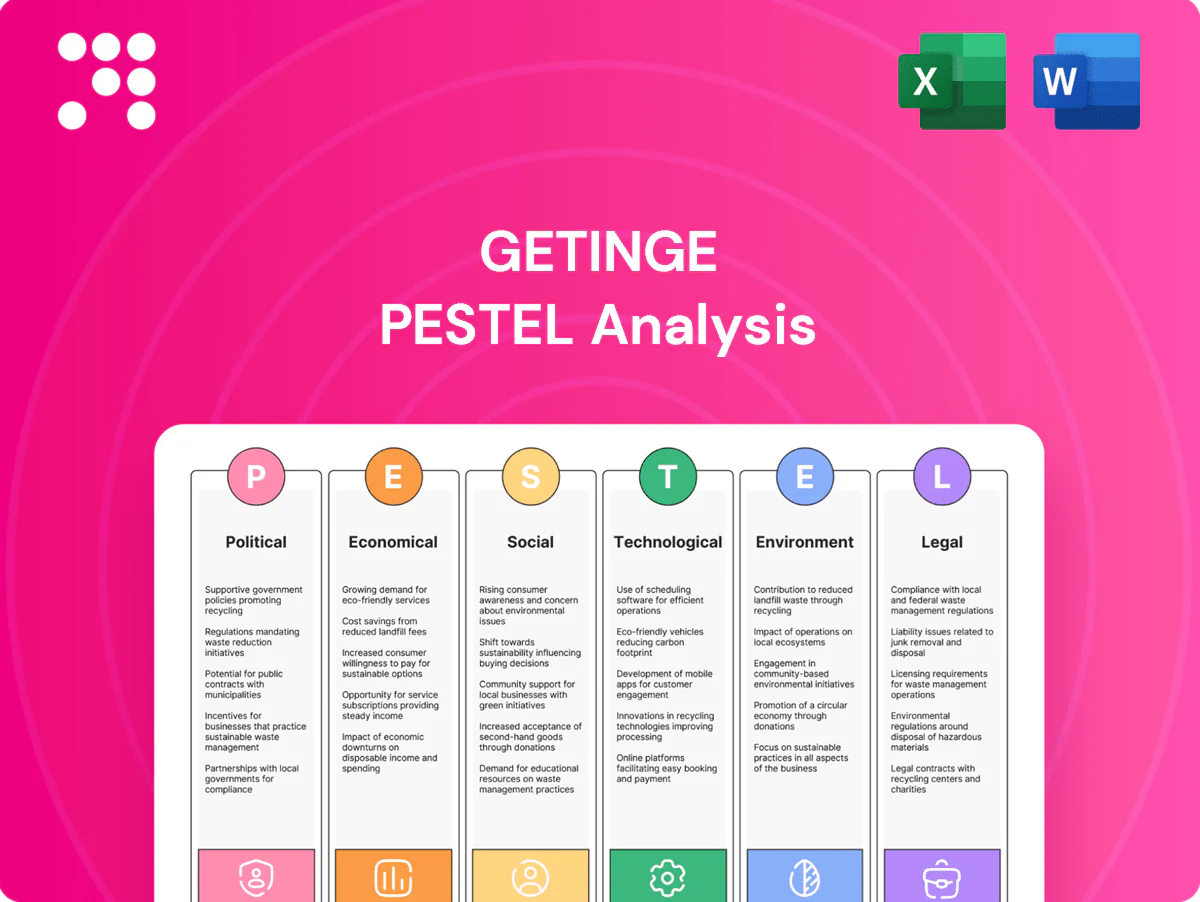
Getinge PESTLE Analysis

Plan Smarter. Present Sharper. Compete Stronger.
Get a competitive edge with our focused PESTLE Analysis of Getinge—mapping political, economic, social, technological, legal, and environmental forces that will shape strategy and valuation. Ideal for investors, consultants, and executives, it translates external risks into actionable insights. Purchase the full report to download editable, board-ready analysis instantly.
Political factors

Public healthcare funding
Government budget priorities directly shape demand for ICU, OR and sterilization equipment; fiscal tightening can delay tenders and upgrades while stimulus programs such as the EU NextGenerationEU €750 billion recovery package boost capacity investments. Regional disparities require tailored go-to-market and pricing strategies, and long public procurement cycles of 12–36 months hinge on policy stability and multi-year capital plans.
Procurement and localization
Public tenders favor compliant, cost‑effective suppliers with broad service footprints; public procurement represents about 12% of EU GDP, increasing award weight on service capacity. Localization rules and domestic content preferences shift competitiveness and supply placement in major markets. Vendor selection increasingly weighs lifecycle costs and sustainability in scoring. Building local partnerships mitigates entry barriers and supports tender success.

Trade and geopolitics
Tariffs, export controls and customs delays have disrupted global device flows and components, prompting Getinge to expand dual-sourcing and inventory buffers for critical parts after 2022–24 supply shocks. Geopolitical risk across EU, US and China trade corridors has increased contingency stocking and nearshoring. Currency-managed import regimes in 2024 shifted pricing power toward local distributors. Market-access strategies must align with regional blocs like the EU and USMCA to ensure cross-border serviceability.

Pandemic preparedness agendas
National resilience programs now prioritize ICU capacity, sterile workflows, and scalable bioprocess lines, driving recurring demand for Getinge ventilators, sterile processing and bioprocess equipment; stockpiles and surge procurement can accelerate orders but remain cyclical, with procurement waves after crises.
- Policy reviews raise facility infection-control standards
- Funding often tied to local manufacturing and rapid deployment
- Stockpile-driven demand spikes then taper
HTA and pricing oversight
HTA bodies and payers cap margins and set clinical specs; NICE applies a £20k–30k/QALY benchmark and the EU HTA Regulation began centralized assessments in 2025. Value-based procurement links payments to outcomes and uptime guarantees, increasingly used in EU/US tenders. Demonstrating robust clinical and economic evidence is essential, while stricter post-market surveillance under EU MDR increases lifecycle compliance costs.
- HTA thresholds: NICE £20k–30k/QALY
- EU HTA centralized from 2025
- Post-market MDR raises compliance burden
Public procurement ~12% EU GDP; NG-EU €750bn spurs nearshoring
Government budgets and EU NextGenerationEU €750bn shape demand; public procurement ~12% of EU GDP with 12–36 month cycles. Tariffs and 2022–24 supply shocks drove nearshoring and dual‑sourcing. HTA: NICE £20k–30k/QALY; EU HTA centralized 2025, raising lifecycle compliance costs.
| Metric | Value |
|---|---|
| Public procurement | ~12% EU GDP |
| NG-EU | €750bn |
| NICE threshold | £20k–30k/QALY |
What is included in the product
 Detailed Word Document
Explores how macro-environmental factors uniquely affect Getinge across Political, Economic, Social, Technological, Environmental and Legal dimensions, with data-backed insights, forward-looking scenarios and detailed sub-points to help executives, consultants and investors identify risks, opportunities and strategic responses.

 Customizable Excel Spreadsheet
A concise, visually segmented Getinge PESTLE summary that’s easy to drop into presentations or strategy packs, editable for region- or product-specific notes and ideal for quick team alignment during planning sessions.
Economic factors

Hospital capex cycles
Cyclical hospital capital budgets drive timing for OR suites, reprocessing and ICU upgrades, creating waves of procurement tied to multi-year budget cycles; deferred maintenance builds pent-up demand but often compresses pricing as hospitals bundle projects. Private hospitals apply higher ROI thresholds than public systems; leasing and managed-service models—growing as hospitals seek opex solutions—smooth adoption amid OECD health spending near 10% of GDP (2022–23).
Macroeconomy and inflation
Input-cost inflation has raised BOM and service costs, squeezing margins as Getinge faces higher stainless-steel and electronics prices; euro-area HICP eased to about 2.4% in 2024 but past cost spikes still outpace contract price-indexing. Lagging price indexing in service contracts delays full pass-through. Soft economic cycles reduce elective procedure volumes and service revenues, while strong growth phases drive refurbishment and expansion projects.

FX and global footprint
Getinge earns revenue in multiple currencies, exposing reported results to FX swings across markets and business units.
Active hedging programs mitigate short-term volatility, while varying regional pricing power limits the ability to pass through currency moves.
Global sourcing of components requires alignment of procurement contracts with sales currency exposure; reporting in SEK, EUR and USD complicates investor comparability.

Reimbursement and DRGs
Procedure reimbursements shape hospital adoption of cardiovascular and OR technologies by determining ROI; DRG payment levels and length-of-stay incentives push hospitals toward efficiency-focused purchases and capital that reduces per-case costs. Demonstrated throughput and OR turnover gains enable premium pricing and service contracts, while shifts in payer mix change utilization patterns and device mix procurement.
- Reimbursement-driven adoption
- DRG & length-of-stay incentives
- Throughput supports premium pricing
- Payer-mix alters utilization
Emerging market growth
Rising healthcare investment in APAC, LATAM and MEA is expanding Getinge’s addressable market—APAC healthcare spending is estimated near 3.2 trillion USD in 2025, LATAM capital healthcare outlays grew ~6% YoY in 2024 and MEA facility investments accelerated with >5% annual growth in 2024.
- Infrastructure variability: modular, robust devices required
- Financing & training: key to adoption in 60–70% of projects
- Price-sensitive segments: favor scalable platforms & service bundles
Public procurement ~12% EU GDP; NG-EU €750bn spurs nearshoring
Cyclical hospital capital cycles and rising input-cost inflation compress Getinge margins despite euro-area HICP easing to ~2.4% in 2024; elective volumes vary with economic cycles. FX exposure (SEK/EUR/USD) and hedging shape reported results. Reimbursement/DRG incentives drive premium pricing; APAC healthcare spending ~3.2T USD (2025), LATAM capital +6% (2024), MEA >5% (2024).
| Metric | Value |
|---|---|
| OECD health spend | ~10% GDP (2022–23) |
| Euro HICP | ~2.4% (2024) |
| APAC healthcare | ~3.2T USD (2025) |
| LATAM capital | +6% YoY (2024) |
| MEA facility growth | >5% (2024) |
Preview Before You Purchase
Getinge PESTLE Analysis
The preview of the Getinge PESTLE Analysis shown here is the exact, fully formatted document you will receive after purchase; no placeholders or teasers. The layout, content, and structure are final and ready to download instantly after checkout. Use it immediately for strategic review and decision-making.

Plan Smarter. Present Sharper. Compete Stronger.
Get a competitive edge with our focused PESTLE Analysis of Getinge—mapping political, economic, social, technological, legal, and environmental forces that will shape strategy and valuation. Ideal for investors, consultants, and executives, it translates external risks into actionable insights. Purchase the full report to download editable, board-ready analysis instantly.
Political factors
Public healthcare funding
Government budget priorities directly shape demand for ICU, OR and sterilization equipment; fiscal tightening can delay tenders and upgrades while stimulus programs such as the EU NextGenerationEU €750 billion recovery package boost capacity investments. Regional disparities require tailored go-to-market and pricing strategies, and long public procurement cycles of 12–36 months hinge on policy stability and multi-year capital plans.
Procurement and localization
Public tenders favor compliant, cost‑effective suppliers with broad service footprints; public procurement represents about 12% of EU GDP, increasing award weight on service capacity. Localization rules and domestic content preferences shift competitiveness and supply placement in major markets. Vendor selection increasingly weighs lifecycle costs and sustainability in scoring. Building local partnerships mitigates entry barriers and supports tender success.
Trade and geopolitics
Tariffs, export controls and customs delays have disrupted global device flows and components, prompting Getinge to expand dual-sourcing and inventory buffers for critical parts after 2022–24 supply shocks. Geopolitical risk across EU, US and China trade corridors has increased contingency stocking and nearshoring. Currency-managed import regimes in 2024 shifted pricing power toward local distributors. Market-access strategies must align with regional blocs like the EU and USMCA to ensure cross-border serviceability.
Pandemic preparedness agendas
National resilience programs now prioritize ICU capacity, sterile workflows, and scalable bioprocess lines, driving recurring demand for Getinge ventilators, sterile processing and bioprocess equipment; stockpiles and surge procurement can accelerate orders but remain cyclical, with procurement waves after crises.
- Policy reviews raise facility infection-control standards
- Funding often tied to local manufacturing and rapid deployment
- Stockpile-driven demand spikes then taper
HTA and pricing oversight
HTA bodies and payers cap margins and set clinical specs; NICE applies a £20k–30k/QALY benchmark and the EU HTA Regulation began centralized assessments in 2025. Value-based procurement links payments to outcomes and uptime guarantees, increasingly used in EU/US tenders. Demonstrating robust clinical and economic evidence is essential, while stricter post-market surveillance under EU MDR increases lifecycle compliance costs.
- HTA thresholds: NICE £20k–30k/QALY
- EU HTA centralized from 2025
- Post-market MDR raises compliance burden
Public procurement ~12% EU GDP; NG-EU €750bn spurs nearshoring
Government budgets and EU NextGenerationEU €750bn shape demand; public procurement ~12% of EU GDP with 12–36 month cycles. Tariffs and 2022–24 supply shocks drove nearshoring and dual‑sourcing. HTA: NICE £20k–30k/QALY; EU HTA centralized 2025, raising lifecycle compliance costs.
| Metric | Value |
|---|---|
| Public procurement | ~12% EU GDP |
| NG-EU | €750bn |
| NICE threshold | £20k–30k/QALY |
What is included in the product
Detailed Word Document
Explores how macro-environmental factors uniquely affect Getinge across Political, Economic, Social, Technological, Environmental and Legal dimensions, with data-backed insights, forward-looking scenarios and detailed sub-points to help executives, consultants and investors identify risks, opportunities and strategic responses.
Customizable Excel Spreadsheet
A concise, visually segmented Getinge PESTLE summary that’s easy to drop into presentations or strategy packs, editable for region- or product-specific notes and ideal for quick team alignment during planning sessions.
Economic factors
Hospital capex cycles
Cyclical hospital capital budgets drive timing for OR suites, reprocessing and ICU upgrades, creating waves of procurement tied to multi-year budget cycles; deferred maintenance builds pent-up demand but often compresses pricing as hospitals bundle projects. Private hospitals apply higher ROI thresholds than public systems; leasing and managed-service models—growing as hospitals seek opex solutions—smooth adoption amid OECD health spending near 10% of GDP (2022–23).
Macroeconomy and inflation
Input-cost inflation has raised BOM and service costs, squeezing margins as Getinge faces higher stainless-steel and electronics prices; euro-area HICP eased to about 2.4% in 2024 but past cost spikes still outpace contract price-indexing. Lagging price indexing in service contracts delays full pass-through. Soft economic cycles reduce elective procedure volumes and service revenues, while strong growth phases drive refurbishment and expansion projects.
FX and global footprint
Getinge earns revenue in multiple currencies, exposing reported results to FX swings across markets and business units.
Active hedging programs mitigate short-term volatility, while varying regional pricing power limits the ability to pass through currency moves.
Global sourcing of components requires alignment of procurement contracts with sales currency exposure; reporting in SEK, EUR and USD complicates investor comparability.
Reimbursement and DRGs
Procedure reimbursements shape hospital adoption of cardiovascular and OR technologies by determining ROI; DRG payment levels and length-of-stay incentives push hospitals toward efficiency-focused purchases and capital that reduces per-case costs. Demonstrated throughput and OR turnover gains enable premium pricing and service contracts, while shifts in payer mix change utilization patterns and device mix procurement.
- Reimbursement-driven adoption
- DRG & length-of-stay incentives
- Throughput supports premium pricing
- Payer-mix alters utilization
Emerging market growth
Rising healthcare investment in APAC, LATAM and MEA is expanding Getinge’s addressable market—APAC healthcare spending is estimated near 3.2 trillion USD in 2025, LATAM capital healthcare outlays grew ~6% YoY in 2024 and MEA facility investments accelerated with >5% annual growth in 2024.
- Infrastructure variability: modular, robust devices required
- Financing & training: key to adoption in 60–70% of projects
- Price-sensitive segments: favor scalable platforms & service bundles
Public procurement ~12% EU GDP; NG-EU €750bn spurs nearshoring
Cyclical hospital capital cycles and rising input-cost inflation compress Getinge margins despite euro-area HICP easing to ~2.4% in 2024; elective volumes vary with economic cycles. FX exposure (SEK/EUR/USD) and hedging shape reported results. Reimbursement/DRG incentives drive premium pricing; APAC healthcare spending ~3.2T USD (2025), LATAM capital +6% (2024), MEA >5% (2024).
| Metric | Value |
|---|---|
| OECD health spend | ~10% GDP (2022–23) |
| Euro HICP | ~2.4% (2024) |
| APAC healthcare | ~3.2T USD (2025) |
| LATAM capital | +6% YoY (2024) |
| MEA facility growth | >5% (2024) |
Preview Before You Purchase
Getinge PESTLE Analysis
The preview of the Getinge PESTLE Analysis shown here is the exact, fully formatted document you will receive after purchase; no placeholders or teasers. The layout, content, and structure are final and ready to download instantly after checkout. Use it immediately for strategic review and decision-making.
Original: $10.00
-65%$10.00
$3.50Description
Plan Smarter. Present Sharper. Compete Stronger.
Get a competitive edge with our focused PESTLE Analysis of Getinge—mapping political, economic, social, technological, legal, and environmental forces that will shape strategy and valuation. Ideal for investors, consultants, and executives, it translates external risks into actionable insights. Purchase the full report to download editable, board-ready analysis instantly.
Political factors
Public healthcare funding
Government budget priorities directly shape demand for ICU, OR and sterilization equipment; fiscal tightening can delay tenders and upgrades while stimulus programs such as the EU NextGenerationEU €750 billion recovery package boost capacity investments. Regional disparities require tailored go-to-market and pricing strategies, and long public procurement cycles of 12–36 months hinge on policy stability and multi-year capital plans.
Procurement and localization
Public tenders favor compliant, cost‑effective suppliers with broad service footprints; public procurement represents about 12% of EU GDP, increasing award weight on service capacity. Localization rules and domestic content preferences shift competitiveness and supply placement in major markets. Vendor selection increasingly weighs lifecycle costs and sustainability in scoring. Building local partnerships mitigates entry barriers and supports tender success.
Trade and geopolitics
Tariffs, export controls and customs delays have disrupted global device flows and components, prompting Getinge to expand dual-sourcing and inventory buffers for critical parts after 2022–24 supply shocks. Geopolitical risk across EU, US and China trade corridors has increased contingency stocking and nearshoring. Currency-managed import regimes in 2024 shifted pricing power toward local distributors. Market-access strategies must align with regional blocs like the EU and USMCA to ensure cross-border serviceability.
Pandemic preparedness agendas
National resilience programs now prioritize ICU capacity, sterile workflows, and scalable bioprocess lines, driving recurring demand for Getinge ventilators, sterile processing and bioprocess equipment; stockpiles and surge procurement can accelerate orders but remain cyclical, with procurement waves after crises.
- Policy reviews raise facility infection-control standards
- Funding often tied to local manufacturing and rapid deployment
- Stockpile-driven demand spikes then taper
HTA and pricing oversight
HTA bodies and payers cap margins and set clinical specs; NICE applies a £20k–30k/QALY benchmark and the EU HTA Regulation began centralized assessments in 2025. Value-based procurement links payments to outcomes and uptime guarantees, increasingly used in EU/US tenders. Demonstrating robust clinical and economic evidence is essential, while stricter post-market surveillance under EU MDR increases lifecycle compliance costs.
- HTA thresholds: NICE £20k–30k/QALY
- EU HTA centralized from 2025
- Post-market MDR raises compliance burden
Public procurement ~12% EU GDP; NG-EU €750bn spurs nearshoring
Government budgets and EU NextGenerationEU €750bn shape demand; public procurement ~12% of EU GDP with 12–36 month cycles. Tariffs and 2022–24 supply shocks drove nearshoring and dual‑sourcing. HTA: NICE £20k–30k/QALY; EU HTA centralized 2025, raising lifecycle compliance costs.
| Metric | Value |
|---|---|
| Public procurement | ~12% EU GDP |
| NG-EU | €750bn |
| NICE threshold | £20k–30k/QALY |
What is included in the product
Detailed Word Document
Explores how macro-environmental factors uniquely affect Getinge across Political, Economic, Social, Technological, Environmental and Legal dimensions, with data-backed insights, forward-looking scenarios and detailed sub-points to help executives, consultants and investors identify risks, opportunities and strategic responses.
Customizable Excel Spreadsheet
A concise, visually segmented Getinge PESTLE summary that’s easy to drop into presentations or strategy packs, editable for region- or product-specific notes and ideal for quick team alignment during planning sessions.
Economic factors
Hospital capex cycles
Cyclical hospital capital budgets drive timing for OR suites, reprocessing and ICU upgrades, creating waves of procurement tied to multi-year budget cycles; deferred maintenance builds pent-up demand but often compresses pricing as hospitals bundle projects. Private hospitals apply higher ROI thresholds than public systems; leasing and managed-service models—growing as hospitals seek opex solutions—smooth adoption amid OECD health spending near 10% of GDP (2022–23).
Macroeconomy and inflation
Input-cost inflation has raised BOM and service costs, squeezing margins as Getinge faces higher stainless-steel and electronics prices; euro-area HICP eased to about 2.4% in 2024 but past cost spikes still outpace contract price-indexing. Lagging price indexing in service contracts delays full pass-through. Soft economic cycles reduce elective procedure volumes and service revenues, while strong growth phases drive refurbishment and expansion projects.
FX and global footprint
Getinge earns revenue in multiple currencies, exposing reported results to FX swings across markets and business units.
Active hedging programs mitigate short-term volatility, while varying regional pricing power limits the ability to pass through currency moves.
Global sourcing of components requires alignment of procurement contracts with sales currency exposure; reporting in SEK, EUR and USD complicates investor comparability.
Reimbursement and DRGs
Procedure reimbursements shape hospital adoption of cardiovascular and OR technologies by determining ROI; DRG payment levels and length-of-stay incentives push hospitals toward efficiency-focused purchases and capital that reduces per-case costs. Demonstrated throughput and OR turnover gains enable premium pricing and service contracts, while shifts in payer mix change utilization patterns and device mix procurement.
- Reimbursement-driven adoption
- DRG & length-of-stay incentives
- Throughput supports premium pricing
- Payer-mix alters utilization
Emerging market growth
Rising healthcare investment in APAC, LATAM and MEA is expanding Getinge’s addressable market—APAC healthcare spending is estimated near 3.2 trillion USD in 2025, LATAM capital healthcare outlays grew ~6% YoY in 2024 and MEA facility investments accelerated with >5% annual growth in 2024.
- Infrastructure variability: modular, robust devices required
- Financing & training: key to adoption in 60–70% of projects
- Price-sensitive segments: favor scalable platforms & service bundles
Public procurement ~12% EU GDP; NG-EU €750bn spurs nearshoring
Cyclical hospital capital cycles and rising input-cost inflation compress Getinge margins despite euro-area HICP easing to ~2.4% in 2024; elective volumes vary with economic cycles. FX exposure (SEK/EUR/USD) and hedging shape reported results. Reimbursement/DRG incentives drive premium pricing; APAC healthcare spending ~3.2T USD (2025), LATAM capital +6% (2024), MEA >5% (2024).
| Metric | Value |
|---|---|
| OECD health spend | ~10% GDP (2022–23) |
| Euro HICP | ~2.4% (2024) |
| APAC healthcare | ~3.2T USD (2025) |
| LATAM capital | +6% YoY (2024) |
| MEA facility growth | >5% (2024) |
Preview Before You Purchase
Getinge PESTLE Analysis
The preview of the Getinge PESTLE Analysis shown here is the exact, fully formatted document you will receive after purchase; no placeholders or teasers. The layout, content, and structure are final and ready to download instantly after checkout. Use it immediately for strategic review and decision-making.











