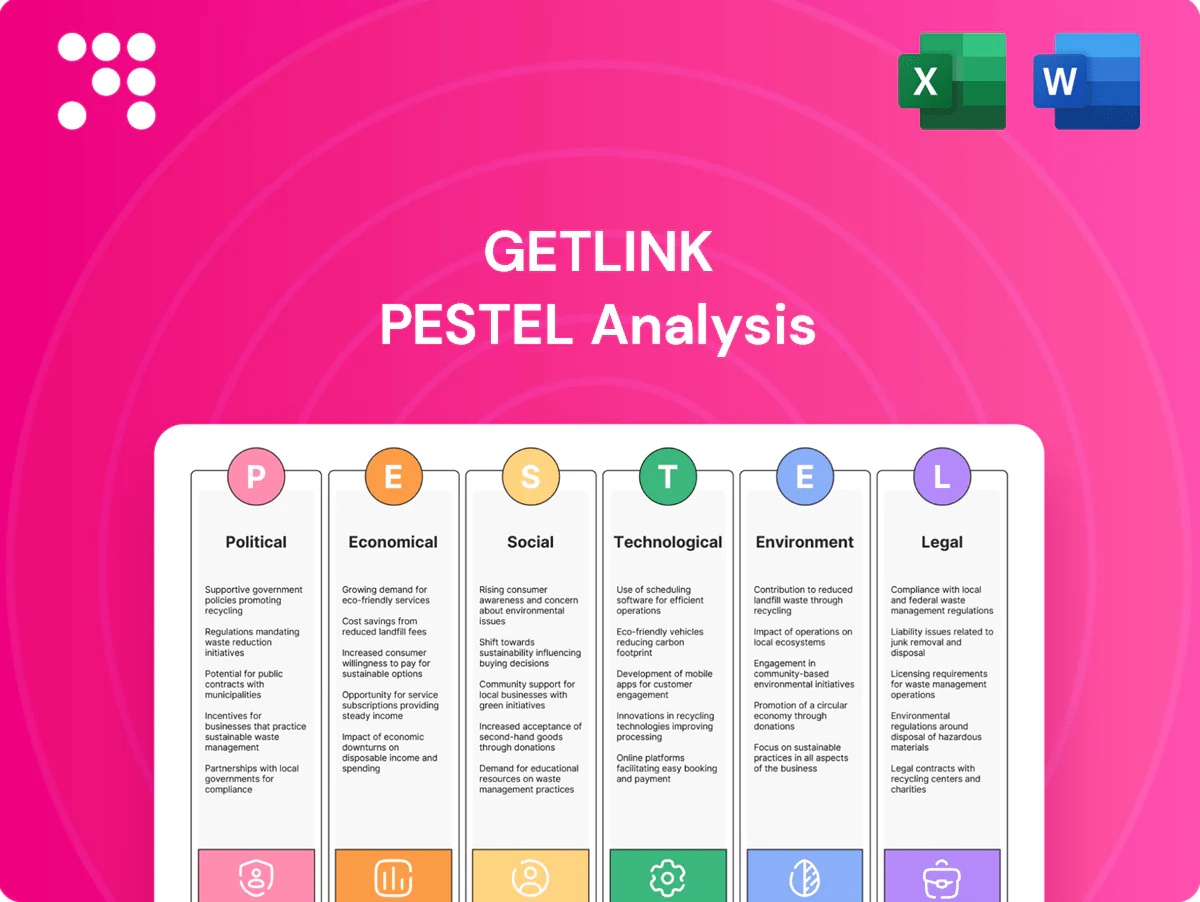
Getlink PESTLE Analysis

Your Shortcut to Market Insight Starts Here
Gain a competitive edge with our tailored PESTLE Analysis of Getlink—three to five key areas explored in depth to reveal regulatory risks, economic drivers, and environmental trends shaping future performance. Ideal for investors and strategists, this actionable report is fully editable and ready for boardrooms. Purchase the full analysis now to unlock strategic insights and make smarter decisions.
Political factors

UK–France bilateral relations stability
Operations hinge on UK–France political cooperation for border, security and transport policy alignment, overseen by the bi‑national Intergovernmental Commission (IGC). Diplomatic tension can tighten controls, lengthen dwell times and reduce throughput, threatening revenue tied to cross‑Channel trade (UK‑EU goods trade ~£600bn in 2023). Positive coordination streamlines immigration and customs for passengers and freight, so Getlink must sustain active stakeholder engagement with both governments and the IGC.
Post‑Brexit border and customs regime
Post‑Brexit separate UK/EU customs and immigration frameworks have altered Channel Tunnel flows since the 2021 Trade and Cooperation Agreement, with phased SPS controls implemented through 2024 that increased processing complexity. Introduction of digital customs corridors and full SPS checks could materially change processing times and throughput. Getlink has invested in smart‑border systems to mitigate friction, requiring ongoing capex commitments. Any UK–EU operational easing would act as a clear demand catalyst.

Public safety and security policy
Heightened terrorism or migration pressures — Frontex recorded about 1.2 million detections at EU external borders in 2023 — drive stricter screening and policing around Getlink infrastructure. Policy shifts force investment in screening tech and staffing, raising compliance and capex demands. Coordinated incident response with national authorities is critical to safeguard Channel Tunnel continuity. Prolonged high alert raises opex and can compress margins.

Transport and energy policy incentives
EU and UK modal-shift policies (EU target to shift 30% of road freight over 300 km to rail by 2030) plus carbon pricing—EU ETS ~€90/t and UK ETS ~£60/t in 2024–25—boost rail freight and interconnector demand, favoring Getlink’s Channel Tunnel and ElecLink. Green subsidies and capacity mechanisms underpin ElecLink revenues; removal of incentives would erode growth and pricing power.
- Modal-shift target: 30% by 2030
- EU ETS ≈ €90/t (2024–25)
- UK ETS ≈ £60/t (2024–25)
- ElecLink reliant on capacity mechanisms
Regulatory oversight and concession governance
The bi‑national Intergovernmental Commission, created under the 1986 Treaty of Canterbury, oversees safety, access and tariffs for the Channel Tunnel, setting binding rules for Getlink operations.
Getlink holds a 99‑year concession running to 2086 that prescribes investment obligations, pricing corridors and long‑term performance targets for infrastructure and services.
Periodic policy reviews can recalibrate access charges and capacity allocation; predictable rulemaking reduces regulatory risk and lowers the companys cost of capital.
- IGC established 1986
- Concession length 99 years (expires 2086)
- Governance covers safety, access, tariffs
- Policy reviews affect access charges & capacity
UK–France cooperation, ETS prices and modal‑shift targets drive Tunnel and ElecLink demand
Getlink depends on UK–France political cooperation (IGC) for border, safety and tariff stability; diplomatic strain can cut throughput and revenue. Post‑Brexit customs/SPS changes raised processing complexity and capex for smart‑border systems; EU ETS ≈ €90/t and UK ETS ≈ £60/t (2024–25) favor rail shift. Modal‑shift targets (30% by 2030) and capacity mechanisms materially affect Tunnel and ElecLink demand.
| Metric | Value | Year/Source |
|---|---|---|
| EU ETS price | ≈ €90/t | 2024–25 |
| UK ETS price | ≈ £60/t | 2024–25 |
| Modal‑shift target | 30% road→rail | 2030 (EU) |
| Concession expiry | 2086 | Treaty/Concession |
What is included in the product
 Detailed Word Document
Explores how macro-environmental factors uniquely affect Getlink across Political, Economic, Social, Technological, Environmental and Legal dimensions, with data‑backed trends and region‑specific regulatory context. Designed for executives and investors, it offers forward‑looking insights and ready‑to‑use findings for strategy and risk planning.

 Customizable Excel Spreadsheet
Concise, visually segmented Getlink PESTLE summary that’s easily dropped into presentations or shared across teams, editable for region- or business-specific notes and ideal for accelerating risk discussions and strategic alignment.
Economic factors

Cross‑border travel and trade cycles
Passenger demand closely follows UK/EU tourism, business travel and disposable income, with volumes recovering to near 2019 levels by 2024; freight correlates with industrial output and e‑commerce, showing procyclical swings that fell in recessions and rose in recoveries. Recessions compress yields and load factors, recoveries lift both. Diversification via Europorte and ElecLink (commissioned 2022) smooths cyclicality.
GBP/EUR exchange rate volatility
GBP/EUR volatility (around 1.17 in July 2025) directly alters UK traveler affordability and the competitiveness of freight pricing across the Channel. Revenue and cost bases span both currencies, creating both translation risk on reported euro revenues and transaction risk on sterling‑denominated ticket and freight receipts. Robust hedging policies are essential to stabilise cash flows and ensure predictable debt service. Prolonged sterling weakness can materially suppress UK‑origin demand, pressuring volumes and yields.

Inflation and interest rate environment
High inflation (Euro area HICP 2024 2.9%, Eurostat) raises wages, energy and maintenance costs across Getlink operations, squeezing margins. ECB policy rates (deposit rate ~4.00% in mid‑2025) drive refinancing costs for an infrastructure‑heavy balance sheet. Index‑linked pricing and contractual cost pass‑throughs partially offset input inflation. Future rate cuts would lower WACC and support new capex programs.

Energy prices and power market spreads
ElecLink economics hinge on GB–FR price differentials and congestion rents; ElecLink is a 1 GW interconnector in commercial service since Jan 2022. Volatile gas prices and variable renewable output swing spreads and capacity value, while stable, liquid markets enable monetization via auctions and hedges. Power price spikes increase rail traction costs but can materially boost ElecLink revenue.
- Capacity: 1 GW operational since 2022
- Revenue drivers: spreads, congestion rents, hedging
- Risks: gas/renewable volatility, traction cost spikes
Competition and modal substitution
Airlines, ferries and road freight compete with the tunnel on price, speed and reliability, and disruptions such as fuel-price volatility, driver shortages and port congestion have in recent years shifted measurable share toward rail and the Channel Tunnel.
Getlink defends volumes through dynamic pricing, high-frequency Shuttle services and reliability guarantees; ESG-driven shippers increasingly prefer lower-emission rail options, strengthening modal substitution trends.
- Competition axes: price, speed, reliability
- Operational risks: fuel costs, driver shortages, port congestion
- Defensive levers: pricing, frequency, ESG-attraction
UK–France cooperation, ETS prices and modal‑shift targets drive Tunnel and ElecLink demand
Demand recovered to near 2019 levels by 2024; freight remains procyclical. GBP/EUR ~1.17 (Jul 2025) and Euro area HICP 2.9% (2024) drive affordability and costs; ECB deposit ~4.00% (mid‑2025) raises financing costs. ElecLink 1 GW (operational 2022) adds revenue diversification but faces power/gas volatility.
| Metric | Value |
|---|---|
| GBP/EUR (Jul 2025) | 1.17 |
| Euro HICP (2024) | 2.9% |
| ECB deposit (mid‑2025) | 4.00% |
| ElecLink capacity | 1 GW |
Full Version Awaits
Getlink PESTLE Analysis
This Getlink PESTLE Analysis preview is the exact, fully formatted document you’ll receive after purchase—professionally structured and ready to use. It contains the same content, layout, and insights shown here, with no placeholders or surprises, available for immediate download upon payment.

Your Shortcut to Market Insight Starts Here
Gain a competitive edge with our tailored PESTLE Analysis of Getlink—three to five key areas explored in depth to reveal regulatory risks, economic drivers, and environmental trends shaping future performance. Ideal for investors and strategists, this actionable report is fully editable and ready for boardrooms. Purchase the full analysis now to unlock strategic insights and make smarter decisions.
Political factors
UK–France bilateral relations stability
Operations hinge on UK–France political cooperation for border, security and transport policy alignment, overseen by the bi‑national Intergovernmental Commission (IGC). Diplomatic tension can tighten controls, lengthen dwell times and reduce throughput, threatening revenue tied to cross‑Channel trade (UK‑EU goods trade ~£600bn in 2023). Positive coordination streamlines immigration and customs for passengers and freight, so Getlink must sustain active stakeholder engagement with both governments and the IGC.
Post‑Brexit border and customs regime
Post‑Brexit separate UK/EU customs and immigration frameworks have altered Channel Tunnel flows since the 2021 Trade and Cooperation Agreement, with phased SPS controls implemented through 2024 that increased processing complexity. Introduction of digital customs corridors and full SPS checks could materially change processing times and throughput. Getlink has invested in smart‑border systems to mitigate friction, requiring ongoing capex commitments. Any UK–EU operational easing would act as a clear demand catalyst.
Public safety and security policy
Heightened terrorism or migration pressures — Frontex recorded about 1.2 million detections at EU external borders in 2023 — drive stricter screening and policing around Getlink infrastructure. Policy shifts force investment in screening tech and staffing, raising compliance and capex demands. Coordinated incident response with national authorities is critical to safeguard Channel Tunnel continuity. Prolonged high alert raises opex and can compress margins.
Transport and energy policy incentives
EU and UK modal-shift policies (EU target to shift 30% of road freight over 300 km to rail by 2030) plus carbon pricing—EU ETS ~€90/t and UK ETS ~£60/t in 2024–25—boost rail freight and interconnector demand, favoring Getlink’s Channel Tunnel and ElecLink. Green subsidies and capacity mechanisms underpin ElecLink revenues; removal of incentives would erode growth and pricing power.
- Modal-shift target: 30% by 2030
- EU ETS ≈ €90/t (2024–25)
- UK ETS ≈ £60/t (2024–25)
- ElecLink reliant on capacity mechanisms
Regulatory oversight and concession governance
The bi‑national Intergovernmental Commission, created under the 1986 Treaty of Canterbury, oversees safety, access and tariffs for the Channel Tunnel, setting binding rules for Getlink operations.
Getlink holds a 99‑year concession running to 2086 that prescribes investment obligations, pricing corridors and long‑term performance targets for infrastructure and services.
Periodic policy reviews can recalibrate access charges and capacity allocation; predictable rulemaking reduces regulatory risk and lowers the companys cost of capital.
- IGC established 1986
- Concession length 99 years (expires 2086)
- Governance covers safety, access, tariffs
- Policy reviews affect access charges & capacity
UK–France cooperation, ETS prices and modal‑shift targets drive Tunnel and ElecLink demand
Getlink depends on UK–France political cooperation (IGC) for border, safety and tariff stability; diplomatic strain can cut throughput and revenue. Post‑Brexit customs/SPS changes raised processing complexity and capex for smart‑border systems; EU ETS ≈ €90/t and UK ETS ≈ £60/t (2024–25) favor rail shift. Modal‑shift targets (30% by 2030) and capacity mechanisms materially affect Tunnel and ElecLink demand.
| Metric | Value | Year/Source |
|---|---|---|
| EU ETS price | ≈ €90/t | 2024–25 |
| UK ETS price | ≈ £60/t | 2024–25 |
| Modal‑shift target | 30% road→rail | 2030 (EU) |
| Concession expiry | 2086 | Treaty/Concession |
What is included in the product
Detailed Word Document
Explores how macro-environmental factors uniquely affect Getlink across Political, Economic, Social, Technological, Environmental and Legal dimensions, with data‑backed trends and region‑specific regulatory context. Designed for executives and investors, it offers forward‑looking insights and ready‑to‑use findings for strategy and risk planning.
Customizable Excel Spreadsheet
Concise, visually segmented Getlink PESTLE summary that’s easily dropped into presentations or shared across teams, editable for region- or business-specific notes and ideal for accelerating risk discussions and strategic alignment.
Economic factors
Cross‑border travel and trade cycles
Passenger demand closely follows UK/EU tourism, business travel and disposable income, with volumes recovering to near 2019 levels by 2024; freight correlates with industrial output and e‑commerce, showing procyclical swings that fell in recessions and rose in recoveries. Recessions compress yields and load factors, recoveries lift both. Diversification via Europorte and ElecLink (commissioned 2022) smooths cyclicality.
GBP/EUR exchange rate volatility
GBP/EUR volatility (around 1.17 in July 2025) directly alters UK traveler affordability and the competitiveness of freight pricing across the Channel. Revenue and cost bases span both currencies, creating both translation risk on reported euro revenues and transaction risk on sterling‑denominated ticket and freight receipts. Robust hedging policies are essential to stabilise cash flows and ensure predictable debt service. Prolonged sterling weakness can materially suppress UK‑origin demand, pressuring volumes and yields.
Inflation and interest rate environment
High inflation (Euro area HICP 2024 2.9%, Eurostat) raises wages, energy and maintenance costs across Getlink operations, squeezing margins. ECB policy rates (deposit rate ~4.00% in mid‑2025) drive refinancing costs for an infrastructure‑heavy balance sheet. Index‑linked pricing and contractual cost pass‑throughs partially offset input inflation. Future rate cuts would lower WACC and support new capex programs.
Energy prices and power market spreads
ElecLink economics hinge on GB–FR price differentials and congestion rents; ElecLink is a 1 GW interconnector in commercial service since Jan 2022. Volatile gas prices and variable renewable output swing spreads and capacity value, while stable, liquid markets enable monetization via auctions and hedges. Power price spikes increase rail traction costs but can materially boost ElecLink revenue.
- Capacity: 1 GW operational since 2022
- Revenue drivers: spreads, congestion rents, hedging
- Risks: gas/renewable volatility, traction cost spikes
Competition and modal substitution
Airlines, ferries and road freight compete with the tunnel on price, speed and reliability, and disruptions such as fuel-price volatility, driver shortages and port congestion have in recent years shifted measurable share toward rail and the Channel Tunnel.
Getlink defends volumes through dynamic pricing, high-frequency Shuttle services and reliability guarantees; ESG-driven shippers increasingly prefer lower-emission rail options, strengthening modal substitution trends.
- Competition axes: price, speed, reliability
- Operational risks: fuel costs, driver shortages, port congestion
- Defensive levers: pricing, frequency, ESG-attraction
UK–France cooperation, ETS prices and modal‑shift targets drive Tunnel and ElecLink demand
Demand recovered to near 2019 levels by 2024; freight remains procyclical. GBP/EUR ~1.17 (Jul 2025) and Euro area HICP 2.9% (2024) drive affordability and costs; ECB deposit ~4.00% (mid‑2025) raises financing costs. ElecLink 1 GW (operational 2022) adds revenue diversification but faces power/gas volatility.
| Metric | Value |
|---|---|
| GBP/EUR (Jul 2025) | 1.17 |
| Euro HICP (2024) | 2.9% |
| ECB deposit (mid‑2025) | 4.00% |
| ElecLink capacity | 1 GW |
Full Version Awaits
Getlink PESTLE Analysis
This Getlink PESTLE Analysis preview is the exact, fully formatted document you’ll receive after purchase—professionally structured and ready to use. It contains the same content, layout, and insights shown here, with no placeholders or surprises, available for immediate download upon payment.
Description
Your Shortcut to Market Insight Starts Here
Gain a competitive edge with our tailored PESTLE Analysis of Getlink—three to five key areas explored in depth to reveal regulatory risks, economic drivers, and environmental trends shaping future performance. Ideal for investors and strategists, this actionable report is fully editable and ready for boardrooms. Purchase the full analysis now to unlock strategic insights and make smarter decisions.
Political factors
UK–France bilateral relations stability
Operations hinge on UK–France political cooperation for border, security and transport policy alignment, overseen by the bi‑national Intergovernmental Commission (IGC). Diplomatic tension can tighten controls, lengthen dwell times and reduce throughput, threatening revenue tied to cross‑Channel trade (UK‑EU goods trade ~£600bn in 2023). Positive coordination streamlines immigration and customs for passengers and freight, so Getlink must sustain active stakeholder engagement with both governments and the IGC.
Post‑Brexit border and customs regime
Post‑Brexit separate UK/EU customs and immigration frameworks have altered Channel Tunnel flows since the 2021 Trade and Cooperation Agreement, with phased SPS controls implemented through 2024 that increased processing complexity. Introduction of digital customs corridors and full SPS checks could materially change processing times and throughput. Getlink has invested in smart‑border systems to mitigate friction, requiring ongoing capex commitments. Any UK–EU operational easing would act as a clear demand catalyst.
Public safety and security policy
Heightened terrorism or migration pressures — Frontex recorded about 1.2 million detections at EU external borders in 2023 — drive stricter screening and policing around Getlink infrastructure. Policy shifts force investment in screening tech and staffing, raising compliance and capex demands. Coordinated incident response with national authorities is critical to safeguard Channel Tunnel continuity. Prolonged high alert raises opex and can compress margins.
Transport and energy policy incentives
EU and UK modal-shift policies (EU target to shift 30% of road freight over 300 km to rail by 2030) plus carbon pricing—EU ETS ~€90/t and UK ETS ~£60/t in 2024–25—boost rail freight and interconnector demand, favoring Getlink’s Channel Tunnel and ElecLink. Green subsidies and capacity mechanisms underpin ElecLink revenues; removal of incentives would erode growth and pricing power.
- Modal-shift target: 30% by 2030
- EU ETS ≈ €90/t (2024–25)
- UK ETS ≈ £60/t (2024–25)
- ElecLink reliant on capacity mechanisms
Regulatory oversight and concession governance
The bi‑national Intergovernmental Commission, created under the 1986 Treaty of Canterbury, oversees safety, access and tariffs for the Channel Tunnel, setting binding rules for Getlink operations.
Getlink holds a 99‑year concession running to 2086 that prescribes investment obligations, pricing corridors and long‑term performance targets for infrastructure and services.
Periodic policy reviews can recalibrate access charges and capacity allocation; predictable rulemaking reduces regulatory risk and lowers the companys cost of capital.
- IGC established 1986
- Concession length 99 years (expires 2086)
- Governance covers safety, access, tariffs
- Policy reviews affect access charges & capacity
UK–France cooperation, ETS prices and modal‑shift targets drive Tunnel and ElecLink demand
Getlink depends on UK–France political cooperation (IGC) for border, safety and tariff stability; diplomatic strain can cut throughput and revenue. Post‑Brexit customs/SPS changes raised processing complexity and capex for smart‑border systems; EU ETS ≈ €90/t and UK ETS ≈ £60/t (2024–25) favor rail shift. Modal‑shift targets (30% by 2030) and capacity mechanisms materially affect Tunnel and ElecLink demand.
| Metric | Value | Year/Source |
|---|---|---|
| EU ETS price | ≈ €90/t | 2024–25 |
| UK ETS price | ≈ £60/t | 2024–25 |
| Modal‑shift target | 30% road→rail | 2030 (EU) |
| Concession expiry | 2086 | Treaty/Concession |
What is included in the product
Detailed Word Document
Explores how macro-environmental factors uniquely affect Getlink across Political, Economic, Social, Technological, Environmental and Legal dimensions, with data‑backed trends and region‑specific regulatory context. Designed for executives and investors, it offers forward‑looking insights and ready‑to‑use findings for strategy and risk planning.
Customizable Excel Spreadsheet
Concise, visually segmented Getlink PESTLE summary that’s easily dropped into presentations or shared across teams, editable for region- or business-specific notes and ideal for accelerating risk discussions and strategic alignment.
Economic factors
Cross‑border travel and trade cycles
Passenger demand closely follows UK/EU tourism, business travel and disposable income, with volumes recovering to near 2019 levels by 2024; freight correlates with industrial output and e‑commerce, showing procyclical swings that fell in recessions and rose in recoveries. Recessions compress yields and load factors, recoveries lift both. Diversification via Europorte and ElecLink (commissioned 2022) smooths cyclicality.
GBP/EUR exchange rate volatility
GBP/EUR volatility (around 1.17 in July 2025) directly alters UK traveler affordability and the competitiveness of freight pricing across the Channel. Revenue and cost bases span both currencies, creating both translation risk on reported euro revenues and transaction risk on sterling‑denominated ticket and freight receipts. Robust hedging policies are essential to stabilise cash flows and ensure predictable debt service. Prolonged sterling weakness can materially suppress UK‑origin demand, pressuring volumes and yields.
Inflation and interest rate environment
High inflation (Euro area HICP 2024 2.9%, Eurostat) raises wages, energy and maintenance costs across Getlink operations, squeezing margins. ECB policy rates (deposit rate ~4.00% in mid‑2025) drive refinancing costs for an infrastructure‑heavy balance sheet. Index‑linked pricing and contractual cost pass‑throughs partially offset input inflation. Future rate cuts would lower WACC and support new capex programs.
Energy prices and power market spreads
ElecLink economics hinge on GB–FR price differentials and congestion rents; ElecLink is a 1 GW interconnector in commercial service since Jan 2022. Volatile gas prices and variable renewable output swing spreads and capacity value, while stable, liquid markets enable monetization via auctions and hedges. Power price spikes increase rail traction costs but can materially boost ElecLink revenue.
- Capacity: 1 GW operational since 2022
- Revenue drivers: spreads, congestion rents, hedging
- Risks: gas/renewable volatility, traction cost spikes
Competition and modal substitution
Airlines, ferries and road freight compete with the tunnel on price, speed and reliability, and disruptions such as fuel-price volatility, driver shortages and port congestion have in recent years shifted measurable share toward rail and the Channel Tunnel.
Getlink defends volumes through dynamic pricing, high-frequency Shuttle services and reliability guarantees; ESG-driven shippers increasingly prefer lower-emission rail options, strengthening modal substitution trends.
- Competition axes: price, speed, reliability
- Operational risks: fuel costs, driver shortages, port congestion
- Defensive levers: pricing, frequency, ESG-attraction
UK–France cooperation, ETS prices and modal‑shift targets drive Tunnel and ElecLink demand
Demand recovered to near 2019 levels by 2024; freight remains procyclical. GBP/EUR ~1.17 (Jul 2025) and Euro area HICP 2.9% (2024) drive affordability and costs; ECB deposit ~4.00% (mid‑2025) raises financing costs. ElecLink 1 GW (operational 2022) adds revenue diversification but faces power/gas volatility.
| Metric | Value |
|---|---|
| GBP/EUR (Jul 2025) | 1.17 |
| Euro HICP (2024) | 2.9% |
| ECB deposit (mid‑2025) | 4.00% |
| ElecLink capacity | 1 GW |
Full Version Awaits
Getlink PESTLE Analysis
This Getlink PESTLE Analysis preview is the exact, fully formatted document you’ll receive after purchase—professionally structured and ready to use. It contains the same content, layout, and insights shown here, with no placeholders or surprises, available for immediate download upon payment.











