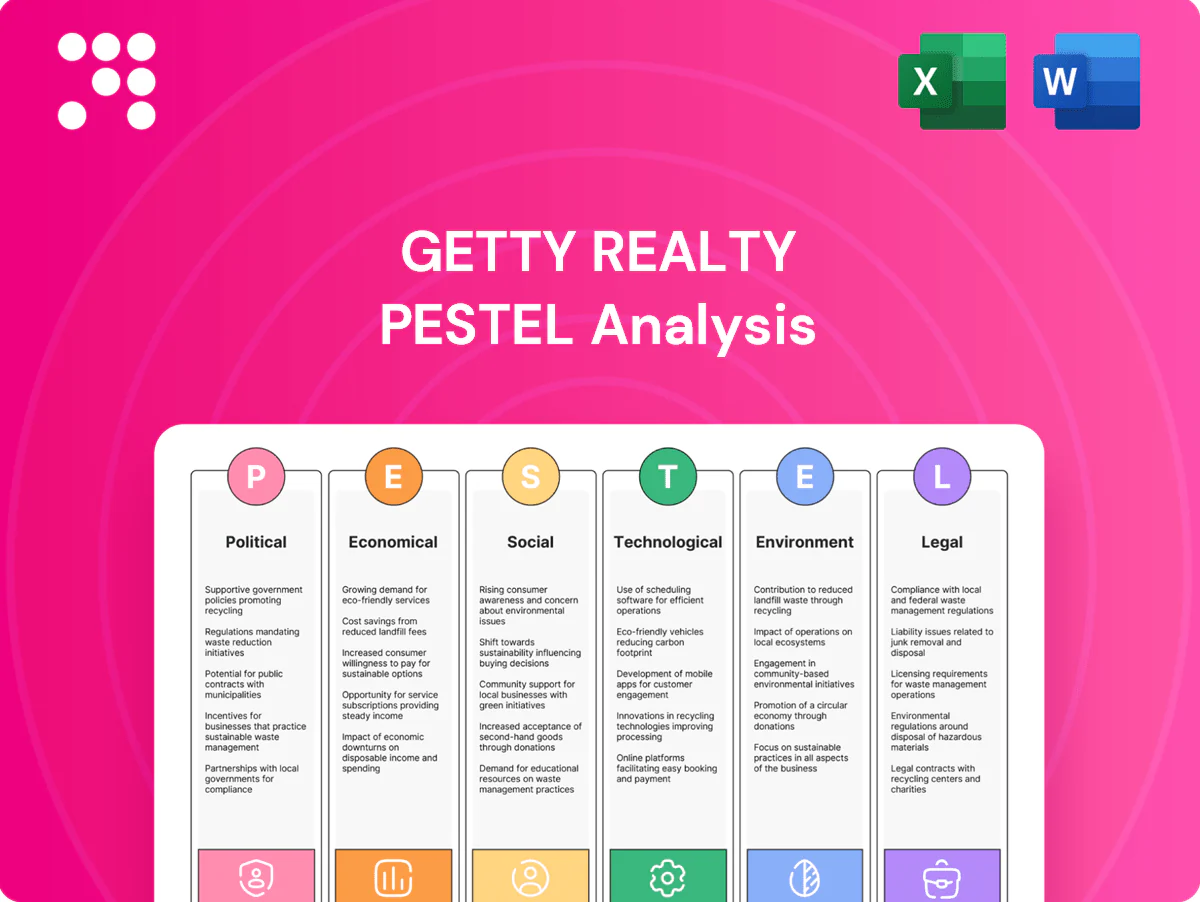
Getty Realty PESTLE Analysis

Your Shortcut to Market Insight Starts Here
Unlock strategic clarity with our Getty Realty PESTLE Analysis—three to five concise insights reveal how political, economic, social, technological, legal, and environmental forces shape the company's outlook. Perfect for investors and strategists, this brief highlights key risks and opportunities. Buy the full PESTLE to access the complete, actionable breakdown and ready-to-use charts.
Political factors

Fuel taxation and policy shifts
Federal fuel excise remains 18.4¢/gal for gasoline and 24.4¢/gal for diesel, while state levies vary widely, directly affecting site traffic, operator margins and Getty's rent coverage. Political momentum for carbon pricing and EV incentives through 2024–25 could erode gasoline volumes over time. Getty must track legislative calendars to adapt underwriting and escalators. Active policy engagement can reduce revenue shocks.
Infrastructure and EV incentives
Federal NEVI funding of roughly $5 billion and a federal tax credit covering up to 30% of commercial EV charging costs shift capital toward charger-equipped sites. Getty Realty assets positioned for grant-supported chargers can retain and grow tenant demand as charging corridors are prioritized by states. Timing alignment with incentive windows improves tenant credit profiles and lease stability.

Zoning and land-use priorities
Local governments control permits for fuel retail, car washes and convenience expansions, directly shaping Getty Realty (NYSE: GTY) redevelopment timelines. Pro-growth municipalities expedite entitlements and can compress redevelopment from years to months, while restrictive jurisdictions delay cash flows and capital recycling. Political appetite for mixed-use density unlocks alternative uses and higher land value, and consistent municipal relations materially reduce entitlement risk.

Energy security and geopolitical risks
Oil supply disruptions lift pump prices and drive volume volatility for tenants; US retail gasoline averaged about 3.54 per gallon in 2024 and sudden shocks raise short-term margin and foot-traffic variability. Policymaker tools such as the 2022 US SPR release of 180 million barrels show demand stabilization potential, reducing persistent drops in site throughput. Getty’s diversified tenant base across regions buffers localized political shocks; planning should assume recurring geopolitical risk cycles.
- Impact: higher pump prices → lower volumes
- Policy: SPR 2022 release 180 million barrels
- Benchmark: US avg gas 2024 ~3.54/gal
- Strategy: assume periodic geopolitical cycles
Public sentiment and lobbying power
Getty Realty (GTY) is a net-lease REIT and industry groups like Nareit shape siting, environmental rules and tax treatment; federal policy shifts such as the Inflation Reduction Act (roughly $369 billion for clean energy) can tighten operating conditions for fossil-fuel-linked tenants. Coordinated advocacy preserves redevelopment optionality, while a neutral landlord profile limits reputational and political risk.
- GTY: net-lease REIT
- IRA: $369 billion clean-energy funding
- Industry associations influence regulation
- Neutral profile reduces reputational exposure
Fuel taxes, IRA/NEVI EV funding and SPR shocks reshape fuel volumes, capex and rent risk
Federal/state fuel taxes (federal 18.4¢/gal gas, 24.4¢/gal diesel) and policy momentum for EVs/ carbon pricing (IRA ~$369B; NEVI ~$5B) shift volumes and capex needs; US avg gas 2024 ~$3.54/gal. SPR releases (180M barrels in 2022) and geopolitical shocks drive short-term throughput volatility. Active advocacy, permit relationships and charger grant alignment protect rent coverage and redevelopment timing.
| Factor | Metric | Implication |
|---|---|---|
| Fuel taxes | 18.4¢/24.4¢ | Rent coverage |
| EV policy | NEVI $5B | Capex shift |
| Gas price | $3.54/gal (2024) | Volume risk |
What is included in the product
 Detailed Word Document
Explores how Political, Economic, Social, Technological, Environmental and Legal forces uniquely affect Getty Realty, with data-backed trends and region-specific regulatory context to identify threats and opportunities. Delivered in clean, investor-ready format with forward-looking insights for strategic planning.

 Customizable Excel Spreadsheet
Concise, visually segmented Getty Realty PESTLE summary that relieves meeting prep pain—easy to drop into slides, annotate with local notes, and share across teams to streamline risk discussions and strategic alignment.
Economic factors

Interest rates and cost of capital
As a REIT, Getty Realty valuations and acquisitions are highly rate-sensitive; with the 10-year Treasury near 4.3% in mid‑2025, higher yields have compressed deal spreads and slowed external growth. Refinancing at higher rates increases interest expense, pressuring FFO and dividend capacity. Getty's active debt laddering and predominately fixed‑rate borrowings mitigate short‑term volatility.
Fuel demand and consumer mobility
Vehicle miles traveled recovered to near pre‑pandemic levels by 2023–24 per FHWA, supporting store traffic and in‑store sales that underpin ground‑lease rents. EIA shows U.S. motor gasoline use averaged about 9.0 million b/d in 2023, reflecting sustained mobility, while economic slowdowns can still compress discretionary spend and tenant coverage. Suburban commuting and logistics growth, plus Getty Realty’s corridor‑adjacent portfolio, help stabilize cash flows.

Inflation and rent escalators
Inflation (US CPI rose ~3.4% in 2024) supports Getty Realty’s CPI-linked or fixed-step rent escalators but raises tenants’ operating costs and default risk. Triple-net leases largely pass property taxes and insurance to tenants, preserving landlord cash flow. Underwriting must balance escalators with tenant credit durability; persistent inflation and 10-year Treasury ~4.3% (mid-2025) favor hard-asset valuation.

Credit markets and sale-leaseback demand
Tighter credit and a higher federal funds rate (5.25–5.50% through much of 2024) push operators toward sale-leasebacks, expanding Getty Realty’s deal pipeline as tenants seek liquidity. Getty can price risk and lock long leases at attractive cap rates, but counterparty vetting becomes critical in stressed cycles. Diversification across brands and regions lowers concentration risk and supports portfolio resilience.
- pipeline growth
- pricing power
- counterparty vetting
- brand/region diversification
Convenience retail mix shift
Foodservice and higher-margin categories lift tenant profitability and rent coverage, supporting Getty Realty’s portfolio occupancy above 98% in 2024 and underpinning stable rent collection. Macroeconomic pressure pushed baskets toward value SKUs as U.S. food-at-home inflation eased to roughly 3% y/y in 2024, favoring discount assortments. Sites with modern formats command stronger lease terms and lower vacancy risk; targeted capex to align with tenant repositioning improves NOI visibility.
- tenant profitability: higher-margin foodservice improves rent coverage
- macro: 2024 food-at-home inflation ~3% y/y shifts demand to value
- modern sites: better lease terms, lower vacancy
- capex: strategic investments increase NOI visibility
Fuel taxes, IRA/NEVI EV funding and SPR shocks reshape fuel volumes, capex and rent risk
Getty Realty is rate-sensitive: 10‑yr Treasury ~4.3% (mid‑2025) and Fed funds 5.25–5.50% in 2024 compress spreads and raise refinancing costs. CPI ~3.4% (2024) supports CPI-linked escalators but raises tenant cost stress; occupancy ~98% (2024) and U.S. motor gasoline ~9.0M b/d (2023) support store traffic and rent coverage.
| Metric | Value |
|---|---|
| 10‑yr Treasury | ~4.3% (mid‑2025) |
| Fed funds | 5.25–5.50% (2024) |
| CPI | ~3.4% (2024) |
| Occupancy | ~98% (2024) |
Preview the Actual Deliverable
Getty Realty PESTLE Analysis
The preview shown here is the exact Getty Realty PESTLE Analysis document you’ll receive after purchase — fully formatted, professionally structured, and ready to use. It contains the complete PESTLE assessment, insights, and supporting data as displayed. After checkout you’ll instantly download this exact file with no placeholders or changes.

Your Shortcut to Market Insight Starts Here
Unlock strategic clarity with our Getty Realty PESTLE Analysis—three to five concise insights reveal how political, economic, social, technological, legal, and environmental forces shape the company's outlook. Perfect for investors and strategists, this brief highlights key risks and opportunities. Buy the full PESTLE to access the complete, actionable breakdown and ready-to-use charts.
Political factors
Fuel taxation and policy shifts
Federal fuel excise remains 18.4¢/gal for gasoline and 24.4¢/gal for diesel, while state levies vary widely, directly affecting site traffic, operator margins and Getty's rent coverage. Political momentum for carbon pricing and EV incentives through 2024–25 could erode gasoline volumes over time. Getty must track legislative calendars to adapt underwriting and escalators. Active policy engagement can reduce revenue shocks.
Infrastructure and EV incentives
Federal NEVI funding of roughly $5 billion and a federal tax credit covering up to 30% of commercial EV charging costs shift capital toward charger-equipped sites. Getty Realty assets positioned for grant-supported chargers can retain and grow tenant demand as charging corridors are prioritized by states. Timing alignment with incentive windows improves tenant credit profiles and lease stability.
Zoning and land-use priorities
Local governments control permits for fuel retail, car washes and convenience expansions, directly shaping Getty Realty (NYSE: GTY) redevelopment timelines. Pro-growth municipalities expedite entitlements and can compress redevelopment from years to months, while restrictive jurisdictions delay cash flows and capital recycling. Political appetite for mixed-use density unlocks alternative uses and higher land value, and consistent municipal relations materially reduce entitlement risk.
Energy security and geopolitical risks
Oil supply disruptions lift pump prices and drive volume volatility for tenants; US retail gasoline averaged about 3.54 per gallon in 2024 and sudden shocks raise short-term margin and foot-traffic variability. Policymaker tools such as the 2022 US SPR release of 180 million barrels show demand stabilization potential, reducing persistent drops in site throughput. Getty’s diversified tenant base across regions buffers localized political shocks; planning should assume recurring geopolitical risk cycles.
- Impact: higher pump prices → lower volumes
- Policy: SPR 2022 release 180 million barrels
- Benchmark: US avg gas 2024 ~3.54/gal
- Strategy: assume periodic geopolitical cycles
Public sentiment and lobbying power
Getty Realty (GTY) is a net-lease REIT and industry groups like Nareit shape siting, environmental rules and tax treatment; federal policy shifts such as the Inflation Reduction Act (roughly $369 billion for clean energy) can tighten operating conditions for fossil-fuel-linked tenants. Coordinated advocacy preserves redevelopment optionality, while a neutral landlord profile limits reputational and political risk.
- GTY: net-lease REIT
- IRA: $369 billion clean-energy funding
- Industry associations influence regulation
- Neutral profile reduces reputational exposure
Fuel taxes, IRA/NEVI EV funding and SPR shocks reshape fuel volumes, capex and rent risk
Federal/state fuel taxes (federal 18.4¢/gal gas, 24.4¢/gal diesel) and policy momentum for EVs/ carbon pricing (IRA ~$369B; NEVI ~$5B) shift volumes and capex needs; US avg gas 2024 ~$3.54/gal. SPR releases (180M barrels in 2022) and geopolitical shocks drive short-term throughput volatility. Active advocacy, permit relationships and charger grant alignment protect rent coverage and redevelopment timing.
| Factor | Metric | Implication |
|---|---|---|
| Fuel taxes | 18.4¢/24.4¢ | Rent coverage |
| EV policy | NEVI $5B | Capex shift |
| Gas price | $3.54/gal (2024) | Volume risk |
What is included in the product
Detailed Word Document
Explores how Political, Economic, Social, Technological, Environmental and Legal forces uniquely affect Getty Realty, with data-backed trends and region-specific regulatory context to identify threats and opportunities. Delivered in clean, investor-ready format with forward-looking insights for strategic planning.
Customizable Excel Spreadsheet
Concise, visually segmented Getty Realty PESTLE summary that relieves meeting prep pain—easy to drop into slides, annotate with local notes, and share across teams to streamline risk discussions and strategic alignment.
Economic factors
Interest rates and cost of capital
As a REIT, Getty Realty valuations and acquisitions are highly rate-sensitive; with the 10-year Treasury near 4.3% in mid‑2025, higher yields have compressed deal spreads and slowed external growth. Refinancing at higher rates increases interest expense, pressuring FFO and dividend capacity. Getty's active debt laddering and predominately fixed‑rate borrowings mitigate short‑term volatility.
Fuel demand and consumer mobility
Vehicle miles traveled recovered to near pre‑pandemic levels by 2023–24 per FHWA, supporting store traffic and in‑store sales that underpin ground‑lease rents. EIA shows U.S. motor gasoline use averaged about 9.0 million b/d in 2023, reflecting sustained mobility, while economic slowdowns can still compress discretionary spend and tenant coverage. Suburban commuting and logistics growth, plus Getty Realty’s corridor‑adjacent portfolio, help stabilize cash flows.
Inflation and rent escalators
Inflation (US CPI rose ~3.4% in 2024) supports Getty Realty’s CPI-linked or fixed-step rent escalators but raises tenants’ operating costs and default risk. Triple-net leases largely pass property taxes and insurance to tenants, preserving landlord cash flow. Underwriting must balance escalators with tenant credit durability; persistent inflation and 10-year Treasury ~4.3% (mid-2025) favor hard-asset valuation.
Credit markets and sale-leaseback demand
Tighter credit and a higher federal funds rate (5.25–5.50% through much of 2024) push operators toward sale-leasebacks, expanding Getty Realty’s deal pipeline as tenants seek liquidity. Getty can price risk and lock long leases at attractive cap rates, but counterparty vetting becomes critical in stressed cycles. Diversification across brands and regions lowers concentration risk and supports portfolio resilience.
- pipeline growth
- pricing power
- counterparty vetting
- brand/region diversification
Convenience retail mix shift
Foodservice and higher-margin categories lift tenant profitability and rent coverage, supporting Getty Realty’s portfolio occupancy above 98% in 2024 and underpinning stable rent collection. Macroeconomic pressure pushed baskets toward value SKUs as U.S. food-at-home inflation eased to roughly 3% y/y in 2024, favoring discount assortments. Sites with modern formats command stronger lease terms and lower vacancy risk; targeted capex to align with tenant repositioning improves NOI visibility.
- tenant profitability: higher-margin foodservice improves rent coverage
- macro: 2024 food-at-home inflation ~3% y/y shifts demand to value
- modern sites: better lease terms, lower vacancy
- capex: strategic investments increase NOI visibility
Fuel taxes, IRA/NEVI EV funding and SPR shocks reshape fuel volumes, capex and rent risk
Getty Realty is rate-sensitive: 10‑yr Treasury ~4.3% (mid‑2025) and Fed funds 5.25–5.50% in 2024 compress spreads and raise refinancing costs. CPI ~3.4% (2024) supports CPI-linked escalators but raises tenant cost stress; occupancy ~98% (2024) and U.S. motor gasoline ~9.0M b/d (2023) support store traffic and rent coverage.
| Metric | Value |
|---|---|
| 10‑yr Treasury | ~4.3% (mid‑2025) |
| Fed funds | 5.25–5.50% (2024) |
| CPI | ~3.4% (2024) |
| Occupancy | ~98% (2024) |
Preview the Actual Deliverable
Getty Realty PESTLE Analysis
The preview shown here is the exact Getty Realty PESTLE Analysis document you’ll receive after purchase — fully formatted, professionally structured, and ready to use. It contains the complete PESTLE assessment, insights, and supporting data as displayed. After checkout you’ll instantly download this exact file with no placeholders or changes.
Description
Your Shortcut to Market Insight Starts Here
Unlock strategic clarity with our Getty Realty PESTLE Analysis—three to five concise insights reveal how political, economic, social, technological, legal, and environmental forces shape the company's outlook. Perfect for investors and strategists, this brief highlights key risks and opportunities. Buy the full PESTLE to access the complete, actionable breakdown and ready-to-use charts.
Political factors
Fuel taxation and policy shifts
Federal fuel excise remains 18.4¢/gal for gasoline and 24.4¢/gal for diesel, while state levies vary widely, directly affecting site traffic, operator margins and Getty's rent coverage. Political momentum for carbon pricing and EV incentives through 2024–25 could erode gasoline volumes over time. Getty must track legislative calendars to adapt underwriting and escalators. Active policy engagement can reduce revenue shocks.
Infrastructure and EV incentives
Federal NEVI funding of roughly $5 billion and a federal tax credit covering up to 30% of commercial EV charging costs shift capital toward charger-equipped sites. Getty Realty assets positioned for grant-supported chargers can retain and grow tenant demand as charging corridors are prioritized by states. Timing alignment with incentive windows improves tenant credit profiles and lease stability.
Zoning and land-use priorities
Local governments control permits for fuel retail, car washes and convenience expansions, directly shaping Getty Realty (NYSE: GTY) redevelopment timelines. Pro-growth municipalities expedite entitlements and can compress redevelopment from years to months, while restrictive jurisdictions delay cash flows and capital recycling. Political appetite for mixed-use density unlocks alternative uses and higher land value, and consistent municipal relations materially reduce entitlement risk.
Energy security and geopolitical risks
Oil supply disruptions lift pump prices and drive volume volatility for tenants; US retail gasoline averaged about 3.54 per gallon in 2024 and sudden shocks raise short-term margin and foot-traffic variability. Policymaker tools such as the 2022 US SPR release of 180 million barrels show demand stabilization potential, reducing persistent drops in site throughput. Getty’s diversified tenant base across regions buffers localized political shocks; planning should assume recurring geopolitical risk cycles.
- Impact: higher pump prices → lower volumes
- Policy: SPR 2022 release 180 million barrels
- Benchmark: US avg gas 2024 ~3.54/gal
- Strategy: assume periodic geopolitical cycles
Public sentiment and lobbying power
Getty Realty (GTY) is a net-lease REIT and industry groups like Nareit shape siting, environmental rules and tax treatment; federal policy shifts such as the Inflation Reduction Act (roughly $369 billion for clean energy) can tighten operating conditions for fossil-fuel-linked tenants. Coordinated advocacy preserves redevelopment optionality, while a neutral landlord profile limits reputational and political risk.
- GTY: net-lease REIT
- IRA: $369 billion clean-energy funding
- Industry associations influence regulation
- Neutral profile reduces reputational exposure
Fuel taxes, IRA/NEVI EV funding and SPR shocks reshape fuel volumes, capex and rent risk
Federal/state fuel taxes (federal 18.4¢/gal gas, 24.4¢/gal diesel) and policy momentum for EVs/ carbon pricing (IRA ~$369B; NEVI ~$5B) shift volumes and capex needs; US avg gas 2024 ~$3.54/gal. SPR releases (180M barrels in 2022) and geopolitical shocks drive short-term throughput volatility. Active advocacy, permit relationships and charger grant alignment protect rent coverage and redevelopment timing.
| Factor | Metric | Implication |
|---|---|---|
| Fuel taxes | 18.4¢/24.4¢ | Rent coverage |
| EV policy | NEVI $5B | Capex shift |
| Gas price | $3.54/gal (2024) | Volume risk |
What is included in the product
Detailed Word Document
Explores how Political, Economic, Social, Technological, Environmental and Legal forces uniquely affect Getty Realty, with data-backed trends and region-specific regulatory context to identify threats and opportunities. Delivered in clean, investor-ready format with forward-looking insights for strategic planning.
Customizable Excel Spreadsheet
Concise, visually segmented Getty Realty PESTLE summary that relieves meeting prep pain—easy to drop into slides, annotate with local notes, and share across teams to streamline risk discussions and strategic alignment.
Economic factors
Interest rates and cost of capital
As a REIT, Getty Realty valuations and acquisitions are highly rate-sensitive; with the 10-year Treasury near 4.3% in mid‑2025, higher yields have compressed deal spreads and slowed external growth. Refinancing at higher rates increases interest expense, pressuring FFO and dividend capacity. Getty's active debt laddering and predominately fixed‑rate borrowings mitigate short‑term volatility.
Fuel demand and consumer mobility
Vehicle miles traveled recovered to near pre‑pandemic levels by 2023–24 per FHWA, supporting store traffic and in‑store sales that underpin ground‑lease rents. EIA shows U.S. motor gasoline use averaged about 9.0 million b/d in 2023, reflecting sustained mobility, while economic slowdowns can still compress discretionary spend and tenant coverage. Suburban commuting and logistics growth, plus Getty Realty’s corridor‑adjacent portfolio, help stabilize cash flows.
Inflation and rent escalators
Inflation (US CPI rose ~3.4% in 2024) supports Getty Realty’s CPI-linked or fixed-step rent escalators but raises tenants’ operating costs and default risk. Triple-net leases largely pass property taxes and insurance to tenants, preserving landlord cash flow. Underwriting must balance escalators with tenant credit durability; persistent inflation and 10-year Treasury ~4.3% (mid-2025) favor hard-asset valuation.
Credit markets and sale-leaseback demand
Tighter credit and a higher federal funds rate (5.25–5.50% through much of 2024) push operators toward sale-leasebacks, expanding Getty Realty’s deal pipeline as tenants seek liquidity. Getty can price risk and lock long leases at attractive cap rates, but counterparty vetting becomes critical in stressed cycles. Diversification across brands and regions lowers concentration risk and supports portfolio resilience.
- pipeline growth
- pricing power
- counterparty vetting
- brand/region diversification
Convenience retail mix shift
Foodservice and higher-margin categories lift tenant profitability and rent coverage, supporting Getty Realty’s portfolio occupancy above 98% in 2024 and underpinning stable rent collection. Macroeconomic pressure pushed baskets toward value SKUs as U.S. food-at-home inflation eased to roughly 3% y/y in 2024, favoring discount assortments. Sites with modern formats command stronger lease terms and lower vacancy risk; targeted capex to align with tenant repositioning improves NOI visibility.
- tenant profitability: higher-margin foodservice improves rent coverage
- macro: 2024 food-at-home inflation ~3% y/y shifts demand to value
- modern sites: better lease terms, lower vacancy
- capex: strategic investments increase NOI visibility
Fuel taxes, IRA/NEVI EV funding and SPR shocks reshape fuel volumes, capex and rent risk
Getty Realty is rate-sensitive: 10‑yr Treasury ~4.3% (mid‑2025) and Fed funds 5.25–5.50% in 2024 compress spreads and raise refinancing costs. CPI ~3.4% (2024) supports CPI-linked escalators but raises tenant cost stress; occupancy ~98% (2024) and U.S. motor gasoline ~9.0M b/d (2023) support store traffic and rent coverage.
| Metric | Value |
|---|---|
| 10‑yr Treasury | ~4.3% (mid‑2025) |
| Fed funds | 5.25–5.50% (2024) |
| CPI | ~3.4% (2024) |
| Occupancy | ~98% (2024) |
Preview the Actual Deliverable
Getty Realty PESTLE Analysis
The preview shown here is the exact Getty Realty PESTLE Analysis document you’ll receive after purchase — fully formatted, professionally structured, and ready to use. It contains the complete PESTLE assessment, insights, and supporting data as displayed. After checkout you’ll instantly download this exact file with no placeholders or changes.











