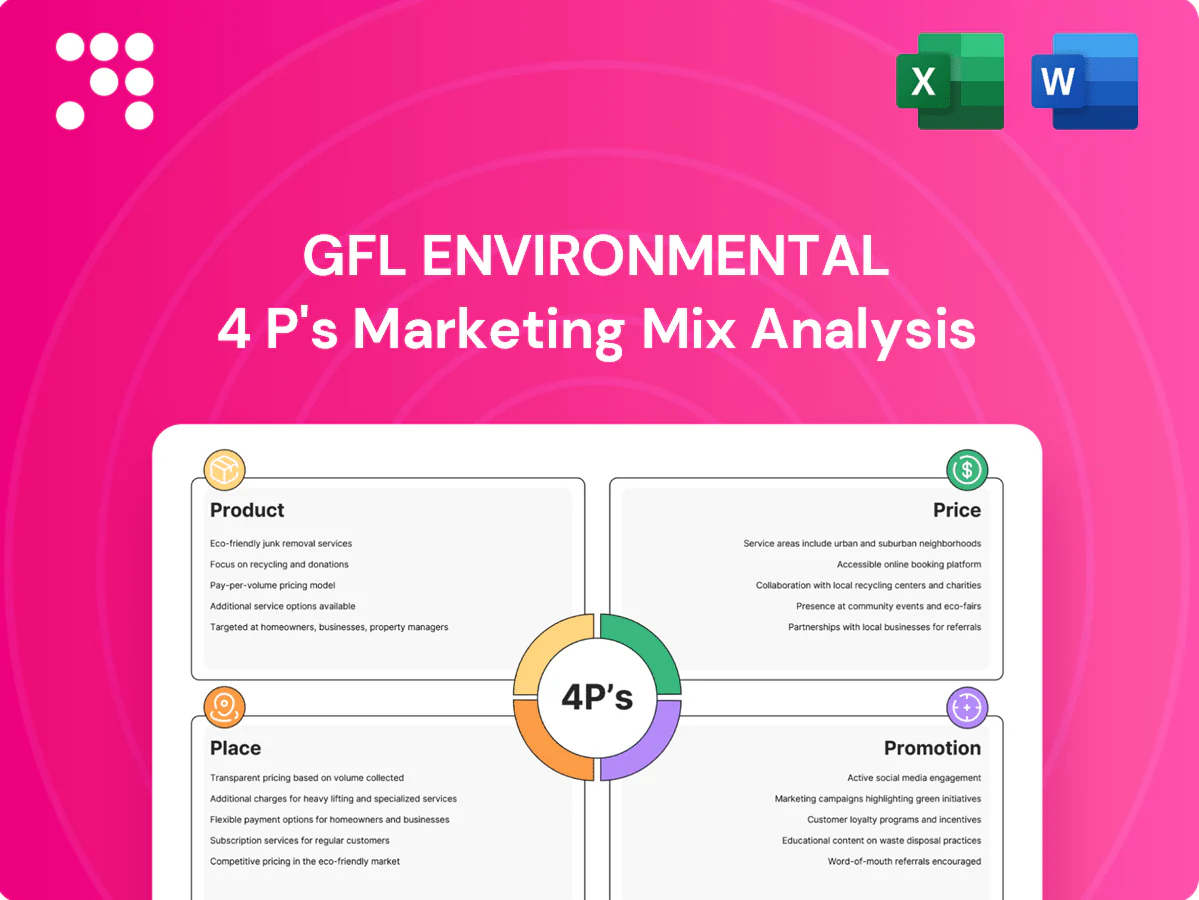
GFL Environmental Marketing Mix

Ready-Made Marketing Analysis, Ready to Use
Discover how GFL Environmental's product offerings, pricing architecture, distribution channels and promotional mix combine to drive growth. This preview highlights key tactics—unlock the full 4Ps Marketing Mix Analysis for editable slides, data-backed insights, and strategic recommendations. Save hours and apply professional templates instantly.
Product

Integrated waste and recycling services
Integrated non-hazardous solid waste services cover curbside collection, transfer, MRF processing and landfill disposal, packaged modularly for municipal, residential, commercial and industrial clients. GFL reported CA$5.6B revenue and ~24,000 employees (2023-24), emphasizing reliability, safety and regulatory compliance. Value-adds include diversion tracking, contamination reduction initiatives and operational reporting to boost recycling rates and lower costs.
Recycling and materials recovery
MRF operations process fiber, plastics, metals and glass using optical and AI sorting, lifting recovery rates into the 70–90% range per 2024 industry reports. Offerings include contamination audits and education that improve feedstock quality and reduce residue rates. 2024 commodity market insights tightened bale pricing and inform client negotiations. The value proposition is measurable landfill diversion, circularity support and ESG outcomes.

Organics and sustainability solutions
Organics collection, composting and anaerobic digestion reduce landfill methane and capture biogas for energy; food waste alone is estimated by the FAO to account for about 8–10% of global GHGs. Programs such as green bins, food-waste capture and yard-waste processing create landfill-diversion credits and produce soil-amendment outputs (compost, digestate) while supporting municipal zero-waste and corporate sustainability targets.

Liquid waste management
Soil remediation and infrastructure services
GFLs soil remediation and infrastructure services provide excavation, soil testing, treatment and beneficial reuse to support construction and brownfield projects; on-site and off-site remediation meet regulatory thresholds, reducing liability and accelerating permits. Integration with GFL hauling and disposal streamlines timelines and improves cost transparency, lowering project risk and TCO.
Modular non-hazardous waste suites drive diversion, compliance and lower TCO
GFL bundles curbside, MRF, organics, liquid waste and remediation into modular non-hazardous waste product suites—driving diversion, compliance and ESG outcomes. 2023–24 revenue CA$5.6B with ~24,000 employees; MRF recovery 70–90% (2024); organics cut ~8–10% GHG contribution (FAO). Integrated hauling/remediation lowers TCO and accelerates permits.
| Metric | Value |
|---|---|
| Revenue (2023–24) | CA$5.6B |
| Employees | ~24,000 |
| MRF recovery (2024) | 70–90% |
| Vacuum truck capacity | 1,000–6,000 gal |
| RCRA manifest retention | 3 years |
| Food waste GHG share (FAO) | 8–10% |
What is included in the product
 Detailed Word Document
Delivering a company-specific deep dive into GFL Environmental’s Product, Price, Place, and Promotion strategies, this analysis maps service offerings, pricing framework, distribution channels, and communications tactics against competitive and regulatory contexts. Ideal for managers and consultants, it uses real practices, data, and examples to support benchmarking, strategy audits, and client presentations.

 Customizable Excel Spreadsheet
Condenses GFL Environmental’s 4Ps into a high-level, at-a-glance view that relieves analysis overload and accelerates leadership alignment, while being easily customizable for presentations, comparisons, or quick decision-making.
Place

North American network footprint
GFL’s North American footprint spans multiple Canadian provinces and U.S. states with dense regional clusters, operating more than 500 facilities including transfer stations, MRFs, landfills, organics sites and liquid processing plants; the company reported roughly 20,000 employees across its network in 2024. Geographic density shortens haul distances and improves route efficiency, supporting lower per-ton collection costs and faster turnaround. Coverage enables multi-site enterprise contracts and continuity for municipal services across regions.
Hub-and-spoke logistics
Local collection routes feed regional transfer and processing hubs, concentrating volume to improve sorting and recycling yields; GFL reported CAD 4.16 billion revenue in FY2024, supporting an extensive network of assets. The asset mix — automated side-loaders, roll-offs, front-loaders and vacuum units — enables diversified service lines. Real-time routing and telematics optimize utilization and tighten service windows. This hub-and-spoke structure increases throughput and lowers cost-to-serve.

On-site customer services
GFL deploys container placement, compactors and specialty equipment at customer sites, with field teams handling scheduled pickups and responsive overflow to minimize downtime. Industrial clients receive tailored manifests and staged areas to streamline compliance; GFL reported CAD 7.6 billion revenue in FY2023 and employs over 20,000 staff, underpinning this proximity model. This on-site approach boosts convenience and regulatory adherence for large accounts.

Digital channels and self-service
GFLs digital portals and mobile tools enable service requests, schedule changes and payments, while diversion dashboards and invoice histories give customers on-demand visibility; industry data (Salesforce Service 2024) shows roughly 70% of customers prefer digital self-service and firms report up to 30% fewer service contacts after digital adoption. APIs and EDI enable direct integration with procurement and AP systems, reducing friction and improving uptime.
- Digital adoption: ~70% prefer self-service (Salesforce 2024)
- Service contact reduction: up to 30% (industry 2024)
- Capabilities: portals, dashboards, APIs/EDI
Acquisition-led market entry
Acquisition-led market entry leverages tuck-ins and platform deals to expand routes and permits in priority markets, with playbooks that rapidly integrate systems, branding and safety standards. Local teams and assets are preserved to maintain community relationships, accelerating scale while retaining market-specific expertise.
- Tuck-ins expand routes
- Playbooks unify ops
- Local teams retained
- Faster scale, local expertise
500+ facilities, CAD 4.16B revenue and 20,000 staff drive hub-and-spoke efficiency
GFL's dense North American footprint (500+ facilities) uses hub-and-spoke routing to cut haul distances and lower per-ton costs; FY2024 revenue CAD 4.16B, ~20,000 employees. Local assets and tuck-in acquisitions preserve community ties while enabling scale. Digital portals, APIs and telematics improve utilization and reduce service contacts.
| Metric | Value |
|---|---|
| Facilities | 500+ |
| FY2024 Revenue | CAD 4.16B |
| Employees | ~20,000 |
Same Document Delivered
GFL Environmental 4P's Marketing Mix Analysis
The GFL Environmental 4P's Marketing Mix Analysis you see here is the actual document you’ll receive instantly after purchase—no surprises. It’s a complete, editable review of Product, Price, Place and Promotion tailored for GFL. Download and use immediately for strategy or presentations. Buy with confidence.

Ready-Made Marketing Analysis, Ready to Use
Discover how GFL Environmental's product offerings, pricing architecture, distribution channels and promotional mix combine to drive growth. This preview highlights key tactics—unlock the full 4Ps Marketing Mix Analysis for editable slides, data-backed insights, and strategic recommendations. Save hours and apply professional templates instantly.
Product
Integrated waste and recycling services
Integrated non-hazardous solid waste services cover curbside collection, transfer, MRF processing and landfill disposal, packaged modularly for municipal, residential, commercial and industrial clients. GFL reported CA$5.6B revenue and ~24,000 employees (2023-24), emphasizing reliability, safety and regulatory compliance. Value-adds include diversion tracking, contamination reduction initiatives and operational reporting to boost recycling rates and lower costs.
Recycling and materials recovery
MRF operations process fiber, plastics, metals and glass using optical and AI sorting, lifting recovery rates into the 70–90% range per 2024 industry reports. Offerings include contamination audits and education that improve feedstock quality and reduce residue rates. 2024 commodity market insights tightened bale pricing and inform client negotiations. The value proposition is measurable landfill diversion, circularity support and ESG outcomes.
Organics and sustainability solutions
Organics collection, composting and anaerobic digestion reduce landfill methane and capture biogas for energy; food waste alone is estimated by the FAO to account for about 8–10% of global GHGs. Programs such as green bins, food-waste capture and yard-waste processing create landfill-diversion credits and produce soil-amendment outputs (compost, digestate) while supporting municipal zero-waste and corporate sustainability targets.
Liquid waste management
Soil remediation and infrastructure services
GFLs soil remediation and infrastructure services provide excavation, soil testing, treatment and beneficial reuse to support construction and brownfield projects; on-site and off-site remediation meet regulatory thresholds, reducing liability and accelerating permits. Integration with GFL hauling and disposal streamlines timelines and improves cost transparency, lowering project risk and TCO.
Modular non-hazardous waste suites drive diversion, compliance and lower TCO
GFL bundles curbside, MRF, organics, liquid waste and remediation into modular non-hazardous waste product suites—driving diversion, compliance and ESG outcomes. 2023–24 revenue CA$5.6B with ~24,000 employees; MRF recovery 70–90% (2024); organics cut ~8–10% GHG contribution (FAO). Integrated hauling/remediation lowers TCO and accelerates permits.
| Metric | Value |
|---|---|
| Revenue (2023–24) | CA$5.6B |
| Employees | ~24,000 |
| MRF recovery (2024) | 70–90% |
| Vacuum truck capacity | 1,000–6,000 gal |
| RCRA manifest retention | 3 years |
| Food waste GHG share (FAO) | 8–10% |
What is included in the product
Detailed Word Document
Delivering a company-specific deep dive into GFL Environmental’s Product, Price, Place, and Promotion strategies, this analysis maps service offerings, pricing framework, distribution channels, and communications tactics against competitive and regulatory contexts. Ideal for managers and consultants, it uses real practices, data, and examples to support benchmarking, strategy audits, and client presentations.
Customizable Excel Spreadsheet
Condenses GFL Environmental’s 4Ps into a high-level, at-a-glance view that relieves analysis overload and accelerates leadership alignment, while being easily customizable for presentations, comparisons, or quick decision-making.
Place
North American network footprint
GFL’s North American footprint spans multiple Canadian provinces and U.S. states with dense regional clusters, operating more than 500 facilities including transfer stations, MRFs, landfills, organics sites and liquid processing plants; the company reported roughly 20,000 employees across its network in 2024. Geographic density shortens haul distances and improves route efficiency, supporting lower per-ton collection costs and faster turnaround. Coverage enables multi-site enterprise contracts and continuity for municipal services across regions.
Hub-and-spoke logistics
Local collection routes feed regional transfer and processing hubs, concentrating volume to improve sorting and recycling yields; GFL reported CAD 4.16 billion revenue in FY2024, supporting an extensive network of assets. The asset mix — automated side-loaders, roll-offs, front-loaders and vacuum units — enables diversified service lines. Real-time routing and telematics optimize utilization and tighten service windows. This hub-and-spoke structure increases throughput and lowers cost-to-serve.
On-site customer services
GFL deploys container placement, compactors and specialty equipment at customer sites, with field teams handling scheduled pickups and responsive overflow to minimize downtime. Industrial clients receive tailored manifests and staged areas to streamline compliance; GFL reported CAD 7.6 billion revenue in FY2023 and employs over 20,000 staff, underpinning this proximity model. This on-site approach boosts convenience and regulatory adherence for large accounts.
Digital channels and self-service
GFLs digital portals and mobile tools enable service requests, schedule changes and payments, while diversion dashboards and invoice histories give customers on-demand visibility; industry data (Salesforce Service 2024) shows roughly 70% of customers prefer digital self-service and firms report up to 30% fewer service contacts after digital adoption. APIs and EDI enable direct integration with procurement and AP systems, reducing friction and improving uptime.
- Digital adoption: ~70% prefer self-service (Salesforce 2024)
- Service contact reduction: up to 30% (industry 2024)
- Capabilities: portals, dashboards, APIs/EDI
Acquisition-led market entry
Acquisition-led market entry leverages tuck-ins and platform deals to expand routes and permits in priority markets, with playbooks that rapidly integrate systems, branding and safety standards. Local teams and assets are preserved to maintain community relationships, accelerating scale while retaining market-specific expertise.
- Tuck-ins expand routes
- Playbooks unify ops
- Local teams retained
- Faster scale, local expertise
500+ facilities, CAD 4.16B revenue and 20,000 staff drive hub-and-spoke efficiency
GFL's dense North American footprint (500+ facilities) uses hub-and-spoke routing to cut haul distances and lower per-ton costs; FY2024 revenue CAD 4.16B, ~20,000 employees. Local assets and tuck-in acquisitions preserve community ties while enabling scale. Digital portals, APIs and telematics improve utilization and reduce service contacts.
| Metric | Value |
|---|---|
| Facilities | 500+ |
| FY2024 Revenue | CAD 4.16B |
| Employees | ~20,000 |
Same Document Delivered
GFL Environmental 4P's Marketing Mix Analysis
The GFL Environmental 4P's Marketing Mix Analysis you see here is the actual document you’ll receive instantly after purchase—no surprises. It’s a complete, editable review of Product, Price, Place and Promotion tailored for GFL. Download and use immediately for strategy or presentations. Buy with confidence.
Original: $10.00
-65%$10.00
$3.50Description
Ready-Made Marketing Analysis, Ready to Use
Discover how GFL Environmental's product offerings, pricing architecture, distribution channels and promotional mix combine to drive growth. This preview highlights key tactics—unlock the full 4Ps Marketing Mix Analysis for editable slides, data-backed insights, and strategic recommendations. Save hours and apply professional templates instantly.
Product
Integrated waste and recycling services
Integrated non-hazardous solid waste services cover curbside collection, transfer, MRF processing and landfill disposal, packaged modularly for municipal, residential, commercial and industrial clients. GFL reported CA$5.6B revenue and ~24,000 employees (2023-24), emphasizing reliability, safety and regulatory compliance. Value-adds include diversion tracking, contamination reduction initiatives and operational reporting to boost recycling rates and lower costs.
Recycling and materials recovery
MRF operations process fiber, plastics, metals and glass using optical and AI sorting, lifting recovery rates into the 70–90% range per 2024 industry reports. Offerings include contamination audits and education that improve feedstock quality and reduce residue rates. 2024 commodity market insights tightened bale pricing and inform client negotiations. The value proposition is measurable landfill diversion, circularity support and ESG outcomes.
Organics and sustainability solutions
Organics collection, composting and anaerobic digestion reduce landfill methane and capture biogas for energy; food waste alone is estimated by the FAO to account for about 8–10% of global GHGs. Programs such as green bins, food-waste capture and yard-waste processing create landfill-diversion credits and produce soil-amendment outputs (compost, digestate) while supporting municipal zero-waste and corporate sustainability targets.
Liquid waste management
Soil remediation and infrastructure services
GFLs soil remediation and infrastructure services provide excavation, soil testing, treatment and beneficial reuse to support construction and brownfield projects; on-site and off-site remediation meet regulatory thresholds, reducing liability and accelerating permits. Integration with GFL hauling and disposal streamlines timelines and improves cost transparency, lowering project risk and TCO.
Modular non-hazardous waste suites drive diversion, compliance and lower TCO
GFL bundles curbside, MRF, organics, liquid waste and remediation into modular non-hazardous waste product suites—driving diversion, compliance and ESG outcomes. 2023–24 revenue CA$5.6B with ~24,000 employees; MRF recovery 70–90% (2024); organics cut ~8–10% GHG contribution (FAO). Integrated hauling/remediation lowers TCO and accelerates permits.
| Metric | Value |
|---|---|
| Revenue (2023–24) | CA$5.6B |
| Employees | ~24,000 |
| MRF recovery (2024) | 70–90% |
| Vacuum truck capacity | 1,000–6,000 gal |
| RCRA manifest retention | 3 years |
| Food waste GHG share (FAO) | 8–10% |
What is included in the product
Detailed Word Document
Delivering a company-specific deep dive into GFL Environmental’s Product, Price, Place, and Promotion strategies, this analysis maps service offerings, pricing framework, distribution channels, and communications tactics against competitive and regulatory contexts. Ideal for managers and consultants, it uses real practices, data, and examples to support benchmarking, strategy audits, and client presentations.
Customizable Excel Spreadsheet
Condenses GFL Environmental’s 4Ps into a high-level, at-a-glance view that relieves analysis overload and accelerates leadership alignment, while being easily customizable for presentations, comparisons, or quick decision-making.
Place
North American network footprint
GFL’s North American footprint spans multiple Canadian provinces and U.S. states with dense regional clusters, operating more than 500 facilities including transfer stations, MRFs, landfills, organics sites and liquid processing plants; the company reported roughly 20,000 employees across its network in 2024. Geographic density shortens haul distances and improves route efficiency, supporting lower per-ton collection costs and faster turnaround. Coverage enables multi-site enterprise contracts and continuity for municipal services across regions.
Hub-and-spoke logistics
Local collection routes feed regional transfer and processing hubs, concentrating volume to improve sorting and recycling yields; GFL reported CAD 4.16 billion revenue in FY2024, supporting an extensive network of assets. The asset mix — automated side-loaders, roll-offs, front-loaders and vacuum units — enables diversified service lines. Real-time routing and telematics optimize utilization and tighten service windows. This hub-and-spoke structure increases throughput and lowers cost-to-serve.
On-site customer services
GFL deploys container placement, compactors and specialty equipment at customer sites, with field teams handling scheduled pickups and responsive overflow to minimize downtime. Industrial clients receive tailored manifests and staged areas to streamline compliance; GFL reported CAD 7.6 billion revenue in FY2023 and employs over 20,000 staff, underpinning this proximity model. This on-site approach boosts convenience and regulatory adherence for large accounts.
Digital channels and self-service
GFLs digital portals and mobile tools enable service requests, schedule changes and payments, while diversion dashboards and invoice histories give customers on-demand visibility; industry data (Salesforce Service 2024) shows roughly 70% of customers prefer digital self-service and firms report up to 30% fewer service contacts after digital adoption. APIs and EDI enable direct integration with procurement and AP systems, reducing friction and improving uptime.
- Digital adoption: ~70% prefer self-service (Salesforce 2024)
- Service contact reduction: up to 30% (industry 2024)
- Capabilities: portals, dashboards, APIs/EDI
Acquisition-led market entry
Acquisition-led market entry leverages tuck-ins and platform deals to expand routes and permits in priority markets, with playbooks that rapidly integrate systems, branding and safety standards. Local teams and assets are preserved to maintain community relationships, accelerating scale while retaining market-specific expertise.
- Tuck-ins expand routes
- Playbooks unify ops
- Local teams retained
- Faster scale, local expertise
500+ facilities, CAD 4.16B revenue and 20,000 staff drive hub-and-spoke efficiency
GFL's dense North American footprint (500+ facilities) uses hub-and-spoke routing to cut haul distances and lower per-ton costs; FY2024 revenue CAD 4.16B, ~20,000 employees. Local assets and tuck-in acquisitions preserve community ties while enabling scale. Digital portals, APIs and telematics improve utilization and reduce service contacts.
| Metric | Value |
|---|---|
| Facilities | 500+ |
| FY2024 Revenue | CAD 4.16B |
| Employees | ~20,000 |
Same Document Delivered
GFL Environmental 4P's Marketing Mix Analysis
The GFL Environmental 4P's Marketing Mix Analysis you see here is the actual document you’ll receive instantly after purchase—no surprises. It’s a complete, editable review of Product, Price, Place and Promotion tailored for GFL. Download and use immediately for strategy or presentations. Buy with confidence.











