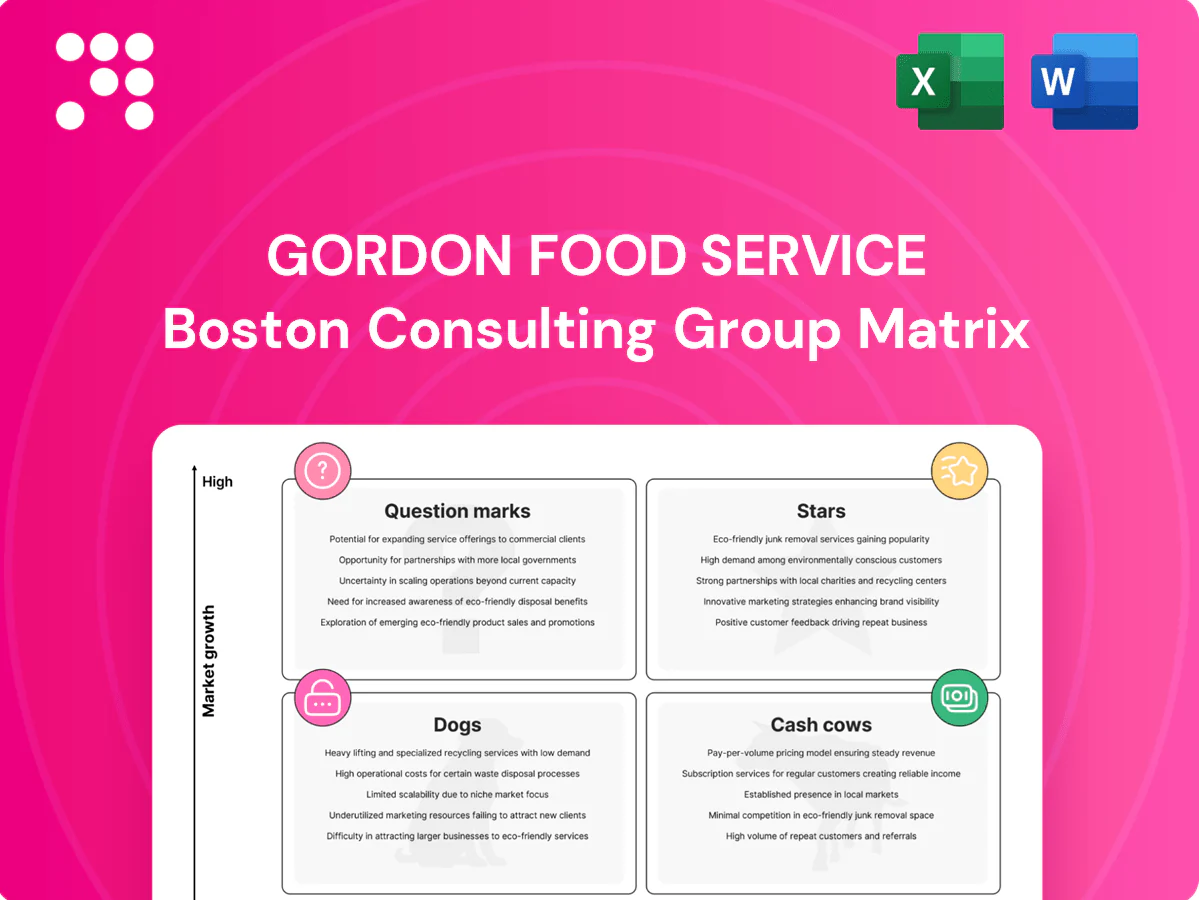
Gordon Food Service Boston Consulting Group Matrix

Actionable Strategy Starts Here
Gordon Food Service’s sneak peek shows where key product lines might sit in the BCG Matrix, but the full picture matters — which SKUs are Stars, which are dragging margin, and where to double down. Buy the complete BCG Matrix for quadrant-by-quadrant placements, crisp data-backed recommendations, and a ready-to-use Word report plus an Excel summary. Skip the guesswork; get strategic clarity and a practical roadmap to allocate capital and boost returns now.
Stars

Broadline distribution leadership
Broadline distribution leadership: Gordon Food Service holds a leading position across the U.S. and Canada with strong customer stickiness driven by long-term contracts and route density. The market continues expanding as independents rebound post-pandemic and contract feeders consolidate, supporting volume growth. Capital-intensive needs for fleet, cold chain, and inventory are high, but invested returns have broadly matched capital deployment. Continue investing to lock in routing density and service levels.
Private label portfolio
Private label portfolio is a Star for Gordon Food Service as own brands drive margin and operator loyalty in a cost-conscious market; GFS can expand assortment breadth and upgrade quality to lead the basket. Marketing and QA investments remain elevated but recent share gains in foodservice private label validate the spend. Hold the line on margin and scale where SKU velocity is strongest.

Digital ordering & e-commerce
Adoption of digital ordering and e-commerce in foodservice rose ~35% year-over-year in 2024 as kitchens shifted to mobile, 24/7 replenishment workflows. Gordon Food Service leverages embedded workflow and pricing to capture high-growth share and strengthen upsell despite heavy UX, integration and data spending. Cash burn is meaningful but defends share; prioritize features that collapse order-to-delivery time to accelerate ROI.

Healthcare & education channels
Healthcare and education channels deliver stable volumes with rising demand for specialty diets and regulatory compliance; in 2024 GFS leverages credibility and long-term contracts to capture high share positions across 6,000+ US hospitals and thousands of school districts. These accounts need menu engineering and strict spec management, adding cost but enabling scalable, long-lived anchor relationships.
- Stable volume + specialty diet growth (2024)
- High share via contracts and credibility
- Requires menu support and strict specs — not cheap
- Worth the spend: scalable, long-lived anchors
Fresh produce & value-added
Operators want frequent turns and prepped SKUs; produce demand climbed about 5% in 2024, and GFS’s cold chain and QA are driving share gains in fresh and value-added lines, leveraging a reported roughly $16B company scale to expand processing capacity.
Costs run hot—industry shrink averages near 6% and throughput pressures raise COGS—but growth offsets margin drag; targeted investment in processing and category management is required to keep the flywheel spinning.
- category_growth_2024: +5%
- industry_shrink: ~6%
- GFS_scale_2024: ~$16B
- priority: invest_processing & category_management
Broadline + private label boost share; 35% e-commerce lift — invest in routing density, QA, digital
GFS Stars: broadline distribution and private label drive share with heavy capex but strong returns; e‑commerce adoption rose ~35% YoY (2024) boosting ARPU; produce/value‑added up ~5% (2024) and healthcare anchors >6,000 hospitals. Invest to protect routing density, QA, and digital product features to accelerate ROI.
| Metric | 2024 |
|---|---|
| Company scale (revenue) | ~$16B |
| E‑commerce growth | +35% YoY |
| Produce/category growth | +5% |
| Hospitals served | >6,000 |
| Industry shrink | ~6% |
What is included in the product
 Detailed Word Document
BCG Matrix for Gordon Food Service: quadrant-by-quadrant analysis with invest, hold or divest recommendations and trend-driven risks.

 Customizable Excel Spreadsheet
One-page Gordon Food Service BCG Matrix mapping units to quadrants — fast clarity for portfolio decisions.
Cash Cows

Frozen & dry staples
Frozen and dry staples are mature, high-share cash cows for Gordon Food Service, supporting its roughly $14.6 billion 2023 revenue with predictable turns and steady demand. Scale buying and slotting efficiency drive stronger gross margins and lower carriage costs. Low promotional need means high cash conversion—milk the cash and keep service levels tight.
Non-food disposables & janitorial
Non-food disposables and janitorial are steady cash cows for Gordon Food Service, supporting the company’s reported ~$14.7 billion in 2023 sales and delivering predictable volume year-round. Private label penetration in disposables is high, roughly 50% in 2024, with minimal innovation cycles and stable unit economics. Routing these SKUs on existing deliveries keeps incremental cost very low and generates reliable cash to fund growth bets. Maintain assortment, push private label share, and negotiate hard upstream to preserve margin.

Route density in core regions
Midwest and Canadian lanes show high route density with utilization above 90% in 2024, keeping trucks full and schedules tight.
Fixed network costs are already absorbed, so incremental drops largely flow to operating profit, compressing incremental cost per stop.
Growth remains modest but share is entrenched; focus on protecting contracts, optimizing stops per route, and banking cash from strong margin contribution.

GFS Marketplace retail baseline
GFS Marketplace retail baseline sits as a Cash Cow: steady foot traffic from small businesses and the public with no surge, supporting consistent daily sales and a 2024 network of about 180 locations across North America that capture high local catchment share while keeping marketing spend low.
Stores operate under existing leases and staffed teams, generating reliable cash flow and EBITDA contribution that funds growth initiatives elsewhere; focus on optimizing product mix and loyalty programs rather than scaling marketing or new store capex.
- steady foot traffic, consistent daily sales
- ~180 stores (2024) with high local share
- low marketing spend, strong cash generation
- optimize mix and loyalty; avoid overspending
Dairy and center-of-plate proteins
Dairy and center-of-plate proteins act as cash cows for Gordon Food Service: commodity categories with scale advantages and repeat demand deliver steady volume and share even though margin per pound is modest; Gordon Food Service, a family-owned distributor with reported sales near $14 billion (2023), relies on predictable protein and dairy turnover to generate ongoing cash flow while growth stays limited.
- High-volume, low-margin supply
- Repeat institutional demand
- Predictable cash generation
- Procurement efficiency and waste control critical
Core staples and private label (~50%) drive $14.6B - protect share, optimize routes
Frozen/dry staples, disposables/janitorial, dairy/proteins and GFS Marketplace stores are Gordon Food Service cash cows, supporting ~14.6–14.7B revenue (2023) with high share, predictable volume and strong cash conversion; private label ~50% (2024), route utilization >90% (2024). Protect share, optimize routes and private label margins to fund growth.
| Category | 2023/24 Metric | Note |
|---|---|---|
| Revenue | $14.6–14.7B (2023) | Company-wide base |
| Stores | ~180 (2024) | Low marketing, steady sales |
| Private label | ~50% (2024) | High margin lift |
What You’re Viewing Is Included
Gordon Food Service BCG Matrix
The file you're previewing is the exact Gordon Food Service BCG Matrix report you'll receive after purchase. No watermarks, no demo content—just a fully formatted, ready-to-use analysis designed for strategic clarity. Buy once and download immediately; it's editable, printable, and presentation-ready. No surprises—just clean, expert work you can plug into planning or client decks.

Actionable Strategy Starts Here
Gordon Food Service’s sneak peek shows where key product lines might sit in the BCG Matrix, but the full picture matters — which SKUs are Stars, which are dragging margin, and where to double down. Buy the complete BCG Matrix for quadrant-by-quadrant placements, crisp data-backed recommendations, and a ready-to-use Word report plus an Excel summary. Skip the guesswork; get strategic clarity and a practical roadmap to allocate capital and boost returns now.
Stars
Broadline distribution leadership
Broadline distribution leadership: Gordon Food Service holds a leading position across the U.S. and Canada with strong customer stickiness driven by long-term contracts and route density. The market continues expanding as independents rebound post-pandemic and contract feeders consolidate, supporting volume growth. Capital-intensive needs for fleet, cold chain, and inventory are high, but invested returns have broadly matched capital deployment. Continue investing to lock in routing density and service levels.
Private label portfolio
Private label portfolio is a Star for Gordon Food Service as own brands drive margin and operator loyalty in a cost-conscious market; GFS can expand assortment breadth and upgrade quality to lead the basket. Marketing and QA investments remain elevated but recent share gains in foodservice private label validate the spend. Hold the line on margin and scale where SKU velocity is strongest.
Digital ordering & e-commerce
Adoption of digital ordering and e-commerce in foodservice rose ~35% year-over-year in 2024 as kitchens shifted to mobile, 24/7 replenishment workflows. Gordon Food Service leverages embedded workflow and pricing to capture high-growth share and strengthen upsell despite heavy UX, integration and data spending. Cash burn is meaningful but defends share; prioritize features that collapse order-to-delivery time to accelerate ROI.
Healthcare & education channels
Healthcare and education channels deliver stable volumes with rising demand for specialty diets and regulatory compliance; in 2024 GFS leverages credibility and long-term contracts to capture high share positions across 6,000+ US hospitals and thousands of school districts. These accounts need menu engineering and strict spec management, adding cost but enabling scalable, long-lived anchor relationships.
- Stable volume + specialty diet growth (2024)
- High share via contracts and credibility
- Requires menu support and strict specs — not cheap
- Worth the spend: scalable, long-lived anchors
Fresh produce & value-added
Operators want frequent turns and prepped SKUs; produce demand climbed about 5% in 2024, and GFS’s cold chain and QA are driving share gains in fresh and value-added lines, leveraging a reported roughly $16B company scale to expand processing capacity.
Costs run hot—industry shrink averages near 6% and throughput pressures raise COGS—but growth offsets margin drag; targeted investment in processing and category management is required to keep the flywheel spinning.
- category_growth_2024: +5%
- industry_shrink: ~6%
- GFS_scale_2024: ~$16B
- priority: invest_processing & category_management
Broadline + private label boost share; 35% e-commerce lift — invest in routing density, QA, digital
GFS Stars: broadline distribution and private label drive share with heavy capex but strong returns; e‑commerce adoption rose ~35% YoY (2024) boosting ARPU; produce/value‑added up ~5% (2024) and healthcare anchors >6,000 hospitals. Invest to protect routing density, QA, and digital product features to accelerate ROI.
| Metric | 2024 |
|---|---|
| Company scale (revenue) | ~$16B |
| E‑commerce growth | +35% YoY |
| Produce/category growth | +5% |
| Hospitals served | >6,000 |
| Industry shrink | ~6% |
What is included in the product
Detailed Word Document
BCG Matrix for Gordon Food Service: quadrant-by-quadrant analysis with invest, hold or divest recommendations and trend-driven risks.
Customizable Excel Spreadsheet
One-page Gordon Food Service BCG Matrix mapping units to quadrants — fast clarity for portfolio decisions.
Cash Cows
Frozen & dry staples
Frozen and dry staples are mature, high-share cash cows for Gordon Food Service, supporting its roughly $14.6 billion 2023 revenue with predictable turns and steady demand. Scale buying and slotting efficiency drive stronger gross margins and lower carriage costs. Low promotional need means high cash conversion—milk the cash and keep service levels tight.
Non-food disposables & janitorial
Non-food disposables and janitorial are steady cash cows for Gordon Food Service, supporting the company’s reported ~$14.7 billion in 2023 sales and delivering predictable volume year-round. Private label penetration in disposables is high, roughly 50% in 2024, with minimal innovation cycles and stable unit economics. Routing these SKUs on existing deliveries keeps incremental cost very low and generates reliable cash to fund growth bets. Maintain assortment, push private label share, and negotiate hard upstream to preserve margin.
Route density in core regions
Midwest and Canadian lanes show high route density with utilization above 90% in 2024, keeping trucks full and schedules tight.
Fixed network costs are already absorbed, so incremental drops largely flow to operating profit, compressing incremental cost per stop.
Growth remains modest but share is entrenched; focus on protecting contracts, optimizing stops per route, and banking cash from strong margin contribution.
GFS Marketplace retail baseline
GFS Marketplace retail baseline sits as a Cash Cow: steady foot traffic from small businesses and the public with no surge, supporting consistent daily sales and a 2024 network of about 180 locations across North America that capture high local catchment share while keeping marketing spend low.
Stores operate under existing leases and staffed teams, generating reliable cash flow and EBITDA contribution that funds growth initiatives elsewhere; focus on optimizing product mix and loyalty programs rather than scaling marketing or new store capex.
- steady foot traffic, consistent daily sales
- ~180 stores (2024) with high local share
- low marketing spend, strong cash generation
- optimize mix and loyalty; avoid overspending
Dairy and center-of-plate proteins
Dairy and center-of-plate proteins act as cash cows for Gordon Food Service: commodity categories with scale advantages and repeat demand deliver steady volume and share even though margin per pound is modest; Gordon Food Service, a family-owned distributor with reported sales near $14 billion (2023), relies on predictable protein and dairy turnover to generate ongoing cash flow while growth stays limited.
- High-volume, low-margin supply
- Repeat institutional demand
- Predictable cash generation
- Procurement efficiency and waste control critical
Core staples and private label (~50%) drive $14.6B - protect share, optimize routes
Frozen/dry staples, disposables/janitorial, dairy/proteins and GFS Marketplace stores are Gordon Food Service cash cows, supporting ~14.6–14.7B revenue (2023) with high share, predictable volume and strong cash conversion; private label ~50% (2024), route utilization >90% (2024). Protect share, optimize routes and private label margins to fund growth.
| Category | 2023/24 Metric | Note |
|---|---|---|
| Revenue | $14.6–14.7B (2023) | Company-wide base |
| Stores | ~180 (2024) | Low marketing, steady sales |
| Private label | ~50% (2024) | High margin lift |
What You’re Viewing Is Included
Gordon Food Service BCG Matrix
The file you're previewing is the exact Gordon Food Service BCG Matrix report you'll receive after purchase. No watermarks, no demo content—just a fully formatted, ready-to-use analysis designed for strategic clarity. Buy once and download immediately; it's editable, printable, and presentation-ready. No surprises—just clean, expert work you can plug into planning or client decks.
Original: $10.00
-65%$10.00
$3.50Description
Actionable Strategy Starts Here
Gordon Food Service’s sneak peek shows where key product lines might sit in the BCG Matrix, but the full picture matters — which SKUs are Stars, which are dragging margin, and where to double down. Buy the complete BCG Matrix for quadrant-by-quadrant placements, crisp data-backed recommendations, and a ready-to-use Word report plus an Excel summary. Skip the guesswork; get strategic clarity and a practical roadmap to allocate capital and boost returns now.
Stars
Broadline distribution leadership
Broadline distribution leadership: Gordon Food Service holds a leading position across the U.S. and Canada with strong customer stickiness driven by long-term contracts and route density. The market continues expanding as independents rebound post-pandemic and contract feeders consolidate, supporting volume growth. Capital-intensive needs for fleet, cold chain, and inventory are high, but invested returns have broadly matched capital deployment. Continue investing to lock in routing density and service levels.
Private label portfolio
Private label portfolio is a Star for Gordon Food Service as own brands drive margin and operator loyalty in a cost-conscious market; GFS can expand assortment breadth and upgrade quality to lead the basket. Marketing and QA investments remain elevated but recent share gains in foodservice private label validate the spend. Hold the line on margin and scale where SKU velocity is strongest.
Digital ordering & e-commerce
Adoption of digital ordering and e-commerce in foodservice rose ~35% year-over-year in 2024 as kitchens shifted to mobile, 24/7 replenishment workflows. Gordon Food Service leverages embedded workflow and pricing to capture high-growth share and strengthen upsell despite heavy UX, integration and data spending. Cash burn is meaningful but defends share; prioritize features that collapse order-to-delivery time to accelerate ROI.
Healthcare & education channels
Healthcare and education channels deliver stable volumes with rising demand for specialty diets and regulatory compliance; in 2024 GFS leverages credibility and long-term contracts to capture high share positions across 6,000+ US hospitals and thousands of school districts. These accounts need menu engineering and strict spec management, adding cost but enabling scalable, long-lived anchor relationships.
- Stable volume + specialty diet growth (2024)
- High share via contracts and credibility
- Requires menu support and strict specs — not cheap
- Worth the spend: scalable, long-lived anchors
Fresh produce & value-added
Operators want frequent turns and prepped SKUs; produce demand climbed about 5% in 2024, and GFS’s cold chain and QA are driving share gains in fresh and value-added lines, leveraging a reported roughly $16B company scale to expand processing capacity.
Costs run hot—industry shrink averages near 6% and throughput pressures raise COGS—but growth offsets margin drag; targeted investment in processing and category management is required to keep the flywheel spinning.
- category_growth_2024: +5%
- industry_shrink: ~6%
- GFS_scale_2024: ~$16B
- priority: invest_processing & category_management
Broadline + private label boost share; 35% e-commerce lift — invest in routing density, QA, digital
GFS Stars: broadline distribution and private label drive share with heavy capex but strong returns; e‑commerce adoption rose ~35% YoY (2024) boosting ARPU; produce/value‑added up ~5% (2024) and healthcare anchors >6,000 hospitals. Invest to protect routing density, QA, and digital product features to accelerate ROI.
| Metric | 2024 |
|---|---|
| Company scale (revenue) | ~$16B |
| E‑commerce growth | +35% YoY |
| Produce/category growth | +5% |
| Hospitals served | >6,000 |
| Industry shrink | ~6% |
What is included in the product
Detailed Word Document
BCG Matrix for Gordon Food Service: quadrant-by-quadrant analysis with invest, hold or divest recommendations and trend-driven risks.
Customizable Excel Spreadsheet
One-page Gordon Food Service BCG Matrix mapping units to quadrants — fast clarity for portfolio decisions.
Cash Cows
Frozen & dry staples
Frozen and dry staples are mature, high-share cash cows for Gordon Food Service, supporting its roughly $14.6 billion 2023 revenue with predictable turns and steady demand. Scale buying and slotting efficiency drive stronger gross margins and lower carriage costs. Low promotional need means high cash conversion—milk the cash and keep service levels tight.
Non-food disposables & janitorial
Non-food disposables and janitorial are steady cash cows for Gordon Food Service, supporting the company’s reported ~$14.7 billion in 2023 sales and delivering predictable volume year-round. Private label penetration in disposables is high, roughly 50% in 2024, with minimal innovation cycles and stable unit economics. Routing these SKUs on existing deliveries keeps incremental cost very low and generates reliable cash to fund growth bets. Maintain assortment, push private label share, and negotiate hard upstream to preserve margin.
Route density in core regions
Midwest and Canadian lanes show high route density with utilization above 90% in 2024, keeping trucks full and schedules tight.
Fixed network costs are already absorbed, so incremental drops largely flow to operating profit, compressing incremental cost per stop.
Growth remains modest but share is entrenched; focus on protecting contracts, optimizing stops per route, and banking cash from strong margin contribution.
GFS Marketplace retail baseline
GFS Marketplace retail baseline sits as a Cash Cow: steady foot traffic from small businesses and the public with no surge, supporting consistent daily sales and a 2024 network of about 180 locations across North America that capture high local catchment share while keeping marketing spend low.
Stores operate under existing leases and staffed teams, generating reliable cash flow and EBITDA contribution that funds growth initiatives elsewhere; focus on optimizing product mix and loyalty programs rather than scaling marketing or new store capex.
- steady foot traffic, consistent daily sales
- ~180 stores (2024) with high local share
- low marketing spend, strong cash generation
- optimize mix and loyalty; avoid overspending
Dairy and center-of-plate proteins
Dairy and center-of-plate proteins act as cash cows for Gordon Food Service: commodity categories with scale advantages and repeat demand deliver steady volume and share even though margin per pound is modest; Gordon Food Service, a family-owned distributor with reported sales near $14 billion (2023), relies on predictable protein and dairy turnover to generate ongoing cash flow while growth stays limited.
- High-volume, low-margin supply
- Repeat institutional demand
- Predictable cash generation
- Procurement efficiency and waste control critical
Core staples and private label (~50%) drive $14.6B - protect share, optimize routes
Frozen/dry staples, disposables/janitorial, dairy/proteins and GFS Marketplace stores are Gordon Food Service cash cows, supporting ~14.6–14.7B revenue (2023) with high share, predictable volume and strong cash conversion; private label ~50% (2024), route utilization >90% (2024). Protect share, optimize routes and private label margins to fund growth.
| Category | 2023/24 Metric | Note |
|---|---|---|
| Revenue | $14.6–14.7B (2023) | Company-wide base |
| Stores | ~180 (2024) | Low marketing, steady sales |
| Private label | ~50% (2024) | High margin lift |
What You’re Viewing Is Included
Gordon Food Service BCG Matrix
The file you're previewing is the exact Gordon Food Service BCG Matrix report you'll receive after purchase. No watermarks, no demo content—just a fully formatted, ready-to-use analysis designed for strategic clarity. Buy once and download immediately; it's editable, printable, and presentation-ready. No surprises—just clean, expert work you can plug into planning or client decks.











