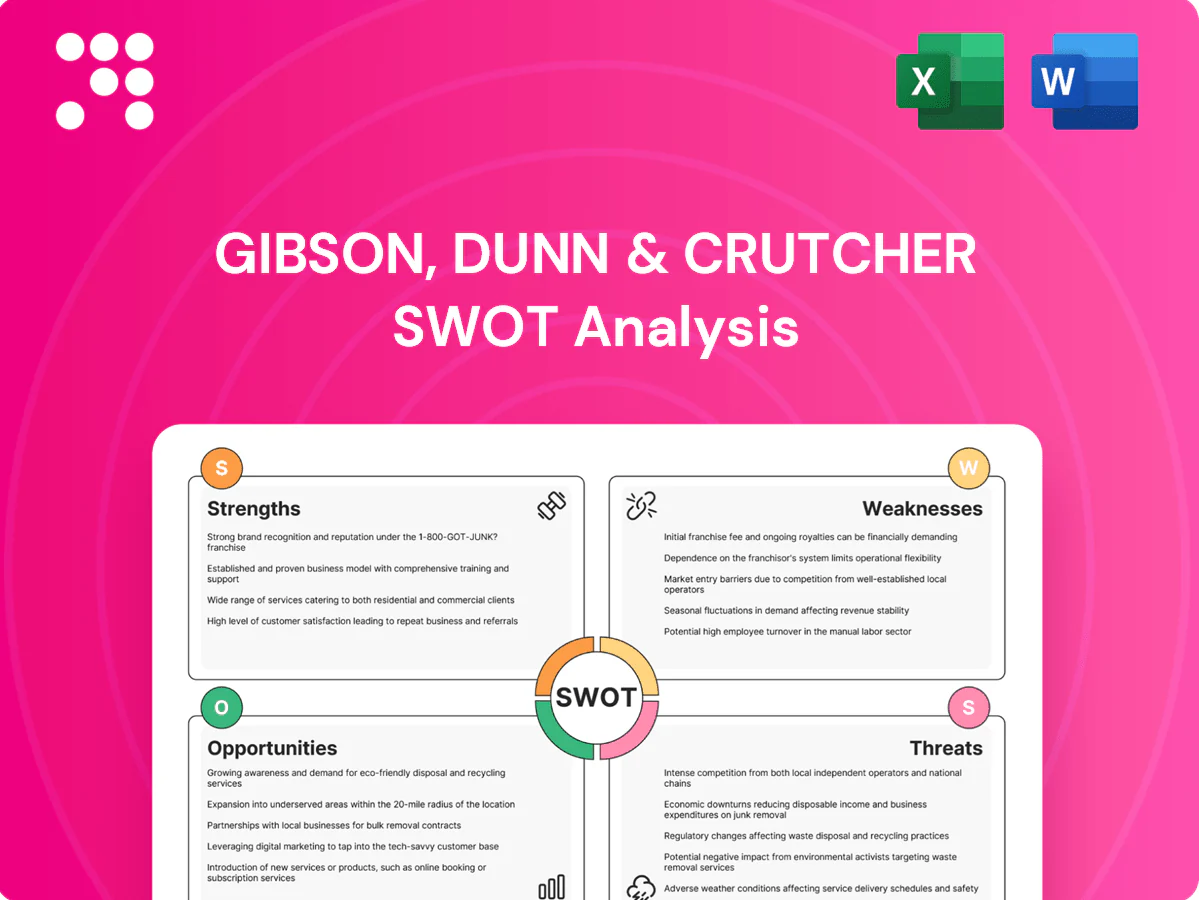
Gibson, Dunn & Crutcher SWOT Analysis

Elevate Your Analysis with the Complete SWOT Report
Gibson, Dunn & Crutcher SWOT snapshot highlights elite litigation strengths, global platform, and regulatory expertise but flags talent competition and sector volatility. Want deeper, actionable analysis with financial context and strategic recommendations? Purchase the full SWOT for a ready-to-use Word report and editable Excel matrix to plan, pitch, or invest with confidence.
Strengths

Elite litigation pedigree
Gibson Dunn's elite litigation pedigree, backed by over 1,400 attorneys in 20+ global offices as of 2024, drives deep bench strength in complex and appellate matters. A strong track record in bet-the-company cases boosts client confidence and pricing power, attracting top-tier clients and talent. That reputation fuels cross-selling into investigations and regulatory defense, generating significant high-margin work.
Corporate and deals capability
Strong corporate, M&A and finance practices provide end-to-end transaction support, enabling deal teams to handle structuring, financing and post-closing matters. The firm’s lawyers execute sophisticated cross-border deals across industries, supported by integrated tax, antitrust and regulatory teams to improve execution certainty. With 20+ offices and roughly 1,400 lawyers worldwide, this breadth drives recurring mandates from blue-chip corporates and financial sponsors.

Regulatory and investigations depth
Gibson Dunn's regulatory and investigations depth combines robust global compliance and internal-investigations capabilities, addressing rising scrutiny with coordinated multi-jurisdictional teams across 20+ offices in 14 countries. The firm regularly handles FCPA, sanctions, antitrust and data-privacy matters, leveraging cross-border experience to manage complex agency interactions. This positions Gibson Dunn as a go-to advisor for high-risk, enforcement-led matters.

Global, diversified client base
Gibson Dunn serves corporations, financial institutions, governments and high-net-worth individuals, diversifying revenue streams and reducing client-concentration risk; the firm operates with over 1,400 lawyers across 20+ global offices, supporting cross-border mandates. Industry spread mitigates sector-specific downturns and the international footprint enhances responsiveness to multinational clients.
- Client mix: corporations, banks, governments, HNWIs
- Scale: 1,400+ lawyers, 20+ offices
- Benefit: revenue diversification, cross-border agility
Strong brand and talent pipeline
Gibson, Dunn & Crutcher leverages a prestigious global platform of about 1,400 lawyers in 20 offices (2024) to support premium billing and deep client trust. Its high-performance culture and marquee partners consistently attract elite associates, while a robust alumni network amplifies business-development channels. Continued thought leadership and high-profile appellate and trial wins sustain market visibility and referral flow.
- scale: ~1,400 lawyers; 20 offices (2024)
- premium pricing: strong client trust
- talent: marquee partners attract top associates
- alumni: expands BD and referrals
- visibility: thought leadership + major court wins
Elite global litigation, appellate and M&A team driving high-value cross-border mandates
Gibson Dunn's elite litigation and appellate bench, with roughly 1,400 attorneys across 20+ global offices (2024), drives high‑value bet‑the‑company and investigative mandates. Strong corporate, M&A and finance practices enable full‑cycle cross‑border deals supported by integrated tax and antitrust teams. Diversified client mix—corporates, banks, governments, HNWIs—reduces concentration and sustains premium pricing.
| Metric | 2024 |
|---|---|
| Lawyers | ~1,400 |
| Offices | 20+ |
| Countries | 14 |
| Key clients | Corporates, banks, governments, HNWIs |
What is included in the product
 Detailed Word Document
Provides a concise SWOT analysis of Gibson, Dunn & Crutcher, highlighting its core strengths, operational weaknesses, market opportunities, and external threats to assess strategic positioning and future risks.

 Customizable Excel Spreadsheet
Delivers a concise, visually clear Gibson, Dunn & Crutcher SWOT matrix to streamline strategic alignment and speed stakeholder decision-making.
Weaknesses

Premium pricing sensitivity
Gibson Dunns high billing rates, aligned with Am Law 100 partner averages exceeding $1,200/hr in 2024, can deter cost-conscious clients and mid-market work. Pricing pressure typically intensifies in slowdowns—demand shifts to in-house teams or boutiques. Alternative providers and managed legal services increasingly undercut fees for routine matters, limiting share in commoditized segments.
Resource intensity of matters
Complex matters at Gibson, Dunn often require teams of 10–40 lawyers and 12–36 month timelines, driving cost-to-serve materially; the firm reported roughly $2.0B in revenue and about $5.5M profits per equity partner in 2024, amplifying the impact of high matter costs. Utilization swings of 10–15% can compress margins, while staffing-heavy matters strain leverage and profitability; efficiency gains need sustained process and tech investment.

Potential client conflicts
Serving a broad roster, including many Fortune 500 clients, raises conflict-of-interest risks for Gibson Dunn, especially given its roughly 1,400 lawyers worldwide (2024). Conflicts can block lucrative mandates or require costly waivers and screening, delaying or losing fee income. Managing ethical walls complicates staffing and business development, sometimes ceding work to conflict-free competitors.

Exposure to cyclical deal flow
M&A and capital-markets work is highly cyclical; Fed policy tightening to about 5.25–5.50% in 2023–24 and a roughly 50–55% decline in global M&A value from the 2021 peak materially reduced high-margin transactional fees. Litigation demand can provice countervailing revenue but often falls short of fully offsetting lost deal work, producing uneven visibility across practices.
- Cyclical revenue exposure
- Rates impact: Fed ~5.25–5.50% (2023–24)
- ~50–55% drop in global M&A vs 2021 peak
- Litigation only partial offset, uneven practice visibility
Talent retention pressure
Top associates at Gibson Dunn face heavy workloads and abundant lateral/exit opportunities; BigLaw first-year salary reached $215,000 in 2024, intensifying market competition. Elevated attrition increases recruiting and training spend and erodes client continuity through knowledge loss, while rising compensation pressures partner profit margins if fee rates do not rise proportionately.
- Heavy workloads vs market pay
- Attrition → higher hiring/training costs
- Knowledge loss harms client continuity
- Compensation inflation compresses partner profits
High partner rates (~$1,200+/hr), massive staffing (~1,400 lawyers) raise costs, hurt M&A wins
Gibson Dunns high rates (~$1,200+/hr partner 2024), large staffing on complex matters (teams 10–40; $2.0B revenue; ~$5.5M PEP 2024) and ~1,400 lawyers raise conflict risk and cost-to-serve, reducing win rates as M&A fell ~50–55% vs 2021.
| Metric | 2024 |
|---|---|
| Revenue | $2.0B |
| PEP | $5.5M |
| Lawyers | ~1,400 |
| Avg partner rate | ~$1,200+/hr |
| M&A change vs 2021 | -50–55% |
Preview the Actual Deliverable
Gibson, Dunn & Crutcher SWOT Analysis
This is a real excerpt from the Gibson, Dunn & Crutcher SWOT analysis document you’ll receive upon purchase—no surprises, just professional quality. The preview below is taken directly from the full report and reflects the same structured, editable content included in the downloadable file. Buy now to unlock the complete, in-depth analysis for immediate use.

Elevate Your Analysis with the Complete SWOT Report
Gibson, Dunn & Crutcher SWOT snapshot highlights elite litigation strengths, global platform, and regulatory expertise but flags talent competition and sector volatility. Want deeper, actionable analysis with financial context and strategic recommendations? Purchase the full SWOT for a ready-to-use Word report and editable Excel matrix to plan, pitch, or invest with confidence.
Strengths
Elite litigation pedigree
Gibson Dunn's elite litigation pedigree, backed by over 1,400 attorneys in 20+ global offices as of 2024, drives deep bench strength in complex and appellate matters. A strong track record in bet-the-company cases boosts client confidence and pricing power, attracting top-tier clients and talent. That reputation fuels cross-selling into investigations and regulatory defense, generating significant high-margin work.
Corporate and deals capability
Strong corporate, M&A and finance practices provide end-to-end transaction support, enabling deal teams to handle structuring, financing and post-closing matters. The firm’s lawyers execute sophisticated cross-border deals across industries, supported by integrated tax, antitrust and regulatory teams to improve execution certainty. With 20+ offices and roughly 1,400 lawyers worldwide, this breadth drives recurring mandates from blue-chip corporates and financial sponsors.
Regulatory and investigations depth
Gibson Dunn's regulatory and investigations depth combines robust global compliance and internal-investigations capabilities, addressing rising scrutiny with coordinated multi-jurisdictional teams across 20+ offices in 14 countries. The firm regularly handles FCPA, sanctions, antitrust and data-privacy matters, leveraging cross-border experience to manage complex agency interactions. This positions Gibson Dunn as a go-to advisor for high-risk, enforcement-led matters.
Global, diversified client base
Gibson Dunn serves corporations, financial institutions, governments and high-net-worth individuals, diversifying revenue streams and reducing client-concentration risk; the firm operates with over 1,400 lawyers across 20+ global offices, supporting cross-border mandates. Industry spread mitigates sector-specific downturns and the international footprint enhances responsiveness to multinational clients.
- Client mix: corporations, banks, governments, HNWIs
- Scale: 1,400+ lawyers, 20+ offices
- Benefit: revenue diversification, cross-border agility
Strong brand and talent pipeline
Gibson, Dunn & Crutcher leverages a prestigious global platform of about 1,400 lawyers in 20 offices (2024) to support premium billing and deep client trust. Its high-performance culture and marquee partners consistently attract elite associates, while a robust alumni network amplifies business-development channels. Continued thought leadership and high-profile appellate and trial wins sustain market visibility and referral flow.
- scale: ~1,400 lawyers; 20 offices (2024)
- premium pricing: strong client trust
- talent: marquee partners attract top associates
- alumni: expands BD and referrals
- visibility: thought leadership + major court wins
Elite global litigation, appellate and M&A team driving high-value cross-border mandates
Gibson Dunn's elite litigation and appellate bench, with roughly 1,400 attorneys across 20+ global offices (2024), drives high‑value bet‑the‑company and investigative mandates. Strong corporate, M&A and finance practices enable full‑cycle cross‑border deals supported by integrated tax and antitrust teams. Diversified client mix—corporates, banks, governments, HNWIs—reduces concentration and sustains premium pricing.
| Metric | 2024 |
|---|---|
| Lawyers | ~1,400 |
| Offices | 20+ |
| Countries | 14 |
| Key clients | Corporates, banks, governments, HNWIs |
What is included in the product
Detailed Word Document
Provides a concise SWOT analysis of Gibson, Dunn & Crutcher, highlighting its core strengths, operational weaknesses, market opportunities, and external threats to assess strategic positioning and future risks.
Customizable Excel Spreadsheet
Delivers a concise, visually clear Gibson, Dunn & Crutcher SWOT matrix to streamline strategic alignment and speed stakeholder decision-making.
Weaknesses
Premium pricing sensitivity
Gibson Dunns high billing rates, aligned with Am Law 100 partner averages exceeding $1,200/hr in 2024, can deter cost-conscious clients and mid-market work. Pricing pressure typically intensifies in slowdowns—demand shifts to in-house teams or boutiques. Alternative providers and managed legal services increasingly undercut fees for routine matters, limiting share in commoditized segments.
Resource intensity of matters
Complex matters at Gibson, Dunn often require teams of 10–40 lawyers and 12–36 month timelines, driving cost-to-serve materially; the firm reported roughly $2.0B in revenue and about $5.5M profits per equity partner in 2024, amplifying the impact of high matter costs. Utilization swings of 10–15% can compress margins, while staffing-heavy matters strain leverage and profitability; efficiency gains need sustained process and tech investment.
Potential client conflicts
Serving a broad roster, including many Fortune 500 clients, raises conflict-of-interest risks for Gibson Dunn, especially given its roughly 1,400 lawyers worldwide (2024). Conflicts can block lucrative mandates or require costly waivers and screening, delaying or losing fee income. Managing ethical walls complicates staffing and business development, sometimes ceding work to conflict-free competitors.
Exposure to cyclical deal flow
M&A and capital-markets work is highly cyclical; Fed policy tightening to about 5.25–5.50% in 2023–24 and a roughly 50–55% decline in global M&A value from the 2021 peak materially reduced high-margin transactional fees. Litigation demand can provice countervailing revenue but often falls short of fully offsetting lost deal work, producing uneven visibility across practices.
- Cyclical revenue exposure
- Rates impact: Fed ~5.25–5.50% (2023–24)
- ~50–55% drop in global M&A vs 2021 peak
- Litigation only partial offset, uneven practice visibility
Talent retention pressure
Top associates at Gibson Dunn face heavy workloads and abundant lateral/exit opportunities; BigLaw first-year salary reached $215,000 in 2024, intensifying market competition. Elevated attrition increases recruiting and training spend and erodes client continuity through knowledge loss, while rising compensation pressures partner profit margins if fee rates do not rise proportionately.
- Heavy workloads vs market pay
- Attrition → higher hiring/training costs
- Knowledge loss harms client continuity
- Compensation inflation compresses partner profits
High partner rates (~$1,200+/hr), massive staffing (~1,400 lawyers) raise costs, hurt M&A wins
Gibson Dunns high rates (~$1,200+/hr partner 2024), large staffing on complex matters (teams 10–40; $2.0B revenue; ~$5.5M PEP 2024) and ~1,400 lawyers raise conflict risk and cost-to-serve, reducing win rates as M&A fell ~50–55% vs 2021.
| Metric | 2024 |
|---|---|
| Revenue | $2.0B |
| PEP | $5.5M |
| Lawyers | ~1,400 |
| Avg partner rate | ~$1,200+/hr |
| M&A change vs 2021 | -50–55% |
Preview the Actual Deliverable
Gibson, Dunn & Crutcher SWOT Analysis
This is a real excerpt from the Gibson, Dunn & Crutcher SWOT analysis document you’ll receive upon purchase—no surprises, just professional quality. The preview below is taken directly from the full report and reflects the same structured, editable content included in the downloadable file. Buy now to unlock the complete, in-depth analysis for immediate use.
Description
Elevate Your Analysis with the Complete SWOT Report
Gibson, Dunn & Crutcher SWOT snapshot highlights elite litigation strengths, global platform, and regulatory expertise but flags talent competition and sector volatility. Want deeper, actionable analysis with financial context and strategic recommendations? Purchase the full SWOT for a ready-to-use Word report and editable Excel matrix to plan, pitch, or invest with confidence.
Strengths
Elite litigation pedigree
Gibson Dunn's elite litigation pedigree, backed by over 1,400 attorneys in 20+ global offices as of 2024, drives deep bench strength in complex and appellate matters. A strong track record in bet-the-company cases boosts client confidence and pricing power, attracting top-tier clients and talent. That reputation fuels cross-selling into investigations and regulatory defense, generating significant high-margin work.
Corporate and deals capability
Strong corporate, M&A and finance practices provide end-to-end transaction support, enabling deal teams to handle structuring, financing and post-closing matters. The firm’s lawyers execute sophisticated cross-border deals across industries, supported by integrated tax, antitrust and regulatory teams to improve execution certainty. With 20+ offices and roughly 1,400 lawyers worldwide, this breadth drives recurring mandates from blue-chip corporates and financial sponsors.
Regulatory and investigations depth
Gibson Dunn's regulatory and investigations depth combines robust global compliance and internal-investigations capabilities, addressing rising scrutiny with coordinated multi-jurisdictional teams across 20+ offices in 14 countries. The firm regularly handles FCPA, sanctions, antitrust and data-privacy matters, leveraging cross-border experience to manage complex agency interactions. This positions Gibson Dunn as a go-to advisor for high-risk, enforcement-led matters.
Global, diversified client base
Gibson Dunn serves corporations, financial institutions, governments and high-net-worth individuals, diversifying revenue streams and reducing client-concentration risk; the firm operates with over 1,400 lawyers across 20+ global offices, supporting cross-border mandates. Industry spread mitigates sector-specific downturns and the international footprint enhances responsiveness to multinational clients.
- Client mix: corporations, banks, governments, HNWIs
- Scale: 1,400+ lawyers, 20+ offices
- Benefit: revenue diversification, cross-border agility
Strong brand and talent pipeline
Gibson, Dunn & Crutcher leverages a prestigious global platform of about 1,400 lawyers in 20 offices (2024) to support premium billing and deep client trust. Its high-performance culture and marquee partners consistently attract elite associates, while a robust alumni network amplifies business-development channels. Continued thought leadership and high-profile appellate and trial wins sustain market visibility and referral flow.
- scale: ~1,400 lawyers; 20 offices (2024)
- premium pricing: strong client trust
- talent: marquee partners attract top associates
- alumni: expands BD and referrals
- visibility: thought leadership + major court wins
Elite global litigation, appellate and M&A team driving high-value cross-border mandates
Gibson Dunn's elite litigation and appellate bench, with roughly 1,400 attorneys across 20+ global offices (2024), drives high‑value bet‑the‑company and investigative mandates. Strong corporate, M&A and finance practices enable full‑cycle cross‑border deals supported by integrated tax and antitrust teams. Diversified client mix—corporates, banks, governments, HNWIs—reduces concentration and sustains premium pricing.
| Metric | 2024 |
|---|---|
| Lawyers | ~1,400 |
| Offices | 20+ |
| Countries | 14 |
| Key clients | Corporates, banks, governments, HNWIs |
What is included in the product
Detailed Word Document
Provides a concise SWOT analysis of Gibson, Dunn & Crutcher, highlighting its core strengths, operational weaknesses, market opportunities, and external threats to assess strategic positioning and future risks.
Customizable Excel Spreadsheet
Delivers a concise, visually clear Gibson, Dunn & Crutcher SWOT matrix to streamline strategic alignment and speed stakeholder decision-making.
Weaknesses
Premium pricing sensitivity
Gibson Dunns high billing rates, aligned with Am Law 100 partner averages exceeding $1,200/hr in 2024, can deter cost-conscious clients and mid-market work. Pricing pressure typically intensifies in slowdowns—demand shifts to in-house teams or boutiques. Alternative providers and managed legal services increasingly undercut fees for routine matters, limiting share in commoditized segments.
Resource intensity of matters
Complex matters at Gibson, Dunn often require teams of 10–40 lawyers and 12–36 month timelines, driving cost-to-serve materially; the firm reported roughly $2.0B in revenue and about $5.5M profits per equity partner in 2024, amplifying the impact of high matter costs. Utilization swings of 10–15% can compress margins, while staffing-heavy matters strain leverage and profitability; efficiency gains need sustained process and tech investment.
Potential client conflicts
Serving a broad roster, including many Fortune 500 clients, raises conflict-of-interest risks for Gibson Dunn, especially given its roughly 1,400 lawyers worldwide (2024). Conflicts can block lucrative mandates or require costly waivers and screening, delaying or losing fee income. Managing ethical walls complicates staffing and business development, sometimes ceding work to conflict-free competitors.
Exposure to cyclical deal flow
M&A and capital-markets work is highly cyclical; Fed policy tightening to about 5.25–5.50% in 2023–24 and a roughly 50–55% decline in global M&A value from the 2021 peak materially reduced high-margin transactional fees. Litigation demand can provice countervailing revenue but often falls short of fully offsetting lost deal work, producing uneven visibility across practices.
- Cyclical revenue exposure
- Rates impact: Fed ~5.25–5.50% (2023–24)
- ~50–55% drop in global M&A vs 2021 peak
- Litigation only partial offset, uneven practice visibility
Talent retention pressure
Top associates at Gibson Dunn face heavy workloads and abundant lateral/exit opportunities; BigLaw first-year salary reached $215,000 in 2024, intensifying market competition. Elevated attrition increases recruiting and training spend and erodes client continuity through knowledge loss, while rising compensation pressures partner profit margins if fee rates do not rise proportionately.
- Heavy workloads vs market pay
- Attrition → higher hiring/training costs
- Knowledge loss harms client continuity
- Compensation inflation compresses partner profits
High partner rates (~$1,200+/hr), massive staffing (~1,400 lawyers) raise costs, hurt M&A wins
Gibson Dunns high rates (~$1,200+/hr partner 2024), large staffing on complex matters (teams 10–40; $2.0B revenue; ~$5.5M PEP 2024) and ~1,400 lawyers raise conflict risk and cost-to-serve, reducing win rates as M&A fell ~50–55% vs 2021.
| Metric | 2024 |
|---|---|
| Revenue | $2.0B |
| PEP | $5.5M |
| Lawyers | ~1,400 |
| Avg partner rate | ~$1,200+/hr |
| M&A change vs 2021 | -50–55% |
Preview the Actual Deliverable
Gibson, Dunn & Crutcher SWOT Analysis
This is a real excerpt from the Gibson, Dunn & Crutcher SWOT analysis document you’ll receive upon purchase—no surprises, just professional quality. The preview below is taken directly from the full report and reflects the same structured, editable content included in the downloadable file. Buy now to unlock the complete, in-depth analysis for immediate use.











