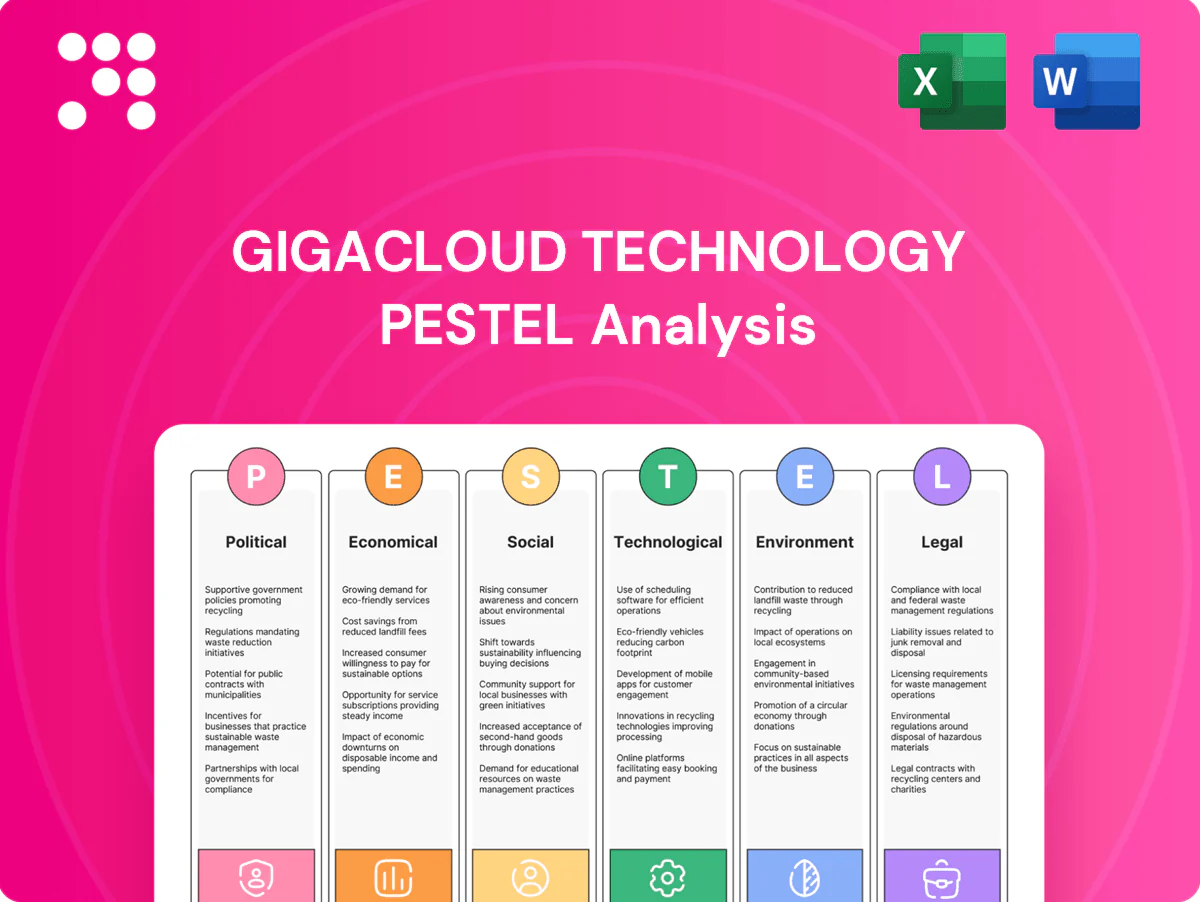
GigaCloud Technology PESTLE Analysis

Your Shortcut to Market Insight Starts Here
Discover how political, economic, sociocultural, technological, legal, and environmental forces are shaping GigaCloud Technology's trajectory in our concise PESTLE overview; ideal for investors and strategists seeking clear external risk and opportunity signals. Purchase the full PESTLE for detailed, actionable insights and ready-to-use charts.
Political factors

US–China trade and tariffs
Shifts in tariff policy directly affect landed costs for Asia-to-U.S. bulky goods; Section 301 tariffs of up to 25 percent on roughly $350 billion of Chinese goods raised landed costs materially. Escalation increases price volatility and complicates reseller pricing. De-escalation or product exclusions can expand margins and volume. Hedging sourcing across Asian countries mitigates concentration risk as China’s share of U.S. goods imports fell to about 18 percent by 2023.
Customs, port, and cross-border logistics policy
Changes in customs procedures and de minimis thresholds, such as the US $800 rule, plus port labor relations materially change throughput and lead times, and strikes or congestion can delay fulfillment of large parcels for days or weeks. Pre-clearance and trusted trader programs like CTPAT and AEO improve predictability. Building bonded and FTZ capabilities lets GigaCloud buffer disruptions by deferring duties and holding inventory under customs control.

EU industrial and digital market policies
EU initiatives like the Digital Markets Act, which designated about 22 gatekeepers in 2023, and industrial policies shape platform rules and competition for GigaCloud. The EU Chips Act mobilizes up to €43 billion in public/private support and localization pressures can shift where inventory is staged. Alignment with TEN-T and Connecting Europe Facility funding (~€33.7 billion 2021–27) eases cross-border logistics, and active DMA/DPA compliance speeds European expansion.

Geopolitical tensions and sanctions
Geopolitical tensions and sanctions regimes constrain eligible suppliers and destinations, notably expanded Western export controls on advanced semiconductors and cloud technologies toward China since 2022. Rapid designation changes demand agile supplier vetting and can disrupt supply chains and payment corridors. Banking relationships and payment flows may be constrained; diversified trade lanes and regional partners reduce exposure.
- Sanctions restrict supplier/destination eligibility
- Fast designation changes need agile vetting
- Payment flows and correspondent banking constrained
- Diversified trade lanes lower concentration risk
Government incentives for nearshoring
- Policy drivers: CHIPS Act ~52 billion
- Logistics impact: US industrial vacancy ~3.9% (2024)
- Supplier mix: more regional suppliers, faster SLAs
- Strategy: early entry = market share gains
Tariffs and policy spur nearshoring — Section 301 25%, China ~18%
Shifts in tariffs (Section 301 up to 25% on ~350B) raise landed costs and price volatility; China’s share of US goods imports fell to ~18% by 2023. Customs changes (de minimis $800), port labor and strikes disrupt throughput; FTZ/CTPAT and bonded inventory mitigate impact. Policy incentives (CHIPS ~52B, EU Chips ~43B) and DMA (≈22 gatekeepers) accelerate nearshoring and platform compliance.
| Policy | Key figure |
|---|---|
| Section 301 | ~25% on $350B |
| CHIPS | $52B |
| EU Chips | €43B |
What is included in the product
 Detailed Word Document
Explores how macro-environmental forces uniquely affect GigaCloud Technology across Political, Economic, Social, Technological, Environmental and Legal dimensions, with data-backed trends and region-specific regulatory context. Designed for executives and investors, it highlights actionable risks, opportunities and forward-looking scenarios ready for reports and decks.

 Customizable Excel Spreadsheet
A concise, visually segmented PESTLE summary of GigaCloud Technology that can be dropped into presentations, edited for regional or business-line context, and easily shared to align teams quickly during strategic planning and risk discussions.
Economic factors

Global demand cycles for furniture and bulky goods
Large-parcel furniture demand is cyclical with housing and discretionary spend; the global furniture market was about $545 billion in 2022 and US housing starts ran near a 1.5 million annual rate in 2023, linking construction to order volumes. Slowdowns cut order frequency and basket size, while recoveries drive reseller restocking and inventory rebuilds. GigaCloud’s marketplace model can smooth volatility via category diversification and multi-seller liquidity.
Freight rates and fuel costs
Ocean, air, and trucking rates materially affect buyer total cost; container spot rates in 2024 were roughly 60–70% below 2021 peaks while airfreight remained about 50–100% above pre‑COVID levels, creating variability for GigaCloud’s hardware procurement. Fuel spikes—Brent averaged near $85/bbl in 2024—compress reseller margins and curb conversion. Long‑term carrier contracts, mode optimization and load consolidation for oversized items stabilize costs.

Currency volatility across USD, EUR, and Asian FX
Currency volatility across USD, EUR and Asian FX alters sourcing attractiveness as a stronger USD (DXY ~104 in H1 2025) tightened Asian supplier margins while boosting U.S. buyer power. FX swings saw major Asian pairs move 3–6% in 2024–2025, prompting higher hedging use and multi-currency settlement to reduce transaction friction. Corporate reports indicate hedging uptake rose, and transparent FX pass-through mechanisms helped preserve margins and build supplier–buyer trust.

Interest rates and working capital
Higher policy rates (US fed funds ~5.25–5.50% mid‑2025) raise inventory carrying and trade‑finance costs, pushing resellers toward lighter stock and faster turns; embedded fintech—escrow, factoring, pay‑as‑sold—can sustain volumes by funding working capital; shortening cash cycles raises platform stickiness and lowers churn.
- Higher rates: ↑ carrying + trade finance costs
- Resellers: prefer lower inventory, faster turns
- Embedded fintech: escrow/factoring sustains sales
- Shorter cash cycles: higher retention
E-commerce penetration in B2B
Digital adoption by small and mid-sized resellers has expanded addressable demand—McKinsey 2024 reports roughly 70% of SMEs increased digital sales channels since 2020, lifting B2B online sourcing; category-specific UX for bulky goods drove ~30% y/y online penetration gains in 2023–24 as buyers shift from offline brokers.
Network effects strengthen as listings and fulfillment density rise, with leading B2B marketplaces reporting 20–30% GMV lift per density increase; IMF 2024 global GDP ≈3.1% supports trade and purchasing stability, further amplifying migration to e-commerce.
- SME digital adoption ~70% (McKinsey 2024)
- Bulky-goods online penetration +~30% y/y (2023–24)
- Marketplace GMV lift 20–30% with density
- IMF global GDP ~3.1% (2024) boosts demand
Tariffs and policy spur nearshoring — Section 301 25%, China ~18%
Demand tied to housing: global furniture ~$545B (2022) and US housing starts ~1.5M (2023) drive order cycles; transport cost swings (container rates -60–70% vs 2021; airfreight 50–100% above pre‑COVID) and Brent ~$85/bbl (2024) compress margins. USD strength (DXY ~104 H1 2025) and Fed funds 5.25–5.50% mid‑2025 raise FX/financing costs; SME digital adoption ~70% (McKinsey 2024) expands addressable market.
| Metric | Value |
|---|---|
| Global furniture | $545B (2022) |
| US housing starts | 1.5M (2023) |
| Brent | $85/bbl (2024) |
| DXY | ~104 (H1 2025) |
| Fed funds | 5.25–5.50% (mid‑2025) |
Preview the Actual Deliverable
GigaCloud Technology PESTLE Analysis
The preview shown here is the exact GigaCloud Technology PESTLE Analysis you’ll receive after purchase—fully formatted, professionally structured and ready to use. This is the real file with complete Political, Economic, Social, Technological, Legal and Environmental insights. No placeholders, no surprises.

Your Shortcut to Market Insight Starts Here
Discover how political, economic, sociocultural, technological, legal, and environmental forces are shaping GigaCloud Technology's trajectory in our concise PESTLE overview; ideal for investors and strategists seeking clear external risk and opportunity signals. Purchase the full PESTLE for detailed, actionable insights and ready-to-use charts.
Political factors
US–China trade and tariffs
Shifts in tariff policy directly affect landed costs for Asia-to-U.S. bulky goods; Section 301 tariffs of up to 25 percent on roughly $350 billion of Chinese goods raised landed costs materially. Escalation increases price volatility and complicates reseller pricing. De-escalation or product exclusions can expand margins and volume. Hedging sourcing across Asian countries mitigates concentration risk as China’s share of U.S. goods imports fell to about 18 percent by 2023.
Customs, port, and cross-border logistics policy
Changes in customs procedures and de minimis thresholds, such as the US $800 rule, plus port labor relations materially change throughput and lead times, and strikes or congestion can delay fulfillment of large parcels for days or weeks. Pre-clearance and trusted trader programs like CTPAT and AEO improve predictability. Building bonded and FTZ capabilities lets GigaCloud buffer disruptions by deferring duties and holding inventory under customs control.
EU industrial and digital market policies
EU initiatives like the Digital Markets Act, which designated about 22 gatekeepers in 2023, and industrial policies shape platform rules and competition for GigaCloud. The EU Chips Act mobilizes up to €43 billion in public/private support and localization pressures can shift where inventory is staged. Alignment with TEN-T and Connecting Europe Facility funding (~€33.7 billion 2021–27) eases cross-border logistics, and active DMA/DPA compliance speeds European expansion.
Geopolitical tensions and sanctions
Geopolitical tensions and sanctions regimes constrain eligible suppliers and destinations, notably expanded Western export controls on advanced semiconductors and cloud technologies toward China since 2022. Rapid designation changes demand agile supplier vetting and can disrupt supply chains and payment corridors. Banking relationships and payment flows may be constrained; diversified trade lanes and regional partners reduce exposure.
- Sanctions restrict supplier/destination eligibility
- Fast designation changes need agile vetting
- Payment flows and correspondent banking constrained
- Diversified trade lanes lower concentration risk
Government incentives for nearshoring
- Policy drivers: CHIPS Act ~52 billion
- Logistics impact: US industrial vacancy ~3.9% (2024)
- Supplier mix: more regional suppliers, faster SLAs
- Strategy: early entry = market share gains
Tariffs and policy spur nearshoring — Section 301 25%, China ~18%
Shifts in tariffs (Section 301 up to 25% on ~350B) raise landed costs and price volatility; China’s share of US goods imports fell to ~18% by 2023. Customs changes (de minimis $800), port labor and strikes disrupt throughput; FTZ/CTPAT and bonded inventory mitigate impact. Policy incentives (CHIPS ~52B, EU Chips ~43B) and DMA (≈22 gatekeepers) accelerate nearshoring and platform compliance.
| Policy | Key figure |
|---|---|
| Section 301 | ~25% on $350B |
| CHIPS | $52B |
| EU Chips | €43B |
What is included in the product
Detailed Word Document
Explores how macro-environmental forces uniquely affect GigaCloud Technology across Political, Economic, Social, Technological, Environmental and Legal dimensions, with data-backed trends and region-specific regulatory context. Designed for executives and investors, it highlights actionable risks, opportunities and forward-looking scenarios ready for reports and decks.
Customizable Excel Spreadsheet
A concise, visually segmented PESTLE summary of GigaCloud Technology that can be dropped into presentations, edited for regional or business-line context, and easily shared to align teams quickly during strategic planning and risk discussions.
Economic factors
Global demand cycles for furniture and bulky goods
Large-parcel furniture demand is cyclical with housing and discretionary spend; the global furniture market was about $545 billion in 2022 and US housing starts ran near a 1.5 million annual rate in 2023, linking construction to order volumes. Slowdowns cut order frequency and basket size, while recoveries drive reseller restocking and inventory rebuilds. GigaCloud’s marketplace model can smooth volatility via category diversification and multi-seller liquidity.
Freight rates and fuel costs
Ocean, air, and trucking rates materially affect buyer total cost; container spot rates in 2024 were roughly 60–70% below 2021 peaks while airfreight remained about 50–100% above pre‑COVID levels, creating variability for GigaCloud’s hardware procurement. Fuel spikes—Brent averaged near $85/bbl in 2024—compress reseller margins and curb conversion. Long‑term carrier contracts, mode optimization and load consolidation for oversized items stabilize costs.
Currency volatility across USD, EUR, and Asian FX
Currency volatility across USD, EUR and Asian FX alters sourcing attractiveness as a stronger USD (DXY ~104 in H1 2025) tightened Asian supplier margins while boosting U.S. buyer power. FX swings saw major Asian pairs move 3–6% in 2024–2025, prompting higher hedging use and multi-currency settlement to reduce transaction friction. Corporate reports indicate hedging uptake rose, and transparent FX pass-through mechanisms helped preserve margins and build supplier–buyer trust.
Interest rates and working capital
Higher policy rates (US fed funds ~5.25–5.50% mid‑2025) raise inventory carrying and trade‑finance costs, pushing resellers toward lighter stock and faster turns; embedded fintech—escrow, factoring, pay‑as‑sold—can sustain volumes by funding working capital; shortening cash cycles raises platform stickiness and lowers churn.
- Higher rates: ↑ carrying + trade finance costs
- Resellers: prefer lower inventory, faster turns
- Embedded fintech: escrow/factoring sustains sales
- Shorter cash cycles: higher retention
E-commerce penetration in B2B
Digital adoption by small and mid-sized resellers has expanded addressable demand—McKinsey 2024 reports roughly 70% of SMEs increased digital sales channels since 2020, lifting B2B online sourcing; category-specific UX for bulky goods drove ~30% y/y online penetration gains in 2023–24 as buyers shift from offline brokers.
Network effects strengthen as listings and fulfillment density rise, with leading B2B marketplaces reporting 20–30% GMV lift per density increase; IMF 2024 global GDP ≈3.1% supports trade and purchasing stability, further amplifying migration to e-commerce.
- SME digital adoption ~70% (McKinsey 2024)
- Bulky-goods online penetration +~30% y/y (2023–24)
- Marketplace GMV lift 20–30% with density
- IMF global GDP ~3.1% (2024) boosts demand
Tariffs and policy spur nearshoring — Section 301 25%, China ~18%
Demand tied to housing: global furniture ~$545B (2022) and US housing starts ~1.5M (2023) drive order cycles; transport cost swings (container rates -60–70% vs 2021; airfreight 50–100% above pre‑COVID) and Brent ~$85/bbl (2024) compress margins. USD strength (DXY ~104 H1 2025) and Fed funds 5.25–5.50% mid‑2025 raise FX/financing costs; SME digital adoption ~70% (McKinsey 2024) expands addressable market.
| Metric | Value |
|---|---|
| Global furniture | $545B (2022) |
| US housing starts | 1.5M (2023) |
| Brent | $85/bbl (2024) |
| DXY | ~104 (H1 2025) |
| Fed funds | 5.25–5.50% (mid‑2025) |
Preview the Actual Deliverable
GigaCloud Technology PESTLE Analysis
The preview shown here is the exact GigaCloud Technology PESTLE Analysis you’ll receive after purchase—fully formatted, professionally structured and ready to use. This is the real file with complete Political, Economic, Social, Technological, Legal and Environmental insights. No placeholders, no surprises.
Original: $10.00
-65%$10.00
$3.50Description
Your Shortcut to Market Insight Starts Here
Discover how political, economic, sociocultural, technological, legal, and environmental forces are shaping GigaCloud Technology's trajectory in our concise PESTLE overview; ideal for investors and strategists seeking clear external risk and opportunity signals. Purchase the full PESTLE for detailed, actionable insights and ready-to-use charts.
Political factors
US–China trade and tariffs
Shifts in tariff policy directly affect landed costs for Asia-to-U.S. bulky goods; Section 301 tariffs of up to 25 percent on roughly $350 billion of Chinese goods raised landed costs materially. Escalation increases price volatility and complicates reseller pricing. De-escalation or product exclusions can expand margins and volume. Hedging sourcing across Asian countries mitigates concentration risk as China’s share of U.S. goods imports fell to about 18 percent by 2023.
Customs, port, and cross-border logistics policy
Changes in customs procedures and de minimis thresholds, such as the US $800 rule, plus port labor relations materially change throughput and lead times, and strikes or congestion can delay fulfillment of large parcels for days or weeks. Pre-clearance and trusted trader programs like CTPAT and AEO improve predictability. Building bonded and FTZ capabilities lets GigaCloud buffer disruptions by deferring duties and holding inventory under customs control.
EU industrial and digital market policies
EU initiatives like the Digital Markets Act, which designated about 22 gatekeepers in 2023, and industrial policies shape platform rules and competition for GigaCloud. The EU Chips Act mobilizes up to €43 billion in public/private support and localization pressures can shift where inventory is staged. Alignment with TEN-T and Connecting Europe Facility funding (~€33.7 billion 2021–27) eases cross-border logistics, and active DMA/DPA compliance speeds European expansion.
Geopolitical tensions and sanctions
Geopolitical tensions and sanctions regimes constrain eligible suppliers and destinations, notably expanded Western export controls on advanced semiconductors and cloud technologies toward China since 2022. Rapid designation changes demand agile supplier vetting and can disrupt supply chains and payment corridors. Banking relationships and payment flows may be constrained; diversified trade lanes and regional partners reduce exposure.
- Sanctions restrict supplier/destination eligibility
- Fast designation changes need agile vetting
- Payment flows and correspondent banking constrained
- Diversified trade lanes lower concentration risk
Government incentives for nearshoring
- Policy drivers: CHIPS Act ~52 billion
- Logistics impact: US industrial vacancy ~3.9% (2024)
- Supplier mix: more regional suppliers, faster SLAs
- Strategy: early entry = market share gains
Tariffs and policy spur nearshoring — Section 301 25%, China ~18%
Shifts in tariffs (Section 301 up to 25% on ~350B) raise landed costs and price volatility; China’s share of US goods imports fell to ~18% by 2023. Customs changes (de minimis $800), port labor and strikes disrupt throughput; FTZ/CTPAT and bonded inventory mitigate impact. Policy incentives (CHIPS ~52B, EU Chips ~43B) and DMA (≈22 gatekeepers) accelerate nearshoring and platform compliance.
| Policy | Key figure |
|---|---|
| Section 301 | ~25% on $350B |
| CHIPS | $52B |
| EU Chips | €43B |
What is included in the product
Detailed Word Document
Explores how macro-environmental forces uniquely affect GigaCloud Technology across Political, Economic, Social, Technological, Environmental and Legal dimensions, with data-backed trends and region-specific regulatory context. Designed for executives and investors, it highlights actionable risks, opportunities and forward-looking scenarios ready for reports and decks.
Customizable Excel Spreadsheet
A concise, visually segmented PESTLE summary of GigaCloud Technology that can be dropped into presentations, edited for regional or business-line context, and easily shared to align teams quickly during strategic planning and risk discussions.
Economic factors
Global demand cycles for furniture and bulky goods
Large-parcel furniture demand is cyclical with housing and discretionary spend; the global furniture market was about $545 billion in 2022 and US housing starts ran near a 1.5 million annual rate in 2023, linking construction to order volumes. Slowdowns cut order frequency and basket size, while recoveries drive reseller restocking and inventory rebuilds. GigaCloud’s marketplace model can smooth volatility via category diversification and multi-seller liquidity.
Freight rates and fuel costs
Ocean, air, and trucking rates materially affect buyer total cost; container spot rates in 2024 were roughly 60–70% below 2021 peaks while airfreight remained about 50–100% above pre‑COVID levels, creating variability for GigaCloud’s hardware procurement. Fuel spikes—Brent averaged near $85/bbl in 2024—compress reseller margins and curb conversion. Long‑term carrier contracts, mode optimization and load consolidation for oversized items stabilize costs.
Currency volatility across USD, EUR, and Asian FX
Currency volatility across USD, EUR and Asian FX alters sourcing attractiveness as a stronger USD (DXY ~104 in H1 2025) tightened Asian supplier margins while boosting U.S. buyer power. FX swings saw major Asian pairs move 3–6% in 2024–2025, prompting higher hedging use and multi-currency settlement to reduce transaction friction. Corporate reports indicate hedging uptake rose, and transparent FX pass-through mechanisms helped preserve margins and build supplier–buyer trust.
Interest rates and working capital
Higher policy rates (US fed funds ~5.25–5.50% mid‑2025) raise inventory carrying and trade‑finance costs, pushing resellers toward lighter stock and faster turns; embedded fintech—escrow, factoring, pay‑as‑sold—can sustain volumes by funding working capital; shortening cash cycles raises platform stickiness and lowers churn.
- Higher rates: ↑ carrying + trade finance costs
- Resellers: prefer lower inventory, faster turns
- Embedded fintech: escrow/factoring sustains sales
- Shorter cash cycles: higher retention
E-commerce penetration in B2B
Digital adoption by small and mid-sized resellers has expanded addressable demand—McKinsey 2024 reports roughly 70% of SMEs increased digital sales channels since 2020, lifting B2B online sourcing; category-specific UX for bulky goods drove ~30% y/y online penetration gains in 2023–24 as buyers shift from offline brokers.
Network effects strengthen as listings and fulfillment density rise, with leading B2B marketplaces reporting 20–30% GMV lift per density increase; IMF 2024 global GDP ≈3.1% supports trade and purchasing stability, further amplifying migration to e-commerce.
- SME digital adoption ~70% (McKinsey 2024)
- Bulky-goods online penetration +~30% y/y (2023–24)
- Marketplace GMV lift 20–30% with density
- IMF global GDP ~3.1% (2024) boosts demand
Tariffs and policy spur nearshoring — Section 301 25%, China ~18%
Demand tied to housing: global furniture ~$545B (2022) and US housing starts ~1.5M (2023) drive order cycles; transport cost swings (container rates -60–70% vs 2021; airfreight 50–100% above pre‑COVID) and Brent ~$85/bbl (2024) compress margins. USD strength (DXY ~104 H1 2025) and Fed funds 5.25–5.50% mid‑2025 raise FX/financing costs; SME digital adoption ~70% (McKinsey 2024) expands addressable market.
| Metric | Value |
|---|---|
| Global furniture | $545B (2022) |
| US housing starts | 1.5M (2023) |
| Brent | $85/bbl (2024) |
| DXY | ~104 (H1 2025) |
| Fed funds | 5.25–5.50% (mid‑2025) |
Preview the Actual Deliverable
GigaCloud Technology PESTLE Analysis
The preview shown here is the exact GigaCloud Technology PESTLE Analysis you’ll receive after purchase—fully formatted, professionally structured and ready to use. This is the real file with complete Political, Economic, Social, Technological, Legal and Environmental insights. No placeholders, no surprises.











