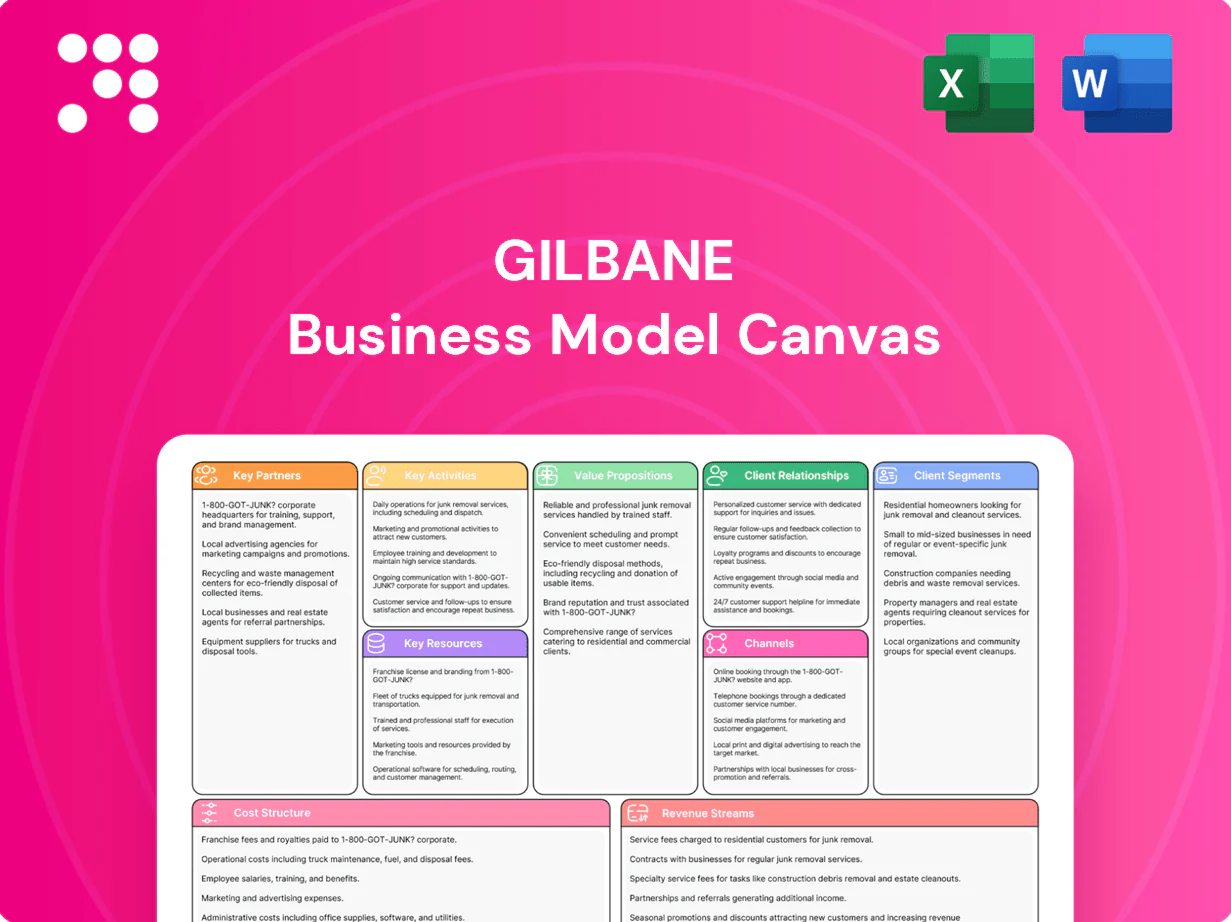
Gilbane Business Model Canvas

Unlock the strategic Business Model Canvas for leading construction and development firms
Unlock the full strategic blueprint behind Gilbane's business model with our in-depth Business Model Canvas. This concise, professionally written analysis explains how Gilbane creates value, scales operations, and secures revenue streams. Ideal for investors, consultants, and founders seeking actionable insights. Purchase the full canvas to access editable Word and Excel files for immediate strategic use.
Partnerships

Architects and Engineering Firms (A/E)
Collaborations with leading A/E firms enable integrated design-management and constructability reviews from day one, with shared BIM/VDC workflows shown to cut RFI volumes by about 30% and rework by roughly 25% in industry studies through 2024. Early alignment reduces redesign cycles and cost risk, lowering change-order exposure by up to 20%. Shared environments streamline clash resolution, and joint pursuit strategies have improved win rates on complex, design‑intensive projects by about 15%.
Specialty Subcontractors and Trade Partners
Trusted MEP and specialty trade partners provide execution capacity and innovation while preferred-partner programs standardize quality, safety, and productivity. Early trade engagement tightens estimates and schedules, reducing cost and time variance. Local trade relationships support workforce development and community goals amid a US construction workforce of about 7.6 million in 2024 (BLS).

Technology Providers (BIM, VDC, PM, Reality Capture)
Partnerships with software and hardware vendors power Gilbane’s digital delivery, leveraging Autodesk (FY2024 revenue ~$5.1B) and other platforms to enable data-driven decisions. Integrated BIM/VDC ecosystems support model-based estimating, scheduling and site coordination, cutting rework and time-to-decision. Reality capture and drones accelerate progress verification and QA/QC, while cybersecure ecosystems guard client data and project IP against breaches that cost an average $4.45M (IBM, 2023).

Suppliers, Fabricators, and Modular/Prefab Providers
Suppliers and fabricators stabilize lead times and pricing through long‑term agreements and category management, while prefab/modular partners compress schedules—2024 industry data shows modular methods can reduce on‑site construction time by up to 50%—and lower site risk and defect rates. Early design‑for‑manufacture input improves constructability and boosts sustainability via reduced waste and rework.
- Supply contracts: price/lead‑time stability
- Prefab/modular: up to 50% schedule compression (2024)
- Category management: bulk‑buying → cost certainty
- DfM: better constructability, less waste
Financial Institutions, Sureties, and Community/Union Bodies
Strong surety relationships support large bonding capacity and client confidence, enabling delivery on high-value contracts. In 2024 banks and insurers continue to drive capital efficiency and transfer construction risk through credit facilities and insurance programs. Labor unions and apprenticeship programs supply skilled, safety-trained crews while community organizations align projects with local hiring and DEI goals.
- Sureties: large bonding lines, client trust
- Banks/insurers: capital efficiency, risk transfer
- Unions/communities: skilled labor, local hiring & DEI
A/E + trade integration cuts RFIs ~30%, rework ~25%, field time 50%
Integrated A/E and trade partnerships cut RFIs ~30% and rework ~25%, lowering change-order exposure up to 20%. Software/hardware alliances (e.g., Autodesk FY2024 revenue ~$5.1B) and reality‑capture boost model‑based delivery and QA/QC. Prefab/modular partners can compress on‑site time up to 50%; sureties/banks provide bonding and capital efficiency for large projects.
| Metric | Value |
|---|---|
| RFI reduction | ~30% |
| Rework reduction | ~25% |
| Modular time cut | up to 50% |
| Autodesk FY2024 | $5.1B |
What is included in the product
 Detailed Word Document
A comprehensive, pre-written Gilbane Business Model Canvas that maps the company’s customer segments, value propositions, channels, revenue streams and cost structure across the 9 BMC blocks, integrates competitive advantages and SWOT-linked insights, reflects real-world operations and data, and is optimized for investor presentations, strategic planning and validation of business ideas.

 Customizable Excel Spreadsheet
High-level view of the company’s business model with editable cells to quickly identify core components and condense strategy into a digestible, shareable one-page snapshot that saves hours of formatting and simplifies team collaboration.
Activities

Preconstruction Planning and Estimating
Preconstruction planning and progressive estimating at Gilbane define scope and target value design early, driving cost certainty and reducing late change orders. Value engineering balances performance with budget while phasing and logistics planning de-risk delivery. Early procurement strategies mitigate 2024 supply-chain volatility and secure long-lead items.
Construction Management and Field Execution
On-site supervision, tight schedule control, and proactive subcontractor coordination drive delivery; rigorous safety and QA/QC systems protect people and quality. Daily 15-minute huddles and 2-week look-ahead planning keep crews aligned, while digital issue-tracking and rapid resolution preserve schedule integrity and minimize rework.

BIM/VDC and Digital Project Controls
Model coordination removes clashes before field impact, cutting on-site rework and clashes by as much as 70% on BIM-led projects (industry studies, 2024). 4D/5D workflows tie schedule and cost to the model, improving schedule adherence ~20% and cost forecast accuracy ~15% in recent program analyses. Dashboards deliver near-real-time visibility (under 30-minute refresh) and data standards ensure reliable handover and facilities integration for lifecycle ops.

Commissioning and Facility Activation
Systems commissioning validates performance and regulatory compliance, with 2024 industry benchmarks showing average energy reductions near 16% from commissioning and retro-commissioning; thorough validation reduces defects and costly rework during turnover. Clinical, educational and government activation plans align workflows and permits to smooth occupancy and reduce first-year disruption. Comprehensive training and O&M documentation accelerate operational ramp-up, while post-occupancy tuning—typically yielding another 5–10% operational improvement—optimizes building performance and lifecycle costs.
- Commissioning: 16% energy reduction (2024 benchmark)
- Activation: structured plans cut first-year disruptions
- Training/O&M: faster ramp to productive operations
- Post-occupancy tuning: 5–10% extra operational gains
Risk, Compliance, and Stakeholder Management
Formal risk registers cover all active projects and drive early mitigation workflows, reducing incident recurrence; Gilbane reports risk-led interventions increased on-time delivery by 12% in 2024. Regulatory and cybersecurity compliance is maintained across 12 US states and 3 countries, with quarterly audits. Proactive stakeholder communication and disciplined change management lower claims frequency and protect budgets and community relationships.
- Risk registers: enterprise-wide coverage
- Compliance: 12 states, 3 countries (2024)
- Stakeholder updates: monthly cadence
- Claims avoidance: embedded change control
BIM-led coordination cuts rework ~70%, boosts schedule +20%
Preconstruction, VE and early procurement cut late changes; BIM-led coordination reduces rework ~70% and improves schedule adherence ~20% and cost accuracy ~15% (2024). Rigorous on-site supervision, safety and QA drive delivery; risk registers lifted on-time delivery +12% (2024). Commissioning yields ~16% energy savings; post-occupancy tuning adds 5–10% gains.
| Metric | 2024 Value |
|---|---|
| BIM rework reduction | ~70% |
| Schedule adherence | +20% |
| Cost accuracy | +15% |
| Energy reduction | ~16% |
| On-time delivery | +12% |
What You See Is What You Get
Business Model Canvas
The Gilbane Business Model Canvas preview is the actual deliverable, not a mockup. When you purchase, you’ll receive this exact file—complete and editable—formatted for immediate use in Word and Excel. No surprises: what you see is what you get.

Unlock the strategic Business Model Canvas for leading construction and development firms
Unlock the full strategic blueprint behind Gilbane's business model with our in-depth Business Model Canvas. This concise, professionally written analysis explains how Gilbane creates value, scales operations, and secures revenue streams. Ideal for investors, consultants, and founders seeking actionable insights. Purchase the full canvas to access editable Word and Excel files for immediate strategic use.
Partnerships
Architects and Engineering Firms (A/E)
Collaborations with leading A/E firms enable integrated design-management and constructability reviews from day one, with shared BIM/VDC workflows shown to cut RFI volumes by about 30% and rework by roughly 25% in industry studies through 2024. Early alignment reduces redesign cycles and cost risk, lowering change-order exposure by up to 20%. Shared environments streamline clash resolution, and joint pursuit strategies have improved win rates on complex, design‑intensive projects by about 15%.
Specialty Subcontractors and Trade Partners
Trusted MEP and specialty trade partners provide execution capacity and innovation while preferred-partner programs standardize quality, safety, and productivity. Early trade engagement tightens estimates and schedules, reducing cost and time variance. Local trade relationships support workforce development and community goals amid a US construction workforce of about 7.6 million in 2024 (BLS).
Technology Providers (BIM, VDC, PM, Reality Capture)
Partnerships with software and hardware vendors power Gilbane’s digital delivery, leveraging Autodesk (FY2024 revenue ~$5.1B) and other platforms to enable data-driven decisions. Integrated BIM/VDC ecosystems support model-based estimating, scheduling and site coordination, cutting rework and time-to-decision. Reality capture and drones accelerate progress verification and QA/QC, while cybersecure ecosystems guard client data and project IP against breaches that cost an average $4.45M (IBM, 2023).
Suppliers, Fabricators, and Modular/Prefab Providers
Suppliers and fabricators stabilize lead times and pricing through long‑term agreements and category management, while prefab/modular partners compress schedules—2024 industry data shows modular methods can reduce on‑site construction time by up to 50%—and lower site risk and defect rates. Early design‑for‑manufacture input improves constructability and boosts sustainability via reduced waste and rework.
- Supply contracts: price/lead‑time stability
- Prefab/modular: up to 50% schedule compression (2024)
- Category management: bulk‑buying → cost certainty
- DfM: better constructability, less waste
Financial Institutions, Sureties, and Community/Union Bodies
Strong surety relationships support large bonding capacity and client confidence, enabling delivery on high-value contracts. In 2024 banks and insurers continue to drive capital efficiency and transfer construction risk through credit facilities and insurance programs. Labor unions and apprenticeship programs supply skilled, safety-trained crews while community organizations align projects with local hiring and DEI goals.
- Sureties: large bonding lines, client trust
- Banks/insurers: capital efficiency, risk transfer
- Unions/communities: skilled labor, local hiring & DEI
A/E + trade integration cuts RFIs ~30%, rework ~25%, field time 50%
Integrated A/E and trade partnerships cut RFIs ~30% and rework ~25%, lowering change-order exposure up to 20%. Software/hardware alliances (e.g., Autodesk FY2024 revenue ~$5.1B) and reality‑capture boost model‑based delivery and QA/QC. Prefab/modular partners can compress on‑site time up to 50%; sureties/banks provide bonding and capital efficiency for large projects.
| Metric | Value |
|---|---|
| RFI reduction | ~30% |
| Rework reduction | ~25% |
| Modular time cut | up to 50% |
| Autodesk FY2024 | $5.1B |
What is included in the product
Detailed Word Document
A comprehensive, pre-written Gilbane Business Model Canvas that maps the company’s customer segments, value propositions, channels, revenue streams and cost structure across the 9 BMC blocks, integrates competitive advantages and SWOT-linked insights, reflects real-world operations and data, and is optimized for investor presentations, strategic planning and validation of business ideas.
Customizable Excel Spreadsheet
High-level view of the company’s business model with editable cells to quickly identify core components and condense strategy into a digestible, shareable one-page snapshot that saves hours of formatting and simplifies team collaboration.
Activities
Preconstruction Planning and Estimating
Preconstruction planning and progressive estimating at Gilbane define scope and target value design early, driving cost certainty and reducing late change orders. Value engineering balances performance with budget while phasing and logistics planning de-risk delivery. Early procurement strategies mitigate 2024 supply-chain volatility and secure long-lead items.
Construction Management and Field Execution
On-site supervision, tight schedule control, and proactive subcontractor coordination drive delivery; rigorous safety and QA/QC systems protect people and quality. Daily 15-minute huddles and 2-week look-ahead planning keep crews aligned, while digital issue-tracking and rapid resolution preserve schedule integrity and minimize rework.
BIM/VDC and Digital Project Controls
Model coordination removes clashes before field impact, cutting on-site rework and clashes by as much as 70% on BIM-led projects (industry studies, 2024). 4D/5D workflows tie schedule and cost to the model, improving schedule adherence ~20% and cost forecast accuracy ~15% in recent program analyses. Dashboards deliver near-real-time visibility (under 30-minute refresh) and data standards ensure reliable handover and facilities integration for lifecycle ops.
Commissioning and Facility Activation
Systems commissioning validates performance and regulatory compliance, with 2024 industry benchmarks showing average energy reductions near 16% from commissioning and retro-commissioning; thorough validation reduces defects and costly rework during turnover. Clinical, educational and government activation plans align workflows and permits to smooth occupancy and reduce first-year disruption. Comprehensive training and O&M documentation accelerate operational ramp-up, while post-occupancy tuning—typically yielding another 5–10% operational improvement—optimizes building performance and lifecycle costs.
- Commissioning: 16% energy reduction (2024 benchmark)
- Activation: structured plans cut first-year disruptions
- Training/O&M: faster ramp to productive operations
- Post-occupancy tuning: 5–10% extra operational gains
Risk, Compliance, and Stakeholder Management
Formal risk registers cover all active projects and drive early mitigation workflows, reducing incident recurrence; Gilbane reports risk-led interventions increased on-time delivery by 12% in 2024. Regulatory and cybersecurity compliance is maintained across 12 US states and 3 countries, with quarterly audits. Proactive stakeholder communication and disciplined change management lower claims frequency and protect budgets and community relationships.
- Risk registers: enterprise-wide coverage
- Compliance: 12 states, 3 countries (2024)
- Stakeholder updates: monthly cadence
- Claims avoidance: embedded change control
BIM-led coordination cuts rework ~70%, boosts schedule +20%
Preconstruction, VE and early procurement cut late changes; BIM-led coordination reduces rework ~70% and improves schedule adherence ~20% and cost accuracy ~15% (2024). Rigorous on-site supervision, safety and QA drive delivery; risk registers lifted on-time delivery +12% (2024). Commissioning yields ~16% energy savings; post-occupancy tuning adds 5–10% gains.
| Metric | 2024 Value |
|---|---|
| BIM rework reduction | ~70% |
| Schedule adherence | +20% |
| Cost accuracy | +15% |
| Energy reduction | ~16% |
| On-time delivery | +12% |
What You See Is What You Get
Business Model Canvas
The Gilbane Business Model Canvas preview is the actual deliverable, not a mockup. When you purchase, you’ll receive this exact file—complete and editable—formatted for immediate use in Word and Excel. No surprises: what you see is what you get.
Original: $10.00
-65%$10.00
$3.50Description
Unlock the strategic Business Model Canvas for leading construction and development firms
Unlock the full strategic blueprint behind Gilbane's business model with our in-depth Business Model Canvas. This concise, professionally written analysis explains how Gilbane creates value, scales operations, and secures revenue streams. Ideal for investors, consultants, and founders seeking actionable insights. Purchase the full canvas to access editable Word and Excel files for immediate strategic use.
Partnerships
Architects and Engineering Firms (A/E)
Collaborations with leading A/E firms enable integrated design-management and constructability reviews from day one, with shared BIM/VDC workflows shown to cut RFI volumes by about 30% and rework by roughly 25% in industry studies through 2024. Early alignment reduces redesign cycles and cost risk, lowering change-order exposure by up to 20%. Shared environments streamline clash resolution, and joint pursuit strategies have improved win rates on complex, design‑intensive projects by about 15%.
Specialty Subcontractors and Trade Partners
Trusted MEP and specialty trade partners provide execution capacity and innovation while preferred-partner programs standardize quality, safety, and productivity. Early trade engagement tightens estimates and schedules, reducing cost and time variance. Local trade relationships support workforce development and community goals amid a US construction workforce of about 7.6 million in 2024 (BLS).
Technology Providers (BIM, VDC, PM, Reality Capture)
Partnerships with software and hardware vendors power Gilbane’s digital delivery, leveraging Autodesk (FY2024 revenue ~$5.1B) and other platforms to enable data-driven decisions. Integrated BIM/VDC ecosystems support model-based estimating, scheduling and site coordination, cutting rework and time-to-decision. Reality capture and drones accelerate progress verification and QA/QC, while cybersecure ecosystems guard client data and project IP against breaches that cost an average $4.45M (IBM, 2023).
Suppliers, Fabricators, and Modular/Prefab Providers
Suppliers and fabricators stabilize lead times and pricing through long‑term agreements and category management, while prefab/modular partners compress schedules—2024 industry data shows modular methods can reduce on‑site construction time by up to 50%—and lower site risk and defect rates. Early design‑for‑manufacture input improves constructability and boosts sustainability via reduced waste and rework.
- Supply contracts: price/lead‑time stability
- Prefab/modular: up to 50% schedule compression (2024)
- Category management: bulk‑buying → cost certainty
- DfM: better constructability, less waste
Financial Institutions, Sureties, and Community/Union Bodies
Strong surety relationships support large bonding capacity and client confidence, enabling delivery on high-value contracts. In 2024 banks and insurers continue to drive capital efficiency and transfer construction risk through credit facilities and insurance programs. Labor unions and apprenticeship programs supply skilled, safety-trained crews while community organizations align projects with local hiring and DEI goals.
- Sureties: large bonding lines, client trust
- Banks/insurers: capital efficiency, risk transfer
- Unions/communities: skilled labor, local hiring & DEI
A/E + trade integration cuts RFIs ~30%, rework ~25%, field time 50%
Integrated A/E and trade partnerships cut RFIs ~30% and rework ~25%, lowering change-order exposure up to 20%. Software/hardware alliances (e.g., Autodesk FY2024 revenue ~$5.1B) and reality‑capture boost model‑based delivery and QA/QC. Prefab/modular partners can compress on‑site time up to 50%; sureties/banks provide bonding and capital efficiency for large projects.
| Metric | Value |
|---|---|
| RFI reduction | ~30% |
| Rework reduction | ~25% |
| Modular time cut | up to 50% |
| Autodesk FY2024 | $5.1B |
What is included in the product
Detailed Word Document
A comprehensive, pre-written Gilbane Business Model Canvas that maps the company’s customer segments, value propositions, channels, revenue streams and cost structure across the 9 BMC blocks, integrates competitive advantages and SWOT-linked insights, reflects real-world operations and data, and is optimized for investor presentations, strategic planning and validation of business ideas.
Customizable Excel Spreadsheet
High-level view of the company’s business model with editable cells to quickly identify core components and condense strategy into a digestible, shareable one-page snapshot that saves hours of formatting and simplifies team collaboration.
Activities
Preconstruction Planning and Estimating
Preconstruction planning and progressive estimating at Gilbane define scope and target value design early, driving cost certainty and reducing late change orders. Value engineering balances performance with budget while phasing and logistics planning de-risk delivery. Early procurement strategies mitigate 2024 supply-chain volatility and secure long-lead items.
Construction Management and Field Execution
On-site supervision, tight schedule control, and proactive subcontractor coordination drive delivery; rigorous safety and QA/QC systems protect people and quality. Daily 15-minute huddles and 2-week look-ahead planning keep crews aligned, while digital issue-tracking and rapid resolution preserve schedule integrity and minimize rework.
BIM/VDC and Digital Project Controls
Model coordination removes clashes before field impact, cutting on-site rework and clashes by as much as 70% on BIM-led projects (industry studies, 2024). 4D/5D workflows tie schedule and cost to the model, improving schedule adherence ~20% and cost forecast accuracy ~15% in recent program analyses. Dashboards deliver near-real-time visibility (under 30-minute refresh) and data standards ensure reliable handover and facilities integration for lifecycle ops.
Commissioning and Facility Activation
Systems commissioning validates performance and regulatory compliance, with 2024 industry benchmarks showing average energy reductions near 16% from commissioning and retro-commissioning; thorough validation reduces defects and costly rework during turnover. Clinical, educational and government activation plans align workflows and permits to smooth occupancy and reduce first-year disruption. Comprehensive training and O&M documentation accelerate operational ramp-up, while post-occupancy tuning—typically yielding another 5–10% operational improvement—optimizes building performance and lifecycle costs.
- Commissioning: 16% energy reduction (2024 benchmark)
- Activation: structured plans cut first-year disruptions
- Training/O&M: faster ramp to productive operations
- Post-occupancy tuning: 5–10% extra operational gains
Risk, Compliance, and Stakeholder Management
Formal risk registers cover all active projects and drive early mitigation workflows, reducing incident recurrence; Gilbane reports risk-led interventions increased on-time delivery by 12% in 2024. Regulatory and cybersecurity compliance is maintained across 12 US states and 3 countries, with quarterly audits. Proactive stakeholder communication and disciplined change management lower claims frequency and protect budgets and community relationships.
- Risk registers: enterprise-wide coverage
- Compliance: 12 states, 3 countries (2024)
- Stakeholder updates: monthly cadence
- Claims avoidance: embedded change control
BIM-led coordination cuts rework ~70%, boosts schedule +20%
Preconstruction, VE and early procurement cut late changes; BIM-led coordination reduces rework ~70% and improves schedule adherence ~20% and cost accuracy ~15% (2024). Rigorous on-site supervision, safety and QA drive delivery; risk registers lifted on-time delivery +12% (2024). Commissioning yields ~16% energy savings; post-occupancy tuning adds 5–10% gains.
| Metric | 2024 Value |
|---|---|
| BIM rework reduction | ~70% |
| Schedule adherence | +20% |
| Cost accuracy | +15% |
| Energy reduction | ~16% |
| On-time delivery | +12% |
What You See Is What You Get
Business Model Canvas
The Gilbane Business Model Canvas preview is the actual deliverable, not a mockup. When you purchase, you’ll receive this exact file—complete and editable—formatted for immediate use in Word and Excel. No surprises: what you see is what you get.











