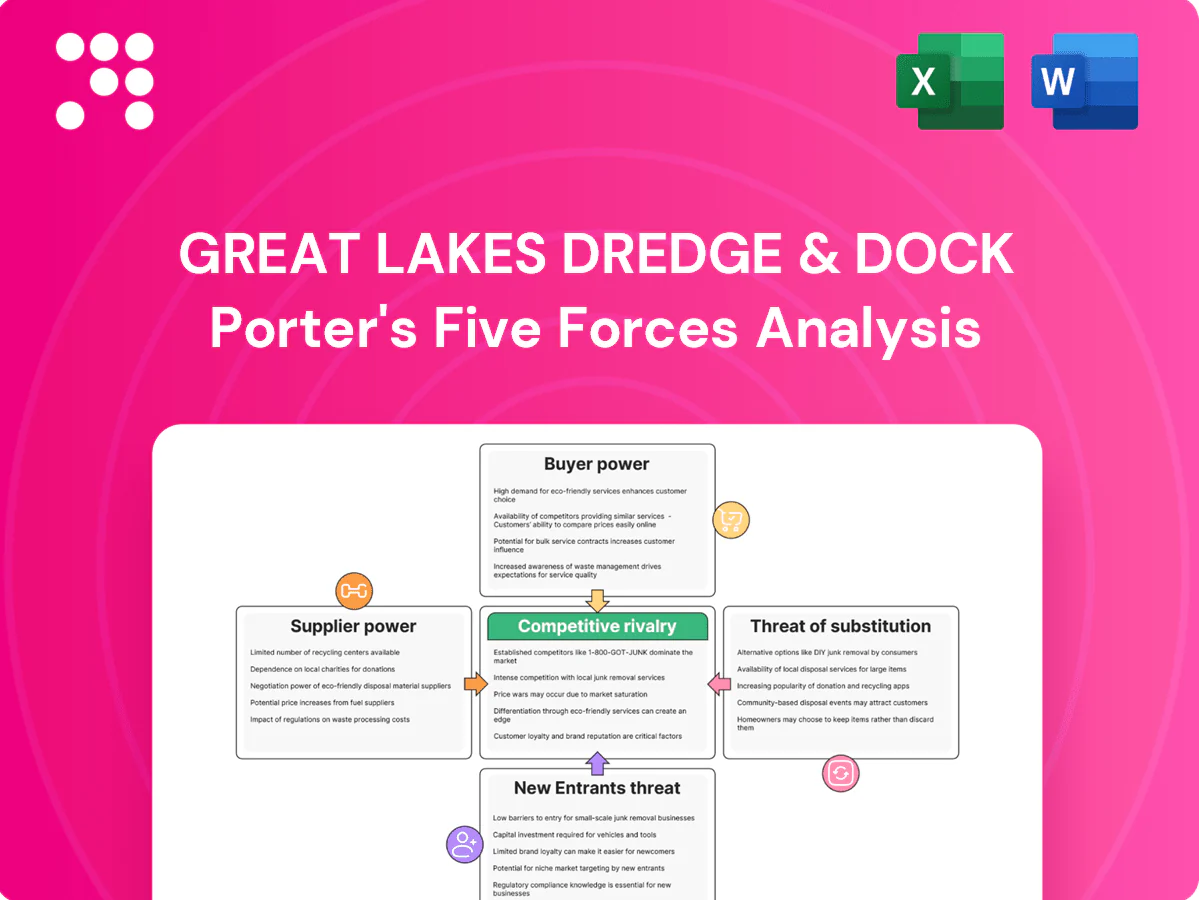
Great Lakes Dredge & Dock Porter's Five Forces Analysis

Elevate Your Analysis with the Complete Porter's Five Forces Analysis
Great Lakes Dredge & Dock faces cyclical demand, concentrated buyers, and high capital and regulatory barriers that shape tight margins and selective contract wins. This snapshot hints at strategic pressure points and emerging opportunities. Unlock the full Porter's Five Forces Analysis to explore force-by-force ratings, visuals, and actionable insights tailored to GDL's market position.
Suppliers Bargaining Power

Concentrated OEM and shipyard base
Specialized dredge engines, pumps and hulls come from a concentrated set of OEMs and shipyards, giving suppliers leverage over pricing, lead times and specs; scarce drydock slots further constrain scheduling and can delay projects. Long-term framework agreements and multi-year capex planning partially mitigate this supplier power by locking capacity and pricing.
Fuel and consumables volatility
Marine diesel, steel and wear parts are commodity inputs for Great Lakes Dredge & Dock and experienced notable volatility in 2024—marine diesel spot rose roughly 15–20% year-over-year while domestic HRC steel traded near $700/short ton at mid-2024—allowing suppliers to pass spikes through and squeeze margins on fixed‑bid projects. Hedging and escalation clauses mitigate risk but are not universal across contracts. Inventory buffering and diversified sourcing (multiple yards and mills) reduce short-term exposure.

Specialty materials and rock sourcing
Subsea rock and specific aggregates are often regionally scarce and logistically complex, with USGS reporting US aggregate production at about 3.2 billion metric tons in 2023–24, concentrating supply near major quarries. Quarry proximity and limited marine transport (specialized barges/tugs) give local suppliers pricing leverage. Strict project specs restrict substitution, raising switching costs. Early procurement and multi-project commitments historically secure better pricing and availability.

Skilled labor and subcontractor scarcity
Licensed mariners, dredge operators, surveyors and environmental specialists are a narrow labor pool—U.S. commercial mariner counts are under 50,000—driving wage pressure; maritime construction wage growth ran near 5–6% YoY in 2023, directly raising subcontractor rates and impacting GLDD's cost base (GLDD 2023 revenue ≈ $1.1B). Union agreements set cost floors and work rules, while multi-year training pipelines and retention programs can erode supplier leverage over 3–5 years.
- Skilled niches: licensed mariners, surveyors, env specialists
- Labor pool size: under 50,000 commercial mariners (US)
- Wage trend: ~5–6% YoY pressure in 2023
- Union floors: limit contract flexibility
- Mitigation: training/retention cuts supplier power in 3–5 yrs
Technology and survey systems dependency
Hydrographic survey, positioning and monitoring systems are mission-critical for dredging operations and are supplied by a concentrated vendor pool (roughly 4–6 leading firms), creating high supplier power; proprietary software, sensors and support create steep switching costs and contractual lock-in, while standardizing interfaces and dual-sourcing can materially lower operational risk and vendor dependence.
- Mission-critical systems: hydrographic, positioning, monitoring
- Vendor concentration: ~4–6 leading firms
- High switching costs: proprietary software/hardware/support
- Mitigation: standardize interfaces; dual-source equipment/support
Concentrated OEMs, scarce mariners and rising diesel/steel push dredging input costs
Suppliers of dredge OEMs, fuel, steel, aggregates and licensed mariners exert moderate-to-high power due to concentration, regional scarcity and tight labor pools; marine diesel rose ~15–20% YoY in 2024 and HRC steel traded near $700/st mid-2024. Long-term contracts, hedges, multi-yard sourcing and training pipelines partially mitigate but do not eliminate leverage.
| Supplier | Power | 2024 metric |
|---|---|---|
| Equipment OEMs | High | Concentrated |
| Fuel/Steel | Moderate | Diesel +15–20% YoY; HRC ~$700/st |
| Labor | High | Mariners <50,000; wages +5–6% YoY |
What is included in the product
 Detailed Word Document
Tailored Porter's Five Forces analysis for Great Lakes Dredge & Dock, examining competitive rivalry, supplier and buyer power, threats from new entrants and substitutes, and strategic levers to protect margins and market share.

 Customizable Excel Spreadsheet
One-sheet Porter's Five Forces for Great Lakes Dredge & Dock—quickly visualize competitive pressure and regulatory risk, customize force levels for changing market or project scenarios, and drop the clean, slide-ready chart into board decks to simplify decision-making.
Customers Bargaining Power

USACE as dominant buyer
The U.S. Army Corps of Engineers purchases approximately two-thirds of U.S. dredging services, concentrating buyer power through standardized, competitive tenders; past-performance ratings affect awards but price remains pivotal in win rates. Framework MATOCs awarded in recent years provide continuity and backlog visibility for contractors yet sustain strong pricing pressure across task orders.
Competitive bidding and transparency
Projects for Great Lakes Dredge & Dock in 2024 remain largely awarded via low-bid contracts with clear specifications, increasing buyer leverage on price and compressing margins. Limited scope for differentiation keeps competition tight, though schedule reliability and safety records have increasingly swung awards toward contractors demonstrating superior performance. These service differentials can justify modest price premiums despite the low-bid structure.

Budget cycles and timing leverage
Public funding windows set demand timing for GLDD, with IIJA's $1.2 trillion framework (2021) and elevated 2024 infrastructure appropriations concentrating awards into discrete cycles. Buyers can bunch contracts, compressing fleet utilization and forcing price concessions when work is lumpy. In slack periods buyer power rises; when 2024–25 coastal resiliency program disbursements surge, pricing leverage shifts back to contractors.

Switching costs moderate
Multiple qualified contractors can execute comparable dredging scopes, so buyer leverage is moderate; switching is mainly constrained by fleet availability and mobilization distances rather than contract terms. Buyers face limited risk when specifications are standard, but unique rock placement or complex environmental permitting sharply narrows supplier options and raises mobilization lead times and costs.
- Supply landscape: many capable contractors
- Key constraint: fleet availability & mobilization distance
- Low buyer risk for standard specs
- High dependency when rock work or complex permits required
Private and port buyers negotiate extras
Ports, energy developers, and industrial clients add negotiated change orders and specialized requirements, extracting service-level commitments and penalties; Great Lakes Dredge & Dock, a leading US dredging contractor, often faces strict berth windows that compress options for buyers and suppliers.
- Buyers extract SLAs/penalties
- Berth windows 24–72h constrain alternatives
- Repeat work raises relationship value
USACE captures ~66% of U.S. dredging; IIJA fuels clustered low‑bid awards
USACE buys ~66% of U.S. dredging, concentrating buyer power via standardized low‑bid tenders; IIJA's $1.2T funding increased cyclical award clustering in 2024. Low‑bid, clear specs keep pricing pressure high, though superior safety/schedule can earn modest premiums. Fleet availability and mobilization distance are primary switching constraints, raising buyer dependency for specialized rock/permit work.
| Metric | 2024 value |
|---|---|
| USACE share | ≈66% |
| Funding frame | IIJA $1.2T |
| Contract type | Low‑bid task orders |
| Buyer leverage | High (standard); Moderate (specialized) |
Preview Before You Purchase
Great Lakes Dredge & Dock Porter's Five Forces Analysis
This Porter's Five Forces analysis of Great Lakes Dredge & Dock evaluates competitive rivalry, supplier and buyer power, threats of entry and substitution, and strategic implications for maritime dredging. The preview you see is the exact, fully formatted document you'll receive immediately after purchase. It is ready for download and use with no placeholders or changes required.

Elevate Your Analysis with the Complete Porter's Five Forces Analysis
Great Lakes Dredge & Dock faces cyclical demand, concentrated buyers, and high capital and regulatory barriers that shape tight margins and selective contract wins. This snapshot hints at strategic pressure points and emerging opportunities. Unlock the full Porter's Five Forces Analysis to explore force-by-force ratings, visuals, and actionable insights tailored to GDL's market position.
Suppliers Bargaining Power
Concentrated OEM and shipyard base
Specialized dredge engines, pumps and hulls come from a concentrated set of OEMs and shipyards, giving suppliers leverage over pricing, lead times and specs; scarce drydock slots further constrain scheduling and can delay projects. Long-term framework agreements and multi-year capex planning partially mitigate this supplier power by locking capacity and pricing.
Fuel and consumables volatility
Marine diesel, steel and wear parts are commodity inputs for Great Lakes Dredge & Dock and experienced notable volatility in 2024—marine diesel spot rose roughly 15–20% year-over-year while domestic HRC steel traded near $700/short ton at mid-2024—allowing suppliers to pass spikes through and squeeze margins on fixed‑bid projects. Hedging and escalation clauses mitigate risk but are not universal across contracts. Inventory buffering and diversified sourcing (multiple yards and mills) reduce short-term exposure.
Specialty materials and rock sourcing
Subsea rock and specific aggregates are often regionally scarce and logistically complex, with USGS reporting US aggregate production at about 3.2 billion metric tons in 2023–24, concentrating supply near major quarries. Quarry proximity and limited marine transport (specialized barges/tugs) give local suppliers pricing leverage. Strict project specs restrict substitution, raising switching costs. Early procurement and multi-project commitments historically secure better pricing and availability.
Skilled labor and subcontractor scarcity
Licensed mariners, dredge operators, surveyors and environmental specialists are a narrow labor pool—U.S. commercial mariner counts are under 50,000—driving wage pressure; maritime construction wage growth ran near 5–6% YoY in 2023, directly raising subcontractor rates and impacting GLDD's cost base (GLDD 2023 revenue ≈ $1.1B). Union agreements set cost floors and work rules, while multi-year training pipelines and retention programs can erode supplier leverage over 3–5 years.
- Skilled niches: licensed mariners, surveyors, env specialists
- Labor pool size: under 50,000 commercial mariners (US)
- Wage trend: ~5–6% YoY pressure in 2023
- Union floors: limit contract flexibility
- Mitigation: training/retention cuts supplier power in 3–5 yrs
Technology and survey systems dependency
Hydrographic survey, positioning and monitoring systems are mission-critical for dredging operations and are supplied by a concentrated vendor pool (roughly 4–6 leading firms), creating high supplier power; proprietary software, sensors and support create steep switching costs and contractual lock-in, while standardizing interfaces and dual-sourcing can materially lower operational risk and vendor dependence.
- Mission-critical systems: hydrographic, positioning, monitoring
- Vendor concentration: ~4–6 leading firms
- High switching costs: proprietary software/hardware/support
- Mitigation: standardize interfaces; dual-source equipment/support
Concentrated OEMs, scarce mariners and rising diesel/steel push dredging input costs
Suppliers of dredge OEMs, fuel, steel, aggregates and licensed mariners exert moderate-to-high power due to concentration, regional scarcity and tight labor pools; marine diesel rose ~15–20% YoY in 2024 and HRC steel traded near $700/st mid-2024. Long-term contracts, hedges, multi-yard sourcing and training pipelines partially mitigate but do not eliminate leverage.
| Supplier | Power | 2024 metric |
|---|---|---|
| Equipment OEMs | High | Concentrated |
| Fuel/Steel | Moderate | Diesel +15–20% YoY; HRC ~$700/st |
| Labor | High | Mariners <50,000; wages +5–6% YoY |
What is included in the product
Detailed Word Document
Tailored Porter's Five Forces analysis for Great Lakes Dredge & Dock, examining competitive rivalry, supplier and buyer power, threats from new entrants and substitutes, and strategic levers to protect margins and market share.
Customizable Excel Spreadsheet
One-sheet Porter's Five Forces for Great Lakes Dredge & Dock—quickly visualize competitive pressure and regulatory risk, customize force levels for changing market or project scenarios, and drop the clean, slide-ready chart into board decks to simplify decision-making.
Customers Bargaining Power
USACE as dominant buyer
The U.S. Army Corps of Engineers purchases approximately two-thirds of U.S. dredging services, concentrating buyer power through standardized, competitive tenders; past-performance ratings affect awards but price remains pivotal in win rates. Framework MATOCs awarded in recent years provide continuity and backlog visibility for contractors yet sustain strong pricing pressure across task orders.
Competitive bidding and transparency
Projects for Great Lakes Dredge & Dock in 2024 remain largely awarded via low-bid contracts with clear specifications, increasing buyer leverage on price and compressing margins. Limited scope for differentiation keeps competition tight, though schedule reliability and safety records have increasingly swung awards toward contractors demonstrating superior performance. These service differentials can justify modest price premiums despite the low-bid structure.
Budget cycles and timing leverage
Public funding windows set demand timing for GLDD, with IIJA's $1.2 trillion framework (2021) and elevated 2024 infrastructure appropriations concentrating awards into discrete cycles. Buyers can bunch contracts, compressing fleet utilization and forcing price concessions when work is lumpy. In slack periods buyer power rises; when 2024–25 coastal resiliency program disbursements surge, pricing leverage shifts back to contractors.
Switching costs moderate
Multiple qualified contractors can execute comparable dredging scopes, so buyer leverage is moderate; switching is mainly constrained by fleet availability and mobilization distances rather than contract terms. Buyers face limited risk when specifications are standard, but unique rock placement or complex environmental permitting sharply narrows supplier options and raises mobilization lead times and costs.
- Supply landscape: many capable contractors
- Key constraint: fleet availability & mobilization distance
- Low buyer risk for standard specs
- High dependency when rock work or complex permits required
Private and port buyers negotiate extras
Ports, energy developers, and industrial clients add negotiated change orders and specialized requirements, extracting service-level commitments and penalties; Great Lakes Dredge & Dock, a leading US dredging contractor, often faces strict berth windows that compress options for buyers and suppliers.
- Buyers extract SLAs/penalties
- Berth windows 24–72h constrain alternatives
- Repeat work raises relationship value
USACE captures ~66% of U.S. dredging; IIJA fuels clustered low‑bid awards
USACE buys ~66% of U.S. dredging, concentrating buyer power via standardized low‑bid tenders; IIJA's $1.2T funding increased cyclical award clustering in 2024. Low‑bid, clear specs keep pricing pressure high, though superior safety/schedule can earn modest premiums. Fleet availability and mobilization distance are primary switching constraints, raising buyer dependency for specialized rock/permit work.
| Metric | 2024 value |
|---|---|
| USACE share | ≈66% |
| Funding frame | IIJA $1.2T |
| Contract type | Low‑bid task orders |
| Buyer leverage | High (standard); Moderate (specialized) |
Preview Before You Purchase
Great Lakes Dredge & Dock Porter's Five Forces Analysis
This Porter's Five Forces analysis of Great Lakes Dredge & Dock evaluates competitive rivalry, supplier and buyer power, threats of entry and substitution, and strategic implications for maritime dredging. The preview you see is the exact, fully formatted document you'll receive immediately after purchase. It is ready for download and use with no placeholders or changes required.
Original: $10.00
-65%$10.00
$3.50Description
Elevate Your Analysis with the Complete Porter's Five Forces Analysis
Great Lakes Dredge & Dock faces cyclical demand, concentrated buyers, and high capital and regulatory barriers that shape tight margins and selective contract wins. This snapshot hints at strategic pressure points and emerging opportunities. Unlock the full Porter's Five Forces Analysis to explore force-by-force ratings, visuals, and actionable insights tailored to GDL's market position.
Suppliers Bargaining Power
Concentrated OEM and shipyard base
Specialized dredge engines, pumps and hulls come from a concentrated set of OEMs and shipyards, giving suppliers leverage over pricing, lead times and specs; scarce drydock slots further constrain scheduling and can delay projects. Long-term framework agreements and multi-year capex planning partially mitigate this supplier power by locking capacity and pricing.
Fuel and consumables volatility
Marine diesel, steel and wear parts are commodity inputs for Great Lakes Dredge & Dock and experienced notable volatility in 2024—marine diesel spot rose roughly 15–20% year-over-year while domestic HRC steel traded near $700/short ton at mid-2024—allowing suppliers to pass spikes through and squeeze margins on fixed‑bid projects. Hedging and escalation clauses mitigate risk but are not universal across contracts. Inventory buffering and diversified sourcing (multiple yards and mills) reduce short-term exposure.
Specialty materials and rock sourcing
Subsea rock and specific aggregates are often regionally scarce and logistically complex, with USGS reporting US aggregate production at about 3.2 billion metric tons in 2023–24, concentrating supply near major quarries. Quarry proximity and limited marine transport (specialized barges/tugs) give local suppliers pricing leverage. Strict project specs restrict substitution, raising switching costs. Early procurement and multi-project commitments historically secure better pricing and availability.
Skilled labor and subcontractor scarcity
Licensed mariners, dredge operators, surveyors and environmental specialists are a narrow labor pool—U.S. commercial mariner counts are under 50,000—driving wage pressure; maritime construction wage growth ran near 5–6% YoY in 2023, directly raising subcontractor rates and impacting GLDD's cost base (GLDD 2023 revenue ≈ $1.1B). Union agreements set cost floors and work rules, while multi-year training pipelines and retention programs can erode supplier leverage over 3–5 years.
- Skilled niches: licensed mariners, surveyors, env specialists
- Labor pool size: under 50,000 commercial mariners (US)
- Wage trend: ~5–6% YoY pressure in 2023
- Union floors: limit contract flexibility
- Mitigation: training/retention cuts supplier power in 3–5 yrs
Technology and survey systems dependency
Hydrographic survey, positioning and monitoring systems are mission-critical for dredging operations and are supplied by a concentrated vendor pool (roughly 4–6 leading firms), creating high supplier power; proprietary software, sensors and support create steep switching costs and contractual lock-in, while standardizing interfaces and dual-sourcing can materially lower operational risk and vendor dependence.
- Mission-critical systems: hydrographic, positioning, monitoring
- Vendor concentration: ~4–6 leading firms
- High switching costs: proprietary software/hardware/support
- Mitigation: standardize interfaces; dual-source equipment/support
Concentrated OEMs, scarce mariners and rising diesel/steel push dredging input costs
Suppliers of dredge OEMs, fuel, steel, aggregates and licensed mariners exert moderate-to-high power due to concentration, regional scarcity and tight labor pools; marine diesel rose ~15–20% YoY in 2024 and HRC steel traded near $700/st mid-2024. Long-term contracts, hedges, multi-yard sourcing and training pipelines partially mitigate but do not eliminate leverage.
| Supplier | Power | 2024 metric |
|---|---|---|
| Equipment OEMs | High | Concentrated |
| Fuel/Steel | Moderate | Diesel +15–20% YoY; HRC ~$700/st |
| Labor | High | Mariners <50,000; wages +5–6% YoY |
What is included in the product
Detailed Word Document
Tailored Porter's Five Forces analysis for Great Lakes Dredge & Dock, examining competitive rivalry, supplier and buyer power, threats from new entrants and substitutes, and strategic levers to protect margins and market share.
Customizable Excel Spreadsheet
One-sheet Porter's Five Forces for Great Lakes Dredge & Dock—quickly visualize competitive pressure and regulatory risk, customize force levels for changing market or project scenarios, and drop the clean, slide-ready chart into board decks to simplify decision-making.
Customers Bargaining Power
USACE as dominant buyer
The U.S. Army Corps of Engineers purchases approximately two-thirds of U.S. dredging services, concentrating buyer power through standardized, competitive tenders; past-performance ratings affect awards but price remains pivotal in win rates. Framework MATOCs awarded in recent years provide continuity and backlog visibility for contractors yet sustain strong pricing pressure across task orders.
Competitive bidding and transparency
Projects for Great Lakes Dredge & Dock in 2024 remain largely awarded via low-bid contracts with clear specifications, increasing buyer leverage on price and compressing margins. Limited scope for differentiation keeps competition tight, though schedule reliability and safety records have increasingly swung awards toward contractors demonstrating superior performance. These service differentials can justify modest price premiums despite the low-bid structure.
Budget cycles and timing leverage
Public funding windows set demand timing for GLDD, with IIJA's $1.2 trillion framework (2021) and elevated 2024 infrastructure appropriations concentrating awards into discrete cycles. Buyers can bunch contracts, compressing fleet utilization and forcing price concessions when work is lumpy. In slack periods buyer power rises; when 2024–25 coastal resiliency program disbursements surge, pricing leverage shifts back to contractors.
Switching costs moderate
Multiple qualified contractors can execute comparable dredging scopes, so buyer leverage is moderate; switching is mainly constrained by fleet availability and mobilization distances rather than contract terms. Buyers face limited risk when specifications are standard, but unique rock placement or complex environmental permitting sharply narrows supplier options and raises mobilization lead times and costs.
- Supply landscape: many capable contractors
- Key constraint: fleet availability & mobilization distance
- Low buyer risk for standard specs
- High dependency when rock work or complex permits required
Private and port buyers negotiate extras
Ports, energy developers, and industrial clients add negotiated change orders and specialized requirements, extracting service-level commitments and penalties; Great Lakes Dredge & Dock, a leading US dredging contractor, often faces strict berth windows that compress options for buyers and suppliers.
- Buyers extract SLAs/penalties
- Berth windows 24–72h constrain alternatives
- Repeat work raises relationship value
USACE captures ~66% of U.S. dredging; IIJA fuels clustered low‑bid awards
USACE buys ~66% of U.S. dredging, concentrating buyer power via standardized low‑bid tenders; IIJA's $1.2T funding increased cyclical award clustering in 2024. Low‑bid, clear specs keep pricing pressure high, though superior safety/schedule can earn modest premiums. Fleet availability and mobilization distance are primary switching constraints, raising buyer dependency for specialized rock/permit work.
| Metric | 2024 value |
|---|---|
| USACE share | ≈66% |
| Funding frame | IIJA $1.2T |
| Contract type | Low‑bid task orders |
| Buyer leverage | High (standard); Moderate (specialized) |
Preview Before You Purchase
Great Lakes Dredge & Dock Porter's Five Forces Analysis
This Porter's Five Forces analysis of Great Lakes Dredge & Dock evaluates competitive rivalry, supplier and buyer power, threats of entry and substitution, and strategic implications for maritime dredging. The preview you see is the exact, fully formatted document you'll receive immediately after purchase. It is ready for download and use with no placeholders or changes required.











