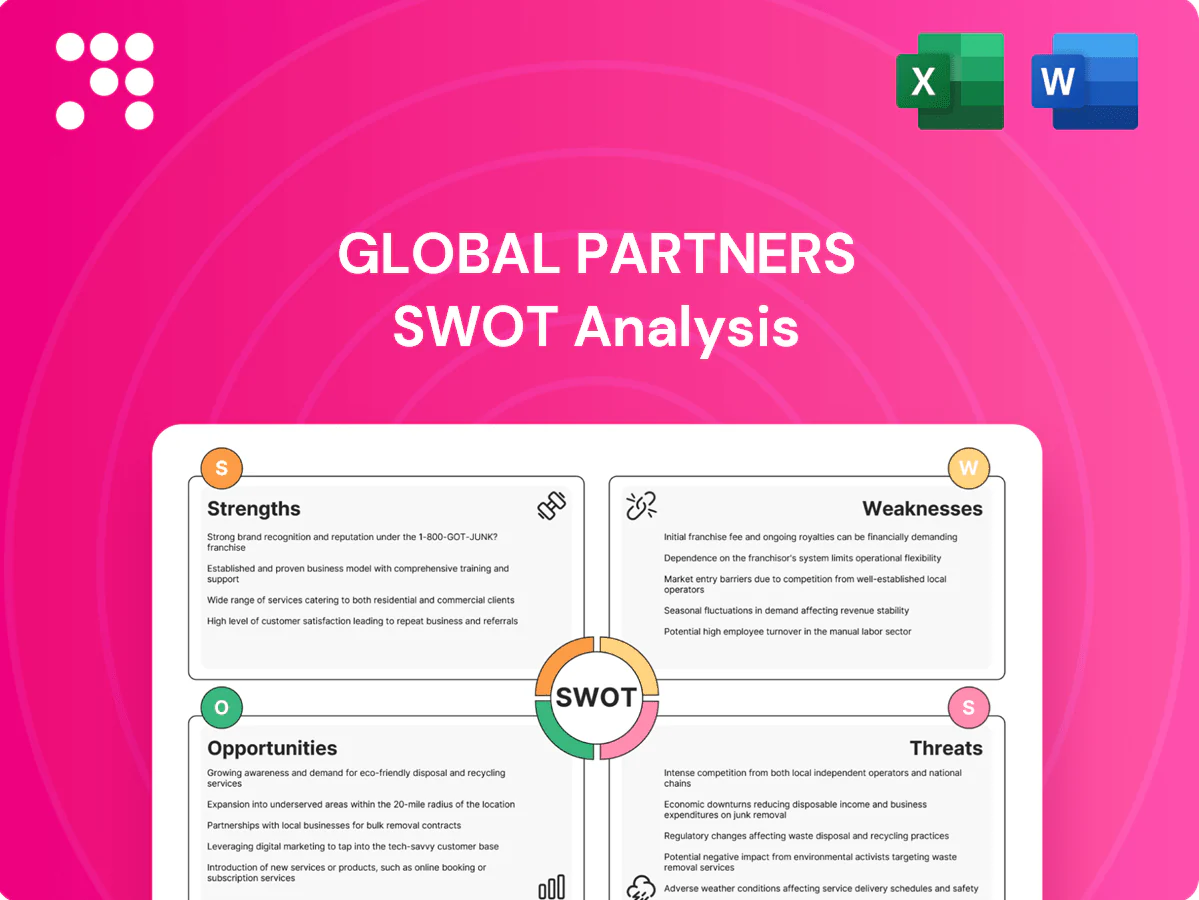
Global Partners SWOT Analysis

Elevate Your Analysis with the Complete SWOT Report
Global Partners' SWOT snapshot highlights a resilient retail network, midstream integration strengths, and exposure to fuel price cycles and regulatory shifts. Our full SWOT uncovers strategic risks, financial implications, and actionable recommendations for investors and managers. Purchase the complete, editable report and Excel model to plan, present, and invest with confidence.
Strengths

Extensive Northeast terminal network
One of the region’s largest storage and distribution footprints gives Global Partners scale advantages and service reliability across the Northeast. Dense, dozens-strong terminal coverage shortens last-mile delivery and improves turn times, supporting higher fill rates. That concentrated network increases pricing power in constrained markets and raises switching costs for customers.
Diverse petroleum and renewable fuel portfolio
Diverse product mix across gasoline, distillates, residuals and renewables broadens Global Partners’ revenue streams and mitigates single-market exposure. Advanced blending and handling capabilities let the company capture RINs and LCFS-driven demand and regulatory incentives. Product optionality supports margin resilience through fuel-cycle volatility and better aligns offerings with a shifting customer mix toward lower-carbon fuels.

Integrated logistics and marketing capabilities
Ownership and control of storage, transport interfaces, and merchandising deepen margins by capturing logistics spreads and retail uplift. Scheduling, inventory optimization, and basis/arbitrage capture boost profitability through tighter seasonal and regional matching. Integrated operations reduce counterparties and friction costs, lowering transactional risk. This supports dependable supply to wholesalers and commercial clients, enhancing contract reliability.

Entrenched regional relationships
Long-standing ties with regional retailers, wholesalers and commercial customers (primarily in the Northeast US and eastern Canada) drive recurring volumes and repeat business, while term supply arrangements stabilize throughput and cash flows.
Deep knowledge of local regulations and seasonal demand patterns improves planning and logistics; reputation for reliable deliveries is a measurable competitive moat.
- Regional footprint: Northeast US & eastern Canada
- Term contracts: stabilize cash flow
- Seasonal/regulatory expertise
- Reliability = competitive moat
Scale-driven purchasing and supply optionality
Scale-driven purchasing and multimodal supply optionality give Global Partners access to marine, rail and pipeline sources, improving security of supply and enabling procurement leverage that lowers delivered cost and freight per gallon. Storage optionality permits time-spread purchasing and basis management, supporting superior gross margin per gallon versus spot-only competitors.
- Multimodal supply: marine, rail, pipeline
- Procurement leverage: improved freight economics
- Storage optionality: time-spread & basis management
- Result: higher gross margin per gallon
Northeast multimodal fuel network drives stable cash flow and renewable credits upside
Dense Northeast US & eastern Canada terminal network and multimodal supply provide reliable last-mile delivery and procurement leverage; integrated storage, transport and merchandising capture logistics spreads and retail uplift. Diverse fuel mix and blending capability enable participation in RIN/LCFS markets and margin resilience. Long-term term contracts and regional regulatory expertise sustain repeat volumes and cash-flow stability.
| Metric | Evidence |
|---|---|
| Footprint | Northeast US & eastern Canada terminals |
| Integration | Storage, transport, merchandising |
| Product mix | Gasoline, distillates, residuals, renewables |
| Contracts | Term supply arrangements |
What is included in the product
 Detailed Word Document
Provides a concise SWOT overview of Global Partners, highlighting internal strengths and weaknesses and external opportunities and threats affecting its fuel distribution, retail and convenience operations, along with key strategic risks and growth levers shaping its competitive position.

 Customizable Excel Spreadsheet
Provides a clear, tailored SWOT matrix for Global Partners to quickly pinpoint and address strategic pain points, enabling fast alignment for executives and concise stakeholder briefings.
Weaknesses

Geographic concentration in New England and New York
Global Partners' revenue is highly tied to New England and New York, so regional economic slowdowns or state-level policy changes directly pressure top-line performance. Local demand shifts or regulatory actions can disproportionately reduce fuel volumes and margins. Weather volatility in the Northeast—storms and harsh winters—amplifies operational disruption risk. Limited national diversification constrains the company’s resilience to localized shocks.
Exposure to commodity and basis volatility
While Global Partners is largely midstream, margins remain tied to product spreads and crude-to-product differentials; inventory price swings have historically amplified working capital swings and quarterly earnings volatility. Hedging programs mitigate but do not eliminate basis and crack-spread risk, and abrupt commodity moves can quickly strain liquidity and increase borrowing needs.

Capital-intensive asset base
Terminal maintenance, upgrades and regulatory compliance require steady capital expenditures, making Global Partners' asset base capital-intensive. Returns depend on high terminal utilization and operational efficiency; underuse compresses margins. Project delays or cost overruns directly erode IRR. In downturns, heavy fixed assets can tighten balance sheet flexibility and increase refinancing risk.

Regulatory and environmental compliance burden
Regulatory and environmental compliance in the Northeast — covering permitting, stringent emissions limits, and rigorous spill-prevention standards — raises operating complexity and costs for Global Partners, increasing CAPEX and OPEX and heightening scheduling risk. Noncompliance carries fines and reputational damage that can disrupt fuel supply contracts. Emerging standards may force costly retrofits of terminals and pipelines.
- Permitting complexity raises project timelines
- Emissions and spill rules increase OPEX/CAPEX
- Noncompliance risk: fines and reputational loss
- Future standards may require expensive retrofits
Dependence on third-party transport links
Dependence on third-party pipelines, railroads and marine terminals creates bottleneck risk for Global Partners; EIA data shows pipelines carry roughly 70% of U.S. petroleum volumes, concentrating exposure. Disruptions to any link can cut throughput and raise logistics costs, while limited alternatives in key Northeast and Gulf corridors increase vulnerability. Repeated service issues risk straining wholesale and retail customer relationships and margins.
- Exposure: heavy reliance on pipelines/rail/marine
- Impact: reduced throughput, higher transport costs
- Vulnerability: few alternatives in key corridors
- Customer risk: service failures harm contracts and margins
Northeast concentration and 70% pipeline reliance amplify earnings, liquidity and operational risk
Heavy regional exposure to the Northeast/New York concentrates revenue and policy risk; weather and local demand swings amplify volatility. Commodity basis/crack spread swings and imperfect hedges create earnings and liquidity volatility. Capital-intensive terminals, regulatory compliance and reliance on third-party pipelines (pipelines carry roughly 70% of U.S. petroleum volumes per EIA) raise operational and refinancing risk.
| Weakness | Metric |
|---|---|
| Pipeline reliance | ~70% U.S. petroleum via pipelines (EIA) |
| Regional concentration | High (Northeast/NY) |
Full Version Awaits
Global Partners SWOT Analysis
This is the actual SWOT analysis document you’ll receive upon purchase—no surprises, just professional quality. The preview below is taken directly from the full report and reflects the structure, findings and editable format of the final file. Purchase unlocks the entire, downloadable version for immediate use.

Elevate Your Analysis with the Complete SWOT Report
Global Partners' SWOT snapshot highlights a resilient retail network, midstream integration strengths, and exposure to fuel price cycles and regulatory shifts. Our full SWOT uncovers strategic risks, financial implications, and actionable recommendations for investors and managers. Purchase the complete, editable report and Excel model to plan, present, and invest with confidence.
Strengths
Extensive Northeast terminal network
One of the region’s largest storage and distribution footprints gives Global Partners scale advantages and service reliability across the Northeast. Dense, dozens-strong terminal coverage shortens last-mile delivery and improves turn times, supporting higher fill rates. That concentrated network increases pricing power in constrained markets and raises switching costs for customers.
Diverse petroleum and renewable fuel portfolio
Diverse product mix across gasoline, distillates, residuals and renewables broadens Global Partners’ revenue streams and mitigates single-market exposure. Advanced blending and handling capabilities let the company capture RINs and LCFS-driven demand and regulatory incentives. Product optionality supports margin resilience through fuel-cycle volatility and better aligns offerings with a shifting customer mix toward lower-carbon fuels.
Integrated logistics and marketing capabilities
Ownership and control of storage, transport interfaces, and merchandising deepen margins by capturing logistics spreads and retail uplift. Scheduling, inventory optimization, and basis/arbitrage capture boost profitability through tighter seasonal and regional matching. Integrated operations reduce counterparties and friction costs, lowering transactional risk. This supports dependable supply to wholesalers and commercial clients, enhancing contract reliability.
Entrenched regional relationships
Long-standing ties with regional retailers, wholesalers and commercial customers (primarily in the Northeast US and eastern Canada) drive recurring volumes and repeat business, while term supply arrangements stabilize throughput and cash flows.
Deep knowledge of local regulations and seasonal demand patterns improves planning and logistics; reputation for reliable deliveries is a measurable competitive moat.
- Regional footprint: Northeast US & eastern Canada
- Term contracts: stabilize cash flow
- Seasonal/regulatory expertise
- Reliability = competitive moat
Scale-driven purchasing and supply optionality
Scale-driven purchasing and multimodal supply optionality give Global Partners access to marine, rail and pipeline sources, improving security of supply and enabling procurement leverage that lowers delivered cost and freight per gallon. Storage optionality permits time-spread purchasing and basis management, supporting superior gross margin per gallon versus spot-only competitors.
- Multimodal supply: marine, rail, pipeline
- Procurement leverage: improved freight economics
- Storage optionality: time-spread & basis management
- Result: higher gross margin per gallon
Northeast multimodal fuel network drives stable cash flow and renewable credits upside
Dense Northeast US & eastern Canada terminal network and multimodal supply provide reliable last-mile delivery and procurement leverage; integrated storage, transport and merchandising capture logistics spreads and retail uplift. Diverse fuel mix and blending capability enable participation in RIN/LCFS markets and margin resilience. Long-term term contracts and regional regulatory expertise sustain repeat volumes and cash-flow stability.
| Metric | Evidence |
|---|---|
| Footprint | Northeast US & eastern Canada terminals |
| Integration | Storage, transport, merchandising |
| Product mix | Gasoline, distillates, residuals, renewables |
| Contracts | Term supply arrangements |
What is included in the product
Detailed Word Document
Provides a concise SWOT overview of Global Partners, highlighting internal strengths and weaknesses and external opportunities and threats affecting its fuel distribution, retail and convenience operations, along with key strategic risks and growth levers shaping its competitive position.
Customizable Excel Spreadsheet
Provides a clear, tailored SWOT matrix for Global Partners to quickly pinpoint and address strategic pain points, enabling fast alignment for executives and concise stakeholder briefings.
Weaknesses
Geographic concentration in New England and New York
Global Partners' revenue is highly tied to New England and New York, so regional economic slowdowns or state-level policy changes directly pressure top-line performance. Local demand shifts or regulatory actions can disproportionately reduce fuel volumes and margins. Weather volatility in the Northeast—storms and harsh winters—amplifies operational disruption risk. Limited national diversification constrains the company’s resilience to localized shocks.
Exposure to commodity and basis volatility
While Global Partners is largely midstream, margins remain tied to product spreads and crude-to-product differentials; inventory price swings have historically amplified working capital swings and quarterly earnings volatility. Hedging programs mitigate but do not eliminate basis and crack-spread risk, and abrupt commodity moves can quickly strain liquidity and increase borrowing needs.
Capital-intensive asset base
Terminal maintenance, upgrades and regulatory compliance require steady capital expenditures, making Global Partners' asset base capital-intensive. Returns depend on high terminal utilization and operational efficiency; underuse compresses margins. Project delays or cost overruns directly erode IRR. In downturns, heavy fixed assets can tighten balance sheet flexibility and increase refinancing risk.
Regulatory and environmental compliance burden
Regulatory and environmental compliance in the Northeast — covering permitting, stringent emissions limits, and rigorous spill-prevention standards — raises operating complexity and costs for Global Partners, increasing CAPEX and OPEX and heightening scheduling risk. Noncompliance carries fines and reputational damage that can disrupt fuel supply contracts. Emerging standards may force costly retrofits of terminals and pipelines.
- Permitting complexity raises project timelines
- Emissions and spill rules increase OPEX/CAPEX
- Noncompliance risk: fines and reputational loss
- Future standards may require expensive retrofits
Dependence on third-party transport links
Dependence on third-party pipelines, railroads and marine terminals creates bottleneck risk for Global Partners; EIA data shows pipelines carry roughly 70% of U.S. petroleum volumes, concentrating exposure. Disruptions to any link can cut throughput and raise logistics costs, while limited alternatives in key Northeast and Gulf corridors increase vulnerability. Repeated service issues risk straining wholesale and retail customer relationships and margins.
- Exposure: heavy reliance on pipelines/rail/marine
- Impact: reduced throughput, higher transport costs
- Vulnerability: few alternatives in key corridors
- Customer risk: service failures harm contracts and margins
Northeast concentration and 70% pipeline reliance amplify earnings, liquidity and operational risk
Heavy regional exposure to the Northeast/New York concentrates revenue and policy risk; weather and local demand swings amplify volatility. Commodity basis/crack spread swings and imperfect hedges create earnings and liquidity volatility. Capital-intensive terminals, regulatory compliance and reliance on third-party pipelines (pipelines carry roughly 70% of U.S. petroleum volumes per EIA) raise operational and refinancing risk.
| Weakness | Metric |
|---|---|
| Pipeline reliance | ~70% U.S. petroleum via pipelines (EIA) |
| Regional concentration | High (Northeast/NY) |
Full Version Awaits
Global Partners SWOT Analysis
This is the actual SWOT analysis document you’ll receive upon purchase—no surprises, just professional quality. The preview below is taken directly from the full report and reflects the structure, findings and editable format of the final file. Purchase unlocks the entire, downloadable version for immediate use.
Original: $10.00
-65%$10.00
$3.50Description
Elevate Your Analysis with the Complete SWOT Report
Global Partners' SWOT snapshot highlights a resilient retail network, midstream integration strengths, and exposure to fuel price cycles and regulatory shifts. Our full SWOT uncovers strategic risks, financial implications, and actionable recommendations for investors and managers. Purchase the complete, editable report and Excel model to plan, present, and invest with confidence.
Strengths
Extensive Northeast terminal network
One of the region’s largest storage and distribution footprints gives Global Partners scale advantages and service reliability across the Northeast. Dense, dozens-strong terminal coverage shortens last-mile delivery and improves turn times, supporting higher fill rates. That concentrated network increases pricing power in constrained markets and raises switching costs for customers.
Diverse petroleum and renewable fuel portfolio
Diverse product mix across gasoline, distillates, residuals and renewables broadens Global Partners’ revenue streams and mitigates single-market exposure. Advanced blending and handling capabilities let the company capture RINs and LCFS-driven demand and regulatory incentives. Product optionality supports margin resilience through fuel-cycle volatility and better aligns offerings with a shifting customer mix toward lower-carbon fuels.
Integrated logistics and marketing capabilities
Ownership and control of storage, transport interfaces, and merchandising deepen margins by capturing logistics spreads and retail uplift. Scheduling, inventory optimization, and basis/arbitrage capture boost profitability through tighter seasonal and regional matching. Integrated operations reduce counterparties and friction costs, lowering transactional risk. This supports dependable supply to wholesalers and commercial clients, enhancing contract reliability.
Entrenched regional relationships
Long-standing ties with regional retailers, wholesalers and commercial customers (primarily in the Northeast US and eastern Canada) drive recurring volumes and repeat business, while term supply arrangements stabilize throughput and cash flows.
Deep knowledge of local regulations and seasonal demand patterns improves planning and logistics; reputation for reliable deliveries is a measurable competitive moat.
- Regional footprint: Northeast US & eastern Canada
- Term contracts: stabilize cash flow
- Seasonal/regulatory expertise
- Reliability = competitive moat
Scale-driven purchasing and supply optionality
Scale-driven purchasing and multimodal supply optionality give Global Partners access to marine, rail and pipeline sources, improving security of supply and enabling procurement leverage that lowers delivered cost and freight per gallon. Storage optionality permits time-spread purchasing and basis management, supporting superior gross margin per gallon versus spot-only competitors.
- Multimodal supply: marine, rail, pipeline
- Procurement leverage: improved freight economics
- Storage optionality: time-spread & basis management
- Result: higher gross margin per gallon
Northeast multimodal fuel network drives stable cash flow and renewable credits upside
Dense Northeast US & eastern Canada terminal network and multimodal supply provide reliable last-mile delivery and procurement leverage; integrated storage, transport and merchandising capture logistics spreads and retail uplift. Diverse fuel mix and blending capability enable participation in RIN/LCFS markets and margin resilience. Long-term term contracts and regional regulatory expertise sustain repeat volumes and cash-flow stability.
| Metric | Evidence |
|---|---|
| Footprint | Northeast US & eastern Canada terminals |
| Integration | Storage, transport, merchandising |
| Product mix | Gasoline, distillates, residuals, renewables |
| Contracts | Term supply arrangements |
What is included in the product
Detailed Word Document
Provides a concise SWOT overview of Global Partners, highlighting internal strengths and weaknesses and external opportunities and threats affecting its fuel distribution, retail and convenience operations, along with key strategic risks and growth levers shaping its competitive position.
Customizable Excel Spreadsheet
Provides a clear, tailored SWOT matrix for Global Partners to quickly pinpoint and address strategic pain points, enabling fast alignment for executives and concise stakeholder briefings.
Weaknesses
Geographic concentration in New England and New York
Global Partners' revenue is highly tied to New England and New York, so regional economic slowdowns or state-level policy changes directly pressure top-line performance. Local demand shifts or regulatory actions can disproportionately reduce fuel volumes and margins. Weather volatility in the Northeast—storms and harsh winters—amplifies operational disruption risk. Limited national diversification constrains the company’s resilience to localized shocks.
Exposure to commodity and basis volatility
While Global Partners is largely midstream, margins remain tied to product spreads and crude-to-product differentials; inventory price swings have historically amplified working capital swings and quarterly earnings volatility. Hedging programs mitigate but do not eliminate basis and crack-spread risk, and abrupt commodity moves can quickly strain liquidity and increase borrowing needs.
Capital-intensive asset base
Terminal maintenance, upgrades and regulatory compliance require steady capital expenditures, making Global Partners' asset base capital-intensive. Returns depend on high terminal utilization and operational efficiency; underuse compresses margins. Project delays or cost overruns directly erode IRR. In downturns, heavy fixed assets can tighten balance sheet flexibility and increase refinancing risk.
Regulatory and environmental compliance burden
Regulatory and environmental compliance in the Northeast — covering permitting, stringent emissions limits, and rigorous spill-prevention standards — raises operating complexity and costs for Global Partners, increasing CAPEX and OPEX and heightening scheduling risk. Noncompliance carries fines and reputational damage that can disrupt fuel supply contracts. Emerging standards may force costly retrofits of terminals and pipelines.
- Permitting complexity raises project timelines
- Emissions and spill rules increase OPEX/CAPEX
- Noncompliance risk: fines and reputational loss
- Future standards may require expensive retrofits
Dependence on third-party transport links
Dependence on third-party pipelines, railroads and marine terminals creates bottleneck risk for Global Partners; EIA data shows pipelines carry roughly 70% of U.S. petroleum volumes, concentrating exposure. Disruptions to any link can cut throughput and raise logistics costs, while limited alternatives in key Northeast and Gulf corridors increase vulnerability. Repeated service issues risk straining wholesale and retail customer relationships and margins.
- Exposure: heavy reliance on pipelines/rail/marine
- Impact: reduced throughput, higher transport costs
- Vulnerability: few alternatives in key corridors
- Customer risk: service failures harm contracts and margins
Northeast concentration and 70% pipeline reliance amplify earnings, liquidity and operational risk
Heavy regional exposure to the Northeast/New York concentrates revenue and policy risk; weather and local demand swings amplify volatility. Commodity basis/crack spread swings and imperfect hedges create earnings and liquidity volatility. Capital-intensive terminals, regulatory compliance and reliance on third-party pipelines (pipelines carry roughly 70% of U.S. petroleum volumes per EIA) raise operational and refinancing risk.
| Weakness | Metric |
|---|---|
| Pipeline reliance | ~70% U.S. petroleum via pipelines (EIA) |
| Regional concentration | High (Northeast/NY) |
Full Version Awaits
Global Partners SWOT Analysis
This is the actual SWOT analysis document you’ll receive upon purchase—no surprises, just professional quality. The preview below is taken directly from the full report and reflects the structure, findings and editable format of the final file. Purchase unlocks the entire, downloadable version for immediate use.











