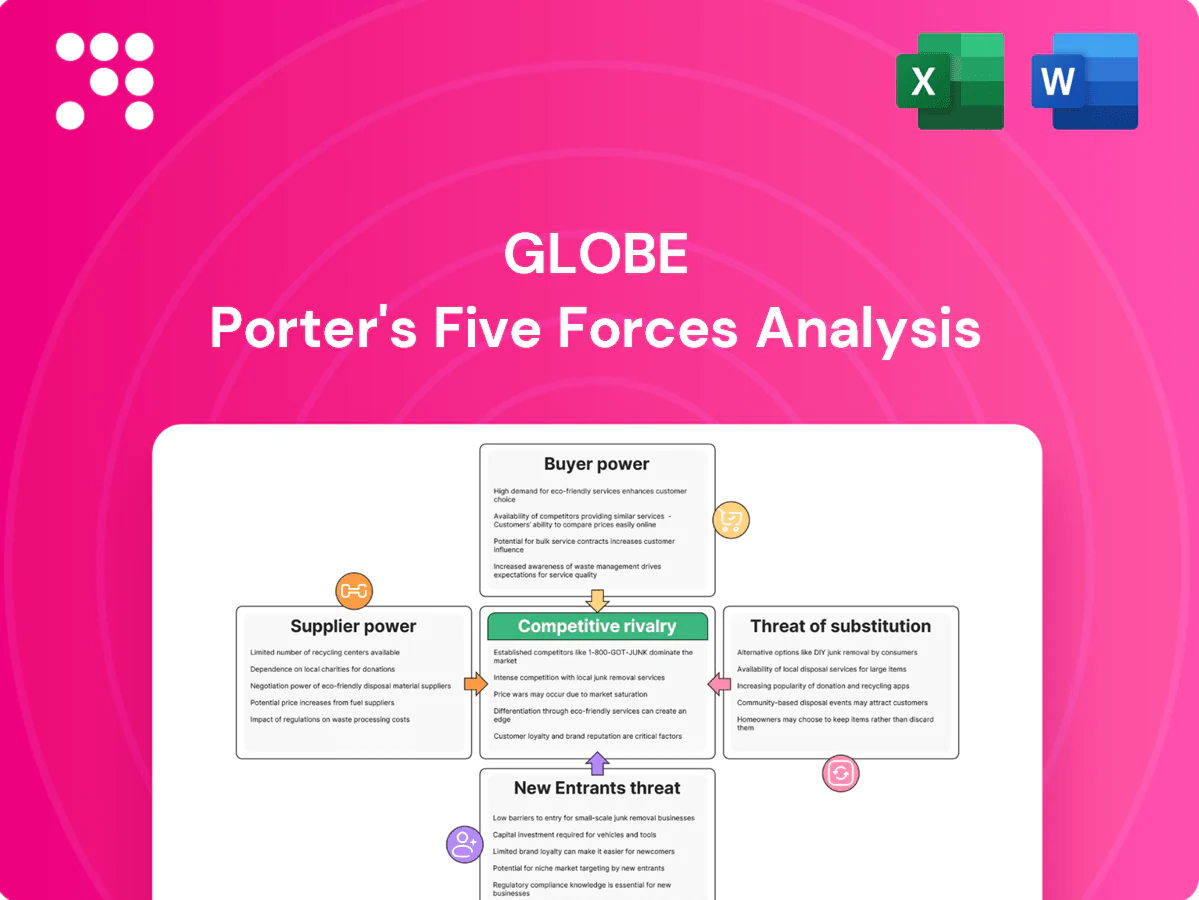
Globe Porter's Five Forces Analysis

Elevate Your Analysis with the Complete Porter's Five Forces Analysis
Globe’s Porter’s Five Forces snapshot highlights competitive intensity across suppliers, buyers, new entrants, substitutes, and rivalry, revealing key pressure points on margins and growth. This brief overview teases strategic implications and tactical moves. The full Porter’s Five Forces Analysis unlocks force-by-force ratings, visuals, and actionable recommendations to inform investment or strategy decisions—purchase the complete report to dive deeper.
Suppliers Bargaining Power

Concentrated specialty inputs
Skateboard hardgoods depend on Canadian hard rock maple plus specialized trucks, wheels and bearings made by a handful of mills and component makers, a concentration that increased supplier leverage and lead times in 2024. Globe can mitigate exposure via dual-sourcing and forward-buying critical inputs to smooth procurement. Sudden supply shocks or quality constraints in 2024 still risk passing cost pressure upstream to Globe.
Contract manufacturing dependence
Apparel and footwear production is largely outsourced to Asia—China accounted for ~34% of global apparel exports in 2024, Vietnam 14% and Bangladesh 6% (UN Comtrade 2024). While capacity is ample, switching suppliers typically requires 3–6 months of onboarding plus QA risk and potential timeline slippage. Suppliers with advanced capabilities or verified sustainability credentials command price premiums (often cited around 8–12%). Long-term volume commitments and multi-year contracts materially temper supplier bargaining power.

Logistics and freight volatility
Global distribution exposes Globe to freight rate swings, port congestion and FX; Drewry reported the World Container Index fell roughly 80% from 2021 peaks to 2023–24 normalization, but episodic spikes persist. Logistics providers and carriers wield power during capacity tightness via blank sailings and surcharges. Diversified lanes, nearshoring and inventory buffers cut exposure, though persistent volatility can still compress margins in peak seasons.

Quality and compliance requirements
Buyers demand consistent performance, safety standards and ESG certifications, narrowing the qualified supplier pool; by 2024 the EU CSRD expanded reporting obligations to roughly 50,000 companies, increasing downstream supplier scrutiny and compliance burden. Compliance raises switching costs and gives certified suppliers more leverage; Globe can standardize specs and invest in supplier development, while co-creating materials to secure preferential terms over time.
- Qualified suppliers: fewer due to ESG/CSRD-driven requirements
- Switching costs: higher for noncompliant suppliers
- Mitigation: standard specs + supplier development
- Lock-in: co-creation of materials for preferential terms
Input cost pass-through
Fluctuations in cotton, leather, rubber, resins and energy in 2024 have led suppliers to seek input cost pass-throughs, with contract structures and hedging determining how much is recovered by suppliers versus Globe.
Tiered pricing and indexed clauses spread risk, while strong forecasting and design-to-cost reduce escalation and limit supplier leverage.
- Contract structures: tiered/indexed clauses
- Hedging: reduces pass-through
- Design-to-cost: contains escalation
Supplier concentration raises 2024 leverage; China 34%, VN 14%, BGD 6%
Supplier concentration for hardgoods and critical components raised leverage in 2024, while apparel suppliers in Asia (China 34%, Vietnam 14%, Bangladesh 6% of exports) retain moderate power due to switching costs. Logistics volatility and ESG/CSRD compliance increase supplier bargaining. Mitigations: dual-sourcing, forward-buying, long-term contracts and indexed pricing.
| Metric | 2024 |
|---|---|
| China apparel export share | 34% |
| VN | 14% |
| BGD | 6% |
What is included in the product
 Detailed Word Document
Concise Porter's Five Forces analysis for Globe, uncovering competitive intensity, supplier and buyer power, threat of substitutes and new entrants, and highlighting disruptive trends and strategic levers that shape pricing, profitability, and market positioning.

 Customizable Excel Spreadsheet
A concise Globe Porter's Five Forces one-sheet that distills competitive pressures for rapid decision-making. Editable pressure sliders and an instant radar chart visualize shifts so you can adapt scenarios quickly and drop polished insights straight into pitch decks.
Customers Bargaining Power

Powerful wholesale retailers
Powerful wholesale retailers—large action-sports chains and department stores—extract markdown allowances, extended payment terms and slotting fees, with markdowns commonly ranging 10–30% and net payment terms often stretching 60–120 days; this compresses Globe’s pricing and margins. Globe can counter via differentiated assortments and exclusive drops to preserve ASP and margin. Diversifying account mix reduces reliance on any single retailer and limits buyer leverage.
Low consumer switching costs
Low switching costs: streetwear and skate consumers shift brands quickly over style and price; abundant online options (e-commerce ~24% of global retail sales in 2024) make comparison shopping easy. Core skaters show brand loyalty but remain trend-sensitive. Community engagement and athlete endorsements help stabilize repeat purchases.

DTC channel data advantage
Direct online sales deliver first-party data that enables tighter pricing control and personalization, with many brands reporting 10–25 percentage points higher gross margins on DTC versus wholesale in 2024. First-party insights can reduce customer acquisition costs and lift conversion rates, offsetting buyer power from large retailers. DTC also raises service expectations—e.g., US e-commerce return rates averaged ~18–20% in 2024 and 65–70% of shoppers expect free or fast shipping. Omnichannel alignment is critical to prevent channel conflict and discount spirals.

Promotion and discount expectations
Frequent promotions in footwear and apparel condition buyers to delay purchases, increasing customer bargaining power and pressuring margins as retailers demand cooperative marketing funds and in-season discounts. Globe can protect AUR through limited editions, controlled release calendars and clear pricing fences to reduce promotional leakage. Robust outlet strategies limit brand dilution while preserving full-price channels.
- Retailer co-op demands: negotiated per-partner
- Controlled releases: protect AUR
- Pricing fences + outlets: minimize dilution
Product performance scrutiny
Skate hardgoods face rigorous user testing and viral word-of-mouth, with product failures amplified quickly across social platforms, giving customers indirect leverage over brands. Robust QA, clear warranty policies and rapid feedback loops are essential to preserve trust and enable fast iterative improvements.
- user-testing scrutiny
- social amplification risk
- QA and warranty critical
- fast feedback → iteration
Markdowns compress margins; DTC uplifts; e-commerce 24%, returns 18–20%
Wholesale retailers extract markdowns (10–30%) and extend payment terms (60–120 days), compressing Globe’s margins; diversified accounts and exclusives mitigate this. DTC offers 10–25 pp higher gross margin and e‑commerce was ~24% of global retail sales in 2024, improving pricing control. High return rates (18–20%) and trend sensitivity mean controlled releases, QA and omnichannel alignment are critical.
| Metric | 2024 Value |
|---|---|
| Markdowns | 10–30% |
| Payment terms | 60–120 days |
| DTC margin uplift | 10–25 pp |
| E‑commerce share | ~24% |
| Return rate (US e‑commerce) | 18–20% |
Preview the Actual Deliverable
Globe Porter's Five Forces Analysis
This preview shows the exact Globe Porter's Five Forces Analysis you'll receive immediately after purchase—no placeholders or samples. The document is fully formatted, professionally written, and ready for download and use the moment you buy. You're looking at the final deliverable; once purchased you'll get instant access to this same file.

Elevate Your Analysis with the Complete Porter's Five Forces Analysis
Globe’s Porter’s Five Forces snapshot highlights competitive intensity across suppliers, buyers, new entrants, substitutes, and rivalry, revealing key pressure points on margins and growth. This brief overview teases strategic implications and tactical moves. The full Porter’s Five Forces Analysis unlocks force-by-force ratings, visuals, and actionable recommendations to inform investment or strategy decisions—purchase the complete report to dive deeper.
Suppliers Bargaining Power
Concentrated specialty inputs
Skateboard hardgoods depend on Canadian hard rock maple plus specialized trucks, wheels and bearings made by a handful of mills and component makers, a concentration that increased supplier leverage and lead times in 2024. Globe can mitigate exposure via dual-sourcing and forward-buying critical inputs to smooth procurement. Sudden supply shocks or quality constraints in 2024 still risk passing cost pressure upstream to Globe.
Contract manufacturing dependence
Apparel and footwear production is largely outsourced to Asia—China accounted for ~34% of global apparel exports in 2024, Vietnam 14% and Bangladesh 6% (UN Comtrade 2024). While capacity is ample, switching suppliers typically requires 3–6 months of onboarding plus QA risk and potential timeline slippage. Suppliers with advanced capabilities or verified sustainability credentials command price premiums (often cited around 8–12%). Long-term volume commitments and multi-year contracts materially temper supplier bargaining power.
Logistics and freight volatility
Global distribution exposes Globe to freight rate swings, port congestion and FX; Drewry reported the World Container Index fell roughly 80% from 2021 peaks to 2023–24 normalization, but episodic spikes persist. Logistics providers and carriers wield power during capacity tightness via blank sailings and surcharges. Diversified lanes, nearshoring and inventory buffers cut exposure, though persistent volatility can still compress margins in peak seasons.
Quality and compliance requirements
Buyers demand consistent performance, safety standards and ESG certifications, narrowing the qualified supplier pool; by 2024 the EU CSRD expanded reporting obligations to roughly 50,000 companies, increasing downstream supplier scrutiny and compliance burden. Compliance raises switching costs and gives certified suppliers more leverage; Globe can standardize specs and invest in supplier development, while co-creating materials to secure preferential terms over time.
- Qualified suppliers: fewer due to ESG/CSRD-driven requirements
- Switching costs: higher for noncompliant suppliers
- Mitigation: standard specs + supplier development
- Lock-in: co-creation of materials for preferential terms
Input cost pass-through
Fluctuations in cotton, leather, rubber, resins and energy in 2024 have led suppliers to seek input cost pass-throughs, with contract structures and hedging determining how much is recovered by suppliers versus Globe.
Tiered pricing and indexed clauses spread risk, while strong forecasting and design-to-cost reduce escalation and limit supplier leverage.
- Contract structures: tiered/indexed clauses
- Hedging: reduces pass-through
- Design-to-cost: contains escalation
Supplier concentration raises 2024 leverage; China 34%, VN 14%, BGD 6%
Supplier concentration for hardgoods and critical components raised leverage in 2024, while apparel suppliers in Asia (China 34%, Vietnam 14%, Bangladesh 6% of exports) retain moderate power due to switching costs. Logistics volatility and ESG/CSRD compliance increase supplier bargaining. Mitigations: dual-sourcing, forward-buying, long-term contracts and indexed pricing.
| Metric | 2024 |
|---|---|
| China apparel export share | 34% |
| VN | 14% |
| BGD | 6% |
What is included in the product
Detailed Word Document
Concise Porter's Five Forces analysis for Globe, uncovering competitive intensity, supplier and buyer power, threat of substitutes and new entrants, and highlighting disruptive trends and strategic levers that shape pricing, profitability, and market positioning.
Customizable Excel Spreadsheet
A concise Globe Porter's Five Forces one-sheet that distills competitive pressures for rapid decision-making. Editable pressure sliders and an instant radar chart visualize shifts so you can adapt scenarios quickly and drop polished insights straight into pitch decks.
Customers Bargaining Power
Powerful wholesale retailers
Powerful wholesale retailers—large action-sports chains and department stores—extract markdown allowances, extended payment terms and slotting fees, with markdowns commonly ranging 10–30% and net payment terms often stretching 60–120 days; this compresses Globe’s pricing and margins. Globe can counter via differentiated assortments and exclusive drops to preserve ASP and margin. Diversifying account mix reduces reliance on any single retailer and limits buyer leverage.
Low consumer switching costs
Low switching costs: streetwear and skate consumers shift brands quickly over style and price; abundant online options (e-commerce ~24% of global retail sales in 2024) make comparison shopping easy. Core skaters show brand loyalty but remain trend-sensitive. Community engagement and athlete endorsements help stabilize repeat purchases.
DTC channel data advantage
Direct online sales deliver first-party data that enables tighter pricing control and personalization, with many brands reporting 10–25 percentage points higher gross margins on DTC versus wholesale in 2024. First-party insights can reduce customer acquisition costs and lift conversion rates, offsetting buyer power from large retailers. DTC also raises service expectations—e.g., US e-commerce return rates averaged ~18–20% in 2024 and 65–70% of shoppers expect free or fast shipping. Omnichannel alignment is critical to prevent channel conflict and discount spirals.
Promotion and discount expectations
Frequent promotions in footwear and apparel condition buyers to delay purchases, increasing customer bargaining power and pressuring margins as retailers demand cooperative marketing funds and in-season discounts. Globe can protect AUR through limited editions, controlled release calendars and clear pricing fences to reduce promotional leakage. Robust outlet strategies limit brand dilution while preserving full-price channels.
- Retailer co-op demands: negotiated per-partner
- Controlled releases: protect AUR
- Pricing fences + outlets: minimize dilution
Product performance scrutiny
Skate hardgoods face rigorous user testing and viral word-of-mouth, with product failures amplified quickly across social platforms, giving customers indirect leverage over brands. Robust QA, clear warranty policies and rapid feedback loops are essential to preserve trust and enable fast iterative improvements.
- user-testing scrutiny
- social amplification risk
- QA and warranty critical
- fast feedback → iteration
Markdowns compress margins; DTC uplifts; e-commerce 24%, returns 18–20%
Wholesale retailers extract markdowns (10–30%) and extend payment terms (60–120 days), compressing Globe’s margins; diversified accounts and exclusives mitigate this. DTC offers 10–25 pp higher gross margin and e‑commerce was ~24% of global retail sales in 2024, improving pricing control. High return rates (18–20%) and trend sensitivity mean controlled releases, QA and omnichannel alignment are critical.
| Metric | 2024 Value |
|---|---|
| Markdowns | 10–30% |
| Payment terms | 60–120 days |
| DTC margin uplift | 10–25 pp |
| E‑commerce share | ~24% |
| Return rate (US e‑commerce) | 18–20% |
Preview the Actual Deliverable
Globe Porter's Five Forces Analysis
This preview shows the exact Globe Porter's Five Forces Analysis you'll receive immediately after purchase—no placeholders or samples. The document is fully formatted, professionally written, and ready for download and use the moment you buy. You're looking at the final deliverable; once purchased you'll get instant access to this same file.
Original: $10.00
-65%$10.00
$3.50Description
Elevate Your Analysis with the Complete Porter's Five Forces Analysis
Globe’s Porter’s Five Forces snapshot highlights competitive intensity across suppliers, buyers, new entrants, substitutes, and rivalry, revealing key pressure points on margins and growth. This brief overview teases strategic implications and tactical moves. The full Porter’s Five Forces Analysis unlocks force-by-force ratings, visuals, and actionable recommendations to inform investment or strategy decisions—purchase the complete report to dive deeper.
Suppliers Bargaining Power
Concentrated specialty inputs
Skateboard hardgoods depend on Canadian hard rock maple plus specialized trucks, wheels and bearings made by a handful of mills and component makers, a concentration that increased supplier leverage and lead times in 2024. Globe can mitigate exposure via dual-sourcing and forward-buying critical inputs to smooth procurement. Sudden supply shocks or quality constraints in 2024 still risk passing cost pressure upstream to Globe.
Contract manufacturing dependence
Apparel and footwear production is largely outsourced to Asia—China accounted for ~34% of global apparel exports in 2024, Vietnam 14% and Bangladesh 6% (UN Comtrade 2024). While capacity is ample, switching suppliers typically requires 3–6 months of onboarding plus QA risk and potential timeline slippage. Suppliers with advanced capabilities or verified sustainability credentials command price premiums (often cited around 8–12%). Long-term volume commitments and multi-year contracts materially temper supplier bargaining power.
Logistics and freight volatility
Global distribution exposes Globe to freight rate swings, port congestion and FX; Drewry reported the World Container Index fell roughly 80% from 2021 peaks to 2023–24 normalization, but episodic spikes persist. Logistics providers and carriers wield power during capacity tightness via blank sailings and surcharges. Diversified lanes, nearshoring and inventory buffers cut exposure, though persistent volatility can still compress margins in peak seasons.
Quality and compliance requirements
Buyers demand consistent performance, safety standards and ESG certifications, narrowing the qualified supplier pool; by 2024 the EU CSRD expanded reporting obligations to roughly 50,000 companies, increasing downstream supplier scrutiny and compliance burden. Compliance raises switching costs and gives certified suppliers more leverage; Globe can standardize specs and invest in supplier development, while co-creating materials to secure preferential terms over time.
- Qualified suppliers: fewer due to ESG/CSRD-driven requirements
- Switching costs: higher for noncompliant suppliers
- Mitigation: standard specs + supplier development
- Lock-in: co-creation of materials for preferential terms
Input cost pass-through
Fluctuations in cotton, leather, rubber, resins and energy in 2024 have led suppliers to seek input cost pass-throughs, with contract structures and hedging determining how much is recovered by suppliers versus Globe.
Tiered pricing and indexed clauses spread risk, while strong forecasting and design-to-cost reduce escalation and limit supplier leverage.
- Contract structures: tiered/indexed clauses
- Hedging: reduces pass-through
- Design-to-cost: contains escalation
Supplier concentration raises 2024 leverage; China 34%, VN 14%, BGD 6%
Supplier concentration for hardgoods and critical components raised leverage in 2024, while apparel suppliers in Asia (China 34%, Vietnam 14%, Bangladesh 6% of exports) retain moderate power due to switching costs. Logistics volatility and ESG/CSRD compliance increase supplier bargaining. Mitigations: dual-sourcing, forward-buying, long-term contracts and indexed pricing.
| Metric | 2024 |
|---|---|
| China apparel export share | 34% |
| VN | 14% |
| BGD | 6% |
What is included in the product
Detailed Word Document
Concise Porter's Five Forces analysis for Globe, uncovering competitive intensity, supplier and buyer power, threat of substitutes and new entrants, and highlighting disruptive trends and strategic levers that shape pricing, profitability, and market positioning.
Customizable Excel Spreadsheet
A concise Globe Porter's Five Forces one-sheet that distills competitive pressures for rapid decision-making. Editable pressure sliders and an instant radar chart visualize shifts so you can adapt scenarios quickly and drop polished insights straight into pitch decks.
Customers Bargaining Power
Powerful wholesale retailers
Powerful wholesale retailers—large action-sports chains and department stores—extract markdown allowances, extended payment terms and slotting fees, with markdowns commonly ranging 10–30% and net payment terms often stretching 60–120 days; this compresses Globe’s pricing and margins. Globe can counter via differentiated assortments and exclusive drops to preserve ASP and margin. Diversifying account mix reduces reliance on any single retailer and limits buyer leverage.
Low consumer switching costs
Low switching costs: streetwear and skate consumers shift brands quickly over style and price; abundant online options (e-commerce ~24% of global retail sales in 2024) make comparison shopping easy. Core skaters show brand loyalty but remain trend-sensitive. Community engagement and athlete endorsements help stabilize repeat purchases.
DTC channel data advantage
Direct online sales deliver first-party data that enables tighter pricing control and personalization, with many brands reporting 10–25 percentage points higher gross margins on DTC versus wholesale in 2024. First-party insights can reduce customer acquisition costs and lift conversion rates, offsetting buyer power from large retailers. DTC also raises service expectations—e.g., US e-commerce return rates averaged ~18–20% in 2024 and 65–70% of shoppers expect free or fast shipping. Omnichannel alignment is critical to prevent channel conflict and discount spirals.
Promotion and discount expectations
Frequent promotions in footwear and apparel condition buyers to delay purchases, increasing customer bargaining power and pressuring margins as retailers demand cooperative marketing funds and in-season discounts. Globe can protect AUR through limited editions, controlled release calendars and clear pricing fences to reduce promotional leakage. Robust outlet strategies limit brand dilution while preserving full-price channels.
- Retailer co-op demands: negotiated per-partner
- Controlled releases: protect AUR
- Pricing fences + outlets: minimize dilution
Product performance scrutiny
Skate hardgoods face rigorous user testing and viral word-of-mouth, with product failures amplified quickly across social platforms, giving customers indirect leverage over brands. Robust QA, clear warranty policies and rapid feedback loops are essential to preserve trust and enable fast iterative improvements.
- user-testing scrutiny
- social amplification risk
- QA and warranty critical
- fast feedback → iteration
Markdowns compress margins; DTC uplifts; e-commerce 24%, returns 18–20%
Wholesale retailers extract markdowns (10–30%) and extend payment terms (60–120 days), compressing Globe’s margins; diversified accounts and exclusives mitigate this. DTC offers 10–25 pp higher gross margin and e‑commerce was ~24% of global retail sales in 2024, improving pricing control. High return rates (18–20%) and trend sensitivity mean controlled releases, QA and omnichannel alignment are critical.
| Metric | 2024 Value |
|---|---|
| Markdowns | 10–30% |
| Payment terms | 60–120 days |
| DTC margin uplift | 10–25 pp |
| E‑commerce share | ~24% |
| Return rate (US e‑commerce) | 18–20% |
Preview the Actual Deliverable
Globe Porter's Five Forces Analysis
This preview shows the exact Globe Porter's Five Forces Analysis you'll receive immediately after purchase—no placeholders or samples. The document is fully formatted, professionally written, and ready for download and use the moment you buy. You're looking at the final deliverable; once purchased you'll get instant access to this same file.











