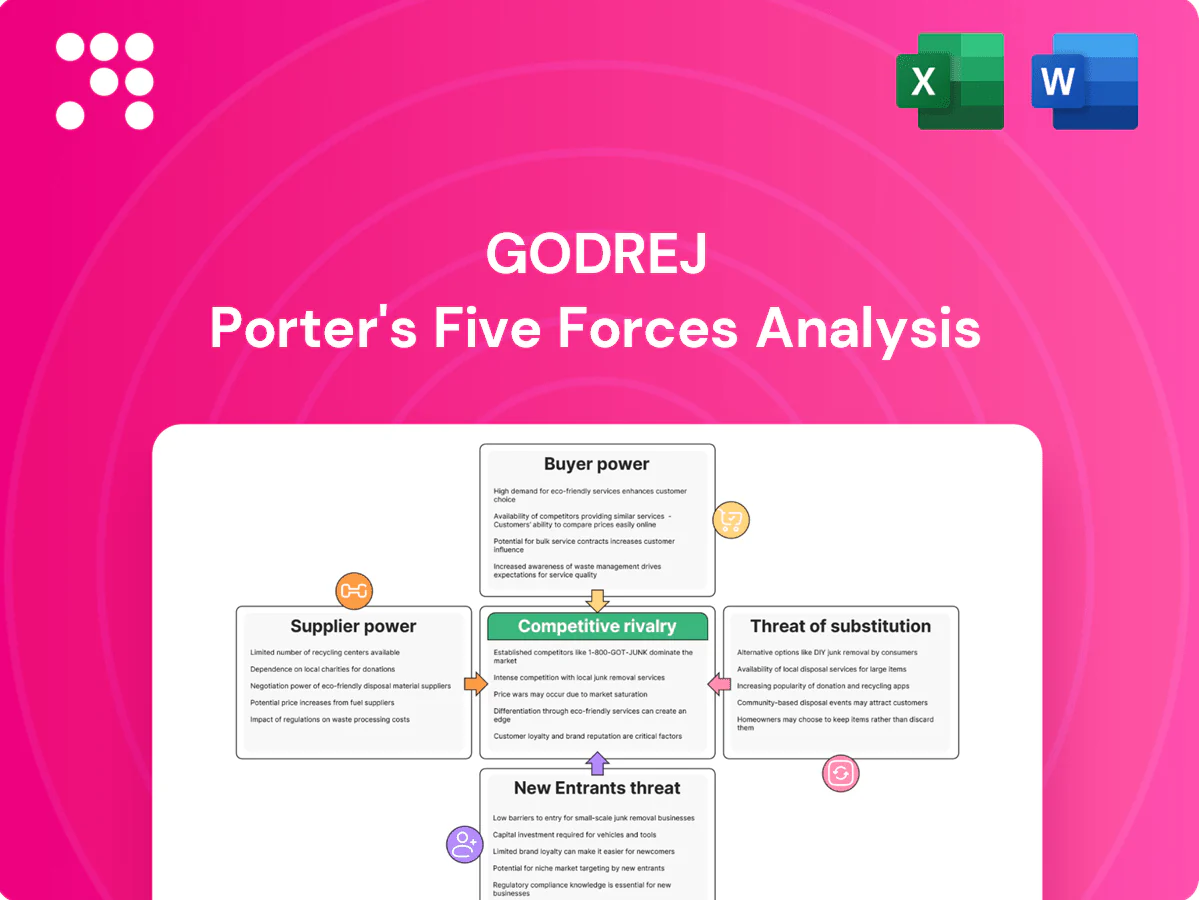
Godrej Porter's Five Forces Analysis

A Must-Have Tool for Decision-Makers
Godrej faces varied competitive pressures—from fragmented suppliers and rising buyer expectations to substitute products and moderate entry barriers in consumer and industrial segments. Our snapshot highlights key risks and strategic levers shaping its market position. You’ll see where margins are vulnerable and where scale provides defense. This brief snapshot only scratches the surface. Unlock the full Porter's Five Forces Analysis to explore Godrej’s competitive dynamics, market pressures, and strategic advantages in detail.
Suppliers Bargaining Power

Commodity input volatility
GCPL relies on palm oil, packaging resins and surfactants whose global prices stayed highly volatile in 2024, and sudden spikes can compress margins if price increases are not passed through quickly. The company uses hedging and recipe re-engineering to partially mitigate input shocks, but these measures only soften, not eliminate, cost pressure. During tight supply cycles volatility increases supplier leverage, limiting GCPL’s pricing flexibility.
Supplier fragmentation
Many raw-material and packaging vendors keep supplier concentration low for GCPL, allowing dual-sourcing and competitive bids to cut dependence and costs; in 2024 GCPL continued leveraging multiple local and global vendors. However, specialty fragrances and active ingredients remain concentrated among a few qualified suppliers. These niche inputs confer selective supplier power, raising procurement risk and margin pressure for specific product lines.

Quality and compliance requirements
Personal care and home care demand consistent quality, safety and regulatory compliance, with the global personal care market sized at about USD 505 billion in 2024, increasing emphasis on certified supply chains. Certification and periodic audits (GMP/ISO) constrain rapid supplier switching and lengthen onboarding. Approved-vendor lists and qualification cycles create moderate switching costs, boosting bargaining power for compliant suppliers.

Contract manufacturing and capacity
GCPL operates a hybrid model of in-house and contract manufacturing across regions, and tight third-party capacity during demand surges can push supplier pricing and shorten negotiation windows.
- Contract manufacturing mix influences cost flexibility
- Capacity tightness strengthens supplier bargaining
- Long-term contracts secure volumes and pricing stability
- Regional capacity availability dictates supplier leverage
Currency and import exposure
Imported inputs expose GCPL to currency swings in INR, IDR, ZAR, BRL and USD; 2024 saw USD/INR near 82, raising landed costs and indirectly strengthening supplier pricing power across key sourcing corridors.
Localizing supply and contract hedging have moderated this pressure; FX management and natural hedges are central to rebalancing supplier bargaining dynamics across India, Indonesia, Africa and Latin America.
Supply concentration and palm oil/packaging volatility threaten 2024 margins
GCPL faces concentrated power in specialty fragrances and surfactants while palm oil and packaging price volatility in 2024 (USD/INR ~82) raises landed costs and compresses margins if not passed through. Dual-sourcing and localisation reduce exposure, but GMP/ISO qualification and tight contract-manufacturing capacity sustain supplier leverage. Hedging and long-term contracts partially mitigate risks.
| Metric | 2024 | Impact |
|---|---|---|
| Global personal care market | USD 505bn | Higher quality/regulatory demand |
| USD/INR | ~82 | ↑ landed costs |
| Supplier concentration | High for fragrances | Selective pricing power |
What is included in the product
 Detailed Word Document
Tailored Porter’s Five Forces analysis for Godrej, uncovering competitive intensity, supplier and buyer power, threats from substitutes and new entrants, and strategic implications for pricing and profitability. Identifies disruptive forces, entry barriers, and actionable insights to reinforce Godrej’s market position.

 Customizable Excel Spreadsheet
A clear, one-sheet summary of Godrej's Five Forces—instantly highlights competitive pressures and strategic levers to relieve decision-making pain for boards and strategists.
Customers Bargaining Power

Fragmented end consumers
Individual consumers in Godrej’s emerging-market footprint are highly fragmented — India alone has ~1.4 billion people and a 2024 FMCG market ~US$110 billion, diluting direct buyer concentration. This dispersion keeps formal bargaining power low, but mass segments are price-sensitive, so small price moves often trigger switching and volume shifts.
Modern trade and e-commerce leverage
Large retailers and marketplaces in 2024 command disproportionate leverage in FMCG, with e-commerce accounting for roughly 9% of FMCG sales and top marketplaces capturing over 60% of online share; they routinely extract 15–30% in margins, slots and promotional funding. Their scale and rich shopper data amplify bargaining power, forcing GCPL to concede trade terms for shelf and search visibility. Structured joint business plans help rebalance value by linking investments to measurable sales and ROI.

Low switching costs
Soap, hair colour and home-care categories face abundant alternatives at similar price points, enabling easy trial and switching; online FMCG penetration rose to about 10% in India in 2024, lowering search costs. Promotions and user reviews—responsible for roughly 35% of new-SKU trials in 2024—accelerate substitution. This amplifies buyer bargaining power on price and feature demands.

Private labels and local brands
Retailer private labels undercut GCPL prices in core categories while regional brands tailor SKUs to local tastes, driving sharper price comparisons; private-label penetration in Indian grocery rose to about 8% by 2023 (Bain), strengthening buyer leverage and forcing GCPL to defend with innovation and pack-price architecture.
- Undercut: private labels expand share
- Local: regional SKUs intensify comparisons
- Defend: GCPL needs innovation & pack-price
- Effect: higher buyer negotiating strength
Information transparency
Digital reviews, price-comparison tools and influencer content—amplified by India’s over 700 million internet users in 2024—sharply reduce brand information asymmetry, raising buyer leverage. Customers increasingly demand measurable value and authenticity, forcing GCPL to back claims with efficacy data and visible ESG signals to retain trust. Failure to do so accelerates switch to cheaper or verified alternatives.
- Reviews: trust shapes purchase
- Price tools: intensify cost scrutiny
- Influencers: drive authenticity expectations
- GCPL: must prove efficacy + ESG to sustain value
India FMCG US$110bn, 700M, online 9-10%
Buyers overall have low formal concentration across India (~1.4bn people) but are price-sensitive; India FMCG ~US$110bn (2024). Large retailers/marketplaces (>60% online share) and e-commerce (~9–10% FMCG) extract 15–30% trade terms, raising buyer leverage. Private labels ~8% (2023) and 700M internet users (2024) amplify switching via reviews and price tools.
| Metric | Value |
|---|---|
| India population | ~1.4bn (2024) |
| FMCG market | ~US$110bn (2024) |
| Online FMCG | 9–10% (2024) |
| Top marketplaces | >60% online share (2024) |
| Private labels | ~8% (2023) |
| Internet users | ~700M (2024) |
Same Document Delivered
Godrej Porter's Five Forces Analysis
This preview shows the exact Godrej Porter’s Five Forces analysis you’ll receive—fully formatted, comprehensive, and ready for immediate download after purchase. It is the final deliverable with no placeholders or mockups, covering competitive rivalry, buyer and supplier power, threats of entry and substitutes. Purchase grants instant access to this same professional file for immediate use.

A Must-Have Tool for Decision-Makers
Godrej faces varied competitive pressures—from fragmented suppliers and rising buyer expectations to substitute products and moderate entry barriers in consumer and industrial segments. Our snapshot highlights key risks and strategic levers shaping its market position. You’ll see where margins are vulnerable and where scale provides defense. This brief snapshot only scratches the surface. Unlock the full Porter's Five Forces Analysis to explore Godrej’s competitive dynamics, market pressures, and strategic advantages in detail.
Suppliers Bargaining Power
Commodity input volatility
GCPL relies on palm oil, packaging resins and surfactants whose global prices stayed highly volatile in 2024, and sudden spikes can compress margins if price increases are not passed through quickly. The company uses hedging and recipe re-engineering to partially mitigate input shocks, but these measures only soften, not eliminate, cost pressure. During tight supply cycles volatility increases supplier leverage, limiting GCPL’s pricing flexibility.
Supplier fragmentation
Many raw-material and packaging vendors keep supplier concentration low for GCPL, allowing dual-sourcing and competitive bids to cut dependence and costs; in 2024 GCPL continued leveraging multiple local and global vendors. However, specialty fragrances and active ingredients remain concentrated among a few qualified suppliers. These niche inputs confer selective supplier power, raising procurement risk and margin pressure for specific product lines.
Quality and compliance requirements
Personal care and home care demand consistent quality, safety and regulatory compliance, with the global personal care market sized at about USD 505 billion in 2024, increasing emphasis on certified supply chains. Certification and periodic audits (GMP/ISO) constrain rapid supplier switching and lengthen onboarding. Approved-vendor lists and qualification cycles create moderate switching costs, boosting bargaining power for compliant suppliers.
Contract manufacturing and capacity
GCPL operates a hybrid model of in-house and contract manufacturing across regions, and tight third-party capacity during demand surges can push supplier pricing and shorten negotiation windows.
- Contract manufacturing mix influences cost flexibility
- Capacity tightness strengthens supplier bargaining
- Long-term contracts secure volumes and pricing stability
- Regional capacity availability dictates supplier leverage
Currency and import exposure
Imported inputs expose GCPL to currency swings in INR, IDR, ZAR, BRL and USD; 2024 saw USD/INR near 82, raising landed costs and indirectly strengthening supplier pricing power across key sourcing corridors.
Localizing supply and contract hedging have moderated this pressure; FX management and natural hedges are central to rebalancing supplier bargaining dynamics across India, Indonesia, Africa and Latin America.
Supply concentration and palm oil/packaging volatility threaten 2024 margins
GCPL faces concentrated power in specialty fragrances and surfactants while palm oil and packaging price volatility in 2024 (USD/INR ~82) raises landed costs and compresses margins if not passed through. Dual-sourcing and localisation reduce exposure, but GMP/ISO qualification and tight contract-manufacturing capacity sustain supplier leverage. Hedging and long-term contracts partially mitigate risks.
| Metric | 2024 | Impact |
|---|---|---|
| Global personal care market | USD 505bn | Higher quality/regulatory demand |
| USD/INR | ~82 | ↑ landed costs |
| Supplier concentration | High for fragrances | Selective pricing power |
What is included in the product
Detailed Word Document
Tailored Porter’s Five Forces analysis for Godrej, uncovering competitive intensity, supplier and buyer power, threats from substitutes and new entrants, and strategic implications for pricing and profitability. Identifies disruptive forces, entry barriers, and actionable insights to reinforce Godrej’s market position.
Customizable Excel Spreadsheet
A clear, one-sheet summary of Godrej's Five Forces—instantly highlights competitive pressures and strategic levers to relieve decision-making pain for boards and strategists.
Customers Bargaining Power
Fragmented end consumers
Individual consumers in Godrej’s emerging-market footprint are highly fragmented — India alone has ~1.4 billion people and a 2024 FMCG market ~US$110 billion, diluting direct buyer concentration. This dispersion keeps formal bargaining power low, but mass segments are price-sensitive, so small price moves often trigger switching and volume shifts.
Modern trade and e-commerce leverage
Large retailers and marketplaces in 2024 command disproportionate leverage in FMCG, with e-commerce accounting for roughly 9% of FMCG sales and top marketplaces capturing over 60% of online share; they routinely extract 15–30% in margins, slots and promotional funding. Their scale and rich shopper data amplify bargaining power, forcing GCPL to concede trade terms for shelf and search visibility. Structured joint business plans help rebalance value by linking investments to measurable sales and ROI.
Low switching costs
Soap, hair colour and home-care categories face abundant alternatives at similar price points, enabling easy trial and switching; online FMCG penetration rose to about 10% in India in 2024, lowering search costs. Promotions and user reviews—responsible for roughly 35% of new-SKU trials in 2024—accelerate substitution. This amplifies buyer bargaining power on price and feature demands.
Private labels and local brands
Retailer private labels undercut GCPL prices in core categories while regional brands tailor SKUs to local tastes, driving sharper price comparisons; private-label penetration in Indian grocery rose to about 8% by 2023 (Bain), strengthening buyer leverage and forcing GCPL to defend with innovation and pack-price architecture.
- Undercut: private labels expand share
- Local: regional SKUs intensify comparisons
- Defend: GCPL needs innovation & pack-price
- Effect: higher buyer negotiating strength
Information transparency
Digital reviews, price-comparison tools and influencer content—amplified by India’s over 700 million internet users in 2024—sharply reduce brand information asymmetry, raising buyer leverage. Customers increasingly demand measurable value and authenticity, forcing GCPL to back claims with efficacy data and visible ESG signals to retain trust. Failure to do so accelerates switch to cheaper or verified alternatives.
- Reviews: trust shapes purchase
- Price tools: intensify cost scrutiny
- Influencers: drive authenticity expectations
- GCPL: must prove efficacy + ESG to sustain value
India FMCG US$110bn, 700M, online 9-10%
Buyers overall have low formal concentration across India (~1.4bn people) but are price-sensitive; India FMCG ~US$110bn (2024). Large retailers/marketplaces (>60% online share) and e-commerce (~9–10% FMCG) extract 15–30% trade terms, raising buyer leverage. Private labels ~8% (2023) and 700M internet users (2024) amplify switching via reviews and price tools.
| Metric | Value |
|---|---|
| India population | ~1.4bn (2024) |
| FMCG market | ~US$110bn (2024) |
| Online FMCG | 9–10% (2024) |
| Top marketplaces | >60% online share (2024) |
| Private labels | ~8% (2023) |
| Internet users | ~700M (2024) |
Same Document Delivered
Godrej Porter's Five Forces Analysis
This preview shows the exact Godrej Porter’s Five Forces analysis you’ll receive—fully formatted, comprehensive, and ready for immediate download after purchase. It is the final deliverable with no placeholders or mockups, covering competitive rivalry, buyer and supplier power, threats of entry and substitutes. Purchase grants instant access to this same professional file for immediate use.
Original: $10.00
-65%$10.00
$3.50Description
A Must-Have Tool for Decision-Makers
Godrej faces varied competitive pressures—from fragmented suppliers and rising buyer expectations to substitute products and moderate entry barriers in consumer and industrial segments. Our snapshot highlights key risks and strategic levers shaping its market position. You’ll see where margins are vulnerable and where scale provides defense. This brief snapshot only scratches the surface. Unlock the full Porter's Five Forces Analysis to explore Godrej’s competitive dynamics, market pressures, and strategic advantages in detail.
Suppliers Bargaining Power
Commodity input volatility
GCPL relies on palm oil, packaging resins and surfactants whose global prices stayed highly volatile in 2024, and sudden spikes can compress margins if price increases are not passed through quickly. The company uses hedging and recipe re-engineering to partially mitigate input shocks, but these measures only soften, not eliminate, cost pressure. During tight supply cycles volatility increases supplier leverage, limiting GCPL’s pricing flexibility.
Supplier fragmentation
Many raw-material and packaging vendors keep supplier concentration low for GCPL, allowing dual-sourcing and competitive bids to cut dependence and costs; in 2024 GCPL continued leveraging multiple local and global vendors. However, specialty fragrances and active ingredients remain concentrated among a few qualified suppliers. These niche inputs confer selective supplier power, raising procurement risk and margin pressure for specific product lines.
Quality and compliance requirements
Personal care and home care demand consistent quality, safety and regulatory compliance, with the global personal care market sized at about USD 505 billion in 2024, increasing emphasis on certified supply chains. Certification and periodic audits (GMP/ISO) constrain rapid supplier switching and lengthen onboarding. Approved-vendor lists and qualification cycles create moderate switching costs, boosting bargaining power for compliant suppliers.
Contract manufacturing and capacity
GCPL operates a hybrid model of in-house and contract manufacturing across regions, and tight third-party capacity during demand surges can push supplier pricing and shorten negotiation windows.
- Contract manufacturing mix influences cost flexibility
- Capacity tightness strengthens supplier bargaining
- Long-term contracts secure volumes and pricing stability
- Regional capacity availability dictates supplier leverage
Currency and import exposure
Imported inputs expose GCPL to currency swings in INR, IDR, ZAR, BRL and USD; 2024 saw USD/INR near 82, raising landed costs and indirectly strengthening supplier pricing power across key sourcing corridors.
Localizing supply and contract hedging have moderated this pressure; FX management and natural hedges are central to rebalancing supplier bargaining dynamics across India, Indonesia, Africa and Latin America.
Supply concentration and palm oil/packaging volatility threaten 2024 margins
GCPL faces concentrated power in specialty fragrances and surfactants while palm oil and packaging price volatility in 2024 (USD/INR ~82) raises landed costs and compresses margins if not passed through. Dual-sourcing and localisation reduce exposure, but GMP/ISO qualification and tight contract-manufacturing capacity sustain supplier leverage. Hedging and long-term contracts partially mitigate risks.
| Metric | 2024 | Impact |
|---|---|---|
| Global personal care market | USD 505bn | Higher quality/regulatory demand |
| USD/INR | ~82 | ↑ landed costs |
| Supplier concentration | High for fragrances | Selective pricing power |
What is included in the product
Detailed Word Document
Tailored Porter’s Five Forces analysis for Godrej, uncovering competitive intensity, supplier and buyer power, threats from substitutes and new entrants, and strategic implications for pricing and profitability. Identifies disruptive forces, entry barriers, and actionable insights to reinforce Godrej’s market position.
Customizable Excel Spreadsheet
A clear, one-sheet summary of Godrej's Five Forces—instantly highlights competitive pressures and strategic levers to relieve decision-making pain for boards and strategists.
Customers Bargaining Power
Fragmented end consumers
Individual consumers in Godrej’s emerging-market footprint are highly fragmented — India alone has ~1.4 billion people and a 2024 FMCG market ~US$110 billion, diluting direct buyer concentration. This dispersion keeps formal bargaining power low, but mass segments are price-sensitive, so small price moves often trigger switching and volume shifts.
Modern trade and e-commerce leverage
Large retailers and marketplaces in 2024 command disproportionate leverage in FMCG, with e-commerce accounting for roughly 9% of FMCG sales and top marketplaces capturing over 60% of online share; they routinely extract 15–30% in margins, slots and promotional funding. Their scale and rich shopper data amplify bargaining power, forcing GCPL to concede trade terms for shelf and search visibility. Structured joint business plans help rebalance value by linking investments to measurable sales and ROI.
Low switching costs
Soap, hair colour and home-care categories face abundant alternatives at similar price points, enabling easy trial and switching; online FMCG penetration rose to about 10% in India in 2024, lowering search costs. Promotions and user reviews—responsible for roughly 35% of new-SKU trials in 2024—accelerate substitution. This amplifies buyer bargaining power on price and feature demands.
Private labels and local brands
Retailer private labels undercut GCPL prices in core categories while regional brands tailor SKUs to local tastes, driving sharper price comparisons; private-label penetration in Indian grocery rose to about 8% by 2023 (Bain), strengthening buyer leverage and forcing GCPL to defend with innovation and pack-price architecture.
- Undercut: private labels expand share
- Local: regional SKUs intensify comparisons
- Defend: GCPL needs innovation & pack-price
- Effect: higher buyer negotiating strength
Information transparency
Digital reviews, price-comparison tools and influencer content—amplified by India’s over 700 million internet users in 2024—sharply reduce brand information asymmetry, raising buyer leverage. Customers increasingly demand measurable value and authenticity, forcing GCPL to back claims with efficacy data and visible ESG signals to retain trust. Failure to do so accelerates switch to cheaper or verified alternatives.
- Reviews: trust shapes purchase
- Price tools: intensify cost scrutiny
- Influencers: drive authenticity expectations
- GCPL: must prove efficacy + ESG to sustain value
India FMCG US$110bn, 700M, online 9-10%
Buyers overall have low formal concentration across India (~1.4bn people) but are price-sensitive; India FMCG ~US$110bn (2024). Large retailers/marketplaces (>60% online share) and e-commerce (~9–10% FMCG) extract 15–30% trade terms, raising buyer leverage. Private labels ~8% (2023) and 700M internet users (2024) amplify switching via reviews and price tools.
| Metric | Value |
|---|---|
| India population | ~1.4bn (2024) |
| FMCG market | ~US$110bn (2024) |
| Online FMCG | 9–10% (2024) |
| Top marketplaces | >60% online share (2024) |
| Private labels | ~8% (2023) |
| Internet users | ~700M (2024) |
Same Document Delivered
Godrej Porter's Five Forces Analysis
This preview shows the exact Godrej Porter’s Five Forces analysis you’ll receive—fully formatted, comprehensive, and ready for immediate download after purchase. It is the final deliverable with no placeholders or mockups, covering competitive rivalry, buyer and supplier power, threats of entry and substitutes. Purchase grants instant access to this same professional file for immediate use.











