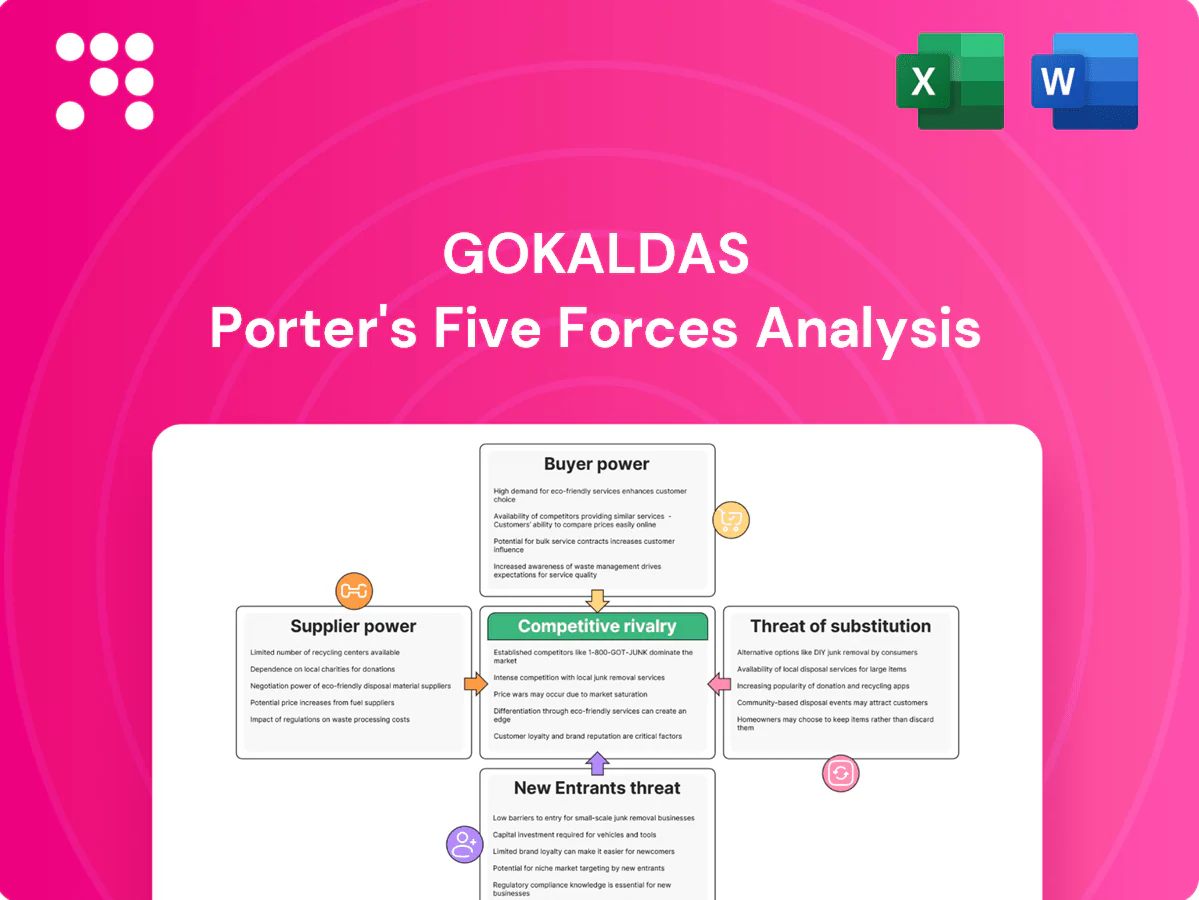
Gokaldas Porter's Five Forces Analysis

A Must-Have Tool for Decision-Makers
Gokaldas’s industry faces mixed forces: concentrated suppliers for fabrics, strong buyer bargaining from large brands, fierce rivalry among contract manufacturers, and evolving threats from new entrants and fast-fashion substitutes. This brief highlights key tensions impacting margins and strategic options. Unlock the full Porter's Five Forces Analysis for detailed ratings, visuals, and actionable recommendations.
Suppliers Bargaining Power

Concentrated raw-material inputs
Core inputs—fabrics, yarn, trims, chemicals, packaging—come from a concentrated, finite set of certified vendors, and rigorous compliance in 2024 further narrowed approved sources, increasing supplier leverage; seasonal demand spikes tighten certain categories, while Gokaldas reduces risk through multi-sourcing and proactive vendor development programs.
Volatile cotton and MMF pricing
Cotton and man‑made fiber prices swing with global cycles, weather and policy, with ICE cotton futures trading roughly 65–95 cents/lb and polyester/PSF complexes around USD 900–1,500/ton in 2023–2024. Suppliers can pass through hikes between orders, squeezing Gokaldas margins. Escalation clauses and inventory hedging mitigate risk but are imperfect. Short lead times limit stock buffering and amplify pass‑through impact.

Specialized machinery and tech
Sewing, cutting, washing and finishing equipment are concentrated among a few global OEMs, with the global textile machinery market near USD 20.5 billion in 2024, reinforcing supplier leverage. After‑sales service, spare parts and software lock‑ins raise switching costs and dependence. Automation and sustainability upgrades drive material capex and long amortization schedules, locking buyers into OEM ecosystems.

Logistics and compliance dependencies
Freight forwarders, dyeing/washing processors and testing labs gain outsized leverage in 2024 capacity crunches, as OEKO‑TEX, GOTS and WRAP compliance narrows switching options; rising ESG traceability demands force upstream data provisioning, and disruptions commonly cascade into OTIF chargebacks given typical 95% OTIF targets.
- Freight forwarders: bottlenecks
- Dye/wash: seasonal full capacity
- Labs: testing delays
- Certifications: restrict suppliers
- ESG traceability: higher data load
- OTIF ≈95%: penalty risk
Energy and utilities sensitivity
Energy and utilities exert high supplier power for Gokaldas: steam, power and water tariffs directly raise processing and in‑house costs; 2024 Indian industrial power tariffs averaged ~₹9/kWh, pushing utilities to seek price cushions in unreliable-grid regions. Renewable deals require upfront supplier commitments and energy shocks translate rapidly into supplier input quotes, compressing margins.
- High power dependence
- ~₹9/kWh industrial tariff (2024)
- Upfront renewables contracts
- Rapid transmission of shocks
Concentrated vendors and compliance raise supplier leverage; cotton 65–95¢, OTIF ≈95%
Concentrated certified vendors and tighter 2024 compliance raise supplier leverage, despite multi‑sourcing programs. Commodity swings (cotton 65–95¢/lb; polyester 900–1,500 USD/ton) plus OTIF ≈95% amplify pass‑through risk. Machinery market ~USD 20.5bn and industrial power ~₹9/kWh increase switching costs and margin exposure.
| Metric | 2024 Value |
|---|---|
| Cotton (ICE) | 65–95¢/lb |
| Polyester/PSF | USD 900–1,500/ton |
| Textile machinery market | USD 20.5bn |
| Industrial power (India) | ~₹9/kWh |
| OTIF target | ≈95% |
What is included in the product
 Detailed Word Document
Tailored Porter’s Five Forces analysis for Gokaldas that uncovers key drivers of competition, buyer and supplier power, entry barriers and substitution threats affecting its pricing and profitability. Includes strategic commentary on disruptive forces and protective market dynamics, with insights ready for investor materials, internal strategy decks, or academic use.

 Customizable Excel Spreadsheet
A concise Porter's Five Forces snapshot for Gokaldas that pinpoints competitive pain points and actionable responses, enabling faster strategic decisions and seamless insertion into pitch decks or executive reports.
Customers Bargaining Power

Concentrated global brands
International retailers and brands aggregate huge volumes, enabling aggressive price and term negotiation; top global apparel retailers generated over $1 trillion in retail sales in 2024, amplifying buying leverage versus suppliers like Gokaldas. They routinely benchmark costs across India, Bangladesh and Vietnam, and sector consolidation further increases scale advantage. Compliance requirements and third‑party audits give buyers additional leverage to enforce terms and price concessions.
Low switching costs among vendors
Buyers increasingly dual‑source styles across qualified factories, and in 2024 standardized technical packs and global SPC workflows further reduce migration friction, enabling rapid vendor swaps. Relationship capital still influences lead allocation, but pure‑play CMT suppliers are frequently replaced when price or capacity mismatches occur. This dynamic keeps pricing under pressure across contract cycles.

Price, quality, speed triad
Gokaldas customers press a price‑quality‑speed triad: sharp FOB/CM demands with strict AQL and fast turns, driving OTIF targets near 95% in 2024 and chargebacks averaging 1–2% of PO value to enforce discipline. Speed‑to‑market (now often 4–8 weeks) and 25–35% small‑drop mixes intensify requirements. Vendors must absorb input volatility to retain programs.

Design and full‑service as counters
Gokaldas leverages design, development and end‑to‑end logistics to raise customer stickiness, enabling a shift from price negotiation to solution selling; co‑creation and quick‑response capabilities capture replenishment orders and shorten lead times, which partially reduces buyer bargaining power. These value‑added services anchor clients, making switching less attractive and enabling margin protection.
- Design & development: solution selling
- Logistics: higher switching costs
- Quick response: wins replenishment
- Net effect: partial reduction in buyer power
Compliance and ESG requirements
- Brands enforce audits, traceability, and emissions limits
- Non‑compliance leads to lost orders and regulatory fines
- Compliance raises costs but enables premium contracts
Buyers with >$1T scale force FOB cuts and 1-2% chargebacks; suppliers lean on design & speed
Buyers wield strong price and compliance leverage—top global apparel retailers >$1T retail sales in 2024—driving FOB pressure, frequent vendor swaps and 1–2% chargebacks; Gokaldas offsets with design, logistics and quick‑response to retain programs and protect margins.
| Metric | 2024 |
|---|---|
| Buyer retail scale | >$1T |
| OTIF target | ~95% |
| Chargebacks | 1–2% PO |
| Compliance cost uplift | 5–10% |
| Replenishment lead time | 4–8 weeks |
What You See Is What You Get
Gokaldas Porter's Five Forces Analysis
This preview is the exact Gokaldas Porter’s Five Forces Analysis you’ll receive after purchase, fully written and formatted for immediate use. It covers competitive rivalry, supplier and buyer power, threats of substitutes and entry with actionable insights. No placeholders or mockups—what you see is the deliverable.

A Must-Have Tool for Decision-Makers
Gokaldas’s industry faces mixed forces: concentrated suppliers for fabrics, strong buyer bargaining from large brands, fierce rivalry among contract manufacturers, and evolving threats from new entrants and fast-fashion substitutes. This brief highlights key tensions impacting margins and strategic options. Unlock the full Porter's Five Forces Analysis for detailed ratings, visuals, and actionable recommendations.
Suppliers Bargaining Power
Concentrated raw-material inputs
Core inputs—fabrics, yarn, trims, chemicals, packaging—come from a concentrated, finite set of certified vendors, and rigorous compliance in 2024 further narrowed approved sources, increasing supplier leverage; seasonal demand spikes tighten certain categories, while Gokaldas reduces risk through multi-sourcing and proactive vendor development programs.
Volatile cotton and MMF pricing
Cotton and man‑made fiber prices swing with global cycles, weather and policy, with ICE cotton futures trading roughly 65–95 cents/lb and polyester/PSF complexes around USD 900–1,500/ton in 2023–2024. Suppliers can pass through hikes between orders, squeezing Gokaldas margins. Escalation clauses and inventory hedging mitigate risk but are imperfect. Short lead times limit stock buffering and amplify pass‑through impact.
Specialized machinery and tech
Sewing, cutting, washing and finishing equipment are concentrated among a few global OEMs, with the global textile machinery market near USD 20.5 billion in 2024, reinforcing supplier leverage. After‑sales service, spare parts and software lock‑ins raise switching costs and dependence. Automation and sustainability upgrades drive material capex and long amortization schedules, locking buyers into OEM ecosystems.
Logistics and compliance dependencies
Freight forwarders, dyeing/washing processors and testing labs gain outsized leverage in 2024 capacity crunches, as OEKO‑TEX, GOTS and WRAP compliance narrows switching options; rising ESG traceability demands force upstream data provisioning, and disruptions commonly cascade into OTIF chargebacks given typical 95% OTIF targets.
- Freight forwarders: bottlenecks
- Dye/wash: seasonal full capacity
- Labs: testing delays
- Certifications: restrict suppliers
- ESG traceability: higher data load
- OTIF ≈95%: penalty risk
Energy and utilities sensitivity
Energy and utilities exert high supplier power for Gokaldas: steam, power and water tariffs directly raise processing and in‑house costs; 2024 Indian industrial power tariffs averaged ~₹9/kWh, pushing utilities to seek price cushions in unreliable-grid regions. Renewable deals require upfront supplier commitments and energy shocks translate rapidly into supplier input quotes, compressing margins.
- High power dependence
- ~₹9/kWh industrial tariff (2024)
- Upfront renewables contracts
- Rapid transmission of shocks
Concentrated vendors and compliance raise supplier leverage; cotton 65–95¢, OTIF ≈95%
Concentrated certified vendors and tighter 2024 compliance raise supplier leverage, despite multi‑sourcing programs. Commodity swings (cotton 65–95¢/lb; polyester 900–1,500 USD/ton) plus OTIF ≈95% amplify pass‑through risk. Machinery market ~USD 20.5bn and industrial power ~₹9/kWh increase switching costs and margin exposure.
| Metric | 2024 Value |
|---|---|
| Cotton (ICE) | 65–95¢/lb |
| Polyester/PSF | USD 900–1,500/ton |
| Textile machinery market | USD 20.5bn |
| Industrial power (India) | ~₹9/kWh |
| OTIF target | ≈95% |
What is included in the product
Detailed Word Document
Tailored Porter’s Five Forces analysis for Gokaldas that uncovers key drivers of competition, buyer and supplier power, entry barriers and substitution threats affecting its pricing and profitability. Includes strategic commentary on disruptive forces and protective market dynamics, with insights ready for investor materials, internal strategy decks, or academic use.
Customizable Excel Spreadsheet
A concise Porter's Five Forces snapshot for Gokaldas that pinpoints competitive pain points and actionable responses, enabling faster strategic decisions and seamless insertion into pitch decks or executive reports.
Customers Bargaining Power
Concentrated global brands
International retailers and brands aggregate huge volumes, enabling aggressive price and term negotiation; top global apparel retailers generated over $1 trillion in retail sales in 2024, amplifying buying leverage versus suppliers like Gokaldas. They routinely benchmark costs across India, Bangladesh and Vietnam, and sector consolidation further increases scale advantage. Compliance requirements and third‑party audits give buyers additional leverage to enforce terms and price concessions.
Low switching costs among vendors
Buyers increasingly dual‑source styles across qualified factories, and in 2024 standardized technical packs and global SPC workflows further reduce migration friction, enabling rapid vendor swaps. Relationship capital still influences lead allocation, but pure‑play CMT suppliers are frequently replaced when price or capacity mismatches occur. This dynamic keeps pricing under pressure across contract cycles.
Price, quality, speed triad
Gokaldas customers press a price‑quality‑speed triad: sharp FOB/CM demands with strict AQL and fast turns, driving OTIF targets near 95% in 2024 and chargebacks averaging 1–2% of PO value to enforce discipline. Speed‑to‑market (now often 4–8 weeks) and 25–35% small‑drop mixes intensify requirements. Vendors must absorb input volatility to retain programs.
Design and full‑service as counters
Gokaldas leverages design, development and end‑to‑end logistics to raise customer stickiness, enabling a shift from price negotiation to solution selling; co‑creation and quick‑response capabilities capture replenishment orders and shorten lead times, which partially reduces buyer bargaining power. These value‑added services anchor clients, making switching less attractive and enabling margin protection.
- Design & development: solution selling
- Logistics: higher switching costs
- Quick response: wins replenishment
- Net effect: partial reduction in buyer power
Compliance and ESG requirements
- Brands enforce audits, traceability, and emissions limits
- Non‑compliance leads to lost orders and regulatory fines
- Compliance raises costs but enables premium contracts
Buyers with >$1T scale force FOB cuts and 1-2% chargebacks; suppliers lean on design & speed
Buyers wield strong price and compliance leverage—top global apparel retailers >$1T retail sales in 2024—driving FOB pressure, frequent vendor swaps and 1–2% chargebacks; Gokaldas offsets with design, logistics and quick‑response to retain programs and protect margins.
| Metric | 2024 |
|---|---|
| Buyer retail scale | >$1T |
| OTIF target | ~95% |
| Chargebacks | 1–2% PO |
| Compliance cost uplift | 5–10% |
| Replenishment lead time | 4–8 weeks |
What You See Is What You Get
Gokaldas Porter's Five Forces Analysis
This preview is the exact Gokaldas Porter’s Five Forces Analysis you’ll receive after purchase, fully written and formatted for immediate use. It covers competitive rivalry, supplier and buyer power, threats of substitutes and entry with actionable insights. No placeholders or mockups—what you see is the deliverable.
Original: $10.00
-65%$10.00
$3.50Description
A Must-Have Tool for Decision-Makers
Gokaldas’s industry faces mixed forces: concentrated suppliers for fabrics, strong buyer bargaining from large brands, fierce rivalry among contract manufacturers, and evolving threats from new entrants and fast-fashion substitutes. This brief highlights key tensions impacting margins and strategic options. Unlock the full Porter's Five Forces Analysis for detailed ratings, visuals, and actionable recommendations.
Suppliers Bargaining Power
Concentrated raw-material inputs
Core inputs—fabrics, yarn, trims, chemicals, packaging—come from a concentrated, finite set of certified vendors, and rigorous compliance in 2024 further narrowed approved sources, increasing supplier leverage; seasonal demand spikes tighten certain categories, while Gokaldas reduces risk through multi-sourcing and proactive vendor development programs.
Volatile cotton and MMF pricing
Cotton and man‑made fiber prices swing with global cycles, weather and policy, with ICE cotton futures trading roughly 65–95 cents/lb and polyester/PSF complexes around USD 900–1,500/ton in 2023–2024. Suppliers can pass through hikes between orders, squeezing Gokaldas margins. Escalation clauses and inventory hedging mitigate risk but are imperfect. Short lead times limit stock buffering and amplify pass‑through impact.
Specialized machinery and tech
Sewing, cutting, washing and finishing equipment are concentrated among a few global OEMs, with the global textile machinery market near USD 20.5 billion in 2024, reinforcing supplier leverage. After‑sales service, spare parts and software lock‑ins raise switching costs and dependence. Automation and sustainability upgrades drive material capex and long amortization schedules, locking buyers into OEM ecosystems.
Logistics and compliance dependencies
Freight forwarders, dyeing/washing processors and testing labs gain outsized leverage in 2024 capacity crunches, as OEKO‑TEX, GOTS and WRAP compliance narrows switching options; rising ESG traceability demands force upstream data provisioning, and disruptions commonly cascade into OTIF chargebacks given typical 95% OTIF targets.
- Freight forwarders: bottlenecks
- Dye/wash: seasonal full capacity
- Labs: testing delays
- Certifications: restrict suppliers
- ESG traceability: higher data load
- OTIF ≈95%: penalty risk
Energy and utilities sensitivity
Energy and utilities exert high supplier power for Gokaldas: steam, power and water tariffs directly raise processing and in‑house costs; 2024 Indian industrial power tariffs averaged ~₹9/kWh, pushing utilities to seek price cushions in unreliable-grid regions. Renewable deals require upfront supplier commitments and energy shocks translate rapidly into supplier input quotes, compressing margins.
- High power dependence
- ~₹9/kWh industrial tariff (2024)
- Upfront renewables contracts
- Rapid transmission of shocks
Concentrated vendors and compliance raise supplier leverage; cotton 65–95¢, OTIF ≈95%
Concentrated certified vendors and tighter 2024 compliance raise supplier leverage, despite multi‑sourcing programs. Commodity swings (cotton 65–95¢/lb; polyester 900–1,500 USD/ton) plus OTIF ≈95% amplify pass‑through risk. Machinery market ~USD 20.5bn and industrial power ~₹9/kWh increase switching costs and margin exposure.
| Metric | 2024 Value |
|---|---|
| Cotton (ICE) | 65–95¢/lb |
| Polyester/PSF | USD 900–1,500/ton |
| Textile machinery market | USD 20.5bn |
| Industrial power (India) | ~₹9/kWh |
| OTIF target | ≈95% |
What is included in the product
Detailed Word Document
Tailored Porter’s Five Forces analysis for Gokaldas that uncovers key drivers of competition, buyer and supplier power, entry barriers and substitution threats affecting its pricing and profitability. Includes strategic commentary on disruptive forces and protective market dynamics, with insights ready for investor materials, internal strategy decks, or academic use.
Customizable Excel Spreadsheet
A concise Porter's Five Forces snapshot for Gokaldas that pinpoints competitive pain points and actionable responses, enabling faster strategic decisions and seamless insertion into pitch decks or executive reports.
Customers Bargaining Power
Concentrated global brands
International retailers and brands aggregate huge volumes, enabling aggressive price and term negotiation; top global apparel retailers generated over $1 trillion in retail sales in 2024, amplifying buying leverage versus suppliers like Gokaldas. They routinely benchmark costs across India, Bangladesh and Vietnam, and sector consolidation further increases scale advantage. Compliance requirements and third‑party audits give buyers additional leverage to enforce terms and price concessions.
Low switching costs among vendors
Buyers increasingly dual‑source styles across qualified factories, and in 2024 standardized technical packs and global SPC workflows further reduce migration friction, enabling rapid vendor swaps. Relationship capital still influences lead allocation, but pure‑play CMT suppliers are frequently replaced when price or capacity mismatches occur. This dynamic keeps pricing under pressure across contract cycles.
Price, quality, speed triad
Gokaldas customers press a price‑quality‑speed triad: sharp FOB/CM demands with strict AQL and fast turns, driving OTIF targets near 95% in 2024 and chargebacks averaging 1–2% of PO value to enforce discipline. Speed‑to‑market (now often 4–8 weeks) and 25–35% small‑drop mixes intensify requirements. Vendors must absorb input volatility to retain programs.
Design and full‑service as counters
Gokaldas leverages design, development and end‑to‑end logistics to raise customer stickiness, enabling a shift from price negotiation to solution selling; co‑creation and quick‑response capabilities capture replenishment orders and shorten lead times, which partially reduces buyer bargaining power. These value‑added services anchor clients, making switching less attractive and enabling margin protection.
- Design & development: solution selling
- Logistics: higher switching costs
- Quick response: wins replenishment
- Net effect: partial reduction in buyer power
Compliance and ESG requirements
- Brands enforce audits, traceability, and emissions limits
- Non‑compliance leads to lost orders and regulatory fines
- Compliance raises costs but enables premium contracts
Buyers with >$1T scale force FOB cuts and 1-2% chargebacks; suppliers lean on design & speed
Buyers wield strong price and compliance leverage—top global apparel retailers >$1T retail sales in 2024—driving FOB pressure, frequent vendor swaps and 1–2% chargebacks; Gokaldas offsets with design, logistics and quick‑response to retain programs and protect margins.
| Metric | 2024 |
|---|---|
| Buyer retail scale | >$1T |
| OTIF target | ~95% |
| Chargebacks | 1–2% PO |
| Compliance cost uplift | 5–10% |
| Replenishment lead time | 4–8 weeks |
What You See Is What You Get
Gokaldas Porter's Five Forces Analysis
This preview is the exact Gokaldas Porter’s Five Forces Analysis you’ll receive after purchase, fully written and formatted for immediate use. It covers competitive rivalry, supplier and buyer power, threats of substitutes and entry with actionable insights. No placeholders or mockups—what you see is the deliverable.











