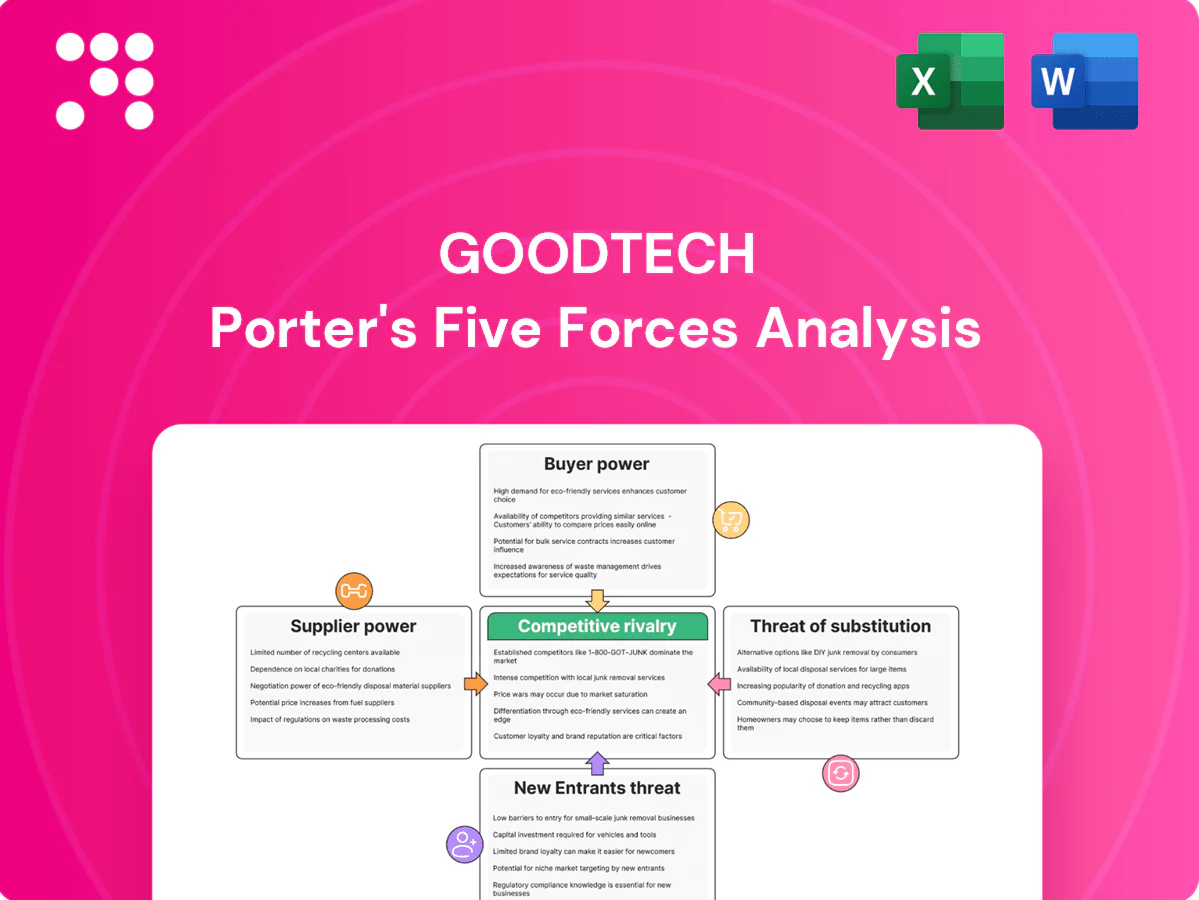
Goodtech Porter's Five Forces Analysis

Go Beyond the Preview—Access the Full Strategic Report
Goodtech’s Porter’s Five Forces snapshot highlights key pressures—competitive rivalry, supplier leverage, buyer power, substitutes and entry threats—and what they mean for margins and growth. This brief view signals strategic priorities and risk areas. The full report quantifies each force with visuals and implications. Unlock the complete analysis to inform investment or strategy.
Suppliers Bargaining Power

Concentrated OEM tech vendors
Goodtech depends on a few global suppliers for PLCs, drives, SCADA, sensors and robotics, chiefly four dominant OEMs in 2024: ABB, Siemens, Schneider and Rockwell; this concentration elevates pricing and contract leverage. Approved-part lists and certifications lock system integrators into vendor ecosystems, limiting sourcing flexibility. Maintaining multi-vendor competence reduces single-supplier risk but increases training and certification costs across platforms.
Proprietary software and licenses
Control and industrial software carry recurring license and support fees—industry maintenance rates commonly range 15–22% of license value annually—locking in predictable revenue. Limited interoperability and proprietary protocols materially raise switching costs and integration effort. Suppliers routinely bundle features to upsell and steer reference architectures, while multi‑year maintenance contracts (commonly 3–5 years) anchor supplier influence over lifecycle economics.

Specialized components lead times
Lead times for semiconductors, power electronics and edge compute averaged near 13 weeks in 2024 but supply shocks have driven spikes above 30 weeks, shifting schedule risk to integrators.
Integrators respond with buffer inventory or redesigns, while expediting fees and redesign labor can raise project costs by roughly 10–20% and 5–15% respectively.
Framework agreements reduce volatility—often lowering schedule variance by ~25–40%—but cannot fully neutralize component scarcity.

Scarce skilled subcontractors
Field electricians, safety engineers and commissioning experts are scarce across the Nordics, giving subcontractors leverage as wage inflation and peak-demand premiums drove double-digit rate increases in 2023–24; mandatory ATEX and IEC 61508/61511 certifications further shrink the available talent pool, while strategic partnerships and internal academies are reducing exposure over time.
- Talent tightness: certified specialists limited
- Cost impact: double-digit premium in peak periods (2023–24)
- Barrier: ATEX, IEC 61508/61511 narrow supply
- Mitigation: partnerships and internal academies
Cloud/IoT platform dependence
Relying on hyperscaler and IIoT platforms exposes Goodtech to platform pricing risk as cloud providers commonly levy data egress fees of $0.05–0.12 per GB and tiered service premiums that can shave 5–15% off digital-project margins; security and compliance modules are often sold as add-ons, narrowing low-cost alternatives. Multi-cloud patterns raise integration overheads (commonly a 10–20% cost premium) but do increase vendor optionality.
- Data egress: $0.05–0.12/GB
- Margin erosion: 5–15%
- Multi-cloud cost premium: 10–20%
- Security features: frequently paywalled
Supplier squeeze boosts costs: maintenance 15-22% and lead times
Goodtech faces concentrated supplier power (ABB, Siemens, Schneider, Rockwell) that elevates pricing and vendor lock; maintenance fees run 15–22% annually. Lead times averaged ~13 weeks in 2024 with spikes >30, raising project costs via 10–20% expediting and 5–15% redesign premiums. Certified field talent scarcity drove double‑digit rate increases in 2023–24, sustaining supplier leverage.
| Metric | 2024 Value |
|---|---|
| Major OEMs | ABB, Siemens, Schneider, Rockwell |
| Maintenance rates | 15–22% |
| Avg lead time | ~13 weeks (spikes >30) |
| Expedite cost | 10–20% |
| Redesign cost | 5–15% |
| Talent premium | Double‑digit (2023–24) |
What is included in the product
 Detailed Word Document
Comprehensive Porter’s Five Forces assessment tailored to Goodtech, uncovering competitive drivers, buyer and supplier power, entry barriers, substitutes and disruptive threats, with strategic commentary to inform pricing, profitability and defensive moves—fully editable for reports and investor materials.

 Customizable Excel Spreadsheet
A clear one-sheet Goodtech Porter's Five Forces summary for rapid decision-making, with adjustable pressure levels to reflect regulatory shifts or new entrants. Instantly visualize strategic pressure via a spider chart and export a clean slide-ready layout for decks or boardroom briefings.
Customers Bargaining Power

Large industrial buyers consolidate spend
Energy, infrastructure and process-industry clients are few but large, and in 2024 they increasingly used competitive tenders and long-term framework agreements to compress supplier margins; volume commitments are routinely traded for tiered discounts and strict service SLAs, and advanced procurement teams with e-sourcing and contract-management capabilities materially heighten their negotiation leverage.
High project specificity yet comparable bids
High project specificity limits direct comparability between Goodtech integrators, yet 2024 RFPs increasingly standardize technical and commercial requirements. Buyers benchmark integrators on price, schedule and references, while unbundling engineering scope invites multiple bidders. Repeated value engineering rounds in 2024 continue to compress integrator margins.

Switching costs after deployment
Once deployed, switching integrators risks downtime and compliance gaps that can halt operations; Gartner 2024 notes vendor lock-in remains a top concern for roughly 70% of enterprises. Proprietary configurations and as-built knowledge create technical and contractual lock-in, raising effective switching costs. Buyers still leverage future project allocations to negotiate; robust documentation and adherence to open standards can cut perceived dependency and lower migration risk.

Outcome and ESG-driven demands
- Clients: performance-linked payments increase integrator risk
- ESG evidence: decarbonization metrics as procurement filter
- Complexity: higher delivery, monitoring, and warranty burdens
Payment terms and risk transfer
- Milestone payments: shift cash burden to suppliers
- Liquidated damages: increase exposure to penalty costs
- Bonds/insurance: raise upfront compliance costs
- Creditworthy clients: improve payment reliability
Buyers shift: ~60% performance; ~70% fear lock-in
Energy and process clients concentrate buying power; 2024 saw increased competitive tenders and framework agreements compressing margins. Gartner 2024: ~70% of enterprises cite vendor lock-in as a top concern; ~60% of large buyers prefer performance‑linked procurement, shifting risk to integrators. Milestone payments, liquidated damages and bonds raise working-capital and compliance costs for suppliers.
| Metric | 2024 Value |
|---|---|
| Vendor lock-in concern | ~70% |
| Performance‑linked procurement | ~60% |
Preview Before You Purchase
Goodtech Porter's Five Forces Analysis
This preview shows the exact Goodtech Porter's Five Forces Analysis you'll receive immediately after purchase—no surprises, no placeholders. The document displayed here is fully formatted and ready for download and use the moment you buy, covering threat of new entrants, supplier and buyer power, competitive rivalry, and substitution. You're looking at the actual file; purchase grants instant access to this same deliverable.

Go Beyond the Preview—Access the Full Strategic Report
Goodtech’s Porter’s Five Forces snapshot highlights key pressures—competitive rivalry, supplier leverage, buyer power, substitutes and entry threats—and what they mean for margins and growth. This brief view signals strategic priorities and risk areas. The full report quantifies each force with visuals and implications. Unlock the complete analysis to inform investment or strategy.
Suppliers Bargaining Power
Concentrated OEM tech vendors
Goodtech depends on a few global suppliers for PLCs, drives, SCADA, sensors and robotics, chiefly four dominant OEMs in 2024: ABB, Siemens, Schneider and Rockwell; this concentration elevates pricing and contract leverage. Approved-part lists and certifications lock system integrators into vendor ecosystems, limiting sourcing flexibility. Maintaining multi-vendor competence reduces single-supplier risk but increases training and certification costs across platforms.
Proprietary software and licenses
Control and industrial software carry recurring license and support fees—industry maintenance rates commonly range 15–22% of license value annually—locking in predictable revenue. Limited interoperability and proprietary protocols materially raise switching costs and integration effort. Suppliers routinely bundle features to upsell and steer reference architectures, while multi‑year maintenance contracts (commonly 3–5 years) anchor supplier influence over lifecycle economics.
Specialized components lead times
Lead times for semiconductors, power electronics and edge compute averaged near 13 weeks in 2024 but supply shocks have driven spikes above 30 weeks, shifting schedule risk to integrators.
Integrators respond with buffer inventory or redesigns, while expediting fees and redesign labor can raise project costs by roughly 10–20% and 5–15% respectively.
Framework agreements reduce volatility—often lowering schedule variance by ~25–40%—but cannot fully neutralize component scarcity.
Scarce skilled subcontractors
Field electricians, safety engineers and commissioning experts are scarce across the Nordics, giving subcontractors leverage as wage inflation and peak-demand premiums drove double-digit rate increases in 2023–24; mandatory ATEX and IEC 61508/61511 certifications further shrink the available talent pool, while strategic partnerships and internal academies are reducing exposure over time.
- Talent tightness: certified specialists limited
- Cost impact: double-digit premium in peak periods (2023–24)
- Barrier: ATEX, IEC 61508/61511 narrow supply
- Mitigation: partnerships and internal academies
Cloud/IoT platform dependence
Relying on hyperscaler and IIoT platforms exposes Goodtech to platform pricing risk as cloud providers commonly levy data egress fees of $0.05–0.12 per GB and tiered service premiums that can shave 5–15% off digital-project margins; security and compliance modules are often sold as add-ons, narrowing low-cost alternatives. Multi-cloud patterns raise integration overheads (commonly a 10–20% cost premium) but do increase vendor optionality.
- Data egress: $0.05–0.12/GB
- Margin erosion: 5–15%
- Multi-cloud cost premium: 10–20%
- Security features: frequently paywalled
Supplier squeeze boosts costs: maintenance 15-22% and lead times
Goodtech faces concentrated supplier power (ABB, Siemens, Schneider, Rockwell) that elevates pricing and vendor lock; maintenance fees run 15–22% annually. Lead times averaged ~13 weeks in 2024 with spikes >30, raising project costs via 10–20% expediting and 5–15% redesign premiums. Certified field talent scarcity drove double‑digit rate increases in 2023–24, sustaining supplier leverage.
| Metric | 2024 Value |
|---|---|
| Major OEMs | ABB, Siemens, Schneider, Rockwell |
| Maintenance rates | 15–22% |
| Avg lead time | ~13 weeks (spikes >30) |
| Expedite cost | 10–20% |
| Redesign cost | 5–15% |
| Talent premium | Double‑digit (2023–24) |
What is included in the product
Detailed Word Document
Comprehensive Porter’s Five Forces assessment tailored to Goodtech, uncovering competitive drivers, buyer and supplier power, entry barriers, substitutes and disruptive threats, with strategic commentary to inform pricing, profitability and defensive moves—fully editable for reports and investor materials.
Customizable Excel Spreadsheet
A clear one-sheet Goodtech Porter's Five Forces summary for rapid decision-making, with adjustable pressure levels to reflect regulatory shifts or new entrants. Instantly visualize strategic pressure via a spider chart and export a clean slide-ready layout for decks or boardroom briefings.
Customers Bargaining Power
Large industrial buyers consolidate spend
Energy, infrastructure and process-industry clients are few but large, and in 2024 they increasingly used competitive tenders and long-term framework agreements to compress supplier margins; volume commitments are routinely traded for tiered discounts and strict service SLAs, and advanced procurement teams with e-sourcing and contract-management capabilities materially heighten their negotiation leverage.
High project specificity yet comparable bids
High project specificity limits direct comparability between Goodtech integrators, yet 2024 RFPs increasingly standardize technical and commercial requirements. Buyers benchmark integrators on price, schedule and references, while unbundling engineering scope invites multiple bidders. Repeated value engineering rounds in 2024 continue to compress integrator margins.
Switching costs after deployment
Once deployed, switching integrators risks downtime and compliance gaps that can halt operations; Gartner 2024 notes vendor lock-in remains a top concern for roughly 70% of enterprises. Proprietary configurations and as-built knowledge create technical and contractual lock-in, raising effective switching costs. Buyers still leverage future project allocations to negotiate; robust documentation and adherence to open standards can cut perceived dependency and lower migration risk.
Outcome and ESG-driven demands
- Clients: performance-linked payments increase integrator risk
- ESG evidence: decarbonization metrics as procurement filter
- Complexity: higher delivery, monitoring, and warranty burdens
Payment terms and risk transfer
- Milestone payments: shift cash burden to suppliers
- Liquidated damages: increase exposure to penalty costs
- Bonds/insurance: raise upfront compliance costs
- Creditworthy clients: improve payment reliability
Buyers shift: ~60% performance; ~70% fear lock-in
Energy and process clients concentrate buying power; 2024 saw increased competitive tenders and framework agreements compressing margins. Gartner 2024: ~70% of enterprises cite vendor lock-in as a top concern; ~60% of large buyers prefer performance‑linked procurement, shifting risk to integrators. Milestone payments, liquidated damages and bonds raise working-capital and compliance costs for suppliers.
| Metric | 2024 Value |
|---|---|
| Vendor lock-in concern | ~70% |
| Performance‑linked procurement | ~60% |
Preview Before You Purchase
Goodtech Porter's Five Forces Analysis
This preview shows the exact Goodtech Porter's Five Forces Analysis you'll receive immediately after purchase—no surprises, no placeholders. The document displayed here is fully formatted and ready for download and use the moment you buy, covering threat of new entrants, supplier and buyer power, competitive rivalry, and substitution. You're looking at the actual file; purchase grants instant access to this same deliverable.
Description
Go Beyond the Preview—Access the Full Strategic Report
Goodtech’s Porter’s Five Forces snapshot highlights key pressures—competitive rivalry, supplier leverage, buyer power, substitutes and entry threats—and what they mean for margins and growth. This brief view signals strategic priorities and risk areas. The full report quantifies each force with visuals and implications. Unlock the complete analysis to inform investment or strategy.
Suppliers Bargaining Power
Concentrated OEM tech vendors
Goodtech depends on a few global suppliers for PLCs, drives, SCADA, sensors and robotics, chiefly four dominant OEMs in 2024: ABB, Siemens, Schneider and Rockwell; this concentration elevates pricing and contract leverage. Approved-part lists and certifications lock system integrators into vendor ecosystems, limiting sourcing flexibility. Maintaining multi-vendor competence reduces single-supplier risk but increases training and certification costs across platforms.
Proprietary software and licenses
Control and industrial software carry recurring license and support fees—industry maintenance rates commonly range 15–22% of license value annually—locking in predictable revenue. Limited interoperability and proprietary protocols materially raise switching costs and integration effort. Suppliers routinely bundle features to upsell and steer reference architectures, while multi‑year maintenance contracts (commonly 3–5 years) anchor supplier influence over lifecycle economics.
Specialized components lead times
Lead times for semiconductors, power electronics and edge compute averaged near 13 weeks in 2024 but supply shocks have driven spikes above 30 weeks, shifting schedule risk to integrators.
Integrators respond with buffer inventory or redesigns, while expediting fees and redesign labor can raise project costs by roughly 10–20% and 5–15% respectively.
Framework agreements reduce volatility—often lowering schedule variance by ~25–40%—but cannot fully neutralize component scarcity.
Scarce skilled subcontractors
Field electricians, safety engineers and commissioning experts are scarce across the Nordics, giving subcontractors leverage as wage inflation and peak-demand premiums drove double-digit rate increases in 2023–24; mandatory ATEX and IEC 61508/61511 certifications further shrink the available talent pool, while strategic partnerships and internal academies are reducing exposure over time.
- Talent tightness: certified specialists limited
- Cost impact: double-digit premium in peak periods (2023–24)
- Barrier: ATEX, IEC 61508/61511 narrow supply
- Mitigation: partnerships and internal academies
Cloud/IoT platform dependence
Relying on hyperscaler and IIoT platforms exposes Goodtech to platform pricing risk as cloud providers commonly levy data egress fees of $0.05–0.12 per GB and tiered service premiums that can shave 5–15% off digital-project margins; security and compliance modules are often sold as add-ons, narrowing low-cost alternatives. Multi-cloud patterns raise integration overheads (commonly a 10–20% cost premium) but do increase vendor optionality.
- Data egress: $0.05–0.12/GB
- Margin erosion: 5–15%
- Multi-cloud cost premium: 10–20%
- Security features: frequently paywalled
Supplier squeeze boosts costs: maintenance 15-22% and lead times
Goodtech faces concentrated supplier power (ABB, Siemens, Schneider, Rockwell) that elevates pricing and vendor lock; maintenance fees run 15–22% annually. Lead times averaged ~13 weeks in 2024 with spikes >30, raising project costs via 10–20% expediting and 5–15% redesign premiums. Certified field talent scarcity drove double‑digit rate increases in 2023–24, sustaining supplier leverage.
| Metric | 2024 Value |
|---|---|
| Major OEMs | ABB, Siemens, Schneider, Rockwell |
| Maintenance rates | 15–22% |
| Avg lead time | ~13 weeks (spikes >30) |
| Expedite cost | 10–20% |
| Redesign cost | 5–15% |
| Talent premium | Double‑digit (2023–24) |
What is included in the product
Detailed Word Document
Comprehensive Porter’s Five Forces assessment tailored to Goodtech, uncovering competitive drivers, buyer and supplier power, entry barriers, substitutes and disruptive threats, with strategic commentary to inform pricing, profitability and defensive moves—fully editable for reports and investor materials.
Customizable Excel Spreadsheet
A clear one-sheet Goodtech Porter's Five Forces summary for rapid decision-making, with adjustable pressure levels to reflect regulatory shifts or new entrants. Instantly visualize strategic pressure via a spider chart and export a clean slide-ready layout for decks or boardroom briefings.
Customers Bargaining Power
Large industrial buyers consolidate spend
Energy, infrastructure and process-industry clients are few but large, and in 2024 they increasingly used competitive tenders and long-term framework agreements to compress supplier margins; volume commitments are routinely traded for tiered discounts and strict service SLAs, and advanced procurement teams with e-sourcing and contract-management capabilities materially heighten their negotiation leverage.
High project specificity yet comparable bids
High project specificity limits direct comparability between Goodtech integrators, yet 2024 RFPs increasingly standardize technical and commercial requirements. Buyers benchmark integrators on price, schedule and references, while unbundling engineering scope invites multiple bidders. Repeated value engineering rounds in 2024 continue to compress integrator margins.
Switching costs after deployment
Once deployed, switching integrators risks downtime and compliance gaps that can halt operations; Gartner 2024 notes vendor lock-in remains a top concern for roughly 70% of enterprises. Proprietary configurations and as-built knowledge create technical and contractual lock-in, raising effective switching costs. Buyers still leverage future project allocations to negotiate; robust documentation and adherence to open standards can cut perceived dependency and lower migration risk.
Outcome and ESG-driven demands
- Clients: performance-linked payments increase integrator risk
- ESG evidence: decarbonization metrics as procurement filter
- Complexity: higher delivery, monitoring, and warranty burdens
Payment terms and risk transfer
- Milestone payments: shift cash burden to suppliers
- Liquidated damages: increase exposure to penalty costs
- Bonds/insurance: raise upfront compliance costs
- Creditworthy clients: improve payment reliability
Buyers shift: ~60% performance; ~70% fear lock-in
Energy and process clients concentrate buying power; 2024 saw increased competitive tenders and framework agreements compressing margins. Gartner 2024: ~70% of enterprises cite vendor lock-in as a top concern; ~60% of large buyers prefer performance‑linked procurement, shifting risk to integrators. Milestone payments, liquidated damages and bonds raise working-capital and compliance costs for suppliers.
| Metric | 2024 Value |
|---|---|
| Vendor lock-in concern | ~70% |
| Performance‑linked procurement | ~60% |
Preview Before You Purchase
Goodtech Porter's Five Forces Analysis
This preview shows the exact Goodtech Porter's Five Forces Analysis you'll receive immediately after purchase—no surprises, no placeholders. The document displayed here is fully formatted and ready for download and use the moment you buy, covering threat of new entrants, supplier and buyer power, competitive rivalry, and substitution. You're looking at the actual file; purchase grants instant access to this same deliverable.











