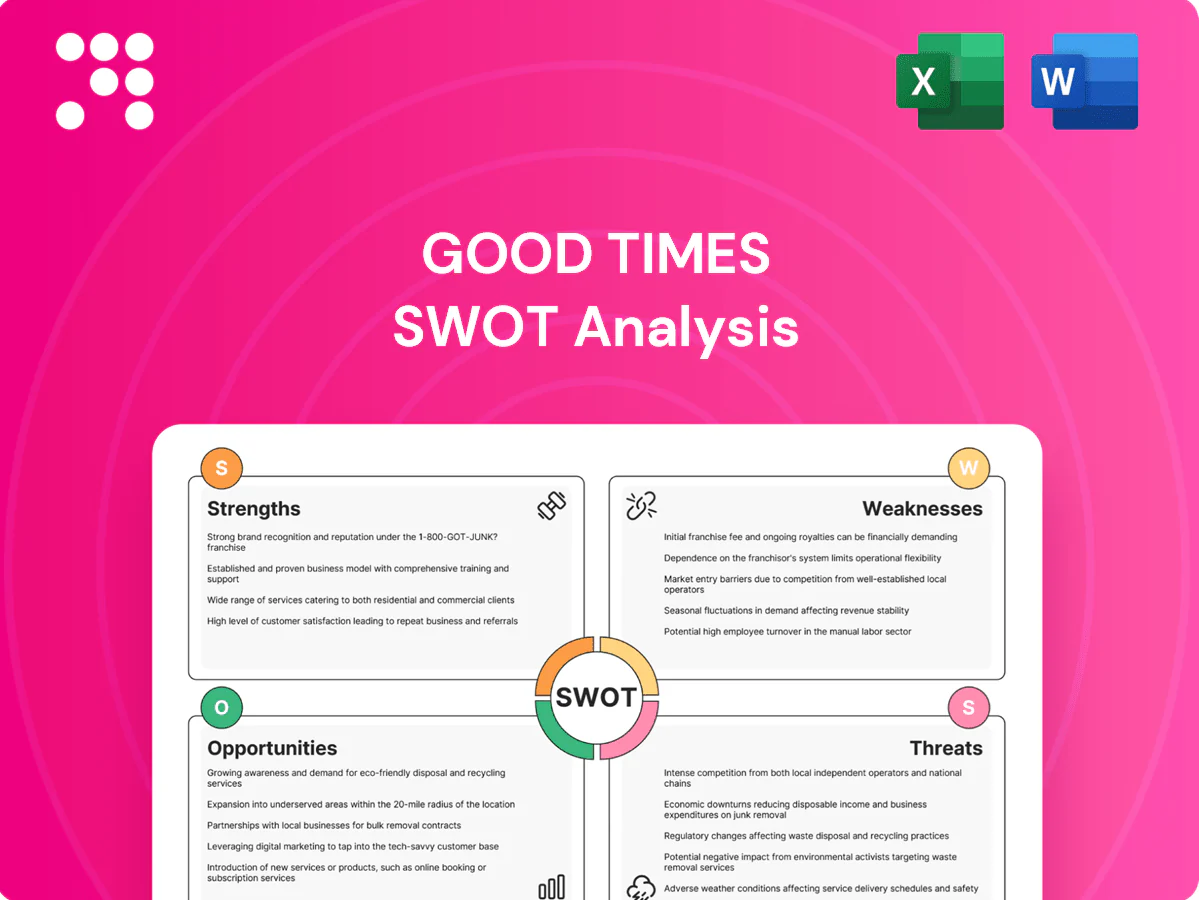
Good Times SWOT Analysis

Your Strategic Toolkit Starts Here
Our Good Times SWOT analysis highlights the brand’s core strengths, market challenges, and key growth opportunities in a concise, actionable way. It outlines risks such as competition and operational constraints alongside strategic levers for expansion. Want the full picture? Purchase the complete SWOT for a research-backed, editable Word and Excel report to plan and pitch with confidence.
Strengths

Dual-brand portfolio synergy
Operating two brands—Good Times and Bad Daddy’s—delivers cross-segment coverage across quick-service and polished fast-casual burgers, broadening traffic drivers and dayparts (lunch, dinner, evenings). Shared back-office functions and joint purchasing/marketing create scale economies and cost leverage. Brand pairings enable market-by-market positioning flexibility and portfolio optionality for site and format decisions.
Premium, all-natural positioning
Emphasizing fresh, all-natural ingredients differentiates Good Times from value-driven QSR rivals and supports pricing power and repeat purchases among health- and quality-conscious consumers. This positioning aligns with 2024 clean-label and transparency trends and reinforces brand loyalty despite Good Times operating roughly 35 restaurants (2024). The premium stance enhances perceived value even at smaller scale.

Frozen custard specialty
Good Times signature frozen custard creates a distinctive dessert anchor that differentiates the brand and reinforces menu identity across its 34 restaurants as of year-end 2024. The premium custard boosts average check through add-ons and supports seasonal limited-time-offers, increasing revenue per transaction. Desserts broaden appeal to families and late-night diners, expanding daypart traffic. This specialized product niche is operationally difficult for competitors to replicate at equal quality.

Operational focus and regional depth
Concentration in core markets builds stronger local brand affinity and operating know-how, enabling consistent field supervision and training across units; tighter geographies reduce logistics complexity and supply risk and make regional strength a springboard for measured expansion.
- Local brand loyalty and deeper operating expertise
- Lower logistics/supply chain complexity
- Consistent training and supervision
- Platform for phased expansion
Sustainability and sourcing narrative
Good Times demonstrates measurable brand equity through responsible sourcing and sustainability, aligning with EU CSRD reporting expansion in 2024 and tapping urban and younger cohorts where ~65% of consumers in 2024 surveys report sustainability influences purchase choice; this strengthens partnership opportunities, community programs, and lowers long-term regulatory and consumer-shift operational risk.
- 65% consumer influence (2024)
- EU CSRD expanded reporting (2024)
- Higher urban/Gen Z resonance
- Reduced regulatory/market risk
Dual-brand model scales ops: 34 restaurants, 65% sustainability influence
Operating two brands (Good Times, Bad Daddy’s) expands dayparts and site flexibility; shared back-office functions deliver scale benefits across the portfolio. Good Times emphasizes fresh, all-natural ingredients and a signature frozen custard that boosts check and repeat visits across 34 restaurants (year-end 2024). Brand sustainability positioning aligns with 65% of consumers citing sustainability influence on purchases (2024), reducing long-term risk.
| Metric | Value (2024) |
|---|---|
| Restaurants | 34 (YE 2024) |
| Brands | Good Times & Bad Daddy’s |
| Consumer sustainability influence | 65% |
| Signature product | Frozen custard |
What is included in the product
 Detailed Word Document
Provides a concise SWOT analysis of Good Times, outlining internal strengths and weaknesses and external opportunities and threats to assess its competitive position and strategic risks.

 Customizable Excel Spreadsheet
Provides a focused SWOT matrix that quickly surfaces strengths, weaknesses, opportunities, and threats to eliminate strategic ambiguity and speed decision-making, while an editable layout enables fast updates so teams can address pain points as priorities shift.
Weaknesses

Limited national scale
Good Times' limited national scale keeps brand awareness concentrated regionally rather than competing with national burger chains, reducing top-of-mind recognition outside core markets.
The small footprint constrains bargaining power in advertising, tech investments, and procurement, raising per-unit costs compared with larger chains.
Scale limitations compress margins during inflationary periods and force a slower, market-by-market growth approach that delays national revenue diversification.
Menu complexity and cost
Premium ingredients and broader builds drive higher food and labor cost pressure, eroding already slim restaurant net margins of roughly 3–6% industry-wide. Complexity can slow throughput during peak hours, increasing service variability and ticket times. Training demands rise to ensure consistent execution, raising payroll and supervision costs. Variability in build quality risks guest experience and squeezes margins further.

Capital intensity of Bad Daddy’s
Polished fast-casual Bad Daddy’s units typically require higher build-out and lease costs, commonly in the $600k–$1.2M range, raising upfront capital requirements. Longer payback periods of roughly 3–5 years make returns sensitive to sales volatility and margin swings. Site-selection risk is elevated versus low-capex drive-thru QSR boxes, and higher investment per unit can constrain growth during tighter credit cycles.

Geographic concentration risk
Good Times is heavily concentrated in Colorado and neighboring Mountain West states, making revenue and same-store sales sensitive to local economic swings, weather and events; competitive entries or regional tourism downturns can disproportionately affect quarterly results.
- Dependence on few regions: majority of locations in Colorado
- Weather/events sensitivity: peak-season revenue risk
- Real estate saturation limits same-market growth
- Diversification needs added capex/overhead
Brand awareness outside core
Good Times and Bad Daddy's recognition lags in new markets, forcing higher customer acquisition costs during entry and greater reliance on promotions that compress margins; Bad Daddy's was acquired by Good Times in 2018 and the combined brands remain regionally concentrated around Colorado. Building loyalty requires consistent execution and often months to years of local investment before stores reach mature unit economics.
- Recognition lag increases CAC
- Promotions dilute margins
- Regional concentration (headquartered in Lakewood, CO)
- Long runway to build loyalty
Colorado-focused casual dining faces tight margins, high build costs and elevated site risk
Good Times remains regionally concentrated (majority of locations in Colorado), limiting national brand reach and making sales sensitive to local economic/weather events.
Smaller scale reduces bargaining power and increases per-unit costs for advertising, technology and procurement versus national chains.
Premium builds and broader menus raise food and labor cost pressure, compressing net margins (industry ~3–6%) and slowing throughput at peak times.
Bad Daddy’s higher build-out ($600k–$1.2M) and longer payback (≈3–5 years) raise capital intensity and site-selection risk.
| Metric | Value |
|---|---|
| Net margin (industry) | 3–6% |
| Bad Daddy’s build-out | $600k–$1.2M |
| Payback period | ≈3–5 years |
| Headquarters / regional base | Lakewood, Colorado; majority locations in CO |
Preview the Actual Deliverable
Good Times SWOT Analysis
This is the actual Good Times SWOT analysis document you’ll receive upon purchase—no surprises, just professional quality. The preview below is pulled directly from the final report; buy to unlock the full, editable version with complete findings and recommendations. It's structured and ready to use.

Your Strategic Toolkit Starts Here
Our Good Times SWOT analysis highlights the brand’s core strengths, market challenges, and key growth opportunities in a concise, actionable way. It outlines risks such as competition and operational constraints alongside strategic levers for expansion. Want the full picture? Purchase the complete SWOT for a research-backed, editable Word and Excel report to plan and pitch with confidence.
Strengths
Dual-brand portfolio synergy
Operating two brands—Good Times and Bad Daddy’s—delivers cross-segment coverage across quick-service and polished fast-casual burgers, broadening traffic drivers and dayparts (lunch, dinner, evenings). Shared back-office functions and joint purchasing/marketing create scale economies and cost leverage. Brand pairings enable market-by-market positioning flexibility and portfolio optionality for site and format decisions.
Premium, all-natural positioning
Emphasizing fresh, all-natural ingredients differentiates Good Times from value-driven QSR rivals and supports pricing power and repeat purchases among health- and quality-conscious consumers. This positioning aligns with 2024 clean-label and transparency trends and reinforces brand loyalty despite Good Times operating roughly 35 restaurants (2024). The premium stance enhances perceived value even at smaller scale.
Frozen custard specialty
Good Times signature frozen custard creates a distinctive dessert anchor that differentiates the brand and reinforces menu identity across its 34 restaurants as of year-end 2024. The premium custard boosts average check through add-ons and supports seasonal limited-time-offers, increasing revenue per transaction. Desserts broaden appeal to families and late-night diners, expanding daypart traffic. This specialized product niche is operationally difficult for competitors to replicate at equal quality.
Operational focus and regional depth
Concentration in core markets builds stronger local brand affinity and operating know-how, enabling consistent field supervision and training across units; tighter geographies reduce logistics complexity and supply risk and make regional strength a springboard for measured expansion.
- Local brand loyalty and deeper operating expertise
- Lower logistics/supply chain complexity
- Consistent training and supervision
- Platform for phased expansion
Sustainability and sourcing narrative
Good Times demonstrates measurable brand equity through responsible sourcing and sustainability, aligning with EU CSRD reporting expansion in 2024 and tapping urban and younger cohorts where ~65% of consumers in 2024 surveys report sustainability influences purchase choice; this strengthens partnership opportunities, community programs, and lowers long-term regulatory and consumer-shift operational risk.
- 65% consumer influence (2024)
- EU CSRD expanded reporting (2024)
- Higher urban/Gen Z resonance
- Reduced regulatory/market risk
Dual-brand model scales ops: 34 restaurants, 65% sustainability influence
Operating two brands (Good Times, Bad Daddy’s) expands dayparts and site flexibility; shared back-office functions deliver scale benefits across the portfolio. Good Times emphasizes fresh, all-natural ingredients and a signature frozen custard that boosts check and repeat visits across 34 restaurants (year-end 2024). Brand sustainability positioning aligns with 65% of consumers citing sustainability influence on purchases (2024), reducing long-term risk.
| Metric | Value (2024) |
|---|---|
| Restaurants | 34 (YE 2024) |
| Brands | Good Times & Bad Daddy’s |
| Consumer sustainability influence | 65% |
| Signature product | Frozen custard |
What is included in the product
Detailed Word Document
Provides a concise SWOT analysis of Good Times, outlining internal strengths and weaknesses and external opportunities and threats to assess its competitive position and strategic risks.
Customizable Excel Spreadsheet
Provides a focused SWOT matrix that quickly surfaces strengths, weaknesses, opportunities, and threats to eliminate strategic ambiguity and speed decision-making, while an editable layout enables fast updates so teams can address pain points as priorities shift.
Weaknesses
Limited national scale
Good Times' limited national scale keeps brand awareness concentrated regionally rather than competing with national burger chains, reducing top-of-mind recognition outside core markets.
The small footprint constrains bargaining power in advertising, tech investments, and procurement, raising per-unit costs compared with larger chains.
Scale limitations compress margins during inflationary periods and force a slower, market-by-market growth approach that delays national revenue diversification.
Menu complexity and cost
Premium ingredients and broader builds drive higher food and labor cost pressure, eroding already slim restaurant net margins of roughly 3–6% industry-wide. Complexity can slow throughput during peak hours, increasing service variability and ticket times. Training demands rise to ensure consistent execution, raising payroll and supervision costs. Variability in build quality risks guest experience and squeezes margins further.
Capital intensity of Bad Daddy’s
Polished fast-casual Bad Daddy’s units typically require higher build-out and lease costs, commonly in the $600k–$1.2M range, raising upfront capital requirements. Longer payback periods of roughly 3–5 years make returns sensitive to sales volatility and margin swings. Site-selection risk is elevated versus low-capex drive-thru QSR boxes, and higher investment per unit can constrain growth during tighter credit cycles.
Geographic concentration risk
Good Times is heavily concentrated in Colorado and neighboring Mountain West states, making revenue and same-store sales sensitive to local economic swings, weather and events; competitive entries or regional tourism downturns can disproportionately affect quarterly results.
- Dependence on few regions: majority of locations in Colorado
- Weather/events sensitivity: peak-season revenue risk
- Real estate saturation limits same-market growth
- Diversification needs added capex/overhead
Brand awareness outside core
Good Times and Bad Daddy's recognition lags in new markets, forcing higher customer acquisition costs during entry and greater reliance on promotions that compress margins; Bad Daddy's was acquired by Good Times in 2018 and the combined brands remain regionally concentrated around Colorado. Building loyalty requires consistent execution and often months to years of local investment before stores reach mature unit economics.
- Recognition lag increases CAC
- Promotions dilute margins
- Regional concentration (headquartered in Lakewood, CO)
- Long runway to build loyalty
Colorado-focused casual dining faces tight margins, high build costs and elevated site risk
Good Times remains regionally concentrated (majority of locations in Colorado), limiting national brand reach and making sales sensitive to local economic/weather events.
Smaller scale reduces bargaining power and increases per-unit costs for advertising, technology and procurement versus national chains.
Premium builds and broader menus raise food and labor cost pressure, compressing net margins (industry ~3–6%) and slowing throughput at peak times.
Bad Daddy’s higher build-out ($600k–$1.2M) and longer payback (≈3–5 years) raise capital intensity and site-selection risk.
| Metric | Value |
|---|---|
| Net margin (industry) | 3–6% |
| Bad Daddy’s build-out | $600k–$1.2M |
| Payback period | ≈3–5 years |
| Headquarters / regional base | Lakewood, Colorado; majority locations in CO |
Preview the Actual Deliverable
Good Times SWOT Analysis
This is the actual Good Times SWOT analysis document you’ll receive upon purchase—no surprises, just professional quality. The preview below is pulled directly from the final report; buy to unlock the full, editable version with complete findings and recommendations. It's structured and ready to use.
Original: $10.00
-65%$10.00
$3.50Description
Your Strategic Toolkit Starts Here
Our Good Times SWOT analysis highlights the brand’s core strengths, market challenges, and key growth opportunities in a concise, actionable way. It outlines risks such as competition and operational constraints alongside strategic levers for expansion. Want the full picture? Purchase the complete SWOT for a research-backed, editable Word and Excel report to plan and pitch with confidence.
Strengths
Dual-brand portfolio synergy
Operating two brands—Good Times and Bad Daddy’s—delivers cross-segment coverage across quick-service and polished fast-casual burgers, broadening traffic drivers and dayparts (lunch, dinner, evenings). Shared back-office functions and joint purchasing/marketing create scale economies and cost leverage. Brand pairings enable market-by-market positioning flexibility and portfolio optionality for site and format decisions.
Premium, all-natural positioning
Emphasizing fresh, all-natural ingredients differentiates Good Times from value-driven QSR rivals and supports pricing power and repeat purchases among health- and quality-conscious consumers. This positioning aligns with 2024 clean-label and transparency trends and reinforces brand loyalty despite Good Times operating roughly 35 restaurants (2024). The premium stance enhances perceived value even at smaller scale.
Frozen custard specialty
Good Times signature frozen custard creates a distinctive dessert anchor that differentiates the brand and reinforces menu identity across its 34 restaurants as of year-end 2024. The premium custard boosts average check through add-ons and supports seasonal limited-time-offers, increasing revenue per transaction. Desserts broaden appeal to families and late-night diners, expanding daypart traffic. This specialized product niche is operationally difficult for competitors to replicate at equal quality.
Operational focus and regional depth
Concentration in core markets builds stronger local brand affinity and operating know-how, enabling consistent field supervision and training across units; tighter geographies reduce logistics complexity and supply risk and make regional strength a springboard for measured expansion.
- Local brand loyalty and deeper operating expertise
- Lower logistics/supply chain complexity
- Consistent training and supervision
- Platform for phased expansion
Sustainability and sourcing narrative
Good Times demonstrates measurable brand equity through responsible sourcing and sustainability, aligning with EU CSRD reporting expansion in 2024 and tapping urban and younger cohorts where ~65% of consumers in 2024 surveys report sustainability influences purchase choice; this strengthens partnership opportunities, community programs, and lowers long-term regulatory and consumer-shift operational risk.
- 65% consumer influence (2024)
- EU CSRD expanded reporting (2024)
- Higher urban/Gen Z resonance
- Reduced regulatory/market risk
Dual-brand model scales ops: 34 restaurants, 65% sustainability influence
Operating two brands (Good Times, Bad Daddy’s) expands dayparts and site flexibility; shared back-office functions deliver scale benefits across the portfolio. Good Times emphasizes fresh, all-natural ingredients and a signature frozen custard that boosts check and repeat visits across 34 restaurants (year-end 2024). Brand sustainability positioning aligns with 65% of consumers citing sustainability influence on purchases (2024), reducing long-term risk.
| Metric | Value (2024) |
|---|---|
| Restaurants | 34 (YE 2024) |
| Brands | Good Times & Bad Daddy’s |
| Consumer sustainability influence | 65% |
| Signature product | Frozen custard |
What is included in the product
Detailed Word Document
Provides a concise SWOT analysis of Good Times, outlining internal strengths and weaknesses and external opportunities and threats to assess its competitive position and strategic risks.
Customizable Excel Spreadsheet
Provides a focused SWOT matrix that quickly surfaces strengths, weaknesses, opportunities, and threats to eliminate strategic ambiguity and speed decision-making, while an editable layout enables fast updates so teams can address pain points as priorities shift.
Weaknesses
Limited national scale
Good Times' limited national scale keeps brand awareness concentrated regionally rather than competing with national burger chains, reducing top-of-mind recognition outside core markets.
The small footprint constrains bargaining power in advertising, tech investments, and procurement, raising per-unit costs compared with larger chains.
Scale limitations compress margins during inflationary periods and force a slower, market-by-market growth approach that delays national revenue diversification.
Menu complexity and cost
Premium ingredients and broader builds drive higher food and labor cost pressure, eroding already slim restaurant net margins of roughly 3–6% industry-wide. Complexity can slow throughput during peak hours, increasing service variability and ticket times. Training demands rise to ensure consistent execution, raising payroll and supervision costs. Variability in build quality risks guest experience and squeezes margins further.
Capital intensity of Bad Daddy’s
Polished fast-casual Bad Daddy’s units typically require higher build-out and lease costs, commonly in the $600k–$1.2M range, raising upfront capital requirements. Longer payback periods of roughly 3–5 years make returns sensitive to sales volatility and margin swings. Site-selection risk is elevated versus low-capex drive-thru QSR boxes, and higher investment per unit can constrain growth during tighter credit cycles.
Geographic concentration risk
Good Times is heavily concentrated in Colorado and neighboring Mountain West states, making revenue and same-store sales sensitive to local economic swings, weather and events; competitive entries or regional tourism downturns can disproportionately affect quarterly results.
- Dependence on few regions: majority of locations in Colorado
- Weather/events sensitivity: peak-season revenue risk
- Real estate saturation limits same-market growth
- Diversification needs added capex/overhead
Brand awareness outside core
Good Times and Bad Daddy's recognition lags in new markets, forcing higher customer acquisition costs during entry and greater reliance on promotions that compress margins; Bad Daddy's was acquired by Good Times in 2018 and the combined brands remain regionally concentrated around Colorado. Building loyalty requires consistent execution and often months to years of local investment before stores reach mature unit economics.
- Recognition lag increases CAC
- Promotions dilute margins
- Regional concentration (headquartered in Lakewood, CO)
- Long runway to build loyalty
Colorado-focused casual dining faces tight margins, high build costs and elevated site risk
Good Times remains regionally concentrated (majority of locations in Colorado), limiting national brand reach and making sales sensitive to local economic/weather events.
Smaller scale reduces bargaining power and increases per-unit costs for advertising, technology and procurement versus national chains.
Premium builds and broader menus raise food and labor cost pressure, compressing net margins (industry ~3–6%) and slowing throughput at peak times.
Bad Daddy’s higher build-out ($600k–$1.2M) and longer payback (≈3–5 years) raise capital intensity and site-selection risk.
| Metric | Value |
|---|---|
| Net margin (industry) | 3–6% |
| Bad Daddy’s build-out | $600k–$1.2M |
| Payback period | ≈3–5 years |
| Headquarters / regional base | Lakewood, Colorado; majority locations in CO |
Preview the Actual Deliverable
Good Times SWOT Analysis
This is the actual Good Times SWOT analysis document you’ll receive upon purchase—no surprises, just professional quality. The preview below is pulled directly from the final report; buy to unlock the full, editable version with complete findings and recommendations. It's structured and ready to use.











