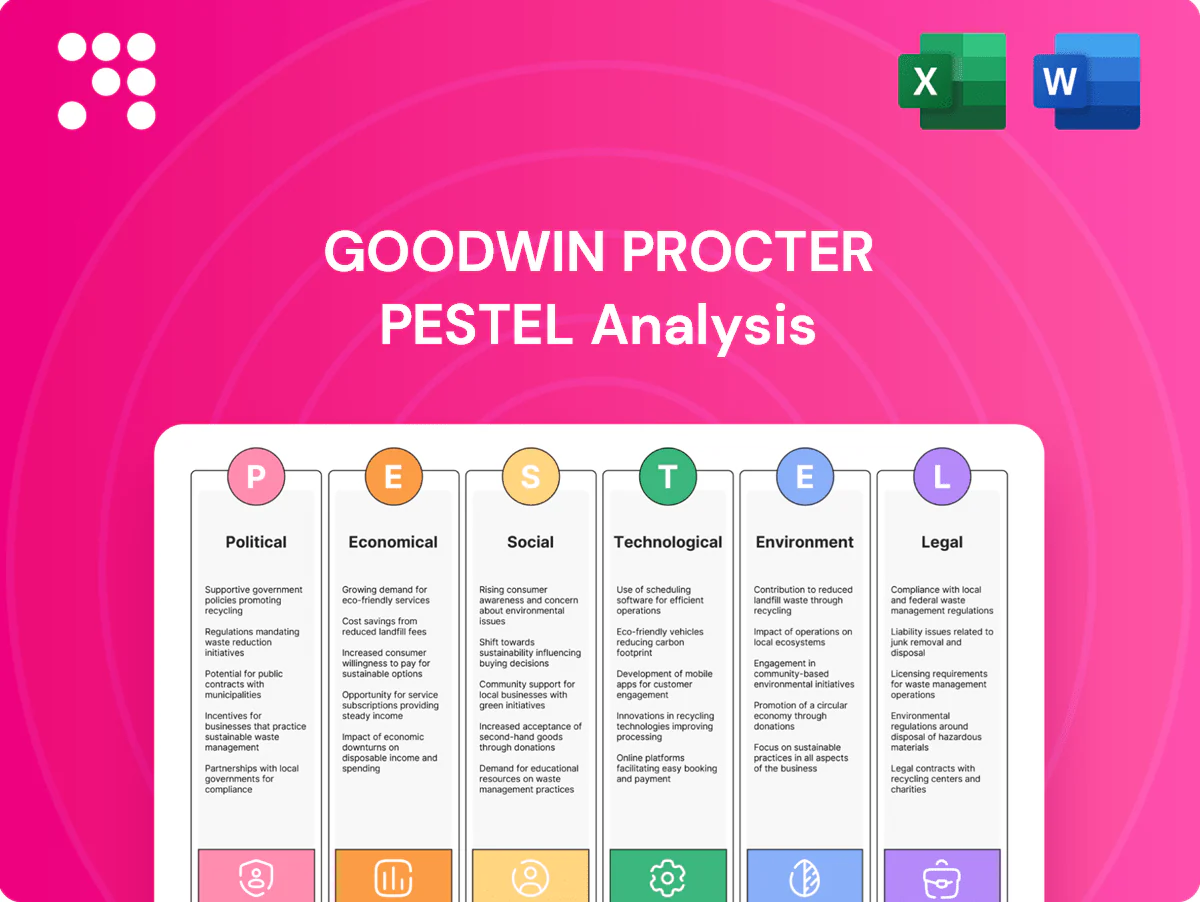
Goodwin Procter PESTLE Analysis

Your Shortcut to Market Insight Starts Here
Our PESTLE Analysis for Goodwin Procter reveals how political, economic, social, technological, legal, and environmental trends shape its strategy and risk profile, offering concise, actionable insights. Ideal for investors, advisors, and strategists, it saves research time and supports confident decisions. Purchase the full report for the complete, editable breakdown and immediate download.
Political factors

Cross-border regulatory alignment
Goodwin Procter’s cross-border work depends on stable cooperation among U.S., U.K., EU and APAC regulators; divergence in data, competition and financial rules increases advisory complexity and can slow deal timetables. Global FDI fell to about $1.2 trillion in 2023 (UNCTAD), underscoring sensitivity to regulatory shifts. Monitoring bilateral trade and investment policies is essential for timeline and cost predictability. Proactive government-relations insight mitigates geopolitical execution risk.
Geopolitical tensions and investment flows
Heightened U.S.–China and allied-nation scrutiny is reshaping tech, life‑sciences and sensitive‑data transactions, with CFIUS registering 1,108 notices in 2023 and global FDI sliding to about $1.26 trillion that year per UNCTAD. Clients now face CFIUS reviews, outbound investment controls and expanded sanctions exposure, raising deal timing and risk. Goodwin must structure transactions to withstand political screening and embed supply‑chain and capital‑routing scenario planning into deal strategy.

Public policy shifts in healthcare
Public policy shifts — notably Medicare drug price negotiation under the Inflation Reduction Act (effective 2026) — reshape drug pricing, reimbursement, and clinical-trial valuation and litigation risk for life sciences firms. Election cycles and agency leadership turnover can redirect FDA and CMS priorities, affecting ~65 million Medicare beneficiaries. Goodwin’s regulatory and litigation teams must pivot strategies to updated guidance, while advocacy and comment-letter engagement bolster client outcomes.

Infrastructure and housing policy impacts
Government incentives and zoning reforms drive real estate development and financing opportunities; the 2021 Infrastructure Investment and Jobs Act (1.2 trillion total, 550 billion new) and 2024 Inflation Reduction Act credits (clean-energy tax credits up to 30%) reshape deal economics. Shifts in tax credits, green-building grants and expanded public-private partnerships alter capital stacks and returns. Political support for affordable housing and life-science lab conversions directly affects pipeline quality, and tracking municipal agendas is vital for permitting and community-benefit negotiations.
- IIJA: 1.2 trillion total, 550 billion new
- IRA: up to 30% clean-energy tax credits (2024)
- Municipal agendas drive permitting timelines and community-benefit terms
ESG and stakeholder governance expectations
Political debate over ESG is reshaping disclosure and fiduciary norms: the SEC climate disclosure rule (2024) and EU CSRD (covering ~50,000 companies by 2026) drive higher reporting expectations, while over 20 US states have adopted divergent ESG-related measures, creating patchwork risk for asset managers and PE sponsors. Goodwin navigates multi-jurisdictional expectations to minimize litigation exposure and advises boards to balance policy uncertainty with long-term stewardship.
- SEC rule 2024 — raised enforcement and disclosure demands
- EU CSRD — ~50,000 firms in scope by 2026
- 20+ US states — divergent statutes create compliance fragmentation
- Goodwin — multi-jurisdictional counsel to reduce litigation risk
Regulatory divergence, CFIUS scrutiny and policy incentives reshape cross-border deal timetables
Goodwin’s cross-border advisory workload is driven by regulatory divergence (UNCTAD global FDI ~1.2T in 2023) and rising political scrutiny (CFIUS 1,108 notices in 2023), slowing deal timetables. Policy shifts—Medicare ~65M beneficiaries, IRA clean-energy credits up to 30%, IIJA $1.2T—reshape life‑sciences, real estate and ESG compliance, requiring proactive government-relations and transaction structuring.
| Factor | Key stat | Impact |
|---|---|---|
| Cross-border/regulators | FDI ~1.2T (2023) | Longer timelines |
| National security | CFIUS 1,108 (2023) | Deal structure risk |
| Policy incentives | IRA credits up to 30% | Alters capital stacks |
What is included in the product
 Detailed Word Document
Explores how external macro-environmental factors uniquely affect Goodwin Procter across Political, Economic, Social, Technological, Environmental, and Legal dimensions, offering data-backed trends and forward-looking insights to help executives, consultants, and entrepreneurs identify threats, opportunities, and scenarios; formatted for seamless inclusion in business plans, pitch decks, or internal reports.

 Customizable Excel Spreadsheet
A concise, visually segmented PESTLE summary of Goodwin Procter that relieves prep pain by enabling quick interpretation at a glance and easy insertion into presentations; editable for region or practice-specific notes and ideal for team alignment in planning sessions.
Economic factors

Interest rates and credit conditions
Federal funds at 5.25–5.50% (mid‑2025) push higher cap rates and directly influence M&A, PE buyouts and real estate valuations. Tighter credit markets increase scrutiny of covenants, MAC clauses and financing‑out provisions during diligence. Goodwin structures resilient funding packages and intercreditor arrangements while rate volatility fuels disputes and restructurings, expanding contentious work.
Deal cycle and IPO window
Equity market sentiment dictates timing for tech and biotech exits, with 2022 recording the lowest global IPO activity since 2009, compressing windows and forcing sponsors toward dual-track processes and structured secondaries. Goodwin must optimize disclosure, governance readiness, and antitrust positioning to shorten deal cycles. Active pipeline triage allocates resources to transactions most likely to clear narrow windows and regulatory scrutiny.

Valuation compression and earnouts
Valuation compression and down‑rounds have driven buyers and sellers to rely more on earnouts and seller notes to bridge price gaps, increasing structuring complexity and dispute risk around milestones, reps and warranties, and post‑closing adjustments. Goodwin mitigates these risks by drafting razor‑sharp milestone definitions, detailed audit rights and escrow terms to reduce ambiguity. Robust representations & warranties insurance (RWI) and bespoke indemnity solutions are used to allocate residual risk and facilitate deal certainty.

Private capital liquidity dynamics
Secondary sales, NAV loans and continuation funds have become primary tools to address exit delays, with GP-leds accounting for roughly two-thirds of secondary volume in 2023–24 and secondary activity exceeding $60bn annually in that window; these structures intensify conflicts and regulatory scrutiny, making fund-formation and GP-led expertise at firms like Goodwin Procter critical.
- conflicts management
- NAV loan underwriting
- continuation fund structuring
- GP-led disclosure & LP communication
Macroeconomic shocks and insolvency
Macroeconomic shocks—supply-chain shifts, persistent inflation (US CPI ~3.4% in 2024) and sudden demand swings—can trigger covenant breaches and insolvency risk, increasing cross-border restructurings that require coordination of multiple insolvency regimes and recognition. Goodwin’s restructuring and litigation teams align to preserve enterprise value while opportunistic investors demand robust risk and claims analysis.
- Supply-chain disruption: higher cost pressure
- Inflation: real margin compression ~2024
- Demand swings: covenant breach spike
- Cross-border: coordinated recognition needed
- Investors: deep claims & risk analytics
Regulatory divergence, CFIUS scrutiny and policy incentives reshape cross-border deal timetables
Higher federal funds (5.25–5.50% mid‑2025) elevate cap rates, tighten financing and spur restructurings; credit scrutiny raises covenant and MAC disputes. Equity windows remain narrow after 2022 IPO trough, pushing earnouts, secondaries and RWI use. GP-leds/secondaries (> $60bn annual 2023–24; ~66% GP-led) increase conflicts and fund‑formation demand.
| Metric | Value |
|---|---|
| Fed funds (mid‑2025) | 5.25–5.50% |
| US CPI (2024) | ~3.4% |
| Secondary volume (2023–24) | >$60bn |
| GP‑led share | ~66% |
Preview the Actual Deliverable
Goodwin Procter PESTLE Analysis
The Goodwin Procter PESTLE Analysis preview shown here is the exact document you’ll receive after purchase—fully formatted and ready to use. This is a real screenshot of the product you’re buying and the content and structure are identical to the downloadable file. No placeholders or teasers—what you see is what you’ll get.

Your Shortcut to Market Insight Starts Here
Our PESTLE Analysis for Goodwin Procter reveals how political, economic, social, technological, legal, and environmental trends shape its strategy and risk profile, offering concise, actionable insights. Ideal for investors, advisors, and strategists, it saves research time and supports confident decisions. Purchase the full report for the complete, editable breakdown and immediate download.
Political factors
Cross-border regulatory alignment
Goodwin Procter’s cross-border work depends on stable cooperation among U.S., U.K., EU and APAC regulators; divergence in data, competition and financial rules increases advisory complexity and can slow deal timetables. Global FDI fell to about $1.2 trillion in 2023 (UNCTAD), underscoring sensitivity to regulatory shifts. Monitoring bilateral trade and investment policies is essential for timeline and cost predictability. Proactive government-relations insight mitigates geopolitical execution risk.
Geopolitical tensions and investment flows
Heightened U.S.–China and allied-nation scrutiny is reshaping tech, life‑sciences and sensitive‑data transactions, with CFIUS registering 1,108 notices in 2023 and global FDI sliding to about $1.26 trillion that year per UNCTAD. Clients now face CFIUS reviews, outbound investment controls and expanded sanctions exposure, raising deal timing and risk. Goodwin must structure transactions to withstand political screening and embed supply‑chain and capital‑routing scenario planning into deal strategy.
Public policy shifts in healthcare
Public policy shifts — notably Medicare drug price negotiation under the Inflation Reduction Act (effective 2026) — reshape drug pricing, reimbursement, and clinical-trial valuation and litigation risk for life sciences firms. Election cycles and agency leadership turnover can redirect FDA and CMS priorities, affecting ~65 million Medicare beneficiaries. Goodwin’s regulatory and litigation teams must pivot strategies to updated guidance, while advocacy and comment-letter engagement bolster client outcomes.
Infrastructure and housing policy impacts
Government incentives and zoning reforms drive real estate development and financing opportunities; the 2021 Infrastructure Investment and Jobs Act (1.2 trillion total, 550 billion new) and 2024 Inflation Reduction Act credits (clean-energy tax credits up to 30%) reshape deal economics. Shifts in tax credits, green-building grants and expanded public-private partnerships alter capital stacks and returns. Political support for affordable housing and life-science lab conversions directly affects pipeline quality, and tracking municipal agendas is vital for permitting and community-benefit negotiations.
- IIJA: 1.2 trillion total, 550 billion new
- IRA: up to 30% clean-energy tax credits (2024)
- Municipal agendas drive permitting timelines and community-benefit terms
ESG and stakeholder governance expectations
Political debate over ESG is reshaping disclosure and fiduciary norms: the SEC climate disclosure rule (2024) and EU CSRD (covering ~50,000 companies by 2026) drive higher reporting expectations, while over 20 US states have adopted divergent ESG-related measures, creating patchwork risk for asset managers and PE sponsors. Goodwin navigates multi-jurisdictional expectations to minimize litigation exposure and advises boards to balance policy uncertainty with long-term stewardship.
- SEC rule 2024 — raised enforcement and disclosure demands
- EU CSRD — ~50,000 firms in scope by 2026
- 20+ US states — divergent statutes create compliance fragmentation
- Goodwin — multi-jurisdictional counsel to reduce litigation risk
Regulatory divergence, CFIUS scrutiny and policy incentives reshape cross-border deal timetables
Goodwin’s cross-border advisory workload is driven by regulatory divergence (UNCTAD global FDI ~1.2T in 2023) and rising political scrutiny (CFIUS 1,108 notices in 2023), slowing deal timetables. Policy shifts—Medicare ~65M beneficiaries, IRA clean-energy credits up to 30%, IIJA $1.2T—reshape life‑sciences, real estate and ESG compliance, requiring proactive government-relations and transaction structuring.
| Factor | Key stat | Impact |
|---|---|---|
| Cross-border/regulators | FDI ~1.2T (2023) | Longer timelines |
| National security | CFIUS 1,108 (2023) | Deal structure risk |
| Policy incentives | IRA credits up to 30% | Alters capital stacks |
What is included in the product
Detailed Word Document
Explores how external macro-environmental factors uniquely affect Goodwin Procter across Political, Economic, Social, Technological, Environmental, and Legal dimensions, offering data-backed trends and forward-looking insights to help executives, consultants, and entrepreneurs identify threats, opportunities, and scenarios; formatted for seamless inclusion in business plans, pitch decks, or internal reports.
Customizable Excel Spreadsheet
A concise, visually segmented PESTLE summary of Goodwin Procter that relieves prep pain by enabling quick interpretation at a glance and easy insertion into presentations; editable for region or practice-specific notes and ideal for team alignment in planning sessions.
Economic factors
Interest rates and credit conditions
Federal funds at 5.25–5.50% (mid‑2025) push higher cap rates and directly influence M&A, PE buyouts and real estate valuations. Tighter credit markets increase scrutiny of covenants, MAC clauses and financing‑out provisions during diligence. Goodwin structures resilient funding packages and intercreditor arrangements while rate volatility fuels disputes and restructurings, expanding contentious work.
Deal cycle and IPO window
Equity market sentiment dictates timing for tech and biotech exits, with 2022 recording the lowest global IPO activity since 2009, compressing windows and forcing sponsors toward dual-track processes and structured secondaries. Goodwin must optimize disclosure, governance readiness, and antitrust positioning to shorten deal cycles. Active pipeline triage allocates resources to transactions most likely to clear narrow windows and regulatory scrutiny.
Valuation compression and earnouts
Valuation compression and down‑rounds have driven buyers and sellers to rely more on earnouts and seller notes to bridge price gaps, increasing structuring complexity and dispute risk around milestones, reps and warranties, and post‑closing adjustments. Goodwin mitigates these risks by drafting razor‑sharp milestone definitions, detailed audit rights and escrow terms to reduce ambiguity. Robust representations & warranties insurance (RWI) and bespoke indemnity solutions are used to allocate residual risk and facilitate deal certainty.
Private capital liquidity dynamics
Secondary sales, NAV loans and continuation funds have become primary tools to address exit delays, with GP-leds accounting for roughly two-thirds of secondary volume in 2023–24 and secondary activity exceeding $60bn annually in that window; these structures intensify conflicts and regulatory scrutiny, making fund-formation and GP-led expertise at firms like Goodwin Procter critical.
- conflicts management
- NAV loan underwriting
- continuation fund structuring
- GP-led disclosure & LP communication
Macroeconomic shocks and insolvency
Macroeconomic shocks—supply-chain shifts, persistent inflation (US CPI ~3.4% in 2024) and sudden demand swings—can trigger covenant breaches and insolvency risk, increasing cross-border restructurings that require coordination of multiple insolvency regimes and recognition. Goodwin’s restructuring and litigation teams align to preserve enterprise value while opportunistic investors demand robust risk and claims analysis.
- Supply-chain disruption: higher cost pressure
- Inflation: real margin compression ~2024
- Demand swings: covenant breach spike
- Cross-border: coordinated recognition needed
- Investors: deep claims & risk analytics
Regulatory divergence, CFIUS scrutiny and policy incentives reshape cross-border deal timetables
Higher federal funds (5.25–5.50% mid‑2025) elevate cap rates, tighten financing and spur restructurings; credit scrutiny raises covenant and MAC disputes. Equity windows remain narrow after 2022 IPO trough, pushing earnouts, secondaries and RWI use. GP-leds/secondaries (> $60bn annual 2023–24; ~66% GP-led) increase conflicts and fund‑formation demand.
| Metric | Value |
|---|---|
| Fed funds (mid‑2025) | 5.25–5.50% |
| US CPI (2024) | ~3.4% |
| Secondary volume (2023–24) | >$60bn |
| GP‑led share | ~66% |
Preview the Actual Deliverable
Goodwin Procter PESTLE Analysis
The Goodwin Procter PESTLE Analysis preview shown here is the exact document you’ll receive after purchase—fully formatted and ready to use. This is a real screenshot of the product you’re buying and the content and structure are identical to the downloadable file. No placeholders or teasers—what you see is what you’ll get.
Original: $10.00
-65%$10.00
$3.50Description
Your Shortcut to Market Insight Starts Here
Our PESTLE Analysis for Goodwin Procter reveals how political, economic, social, technological, legal, and environmental trends shape its strategy and risk profile, offering concise, actionable insights. Ideal for investors, advisors, and strategists, it saves research time and supports confident decisions. Purchase the full report for the complete, editable breakdown and immediate download.
Political factors
Cross-border regulatory alignment
Goodwin Procter’s cross-border work depends on stable cooperation among U.S., U.K., EU and APAC regulators; divergence in data, competition and financial rules increases advisory complexity and can slow deal timetables. Global FDI fell to about $1.2 trillion in 2023 (UNCTAD), underscoring sensitivity to regulatory shifts. Monitoring bilateral trade and investment policies is essential for timeline and cost predictability. Proactive government-relations insight mitigates geopolitical execution risk.
Geopolitical tensions and investment flows
Heightened U.S.–China and allied-nation scrutiny is reshaping tech, life‑sciences and sensitive‑data transactions, with CFIUS registering 1,108 notices in 2023 and global FDI sliding to about $1.26 trillion that year per UNCTAD. Clients now face CFIUS reviews, outbound investment controls and expanded sanctions exposure, raising deal timing and risk. Goodwin must structure transactions to withstand political screening and embed supply‑chain and capital‑routing scenario planning into deal strategy.
Public policy shifts in healthcare
Public policy shifts — notably Medicare drug price negotiation under the Inflation Reduction Act (effective 2026) — reshape drug pricing, reimbursement, and clinical-trial valuation and litigation risk for life sciences firms. Election cycles and agency leadership turnover can redirect FDA and CMS priorities, affecting ~65 million Medicare beneficiaries. Goodwin’s regulatory and litigation teams must pivot strategies to updated guidance, while advocacy and comment-letter engagement bolster client outcomes.
Infrastructure and housing policy impacts
Government incentives and zoning reforms drive real estate development and financing opportunities; the 2021 Infrastructure Investment and Jobs Act (1.2 trillion total, 550 billion new) and 2024 Inflation Reduction Act credits (clean-energy tax credits up to 30%) reshape deal economics. Shifts in tax credits, green-building grants and expanded public-private partnerships alter capital stacks and returns. Political support for affordable housing and life-science lab conversions directly affects pipeline quality, and tracking municipal agendas is vital for permitting and community-benefit negotiations.
- IIJA: 1.2 trillion total, 550 billion new
- IRA: up to 30% clean-energy tax credits (2024)
- Municipal agendas drive permitting timelines and community-benefit terms
ESG and stakeholder governance expectations
Political debate over ESG is reshaping disclosure and fiduciary norms: the SEC climate disclosure rule (2024) and EU CSRD (covering ~50,000 companies by 2026) drive higher reporting expectations, while over 20 US states have adopted divergent ESG-related measures, creating patchwork risk for asset managers and PE sponsors. Goodwin navigates multi-jurisdictional expectations to minimize litigation exposure and advises boards to balance policy uncertainty with long-term stewardship.
- SEC rule 2024 — raised enforcement and disclosure demands
- EU CSRD — ~50,000 firms in scope by 2026
- 20+ US states — divergent statutes create compliance fragmentation
- Goodwin — multi-jurisdictional counsel to reduce litigation risk
Regulatory divergence, CFIUS scrutiny and policy incentives reshape cross-border deal timetables
Goodwin’s cross-border advisory workload is driven by regulatory divergence (UNCTAD global FDI ~1.2T in 2023) and rising political scrutiny (CFIUS 1,108 notices in 2023), slowing deal timetables. Policy shifts—Medicare ~65M beneficiaries, IRA clean-energy credits up to 30%, IIJA $1.2T—reshape life‑sciences, real estate and ESG compliance, requiring proactive government-relations and transaction structuring.
| Factor | Key stat | Impact |
|---|---|---|
| Cross-border/regulators | FDI ~1.2T (2023) | Longer timelines |
| National security | CFIUS 1,108 (2023) | Deal structure risk |
| Policy incentives | IRA credits up to 30% | Alters capital stacks |
What is included in the product
Detailed Word Document
Explores how external macro-environmental factors uniquely affect Goodwin Procter across Political, Economic, Social, Technological, Environmental, and Legal dimensions, offering data-backed trends and forward-looking insights to help executives, consultants, and entrepreneurs identify threats, opportunities, and scenarios; formatted for seamless inclusion in business plans, pitch decks, or internal reports.
Customizable Excel Spreadsheet
A concise, visually segmented PESTLE summary of Goodwin Procter that relieves prep pain by enabling quick interpretation at a glance and easy insertion into presentations; editable for region or practice-specific notes and ideal for team alignment in planning sessions.
Economic factors
Interest rates and credit conditions
Federal funds at 5.25–5.50% (mid‑2025) push higher cap rates and directly influence M&A, PE buyouts and real estate valuations. Tighter credit markets increase scrutiny of covenants, MAC clauses and financing‑out provisions during diligence. Goodwin structures resilient funding packages and intercreditor arrangements while rate volatility fuels disputes and restructurings, expanding contentious work.
Deal cycle and IPO window
Equity market sentiment dictates timing for tech and biotech exits, with 2022 recording the lowest global IPO activity since 2009, compressing windows and forcing sponsors toward dual-track processes and structured secondaries. Goodwin must optimize disclosure, governance readiness, and antitrust positioning to shorten deal cycles. Active pipeline triage allocates resources to transactions most likely to clear narrow windows and regulatory scrutiny.
Valuation compression and earnouts
Valuation compression and down‑rounds have driven buyers and sellers to rely more on earnouts and seller notes to bridge price gaps, increasing structuring complexity and dispute risk around milestones, reps and warranties, and post‑closing adjustments. Goodwin mitigates these risks by drafting razor‑sharp milestone definitions, detailed audit rights and escrow terms to reduce ambiguity. Robust representations & warranties insurance (RWI) and bespoke indemnity solutions are used to allocate residual risk and facilitate deal certainty.
Private capital liquidity dynamics
Secondary sales, NAV loans and continuation funds have become primary tools to address exit delays, with GP-leds accounting for roughly two-thirds of secondary volume in 2023–24 and secondary activity exceeding $60bn annually in that window; these structures intensify conflicts and regulatory scrutiny, making fund-formation and GP-led expertise at firms like Goodwin Procter critical.
- conflicts management
- NAV loan underwriting
- continuation fund structuring
- GP-led disclosure & LP communication
Macroeconomic shocks and insolvency
Macroeconomic shocks—supply-chain shifts, persistent inflation (US CPI ~3.4% in 2024) and sudden demand swings—can trigger covenant breaches and insolvency risk, increasing cross-border restructurings that require coordination of multiple insolvency regimes and recognition. Goodwin’s restructuring and litigation teams align to preserve enterprise value while opportunistic investors demand robust risk and claims analysis.
- Supply-chain disruption: higher cost pressure
- Inflation: real margin compression ~2024
- Demand swings: covenant breach spike
- Cross-border: coordinated recognition needed
- Investors: deep claims & risk analytics
Regulatory divergence, CFIUS scrutiny and policy incentives reshape cross-border deal timetables
Higher federal funds (5.25–5.50% mid‑2025) elevate cap rates, tighten financing and spur restructurings; credit scrutiny raises covenant and MAC disputes. Equity windows remain narrow after 2022 IPO trough, pushing earnouts, secondaries and RWI use. GP-leds/secondaries (> $60bn annual 2023–24; ~66% GP-led) increase conflicts and fund‑formation demand.
| Metric | Value |
|---|---|
| Fed funds (mid‑2025) | 5.25–5.50% |
| US CPI (2024) | ~3.4% |
| Secondary volume (2023–24) | >$60bn |
| GP‑led share | ~66% |
Preview the Actual Deliverable
Goodwin Procter PESTLE Analysis
The Goodwin Procter PESTLE Analysis preview shown here is the exact document you’ll receive after purchase—fully formatted and ready to use. This is a real screenshot of the product you’re buying and the content and structure are identical to the downloadable file. No placeholders or teasers—what you see is what you’ll get.











