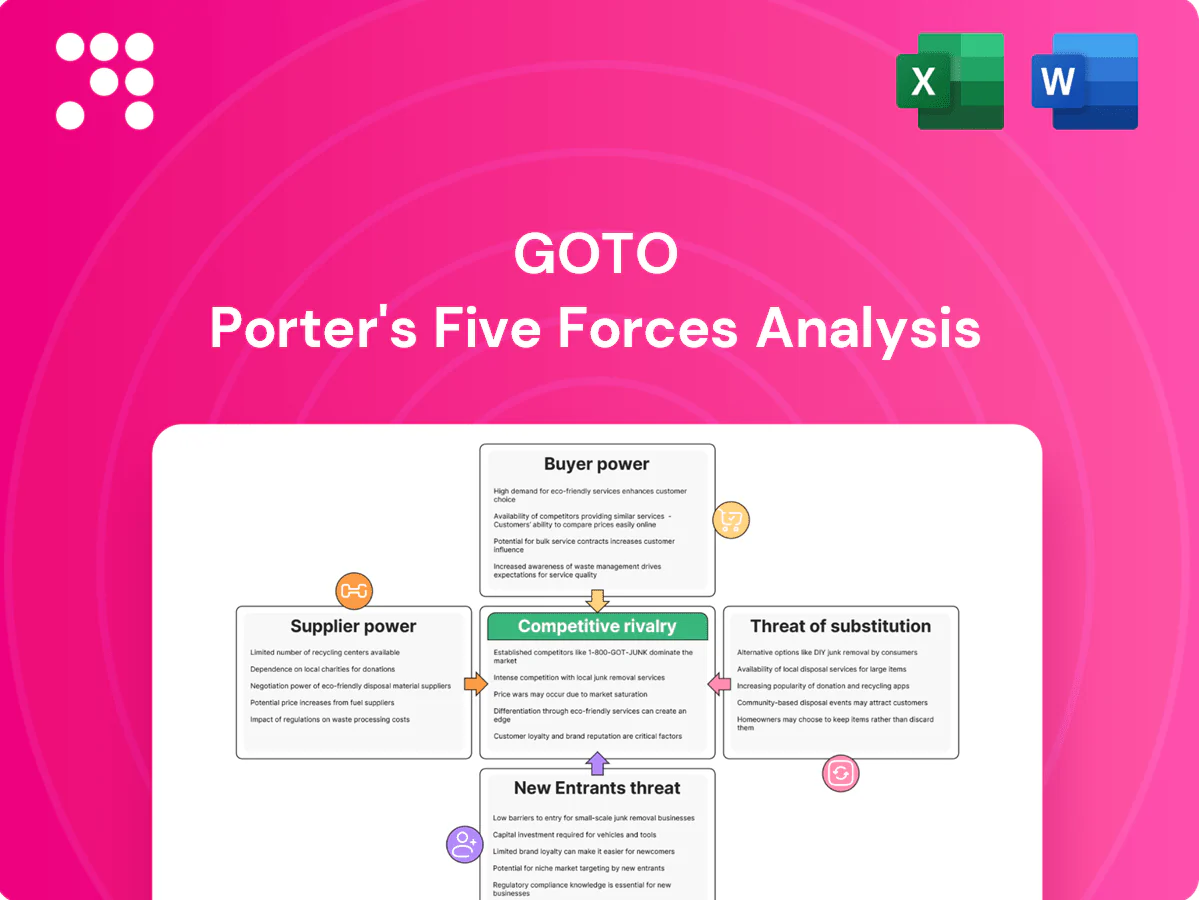
GoTo Porter's Five Forces Analysis

From Overview to Strategy Blueprint
GoTo faces intense rivalry across ride-hailing, fintech, and cloud services, with shifting buyer power and rising substitute threats shaping margins. Supplier leverage and regulatory risks add complexity to strategic choices. This brief snapshot only scratches the surface — unlock the full Porter's Five Forces Analysis to explore GoTo’s competitive dynamics, market pressures, and strategic advantages in detail.
Suppliers Bargaining Power

Dependence on driver-partners
Driver-partners are GoTo’s critical labor supply, numbering over 2 million across Indonesia and SEA, which dilutes individual bargaining power but allows coordinated churn to force higher incentives and temporary bonuses. Regulatory moves in 2024 have nudged partner economics up by mid-single-digit percentages, raising unit costs. Peak-demand scarcity can push surge multipliers up to 2x, amplifying supplier leverage.
Merchant and brand exclusivities
Top merchants and brand exclusives on Tokopedia can secure better fees, preferential traffic placement, and larger promotional budgets, raising switching costs when category leaders or exclusive SKUs are involved; Tokopedia reported over 100 million monthly active users in 2023, heightening platform value for marquee sellers. Marketplace multi-homing, however, caps any single merchant’s leverage, while GoTo deploys data analytics and ad-credit incentives to retain key sellers.

Third-party logistics networks
GoTo relies heavily on external couriers and 3PLs beyond its owned fleet, shifting negotiating leverage to logistics partners when fuel prices, labor conditions, and capacity tighten. Volume commitments and route-optimization help temper per-delivery costs, but seasonal spikes around Ramadan and 11.11 (11 November) materially compress capacity and raise prices. These dynamics intensified through 2024 as peak-period demand surged across Southeast Asia.

Payment rails and financial partners
Bank networks, card schemes, and e-money float partners set take-rates and settlement timelines, with SEA merchant discount rates typically in the 1–3% range in 2024; exclusive bank or wallet promos raise costs but can boost transaction volume materially. Compliance, AML and fraud controls add operational complexity and fee layers. As GoTo Financial scales, internalizing rails and float can reduce external fees and improve settlement terms.
- Take-rates: 1–3% (2024 SEA typical)
- Exclusive promos: higher CAC, faster GMV
- Compliance: added fees and controls
- Scaling benefit: lower external dependency
Tech infrastructure and app stores
Cloud providers and CDNs (AWS, Azure, GCP ~65% combined IaaS market share in 2024) underpin GoTo’s uptime and latency, giving hyperscalers pricing leverage, though multi-cloud and edge CDNs mitigate single-vendor risk. App store policies and fees (standard 30%, reduced 15% tiers in 2024) materially affect distribution economics for mobility and fintech apps. Long-term contracts, reserved instances and negotiated credits (often 20–50% for large customers) lower unit costs over time.
- Hyperscaler concentration: AWS ~32%, Azure ~22%, GCP ~11% (2024)
- App store fees: 30% standard, 15% SMB reduced rates (2024)
- Cost mitigation: multi-cloud, CDNs, reserved contracts, credits 20–50%
Driver base over 2M lifts incentive costs; merchant power and 1–3% take-rates tighten margins
Driver-partners >2M dilute individual leverage but coordinated churn and 2024 regulatory uplifts (mid-single-digit) raise incentive costs; surge can reach 2x.
Top merchants on Tokopedia (100M MAU 2023) secure better fees/promos, though multi-homing limits their power.
External couriers, banks (1–3% take-rates 2024) and hyperscalers (AWS32% AZ22% GCP11% 2024) hold pricing power; scale and internal rails reduce dependence.
| Supplier | Metric |
|---|---|
| Drivers | >2M |
| Tokopedia MAU | 100M (2023) |
| Take-rates | 1–3% (2024) |
| Hyperscalers | AWS32% AZ22% GCP11% (2024) |
What is included in the product
 Detailed Word Document
Concise Porter’s Five Forces for GoTo: evaluates competitive rivalry, buyer/supplier power, threat of new entrants and substitutes, and regulatory risks—highlighting strategic levers to protect market share and pricing power.

 Customizable Excel Spreadsheet
GoTo's one-sheet Five Forces snapshot simplifies competitive pressure into a clear, editable radar chart and concise notes—perfect for quick strategic decisions, slide-ready reporting, and non-technical users.
Customers Bargaining Power

High multi-homing users
Consumers routinely multi-home among Gojek, Grab, Shopee and offline channels, comparing fares, delivery fees and promos across apps; with Indonesia recording about 204 million internet users in 2024, digital price discovery is pervasive. Low switching costs and high promo awareness amplify buyer power, while loyalty programs and subscriptions (e.g., GoClub) mitigate churn. Price transparency compresses contribution margins, forcing aggressive discounting and thin unit economics.
Merchant dependence on traffic
SMEs depend on Tokopedia's reach—Tokopedia reported over 100 million monthly active users in 2023—yet most merchants multi‑home across marketplaces to diversify demand. They leverage cross‑platform sales data to negotiate fees, ad rates and fulfillment choices. Conversion tools (promotions, paid ads, logistics guarantees) allow Tokopedia to justify higher take‑rates. Delisting threat is limited by merchants' network breadth and brand strength.

Enterprise and key-account leverage
Large enterprise and key-account customers win preferential terms, co-marketing funds, and service-level guarantees from GoTo, leveraging volume and exclusivity potential to extract better economics. GoTo concedes higher ad spend and margin trade-offs to secure assortment depth and platform visibility. Losing a handful of such partners can materially shift market share and brand perception within Indonesia's competitive e-commerce landscape.

Sensitivity to delivery time and price
Buyers in on-demand services react sharply to ETA and dynamic pricing; poor ETAs and surge fares prompt immediate switching, pressuring GoTo to prioritize reliability. Investments in routing, fleet and SLAs reduce churn but lift fulfillment unit costs. Granular segmentation lets GoTo apply elastic pricing to tolerant cohorts without broad backlash.
- High ETA sensitivity
- Instant switching on bad experience
- Reliability increases costs
- Segmented elastic pricing
Financial services users’ trust
Financial services users of GoTo demand secure wallets, transparent fees, and clear lending terms; in 2024 global BNPL volume surpassed $100 billion, underscoring sensitivity to pricing and trust. High-profile security or fee incidents rapidly shift users to rival wallets, while broad merchant acceptance and rewards materially raise stickiness. Credit pricing must balance loss provisions with competitive APRs to retain customers.
- Trust sensitivity: security + fee transparency
- Churn risk: incidents → rapid migration
- Retention levers: rewards + acceptance breadth
- Credit trade-off: risk management vs competitive APRs
Multi-home consumers; 204M, $100B+ BNPL squeezes margins
Consumers multi‑home across Gojek, Grab, Shopee and offline with 204M Indonesian internet users (2024), driving price transparency and low switching costs; promos compress margins. SMEs (Tokopedia >100M MAU 2023) multi‑home to negotiate fees; large accounts extract preferential terms. FS users sensitive to trust as global BNPL exceeded $100B (2024), raising churn risk.
| Segment | Buyer power drivers | Key stats |
|---|---|---|
| Consumers | Low switching, price transparency | 204M internet users (2024) |
| SMEs | Multi‑homing, data leverage | Tokopedia >100M MAU (2023) |
| FS users | Trust, fees | BNPL >$100B (2024) |
Preview the Actual Deliverable
GoTo Porter's Five Forces Analysis
This preview shows the exact GoTo Porter’s Five Forces analysis you’ll receive after purchase—no placeholders, no samples. The file is fully formatted, professionally written, and ready for immediate download and use. What you see here is the final deliverable available to you instantly upon payment.

From Overview to Strategy Blueprint
GoTo faces intense rivalry across ride-hailing, fintech, and cloud services, with shifting buyer power and rising substitute threats shaping margins. Supplier leverage and regulatory risks add complexity to strategic choices. This brief snapshot only scratches the surface — unlock the full Porter's Five Forces Analysis to explore GoTo’s competitive dynamics, market pressures, and strategic advantages in detail.
Suppliers Bargaining Power
Dependence on driver-partners
Driver-partners are GoTo’s critical labor supply, numbering over 2 million across Indonesia and SEA, which dilutes individual bargaining power but allows coordinated churn to force higher incentives and temporary bonuses. Regulatory moves in 2024 have nudged partner economics up by mid-single-digit percentages, raising unit costs. Peak-demand scarcity can push surge multipliers up to 2x, amplifying supplier leverage.
Merchant and brand exclusivities
Top merchants and brand exclusives on Tokopedia can secure better fees, preferential traffic placement, and larger promotional budgets, raising switching costs when category leaders or exclusive SKUs are involved; Tokopedia reported over 100 million monthly active users in 2023, heightening platform value for marquee sellers. Marketplace multi-homing, however, caps any single merchant’s leverage, while GoTo deploys data analytics and ad-credit incentives to retain key sellers.
Third-party logistics networks
GoTo relies heavily on external couriers and 3PLs beyond its owned fleet, shifting negotiating leverage to logistics partners when fuel prices, labor conditions, and capacity tighten. Volume commitments and route-optimization help temper per-delivery costs, but seasonal spikes around Ramadan and 11.11 (11 November) materially compress capacity and raise prices. These dynamics intensified through 2024 as peak-period demand surged across Southeast Asia.
Payment rails and financial partners
Bank networks, card schemes, and e-money float partners set take-rates and settlement timelines, with SEA merchant discount rates typically in the 1–3% range in 2024; exclusive bank or wallet promos raise costs but can boost transaction volume materially. Compliance, AML and fraud controls add operational complexity and fee layers. As GoTo Financial scales, internalizing rails and float can reduce external fees and improve settlement terms.
- Take-rates: 1–3% (2024 SEA typical)
- Exclusive promos: higher CAC, faster GMV
- Compliance: added fees and controls
- Scaling benefit: lower external dependency
Tech infrastructure and app stores
Cloud providers and CDNs (AWS, Azure, GCP ~65% combined IaaS market share in 2024) underpin GoTo’s uptime and latency, giving hyperscalers pricing leverage, though multi-cloud and edge CDNs mitigate single-vendor risk. App store policies and fees (standard 30%, reduced 15% tiers in 2024) materially affect distribution economics for mobility and fintech apps. Long-term contracts, reserved instances and negotiated credits (often 20–50% for large customers) lower unit costs over time.
- Hyperscaler concentration: AWS ~32%, Azure ~22%, GCP ~11% (2024)
- App store fees: 30% standard, 15% SMB reduced rates (2024)
- Cost mitigation: multi-cloud, CDNs, reserved contracts, credits 20–50%
Driver base over 2M lifts incentive costs; merchant power and 1–3% take-rates tighten margins
Driver-partners >2M dilute individual leverage but coordinated churn and 2024 regulatory uplifts (mid-single-digit) raise incentive costs; surge can reach 2x.
Top merchants on Tokopedia (100M MAU 2023) secure better fees/promos, though multi-homing limits their power.
External couriers, banks (1–3% take-rates 2024) and hyperscalers (AWS32% AZ22% GCP11% 2024) hold pricing power; scale and internal rails reduce dependence.
| Supplier | Metric |
|---|---|
| Drivers | >2M |
| Tokopedia MAU | 100M (2023) |
| Take-rates | 1–3% (2024) |
| Hyperscalers | AWS32% AZ22% GCP11% (2024) |
What is included in the product
Detailed Word Document
Concise Porter’s Five Forces for GoTo: evaluates competitive rivalry, buyer/supplier power, threat of new entrants and substitutes, and regulatory risks—highlighting strategic levers to protect market share and pricing power.
Customizable Excel Spreadsheet
GoTo's one-sheet Five Forces snapshot simplifies competitive pressure into a clear, editable radar chart and concise notes—perfect for quick strategic decisions, slide-ready reporting, and non-technical users.
Customers Bargaining Power
High multi-homing users
Consumers routinely multi-home among Gojek, Grab, Shopee and offline channels, comparing fares, delivery fees and promos across apps; with Indonesia recording about 204 million internet users in 2024, digital price discovery is pervasive. Low switching costs and high promo awareness amplify buyer power, while loyalty programs and subscriptions (e.g., GoClub) mitigate churn. Price transparency compresses contribution margins, forcing aggressive discounting and thin unit economics.
Merchant dependence on traffic
SMEs depend on Tokopedia's reach—Tokopedia reported over 100 million monthly active users in 2023—yet most merchants multi‑home across marketplaces to diversify demand. They leverage cross‑platform sales data to negotiate fees, ad rates and fulfillment choices. Conversion tools (promotions, paid ads, logistics guarantees) allow Tokopedia to justify higher take‑rates. Delisting threat is limited by merchants' network breadth and brand strength.
Enterprise and key-account leverage
Large enterprise and key-account customers win preferential terms, co-marketing funds, and service-level guarantees from GoTo, leveraging volume and exclusivity potential to extract better economics. GoTo concedes higher ad spend and margin trade-offs to secure assortment depth and platform visibility. Losing a handful of such partners can materially shift market share and brand perception within Indonesia's competitive e-commerce landscape.
Sensitivity to delivery time and price
Buyers in on-demand services react sharply to ETA and dynamic pricing; poor ETAs and surge fares prompt immediate switching, pressuring GoTo to prioritize reliability. Investments in routing, fleet and SLAs reduce churn but lift fulfillment unit costs. Granular segmentation lets GoTo apply elastic pricing to tolerant cohorts without broad backlash.
- High ETA sensitivity
- Instant switching on bad experience
- Reliability increases costs
- Segmented elastic pricing
Financial services users’ trust
Financial services users of GoTo demand secure wallets, transparent fees, and clear lending terms; in 2024 global BNPL volume surpassed $100 billion, underscoring sensitivity to pricing and trust. High-profile security or fee incidents rapidly shift users to rival wallets, while broad merchant acceptance and rewards materially raise stickiness. Credit pricing must balance loss provisions with competitive APRs to retain customers.
- Trust sensitivity: security + fee transparency
- Churn risk: incidents → rapid migration
- Retention levers: rewards + acceptance breadth
- Credit trade-off: risk management vs competitive APRs
Multi-home consumers; 204M, $100B+ BNPL squeezes margins
Consumers multi‑home across Gojek, Grab, Shopee and offline with 204M Indonesian internet users (2024), driving price transparency and low switching costs; promos compress margins. SMEs (Tokopedia >100M MAU 2023) multi‑home to negotiate fees; large accounts extract preferential terms. FS users sensitive to trust as global BNPL exceeded $100B (2024), raising churn risk.
| Segment | Buyer power drivers | Key stats |
|---|---|---|
| Consumers | Low switching, price transparency | 204M internet users (2024) |
| SMEs | Multi‑homing, data leverage | Tokopedia >100M MAU (2023) |
| FS users | Trust, fees | BNPL >$100B (2024) |
Preview the Actual Deliverable
GoTo Porter's Five Forces Analysis
This preview shows the exact GoTo Porter’s Five Forces analysis you’ll receive after purchase—no placeholders, no samples. The file is fully formatted, professionally written, and ready for immediate download and use. What you see here is the final deliverable available to you instantly upon payment.
Original: $10.00
-65%$10.00
$3.50Description
From Overview to Strategy Blueprint
GoTo faces intense rivalry across ride-hailing, fintech, and cloud services, with shifting buyer power and rising substitute threats shaping margins. Supplier leverage and regulatory risks add complexity to strategic choices. This brief snapshot only scratches the surface — unlock the full Porter's Five Forces Analysis to explore GoTo’s competitive dynamics, market pressures, and strategic advantages in detail.
Suppliers Bargaining Power
Dependence on driver-partners
Driver-partners are GoTo’s critical labor supply, numbering over 2 million across Indonesia and SEA, which dilutes individual bargaining power but allows coordinated churn to force higher incentives and temporary bonuses. Regulatory moves in 2024 have nudged partner economics up by mid-single-digit percentages, raising unit costs. Peak-demand scarcity can push surge multipliers up to 2x, amplifying supplier leverage.
Merchant and brand exclusivities
Top merchants and brand exclusives on Tokopedia can secure better fees, preferential traffic placement, and larger promotional budgets, raising switching costs when category leaders or exclusive SKUs are involved; Tokopedia reported over 100 million monthly active users in 2023, heightening platform value for marquee sellers. Marketplace multi-homing, however, caps any single merchant’s leverage, while GoTo deploys data analytics and ad-credit incentives to retain key sellers.
Third-party logistics networks
GoTo relies heavily on external couriers and 3PLs beyond its owned fleet, shifting negotiating leverage to logistics partners when fuel prices, labor conditions, and capacity tighten. Volume commitments and route-optimization help temper per-delivery costs, but seasonal spikes around Ramadan and 11.11 (11 November) materially compress capacity and raise prices. These dynamics intensified through 2024 as peak-period demand surged across Southeast Asia.
Payment rails and financial partners
Bank networks, card schemes, and e-money float partners set take-rates and settlement timelines, with SEA merchant discount rates typically in the 1–3% range in 2024; exclusive bank or wallet promos raise costs but can boost transaction volume materially. Compliance, AML and fraud controls add operational complexity and fee layers. As GoTo Financial scales, internalizing rails and float can reduce external fees and improve settlement terms.
- Take-rates: 1–3% (2024 SEA typical)
- Exclusive promos: higher CAC, faster GMV
- Compliance: added fees and controls
- Scaling benefit: lower external dependency
Tech infrastructure and app stores
Cloud providers and CDNs (AWS, Azure, GCP ~65% combined IaaS market share in 2024) underpin GoTo’s uptime and latency, giving hyperscalers pricing leverage, though multi-cloud and edge CDNs mitigate single-vendor risk. App store policies and fees (standard 30%, reduced 15% tiers in 2024) materially affect distribution economics for mobility and fintech apps. Long-term contracts, reserved instances and negotiated credits (often 20–50% for large customers) lower unit costs over time.
- Hyperscaler concentration: AWS ~32%, Azure ~22%, GCP ~11% (2024)
- App store fees: 30% standard, 15% SMB reduced rates (2024)
- Cost mitigation: multi-cloud, CDNs, reserved contracts, credits 20–50%
Driver base over 2M lifts incentive costs; merchant power and 1–3% take-rates tighten margins
Driver-partners >2M dilute individual leverage but coordinated churn and 2024 regulatory uplifts (mid-single-digit) raise incentive costs; surge can reach 2x.
Top merchants on Tokopedia (100M MAU 2023) secure better fees/promos, though multi-homing limits their power.
External couriers, banks (1–3% take-rates 2024) and hyperscalers (AWS32% AZ22% GCP11% 2024) hold pricing power; scale and internal rails reduce dependence.
| Supplier | Metric |
|---|---|
| Drivers | >2M |
| Tokopedia MAU | 100M (2023) |
| Take-rates | 1–3% (2024) |
| Hyperscalers | AWS32% AZ22% GCP11% (2024) |
What is included in the product
Detailed Word Document
Concise Porter’s Five Forces for GoTo: evaluates competitive rivalry, buyer/supplier power, threat of new entrants and substitutes, and regulatory risks—highlighting strategic levers to protect market share and pricing power.
Customizable Excel Spreadsheet
GoTo's one-sheet Five Forces snapshot simplifies competitive pressure into a clear, editable radar chart and concise notes—perfect for quick strategic decisions, slide-ready reporting, and non-technical users.
Customers Bargaining Power
High multi-homing users
Consumers routinely multi-home among Gojek, Grab, Shopee and offline channels, comparing fares, delivery fees and promos across apps; with Indonesia recording about 204 million internet users in 2024, digital price discovery is pervasive. Low switching costs and high promo awareness amplify buyer power, while loyalty programs and subscriptions (e.g., GoClub) mitigate churn. Price transparency compresses contribution margins, forcing aggressive discounting and thin unit economics.
Merchant dependence on traffic
SMEs depend on Tokopedia's reach—Tokopedia reported over 100 million monthly active users in 2023—yet most merchants multi‑home across marketplaces to diversify demand. They leverage cross‑platform sales data to negotiate fees, ad rates and fulfillment choices. Conversion tools (promotions, paid ads, logistics guarantees) allow Tokopedia to justify higher take‑rates. Delisting threat is limited by merchants' network breadth and brand strength.
Enterprise and key-account leverage
Large enterprise and key-account customers win preferential terms, co-marketing funds, and service-level guarantees from GoTo, leveraging volume and exclusivity potential to extract better economics. GoTo concedes higher ad spend and margin trade-offs to secure assortment depth and platform visibility. Losing a handful of such partners can materially shift market share and brand perception within Indonesia's competitive e-commerce landscape.
Sensitivity to delivery time and price
Buyers in on-demand services react sharply to ETA and dynamic pricing; poor ETAs and surge fares prompt immediate switching, pressuring GoTo to prioritize reliability. Investments in routing, fleet and SLAs reduce churn but lift fulfillment unit costs. Granular segmentation lets GoTo apply elastic pricing to tolerant cohorts without broad backlash.
- High ETA sensitivity
- Instant switching on bad experience
- Reliability increases costs
- Segmented elastic pricing
Financial services users’ trust
Financial services users of GoTo demand secure wallets, transparent fees, and clear lending terms; in 2024 global BNPL volume surpassed $100 billion, underscoring sensitivity to pricing and trust. High-profile security or fee incidents rapidly shift users to rival wallets, while broad merchant acceptance and rewards materially raise stickiness. Credit pricing must balance loss provisions with competitive APRs to retain customers.
- Trust sensitivity: security + fee transparency
- Churn risk: incidents → rapid migration
- Retention levers: rewards + acceptance breadth
- Credit trade-off: risk management vs competitive APRs
Multi-home consumers; 204M, $100B+ BNPL squeezes margins
Consumers multi‑home across Gojek, Grab, Shopee and offline with 204M Indonesian internet users (2024), driving price transparency and low switching costs; promos compress margins. SMEs (Tokopedia >100M MAU 2023) multi‑home to negotiate fees; large accounts extract preferential terms. FS users sensitive to trust as global BNPL exceeded $100B (2024), raising churn risk.
| Segment | Buyer power drivers | Key stats |
|---|---|---|
| Consumers | Low switching, price transparency | 204M internet users (2024) |
| SMEs | Multi‑homing, data leverage | Tokopedia >100M MAU (2023) |
| FS users | Trust, fees | BNPL >$100B (2024) |
Preview the Actual Deliverable
GoTo Porter's Five Forces Analysis
This preview shows the exact GoTo Porter’s Five Forces analysis you’ll receive after purchase—no placeholders, no samples. The file is fully formatted, professionally written, and ready for immediate download and use. What you see here is the final deliverable available to you instantly upon payment.











