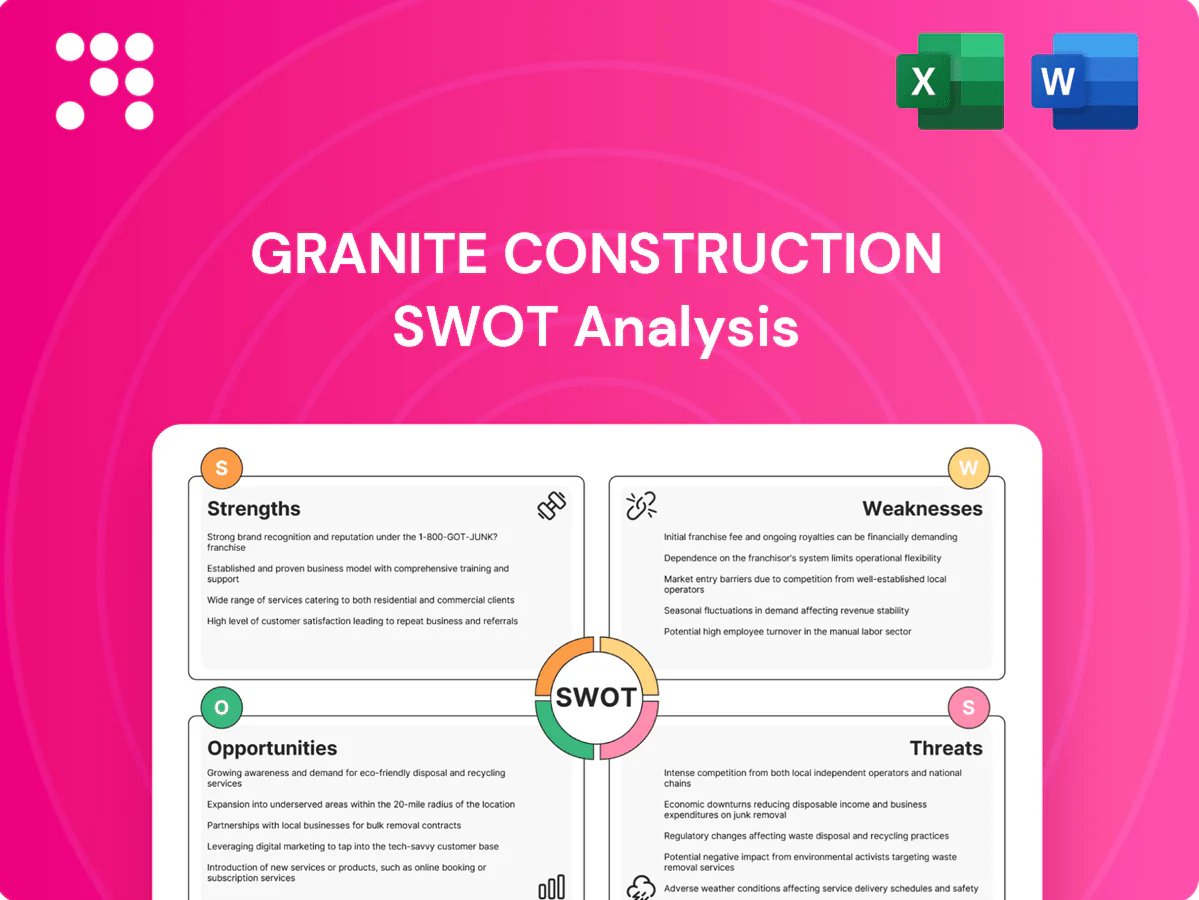
Granite Construction SWOT Analysis

Elevate Your Analysis with the Complete SWOT Report
Granite Construction shows resilient infrastructure demand, strong regional contracts, and operational scale, but faces material cost pressures and project execution risks. Our full SWOT digs into financials, competitive positioning, and mitigation strategies. Purchase the complete report for an editable, investor-ready analysis and Excel backup.
Strengths

Integrated materials supply
Vertical integration in aggregates, asphalt and ready-mix gives Granite control over materials that typically represent 30–40% of project costs, improving schedule reliability and cost control. Internal supply reduces exposure to third-party price spikes and logistics bottlenecks, strengthens bid competitiveness by capturing materials margins, and lets excess production be sold to external customers as an additional revenue stream.
Complex project expertise
Granite Construction (GVA) leverages proven capability in large, multidiscipline civil works—roads, bridges, water, power—positioning it to capture shares of the $550 billion IIJA infrastructure pipeline. Robust execution, QA/QC and safety systems underpin on-time delivery and strengthen prequalification and bid competitiveness. This track record enables pursuit of higher-value alternative delivery models such as design-build and P3s.

Diversified end-markets
Granite Construction's diversified end-markets across transportation, water resources and power help balance demand cycles; the Infrastructure Investment and Jobs Act allocates roughly $1.2 trillion overall and about $550 billion for surface transportation, cushioning sector swings. When one sector moderates, others can offset volume and margin pressure, and diversified clients — DOTs, municipalities and utilities — reduce dependence on any single funding source.

Public funding exposure
Heavy exposure to federally and state-funded infrastructure gives Granite strong revenue visibility; the Bipartisan Infrastructure Law (IIJA) provides about $550 billion in new spending, including roughly $110 billion for roads and bridges through 2026, underpinning multiyear programs in highways and water resiliency that sustain backlog. Public-sector payors typically present lower counterparty risk, stabilizing cash collections and supporting equipment planning.
- Visibility: IIJA $550B new funding
- Program-driven backlog: highways, water resiliency
- Lower counterparty risk: public payors
- Operational benefit: stable cash + equipment planning
Fleet, footprint, and local presence
Granite Construction (GVA) leverages an owned equipment fleet and regional plants to mobilize rapidly across >30 regional yards, cutting project startup time and boosting bid hit rates.
Local market knowledge improves estimating and sourcing accuracy; proximity to quarries and asphalt plants trims haul costs and emissions, supporting margins on a diversified project portfolio.
- Owned fleet + >30 regional plants
- Shorter haul = lower costs/emissions
- Local knowledge => better estimating
Vertical integration secures margins and speed; targets IIJA $550B surface pipeline
Vertical integration in aggregates, asphalt and ready-mix (materials = 30–40% of project costs) gives Granite control over pricing and schedule, enabling margin capture and external sales. Proven delivery on large civil works positions it to capture IIJA's $550B surface-transport pipeline. >30 regional yards and an owned fleet speed mobilization and lower haul costs.
| Metric | Value |
|---|---|
| Materials share of cost | 30–40% |
| IIJA surface-transport | $550B |
| Regional yards | >30 |
What is included in the product
 Detailed Word Document
Delivers a strategic overview of Granite Construction’s internal and external business factors, outlining the company’s strengths, weaknesses, opportunities and threats to clarify its competitive position and future growth prospects.

 Customizable Excel Spreadsheet
Provides a concise Granite Construction SWOT matrix for quick alignment, enabling executives and teams to spot strategic risks and opportunities at a glance and streamline action planning.
Weaknesses

Fixed-price contract risk
Design-bid-build and lump-sum projects expose Granite to cost overruns from scope creep, subsurface surprises and schedule delays, which compress margins on fixed-price work. Claims recovery is often uncertain and lengthy, commonly taking 12–24 months, delaying cash and profit recognition. These factors drive measurable quarter-to-quarter earnings volatility for the firm.
Working capital intensity
Large, bond-backed projects demand substantial bonding, upfront mobilization and on-site inventory, and industry-standard retainage of roughly 5–10% ties up cash. Pay-when-paid contract mechanics and payment lags often extend receipts by up to 60–90 days, stretching cash conversion cycles. Seasonal work and weather concentrate collections in warmer months, tightening liquidity in downcycles absent disciplined cash management.

Litigation and claims burden
Disputes with owners and subcontractors are inherent in Granite Construction’s large, complex infrastructure projects, given its 2024 backlog of roughly $4.3 billion. Legal costs and settlements can materially reduce project profitability and cash flow. Management time is often diverted from operations during claim resolution, and reserves/provisions for claims can compress reported margins and ROIC.

High capex and maintenance needs
High ongoing investment in quarries, asphalt plants and heavy equipment forces Granite to allocate significant capital; maintenance capex is essential to preserve utilization and uptime, while inflation raises rebuild and replacement costs, compressing margins and cash flow in softer cycles.
- Quarries, plants, equipment: continuous capex
- Maintenance capex needed to sustain uptime
- Inflation increases rebuild/replacement costs
- Elevated capex can constrain free cash flow
Geographic concentration risk
Granite Construction’s revenue is predominantly U.S.-based, tying growth to federal and state infrastructure budgets and to domestic economic cycles. State-level budget swings directly influence local backlog and bidding opportunities, while regional weather patterns—seasonal storms or droughts—can halt projects and inflate costs. Limited international presence reduces offsets from stronger foreign markets.
- U.S.-centric revenue exposure
- State budget sensitivity on local backlog
- Weather-driven production disruptions
- Low international diversification
Fixed-price scope risk fuels volatile earnings; backlog $4.3B
Granite’s fixed-price, design-bid-build work risks cost overruns from scope creep and subsurface surprises, causing quarter-to-quarter earnings volatility. Claims recovery typically takes 12–24 months, delaying cash and profit recognition. Retainage of roughly 5–10% and payment lags of 60–90 days strain liquidity against high maintenance capex. Backlog was roughly $4.3 billion in 2024.
| Metric | Value |
|---|---|
| 2024 backlog | $4.3B |
| Claims recovery | 12–24 months |
| Retainage | 5–10% |
| Payment lag | 60–90 days |
Same Document Delivered
Granite Construction SWOT Analysis
This is a real excerpt from the Granite Construction SWOT analysis you’ll receive upon purchase—no surprises, just professional quality. The preview below is taken directly from the full report and reflects the final, structured document. Buy now to unlock the complete, editable version immediately after checkout.

Elevate Your Analysis with the Complete SWOT Report
Granite Construction shows resilient infrastructure demand, strong regional contracts, and operational scale, but faces material cost pressures and project execution risks. Our full SWOT digs into financials, competitive positioning, and mitigation strategies. Purchase the complete report for an editable, investor-ready analysis and Excel backup.
Strengths
Integrated materials supply
Vertical integration in aggregates, asphalt and ready-mix gives Granite control over materials that typically represent 30–40% of project costs, improving schedule reliability and cost control. Internal supply reduces exposure to third-party price spikes and logistics bottlenecks, strengthens bid competitiveness by capturing materials margins, and lets excess production be sold to external customers as an additional revenue stream.
Complex project expertise
Granite Construction (GVA) leverages proven capability in large, multidiscipline civil works—roads, bridges, water, power—positioning it to capture shares of the $550 billion IIJA infrastructure pipeline. Robust execution, QA/QC and safety systems underpin on-time delivery and strengthen prequalification and bid competitiveness. This track record enables pursuit of higher-value alternative delivery models such as design-build and P3s.
Diversified end-markets
Granite Construction's diversified end-markets across transportation, water resources and power help balance demand cycles; the Infrastructure Investment and Jobs Act allocates roughly $1.2 trillion overall and about $550 billion for surface transportation, cushioning sector swings. When one sector moderates, others can offset volume and margin pressure, and diversified clients — DOTs, municipalities and utilities — reduce dependence on any single funding source.
Public funding exposure
Heavy exposure to federally and state-funded infrastructure gives Granite strong revenue visibility; the Bipartisan Infrastructure Law (IIJA) provides about $550 billion in new spending, including roughly $110 billion for roads and bridges through 2026, underpinning multiyear programs in highways and water resiliency that sustain backlog. Public-sector payors typically present lower counterparty risk, stabilizing cash collections and supporting equipment planning.
- Visibility: IIJA $550B new funding
- Program-driven backlog: highways, water resiliency
- Lower counterparty risk: public payors
- Operational benefit: stable cash + equipment planning
Fleet, footprint, and local presence
Granite Construction (GVA) leverages an owned equipment fleet and regional plants to mobilize rapidly across >30 regional yards, cutting project startup time and boosting bid hit rates.
Local market knowledge improves estimating and sourcing accuracy; proximity to quarries and asphalt plants trims haul costs and emissions, supporting margins on a diversified project portfolio.
- Owned fleet + >30 regional plants
- Shorter haul = lower costs/emissions
- Local knowledge => better estimating
Vertical integration secures margins and speed; targets IIJA $550B surface pipeline
Vertical integration in aggregates, asphalt and ready-mix (materials = 30–40% of project costs) gives Granite control over pricing and schedule, enabling margin capture and external sales. Proven delivery on large civil works positions it to capture IIJA's $550B surface-transport pipeline. >30 regional yards and an owned fleet speed mobilization and lower haul costs.
| Metric | Value |
|---|---|
| Materials share of cost | 30–40% |
| IIJA surface-transport | $550B |
| Regional yards | >30 |
What is included in the product
Detailed Word Document
Delivers a strategic overview of Granite Construction’s internal and external business factors, outlining the company’s strengths, weaknesses, opportunities and threats to clarify its competitive position and future growth prospects.
Customizable Excel Spreadsheet
Provides a concise Granite Construction SWOT matrix for quick alignment, enabling executives and teams to spot strategic risks and opportunities at a glance and streamline action planning.
Weaknesses
Fixed-price contract risk
Design-bid-build and lump-sum projects expose Granite to cost overruns from scope creep, subsurface surprises and schedule delays, which compress margins on fixed-price work. Claims recovery is often uncertain and lengthy, commonly taking 12–24 months, delaying cash and profit recognition. These factors drive measurable quarter-to-quarter earnings volatility for the firm.
Working capital intensity
Large, bond-backed projects demand substantial bonding, upfront mobilization and on-site inventory, and industry-standard retainage of roughly 5–10% ties up cash. Pay-when-paid contract mechanics and payment lags often extend receipts by up to 60–90 days, stretching cash conversion cycles. Seasonal work and weather concentrate collections in warmer months, tightening liquidity in downcycles absent disciplined cash management.
Litigation and claims burden
Disputes with owners and subcontractors are inherent in Granite Construction’s large, complex infrastructure projects, given its 2024 backlog of roughly $4.3 billion. Legal costs and settlements can materially reduce project profitability and cash flow. Management time is often diverted from operations during claim resolution, and reserves/provisions for claims can compress reported margins and ROIC.
High capex and maintenance needs
High ongoing investment in quarries, asphalt plants and heavy equipment forces Granite to allocate significant capital; maintenance capex is essential to preserve utilization and uptime, while inflation raises rebuild and replacement costs, compressing margins and cash flow in softer cycles.
- Quarries, plants, equipment: continuous capex
- Maintenance capex needed to sustain uptime
- Inflation increases rebuild/replacement costs
- Elevated capex can constrain free cash flow
Geographic concentration risk
Granite Construction’s revenue is predominantly U.S.-based, tying growth to federal and state infrastructure budgets and to domestic economic cycles. State-level budget swings directly influence local backlog and bidding opportunities, while regional weather patterns—seasonal storms or droughts—can halt projects and inflate costs. Limited international presence reduces offsets from stronger foreign markets.
- U.S.-centric revenue exposure
- State budget sensitivity on local backlog
- Weather-driven production disruptions
- Low international diversification
Fixed-price scope risk fuels volatile earnings; backlog $4.3B
Granite’s fixed-price, design-bid-build work risks cost overruns from scope creep and subsurface surprises, causing quarter-to-quarter earnings volatility. Claims recovery typically takes 12–24 months, delaying cash and profit recognition. Retainage of roughly 5–10% and payment lags of 60–90 days strain liquidity against high maintenance capex. Backlog was roughly $4.3 billion in 2024.
| Metric | Value |
|---|---|
| 2024 backlog | $4.3B |
| Claims recovery | 12–24 months |
| Retainage | 5–10% |
| Payment lag | 60–90 days |
Same Document Delivered
Granite Construction SWOT Analysis
This is a real excerpt from the Granite Construction SWOT analysis you’ll receive upon purchase—no surprises, just professional quality. The preview below is taken directly from the full report and reflects the final, structured document. Buy now to unlock the complete, editable version immediately after checkout.
Description
Elevate Your Analysis with the Complete SWOT Report
Granite Construction shows resilient infrastructure demand, strong regional contracts, and operational scale, but faces material cost pressures and project execution risks. Our full SWOT digs into financials, competitive positioning, and mitigation strategies. Purchase the complete report for an editable, investor-ready analysis and Excel backup.
Strengths
Integrated materials supply
Vertical integration in aggregates, asphalt and ready-mix gives Granite control over materials that typically represent 30–40% of project costs, improving schedule reliability and cost control. Internal supply reduces exposure to third-party price spikes and logistics bottlenecks, strengthens bid competitiveness by capturing materials margins, and lets excess production be sold to external customers as an additional revenue stream.
Complex project expertise
Granite Construction (GVA) leverages proven capability in large, multidiscipline civil works—roads, bridges, water, power—positioning it to capture shares of the $550 billion IIJA infrastructure pipeline. Robust execution, QA/QC and safety systems underpin on-time delivery and strengthen prequalification and bid competitiveness. This track record enables pursuit of higher-value alternative delivery models such as design-build and P3s.
Diversified end-markets
Granite Construction's diversified end-markets across transportation, water resources and power help balance demand cycles; the Infrastructure Investment and Jobs Act allocates roughly $1.2 trillion overall and about $550 billion for surface transportation, cushioning sector swings. When one sector moderates, others can offset volume and margin pressure, and diversified clients — DOTs, municipalities and utilities — reduce dependence on any single funding source.
Public funding exposure
Heavy exposure to federally and state-funded infrastructure gives Granite strong revenue visibility; the Bipartisan Infrastructure Law (IIJA) provides about $550 billion in new spending, including roughly $110 billion for roads and bridges through 2026, underpinning multiyear programs in highways and water resiliency that sustain backlog. Public-sector payors typically present lower counterparty risk, stabilizing cash collections and supporting equipment planning.
- Visibility: IIJA $550B new funding
- Program-driven backlog: highways, water resiliency
- Lower counterparty risk: public payors
- Operational benefit: stable cash + equipment planning
Fleet, footprint, and local presence
Granite Construction (GVA) leverages an owned equipment fleet and regional plants to mobilize rapidly across >30 regional yards, cutting project startup time and boosting bid hit rates.
Local market knowledge improves estimating and sourcing accuracy; proximity to quarries and asphalt plants trims haul costs and emissions, supporting margins on a diversified project portfolio.
- Owned fleet + >30 regional plants
- Shorter haul = lower costs/emissions
- Local knowledge => better estimating
Vertical integration secures margins and speed; targets IIJA $550B surface pipeline
Vertical integration in aggregates, asphalt and ready-mix (materials = 30–40% of project costs) gives Granite control over pricing and schedule, enabling margin capture and external sales. Proven delivery on large civil works positions it to capture IIJA's $550B surface-transport pipeline. >30 regional yards and an owned fleet speed mobilization and lower haul costs.
| Metric | Value |
|---|---|
| Materials share of cost | 30–40% |
| IIJA surface-transport | $550B |
| Regional yards | >30 |
What is included in the product
Detailed Word Document
Delivers a strategic overview of Granite Construction’s internal and external business factors, outlining the company’s strengths, weaknesses, opportunities and threats to clarify its competitive position and future growth prospects.
Customizable Excel Spreadsheet
Provides a concise Granite Construction SWOT matrix for quick alignment, enabling executives and teams to spot strategic risks and opportunities at a glance and streamline action planning.
Weaknesses
Fixed-price contract risk
Design-bid-build and lump-sum projects expose Granite to cost overruns from scope creep, subsurface surprises and schedule delays, which compress margins on fixed-price work. Claims recovery is often uncertain and lengthy, commonly taking 12–24 months, delaying cash and profit recognition. These factors drive measurable quarter-to-quarter earnings volatility for the firm.
Working capital intensity
Large, bond-backed projects demand substantial bonding, upfront mobilization and on-site inventory, and industry-standard retainage of roughly 5–10% ties up cash. Pay-when-paid contract mechanics and payment lags often extend receipts by up to 60–90 days, stretching cash conversion cycles. Seasonal work and weather concentrate collections in warmer months, tightening liquidity in downcycles absent disciplined cash management.
Litigation and claims burden
Disputes with owners and subcontractors are inherent in Granite Construction’s large, complex infrastructure projects, given its 2024 backlog of roughly $4.3 billion. Legal costs and settlements can materially reduce project profitability and cash flow. Management time is often diverted from operations during claim resolution, and reserves/provisions for claims can compress reported margins and ROIC.
High capex and maintenance needs
High ongoing investment in quarries, asphalt plants and heavy equipment forces Granite to allocate significant capital; maintenance capex is essential to preserve utilization and uptime, while inflation raises rebuild and replacement costs, compressing margins and cash flow in softer cycles.
- Quarries, plants, equipment: continuous capex
- Maintenance capex needed to sustain uptime
- Inflation increases rebuild/replacement costs
- Elevated capex can constrain free cash flow
Geographic concentration risk
Granite Construction’s revenue is predominantly U.S.-based, tying growth to federal and state infrastructure budgets and to domestic economic cycles. State-level budget swings directly influence local backlog and bidding opportunities, while regional weather patterns—seasonal storms or droughts—can halt projects and inflate costs. Limited international presence reduces offsets from stronger foreign markets.
- U.S.-centric revenue exposure
- State budget sensitivity on local backlog
- Weather-driven production disruptions
- Low international diversification
Fixed-price scope risk fuels volatile earnings; backlog $4.3B
Granite’s fixed-price, design-bid-build work risks cost overruns from scope creep and subsurface surprises, causing quarter-to-quarter earnings volatility. Claims recovery typically takes 12–24 months, delaying cash and profit recognition. Retainage of roughly 5–10% and payment lags of 60–90 days strain liquidity against high maintenance capex. Backlog was roughly $4.3 billion in 2024.
| Metric | Value |
|---|---|
| 2024 backlog | $4.3B |
| Claims recovery | 12–24 months |
| Retainage | 5–10% |
| Payment lag | 60–90 days |
Same Document Delivered
Granite Construction SWOT Analysis
This is a real excerpt from the Granite Construction SWOT analysis you’ll receive upon purchase—no surprises, just professional quality. The preview below is taken directly from the full report and reflects the final, structured document. Buy now to unlock the complete, editable version immediately after checkout.











