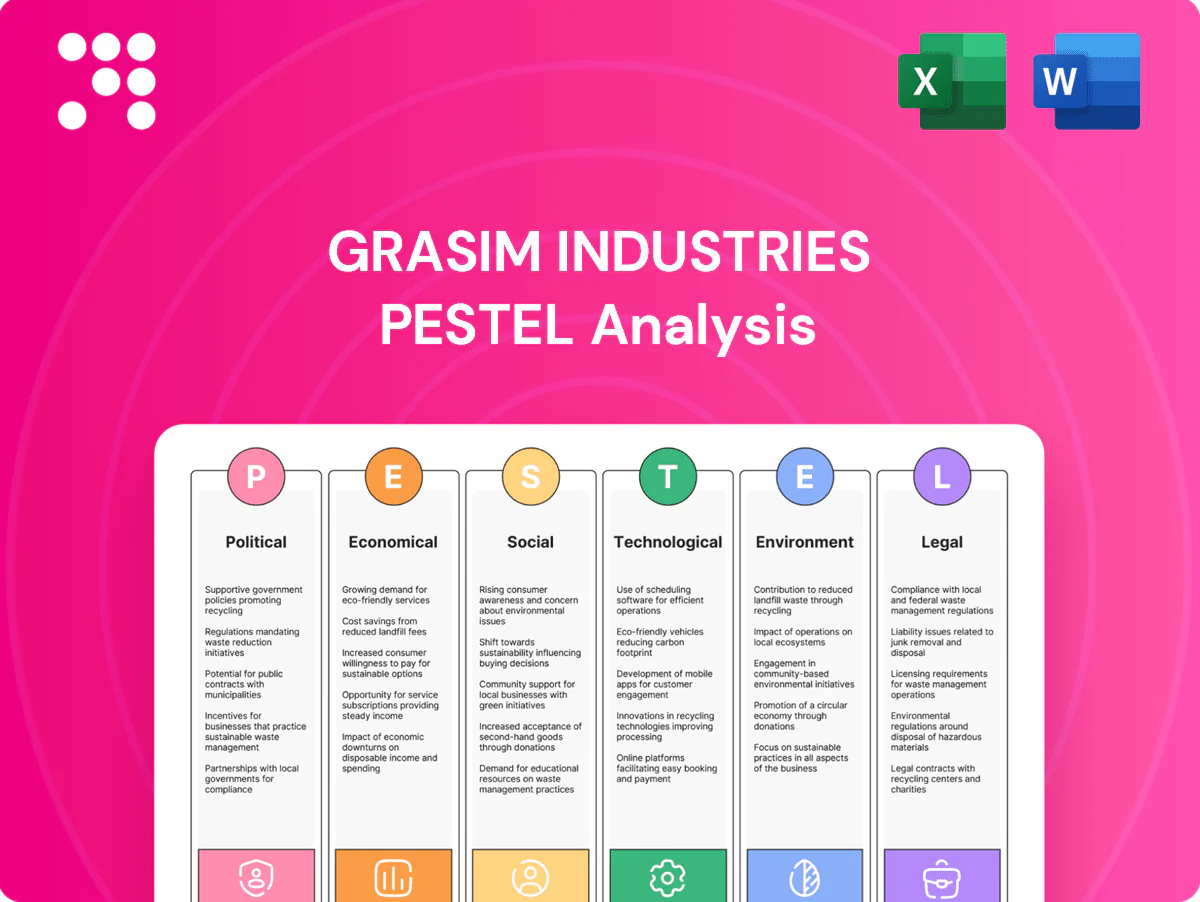
Grasim Industries PESTLE Analysis

Plan Smarter. Present Sharper. Compete Stronger.
Our PESTLE Analysis of Grasim Industries reveals how regulatory shifts, commodity cycles, and decarbonization pressures shape its strategic outlook, while technological adoption and evolving consumer trends create fresh growth vectors; risk hotspots and opportunity areas are clearly mapped. Perfect for investors and strategists, this concise briefing points to actionable moves and scenario levers. Purchase the full report to access the complete, editable breakdown and data-driven recommendations.
Political factors

Infrastructure-led capex tailwinds
India’s infrastructure push — Union Budget 2024–25 set capital outlay at about INR 11.1 lakh crore — underpins multi‑year demand for cement, gypsum and paints, benefitting Grasim and channel partners like UltraTech and paint distributors. Stable policy continuity enhances revenue visibility, while any post‑election capex slowdown or fund reallocation could soften volumes; monitor central budget priorities and state project execution closely.
Trade policy and import duties
Tariffs on fibers, chemicals and intermediates (commonly around 10% basic customs duty in India) directly erode VSF competitiveness versus cheaper China/ASEAN imports, pressuring Grasim's margins. Anti-dumping duties imposed historically on select Chinese viscose products have shielded margins but raise retaliation and supply-chain disruption risks. Export incentives and FTAs (e.g., RCEP exclusion) reshape pricing power and product mix. Policy fluidity warrants hedging and diversified sourcing.

Energy and coal linkage policies
Coal, gas and power policies materially affect cement, chlor-alkali and epoxy feedstock and power costs for Grasim, with coal linkage shortfalls in FY24 increasing reliance on higher-priced e-auctions and merchant power. Fluctuations in linkage allocation and e-auction clearing prices have translated into measurable EBITDA volatility across Grasim’s cement and chemical segments. Renewables procurement rules can reduce carbon intensity but require clearer grid integration and REC settlement mechanisms; state-level power subsidies continue to skew regional competitiveness.

State regulations and approvals
State-specific mining leases, environmental clearances and plant permits drive Grasim Industries timelines and capacity ramps, with approvals often governing project start-dates and operational scale; political stability affects land acquisition and logistics corridors, influencing supply-chain reliability. Delays in clearances have historically escalated project costs in cement and paints expansions, while proactive stakeholder engagement and state-level liaison reduce bottlenecks and permit risks.
- Leases/clearances: state-dependent
- Political stability: impacts land/logistics
- Delays: raise capex and ramp timelines
- Mitigation: stakeholder engagement
China policy and global supply shifts
China’s industrial policy—including capacity controls and rebate shifts—directly influences global VSF, caustic soda and epoxy prices; China held roughly 45% of global VSF capacity in 2024, amplifying price transmission to India. Export rebate changes or capacity cuts re-route trade flows into India, while geopolitical tensions risk pulp and epoxy supply disruptions. Grasim’s diversified markets and localisation reduce exposure to these shocks.
- China ~45% of global VSF capacity (2024)
- Export rebates/cuts alter India import volumes
- Market diversification and localisation mitigate input-risk
INR 11.1L cr capex; ~10% BCD; China 45%
India’s INR 11.1 lakh crore 2024–25 capex drive underpins multi‑year cement/paints demand but any post‑election capex rephasing could soften volumes. ~10% basic customs duty on fibers/chemicals raises input costs; anti‑dumping shields margins but risks trade retaliation. China’s ~45% global VSF share (2024) and export policy swings amplify import price volatility; state clearances and coal linkage shortfalls remain key project risks.
| Policy | Impact | Metric |
|---|---|---|
| Budget capex | Demand up | INR 11.1 lakh cr (2024–25) |
| Trade duties | Input cost pressure | ~10% BCD |
| China VSF | Price transmission | ~45% global (2024) |
What is included in the product
 Detailed Word Document
Explores how Political, Economic, Social, Technological, Environmental and Legal forces uniquely affect Grasim Industries, with each section supported by relevant data and current trends to highlight risks and opportunities. Designed for executives and investors to inform strategy, scenario planning and funding decisions.

 Customizable Excel Spreadsheet
A concise, visually segmented PESTLE summary of Grasim Industries that can be dropped into presentations or planning sessions, edited with region- or line-specific notes, and easily shared across teams to streamline external risk discussions and strategic alignment.
Economic factors

GDP growth and housing cycle
India's GDP growth of about 6.6% in 2024 and rising urbanization (urban share ~35%) bolster cement and decorative paints volumes as real estate cycles expand; Grasim benefits from multi-year public and private capex with gross fixed capital formation near 31% of GDP supporting demand. A growth slowdown or liquidity tightness can defer projects and hit near-term volumes, while regional housing variations determine local pricing power and margin mix.
Commodity and input volatility
Pulp, caustic soda, coal and crude-linked derivatives drive margin cyclicality in VSF and chemicals for Grasim, with Brent crude around 82 USD/bbl and Newcastle thermal coal near 140 USD/ton in mid-2025 amplifying feedstock cost swings. Energy accounts for a large share of cost in cement and chlor-alkali plants, making fuel mix optimization and short-term hedging critical to protect EBITDA. Rapid input-price swings force agile pricing and inventory management to preserve margins and working capital.

Interest rates and credit conditions
RBI policy easing—repo at 6.50% (June 2025)—and cheaper credit support housing demand and infra financing, boosting Grasim’s cement and paints volumes; recent cuts since 2024 have improved project funding affordability. Higher rates earlier compressed discretionary spends and delayed construction starts, dampening short-term demand elasticity. Aditya Birla Capital sees NIM and credit-cost sensitivity and AUM mix shifts (AUM ~₹3.2tn FY24), while rising funding costs push working-capital needs and cascade across Grasim’s value chain.

Currency and export competitiveness
INR at about 82.5/USD (July 2025) means a weaker rupee aids Grasim's VSF export realizations but raises costs of imported pulp, solvents and equipment; a ~5% INR depreciation in 2024 increased input bills despite higher export rupee receipts. Natural hedges from domestic sales and backward integration lower net exposure but basis risk remains; pricing discipline and diversified currency receipts mitigate margin volatility.
- INR ~82.5/USD (Jul 2025)
- Weaker INR: boosts exports, raises import costs
- Natural hedges/backward integration reduce exposure
- Pricing discipline & diversified currency receipts mitigate risk
China capacity and global demand
China's continued capacity additions in VSF and specialty chemicals have created global overcapacity that pressures realizations for Grasim's fiber and chemical segments, while recovery in textiles, automotive and construction is lifting epoxy and viscose demand and supporting pricing momentum.
- Overcapacity: pressures realizations
- Demand recovery: textiles, autos, construction
- Inventory cycles: amplify earnings volatility
- Market diversification: smooths revenue streams
INR 11.1L cr capex; ~10% BCD; China 45%
India GDP ~6.6% (2024) and urbanization ~35% support cement/paints demand; repo 6.50% (Jun 2025) eases funding while INR ~82.5/USD (Jul 2025) boosts VSF exports but raises import costs; Brent ~$82/bbl and Newcastle coal ~$140/t (mid-2025) drive input volatility for VSF/chemicals; backward integration, pricing and hedges moderate margin swings.
| Metric | Value |
|---|---|
| India GDP (2024) | 6.6% |
| Urban share | ~35% |
| Repo (Jun 2025) | 6.50% |
| INR/USD (Jul 2025) | 82.5 |
| Brent (mid-2025) | $82/bbl |
| Newcastle coal | $140/t |
Preview the Actual Deliverable
Grasim Industries PESTLE Analysis
The preview shown here is the exact Grasim Industries PESTLE Analysis you’ll receive after purchase—fully formatted and ready to use. It contains the complete political, economic, social, technological, legal, and environmental assessment as displayed. No placeholders, no surprises—download the final file immediately after checkout.

Plan Smarter. Present Sharper. Compete Stronger.
Our PESTLE Analysis of Grasim Industries reveals how regulatory shifts, commodity cycles, and decarbonization pressures shape its strategic outlook, while technological adoption and evolving consumer trends create fresh growth vectors; risk hotspots and opportunity areas are clearly mapped. Perfect for investors and strategists, this concise briefing points to actionable moves and scenario levers. Purchase the full report to access the complete, editable breakdown and data-driven recommendations.
Political factors
Infrastructure-led capex tailwinds
India’s infrastructure push — Union Budget 2024–25 set capital outlay at about INR 11.1 lakh crore — underpins multi‑year demand for cement, gypsum and paints, benefitting Grasim and channel partners like UltraTech and paint distributors. Stable policy continuity enhances revenue visibility, while any post‑election capex slowdown or fund reallocation could soften volumes; monitor central budget priorities and state project execution closely.
Trade policy and import duties
Tariffs on fibers, chemicals and intermediates (commonly around 10% basic customs duty in India) directly erode VSF competitiveness versus cheaper China/ASEAN imports, pressuring Grasim's margins. Anti-dumping duties imposed historically on select Chinese viscose products have shielded margins but raise retaliation and supply-chain disruption risks. Export incentives and FTAs (e.g., RCEP exclusion) reshape pricing power and product mix. Policy fluidity warrants hedging and diversified sourcing.
Energy and coal linkage policies
Coal, gas and power policies materially affect cement, chlor-alkali and epoxy feedstock and power costs for Grasim, with coal linkage shortfalls in FY24 increasing reliance on higher-priced e-auctions and merchant power. Fluctuations in linkage allocation and e-auction clearing prices have translated into measurable EBITDA volatility across Grasim’s cement and chemical segments. Renewables procurement rules can reduce carbon intensity but require clearer grid integration and REC settlement mechanisms; state-level power subsidies continue to skew regional competitiveness.
State regulations and approvals
State-specific mining leases, environmental clearances and plant permits drive Grasim Industries timelines and capacity ramps, with approvals often governing project start-dates and operational scale; political stability affects land acquisition and logistics corridors, influencing supply-chain reliability. Delays in clearances have historically escalated project costs in cement and paints expansions, while proactive stakeholder engagement and state-level liaison reduce bottlenecks and permit risks.
- Leases/clearances: state-dependent
- Political stability: impacts land/logistics
- Delays: raise capex and ramp timelines
- Mitigation: stakeholder engagement
China policy and global supply shifts
China’s industrial policy—including capacity controls and rebate shifts—directly influences global VSF, caustic soda and epoxy prices; China held roughly 45% of global VSF capacity in 2024, amplifying price transmission to India. Export rebate changes or capacity cuts re-route trade flows into India, while geopolitical tensions risk pulp and epoxy supply disruptions. Grasim’s diversified markets and localisation reduce exposure to these shocks.
- China ~45% of global VSF capacity (2024)
- Export rebates/cuts alter India import volumes
- Market diversification and localisation mitigate input-risk
INR 11.1L cr capex; ~10% BCD; China 45%
India’s INR 11.1 lakh crore 2024–25 capex drive underpins multi‑year cement/paints demand but any post‑election capex rephasing could soften volumes. ~10% basic customs duty on fibers/chemicals raises input costs; anti‑dumping shields margins but risks trade retaliation. China’s ~45% global VSF share (2024) and export policy swings amplify import price volatility; state clearances and coal linkage shortfalls remain key project risks.
| Policy | Impact | Metric |
|---|---|---|
| Budget capex | Demand up | INR 11.1 lakh cr (2024–25) |
| Trade duties | Input cost pressure | ~10% BCD |
| China VSF | Price transmission | ~45% global (2024) |
What is included in the product
Detailed Word Document
Explores how Political, Economic, Social, Technological, Environmental and Legal forces uniquely affect Grasim Industries, with each section supported by relevant data and current trends to highlight risks and opportunities. Designed for executives and investors to inform strategy, scenario planning and funding decisions.
Customizable Excel Spreadsheet
A concise, visually segmented PESTLE summary of Grasim Industries that can be dropped into presentations or planning sessions, edited with region- or line-specific notes, and easily shared across teams to streamline external risk discussions and strategic alignment.
Economic factors
GDP growth and housing cycle
India's GDP growth of about 6.6% in 2024 and rising urbanization (urban share ~35%) bolster cement and decorative paints volumes as real estate cycles expand; Grasim benefits from multi-year public and private capex with gross fixed capital formation near 31% of GDP supporting demand. A growth slowdown or liquidity tightness can defer projects and hit near-term volumes, while regional housing variations determine local pricing power and margin mix.
Commodity and input volatility
Pulp, caustic soda, coal and crude-linked derivatives drive margin cyclicality in VSF and chemicals for Grasim, with Brent crude around 82 USD/bbl and Newcastle thermal coal near 140 USD/ton in mid-2025 amplifying feedstock cost swings. Energy accounts for a large share of cost in cement and chlor-alkali plants, making fuel mix optimization and short-term hedging critical to protect EBITDA. Rapid input-price swings force agile pricing and inventory management to preserve margins and working capital.
Interest rates and credit conditions
RBI policy easing—repo at 6.50% (June 2025)—and cheaper credit support housing demand and infra financing, boosting Grasim’s cement and paints volumes; recent cuts since 2024 have improved project funding affordability. Higher rates earlier compressed discretionary spends and delayed construction starts, dampening short-term demand elasticity. Aditya Birla Capital sees NIM and credit-cost sensitivity and AUM mix shifts (AUM ~₹3.2tn FY24), while rising funding costs push working-capital needs and cascade across Grasim’s value chain.
Currency and export competitiveness
INR at about 82.5/USD (July 2025) means a weaker rupee aids Grasim's VSF export realizations but raises costs of imported pulp, solvents and equipment; a ~5% INR depreciation in 2024 increased input bills despite higher export rupee receipts. Natural hedges from domestic sales and backward integration lower net exposure but basis risk remains; pricing discipline and diversified currency receipts mitigate margin volatility.
- INR ~82.5/USD (Jul 2025)
- Weaker INR: boosts exports, raises import costs
- Natural hedges/backward integration reduce exposure
- Pricing discipline & diversified currency receipts mitigate risk
China capacity and global demand
China's continued capacity additions in VSF and specialty chemicals have created global overcapacity that pressures realizations for Grasim's fiber and chemical segments, while recovery in textiles, automotive and construction is lifting epoxy and viscose demand and supporting pricing momentum.
- Overcapacity: pressures realizations
- Demand recovery: textiles, autos, construction
- Inventory cycles: amplify earnings volatility
- Market diversification: smooths revenue streams
INR 11.1L cr capex; ~10% BCD; China 45%
India GDP ~6.6% (2024) and urbanization ~35% support cement/paints demand; repo 6.50% (Jun 2025) eases funding while INR ~82.5/USD (Jul 2025) boosts VSF exports but raises import costs; Brent ~$82/bbl and Newcastle coal ~$140/t (mid-2025) drive input volatility for VSF/chemicals; backward integration, pricing and hedges moderate margin swings.
| Metric | Value |
|---|---|
| India GDP (2024) | 6.6% |
| Urban share | ~35% |
| Repo (Jun 2025) | 6.50% |
| INR/USD (Jul 2025) | 82.5 |
| Brent (mid-2025) | $82/bbl |
| Newcastle coal | $140/t |
Preview the Actual Deliverable
Grasim Industries PESTLE Analysis
The preview shown here is the exact Grasim Industries PESTLE Analysis you’ll receive after purchase—fully formatted and ready to use. It contains the complete political, economic, social, technological, legal, and environmental assessment as displayed. No placeholders, no surprises—download the final file immediately after checkout.
Original: $10.00
-65%$10.00
$3.50Description
Plan Smarter. Present Sharper. Compete Stronger.
Our PESTLE Analysis of Grasim Industries reveals how regulatory shifts, commodity cycles, and decarbonization pressures shape its strategic outlook, while technological adoption and evolving consumer trends create fresh growth vectors; risk hotspots and opportunity areas are clearly mapped. Perfect for investors and strategists, this concise briefing points to actionable moves and scenario levers. Purchase the full report to access the complete, editable breakdown and data-driven recommendations.
Political factors
Infrastructure-led capex tailwinds
India’s infrastructure push — Union Budget 2024–25 set capital outlay at about INR 11.1 lakh crore — underpins multi‑year demand for cement, gypsum and paints, benefitting Grasim and channel partners like UltraTech and paint distributors. Stable policy continuity enhances revenue visibility, while any post‑election capex slowdown or fund reallocation could soften volumes; monitor central budget priorities and state project execution closely.
Trade policy and import duties
Tariffs on fibers, chemicals and intermediates (commonly around 10% basic customs duty in India) directly erode VSF competitiveness versus cheaper China/ASEAN imports, pressuring Grasim's margins. Anti-dumping duties imposed historically on select Chinese viscose products have shielded margins but raise retaliation and supply-chain disruption risks. Export incentives and FTAs (e.g., RCEP exclusion) reshape pricing power and product mix. Policy fluidity warrants hedging and diversified sourcing.
Energy and coal linkage policies
Coal, gas and power policies materially affect cement, chlor-alkali and epoxy feedstock and power costs for Grasim, with coal linkage shortfalls in FY24 increasing reliance on higher-priced e-auctions and merchant power. Fluctuations in linkage allocation and e-auction clearing prices have translated into measurable EBITDA volatility across Grasim’s cement and chemical segments. Renewables procurement rules can reduce carbon intensity but require clearer grid integration and REC settlement mechanisms; state-level power subsidies continue to skew regional competitiveness.
State regulations and approvals
State-specific mining leases, environmental clearances and plant permits drive Grasim Industries timelines and capacity ramps, with approvals often governing project start-dates and operational scale; political stability affects land acquisition and logistics corridors, influencing supply-chain reliability. Delays in clearances have historically escalated project costs in cement and paints expansions, while proactive stakeholder engagement and state-level liaison reduce bottlenecks and permit risks.
- Leases/clearances: state-dependent
- Political stability: impacts land/logistics
- Delays: raise capex and ramp timelines
- Mitigation: stakeholder engagement
China policy and global supply shifts
China’s industrial policy—including capacity controls and rebate shifts—directly influences global VSF, caustic soda and epoxy prices; China held roughly 45% of global VSF capacity in 2024, amplifying price transmission to India. Export rebate changes or capacity cuts re-route trade flows into India, while geopolitical tensions risk pulp and epoxy supply disruptions. Grasim’s diversified markets and localisation reduce exposure to these shocks.
- China ~45% of global VSF capacity (2024)
- Export rebates/cuts alter India import volumes
- Market diversification and localisation mitigate input-risk
INR 11.1L cr capex; ~10% BCD; China 45%
India’s INR 11.1 lakh crore 2024–25 capex drive underpins multi‑year cement/paints demand but any post‑election capex rephasing could soften volumes. ~10% basic customs duty on fibers/chemicals raises input costs; anti‑dumping shields margins but risks trade retaliation. China’s ~45% global VSF share (2024) and export policy swings amplify import price volatility; state clearances and coal linkage shortfalls remain key project risks.
| Policy | Impact | Metric |
|---|---|---|
| Budget capex | Demand up | INR 11.1 lakh cr (2024–25) |
| Trade duties | Input cost pressure | ~10% BCD |
| China VSF | Price transmission | ~45% global (2024) |
What is included in the product
Detailed Word Document
Explores how Political, Economic, Social, Technological, Environmental and Legal forces uniquely affect Grasim Industries, with each section supported by relevant data and current trends to highlight risks and opportunities. Designed for executives and investors to inform strategy, scenario planning and funding decisions.
Customizable Excel Spreadsheet
A concise, visually segmented PESTLE summary of Grasim Industries that can be dropped into presentations or planning sessions, edited with region- or line-specific notes, and easily shared across teams to streamline external risk discussions and strategic alignment.
Economic factors
GDP growth and housing cycle
India's GDP growth of about 6.6% in 2024 and rising urbanization (urban share ~35%) bolster cement and decorative paints volumes as real estate cycles expand; Grasim benefits from multi-year public and private capex with gross fixed capital formation near 31% of GDP supporting demand. A growth slowdown or liquidity tightness can defer projects and hit near-term volumes, while regional housing variations determine local pricing power and margin mix.
Commodity and input volatility
Pulp, caustic soda, coal and crude-linked derivatives drive margin cyclicality in VSF and chemicals for Grasim, with Brent crude around 82 USD/bbl and Newcastle thermal coal near 140 USD/ton in mid-2025 amplifying feedstock cost swings. Energy accounts for a large share of cost in cement and chlor-alkali plants, making fuel mix optimization and short-term hedging critical to protect EBITDA. Rapid input-price swings force agile pricing and inventory management to preserve margins and working capital.
Interest rates and credit conditions
RBI policy easing—repo at 6.50% (June 2025)—and cheaper credit support housing demand and infra financing, boosting Grasim’s cement and paints volumes; recent cuts since 2024 have improved project funding affordability. Higher rates earlier compressed discretionary spends and delayed construction starts, dampening short-term demand elasticity. Aditya Birla Capital sees NIM and credit-cost sensitivity and AUM mix shifts (AUM ~₹3.2tn FY24), while rising funding costs push working-capital needs and cascade across Grasim’s value chain.
Currency and export competitiveness
INR at about 82.5/USD (July 2025) means a weaker rupee aids Grasim's VSF export realizations but raises costs of imported pulp, solvents and equipment; a ~5% INR depreciation in 2024 increased input bills despite higher export rupee receipts. Natural hedges from domestic sales and backward integration lower net exposure but basis risk remains; pricing discipline and diversified currency receipts mitigate margin volatility.
- INR ~82.5/USD (Jul 2025)
- Weaker INR: boosts exports, raises import costs
- Natural hedges/backward integration reduce exposure
- Pricing discipline & diversified currency receipts mitigate risk
China capacity and global demand
China's continued capacity additions in VSF and specialty chemicals have created global overcapacity that pressures realizations for Grasim's fiber and chemical segments, while recovery in textiles, automotive and construction is lifting epoxy and viscose demand and supporting pricing momentum.
- Overcapacity: pressures realizations
- Demand recovery: textiles, autos, construction
- Inventory cycles: amplify earnings volatility
- Market diversification: smooths revenue streams
INR 11.1L cr capex; ~10% BCD; China 45%
India GDP ~6.6% (2024) and urbanization ~35% support cement/paints demand; repo 6.50% (Jun 2025) eases funding while INR ~82.5/USD (Jul 2025) boosts VSF exports but raises import costs; Brent ~$82/bbl and Newcastle coal ~$140/t (mid-2025) drive input volatility for VSF/chemicals; backward integration, pricing and hedges moderate margin swings.
| Metric | Value |
|---|---|
| India GDP (2024) | 6.6% |
| Urban share | ~35% |
| Repo (Jun 2025) | 6.50% |
| INR/USD (Jul 2025) | 82.5 |
| Brent (mid-2025) | $82/bbl |
| Newcastle coal | $140/t |
Preview the Actual Deliverable
Grasim Industries PESTLE Analysis
The preview shown here is the exact Grasim Industries PESTLE Analysis you’ll receive after purchase—fully formatted and ready to use. It contains the complete political, economic, social, technological, legal, and environmental assessment as displayed. No placeholders, no surprises—download the final file immediately after checkout.











