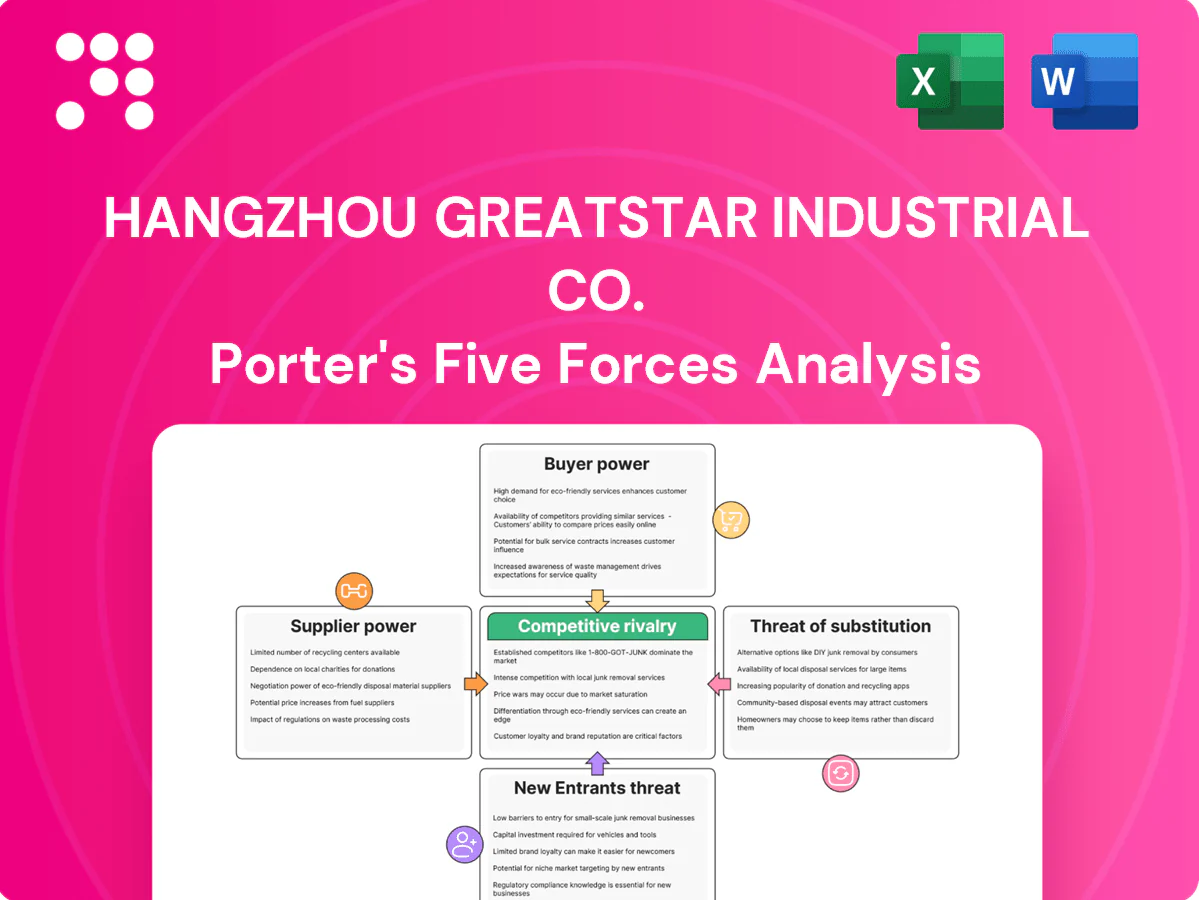
Hangzhou GreatStar Industrial Co. Porter's Five Forces Analysis

Elevate Your Analysis with the Complete Porter's Five Forces Analysis
Hangzhou GreatStar Industrial Co. faces intense competitive rivalry from global toolmakers, moderate supplier power due to diversified inputs, and growing buyer sensitivity driven by price and private-label alternatives. Scale and distribution breadth are strengths, but e-commerce and product substitution raise threats. This brief snapshot only scratches the surface. Unlock the full Porter's Five Forces Analysis to explore Hangzhou GreatStar Industrial Co.’s competitive dynamics, market pressures, and strategic advantages in detail.
Suppliers Bargaining Power

Diversified materials sourcing
GreatStar sources steel, alloys, plastics, lithium cells, motors and electronics from a wide supplier base, lowering dependence on any single vendor and reducing price leverage. Specialized inputs remain concentrated: the top 5 battery cell makers (eg CATL, LG, Panasonic, BYD, Samsung SDI) held roughly two-thirds of market share in 2024, keeping supplier power for cells and brushless motors elevated. Supply-assurance contracts and dual-sourcing mitigate volatility and secure continuity.
Scale-driven purchasing leverage
High volumes across hand tools, power tools and storage—measured in millions of units annually—give Hangzhou GreatStar scale-driven purchasing leverage to secure bulk discounts and priority allocations. Scale enables forward buys and hedging (common 2–5 year procurement plans) to mitigate raw-material swings, though suppliers can still push through surcharges during demand spikes, occasionally reaching double-digit percent adjustments. Tiered pricing and multi-year agreements materially strengthen buyer power by locking lower cost bands and stable supply.

Logistics and regional exposure
Global operations expose GreatStar to freight and port risks, noting container shipping moves roughly 60% of world trade by value, so congestion and geopolitics can spike input lead times. Suppliers located near major Chinese manufacturing hubs gain leverage when logistics tighten, as coastal ports handle tens of millions of TEU annually. Multiregional procurement and nearshoring reduce disruption exposure, while vendor-managed inventory programs smooth supply and rebalance supplier power.

Quality and certification lock-ins
- Approved vendor concentration >50%
- Supplier development lowers single-source risk
Commodity price volatility
Commodity price volatility in 2024—steel HRC avg ~650 USD/ton, LME copper ~9,200 USD/ton and lithium carbonate ~18,000 USD/ton—can rapidly shift supplier bargaining power, forcing GreatStar to renegotiate margins and delivery terms as cycles swing.
- Index-linked contracts: partial insulation via formula pricing
- Hedges: reduce short-term P&L exposure
- Asymmetric pass-through: suppliers raise prices faster than cuts
- Cost-transparency programs: enable fair-share adjustments
Top-5 battery makers ~66%; supplier power rising, commodities volatile
GreatStar's broad supplier base and scale lower supplier leverage, but critical inputs remain concentrated—top‑5 battery cell makers held ~66% market share in 2024—boosting supplier power for cells and motors. Approved vendor lists cover >50% of critical parts, raising switching costs despite supplier development and dual‑sourcing. 2024 commodity prices (HRC steel ~650 USD/t, LME copper ~9,200 USD/t, lithium carbonate ~18,000 USD/t) keep bargaining power volatile.
| Metric | 2024 Value |
|---|---|
| Top‑5 battery share | ~66% |
| Approved vendor concentration | >50% |
| HRC steel | ~650 USD/t |
| LME copper | ~9,200 USD/t |
| Lithium carbonate | ~18,000 USD/t |
What is included in the product
 Detailed Word Document
Uncovers key drivers of competition, customer influence, and market entry risks for Hangzhou GreatStar Industrial Co., assessing supplier power, buyer pressure, threat of substitutes, new entrants, and industry rivalry to reveal strategic vulnerabilities and defensive strengths.

 Customizable Excel Spreadsheet
A clear, one-sheet Porter's Five Forces snapshot for Hangzhou GreatStar that highlights supplier/buyer power, substitutes, entry threats and competitive rivalry—perfect for quick decision-making and relieving analysis paralysis.
Customers Bargaining Power

Concentrated retail channels
Big-box retailers, major distributors and e-commerce platforms command volume and shelf space, with Amazon holding about 38% of US e-commerce in 2024 and Home Depot plus Lowe’s covering roughly 60% of the US home‑improvement market; their scale gives pricing, payment‑term and slotting leverage. Private‑label penetration (~16% of retail sales in 2024) compresses branded margins. Diversifying channels and D2C reduces dependence and restores margin control.
Low switching costs
End users in DIY channels can switch brands easily, driven by comparable specs and frequent promotions that heighten buyer bargaining; this keeps pricing pressure on Hangzhou GreatStar. Professional buyers show higher loyalty but still cross-shop on battery platforms and warranty terms, which constrains premium pricing. Differentiation through superior performance, ergonomics, and service reduces churn and strengthens negotiation position.

Price transparency online
E-commerce price transparency — with global online retail sales exceeding $6 trillion in 2024 — lets buyers compare prices and reviews instantly, pushing Hangzhou GreatStar customers to demand competitive pricing and fast fulfillment. Platform-driven dynamic pricing and algorithmic discounts compress product margins. Rich content, warranties and bundled tool sets can sustain price points and reduce churn.

Specification and compliance demands
Institutional buyers demand certifications, testing and ESG disclosures — with EU CSRD covering ~50,000 companies from 2024 and over 1.1 million ISO 9001 certificates globally — raising entry requirements that increase costs but unlock larger contracts. Noncompliance shifts buying power to alternative vendors; proactive compliance can become a durable moat for Hangzhou GreatStar by securing preferred-supplier status.
- Certifications: ISO 9001 (1.1M+ global certificates)
- Regulation: CSRD ~50,000 firms (2024)
- Risk: noncompliance → lost contracts
- Opportunity: compliance = competitive moat
After-sales and warranty expectations
Professional customers of Hangzhou GreatStar expect reliable service, ready parts and fast turnaround; 2024 surveys indicate about 60% of professional tool buyers rank after-sales support as a decisive purchase factor. Strong support lowers perceived operational risk and reduces buyer leverage, while weak service pushes procurement to rivals offering similar specs and better uptime. Investing in regional service networks and spare-parts logistics can flip power asymmetry into customer lock-in.
- Service availability: key purchase factor (~60% in 2024)
- Parts readiness: reduces downtime and buyer switching
- Turnaround speed: drives perceived value and retention
- Service network investment: converts bargaining power
Retail concentration squeezes margins; services and certification restore negotiating power
Large retailers and platforms (Amazon ~38% US e‑commerce; Home Depot+Lowe’s ~60% US DIY) exert strong price and slotting leverage, amplified by private‑label at ~16% of retail sales in 2024. E‑commerce transparency and dynamic pricing (global online sales ~6T USD in 2024) compress margins; service, warranties and certifications (ISO 9001 ~1.1M; CSRD ~50k firms) restore negotiating power.
| Metric | 2024 Figure |
|---|---|
| Amazon US e‑commerce share | ~38% |
| Home Depot+Lowe’s DIY share | ~60% |
| Private‑label retail | ~16% |
| Global online retail | ~6T USD |
| ISO 9001 certificates | ~1.1M |
| CSRD scope | ~50k firms |
Preview Before You Purchase
Hangzhou GreatStar Industrial Co. Porter's Five Forces Analysis
This Porter’s Five Forces analysis of Hangzhou GreatStar Industrial Co. evaluates competitive rivalry, supplier and buyer power, threat of substitutes, and barriers to entry specific to the hand-tool and hardware industry. It highlights strengths like scale and distribution, risks from low-cost competitors and OEM suppliers, and moderate buyer leverage in retail channels. This preview shows the exact document you'll receive immediately after purchase—no surprises, no placeholders.

Elevate Your Analysis with the Complete Porter's Five Forces Analysis
Hangzhou GreatStar Industrial Co. faces intense competitive rivalry from global toolmakers, moderate supplier power due to diversified inputs, and growing buyer sensitivity driven by price and private-label alternatives. Scale and distribution breadth are strengths, but e-commerce and product substitution raise threats. This brief snapshot only scratches the surface. Unlock the full Porter's Five Forces Analysis to explore Hangzhou GreatStar Industrial Co.’s competitive dynamics, market pressures, and strategic advantages in detail.
Suppliers Bargaining Power
Diversified materials sourcing
GreatStar sources steel, alloys, plastics, lithium cells, motors and electronics from a wide supplier base, lowering dependence on any single vendor and reducing price leverage. Specialized inputs remain concentrated: the top 5 battery cell makers (eg CATL, LG, Panasonic, BYD, Samsung SDI) held roughly two-thirds of market share in 2024, keeping supplier power for cells and brushless motors elevated. Supply-assurance contracts and dual-sourcing mitigate volatility and secure continuity.
Scale-driven purchasing leverage
High volumes across hand tools, power tools and storage—measured in millions of units annually—give Hangzhou GreatStar scale-driven purchasing leverage to secure bulk discounts and priority allocations. Scale enables forward buys and hedging (common 2–5 year procurement plans) to mitigate raw-material swings, though suppliers can still push through surcharges during demand spikes, occasionally reaching double-digit percent adjustments. Tiered pricing and multi-year agreements materially strengthen buyer power by locking lower cost bands and stable supply.
Logistics and regional exposure
Global operations expose GreatStar to freight and port risks, noting container shipping moves roughly 60% of world trade by value, so congestion and geopolitics can spike input lead times. Suppliers located near major Chinese manufacturing hubs gain leverage when logistics tighten, as coastal ports handle tens of millions of TEU annually. Multiregional procurement and nearshoring reduce disruption exposure, while vendor-managed inventory programs smooth supply and rebalance supplier power.
Quality and certification lock-ins
- Approved vendor concentration >50%
- Supplier development lowers single-source risk
Commodity price volatility
Commodity price volatility in 2024—steel HRC avg ~650 USD/ton, LME copper ~9,200 USD/ton and lithium carbonate ~18,000 USD/ton—can rapidly shift supplier bargaining power, forcing GreatStar to renegotiate margins and delivery terms as cycles swing.
- Index-linked contracts: partial insulation via formula pricing
- Hedges: reduce short-term P&L exposure
- Asymmetric pass-through: suppliers raise prices faster than cuts
- Cost-transparency programs: enable fair-share adjustments
Top-5 battery makers ~66%; supplier power rising, commodities volatile
GreatStar's broad supplier base and scale lower supplier leverage, but critical inputs remain concentrated—top‑5 battery cell makers held ~66% market share in 2024—boosting supplier power for cells and motors. Approved vendor lists cover >50% of critical parts, raising switching costs despite supplier development and dual‑sourcing. 2024 commodity prices (HRC steel ~650 USD/t, LME copper ~9,200 USD/t, lithium carbonate ~18,000 USD/t) keep bargaining power volatile.
| Metric | 2024 Value |
|---|---|
| Top‑5 battery share | ~66% |
| Approved vendor concentration | >50% |
| HRC steel | ~650 USD/t |
| LME copper | ~9,200 USD/t |
| Lithium carbonate | ~18,000 USD/t |
What is included in the product
Detailed Word Document
Uncovers key drivers of competition, customer influence, and market entry risks for Hangzhou GreatStar Industrial Co., assessing supplier power, buyer pressure, threat of substitutes, new entrants, and industry rivalry to reveal strategic vulnerabilities and defensive strengths.
Customizable Excel Spreadsheet
A clear, one-sheet Porter's Five Forces snapshot for Hangzhou GreatStar that highlights supplier/buyer power, substitutes, entry threats and competitive rivalry—perfect for quick decision-making and relieving analysis paralysis.
Customers Bargaining Power
Concentrated retail channels
Big-box retailers, major distributors and e-commerce platforms command volume and shelf space, with Amazon holding about 38% of US e-commerce in 2024 and Home Depot plus Lowe’s covering roughly 60% of the US home‑improvement market; their scale gives pricing, payment‑term and slotting leverage. Private‑label penetration (~16% of retail sales in 2024) compresses branded margins. Diversifying channels and D2C reduces dependence and restores margin control.
Low switching costs
End users in DIY channels can switch brands easily, driven by comparable specs and frequent promotions that heighten buyer bargaining; this keeps pricing pressure on Hangzhou GreatStar. Professional buyers show higher loyalty but still cross-shop on battery platforms and warranty terms, which constrains premium pricing. Differentiation through superior performance, ergonomics, and service reduces churn and strengthens negotiation position.
Price transparency online
E-commerce price transparency — with global online retail sales exceeding $6 trillion in 2024 — lets buyers compare prices and reviews instantly, pushing Hangzhou GreatStar customers to demand competitive pricing and fast fulfillment. Platform-driven dynamic pricing and algorithmic discounts compress product margins. Rich content, warranties and bundled tool sets can sustain price points and reduce churn.
Specification and compliance demands
Institutional buyers demand certifications, testing and ESG disclosures — with EU CSRD covering ~50,000 companies from 2024 and over 1.1 million ISO 9001 certificates globally — raising entry requirements that increase costs but unlock larger contracts. Noncompliance shifts buying power to alternative vendors; proactive compliance can become a durable moat for Hangzhou GreatStar by securing preferred-supplier status.
- Certifications: ISO 9001 (1.1M+ global certificates)
- Regulation: CSRD ~50,000 firms (2024)
- Risk: noncompliance → lost contracts
- Opportunity: compliance = competitive moat
After-sales and warranty expectations
Professional customers of Hangzhou GreatStar expect reliable service, ready parts and fast turnaround; 2024 surveys indicate about 60% of professional tool buyers rank after-sales support as a decisive purchase factor. Strong support lowers perceived operational risk and reduces buyer leverage, while weak service pushes procurement to rivals offering similar specs and better uptime. Investing in regional service networks and spare-parts logistics can flip power asymmetry into customer lock-in.
- Service availability: key purchase factor (~60% in 2024)
- Parts readiness: reduces downtime and buyer switching
- Turnaround speed: drives perceived value and retention
- Service network investment: converts bargaining power
Retail concentration squeezes margins; services and certification restore negotiating power
Large retailers and platforms (Amazon ~38% US e‑commerce; Home Depot+Lowe’s ~60% US DIY) exert strong price and slotting leverage, amplified by private‑label at ~16% of retail sales in 2024. E‑commerce transparency and dynamic pricing (global online sales ~6T USD in 2024) compress margins; service, warranties and certifications (ISO 9001 ~1.1M; CSRD ~50k firms) restore negotiating power.
| Metric | 2024 Figure |
|---|---|
| Amazon US e‑commerce share | ~38% |
| Home Depot+Lowe’s DIY share | ~60% |
| Private‑label retail | ~16% |
| Global online retail | ~6T USD |
| ISO 9001 certificates | ~1.1M |
| CSRD scope | ~50k firms |
Preview Before You Purchase
Hangzhou GreatStar Industrial Co. Porter's Five Forces Analysis
This Porter’s Five Forces analysis of Hangzhou GreatStar Industrial Co. evaluates competitive rivalry, supplier and buyer power, threat of substitutes, and barriers to entry specific to the hand-tool and hardware industry. It highlights strengths like scale and distribution, risks from low-cost competitors and OEM suppliers, and moderate buyer leverage in retail channels. This preview shows the exact document you'll receive immediately after purchase—no surprises, no placeholders.
Original: $10.00
-65%$10.00
$3.50Description
Elevate Your Analysis with the Complete Porter's Five Forces Analysis
Hangzhou GreatStar Industrial Co. faces intense competitive rivalry from global toolmakers, moderate supplier power due to diversified inputs, and growing buyer sensitivity driven by price and private-label alternatives. Scale and distribution breadth are strengths, but e-commerce and product substitution raise threats. This brief snapshot only scratches the surface. Unlock the full Porter's Five Forces Analysis to explore Hangzhou GreatStar Industrial Co.’s competitive dynamics, market pressures, and strategic advantages in detail.
Suppliers Bargaining Power
Diversified materials sourcing
GreatStar sources steel, alloys, plastics, lithium cells, motors and electronics from a wide supplier base, lowering dependence on any single vendor and reducing price leverage. Specialized inputs remain concentrated: the top 5 battery cell makers (eg CATL, LG, Panasonic, BYD, Samsung SDI) held roughly two-thirds of market share in 2024, keeping supplier power for cells and brushless motors elevated. Supply-assurance contracts and dual-sourcing mitigate volatility and secure continuity.
Scale-driven purchasing leverage
High volumes across hand tools, power tools and storage—measured in millions of units annually—give Hangzhou GreatStar scale-driven purchasing leverage to secure bulk discounts and priority allocations. Scale enables forward buys and hedging (common 2–5 year procurement plans) to mitigate raw-material swings, though suppliers can still push through surcharges during demand spikes, occasionally reaching double-digit percent adjustments. Tiered pricing and multi-year agreements materially strengthen buyer power by locking lower cost bands and stable supply.
Logistics and regional exposure
Global operations expose GreatStar to freight and port risks, noting container shipping moves roughly 60% of world trade by value, so congestion and geopolitics can spike input lead times. Suppliers located near major Chinese manufacturing hubs gain leverage when logistics tighten, as coastal ports handle tens of millions of TEU annually. Multiregional procurement and nearshoring reduce disruption exposure, while vendor-managed inventory programs smooth supply and rebalance supplier power.
Quality and certification lock-ins
- Approved vendor concentration >50%
- Supplier development lowers single-source risk
Commodity price volatility
Commodity price volatility in 2024—steel HRC avg ~650 USD/ton, LME copper ~9,200 USD/ton and lithium carbonate ~18,000 USD/ton—can rapidly shift supplier bargaining power, forcing GreatStar to renegotiate margins and delivery terms as cycles swing.
- Index-linked contracts: partial insulation via formula pricing
- Hedges: reduce short-term P&L exposure
- Asymmetric pass-through: suppliers raise prices faster than cuts
- Cost-transparency programs: enable fair-share adjustments
Top-5 battery makers ~66%; supplier power rising, commodities volatile
GreatStar's broad supplier base and scale lower supplier leverage, but critical inputs remain concentrated—top‑5 battery cell makers held ~66% market share in 2024—boosting supplier power for cells and motors. Approved vendor lists cover >50% of critical parts, raising switching costs despite supplier development and dual‑sourcing. 2024 commodity prices (HRC steel ~650 USD/t, LME copper ~9,200 USD/t, lithium carbonate ~18,000 USD/t) keep bargaining power volatile.
| Metric | 2024 Value |
|---|---|
| Top‑5 battery share | ~66% |
| Approved vendor concentration | >50% |
| HRC steel | ~650 USD/t |
| LME copper | ~9,200 USD/t |
| Lithium carbonate | ~18,000 USD/t |
What is included in the product
Detailed Word Document
Uncovers key drivers of competition, customer influence, and market entry risks for Hangzhou GreatStar Industrial Co., assessing supplier power, buyer pressure, threat of substitutes, new entrants, and industry rivalry to reveal strategic vulnerabilities and defensive strengths.
Customizable Excel Spreadsheet
A clear, one-sheet Porter's Five Forces snapshot for Hangzhou GreatStar that highlights supplier/buyer power, substitutes, entry threats and competitive rivalry—perfect for quick decision-making and relieving analysis paralysis.
Customers Bargaining Power
Concentrated retail channels
Big-box retailers, major distributors and e-commerce platforms command volume and shelf space, with Amazon holding about 38% of US e-commerce in 2024 and Home Depot plus Lowe’s covering roughly 60% of the US home‑improvement market; their scale gives pricing, payment‑term and slotting leverage. Private‑label penetration (~16% of retail sales in 2024) compresses branded margins. Diversifying channels and D2C reduces dependence and restores margin control.
Low switching costs
End users in DIY channels can switch brands easily, driven by comparable specs and frequent promotions that heighten buyer bargaining; this keeps pricing pressure on Hangzhou GreatStar. Professional buyers show higher loyalty but still cross-shop on battery platforms and warranty terms, which constrains premium pricing. Differentiation through superior performance, ergonomics, and service reduces churn and strengthens negotiation position.
Price transparency online
E-commerce price transparency — with global online retail sales exceeding $6 trillion in 2024 — lets buyers compare prices and reviews instantly, pushing Hangzhou GreatStar customers to demand competitive pricing and fast fulfillment. Platform-driven dynamic pricing and algorithmic discounts compress product margins. Rich content, warranties and bundled tool sets can sustain price points and reduce churn.
Specification and compliance demands
Institutional buyers demand certifications, testing and ESG disclosures — with EU CSRD covering ~50,000 companies from 2024 and over 1.1 million ISO 9001 certificates globally — raising entry requirements that increase costs but unlock larger contracts. Noncompliance shifts buying power to alternative vendors; proactive compliance can become a durable moat for Hangzhou GreatStar by securing preferred-supplier status.
- Certifications: ISO 9001 (1.1M+ global certificates)
- Regulation: CSRD ~50,000 firms (2024)
- Risk: noncompliance → lost contracts
- Opportunity: compliance = competitive moat
After-sales and warranty expectations
Professional customers of Hangzhou GreatStar expect reliable service, ready parts and fast turnaround; 2024 surveys indicate about 60% of professional tool buyers rank after-sales support as a decisive purchase factor. Strong support lowers perceived operational risk and reduces buyer leverage, while weak service pushes procurement to rivals offering similar specs and better uptime. Investing in regional service networks and spare-parts logistics can flip power asymmetry into customer lock-in.
- Service availability: key purchase factor (~60% in 2024)
- Parts readiness: reduces downtime and buyer switching
- Turnaround speed: drives perceived value and retention
- Service network investment: converts bargaining power
Retail concentration squeezes margins; services and certification restore negotiating power
Large retailers and platforms (Amazon ~38% US e‑commerce; Home Depot+Lowe’s ~60% US DIY) exert strong price and slotting leverage, amplified by private‑label at ~16% of retail sales in 2024. E‑commerce transparency and dynamic pricing (global online sales ~6T USD in 2024) compress margins; service, warranties and certifications (ISO 9001 ~1.1M; CSRD ~50k firms) restore negotiating power.
| Metric | 2024 Figure |
|---|---|
| Amazon US e‑commerce share | ~38% |
| Home Depot+Lowe’s DIY share | ~60% |
| Private‑label retail | ~16% |
| Global online retail | ~6T USD |
| ISO 9001 certificates | ~1.1M |
| CSRD scope | ~50k firms |
Preview Before You Purchase
Hangzhou GreatStar Industrial Co. Porter's Five Forces Analysis
This Porter’s Five Forces analysis of Hangzhou GreatStar Industrial Co. evaluates competitive rivalry, supplier and buyer power, threat of substitutes, and barriers to entry specific to the hand-tool and hardware industry. It highlights strengths like scale and distribution, risks from low-cost competitors and OEM suppliers, and moderate buyer leverage in retail channels. This preview shows the exact document you'll receive immediately after purchase—no surprises, no placeholders.











