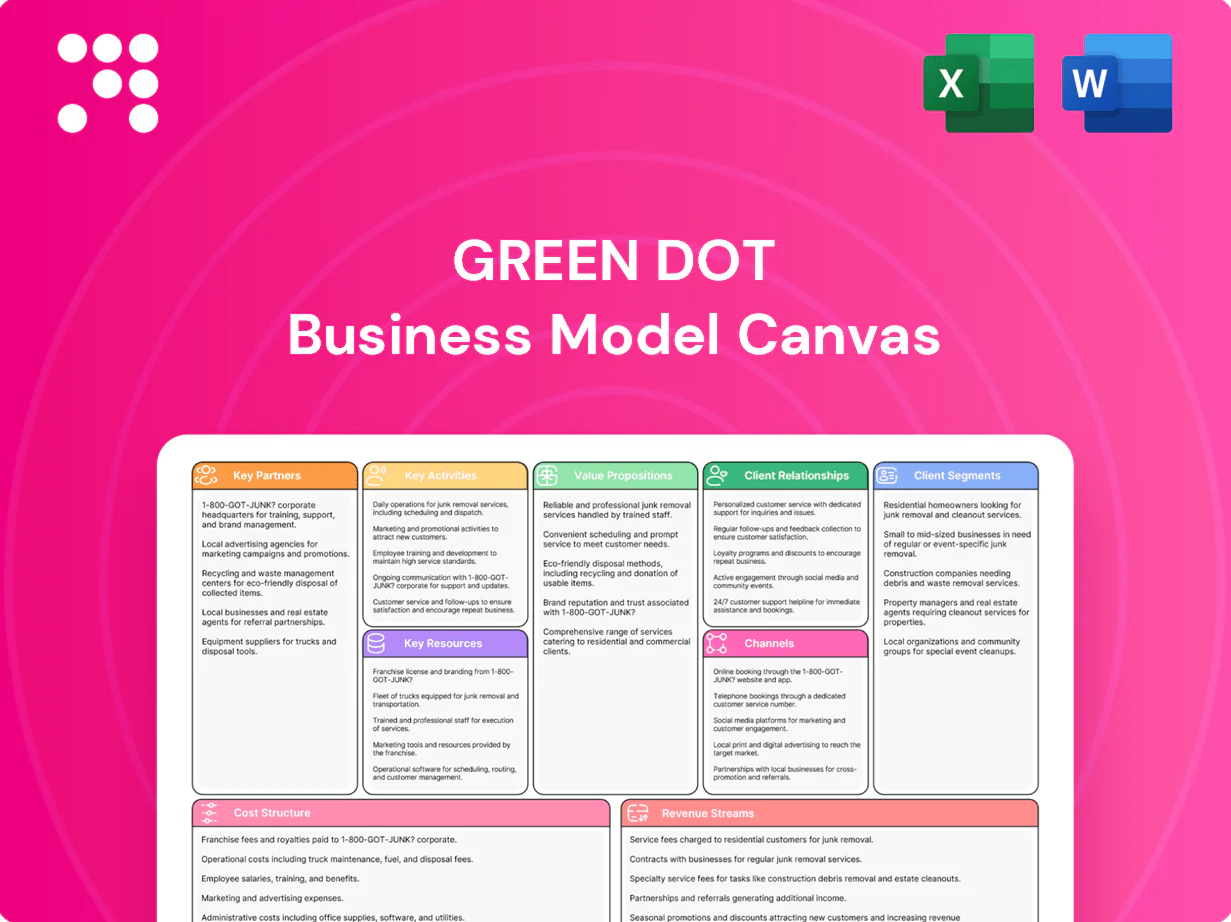
Green Dot Business Model Canvas

Unlock a fintech Business Model Canvas: investor-ready blueprint for value creation
Unlock Green Dot’s strategic blueprint with a concise Business Model Canvas that maps customer segments, revenue streams, key partners and cost drivers. This actionable snapshot reveals how the company creates and captures value, scales its fintech offerings, and sustains competitive advantage. Download the full Word/Excel canvas for a ready-to-use toolkit ideal for investors, consultants, and founders.
Partnerships

Retail distribution partners
Large retail chains (eg Walmart, CVS, Walgreens) enable in‑store sales and cash reloading of prepaid Green Dot cards, reaching thousands of locations including Walmart’s ~4,700 U.S. stores, and expanding access to cash‑centric consumers; FDIC data shows 5.4% of U.S. adults were unbanked and 16.1% underbanked (2022). Shelf space and POS promotion boost visibility and acquisition, while in‑store cash deposits and bill pay meet critical needs for the underbanked, and joint retailer promotions have historically cut customer acquisition costs and raised activation rates.
Payment networks and processors
Alliances with Visa and Mastercard—which together process over 80% of global card transactions—plus major processors ensure Green Dot cards are widely accepted and scalable. Network certifications, dispute workflows, and layered fraud tools underpin program integrity and reduce chargeback costs. Interchange economics are set through these partners, and co-innovation (tokenization, tap-to-pay) speeds new feature rollouts.

BaaS enterprise clients
Large consumer and tech brands embed Green Dot’s banking rails into their ecosystems, leveraging Green Dot’s scale of more than 33 million accounts to drive volume and deposits. These enterprise BaaS relationships boost cross-sell potential across prepaid, checking and card products and include custom SLAs and compliance support. Long-term contracts provide predictable revenue streams and reduce churn for Green Dot.

Regulatory and compliance partners
Legal advisors, KYC/AML vendors, and auditors ensure Green Dot adheres to banking laws and oversight; in 2024 global AML fines exceeded $2 billion, underscoring regulatory risk. Data verification and sanctions screening cut onboarding risk and false positives, while external expertise complements internal teams, lowering regulatory exposure and enhancing program credibility.
- Legal advisors: regulatory defense
- KYC/AML vendors: data verification, sanctions screening
- Auditors: compliance assurance
- Impact: reduced fines, stronger program credibility
Technology and fraud vendors
API gateways and observability tools streamline developer experience; joint roadmaps with vendors speed product rollout and resiliency.
- Uptime: 99.99% SLAs
- False positives: up to 50% reduction (2024)
- Focus: identity, behavioral analytics, API/observability
Retail, card networks and 33M BaaS accounts power cash access; AML fines >$2B
Retail chains (eg Walmart ~4,700 US stores) drive distribution, cash reloads and activation amid 5.4% unbanked/16.1% underbanked (2022). Networks (Visa/Mastercard) secure acceptance and set interchange (>80% global share). BaaS clients leverage Green Dot’s ~33M accounts for deposits and recurring fees. Compliance, identity and fraud vendors cut regulatory and chargeback risk as AML fines topped >$2B (2024).
| Partner | Role | Key metric |
|---|---|---|
| Retail chains | Distribution, cash | Walmart ~4,700 stores |
| Card networks | Acceptance, interchange | >80% global txn share |
| BaaS clients | Deposit volume | ~33M accounts |
| Compliance vendors | Risk mitigation | AML fines >$2B (2024) |
What is included in the product
 Detailed Word Document
A ready-to-use Green Dot Business Model Canvas detailing customer segments, channels, value propositions, revenue streams and key activities, reflecting real operations and competitive analysis for presentations, funding, and strategic decisions.

 Customizable Excel Spreadsheet
High-level view of Green Dot's business model with editable cells, quickly identifying core components to relieve the pain of scattered strategy documents and operational silos.
Activities

Banking platform operations
Operating Green Dot Bank supports deposits, payments, and card issuance across a platform serving roughly 33 million customers, enabling billions in transaction volume annually.
Core processing, reconciliation, and settlement require millisecond-level accuracy and daily balancing to meet regulatory and partner requirements.
Risk controls and liquidity management are daily priorities, with intraday monitoring and stress scenarios driving funding decisions.
Service reliability underpins customer trust and partner SLAs, targeting >99.9% uptime to avoid revenue and reputational loss.
Product development and APIs
Building prepaid, checking, secured credit, and BaaS APIs enables rapid integration across partners and third-party platforms, tapping into a BaaS market estimated at $8.6 billion in 2024; SDKs, sandboxes, and thorough documentation cut developer time-to-market and integration costs while improving launch velocity. Iterating on features — fees, limits, digital wallet support — addresses churn drivers and regulatory needs, and continuous product improvement drives higher adoption and retention.

Compliance and risk management
KYC/AML, BSA compliance, fraud prevention, and regulatory reporting are continuous operations, with the Corporate Transparency Act BOI reporting requirements implemented by FinCEN starting January 2024 increasing reporting and verification workloads. Model governance and real‑time transaction monitoring protect the platform and reduce fraud exposure. Vendor due diligence, periodic audits, and control testing ensure partner compliance, while ongoing training and policy updates keep procedures aligned with evolving rules.

Partnership management
Partnership management drives onboarding and co-marketing with retailers and enterprise clients to scale customer acquisition; Green Dot reported roughly $1.12 billion in 2024 revenue, underpinned by distribution and retail partnerships. Quarterly joint business reviews align KPIs and roadmap while customization and solutioning for partner use cases increase adoption and ARPU. Focused contract renewals secure multi-year economics and predictable cash flow.
Customer support and CX
Multichannel support resolves account, card and dispute issues quickly, lowering friction across phone, chat and in-app channels; Green Dot emphasized this approach in 2024 to maintain prepaid account stability. Proactive communications—automated alerts and retention offers—reduce churn and complaints. UX optimization streamlines onboarding and funding, shortening time-to-first-deposit. Continuous NPS tracking drives prioritized product fixes and roadmap decisions.
- Omnichannel resolution: reduces friction
- Proactive comms: lowers churn
- UX: faster onboarding/funding
- NPS: informs product priorities
Core processor: ~33M customers, $1.12B 2024 revenue, BaaS tapping $8.6B market
Core processing serves ~33M customers; 2024 revenue $1.12B. Targets >99.9% uptime with millisecond reconciliation and daily liquidity/risk management. BaaS APIs address an $8.6B 2024 market enabling prepaid/checking/credit and partner integration. Continuous KYC/AML, BOI reporting, fraud models, vendor audits and omnichannel support sustain compliance and retention.
| Metric | 2024 |
|---|---|
| Customers | ~33M |
| Revenue | $1.12B |
| BaaS market | $8.6B |
| Uptime target | >99.9% |
Delivered as Displayed
Business Model Canvas
The Green Dot Business Model Canvas previewed here is the exact, live section of the final deliverable—not a mockup or sample. Upon purchase you’ll receive this same complete, editable document ready to use for strategy and presentations, formatted exactly as shown.

Unlock a fintech Business Model Canvas: investor-ready blueprint for value creation
Unlock Green Dot’s strategic blueprint with a concise Business Model Canvas that maps customer segments, revenue streams, key partners and cost drivers. This actionable snapshot reveals how the company creates and captures value, scales its fintech offerings, and sustains competitive advantage. Download the full Word/Excel canvas for a ready-to-use toolkit ideal for investors, consultants, and founders.
Partnerships
Retail distribution partners
Large retail chains (eg Walmart, CVS, Walgreens) enable in‑store sales and cash reloading of prepaid Green Dot cards, reaching thousands of locations including Walmart’s ~4,700 U.S. stores, and expanding access to cash‑centric consumers; FDIC data shows 5.4% of U.S. adults were unbanked and 16.1% underbanked (2022). Shelf space and POS promotion boost visibility and acquisition, while in‑store cash deposits and bill pay meet critical needs for the underbanked, and joint retailer promotions have historically cut customer acquisition costs and raised activation rates.
Payment networks and processors
Alliances with Visa and Mastercard—which together process over 80% of global card transactions—plus major processors ensure Green Dot cards are widely accepted and scalable. Network certifications, dispute workflows, and layered fraud tools underpin program integrity and reduce chargeback costs. Interchange economics are set through these partners, and co-innovation (tokenization, tap-to-pay) speeds new feature rollouts.
BaaS enterprise clients
Large consumer and tech brands embed Green Dot’s banking rails into their ecosystems, leveraging Green Dot’s scale of more than 33 million accounts to drive volume and deposits. These enterprise BaaS relationships boost cross-sell potential across prepaid, checking and card products and include custom SLAs and compliance support. Long-term contracts provide predictable revenue streams and reduce churn for Green Dot.
Regulatory and compliance partners
Legal advisors, KYC/AML vendors, and auditors ensure Green Dot adheres to banking laws and oversight; in 2024 global AML fines exceeded $2 billion, underscoring regulatory risk. Data verification and sanctions screening cut onboarding risk and false positives, while external expertise complements internal teams, lowering regulatory exposure and enhancing program credibility.
- Legal advisors: regulatory defense
- KYC/AML vendors: data verification, sanctions screening
- Auditors: compliance assurance
- Impact: reduced fines, stronger program credibility
Technology and fraud vendors
API gateways and observability tools streamline developer experience; joint roadmaps with vendors speed product rollout and resiliency.
- Uptime: 99.99% SLAs
- False positives: up to 50% reduction (2024)
- Focus: identity, behavioral analytics, API/observability
Retail, card networks and 33M BaaS accounts power cash access; AML fines >$2B
Retail chains (eg Walmart ~4,700 US stores) drive distribution, cash reloads and activation amid 5.4% unbanked/16.1% underbanked (2022). Networks (Visa/Mastercard) secure acceptance and set interchange (>80% global share). BaaS clients leverage Green Dot’s ~33M accounts for deposits and recurring fees. Compliance, identity and fraud vendors cut regulatory and chargeback risk as AML fines topped >$2B (2024).
| Partner | Role | Key metric |
|---|---|---|
| Retail chains | Distribution, cash | Walmart ~4,700 stores |
| Card networks | Acceptance, interchange | >80% global txn share |
| BaaS clients | Deposit volume | ~33M accounts |
| Compliance vendors | Risk mitigation | AML fines >$2B (2024) |
What is included in the product
Detailed Word Document
A ready-to-use Green Dot Business Model Canvas detailing customer segments, channels, value propositions, revenue streams and key activities, reflecting real operations and competitive analysis for presentations, funding, and strategic decisions.
Customizable Excel Spreadsheet
High-level view of Green Dot's business model with editable cells, quickly identifying core components to relieve the pain of scattered strategy documents and operational silos.
Activities
Banking platform operations
Operating Green Dot Bank supports deposits, payments, and card issuance across a platform serving roughly 33 million customers, enabling billions in transaction volume annually.
Core processing, reconciliation, and settlement require millisecond-level accuracy and daily balancing to meet regulatory and partner requirements.
Risk controls and liquidity management are daily priorities, with intraday monitoring and stress scenarios driving funding decisions.
Service reliability underpins customer trust and partner SLAs, targeting >99.9% uptime to avoid revenue and reputational loss.
Product development and APIs
Building prepaid, checking, secured credit, and BaaS APIs enables rapid integration across partners and third-party platforms, tapping into a BaaS market estimated at $8.6 billion in 2024; SDKs, sandboxes, and thorough documentation cut developer time-to-market and integration costs while improving launch velocity. Iterating on features — fees, limits, digital wallet support — addresses churn drivers and regulatory needs, and continuous product improvement drives higher adoption and retention.
Compliance and risk management
KYC/AML, BSA compliance, fraud prevention, and regulatory reporting are continuous operations, with the Corporate Transparency Act BOI reporting requirements implemented by FinCEN starting January 2024 increasing reporting and verification workloads. Model governance and real‑time transaction monitoring protect the platform and reduce fraud exposure. Vendor due diligence, periodic audits, and control testing ensure partner compliance, while ongoing training and policy updates keep procedures aligned with evolving rules.
Partnership management
Partnership management drives onboarding and co-marketing with retailers and enterprise clients to scale customer acquisition; Green Dot reported roughly $1.12 billion in 2024 revenue, underpinned by distribution and retail partnerships. Quarterly joint business reviews align KPIs and roadmap while customization and solutioning for partner use cases increase adoption and ARPU. Focused contract renewals secure multi-year economics and predictable cash flow.
Customer support and CX
Multichannel support resolves account, card and dispute issues quickly, lowering friction across phone, chat and in-app channels; Green Dot emphasized this approach in 2024 to maintain prepaid account stability. Proactive communications—automated alerts and retention offers—reduce churn and complaints. UX optimization streamlines onboarding and funding, shortening time-to-first-deposit. Continuous NPS tracking drives prioritized product fixes and roadmap decisions.
- Omnichannel resolution: reduces friction
- Proactive comms: lowers churn
- UX: faster onboarding/funding
- NPS: informs product priorities
Core processor: ~33M customers, $1.12B 2024 revenue, BaaS tapping $8.6B market
Core processing serves ~33M customers; 2024 revenue $1.12B. Targets >99.9% uptime with millisecond reconciliation and daily liquidity/risk management. BaaS APIs address an $8.6B 2024 market enabling prepaid/checking/credit and partner integration. Continuous KYC/AML, BOI reporting, fraud models, vendor audits and omnichannel support sustain compliance and retention.
| Metric | 2024 |
|---|---|
| Customers | ~33M |
| Revenue | $1.12B |
| BaaS market | $8.6B |
| Uptime target | >99.9% |
Delivered as Displayed
Business Model Canvas
The Green Dot Business Model Canvas previewed here is the exact, live section of the final deliverable—not a mockup or sample. Upon purchase you’ll receive this same complete, editable document ready to use for strategy and presentations, formatted exactly as shown.
Original: $10.00
-65%$10.00
$3.50Description
Unlock a fintech Business Model Canvas: investor-ready blueprint for value creation
Unlock Green Dot’s strategic blueprint with a concise Business Model Canvas that maps customer segments, revenue streams, key partners and cost drivers. This actionable snapshot reveals how the company creates and captures value, scales its fintech offerings, and sustains competitive advantage. Download the full Word/Excel canvas for a ready-to-use toolkit ideal for investors, consultants, and founders.
Partnerships
Retail distribution partners
Large retail chains (eg Walmart, CVS, Walgreens) enable in‑store sales and cash reloading of prepaid Green Dot cards, reaching thousands of locations including Walmart’s ~4,700 U.S. stores, and expanding access to cash‑centric consumers; FDIC data shows 5.4% of U.S. adults were unbanked and 16.1% underbanked (2022). Shelf space and POS promotion boost visibility and acquisition, while in‑store cash deposits and bill pay meet critical needs for the underbanked, and joint retailer promotions have historically cut customer acquisition costs and raised activation rates.
Payment networks and processors
Alliances with Visa and Mastercard—which together process over 80% of global card transactions—plus major processors ensure Green Dot cards are widely accepted and scalable. Network certifications, dispute workflows, and layered fraud tools underpin program integrity and reduce chargeback costs. Interchange economics are set through these partners, and co-innovation (tokenization, tap-to-pay) speeds new feature rollouts.
BaaS enterprise clients
Large consumer and tech brands embed Green Dot’s banking rails into their ecosystems, leveraging Green Dot’s scale of more than 33 million accounts to drive volume and deposits. These enterprise BaaS relationships boost cross-sell potential across prepaid, checking and card products and include custom SLAs and compliance support. Long-term contracts provide predictable revenue streams and reduce churn for Green Dot.
Regulatory and compliance partners
Legal advisors, KYC/AML vendors, and auditors ensure Green Dot adheres to banking laws and oversight; in 2024 global AML fines exceeded $2 billion, underscoring regulatory risk. Data verification and sanctions screening cut onboarding risk and false positives, while external expertise complements internal teams, lowering regulatory exposure and enhancing program credibility.
- Legal advisors: regulatory defense
- KYC/AML vendors: data verification, sanctions screening
- Auditors: compliance assurance
- Impact: reduced fines, stronger program credibility
Technology and fraud vendors
API gateways and observability tools streamline developer experience; joint roadmaps with vendors speed product rollout and resiliency.
- Uptime: 99.99% SLAs
- False positives: up to 50% reduction (2024)
- Focus: identity, behavioral analytics, API/observability
Retail, card networks and 33M BaaS accounts power cash access; AML fines >$2B
Retail chains (eg Walmart ~4,700 US stores) drive distribution, cash reloads and activation amid 5.4% unbanked/16.1% underbanked (2022). Networks (Visa/Mastercard) secure acceptance and set interchange (>80% global share). BaaS clients leverage Green Dot’s ~33M accounts for deposits and recurring fees. Compliance, identity and fraud vendors cut regulatory and chargeback risk as AML fines topped >$2B (2024).
| Partner | Role | Key metric |
|---|---|---|
| Retail chains | Distribution, cash | Walmart ~4,700 stores |
| Card networks | Acceptance, interchange | >80% global txn share |
| BaaS clients | Deposit volume | ~33M accounts |
| Compliance vendors | Risk mitigation | AML fines >$2B (2024) |
What is included in the product
Detailed Word Document
A ready-to-use Green Dot Business Model Canvas detailing customer segments, channels, value propositions, revenue streams and key activities, reflecting real operations and competitive analysis for presentations, funding, and strategic decisions.
Customizable Excel Spreadsheet
High-level view of Green Dot's business model with editable cells, quickly identifying core components to relieve the pain of scattered strategy documents and operational silos.
Activities
Banking platform operations
Operating Green Dot Bank supports deposits, payments, and card issuance across a platform serving roughly 33 million customers, enabling billions in transaction volume annually.
Core processing, reconciliation, and settlement require millisecond-level accuracy and daily balancing to meet regulatory and partner requirements.
Risk controls and liquidity management are daily priorities, with intraday monitoring and stress scenarios driving funding decisions.
Service reliability underpins customer trust and partner SLAs, targeting >99.9% uptime to avoid revenue and reputational loss.
Product development and APIs
Building prepaid, checking, secured credit, and BaaS APIs enables rapid integration across partners and third-party platforms, tapping into a BaaS market estimated at $8.6 billion in 2024; SDKs, sandboxes, and thorough documentation cut developer time-to-market and integration costs while improving launch velocity. Iterating on features — fees, limits, digital wallet support — addresses churn drivers and regulatory needs, and continuous product improvement drives higher adoption and retention.
Compliance and risk management
KYC/AML, BSA compliance, fraud prevention, and regulatory reporting are continuous operations, with the Corporate Transparency Act BOI reporting requirements implemented by FinCEN starting January 2024 increasing reporting and verification workloads. Model governance and real‑time transaction monitoring protect the platform and reduce fraud exposure. Vendor due diligence, periodic audits, and control testing ensure partner compliance, while ongoing training and policy updates keep procedures aligned with evolving rules.
Partnership management
Partnership management drives onboarding and co-marketing with retailers and enterprise clients to scale customer acquisition; Green Dot reported roughly $1.12 billion in 2024 revenue, underpinned by distribution and retail partnerships. Quarterly joint business reviews align KPIs and roadmap while customization and solutioning for partner use cases increase adoption and ARPU. Focused contract renewals secure multi-year economics and predictable cash flow.
Customer support and CX
Multichannel support resolves account, card and dispute issues quickly, lowering friction across phone, chat and in-app channels; Green Dot emphasized this approach in 2024 to maintain prepaid account stability. Proactive communications—automated alerts and retention offers—reduce churn and complaints. UX optimization streamlines onboarding and funding, shortening time-to-first-deposit. Continuous NPS tracking drives prioritized product fixes and roadmap decisions.
- Omnichannel resolution: reduces friction
- Proactive comms: lowers churn
- UX: faster onboarding/funding
- NPS: informs product priorities
Core processor: ~33M customers, $1.12B 2024 revenue, BaaS tapping $8.6B market
Core processing serves ~33M customers; 2024 revenue $1.12B. Targets >99.9% uptime with millisecond reconciliation and daily liquidity/risk management. BaaS APIs address an $8.6B 2024 market enabling prepaid/checking/credit and partner integration. Continuous KYC/AML, BOI reporting, fraud models, vendor audits and omnichannel support sustain compliance and retention.
| Metric | 2024 |
|---|---|
| Customers | ~33M |
| Revenue | $1.12B |
| BaaS market | $8.6B |
| Uptime target | >99.9% |
Delivered as Displayed
Business Model Canvas
The Green Dot Business Model Canvas previewed here is the exact, live section of the final deliverable—not a mockup or sample. Upon purchase you’ll receive this same complete, editable document ready to use for strategy and presentations, formatted exactly as shown.











