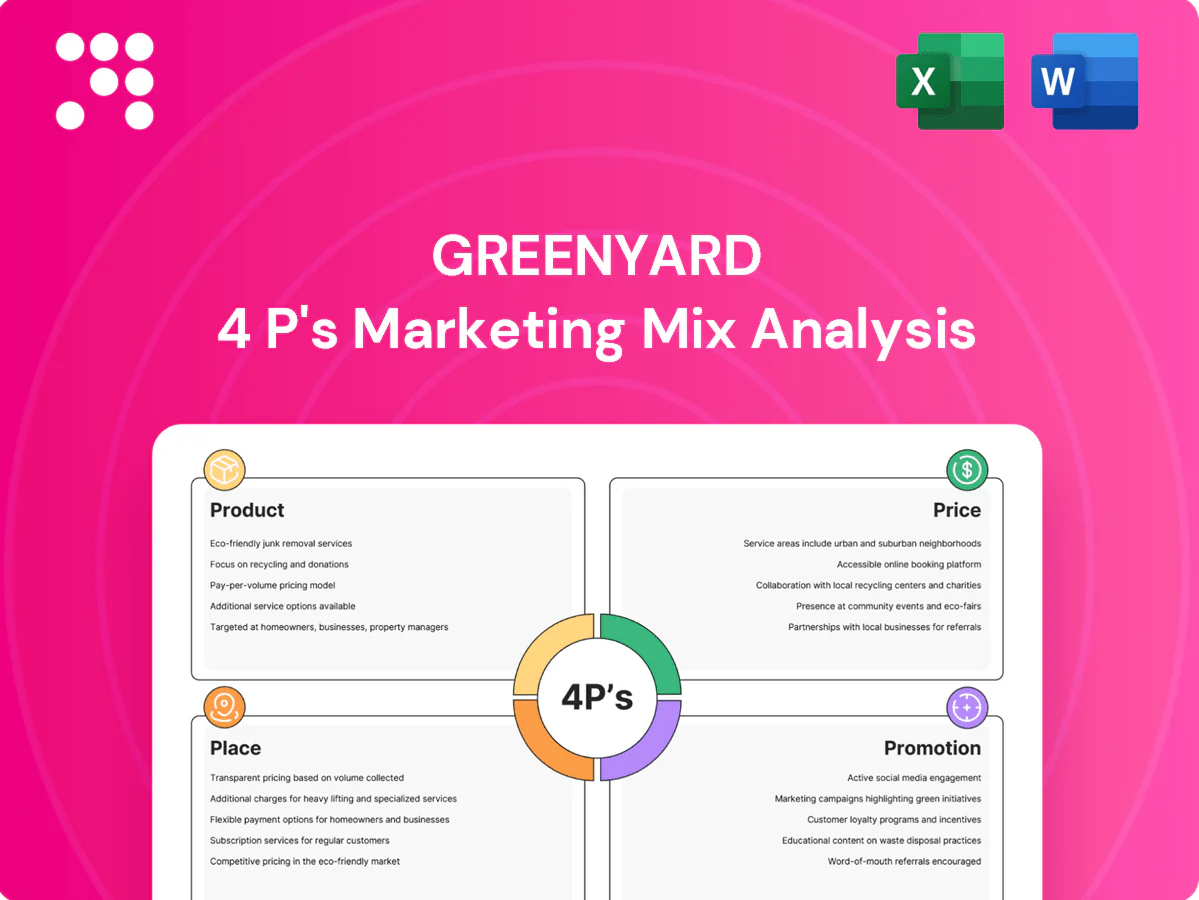
Greenyard Marketing Mix

Go Beyond the Snapshot—Get the Full Strategy
Discover how Greenyard's product range, pricing architecture, distribution network, and promotional mix combine to create market advantage—this concise preview highlights key strategic moves. The full 4P's Marketing Mix Analysis offers editable, presentation-ready detail, data-backed insights, and practical recommendations. Get the complete report to save research time and apply proven tactics to your strategy.
Product

Wide fresh, frozen, prepared range
Greenyard supplies fresh, frozen and prepared fruits and vegetables alongside flowers and plants, serving retailers and foodservice across 25+ countries. The assortment covers core staples and seasonal specialties to match category cycles and promotional windows. Ready-to-cook and ready-to-eat lines provide consumer convenience and higher margin formats. The broad portfolio delivers category depth and one-stop procurement for clients.
Value-added convenience solutions
Value-added convenience solutions include washed, cut, portioned and mixed packs that accelerate meal prep and reduce waste, while meal kits, steam bags and microwavable formats remove friction for time-pressed consumers. Culinary development tailors flavor profiles and regional tastes to drive repeat purchases. These formats increase basket size and offer higher margins for retail partners, supporting category premiumization and retail profitability.

Consistent quality and food safety
Greenyard enforces rigorous standards with GlobalG.A.P., BRCGS and IFS certifications and routine testing to protect brand and retailer trust. Specifications for size, taste and shelf-life deliver consistent quality across markets. Traceability systems link produce from field to fork, enabling rapid recalls and supplier accountability. Continuous improvement programs drive ongoing defect and waste reductions.

Sustainable sourcing and practices
Integrated grower networks prioritize regenerative and water-efficient farming, with Greenyard leveraging long-term partnerships that underpin soil health and a stable fresh produce supply; group revenue ~€2.6bn (FY2023) supports investment in grower programs. Initiatives focus on CO2 reduction, waste minimization and circular packaging to align with retailer ESG and evolving consumer preference.
- grower partnerships: long-term contracts
- ESG alignment: supports retailer targets
- circular packaging: roll-out across SKUs
Packaging and private-label enablement
Custom packaging, branding and private-label development align with retailer strategies to boost shelf differentiation and margin; Greenyard reported renewed retailer contracts across Europe in 2024 supporting scale advantages. Formats optimize shelf life, visibility and portion control, reducing spoilage and supporting retailer inventory turns. Recyclable, lightweight materials reinforce Greenyards eco position while design-to-value balances cost, protection and aesthetics.
- Private-label focus: retailer-aligned design
- Shelf-life & portion control: waste reduction
- Recyclable/lightweight: eco positioning
- Design-to-value: cost, protection, aesthetics
Fresh, frozen and value-added produce powering grocery growth across 25+ countries
Greenyard offers fresh, frozen, prepared produce and plants across 25+ countries, combining core staples, seasonal specialties and convenience formats to drive basket growth. Value-added lines (washed, cut, meal kits, microwavable) raise margins and reduce waste while private-label partnerships and recyclable packaging support retailer differentiation and ESG targets; group revenue €2.6bn (FY2023).
| Metric | Value | Note |
|---|---|---|
| Revenue | €2.6bn | FY2023 |
| Markets | 25+ | Retail & foodservice |
| Private-label | Renewals 2024 | Supports scale |
What is included in the product
 Detailed Word Document
Delivers a company-specific deep dive into Greenyard’s Product, Price, Place and Promotion strategies, using real brand practices and competitive context to ground recommendations. Ideal for managers and consultants seeking a structured, exportable marketing-positioning brief.

 Customizable Excel Spreadsheet
Condenses Greenyard’s 4Ps into a one‑page, leadership‑ready summary that pinpoints product, price, place and promotion pain points and recommended fixes. Easily adaptable for presentations, decks or cross‑functional workshops to speed alignment and drive actionable marketing decisions.
Place

Integrated field-to-fork supply chain
Greenyard coordinates growers, processing, warehousing and distribution end-to-end, enabling direct sourcing that shortens lead times and enhances freshness across a 12-month supply window. Integrated planning and real-time data share improve forecast accuracy and help reduce food loss in line with FAO estimates that roughly 30% of food is wasted globally. This field-to-fork model supports reliable year-round availability and lower spoilage rates for fresh produce.
Deep retail partnerships
Long-term retailer agreements (typically 3–7 years) secure shelf presence for Greenyard, supporting stable revenues and negotiated slotting across major chains.
Vendor-managed inventory and joint planning boost on-shelf availability by several percentage points, reducing stockouts and spoilage through shared POS and forecast data.
Cross-docking and store-ready packs streamline operations, cutting handling and lead times and lowering logistics costs by around 10–25%; category management tailors assortments to local demand, lifting category sales by 2–8%.

Foodservice and industry channels
Greenyard tailors specifications for QSR, hospitality and institutional clients, offering portioning, shelf-life and cut-size options to meet high-volume kitchen standards. Industrial packs supply food manufacturers and meal-kit companies with ingredient-grade frozen and chilled lines. Flexible MOQs and multiple formats adapt to diverse production lines, while service levels focus on consistency, safety and rapid replenishment.

Cold-chain and just-in-time logistics
Refrigerated transport and temperature-controlled hubs preserve freshness and curb spoilage; FAO estimates about 33% of food is lost or wasted globally, underscoring cold-chain value. Just-in-time deliveries reduce shrink and lower inventory carrying costs. Route optimization raises service frequency while cutting fuel use and emissions; real-time monitoring increases visibility and EU food-safety compliance.
- Cold-chain: protects quality, cuts spoilage
- JIT: lowers inventory and shrink
- Routing: boosts frequency, sustainability
- Real-time: visibility, regulatory compliance
Global reach, local execution
Greenyard's operations span key growing regions and consumer markets with presence in 25+ countries and over 5,000 employees (2024), enabling local hubs to tailor assortments to regional tastes and seasons. Multi-origin sourcing balances weather and crop risks, while proximity to customers accelerates replenishment and freshness.
- 25+ countries
- >5,000 employees
- Multi-origin sourcing
- Faster replenishment
Grower-to-retail cold-chain across 25+ countries cuts spoilage, boosts availability
Greenyard integrates growers-to-retail supply chains across 25+ countries with >5,000 employees (2024), enabling year-round fresh availability and lower spoilage.
Long-term retailer contracts, VMI and real-time planning lift on-shelf availability and cut stockouts, while JIT and cross-docking reduce logistics costs ~10–25%.
Cold-chain and route optimization improve freshness and sustainability amid FAO food-waste estimates of ~30–33% globally.
| Metric | Value |
|---|---|
| Countries | 25+ |
| Employees (2024) | >5,000 |
| Logistics cost reduction | ~10–25% |
| Category sales lift | 2–8% |
What You Preview Is What You Download
Greenyard 4P's Marketing Mix Analysis
The preview shown here is the exact Greenyard 4P's Marketing Mix Analysis you'll receive instantly after purchase—no sample or mockup. This fully editable, comprehensive document is complete and ready for immediate use, so you can buy with confidence.

Go Beyond the Snapshot—Get the Full Strategy
Discover how Greenyard's product range, pricing architecture, distribution network, and promotional mix combine to create market advantage—this concise preview highlights key strategic moves. The full 4P's Marketing Mix Analysis offers editable, presentation-ready detail, data-backed insights, and practical recommendations. Get the complete report to save research time and apply proven tactics to your strategy.
Product
Wide fresh, frozen, prepared range
Greenyard supplies fresh, frozen and prepared fruits and vegetables alongside flowers and plants, serving retailers and foodservice across 25+ countries. The assortment covers core staples and seasonal specialties to match category cycles and promotional windows. Ready-to-cook and ready-to-eat lines provide consumer convenience and higher margin formats. The broad portfolio delivers category depth and one-stop procurement for clients.
Value-added convenience solutions
Value-added convenience solutions include washed, cut, portioned and mixed packs that accelerate meal prep and reduce waste, while meal kits, steam bags and microwavable formats remove friction for time-pressed consumers. Culinary development tailors flavor profiles and regional tastes to drive repeat purchases. These formats increase basket size and offer higher margins for retail partners, supporting category premiumization and retail profitability.
Consistent quality and food safety
Greenyard enforces rigorous standards with GlobalG.A.P., BRCGS and IFS certifications and routine testing to protect brand and retailer trust. Specifications for size, taste and shelf-life deliver consistent quality across markets. Traceability systems link produce from field to fork, enabling rapid recalls and supplier accountability. Continuous improvement programs drive ongoing defect and waste reductions.
Sustainable sourcing and practices
Integrated grower networks prioritize regenerative and water-efficient farming, with Greenyard leveraging long-term partnerships that underpin soil health and a stable fresh produce supply; group revenue ~€2.6bn (FY2023) supports investment in grower programs. Initiatives focus on CO2 reduction, waste minimization and circular packaging to align with retailer ESG and evolving consumer preference.
- grower partnerships: long-term contracts
- ESG alignment: supports retailer targets
- circular packaging: roll-out across SKUs
Packaging and private-label enablement
Custom packaging, branding and private-label development align with retailer strategies to boost shelf differentiation and margin; Greenyard reported renewed retailer contracts across Europe in 2024 supporting scale advantages. Formats optimize shelf life, visibility and portion control, reducing spoilage and supporting retailer inventory turns. Recyclable, lightweight materials reinforce Greenyards eco position while design-to-value balances cost, protection and aesthetics.
- Private-label focus: retailer-aligned design
- Shelf-life & portion control: waste reduction
- Recyclable/lightweight: eco positioning
- Design-to-value: cost, protection, aesthetics
Fresh, frozen and value-added produce powering grocery growth across 25+ countries
Greenyard offers fresh, frozen, prepared produce and plants across 25+ countries, combining core staples, seasonal specialties and convenience formats to drive basket growth. Value-added lines (washed, cut, meal kits, microwavable) raise margins and reduce waste while private-label partnerships and recyclable packaging support retailer differentiation and ESG targets; group revenue €2.6bn (FY2023).
| Metric | Value | Note |
|---|---|---|
| Revenue | €2.6bn | FY2023 |
| Markets | 25+ | Retail & foodservice |
| Private-label | Renewals 2024 | Supports scale |
What is included in the product
Detailed Word Document
Delivers a company-specific deep dive into Greenyard’s Product, Price, Place and Promotion strategies, using real brand practices and competitive context to ground recommendations. Ideal for managers and consultants seeking a structured, exportable marketing-positioning brief.
Customizable Excel Spreadsheet
Condenses Greenyard’s 4Ps into a one‑page, leadership‑ready summary that pinpoints product, price, place and promotion pain points and recommended fixes. Easily adaptable for presentations, decks or cross‑functional workshops to speed alignment and drive actionable marketing decisions.
Place
Integrated field-to-fork supply chain
Greenyard coordinates growers, processing, warehousing and distribution end-to-end, enabling direct sourcing that shortens lead times and enhances freshness across a 12-month supply window. Integrated planning and real-time data share improve forecast accuracy and help reduce food loss in line with FAO estimates that roughly 30% of food is wasted globally. This field-to-fork model supports reliable year-round availability and lower spoilage rates for fresh produce.
Deep retail partnerships
Long-term retailer agreements (typically 3–7 years) secure shelf presence for Greenyard, supporting stable revenues and negotiated slotting across major chains.
Vendor-managed inventory and joint planning boost on-shelf availability by several percentage points, reducing stockouts and spoilage through shared POS and forecast data.
Cross-docking and store-ready packs streamline operations, cutting handling and lead times and lowering logistics costs by around 10–25%; category management tailors assortments to local demand, lifting category sales by 2–8%.
Foodservice and industry channels
Greenyard tailors specifications for QSR, hospitality and institutional clients, offering portioning, shelf-life and cut-size options to meet high-volume kitchen standards. Industrial packs supply food manufacturers and meal-kit companies with ingredient-grade frozen and chilled lines. Flexible MOQs and multiple formats adapt to diverse production lines, while service levels focus on consistency, safety and rapid replenishment.
Cold-chain and just-in-time logistics
Refrigerated transport and temperature-controlled hubs preserve freshness and curb spoilage; FAO estimates about 33% of food is lost or wasted globally, underscoring cold-chain value. Just-in-time deliveries reduce shrink and lower inventory carrying costs. Route optimization raises service frequency while cutting fuel use and emissions; real-time monitoring increases visibility and EU food-safety compliance.
- Cold-chain: protects quality, cuts spoilage
- JIT: lowers inventory and shrink
- Routing: boosts frequency, sustainability
- Real-time: visibility, regulatory compliance
Global reach, local execution
Greenyard's operations span key growing regions and consumer markets with presence in 25+ countries and over 5,000 employees (2024), enabling local hubs to tailor assortments to regional tastes and seasons. Multi-origin sourcing balances weather and crop risks, while proximity to customers accelerates replenishment and freshness.
- 25+ countries
- >5,000 employees
- Multi-origin sourcing
- Faster replenishment
Grower-to-retail cold-chain across 25+ countries cuts spoilage, boosts availability
Greenyard integrates growers-to-retail supply chains across 25+ countries with >5,000 employees (2024), enabling year-round fresh availability and lower spoilage.
Long-term retailer contracts, VMI and real-time planning lift on-shelf availability and cut stockouts, while JIT and cross-docking reduce logistics costs ~10–25%.
Cold-chain and route optimization improve freshness and sustainability amid FAO food-waste estimates of ~30–33% globally.
| Metric | Value |
|---|---|
| Countries | 25+ |
| Employees (2024) | >5,000 |
| Logistics cost reduction | ~10–25% |
| Category sales lift | 2–8% |
What You Preview Is What You Download
Greenyard 4P's Marketing Mix Analysis
The preview shown here is the exact Greenyard 4P's Marketing Mix Analysis you'll receive instantly after purchase—no sample or mockup. This fully editable, comprehensive document is complete and ready for immediate use, so you can buy with confidence.
Original: $10.00
-65%$10.00
$3.50Description
Go Beyond the Snapshot—Get the Full Strategy
Discover how Greenyard's product range, pricing architecture, distribution network, and promotional mix combine to create market advantage—this concise preview highlights key strategic moves. The full 4P's Marketing Mix Analysis offers editable, presentation-ready detail, data-backed insights, and practical recommendations. Get the complete report to save research time and apply proven tactics to your strategy.
Product
Wide fresh, frozen, prepared range
Greenyard supplies fresh, frozen and prepared fruits and vegetables alongside flowers and plants, serving retailers and foodservice across 25+ countries. The assortment covers core staples and seasonal specialties to match category cycles and promotional windows. Ready-to-cook and ready-to-eat lines provide consumer convenience and higher margin formats. The broad portfolio delivers category depth and one-stop procurement for clients.
Value-added convenience solutions
Value-added convenience solutions include washed, cut, portioned and mixed packs that accelerate meal prep and reduce waste, while meal kits, steam bags and microwavable formats remove friction for time-pressed consumers. Culinary development tailors flavor profiles and regional tastes to drive repeat purchases. These formats increase basket size and offer higher margins for retail partners, supporting category premiumization and retail profitability.
Consistent quality and food safety
Greenyard enforces rigorous standards with GlobalG.A.P., BRCGS and IFS certifications and routine testing to protect brand and retailer trust. Specifications for size, taste and shelf-life deliver consistent quality across markets. Traceability systems link produce from field to fork, enabling rapid recalls and supplier accountability. Continuous improvement programs drive ongoing defect and waste reductions.
Sustainable sourcing and practices
Integrated grower networks prioritize regenerative and water-efficient farming, with Greenyard leveraging long-term partnerships that underpin soil health and a stable fresh produce supply; group revenue ~€2.6bn (FY2023) supports investment in grower programs. Initiatives focus on CO2 reduction, waste minimization and circular packaging to align with retailer ESG and evolving consumer preference.
- grower partnerships: long-term contracts
- ESG alignment: supports retailer targets
- circular packaging: roll-out across SKUs
Packaging and private-label enablement
Custom packaging, branding and private-label development align with retailer strategies to boost shelf differentiation and margin; Greenyard reported renewed retailer contracts across Europe in 2024 supporting scale advantages. Formats optimize shelf life, visibility and portion control, reducing spoilage and supporting retailer inventory turns. Recyclable, lightweight materials reinforce Greenyards eco position while design-to-value balances cost, protection and aesthetics.
- Private-label focus: retailer-aligned design
- Shelf-life & portion control: waste reduction
- Recyclable/lightweight: eco positioning
- Design-to-value: cost, protection, aesthetics
Fresh, frozen and value-added produce powering grocery growth across 25+ countries
Greenyard offers fresh, frozen, prepared produce and plants across 25+ countries, combining core staples, seasonal specialties and convenience formats to drive basket growth. Value-added lines (washed, cut, meal kits, microwavable) raise margins and reduce waste while private-label partnerships and recyclable packaging support retailer differentiation and ESG targets; group revenue €2.6bn (FY2023).
| Metric | Value | Note |
|---|---|---|
| Revenue | €2.6bn | FY2023 |
| Markets | 25+ | Retail & foodservice |
| Private-label | Renewals 2024 | Supports scale |
What is included in the product
Detailed Word Document
Delivers a company-specific deep dive into Greenyard’s Product, Price, Place and Promotion strategies, using real brand practices and competitive context to ground recommendations. Ideal for managers and consultants seeking a structured, exportable marketing-positioning brief.
Customizable Excel Spreadsheet
Condenses Greenyard’s 4Ps into a one‑page, leadership‑ready summary that pinpoints product, price, place and promotion pain points and recommended fixes. Easily adaptable for presentations, decks or cross‑functional workshops to speed alignment and drive actionable marketing decisions.
Place
Integrated field-to-fork supply chain
Greenyard coordinates growers, processing, warehousing and distribution end-to-end, enabling direct sourcing that shortens lead times and enhances freshness across a 12-month supply window. Integrated planning and real-time data share improve forecast accuracy and help reduce food loss in line with FAO estimates that roughly 30% of food is wasted globally. This field-to-fork model supports reliable year-round availability and lower spoilage rates for fresh produce.
Deep retail partnerships
Long-term retailer agreements (typically 3–7 years) secure shelf presence for Greenyard, supporting stable revenues and negotiated slotting across major chains.
Vendor-managed inventory and joint planning boost on-shelf availability by several percentage points, reducing stockouts and spoilage through shared POS and forecast data.
Cross-docking and store-ready packs streamline operations, cutting handling and lead times and lowering logistics costs by around 10–25%; category management tailors assortments to local demand, lifting category sales by 2–8%.
Foodservice and industry channels
Greenyard tailors specifications for QSR, hospitality and institutional clients, offering portioning, shelf-life and cut-size options to meet high-volume kitchen standards. Industrial packs supply food manufacturers and meal-kit companies with ingredient-grade frozen and chilled lines. Flexible MOQs and multiple formats adapt to diverse production lines, while service levels focus on consistency, safety and rapid replenishment.
Cold-chain and just-in-time logistics
Refrigerated transport and temperature-controlled hubs preserve freshness and curb spoilage; FAO estimates about 33% of food is lost or wasted globally, underscoring cold-chain value. Just-in-time deliveries reduce shrink and lower inventory carrying costs. Route optimization raises service frequency while cutting fuel use and emissions; real-time monitoring increases visibility and EU food-safety compliance.
- Cold-chain: protects quality, cuts spoilage
- JIT: lowers inventory and shrink
- Routing: boosts frequency, sustainability
- Real-time: visibility, regulatory compliance
Global reach, local execution
Greenyard's operations span key growing regions and consumer markets with presence in 25+ countries and over 5,000 employees (2024), enabling local hubs to tailor assortments to regional tastes and seasons. Multi-origin sourcing balances weather and crop risks, while proximity to customers accelerates replenishment and freshness.
- 25+ countries
- >5,000 employees
- Multi-origin sourcing
- Faster replenishment
Grower-to-retail cold-chain across 25+ countries cuts spoilage, boosts availability
Greenyard integrates growers-to-retail supply chains across 25+ countries with >5,000 employees (2024), enabling year-round fresh availability and lower spoilage.
Long-term retailer contracts, VMI and real-time planning lift on-shelf availability and cut stockouts, while JIT and cross-docking reduce logistics costs ~10–25%.
Cold-chain and route optimization improve freshness and sustainability amid FAO food-waste estimates of ~30–33% globally.
| Metric | Value |
|---|---|
| Countries | 25+ |
| Employees (2024) | >5,000 |
| Logistics cost reduction | ~10–25% |
| Category sales lift | 2–8% |
What You Preview Is What You Download
Greenyard 4P's Marketing Mix Analysis
The preview shown here is the exact Greenyard 4P's Marketing Mix Analysis you'll receive instantly after purchase—no sample or mockup. This fully editable, comprehensive document is complete and ready for immediate use, so you can buy with confidence.











