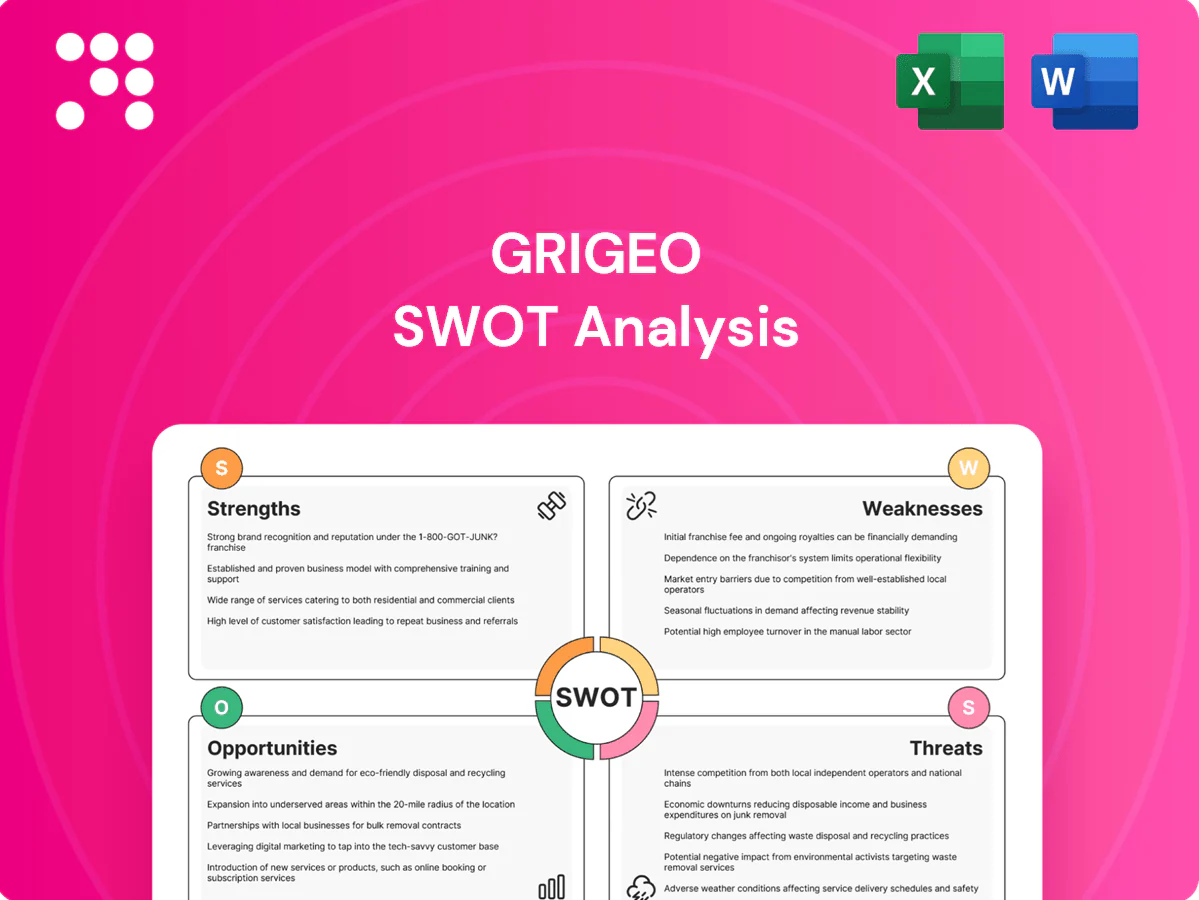
Grigeo SWOT Analysis

Make Insightful Decisions Backed by Expert Research
Grigeo's core strengths in vertical integration and regional market knowledge contrast with risks from commodity price swings and regulatory shifts; opportunities lie in sustainable packaging and export expansion while competition and narrow domestic demand remain threats. Want the full strategic picture and actionable recommendations? Purchase the complete SWOT analysis for a professionally formatted Word report and editable Excel models to plan, pitch, or invest with confidence.
Strengths

Diversified product portfolio
Grigeo operates across three core segments—hygiene paper, corrugated packaging and hardboard—reducing dependence on a single revenue stream. This mix helps balance cyclical swings between consumer tissue and industrial packaging and enables cross-utilization of assets and know-how across divisions. The diversified portfolio supports resilience and enhances cross-selling in both domestic and export markets.
Regional leadership in the Baltics
As a leading Baltic producer listed on Nasdaq Vilnius, Grigeo leverages scale, strong supplier relationships and entrenched local brand trust to lower unit costs and secure inputs. Proximity to customers shortens lead times and improves service levels, boosting retention. Regional dominance enhances bargaining power with suppliers and logistics partners. The Baltic platform supports targeted expansion into adjacent EU markets.

Sustainability integrated operations
Grigeo integrates sustainable sourcing, recycling and efficient production, aligning operations with the EU Green Deal target of around 55% greenhouse gas reduction by 2030 and the CSRD now covering roughly 50,000 companies, which raises ESG reporting expectations. This alignment improves access to green tenders and sustainability-linked financing. Strong sustainability positioning enhances brand value and supports potential price premiums for eco-certified packaging.

Export footprint and customer ties
Grigeo leverages a Nasdaq Vilnius-listed export footprint (ticker GRG1L) to serve both domestic and international markets, reducing demand concentration and enabling currency diversification through sales across EU and regional partners. Long-term packaging and retail clients secure repeat volumes and provide real-time market intelligence for rapid product adaptation.
- Diversified demand: domestic + international
- Currency diversification via export revenues
- Stable volumes from long-term clients
- Improved product-market fit through client intelligence
Access to regional raw materials
The Baltic region provides competitive fiber and wood supply chains, with high forest cover in Estonia 54%, Latvia 56% and Lithuania 34% (Eurostat 2020), strengthening regional availability for Grigeo. Shorter transport distances reduce logistics costs and emissions and local sourcing improves traceability for FSC/PEFC certifications. This underpins reliable input availability and cost efficiency for paper and packaging operations.
- Regional forest cover: Estonia 54%, Latvia 56%, Lithuania 34% (Eurostat 2020)
- Supports FSC/PEFC traceability
- Lower transport costs and emissions
Diversified Baltic paper and packaging group, EU-aligned sustainability and fiber-backed resilience
Grigeo benefits from diversified segments (hygiene paper, corrugated packaging, hardboard), regional scale as Nasdaq Vilnius-listed GRG1L, strong sustainability alignment with EU goals and reliable Baltic fiber supply supporting cost efficiency and market resilience.
| Metric | Value |
|---|---|
| Nasdaq ticker | GRG1L |
| EU GHG target (2030) | -55% |
| CSRD scope (2024) | ~50,000 companies |
| Baltic forest cover (Eurostat 2020) | EE 54% / LV 56% / LT 34% |
What is included in the product
 Detailed Word Document
Provides a concise SWOT analysis of Grigeo, outlining internal strengths and weaknesses and external opportunities and threats to assess its competitive position and strategic risks.

 Customizable Excel Spreadsheet
Provides a concise Grigeo-specific SWOT matrix for fast strategic alignment and clear identification of operational pain points.
Weaknesses

Commodity input exposure
Grigeo faces material input exposure: pulp and recovered paper prices and chemicals plus energy costs — with European softwood pulp around $800–1,000/ton in 2024 and TTF gas averaging ~€60/MWh that year — can swing gross margins significantly. Price volatility is hard to pass immediately to customers, so hedging and surcharge mechanisms only partially offset moves and create lagged effects. Those lags and raw‑material swings have driven quarterly EBITDA variability in comparable paper producers by double digits, amplifying Grigeo’s earnings volatility.
Smaller scale versus global peers
Compared with multinational paper groups, Grigeo (ticker GRG1L) has materially less purchasing leverage and R&D scale. Global competitors with multi‑billion euro revenues can exert pricing pressure and out‑invest in automation and sustainability tech. Grigeo’s marketing reach remains regionally concentrated, which caps international pricing power and slows market share gains. Recent strategy still reflects a Baltic‑focused footprint.

Geographic concentration risk
Operations concentrated in Lithuania and Latvia expose Grigeo to Baltic-specific economic shocks and cross-border policy changes. Local supply or regulatory disruptions could materially reduce output given the firm's limited production footprint and modest geographic redundancy. This concentration increases risk to service continuity during events such as regional energy shortages or transport bottlenecks.

Capital intensity and compliance costs
Paper and board manufacturing demands continuous capex for machinery and environmental controls, and Grigeo faces rising compliance complexity as EU standards tighten, increasing required spending. Long, demand-sensitive payback periods for major upgrades can strain returns and limit free cash flow flexibility. These dynamics raise strategic and liquidity risks for the company.
- High ongoing capex burden
- Rising EU compliance complexity
- Long, demand-sensitive payback periods
- Constrained free cash flow flexibility
Brand visibility in premium tissue
Grigeo's brand visibility in premium tissue is constrained as private-label competition in consumer tissue limits brand equity and compresses margins; building a premium position requires sustained marketing investment and product innovation. Strong retailer bargaining power can force price concessions, which may restrain growth in higher-margin SKUs.
- Private-label pressure reduces shelf differentiation
- High marketing spend needed to build premium equity
- Retailer bargaining compresses pricing and margins
Baltic pulp and gas cost shocks (~$800–1,000/t; ~€60/MWh) fuel double‑digit EBITDA swings
Grigeo (GRG1L) faces raw‑material and energy exposure—softwood pulp ~$800–1,000/t in 2024 and TTF gas ~€60/MWh in 2024—driving double‑digit quarterly EBITDA swings. Limited purchasing scale and regional Baltic footprint constrain pricing power versus multinationals. Rising EU compliance and continuous capex needs pressure free cash flow and long payback horizons.
| Metric | 2024/Note |
|---|---|
| Softwood pulp | $800–1,000/t |
| TTF gas | ~€60/MWh |
| EBITDA variability | double‑digit quarters |
Same Document Delivered
Grigeo SWOT Analysis
This is the actual Grigeo SWOT analysis document you’ll receive upon purchase—no surprises, just professional quality. The preview below is taken directly from the full report; buying unlocks the complete, editable version. You’re viewing a live excerpt of the final file, structured and ready to use after checkout.

Make Insightful Decisions Backed by Expert Research
Grigeo's core strengths in vertical integration and regional market knowledge contrast with risks from commodity price swings and regulatory shifts; opportunities lie in sustainable packaging and export expansion while competition and narrow domestic demand remain threats. Want the full strategic picture and actionable recommendations? Purchase the complete SWOT analysis for a professionally formatted Word report and editable Excel models to plan, pitch, or invest with confidence.
Strengths
Diversified product portfolio
Grigeo operates across three core segments—hygiene paper, corrugated packaging and hardboard—reducing dependence on a single revenue stream. This mix helps balance cyclical swings between consumer tissue and industrial packaging and enables cross-utilization of assets and know-how across divisions. The diversified portfolio supports resilience and enhances cross-selling in both domestic and export markets.
Regional leadership in the Baltics
As a leading Baltic producer listed on Nasdaq Vilnius, Grigeo leverages scale, strong supplier relationships and entrenched local brand trust to lower unit costs and secure inputs. Proximity to customers shortens lead times and improves service levels, boosting retention. Regional dominance enhances bargaining power with suppliers and logistics partners. The Baltic platform supports targeted expansion into adjacent EU markets.
Sustainability integrated operations
Grigeo integrates sustainable sourcing, recycling and efficient production, aligning operations with the EU Green Deal target of around 55% greenhouse gas reduction by 2030 and the CSRD now covering roughly 50,000 companies, which raises ESG reporting expectations. This alignment improves access to green tenders and sustainability-linked financing. Strong sustainability positioning enhances brand value and supports potential price premiums for eco-certified packaging.
Export footprint and customer ties
Grigeo leverages a Nasdaq Vilnius-listed export footprint (ticker GRG1L) to serve both domestic and international markets, reducing demand concentration and enabling currency diversification through sales across EU and regional partners. Long-term packaging and retail clients secure repeat volumes and provide real-time market intelligence for rapid product adaptation.
- Diversified demand: domestic + international
- Currency diversification via export revenues
- Stable volumes from long-term clients
- Improved product-market fit through client intelligence
Access to regional raw materials
The Baltic region provides competitive fiber and wood supply chains, with high forest cover in Estonia 54%, Latvia 56% and Lithuania 34% (Eurostat 2020), strengthening regional availability for Grigeo. Shorter transport distances reduce logistics costs and emissions and local sourcing improves traceability for FSC/PEFC certifications. This underpins reliable input availability and cost efficiency for paper and packaging operations.
- Regional forest cover: Estonia 54%, Latvia 56%, Lithuania 34% (Eurostat 2020)
- Supports FSC/PEFC traceability
- Lower transport costs and emissions
Diversified Baltic paper and packaging group, EU-aligned sustainability and fiber-backed resilience
Grigeo benefits from diversified segments (hygiene paper, corrugated packaging, hardboard), regional scale as Nasdaq Vilnius-listed GRG1L, strong sustainability alignment with EU goals and reliable Baltic fiber supply supporting cost efficiency and market resilience.
| Metric | Value |
|---|---|
| Nasdaq ticker | GRG1L |
| EU GHG target (2030) | -55% |
| CSRD scope (2024) | ~50,000 companies |
| Baltic forest cover (Eurostat 2020) | EE 54% / LV 56% / LT 34% |
What is included in the product
Detailed Word Document
Provides a concise SWOT analysis of Grigeo, outlining internal strengths and weaknesses and external opportunities and threats to assess its competitive position and strategic risks.
Customizable Excel Spreadsheet
Provides a concise Grigeo-specific SWOT matrix for fast strategic alignment and clear identification of operational pain points.
Weaknesses
Commodity input exposure
Grigeo faces material input exposure: pulp and recovered paper prices and chemicals plus energy costs — with European softwood pulp around $800–1,000/ton in 2024 and TTF gas averaging ~€60/MWh that year — can swing gross margins significantly. Price volatility is hard to pass immediately to customers, so hedging and surcharge mechanisms only partially offset moves and create lagged effects. Those lags and raw‑material swings have driven quarterly EBITDA variability in comparable paper producers by double digits, amplifying Grigeo’s earnings volatility.
Smaller scale versus global peers
Compared with multinational paper groups, Grigeo (ticker GRG1L) has materially less purchasing leverage and R&D scale. Global competitors with multi‑billion euro revenues can exert pricing pressure and out‑invest in automation and sustainability tech. Grigeo’s marketing reach remains regionally concentrated, which caps international pricing power and slows market share gains. Recent strategy still reflects a Baltic‑focused footprint.
Geographic concentration risk
Operations concentrated in Lithuania and Latvia expose Grigeo to Baltic-specific economic shocks and cross-border policy changes. Local supply or regulatory disruptions could materially reduce output given the firm's limited production footprint and modest geographic redundancy. This concentration increases risk to service continuity during events such as regional energy shortages or transport bottlenecks.
Capital intensity and compliance costs
Paper and board manufacturing demands continuous capex for machinery and environmental controls, and Grigeo faces rising compliance complexity as EU standards tighten, increasing required spending. Long, demand-sensitive payback periods for major upgrades can strain returns and limit free cash flow flexibility. These dynamics raise strategic and liquidity risks for the company.
- High ongoing capex burden
- Rising EU compliance complexity
- Long, demand-sensitive payback periods
- Constrained free cash flow flexibility
Brand visibility in premium tissue
Grigeo's brand visibility in premium tissue is constrained as private-label competition in consumer tissue limits brand equity and compresses margins; building a premium position requires sustained marketing investment and product innovation. Strong retailer bargaining power can force price concessions, which may restrain growth in higher-margin SKUs.
- Private-label pressure reduces shelf differentiation
- High marketing spend needed to build premium equity
- Retailer bargaining compresses pricing and margins
Baltic pulp and gas cost shocks (~$800–1,000/t; ~€60/MWh) fuel double‑digit EBITDA swings
Grigeo (GRG1L) faces raw‑material and energy exposure—softwood pulp ~$800–1,000/t in 2024 and TTF gas ~€60/MWh in 2024—driving double‑digit quarterly EBITDA swings. Limited purchasing scale and regional Baltic footprint constrain pricing power versus multinationals. Rising EU compliance and continuous capex needs pressure free cash flow and long payback horizons.
| Metric | 2024/Note |
|---|---|
| Softwood pulp | $800–1,000/t |
| TTF gas | ~€60/MWh |
| EBITDA variability | double‑digit quarters |
Same Document Delivered
Grigeo SWOT Analysis
This is the actual Grigeo SWOT analysis document you’ll receive upon purchase—no surprises, just professional quality. The preview below is taken directly from the full report; buying unlocks the complete, editable version. You’re viewing a live excerpt of the final file, structured and ready to use after checkout.
Description
Make Insightful Decisions Backed by Expert Research
Grigeo's core strengths in vertical integration and regional market knowledge contrast with risks from commodity price swings and regulatory shifts; opportunities lie in sustainable packaging and export expansion while competition and narrow domestic demand remain threats. Want the full strategic picture and actionable recommendations? Purchase the complete SWOT analysis for a professionally formatted Word report and editable Excel models to plan, pitch, or invest with confidence.
Strengths
Diversified product portfolio
Grigeo operates across three core segments—hygiene paper, corrugated packaging and hardboard—reducing dependence on a single revenue stream. This mix helps balance cyclical swings between consumer tissue and industrial packaging and enables cross-utilization of assets and know-how across divisions. The diversified portfolio supports resilience and enhances cross-selling in both domestic and export markets.
Regional leadership in the Baltics
As a leading Baltic producer listed on Nasdaq Vilnius, Grigeo leverages scale, strong supplier relationships and entrenched local brand trust to lower unit costs and secure inputs. Proximity to customers shortens lead times and improves service levels, boosting retention. Regional dominance enhances bargaining power with suppliers and logistics partners. The Baltic platform supports targeted expansion into adjacent EU markets.
Sustainability integrated operations
Grigeo integrates sustainable sourcing, recycling and efficient production, aligning operations with the EU Green Deal target of around 55% greenhouse gas reduction by 2030 and the CSRD now covering roughly 50,000 companies, which raises ESG reporting expectations. This alignment improves access to green tenders and sustainability-linked financing. Strong sustainability positioning enhances brand value and supports potential price premiums for eco-certified packaging.
Export footprint and customer ties
Grigeo leverages a Nasdaq Vilnius-listed export footprint (ticker GRG1L) to serve both domestic and international markets, reducing demand concentration and enabling currency diversification through sales across EU and regional partners. Long-term packaging and retail clients secure repeat volumes and provide real-time market intelligence for rapid product adaptation.
- Diversified demand: domestic + international
- Currency diversification via export revenues
- Stable volumes from long-term clients
- Improved product-market fit through client intelligence
Access to regional raw materials
The Baltic region provides competitive fiber and wood supply chains, with high forest cover in Estonia 54%, Latvia 56% and Lithuania 34% (Eurostat 2020), strengthening regional availability for Grigeo. Shorter transport distances reduce logistics costs and emissions and local sourcing improves traceability for FSC/PEFC certifications. This underpins reliable input availability and cost efficiency for paper and packaging operations.
- Regional forest cover: Estonia 54%, Latvia 56%, Lithuania 34% (Eurostat 2020)
- Supports FSC/PEFC traceability
- Lower transport costs and emissions
Diversified Baltic paper and packaging group, EU-aligned sustainability and fiber-backed resilience
Grigeo benefits from diversified segments (hygiene paper, corrugated packaging, hardboard), regional scale as Nasdaq Vilnius-listed GRG1L, strong sustainability alignment with EU goals and reliable Baltic fiber supply supporting cost efficiency and market resilience.
| Metric | Value |
|---|---|
| Nasdaq ticker | GRG1L |
| EU GHG target (2030) | -55% |
| CSRD scope (2024) | ~50,000 companies |
| Baltic forest cover (Eurostat 2020) | EE 54% / LV 56% / LT 34% |
What is included in the product
Detailed Word Document
Provides a concise SWOT analysis of Grigeo, outlining internal strengths and weaknesses and external opportunities and threats to assess its competitive position and strategic risks.
Customizable Excel Spreadsheet
Provides a concise Grigeo-specific SWOT matrix for fast strategic alignment and clear identification of operational pain points.
Weaknesses
Commodity input exposure
Grigeo faces material input exposure: pulp and recovered paper prices and chemicals plus energy costs — with European softwood pulp around $800–1,000/ton in 2024 and TTF gas averaging ~€60/MWh that year — can swing gross margins significantly. Price volatility is hard to pass immediately to customers, so hedging and surcharge mechanisms only partially offset moves and create lagged effects. Those lags and raw‑material swings have driven quarterly EBITDA variability in comparable paper producers by double digits, amplifying Grigeo’s earnings volatility.
Smaller scale versus global peers
Compared with multinational paper groups, Grigeo (ticker GRG1L) has materially less purchasing leverage and R&D scale. Global competitors with multi‑billion euro revenues can exert pricing pressure and out‑invest in automation and sustainability tech. Grigeo’s marketing reach remains regionally concentrated, which caps international pricing power and slows market share gains. Recent strategy still reflects a Baltic‑focused footprint.
Geographic concentration risk
Operations concentrated in Lithuania and Latvia expose Grigeo to Baltic-specific economic shocks and cross-border policy changes. Local supply or regulatory disruptions could materially reduce output given the firm's limited production footprint and modest geographic redundancy. This concentration increases risk to service continuity during events such as regional energy shortages or transport bottlenecks.
Capital intensity and compliance costs
Paper and board manufacturing demands continuous capex for machinery and environmental controls, and Grigeo faces rising compliance complexity as EU standards tighten, increasing required spending. Long, demand-sensitive payback periods for major upgrades can strain returns and limit free cash flow flexibility. These dynamics raise strategic and liquidity risks for the company.
- High ongoing capex burden
- Rising EU compliance complexity
- Long, demand-sensitive payback periods
- Constrained free cash flow flexibility
Brand visibility in premium tissue
Grigeo's brand visibility in premium tissue is constrained as private-label competition in consumer tissue limits brand equity and compresses margins; building a premium position requires sustained marketing investment and product innovation. Strong retailer bargaining power can force price concessions, which may restrain growth in higher-margin SKUs.
- Private-label pressure reduces shelf differentiation
- High marketing spend needed to build premium equity
- Retailer bargaining compresses pricing and margins
Baltic pulp and gas cost shocks (~$800–1,000/t; ~€60/MWh) fuel double‑digit EBITDA swings
Grigeo (GRG1L) faces raw‑material and energy exposure—softwood pulp ~$800–1,000/t in 2024 and TTF gas ~€60/MWh in 2024—driving double‑digit quarterly EBITDA swings. Limited purchasing scale and regional Baltic footprint constrain pricing power versus multinationals. Rising EU compliance and continuous capex needs pressure free cash flow and long payback horizons.
| Metric | 2024/Note |
|---|---|
| Softwood pulp | $800–1,000/t |
| TTF gas | ~€60/MWh |
| EBITDA variability | double‑digit quarters |
Same Document Delivered
Grigeo SWOT Analysis
This is the actual Grigeo SWOT analysis document you’ll receive upon purchase—no surprises, just professional quality. The preview below is taken directly from the full report; buying unlocks the complete, editable version. You’re viewing a live excerpt of the final file, structured and ready to use after checkout.











