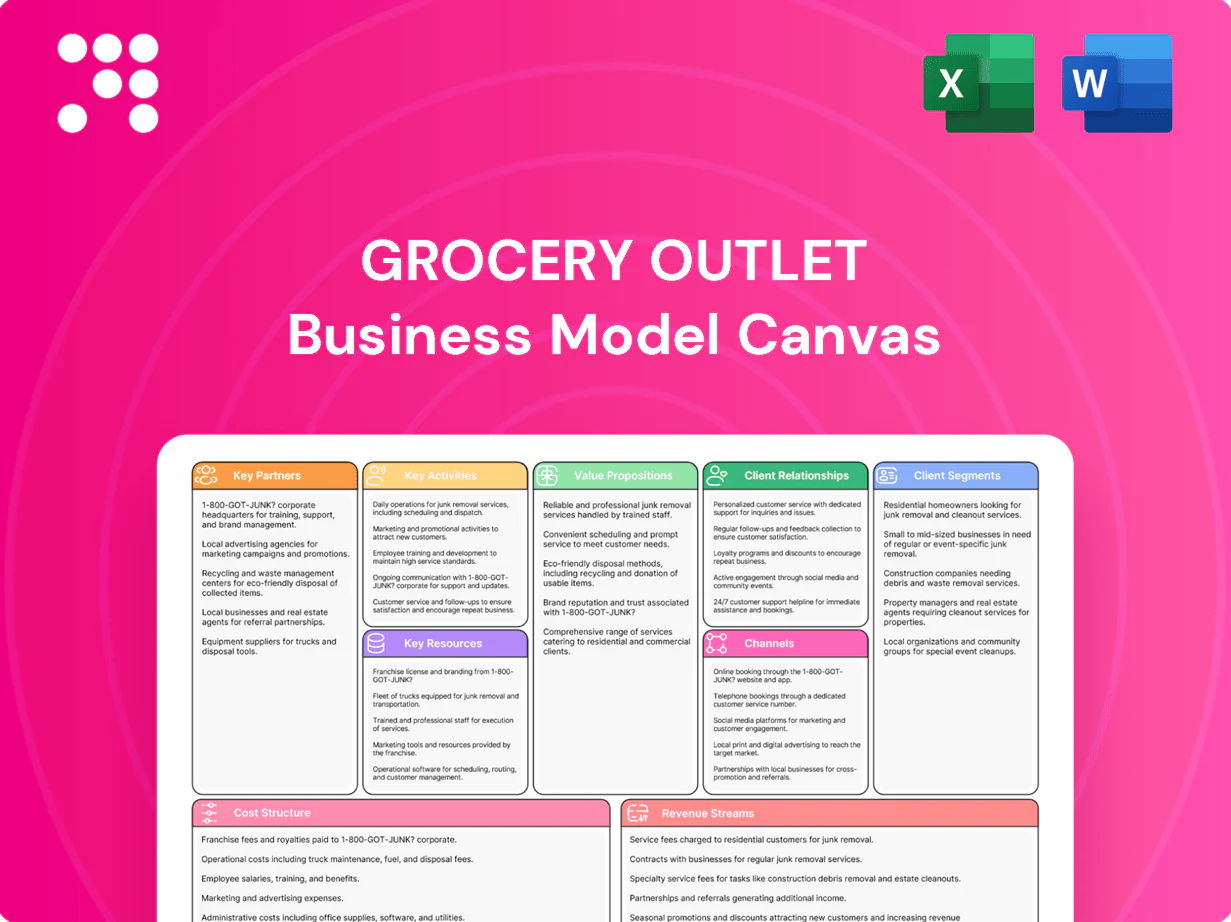
Grocery Outlet Business Model Canvas

Unlock a discount grocery leader Business Model Canvas: concise, actionable investor insights
Unlock Grocery Outlet’s strategic playbook with our Business Model Canvas — a concise, actionable breakdown of its value props, partnerships, and revenue levers. Ideal for investors, founders, and analysts seeking practical insights. Download the full Word & Excel canvas to benchmark, adapt, and execute with confidence.
Partnerships

National brand manufacturers
Strategic relationships with national CPG manufacturers give Grocery Outlet access to overstock, closeouts, and packaging-change runs, enabling rapid inventory turns and protecting primary-channel pricing; in 2024 Grocery Outlet reported about $3.6 billion in net sales, underlining scale. Vendors use Grocery Outlet to move excess without brand erosion, creating repeat deal flow built on speed, confidentiality, and compliance. Reliability and volume flexibility across the chain make Grocery Outlet a preferred liquidation outlet.
Liquidation brokers and wholesalers
Intermediary liquidation brokers aggregate distressed and seasonal lots across multiple suppliers, enabling rapid matching of surplus to Grocery Outlet’s store demand profiles. Terms are optimized for cash-and-carry, mixed pallets and short lead times, supporting fast turnover. Brokers expand sourcing reach beyond direct vendor contracts, vital for a retailer operating over 450 stores in 2024.

Independent owner-operators
Independent owner-operators run Grocery Outlet's local merchandising and community engagement across over 450 stores in 2024, adapting assortments to neighborhood preferences while respecting corporate pricing guardrails. Their entrepreneurial incentives directly drive sales velocity, freshness and tighter cost control, improving unit economics and reducing shrink. The partnership aligns risk-sharing between corporate and operators and enables high store responsiveness to local demand.

Logistics and cold-chain partners
Third-party carriers and 3PLs provide flexible, variable-volume transport for Grocery Outlet, enabling peak capacity without fixed fleet costs and supporting opportunistic buys; cross-dock and pool distribution arrangements can cut cost per case by up to 25% while cold-chain integrity (global cold-chain market >$300B in 2024) preserves perishables. Reliable logistics enable rapid turns on short-dated deals (typically 48–72 hours), protecting margins and shrink.
- 3PLs: flexible peak capacity
- Cold-chain: preserves perishables, market >$300B (2024)
- Cross-dock: up to 25% cost/case reduction
- Rapid turns: 48–72 hours for short-dated deals
Landlords and real estate networks
- Over 400 stores (2024)
- Lower capex via turnkey leases
- Anchor adjacencies lift traffic
- Clustered sites improve distribution
Closeout retail model: $3.6B 48–72 hr turns, 25% cost cut
Key partnerships provide Grocery Outlet with steady streams of overstock and closeouts from national CPGs, supporting rapid inventory turns and protecting primary-channel pricing; Grocery Outlet reported about $3.6B net sales and operated 450+ stores in 2024. Brokers and 3PLs extend sourcing reach and peak logistics capacity (cross-dock can cut cost/case ~25%), enabling 48–72 hour turns on short-dated deals. Owner-operators and value landlords speed market entry and local assortment agility.
| Metric | 2024 |
|---|---|
| Net sales | $3.6B |
| Stores | 450+ |
| Cross-dock cost/case | ~25% reduction |
| Turn time (short-dated) | 48–72 hrs |
What is included in the product
 Detailed Word Document
A concise, real-world Business Model Canvas for Grocery Outlet outlining customer segments, value propositions (deep-discount private label and surplus brand goods), key channels and partners, cost/revenue structure, and logistics; includes competitive advantages, SWOT-linked insights, and actionable guidance for investors, analysts, and operators.

 Customizable Excel Spreadsheet
High-level Grocery Outlet Business Model Canvas that relieves pain by distilling discount retail complexities—supplier opportunistic buying, margin recovery, and decentralized store operations—into a single editable page for rapid strategy alignment and operational fixes.
Activities

Opportunistic procurement
Opportunistic procurement teams identify, evaluate and bid on surplus lots from brands and brokers, weighing price, quantity and remaining shelf life to match store demand. In 2024 Grocery Outlet’s rapid purchasing model—locking deals within 24–72 hours—prioritizes speed to beat competitors and protect margins. Purchases are structured with flexible payment and return terms to maximize gross margin per unit while ensuring product quality and minimizing spoilage.
Assortment and price optimization
Set extreme-value price points to clear inventory fast, blending staples with bargain 'treasure-hunt' finds to drive trip frequency and a larger basket; Grocery Outlet operated over 460 stores in 2024, using POS and supply-chain data to localize, allocate, and replenish high-velocity deals daily, preserving price-perception leadership versus national discounters and sustaining value-driven traffic.

Merchandising and in-store execution
Create treasure-hunt displays and endcaps highlighting finds with price tags showing savings of up to 60% versus national MSRPs; rotate features weekly to keep urgency and freshness. Train teams to sample, cross-sell complementary SKUs and manage perishables to reduce shrink. Leverage footprint of over 400 stores (2024) to scale in-store promotions and boost impulse purchase rates.

Logistics and inventory turns
Coordinate inbound loads with DCs and direct-to-store flows, prioritize short-dated items for immediate placement to cut spoilage, minimize dwell time to reduce shrink and free working capital, and leverage backhaul and load consolidation to lower freight spend; discount grocers target ~15 inventory turns/year (2024).
- Short-dated first
- Under 48h dwell
- Backhaul & consolidation
Quality control and compliance
Inspect lots for date codes, packaging integrity and labeling accuracy across ~450 stores (FY2024), supporting traceability for ~$3.8B in annual sales; enforce FDA and state food-safety standards and recall protocols with audit-ready logs; track provenance to manage recalls and protect brand trust when handling non-standard assortments that drive ~20% SKU turnover.
- Lot inspection: date codes, packaging, labels
- Compliance: FDA/state standards, recall protocols
- Traceability: audit logs, provenance tracking
- Brand protection: manage non-standard assortments
Opportunistic sourcing (24–72h) drives high velocity across 460 stores
Opportunistic sourcing locks surplus buys in 24–72h, prioritizing margin and shelf life; rapid allocation to 460 stores (FY2024) drives high velocity and ~15 inventory turns/year. In-store treasure-hunt merchandising (up to 60% off MSRP) and strict lot inspection reduce shrink and support $3.8B sales. Short-dated goods moved under 48h to cut spoilage and free working capital.
| Metric | 2024 |
|---|---|
| Stores | 460 |
| Revenue | $3.8B |
| Purchase lead time | 24–72h |
| Inventory turns | 15/yr |
| SKU turnover | 20% |
Full Version Awaits
Business Model Canvas
The document previewed here is the actual Grocery Outlet Business Model Canvas, not a mockup or sample. When you purchase, you’ll receive this exact file—complete and ready to edit, present, or share. The delivered package includes the same structured content in editable formats so there are no surprises.

Unlock a discount grocery leader Business Model Canvas: concise, actionable investor insights
Unlock Grocery Outlet’s strategic playbook with our Business Model Canvas — a concise, actionable breakdown of its value props, partnerships, and revenue levers. Ideal for investors, founders, and analysts seeking practical insights. Download the full Word & Excel canvas to benchmark, adapt, and execute with confidence.
Partnerships
National brand manufacturers
Strategic relationships with national CPG manufacturers give Grocery Outlet access to overstock, closeouts, and packaging-change runs, enabling rapid inventory turns and protecting primary-channel pricing; in 2024 Grocery Outlet reported about $3.6 billion in net sales, underlining scale. Vendors use Grocery Outlet to move excess without brand erosion, creating repeat deal flow built on speed, confidentiality, and compliance. Reliability and volume flexibility across the chain make Grocery Outlet a preferred liquidation outlet.
Liquidation brokers and wholesalers
Intermediary liquidation brokers aggregate distressed and seasonal lots across multiple suppliers, enabling rapid matching of surplus to Grocery Outlet’s store demand profiles. Terms are optimized for cash-and-carry, mixed pallets and short lead times, supporting fast turnover. Brokers expand sourcing reach beyond direct vendor contracts, vital for a retailer operating over 450 stores in 2024.
Independent owner-operators
Independent owner-operators run Grocery Outlet's local merchandising and community engagement across over 450 stores in 2024, adapting assortments to neighborhood preferences while respecting corporate pricing guardrails. Their entrepreneurial incentives directly drive sales velocity, freshness and tighter cost control, improving unit economics and reducing shrink. The partnership aligns risk-sharing between corporate and operators and enables high store responsiveness to local demand.
Logistics and cold-chain partners
Third-party carriers and 3PLs provide flexible, variable-volume transport for Grocery Outlet, enabling peak capacity without fixed fleet costs and supporting opportunistic buys; cross-dock and pool distribution arrangements can cut cost per case by up to 25% while cold-chain integrity (global cold-chain market >$300B in 2024) preserves perishables. Reliable logistics enable rapid turns on short-dated deals (typically 48–72 hours), protecting margins and shrink.
- 3PLs: flexible peak capacity
- Cold-chain: preserves perishables, market >$300B (2024)
- Cross-dock: up to 25% cost/case reduction
- Rapid turns: 48–72 hours for short-dated deals
Landlords and real estate networks
- Over 400 stores (2024)
- Lower capex via turnkey leases
- Anchor adjacencies lift traffic
- Clustered sites improve distribution
Closeout retail model: $3.6B 48–72 hr turns, 25% cost cut
Key partnerships provide Grocery Outlet with steady streams of overstock and closeouts from national CPGs, supporting rapid inventory turns and protecting primary-channel pricing; Grocery Outlet reported about $3.6B net sales and operated 450+ stores in 2024. Brokers and 3PLs extend sourcing reach and peak logistics capacity (cross-dock can cut cost/case ~25%), enabling 48–72 hour turns on short-dated deals. Owner-operators and value landlords speed market entry and local assortment agility.
| Metric | 2024 |
|---|---|
| Net sales | $3.6B |
| Stores | 450+ |
| Cross-dock cost/case | ~25% reduction |
| Turn time (short-dated) | 48–72 hrs |
What is included in the product
Detailed Word Document
A concise, real-world Business Model Canvas for Grocery Outlet outlining customer segments, value propositions (deep-discount private label and surplus brand goods), key channels and partners, cost/revenue structure, and logistics; includes competitive advantages, SWOT-linked insights, and actionable guidance for investors, analysts, and operators.
Customizable Excel Spreadsheet
High-level Grocery Outlet Business Model Canvas that relieves pain by distilling discount retail complexities—supplier opportunistic buying, margin recovery, and decentralized store operations—into a single editable page for rapid strategy alignment and operational fixes.
Activities
Opportunistic procurement
Opportunistic procurement teams identify, evaluate and bid on surplus lots from brands and brokers, weighing price, quantity and remaining shelf life to match store demand. In 2024 Grocery Outlet’s rapid purchasing model—locking deals within 24–72 hours—prioritizes speed to beat competitors and protect margins. Purchases are structured with flexible payment and return terms to maximize gross margin per unit while ensuring product quality and minimizing spoilage.
Assortment and price optimization
Set extreme-value price points to clear inventory fast, blending staples with bargain 'treasure-hunt' finds to drive trip frequency and a larger basket; Grocery Outlet operated over 460 stores in 2024, using POS and supply-chain data to localize, allocate, and replenish high-velocity deals daily, preserving price-perception leadership versus national discounters and sustaining value-driven traffic.
Merchandising and in-store execution
Create treasure-hunt displays and endcaps highlighting finds with price tags showing savings of up to 60% versus national MSRPs; rotate features weekly to keep urgency and freshness. Train teams to sample, cross-sell complementary SKUs and manage perishables to reduce shrink. Leverage footprint of over 400 stores (2024) to scale in-store promotions and boost impulse purchase rates.
Logistics and inventory turns
Coordinate inbound loads with DCs and direct-to-store flows, prioritize short-dated items for immediate placement to cut spoilage, minimize dwell time to reduce shrink and free working capital, and leverage backhaul and load consolidation to lower freight spend; discount grocers target ~15 inventory turns/year (2024).
- Short-dated first
- Under 48h dwell
- Backhaul & consolidation
Quality control and compliance
Inspect lots for date codes, packaging integrity and labeling accuracy across ~450 stores (FY2024), supporting traceability for ~$3.8B in annual sales; enforce FDA and state food-safety standards and recall protocols with audit-ready logs; track provenance to manage recalls and protect brand trust when handling non-standard assortments that drive ~20% SKU turnover.
- Lot inspection: date codes, packaging, labels
- Compliance: FDA/state standards, recall protocols
- Traceability: audit logs, provenance tracking
- Brand protection: manage non-standard assortments
Opportunistic sourcing (24–72h) drives high velocity across 460 stores
Opportunistic sourcing locks surplus buys in 24–72h, prioritizing margin and shelf life; rapid allocation to 460 stores (FY2024) drives high velocity and ~15 inventory turns/year. In-store treasure-hunt merchandising (up to 60% off MSRP) and strict lot inspection reduce shrink and support $3.8B sales. Short-dated goods moved under 48h to cut spoilage and free working capital.
| Metric | 2024 |
|---|---|
| Stores | 460 |
| Revenue | $3.8B |
| Purchase lead time | 24–72h |
| Inventory turns | 15/yr |
| SKU turnover | 20% |
Full Version Awaits
Business Model Canvas
The document previewed here is the actual Grocery Outlet Business Model Canvas, not a mockup or sample. When you purchase, you’ll receive this exact file—complete and ready to edit, present, or share. The delivered package includes the same structured content in editable formats so there are no surprises.
Description
Unlock a discount grocery leader Business Model Canvas: concise, actionable investor insights
Unlock Grocery Outlet’s strategic playbook with our Business Model Canvas — a concise, actionable breakdown of its value props, partnerships, and revenue levers. Ideal for investors, founders, and analysts seeking practical insights. Download the full Word & Excel canvas to benchmark, adapt, and execute with confidence.
Partnerships
National brand manufacturers
Strategic relationships with national CPG manufacturers give Grocery Outlet access to overstock, closeouts, and packaging-change runs, enabling rapid inventory turns and protecting primary-channel pricing; in 2024 Grocery Outlet reported about $3.6 billion in net sales, underlining scale. Vendors use Grocery Outlet to move excess without brand erosion, creating repeat deal flow built on speed, confidentiality, and compliance. Reliability and volume flexibility across the chain make Grocery Outlet a preferred liquidation outlet.
Liquidation brokers and wholesalers
Intermediary liquidation brokers aggregate distressed and seasonal lots across multiple suppliers, enabling rapid matching of surplus to Grocery Outlet’s store demand profiles. Terms are optimized for cash-and-carry, mixed pallets and short lead times, supporting fast turnover. Brokers expand sourcing reach beyond direct vendor contracts, vital for a retailer operating over 450 stores in 2024.
Independent owner-operators
Independent owner-operators run Grocery Outlet's local merchandising and community engagement across over 450 stores in 2024, adapting assortments to neighborhood preferences while respecting corporate pricing guardrails. Their entrepreneurial incentives directly drive sales velocity, freshness and tighter cost control, improving unit economics and reducing shrink. The partnership aligns risk-sharing between corporate and operators and enables high store responsiveness to local demand.
Logistics and cold-chain partners
Third-party carriers and 3PLs provide flexible, variable-volume transport for Grocery Outlet, enabling peak capacity without fixed fleet costs and supporting opportunistic buys; cross-dock and pool distribution arrangements can cut cost per case by up to 25% while cold-chain integrity (global cold-chain market >$300B in 2024) preserves perishables. Reliable logistics enable rapid turns on short-dated deals (typically 48–72 hours), protecting margins and shrink.
- 3PLs: flexible peak capacity
- Cold-chain: preserves perishables, market >$300B (2024)
- Cross-dock: up to 25% cost/case reduction
- Rapid turns: 48–72 hours for short-dated deals
Landlords and real estate networks
- Over 400 stores (2024)
- Lower capex via turnkey leases
- Anchor adjacencies lift traffic
- Clustered sites improve distribution
Closeout retail model: $3.6B 48–72 hr turns, 25% cost cut
Key partnerships provide Grocery Outlet with steady streams of overstock and closeouts from national CPGs, supporting rapid inventory turns and protecting primary-channel pricing; Grocery Outlet reported about $3.6B net sales and operated 450+ stores in 2024. Brokers and 3PLs extend sourcing reach and peak logistics capacity (cross-dock can cut cost/case ~25%), enabling 48–72 hour turns on short-dated deals. Owner-operators and value landlords speed market entry and local assortment agility.
| Metric | 2024 |
|---|---|
| Net sales | $3.6B |
| Stores | 450+ |
| Cross-dock cost/case | ~25% reduction |
| Turn time (short-dated) | 48–72 hrs |
What is included in the product
Detailed Word Document
A concise, real-world Business Model Canvas for Grocery Outlet outlining customer segments, value propositions (deep-discount private label and surplus brand goods), key channels and partners, cost/revenue structure, and logistics; includes competitive advantages, SWOT-linked insights, and actionable guidance for investors, analysts, and operators.
Customizable Excel Spreadsheet
High-level Grocery Outlet Business Model Canvas that relieves pain by distilling discount retail complexities—supplier opportunistic buying, margin recovery, and decentralized store operations—into a single editable page for rapid strategy alignment and operational fixes.
Activities
Opportunistic procurement
Opportunistic procurement teams identify, evaluate and bid on surplus lots from brands and brokers, weighing price, quantity and remaining shelf life to match store demand. In 2024 Grocery Outlet’s rapid purchasing model—locking deals within 24–72 hours—prioritizes speed to beat competitors and protect margins. Purchases are structured with flexible payment and return terms to maximize gross margin per unit while ensuring product quality and minimizing spoilage.
Assortment and price optimization
Set extreme-value price points to clear inventory fast, blending staples with bargain 'treasure-hunt' finds to drive trip frequency and a larger basket; Grocery Outlet operated over 460 stores in 2024, using POS and supply-chain data to localize, allocate, and replenish high-velocity deals daily, preserving price-perception leadership versus national discounters and sustaining value-driven traffic.
Merchandising and in-store execution
Create treasure-hunt displays and endcaps highlighting finds with price tags showing savings of up to 60% versus national MSRPs; rotate features weekly to keep urgency and freshness. Train teams to sample, cross-sell complementary SKUs and manage perishables to reduce shrink. Leverage footprint of over 400 stores (2024) to scale in-store promotions and boost impulse purchase rates.
Logistics and inventory turns
Coordinate inbound loads with DCs and direct-to-store flows, prioritize short-dated items for immediate placement to cut spoilage, minimize dwell time to reduce shrink and free working capital, and leverage backhaul and load consolidation to lower freight spend; discount grocers target ~15 inventory turns/year (2024).
- Short-dated first
- Under 48h dwell
- Backhaul & consolidation
Quality control and compliance
Inspect lots for date codes, packaging integrity and labeling accuracy across ~450 stores (FY2024), supporting traceability for ~$3.8B in annual sales; enforce FDA and state food-safety standards and recall protocols with audit-ready logs; track provenance to manage recalls and protect brand trust when handling non-standard assortments that drive ~20% SKU turnover.
- Lot inspection: date codes, packaging, labels
- Compliance: FDA/state standards, recall protocols
- Traceability: audit logs, provenance tracking
- Brand protection: manage non-standard assortments
Opportunistic sourcing (24–72h) drives high velocity across 460 stores
Opportunistic sourcing locks surplus buys in 24–72h, prioritizing margin and shelf life; rapid allocation to 460 stores (FY2024) drives high velocity and ~15 inventory turns/year. In-store treasure-hunt merchandising (up to 60% off MSRP) and strict lot inspection reduce shrink and support $3.8B sales. Short-dated goods moved under 48h to cut spoilage and free working capital.
| Metric | 2024 |
|---|---|
| Stores | 460 |
| Revenue | $3.8B |
| Purchase lead time | 24–72h |
| Inventory turns | 15/yr |
| SKU turnover | 20% |
Full Version Awaits
Business Model Canvas
The document previewed here is the actual Grocery Outlet Business Model Canvas, not a mockup or sample. When you purchase, you’ll receive this exact file—complete and ready to edit, present, or share. The delivered package includes the same structured content in editable formats so there are no surprises.











