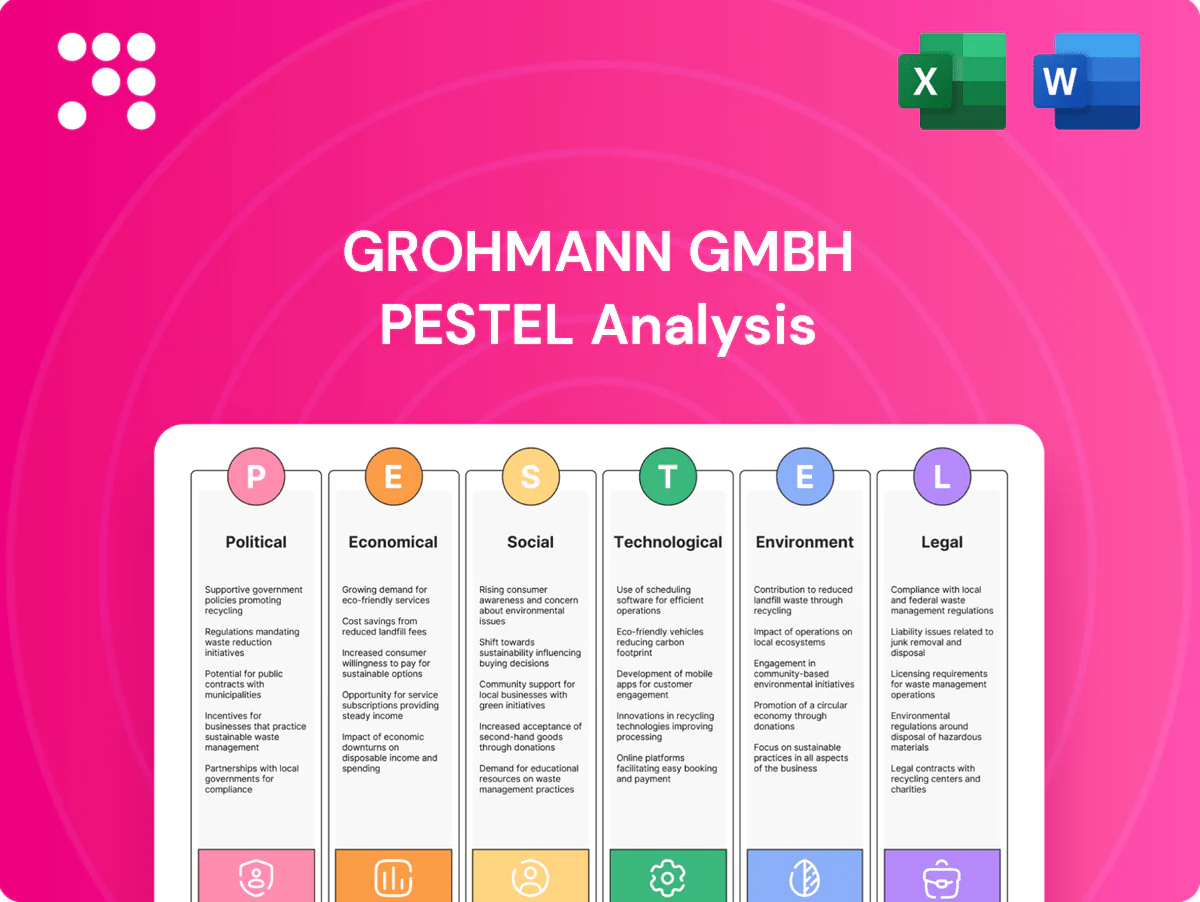
Grohmann GmbH PESTLE Analysis

Your Shortcut to Market Insight Starts Here
Gain a competitive edge with our PESTLE Analysis of Grohmann GmbH—three concise sections reveal how political shifts, economic cycles, and tech trends will shape its trajectory. Ideal for investors and strategists, the full report delivers actionable insights and editable charts. Purchase now to access the complete, ready-to-use analysis.
Political factors

EU industrial policy tilt
EU industrial policy tilt — notably the Chips Act mobilizing up to €43 billion and parallel battery incentives — is reshaping client roadmaps and project timing as firms chase grant-backed capacity. Subsidy windows often accelerate purchase orders for automation, boosting near-term project pipelines; national versus EU funding criteria must be monitored to align proposals to eligibility. Political shifts could reallocate tens of billions in support, reducing demand visibility.
Trade tensions and tariffs
US‑EU‑China trade frictions — notably US Section 301 tariffs on Chinese industrial goods remaining at rates up to 25% — complicate Grohmann's component sourcing and customers' offshoring choices. Tariffs on machinery or inputs can raise total landed cost and erode margins, so scenario pricing and multi‑region sourcing reduce exposure. Customs delays, often adding days to lead times, must be baked into delivery schedules.

Local content and onshoring
Made in EU/US rules in EV and electronics (eg US IRA tax credit up to 7,500 USD) are driving onshoring, favoring regional automation partners with local service footprints. Automakers and suppliers have announced over $100bn in North American EV/battery investments, increasing demand for replicable line designs across geographies. Building partnerships in key regions secures eligibility and recurring service revenue for Grohmann.

Public procurement and standards
Government-backed gigafactories and research centers procure under strict technical and sustainability standards; EU public procurement equals about 14% of GDP, making compliance crucial for scale contracts. Aligning early with EU sustainable procurement criteria measurably raises award probabilities and shortens procurement cycles. Reference projects in batteries and energy storage notably boost credibility with procurers.
- Comply with EU sustainable procurement
- Align technical specs early
- Leverage strategic reference projects
Geopolitical supply chain risk
Geopolitical supply-chain risk is heightened by US export controls on advanced semiconductors (2022–24) and EU/Russia sanctions since 2022, which can disrupt critical mechatronics and control systems. Dual-sourcing PLCs, servos and sensors de-risks projects and maintaining 3–6 months buffer stock for long-lead items protects commissioning dates. Transparent risk-sharing clauses preserve client trust.
- Dual-sourcing: mitigates single-vendor failures
- Buffer stock (3–6 months): secures commissioning
- Contract clauses: align risk and maintain client confidence
Onshoring boom: EU Chips Act and US EV incentives spur automation amid rising tariff risks
EU industrial subsidies (Chips Act €43bn) and US IRA ($7,500 EV credit) drive onshoring and accelerate automation orders; tariffs up to 25% and export controls (2022–24) raise sourcing risk. Public procurement ~14% of EU GDP favors compliant suppliers; >$100bn announced NA EV/battery investments expand repeatable line demand.
| Factor | Metric |
|---|---|
| Chips/Battery funds | €43bn |
| IRA EV credit | $7,500 |
| NA EV investments | $100bn+ |
| EU procurement | ~14% GDP |
| Tariff peak | up to 25% |
What is included in the product
 Detailed Word Document
Explores how Political, Economic, Social, Technological, Environmental, and Legal forces uniquely impact Grohmann GmbH, with data-driven insights and forward-looking scenarios to identify risks, opportunities, and strategic responses for executives, investors, and planners.

 Customizable Excel Spreadsheet
Visually segmented by PESTLE categories, the Grohmann GmbH analysis delivers a concise, editable summary that can be dropped into presentations or shared across teams for quick alignment. It uses clear language to support discussions on external risks, market positioning, and strategic planning during meetings.
Economic factors

Capex cyclicality in end-markets
Capex cyclicality in automotive, battery and electronics drives Grohmann GmbH order intake volatility as EV slowdowns and handset refresh cycles often defer automation projects; diversified sector mix smooths factory utilization and reduces revenue swings. Service, retrofit and spare-parts income provide recurring cash flow that buffers downturns and preserves margins.
Interest rates and financing
Higher rates (Fed funds 5.25–5.50%, ECB ~4.50% in mid‑2025) lift client WACC—corporate borrowing costs are ~250 bps above 2021—stretching payback periods for Grohmann automation projects. ROI calculators and phased deployments can convert marginal cases; vendor financing or lender alliances shorten approval times. Even modest rate cuts would quickly re‑stimulate pipeline velocity.

Labor cost arbitrage
High EU labour costs (Eurostat: average hourly labour cost ~€29.8 in 2023) boost automation ROI, making Grohmann’s advanced cells more attractive as wage inflation runs near 5% y/y (2023–24). Low-cost regions can defer full automation, lengthening payback. Designing labour-lean, flexible cells preserves value across markets. TCO models should quantify wage escalation and projected uptime gains of 10–20% to show net savings.

FX exposure on inputs and sales
EUR-denominated revenue vs USD/CNY input components creates margin volatility; 2024 average EUR/USD ~1.09 and EUR/CNY ~7.75, so 5–10% FX moves can materially swing gross margins. Hedging and price-indexation clauses stabilize profitability. Multi-currency quotations and localized sourcing reduce FX pass-through and improve competitiveness.
- FX rates: EUR/USD ~1.09 (2024)
- EUR/CNY ~7.75 (2024)
- Hedging + indexation lower margin volatility
- Multi-currency quotes & local sourcing boost competitiveness
Commodity and battery materials dynamics
Volatility in lithium, nickel and copper — lithium prices collapsed more than 80% from 2022 peaks by mid-2024, nickel and copper saw multi-quarter rebounds — directly delays clients’ expansion timing and site selection.
When material markets ease, gigafactory capex cycles resume and automation demand rises; keeping modular production cells ready shortens conversion windows and captures upside quickly.
Monitoring OEM guidance (plant build schedules and announced capacity) refines near-term revenue forecasts and inventory planning for Grohmann GmbH.
- Impact: material price swings >50% alter capex timing
- Opportunity: modular lines cut conversion time by weeks
- Signal: OEM build guidance = leading demand indicator
Onshoring boom: EU Chips Act and US EV incentives spur automation amid rising tariff risks
Capex cyclicality in automotive, batteries and electronics drives order volatility; service, retrofit and spare‑parts revenues buffer cash flow. Higher rates (Fed 5.25–5.50% mid‑2025, ECB ~4.50%) raise WACC and lengthen paybacks; vendor financing shortens approvals. High EU labour cost (€29.8/hr 2023) and wage inflation (~5% y/y 2023–24) improve automation ROI. FX (EUR/USD ~1.09 2024, EUR/CNY ~7.75 2024) and >80% lithium drop by mid‑2024 create margin and timing risk.
| Metric | Value |
|---|---|
| Fed funds (mid‑2025) | 5.25–5.50% |
| ECB (mid‑2025) | ~4.50% |
| EUR/USD (2024) | ~1.09 |
| EUR/CNY (2024) | ~7.75 |
| EU hourly labour cost (2023) | €29.8 |
| Lithium price change | >80% decline (peak→mid‑2024) |
What You See Is What You Get
Grohmann GmbH PESTLE Analysis
The Grohmann GmbH PESTLE Analysis provides a concise, actionable review of political, economic, social, technological, legal and environmental factors affecting the company, with strategic implications for management and investors. The preview shown here is the exact document you’ll receive after purchase—fully formatted and ready to use. It contains final charts, findings and recommendations with no placeholders or edits required.

Your Shortcut to Market Insight Starts Here
Gain a competitive edge with our PESTLE Analysis of Grohmann GmbH—three concise sections reveal how political shifts, economic cycles, and tech trends will shape its trajectory. Ideal for investors and strategists, the full report delivers actionable insights and editable charts. Purchase now to access the complete, ready-to-use analysis.
Political factors
EU industrial policy tilt
EU industrial policy tilt — notably the Chips Act mobilizing up to €43 billion and parallel battery incentives — is reshaping client roadmaps and project timing as firms chase grant-backed capacity. Subsidy windows often accelerate purchase orders for automation, boosting near-term project pipelines; national versus EU funding criteria must be monitored to align proposals to eligibility. Political shifts could reallocate tens of billions in support, reducing demand visibility.
Trade tensions and tariffs
US‑EU‑China trade frictions — notably US Section 301 tariffs on Chinese industrial goods remaining at rates up to 25% — complicate Grohmann's component sourcing and customers' offshoring choices. Tariffs on machinery or inputs can raise total landed cost and erode margins, so scenario pricing and multi‑region sourcing reduce exposure. Customs delays, often adding days to lead times, must be baked into delivery schedules.
Local content and onshoring
Made in EU/US rules in EV and electronics (eg US IRA tax credit up to 7,500 USD) are driving onshoring, favoring regional automation partners with local service footprints. Automakers and suppliers have announced over $100bn in North American EV/battery investments, increasing demand for replicable line designs across geographies. Building partnerships in key regions secures eligibility and recurring service revenue for Grohmann.
Public procurement and standards
Government-backed gigafactories and research centers procure under strict technical and sustainability standards; EU public procurement equals about 14% of GDP, making compliance crucial for scale contracts. Aligning early with EU sustainable procurement criteria measurably raises award probabilities and shortens procurement cycles. Reference projects in batteries and energy storage notably boost credibility with procurers.
- Comply with EU sustainable procurement
- Align technical specs early
- Leverage strategic reference projects
Geopolitical supply chain risk
Geopolitical supply-chain risk is heightened by US export controls on advanced semiconductors (2022–24) and EU/Russia sanctions since 2022, which can disrupt critical mechatronics and control systems. Dual-sourcing PLCs, servos and sensors de-risks projects and maintaining 3–6 months buffer stock for long-lead items protects commissioning dates. Transparent risk-sharing clauses preserve client trust.
- Dual-sourcing: mitigates single-vendor failures
- Buffer stock (3–6 months): secures commissioning
- Contract clauses: align risk and maintain client confidence
Onshoring boom: EU Chips Act and US EV incentives spur automation amid rising tariff risks
EU industrial subsidies (Chips Act €43bn) and US IRA ($7,500 EV credit) drive onshoring and accelerate automation orders; tariffs up to 25% and export controls (2022–24) raise sourcing risk. Public procurement ~14% of EU GDP favors compliant suppliers; >$100bn announced NA EV/battery investments expand repeatable line demand.
| Factor | Metric |
|---|---|
| Chips/Battery funds | €43bn |
| IRA EV credit | $7,500 |
| NA EV investments | $100bn+ |
| EU procurement | ~14% GDP |
| Tariff peak | up to 25% |
What is included in the product
Detailed Word Document
Explores how Political, Economic, Social, Technological, Environmental, and Legal forces uniquely impact Grohmann GmbH, with data-driven insights and forward-looking scenarios to identify risks, opportunities, and strategic responses for executives, investors, and planners.
Customizable Excel Spreadsheet
Visually segmented by PESTLE categories, the Grohmann GmbH analysis delivers a concise, editable summary that can be dropped into presentations or shared across teams for quick alignment. It uses clear language to support discussions on external risks, market positioning, and strategic planning during meetings.
Economic factors
Capex cyclicality in end-markets
Capex cyclicality in automotive, battery and electronics drives Grohmann GmbH order intake volatility as EV slowdowns and handset refresh cycles often defer automation projects; diversified sector mix smooths factory utilization and reduces revenue swings. Service, retrofit and spare-parts income provide recurring cash flow that buffers downturns and preserves margins.
Interest rates and financing
Higher rates (Fed funds 5.25–5.50%, ECB ~4.50% in mid‑2025) lift client WACC—corporate borrowing costs are ~250 bps above 2021—stretching payback periods for Grohmann automation projects. ROI calculators and phased deployments can convert marginal cases; vendor financing or lender alliances shorten approval times. Even modest rate cuts would quickly re‑stimulate pipeline velocity.
Labor cost arbitrage
High EU labour costs (Eurostat: average hourly labour cost ~€29.8 in 2023) boost automation ROI, making Grohmann’s advanced cells more attractive as wage inflation runs near 5% y/y (2023–24). Low-cost regions can defer full automation, lengthening payback. Designing labour-lean, flexible cells preserves value across markets. TCO models should quantify wage escalation and projected uptime gains of 10–20% to show net savings.
FX exposure on inputs and sales
EUR-denominated revenue vs USD/CNY input components creates margin volatility; 2024 average EUR/USD ~1.09 and EUR/CNY ~7.75, so 5–10% FX moves can materially swing gross margins. Hedging and price-indexation clauses stabilize profitability. Multi-currency quotations and localized sourcing reduce FX pass-through and improve competitiveness.
- FX rates: EUR/USD ~1.09 (2024)
- EUR/CNY ~7.75 (2024)
- Hedging + indexation lower margin volatility
- Multi-currency quotes & local sourcing boost competitiveness
Commodity and battery materials dynamics
Volatility in lithium, nickel and copper — lithium prices collapsed more than 80% from 2022 peaks by mid-2024, nickel and copper saw multi-quarter rebounds — directly delays clients’ expansion timing and site selection.
When material markets ease, gigafactory capex cycles resume and automation demand rises; keeping modular production cells ready shortens conversion windows and captures upside quickly.
Monitoring OEM guidance (plant build schedules and announced capacity) refines near-term revenue forecasts and inventory planning for Grohmann GmbH.
- Impact: material price swings >50% alter capex timing
- Opportunity: modular lines cut conversion time by weeks
- Signal: OEM build guidance = leading demand indicator
Onshoring boom: EU Chips Act and US EV incentives spur automation amid rising tariff risks
Capex cyclicality in automotive, batteries and electronics drives order volatility; service, retrofit and spare‑parts revenues buffer cash flow. Higher rates (Fed 5.25–5.50% mid‑2025, ECB ~4.50%) raise WACC and lengthen paybacks; vendor financing shortens approvals. High EU labour cost (€29.8/hr 2023) and wage inflation (~5% y/y 2023–24) improve automation ROI. FX (EUR/USD ~1.09 2024, EUR/CNY ~7.75 2024) and >80% lithium drop by mid‑2024 create margin and timing risk.
| Metric | Value |
|---|---|
| Fed funds (mid‑2025) | 5.25–5.50% |
| ECB (mid‑2025) | ~4.50% |
| EUR/USD (2024) | ~1.09 |
| EUR/CNY (2024) | ~7.75 |
| EU hourly labour cost (2023) | €29.8 |
| Lithium price change | >80% decline (peak→mid‑2024) |
What You See Is What You Get
Grohmann GmbH PESTLE Analysis
The Grohmann GmbH PESTLE Analysis provides a concise, actionable review of political, economic, social, technological, legal and environmental factors affecting the company, with strategic implications for management and investors. The preview shown here is the exact document you’ll receive after purchase—fully formatted and ready to use. It contains final charts, findings and recommendations with no placeholders or edits required.
Description
Your Shortcut to Market Insight Starts Here
Gain a competitive edge with our PESTLE Analysis of Grohmann GmbH—three concise sections reveal how political shifts, economic cycles, and tech trends will shape its trajectory. Ideal for investors and strategists, the full report delivers actionable insights and editable charts. Purchase now to access the complete, ready-to-use analysis.
Political factors
EU industrial policy tilt
EU industrial policy tilt — notably the Chips Act mobilizing up to €43 billion and parallel battery incentives — is reshaping client roadmaps and project timing as firms chase grant-backed capacity. Subsidy windows often accelerate purchase orders for automation, boosting near-term project pipelines; national versus EU funding criteria must be monitored to align proposals to eligibility. Political shifts could reallocate tens of billions in support, reducing demand visibility.
Trade tensions and tariffs
US‑EU‑China trade frictions — notably US Section 301 tariffs on Chinese industrial goods remaining at rates up to 25% — complicate Grohmann's component sourcing and customers' offshoring choices. Tariffs on machinery or inputs can raise total landed cost and erode margins, so scenario pricing and multi‑region sourcing reduce exposure. Customs delays, often adding days to lead times, must be baked into delivery schedules.
Local content and onshoring
Made in EU/US rules in EV and electronics (eg US IRA tax credit up to 7,500 USD) are driving onshoring, favoring regional automation partners with local service footprints. Automakers and suppliers have announced over $100bn in North American EV/battery investments, increasing demand for replicable line designs across geographies. Building partnerships in key regions secures eligibility and recurring service revenue for Grohmann.
Public procurement and standards
Government-backed gigafactories and research centers procure under strict technical and sustainability standards; EU public procurement equals about 14% of GDP, making compliance crucial for scale contracts. Aligning early with EU sustainable procurement criteria measurably raises award probabilities and shortens procurement cycles. Reference projects in batteries and energy storage notably boost credibility with procurers.
- Comply with EU sustainable procurement
- Align technical specs early
- Leverage strategic reference projects
Geopolitical supply chain risk
Geopolitical supply-chain risk is heightened by US export controls on advanced semiconductors (2022–24) and EU/Russia sanctions since 2022, which can disrupt critical mechatronics and control systems. Dual-sourcing PLCs, servos and sensors de-risks projects and maintaining 3–6 months buffer stock for long-lead items protects commissioning dates. Transparent risk-sharing clauses preserve client trust.
- Dual-sourcing: mitigates single-vendor failures
- Buffer stock (3–6 months): secures commissioning
- Contract clauses: align risk and maintain client confidence
Onshoring boom: EU Chips Act and US EV incentives spur automation amid rising tariff risks
EU industrial subsidies (Chips Act €43bn) and US IRA ($7,500 EV credit) drive onshoring and accelerate automation orders; tariffs up to 25% and export controls (2022–24) raise sourcing risk. Public procurement ~14% of EU GDP favors compliant suppliers; >$100bn announced NA EV/battery investments expand repeatable line demand.
| Factor | Metric |
|---|---|
| Chips/Battery funds | €43bn |
| IRA EV credit | $7,500 |
| NA EV investments | $100bn+ |
| EU procurement | ~14% GDP |
| Tariff peak | up to 25% |
What is included in the product
Detailed Word Document
Explores how Political, Economic, Social, Technological, Environmental, and Legal forces uniquely impact Grohmann GmbH, with data-driven insights and forward-looking scenarios to identify risks, opportunities, and strategic responses for executives, investors, and planners.
Customizable Excel Spreadsheet
Visually segmented by PESTLE categories, the Grohmann GmbH analysis delivers a concise, editable summary that can be dropped into presentations or shared across teams for quick alignment. It uses clear language to support discussions on external risks, market positioning, and strategic planning during meetings.
Economic factors
Capex cyclicality in end-markets
Capex cyclicality in automotive, battery and electronics drives Grohmann GmbH order intake volatility as EV slowdowns and handset refresh cycles often defer automation projects; diversified sector mix smooths factory utilization and reduces revenue swings. Service, retrofit and spare-parts income provide recurring cash flow that buffers downturns and preserves margins.
Interest rates and financing
Higher rates (Fed funds 5.25–5.50%, ECB ~4.50% in mid‑2025) lift client WACC—corporate borrowing costs are ~250 bps above 2021—stretching payback periods for Grohmann automation projects. ROI calculators and phased deployments can convert marginal cases; vendor financing or lender alliances shorten approval times. Even modest rate cuts would quickly re‑stimulate pipeline velocity.
Labor cost arbitrage
High EU labour costs (Eurostat: average hourly labour cost ~€29.8 in 2023) boost automation ROI, making Grohmann’s advanced cells more attractive as wage inflation runs near 5% y/y (2023–24). Low-cost regions can defer full automation, lengthening payback. Designing labour-lean, flexible cells preserves value across markets. TCO models should quantify wage escalation and projected uptime gains of 10–20% to show net savings.
FX exposure on inputs and sales
EUR-denominated revenue vs USD/CNY input components creates margin volatility; 2024 average EUR/USD ~1.09 and EUR/CNY ~7.75, so 5–10% FX moves can materially swing gross margins. Hedging and price-indexation clauses stabilize profitability. Multi-currency quotations and localized sourcing reduce FX pass-through and improve competitiveness.
- FX rates: EUR/USD ~1.09 (2024)
- EUR/CNY ~7.75 (2024)
- Hedging + indexation lower margin volatility
- Multi-currency quotes & local sourcing boost competitiveness
Commodity and battery materials dynamics
Volatility in lithium, nickel and copper — lithium prices collapsed more than 80% from 2022 peaks by mid-2024, nickel and copper saw multi-quarter rebounds — directly delays clients’ expansion timing and site selection.
When material markets ease, gigafactory capex cycles resume and automation demand rises; keeping modular production cells ready shortens conversion windows and captures upside quickly.
Monitoring OEM guidance (plant build schedules and announced capacity) refines near-term revenue forecasts and inventory planning for Grohmann GmbH.
- Impact: material price swings >50% alter capex timing
- Opportunity: modular lines cut conversion time by weeks
- Signal: OEM build guidance = leading demand indicator
Onshoring boom: EU Chips Act and US EV incentives spur automation amid rising tariff risks
Capex cyclicality in automotive, batteries and electronics drives order volatility; service, retrofit and spare‑parts revenues buffer cash flow. Higher rates (Fed 5.25–5.50% mid‑2025, ECB ~4.50%) raise WACC and lengthen paybacks; vendor financing shortens approvals. High EU labour cost (€29.8/hr 2023) and wage inflation (~5% y/y 2023–24) improve automation ROI. FX (EUR/USD ~1.09 2024, EUR/CNY ~7.75 2024) and >80% lithium drop by mid‑2024 create margin and timing risk.
| Metric | Value |
|---|---|
| Fed funds (mid‑2025) | 5.25–5.50% |
| ECB (mid‑2025) | ~4.50% |
| EUR/USD (2024) | ~1.09 |
| EUR/CNY (2024) | ~7.75 |
| EU hourly labour cost (2023) | €29.8 |
| Lithium price change | >80% decline (peak→mid‑2024) |
What You See Is What You Get
Grohmann GmbH PESTLE Analysis
The Grohmann GmbH PESTLE Analysis provides a concise, actionable review of political, economic, social, technological, legal and environmental factors affecting the company, with strategic implications for management and investors. The preview shown here is the exact document you’ll receive after purchase—fully formatted and ready to use. It contains final charts, findings and recommendations with no placeholders or edits required.











