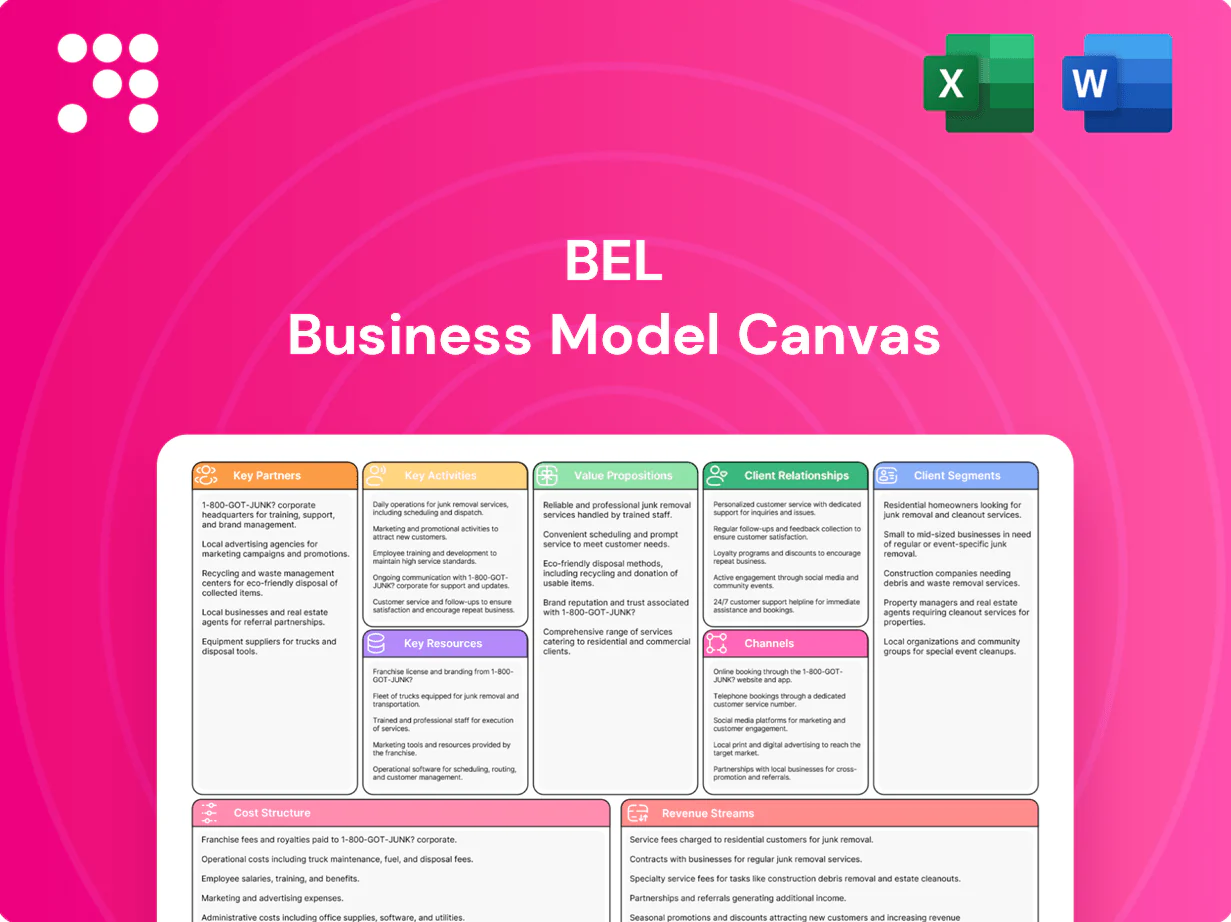
Bel Business Model Canvas

Unlock the strategic Business Model Canvas: value drivers, channels, partners, revenue
Unlock Bel’s strategic playbook with the full Business Model Canvas: a concise, actionable map of its value propositions, channels, partnerships and revenue drivers. Ideal for investors, consultants and founders seeking a competitive edge, this downloadable canvas reveals growth levers and risks. Purchase the complete Word & Excel files to benchmark, adapt and execute proven strategies.
Partnerships

Dairy farmers and milk cooperatives
Long-term offtake agreements with dairy farmers and cooperatives, typically spanning 3–5 years, secure a consistent, high-quality milk supply that preserves taste and safety. Partnerships fund sustainable farming and animal welfare programs aligned with 2024 industry best practices and audit standards. Local sourcing reduces transport and supply-chain risk, helping manage costs and delivery lead times. Collaborative quality programs enforce strict compositional specifications across the supply base.
Packaging and portioning suppliers
Specialized partners provide portion-control formats, wax coatings, and sustainable materials, co-developing solutions that cut food waste and boost convenience. By working with suppliers, Bel—net sales €2.9bn in 2023—targets recyclable and bio-based packaging to meet ESG goals. Innovation in recyclable materials and reliable sealing extends shelf-life and preserves brand presentation.

Retailers and foodservice distributors
Bel’s partnerships with global grocers, convenience chains and HORECA extend its reach across over 120 countries, securing shelf space for brands like La Vache qui Rit and Babybel. Joint category management with retailers boosts shelf visibility and velocity through coordinated planograms and promotions. Data-sharing agreements inform pricing, assortment and promotion cadence. Strategic distributors ensure chilled logistics and reliable last-mile execution.

Logistics and cold-chain providers
- Refrigeration: protects product integrity
- Multi-region partners: shorten lead times, lower spoilage
- Route planning & forecasting: improve fill rates
- Temperature compliance: reduces quality claims
R&D, nutrition, and innovation partners
Universities, flavor houses, and biotech firms accelerate product development for Bel, driving healthier formulations and plant-based alternatives as the global plant-based market reached about 8.0 billion USD in 2024; sensory testing and consumer panels (500+ participants) validate concepts while IP-sharing and licensing frameworks prevalent in 2024 balance speed with protection.
- R&D partners: universities, biotech, flavor houses
- Market: ~8.0B USD (2024)
- Panels: 500+ consumers
- IP: co-development/licensing frameworks
3-5y dairy offtakes and recyclable packaging cut transport risk; $330bn cold-chain tailwinds
Long-term 3–5y offtakes with dairy cooperatives secure quality milk; local sourcing trims transport risk. Suppliers co-develop recyclable packaging and portion formats; Bel net sales €2.9bn (2023). Global cold-chain market ~$330bn (2024) supports refrigerated logistics across 120+ countries; plant-based market ~$8.0bn (2024) fuels R&D partnerships.
| Partnership | Key metric | 2023/2024 |
|---|---|---|
| Dairy offtake | Contract length | 3–5 years |
| Packaging suppliers | ESG focus | Recyclable/bio-based |
| Cold chain | Market size | $330bn (2024) |
| R&D | Plant-based market | $8.0bn (2024) |
What is included in the product
 Detailed Word Document
A comprehensive, pre-written Business Model Canvas for Bel that maps customer segments, channels, value propositions and revenue streams across the 9 classic BMC blocks with real-world operational detail. Ideal for presentations, investor discussions and strategic analysis, it includes competitive advantage assessment and linked SWOT insights to validate and refine business decisions.

 Customizable Excel Spreadsheet
Condenses Bel’s strategy into a one-page, editable Business Model Canvas that removes the headache of formatting and lets teams quickly identify core components for fast decision-making and collaboration.
Activities

Cheese production and portioning
Standardized cheese production ensures consistent taste, texture and food safety across Bel’s lines, supporting 2024 net sales of about €3.0bn. Portioning lines create on-the-go snack formats, expanding retail reach. Continuous OEE improvements (≈7% y/y) lift throughput and lower unit costs. Strict QA/QC cuts returns and consumer complaints, protecting brand loyalty.
Brand building and marketing
Iconic Bel branding, present in 120+ countries with 24 industrial sites, anchors recognition across markets and supported reported group revenues of about €3.6bn (2023). 360° campaigns—digital, in-store and ATL—drive trial and repeat via sampling and CRM-led journeys. Nutrition-forward messaging reinforces Bel’s better-for-you positioning as global dairy demand shifts to health-centric choices. Trade marketing syncs with retailer calendars to lift seasonal sales.

Product innovation and renovation
In 2024 Bel's R&D refines recipes for flavor, nutrition and clean-label positioning, focusing on natural ingredients and nutrient profiles. New formats target lunchboxes and adult snacking with portioned packs and on-the-go servings. Plant-based and reduced-sodium variants broaden appeal across flexitarian and health-conscious consumers. Rapid prototyping and pilot runs shorten time-to-market through iterative shelf tests.

Supply chain and cold-chain management
Forecasting aligns milk intake with production plans to limit overprocessing and match seasonal demand; FAO estimates about 14% of food is lost between harvest and retail, so precision reduces loss. Tight inventory control minimizes write-offs in chilled categories, cutting spoilage often by double-digit percentages. Vendor-managed inventory lifts on-shelf availability by up to 10%, while compliance and cold-chain monitoring ensure temperature integrity end-to-end.
- Forecasting: aligns milk intake to production
- Inventory control: minimizes chilled write-offs
- VMI: +~10% on-shelf availability
- Compliance: end-to-end temperature integrity
Quality, safety, and regulatory compliance
HACCP and GFSI-recognized schemes such as BRCGS and FSSC 22000, aligned with Codex Alimentarius, guide Bel factories worldwide. Traceability systems enable rapid identification and withdrawal of affected batches for recalls. Labeling meets local regulations and US FALCPA requirements for the eight major allergens. Regular audits and certifications sustain retailer acceptance and supply contracts.
- HACCP, GFSI schemes: BRCGS, FSSC 22000
- Traceability: rapid batch recall capability
- Labeling: complies with local law, FALCPA 8 allergens
- Audits: preserve retailer listings
Standardized cheese boosts throughput, ~7% OEE; VMI on-shelf +10%
Standardized cheese production and OEE gains (~7% y/y in 2024) raise throughput and cut unit costs; 2024 branded dairy net sales ≈€3.0bn. R&D drives portioning, plant-based and reduced-sodium SKUs to meet health trends; VMI lifts on-shelf availability ~10%. HACCP/GFSI schemes, traceability and allergen-compliant labeling ensure recalls and retailer trust.
| Metric | 2024 |
|---|---|
| Branded dairy net sales | ≈€3.0bn |
| OEE improvement | ≈7% y/y |
| On-shelf availability (VMI) | +~10% |
Delivered as Displayed
Business Model Canvas
The Bel Business Model Canvas you see here is the actual deliverable, not a mockup—this preview is taken directly from the final file. When you purchase, you’ll receive the exact same document with all content and pages included, ready for download in editable Word and Excel formats. No surprises: what you preview is what you’ll own, prepared for presentation and editing.

Unlock the strategic Business Model Canvas: value drivers, channels, partners, revenue
Unlock Bel’s strategic playbook with the full Business Model Canvas: a concise, actionable map of its value propositions, channels, partnerships and revenue drivers. Ideal for investors, consultants and founders seeking a competitive edge, this downloadable canvas reveals growth levers and risks. Purchase the complete Word & Excel files to benchmark, adapt and execute proven strategies.
Partnerships
Dairy farmers and milk cooperatives
Long-term offtake agreements with dairy farmers and cooperatives, typically spanning 3–5 years, secure a consistent, high-quality milk supply that preserves taste and safety. Partnerships fund sustainable farming and animal welfare programs aligned with 2024 industry best practices and audit standards. Local sourcing reduces transport and supply-chain risk, helping manage costs and delivery lead times. Collaborative quality programs enforce strict compositional specifications across the supply base.
Packaging and portioning suppliers
Specialized partners provide portion-control formats, wax coatings, and sustainable materials, co-developing solutions that cut food waste and boost convenience. By working with suppliers, Bel—net sales €2.9bn in 2023—targets recyclable and bio-based packaging to meet ESG goals. Innovation in recyclable materials and reliable sealing extends shelf-life and preserves brand presentation.
Retailers and foodservice distributors
Bel’s partnerships with global grocers, convenience chains and HORECA extend its reach across over 120 countries, securing shelf space for brands like La Vache qui Rit and Babybel. Joint category management with retailers boosts shelf visibility and velocity through coordinated planograms and promotions. Data-sharing agreements inform pricing, assortment and promotion cadence. Strategic distributors ensure chilled logistics and reliable last-mile execution.
Logistics and cold-chain providers
- Refrigeration: protects product integrity
- Multi-region partners: shorten lead times, lower spoilage
- Route planning & forecasting: improve fill rates
- Temperature compliance: reduces quality claims
R&D, nutrition, and innovation partners
Universities, flavor houses, and biotech firms accelerate product development for Bel, driving healthier formulations and plant-based alternatives as the global plant-based market reached about 8.0 billion USD in 2024; sensory testing and consumer panels (500+ participants) validate concepts while IP-sharing and licensing frameworks prevalent in 2024 balance speed with protection.
- R&D partners: universities, biotech, flavor houses
- Market: ~8.0B USD (2024)
- Panels: 500+ consumers
- IP: co-development/licensing frameworks
3-5y dairy offtakes and recyclable packaging cut transport risk; $330bn cold-chain tailwinds
Long-term 3–5y offtakes with dairy cooperatives secure quality milk; local sourcing trims transport risk. Suppliers co-develop recyclable packaging and portion formats; Bel net sales €2.9bn (2023). Global cold-chain market ~$330bn (2024) supports refrigerated logistics across 120+ countries; plant-based market ~$8.0bn (2024) fuels R&D partnerships.
| Partnership | Key metric | 2023/2024 |
|---|---|---|
| Dairy offtake | Contract length | 3–5 years |
| Packaging suppliers | ESG focus | Recyclable/bio-based |
| Cold chain | Market size | $330bn (2024) |
| R&D | Plant-based market | $8.0bn (2024) |
What is included in the product
Detailed Word Document
A comprehensive, pre-written Business Model Canvas for Bel that maps customer segments, channels, value propositions and revenue streams across the 9 classic BMC blocks with real-world operational detail. Ideal for presentations, investor discussions and strategic analysis, it includes competitive advantage assessment and linked SWOT insights to validate and refine business decisions.
Customizable Excel Spreadsheet
Condenses Bel’s strategy into a one-page, editable Business Model Canvas that removes the headache of formatting and lets teams quickly identify core components for fast decision-making and collaboration.
Activities
Cheese production and portioning
Standardized cheese production ensures consistent taste, texture and food safety across Bel’s lines, supporting 2024 net sales of about €3.0bn. Portioning lines create on-the-go snack formats, expanding retail reach. Continuous OEE improvements (≈7% y/y) lift throughput and lower unit costs. Strict QA/QC cuts returns and consumer complaints, protecting brand loyalty.
Brand building and marketing
Iconic Bel branding, present in 120+ countries with 24 industrial sites, anchors recognition across markets and supported reported group revenues of about €3.6bn (2023). 360° campaigns—digital, in-store and ATL—drive trial and repeat via sampling and CRM-led journeys. Nutrition-forward messaging reinforces Bel’s better-for-you positioning as global dairy demand shifts to health-centric choices. Trade marketing syncs with retailer calendars to lift seasonal sales.
Product innovation and renovation
In 2024 Bel's R&D refines recipes for flavor, nutrition and clean-label positioning, focusing on natural ingredients and nutrient profiles. New formats target lunchboxes and adult snacking with portioned packs and on-the-go servings. Plant-based and reduced-sodium variants broaden appeal across flexitarian and health-conscious consumers. Rapid prototyping and pilot runs shorten time-to-market through iterative shelf tests.
Supply chain and cold-chain management
Forecasting aligns milk intake with production plans to limit overprocessing and match seasonal demand; FAO estimates about 14% of food is lost between harvest and retail, so precision reduces loss. Tight inventory control minimizes write-offs in chilled categories, cutting spoilage often by double-digit percentages. Vendor-managed inventory lifts on-shelf availability by up to 10%, while compliance and cold-chain monitoring ensure temperature integrity end-to-end.
- Forecasting: aligns milk intake to production
- Inventory control: minimizes chilled write-offs
- VMI: +~10% on-shelf availability
- Compliance: end-to-end temperature integrity
Quality, safety, and regulatory compliance
HACCP and GFSI-recognized schemes such as BRCGS and FSSC 22000, aligned with Codex Alimentarius, guide Bel factories worldwide. Traceability systems enable rapid identification and withdrawal of affected batches for recalls. Labeling meets local regulations and US FALCPA requirements for the eight major allergens. Regular audits and certifications sustain retailer acceptance and supply contracts.
- HACCP, GFSI schemes: BRCGS, FSSC 22000
- Traceability: rapid batch recall capability
- Labeling: complies with local law, FALCPA 8 allergens
- Audits: preserve retailer listings
Standardized cheese boosts throughput, ~7% OEE; VMI on-shelf +10%
Standardized cheese production and OEE gains (~7% y/y in 2024) raise throughput and cut unit costs; 2024 branded dairy net sales ≈€3.0bn. R&D drives portioning, plant-based and reduced-sodium SKUs to meet health trends; VMI lifts on-shelf availability ~10%. HACCP/GFSI schemes, traceability and allergen-compliant labeling ensure recalls and retailer trust.
| Metric | 2024 |
|---|---|
| Branded dairy net sales | ≈€3.0bn |
| OEE improvement | ≈7% y/y |
| On-shelf availability (VMI) | +~10% |
Delivered as Displayed
Business Model Canvas
The Bel Business Model Canvas you see here is the actual deliverable, not a mockup—this preview is taken directly from the final file. When you purchase, you’ll receive the exact same document with all content and pages included, ready for download in editable Word and Excel formats. No surprises: what you preview is what you’ll own, prepared for presentation and editing.
Description
Unlock the strategic Business Model Canvas: value drivers, channels, partners, revenue
Unlock Bel’s strategic playbook with the full Business Model Canvas: a concise, actionable map of its value propositions, channels, partnerships and revenue drivers. Ideal for investors, consultants and founders seeking a competitive edge, this downloadable canvas reveals growth levers and risks. Purchase the complete Word & Excel files to benchmark, adapt and execute proven strategies.
Partnerships
Dairy farmers and milk cooperatives
Long-term offtake agreements with dairy farmers and cooperatives, typically spanning 3–5 years, secure a consistent, high-quality milk supply that preserves taste and safety. Partnerships fund sustainable farming and animal welfare programs aligned with 2024 industry best practices and audit standards. Local sourcing reduces transport and supply-chain risk, helping manage costs and delivery lead times. Collaborative quality programs enforce strict compositional specifications across the supply base.
Packaging and portioning suppliers
Specialized partners provide portion-control formats, wax coatings, and sustainable materials, co-developing solutions that cut food waste and boost convenience. By working with suppliers, Bel—net sales €2.9bn in 2023—targets recyclable and bio-based packaging to meet ESG goals. Innovation in recyclable materials and reliable sealing extends shelf-life and preserves brand presentation.
Retailers and foodservice distributors
Bel’s partnerships with global grocers, convenience chains and HORECA extend its reach across over 120 countries, securing shelf space for brands like La Vache qui Rit and Babybel. Joint category management with retailers boosts shelf visibility and velocity through coordinated planograms and promotions. Data-sharing agreements inform pricing, assortment and promotion cadence. Strategic distributors ensure chilled logistics and reliable last-mile execution.
Logistics and cold-chain providers
- Refrigeration: protects product integrity
- Multi-region partners: shorten lead times, lower spoilage
- Route planning & forecasting: improve fill rates
- Temperature compliance: reduces quality claims
R&D, nutrition, and innovation partners
Universities, flavor houses, and biotech firms accelerate product development for Bel, driving healthier formulations and plant-based alternatives as the global plant-based market reached about 8.0 billion USD in 2024; sensory testing and consumer panels (500+ participants) validate concepts while IP-sharing and licensing frameworks prevalent in 2024 balance speed with protection.
- R&D partners: universities, biotech, flavor houses
- Market: ~8.0B USD (2024)
- Panels: 500+ consumers
- IP: co-development/licensing frameworks
3-5y dairy offtakes and recyclable packaging cut transport risk; $330bn cold-chain tailwinds
Long-term 3–5y offtakes with dairy cooperatives secure quality milk; local sourcing trims transport risk. Suppliers co-develop recyclable packaging and portion formats; Bel net sales €2.9bn (2023). Global cold-chain market ~$330bn (2024) supports refrigerated logistics across 120+ countries; plant-based market ~$8.0bn (2024) fuels R&D partnerships.
| Partnership | Key metric | 2023/2024 |
|---|---|---|
| Dairy offtake | Contract length | 3–5 years |
| Packaging suppliers | ESG focus | Recyclable/bio-based |
| Cold chain | Market size | $330bn (2024) |
| R&D | Plant-based market | $8.0bn (2024) |
What is included in the product
Detailed Word Document
A comprehensive, pre-written Business Model Canvas for Bel that maps customer segments, channels, value propositions and revenue streams across the 9 classic BMC blocks with real-world operational detail. Ideal for presentations, investor discussions and strategic analysis, it includes competitive advantage assessment and linked SWOT insights to validate and refine business decisions.
Customizable Excel Spreadsheet
Condenses Bel’s strategy into a one-page, editable Business Model Canvas that removes the headache of formatting and lets teams quickly identify core components for fast decision-making and collaboration.
Activities
Cheese production and portioning
Standardized cheese production ensures consistent taste, texture and food safety across Bel’s lines, supporting 2024 net sales of about €3.0bn. Portioning lines create on-the-go snack formats, expanding retail reach. Continuous OEE improvements (≈7% y/y) lift throughput and lower unit costs. Strict QA/QC cuts returns and consumer complaints, protecting brand loyalty.
Brand building and marketing
Iconic Bel branding, present in 120+ countries with 24 industrial sites, anchors recognition across markets and supported reported group revenues of about €3.6bn (2023). 360° campaigns—digital, in-store and ATL—drive trial and repeat via sampling and CRM-led journeys. Nutrition-forward messaging reinforces Bel’s better-for-you positioning as global dairy demand shifts to health-centric choices. Trade marketing syncs with retailer calendars to lift seasonal sales.
Product innovation and renovation
In 2024 Bel's R&D refines recipes for flavor, nutrition and clean-label positioning, focusing on natural ingredients and nutrient profiles. New formats target lunchboxes and adult snacking with portioned packs and on-the-go servings. Plant-based and reduced-sodium variants broaden appeal across flexitarian and health-conscious consumers. Rapid prototyping and pilot runs shorten time-to-market through iterative shelf tests.
Supply chain and cold-chain management
Forecasting aligns milk intake with production plans to limit overprocessing and match seasonal demand; FAO estimates about 14% of food is lost between harvest and retail, so precision reduces loss. Tight inventory control minimizes write-offs in chilled categories, cutting spoilage often by double-digit percentages. Vendor-managed inventory lifts on-shelf availability by up to 10%, while compliance and cold-chain monitoring ensure temperature integrity end-to-end.
- Forecasting: aligns milk intake to production
- Inventory control: minimizes chilled write-offs
- VMI: +~10% on-shelf availability
- Compliance: end-to-end temperature integrity
Quality, safety, and regulatory compliance
HACCP and GFSI-recognized schemes such as BRCGS and FSSC 22000, aligned with Codex Alimentarius, guide Bel factories worldwide. Traceability systems enable rapid identification and withdrawal of affected batches for recalls. Labeling meets local regulations and US FALCPA requirements for the eight major allergens. Regular audits and certifications sustain retailer acceptance and supply contracts.
- HACCP, GFSI schemes: BRCGS, FSSC 22000
- Traceability: rapid batch recall capability
- Labeling: complies with local law, FALCPA 8 allergens
- Audits: preserve retailer listings
Standardized cheese boosts throughput, ~7% OEE; VMI on-shelf +10%
Standardized cheese production and OEE gains (~7% y/y in 2024) raise throughput and cut unit costs; 2024 branded dairy net sales ≈€3.0bn. R&D drives portioning, plant-based and reduced-sodium SKUs to meet health trends; VMI lifts on-shelf availability ~10%. HACCP/GFSI schemes, traceability and allergen-compliant labeling ensure recalls and retailer trust.
| Metric | 2024 |
|---|---|
| Branded dairy net sales | ≈€3.0bn |
| OEE improvement | ≈7% y/y |
| On-shelf availability (VMI) | +~10% |
Delivered as Displayed
Business Model Canvas
The Bel Business Model Canvas you see here is the actual deliverable, not a mockup—this preview is taken directly from the final file. When you purchase, you’ll receive the exact same document with all content and pages included, ready for download in editable Word and Excel formats. No surprises: what you preview is what you’ll own, prepared for presentation and editing.











