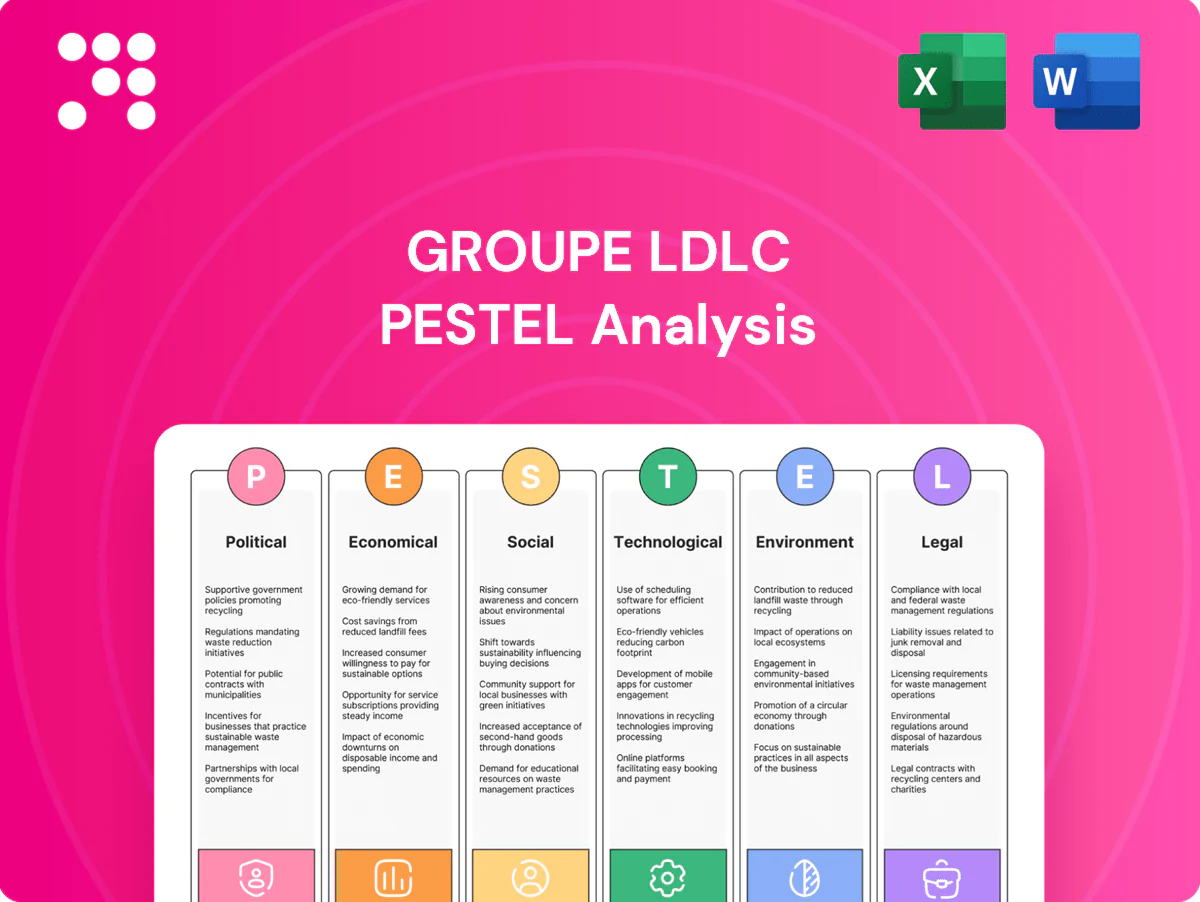
Groupe LDLC PESTLE Analysis

Your Competitive Advantage Starts with This Report
Discover how political, economic, social, technological, legal and environmental forces shape Groupe LDLC’s strategic outlook. Our concise PESTLE highlights risks and growth levers affecting operations and margins. Ideal for investors and strategists seeking actionable intelligence. Buy the full analysis for the detailed, ready-to-use report.
Political factors

EU industrial and digital policy direction
EU industrial/digital policy—notably the Chips Act (mobilising ~€43bn public/private investment) and a 2030 goal of 20% global semiconductor capacity—reshapes LDLCs access to inventory and pricing power. DMA/DSA (effective 2023) and platform dominance (Amazon ~35% EU e‑commerce share) alter marketplace dynamics and require LDLC to align sourcing, pricing and subsidy capture.
France retail and SME support policies
France Relance (€100bn) and follow-up retail revitalization packages, plus apprenticeship subsidies supporting over 900,000 apprentices in 2023 and digital adoption grants, can lower Groupe LDLC’s labor and tech costs. Local zoning and city‑center commerce support influence store expansion and rent dynamics. Public procurement (≈€300bn/year) creates B2B paths, while regional policy volatility can shift store economics.

Geopolitical supply chain risk
US–China tech export controls (expanded since Oct 2022) and 25% tariffs on about $350bn of goods have tightened component availability and extended lead times for electronics. Conflicts and sanctions disrupt key shipping lanes and lift freight costs, increasing volatility in margins. LDLC’s reliance on Asian OEMs necessitates formal contingency planning; diversification and nearshoring can reduce exposure to political shocks.

Tax regime and cross-border VAT rules
EU IOSS/OSS (launched July 2021) and the IOSS low-value threshold of 150 EUR increase pricing transparency but compress cross-border margins; compliance reduces checkout friction while adding reporting complexity. French corporate tax at 25% and a 3% digital services tax on large digital revenues can shift LDLC profitability, so LDLC must optimize tax-efficient EU fulfillment and VAT flows.
- IOSS threshold: 150 EUR
- OSS/IOSS live since Jul 2021
- French CT: 25%
- French DST: 3%
Public cybersecurity and digital trust agenda
Government emphasis on cyber resilience—through NIS2 scope expansion to many digital service providers and the risk environment where global cybercrime cost reached an estimated $8.44 trillion in 2023—raises operational and compliance standards for Groupe LDLC handling payments and customer data; GDPR fines up to 4% of global turnover increase stakes.
- Higher regulatory standards: NIS2 expansion
- Financial risk: GDPR fines up to 4% turnover
- Funding: support programs for upgrades
- Market benefit: stronger trust with professional clients
EU Chips Act €43bn + DMA/DSA reshape supply; top e-commerce ~35% EU share
EU Chips Act (~€43bn) and DMA/DSA reshape supply/pricing; Amazon ≈35% EU e‑commerce share alters channel power. France Relance/supports (900k apprentices 2023) plus ≈€300bn public procurement create B2B/retail opportunities; US–China controls (25% on ~$350bn) tighten components. IOSS 150 EUR, French CT 25% and 3% DST, NIS2/GDPR (fines up to 4%; cyber cost $8.44tn 2023) raise compliance costs.
| Item | Value |
|---|---|
| Chips Act | ~€43bn |
| Amazon EU share | ~35% |
| IOSS threshold | €150 |
| French CT / DST | 25% / 3% |
What is included in the product
 Detailed Word Document
Explores how Political, Economic, Social, Technological, Environmental and Legal forces uniquely affect Groupe LDLC, with data-backed trends and region-specific examples to identify risks and opportunities for executives, investors and strategists; includes forward-looking insights for scenario planning and competitive positioning.

 Customizable Excel Spreadsheet
A concise, visually segmented PESTLE summary of Groupe LDLC that streamlines meeting prep, supports external risk and market-positioning discussions, and can be dropped into presentations or shared across teams—editable for region- or business-line–specific notes.
Economic factors

Consumer demand and inflation cycles
High inflation that surged above 5% in 2022 and eased to low single digits by 2024 has pressured discretionary tech spending, pushing Groupe LDLC customers toward value segments and entry-level peripherals. Replacement cycles for PCs and accessories typically lengthen in downturns, reducing unit demand and average selling prices. Promotional intensity rises to clear inventories, while recovery phases historically boost gaming rigs and work-from-home upgrades.
Semiconductor supply and pricing volatility
Chip cycles drive availability and ASPs across GPUs, CPUs and storage: memory prices dropped roughly 40% in 2023 and GPU ASPs eased about 20% into 2024, while tight supply episodes previously pushed prices and reduced attach rates. Gluts compress margins, making accurate demand forecasting critical for retailers. LDLC’s private-label SKUs and bundled offerings help stabilize gross margin by capturing higher product margin and smoothing SKU-level volatility.

Euro exchange rate exposure
EUR/USD trading near 1.09 in July 2025 and volatile EUR/Asia crosses have raised import costs for dollar-priced components, with 2024–25 swings of several percent increasing landed costs. Forward hedges and options cut P&L volatility but typically add 0.2–0.8% in execution/spread costs. Rapid currency moves complicate consistent pricing across e-commerce and retail channels, so timely price updates are essential to protect margins.

Logistics and last-mile cost structure
Parcel rates rose about 7% in 2024, fuel surcharges added roughly €0.50–€1.50 per parcel and French labor costs grew ~3.5% YoY, squeezing e-commerce margins; click-and-collect uptake offsets delivery expenses and boosts in-store cross-sell; optimizing warehouse/store networks raises throughput and lowers unit cost; peak-season surcharges (up to ~20%) make precise inventory planning essential.
- parcel-rate: +7% (2024)
- fuel-surcharge: €0.50–€1.50/parcel
- labor-cost: +3.5% YoY (FR, 2024)
- click-and-collect: offsets delivery, drives cross-sell
- peak-surcharge: up to ~20%
B2B demand from SMEs and public sector
IT refresh cycles (typically 3–5 years) and rising cybersecurity spending sustain Groupe LDLC professional sales as SMEs—which represent 99% of EU firms—increase IT purchases; NextGenerationEU’s €800bn recovery fund and national digitalization programs further lift device and service demand, while macro slowdowns push noncritical upgrades into later quarters and elevate the value of service contracts for smoothing revenue.
- IT refresh: 3–5 years
- SMEs: 99% of EU firms
- NextGenerationEU: €800bn
- Service contracts: stabilize revenue
EU Chips Act €43bn + DMA/DSA reshape supply; top e-commerce ~35% EU share
Inflation peaked >5% in 2022 and eased to ~3% by 2024–25, lengthening PC replacement cycles and shifting demand to value SKUs. Memory prices fell ~40% in 2023 and GPU ASPs eased ~20% into 2024, while EUR/USD ~1.09 (Jul 2025) raised landed costs. Parcel rates +7% (2024), FR labor +3.5% YoY (2024), peak surcharges up to 20% squeeze margins; private-labels and services stabilize revenue.
| Metric | Value |
|---|---|
| Inflation (EU) | ~3% (2024–25) |
| EUR/USD | ~1.09 (Jul 2025) |
| Memory price change | -40% (2023) |
| GPU ASP change | -20% (into 2024) |
| Parcel rates | +7% (2024) |
| French labor | +3.5% YoY (2024) |
| NextGenerationEU | €800bn |
Preview Before You Purchase
Groupe LDLC PESTLE Analysis
The Groupe LDLC PESTLE Analysis shown here is the exact document you’ll receive after purchase—fully formatted and ready to use. It provides concise political, economic, social, technological, legal, and environmental insights tailored to Groupe LDLC, with no placeholders or teasers. After checkout you’ll instantly download this same professional, final file.

Your Competitive Advantage Starts with This Report
Discover how political, economic, social, technological, legal and environmental forces shape Groupe LDLC’s strategic outlook. Our concise PESTLE highlights risks and growth levers affecting operations and margins. Ideal for investors and strategists seeking actionable intelligence. Buy the full analysis for the detailed, ready-to-use report.
Political factors
EU industrial and digital policy direction
EU industrial/digital policy—notably the Chips Act (mobilising ~€43bn public/private investment) and a 2030 goal of 20% global semiconductor capacity—reshapes LDLCs access to inventory and pricing power. DMA/DSA (effective 2023) and platform dominance (Amazon ~35% EU e‑commerce share) alter marketplace dynamics and require LDLC to align sourcing, pricing and subsidy capture.
France retail and SME support policies
France Relance (€100bn) and follow-up retail revitalization packages, plus apprenticeship subsidies supporting over 900,000 apprentices in 2023 and digital adoption grants, can lower Groupe LDLC’s labor and tech costs. Local zoning and city‑center commerce support influence store expansion and rent dynamics. Public procurement (≈€300bn/year) creates B2B paths, while regional policy volatility can shift store economics.
Geopolitical supply chain risk
US–China tech export controls (expanded since Oct 2022) and 25% tariffs on about $350bn of goods have tightened component availability and extended lead times for electronics. Conflicts and sanctions disrupt key shipping lanes and lift freight costs, increasing volatility in margins. LDLC’s reliance on Asian OEMs necessitates formal contingency planning; diversification and nearshoring can reduce exposure to political shocks.
Tax regime and cross-border VAT rules
EU IOSS/OSS (launched July 2021) and the IOSS low-value threshold of 150 EUR increase pricing transparency but compress cross-border margins; compliance reduces checkout friction while adding reporting complexity. French corporate tax at 25% and a 3% digital services tax on large digital revenues can shift LDLC profitability, so LDLC must optimize tax-efficient EU fulfillment and VAT flows.
- IOSS threshold: 150 EUR
- OSS/IOSS live since Jul 2021
- French CT: 25%
- French DST: 3%
Public cybersecurity and digital trust agenda
Government emphasis on cyber resilience—through NIS2 scope expansion to many digital service providers and the risk environment where global cybercrime cost reached an estimated $8.44 trillion in 2023—raises operational and compliance standards for Groupe LDLC handling payments and customer data; GDPR fines up to 4% of global turnover increase stakes.
- Higher regulatory standards: NIS2 expansion
- Financial risk: GDPR fines up to 4% turnover
- Funding: support programs for upgrades
- Market benefit: stronger trust with professional clients
EU Chips Act €43bn + DMA/DSA reshape supply; top e-commerce ~35% EU share
EU Chips Act (~€43bn) and DMA/DSA reshape supply/pricing; Amazon ≈35% EU e‑commerce share alters channel power. France Relance/supports (900k apprentices 2023) plus ≈€300bn public procurement create B2B/retail opportunities; US–China controls (25% on ~$350bn) tighten components. IOSS 150 EUR, French CT 25% and 3% DST, NIS2/GDPR (fines up to 4%; cyber cost $8.44tn 2023) raise compliance costs.
| Item | Value |
|---|---|
| Chips Act | ~€43bn |
| Amazon EU share | ~35% |
| IOSS threshold | €150 |
| French CT / DST | 25% / 3% |
What is included in the product
Detailed Word Document
Explores how Political, Economic, Social, Technological, Environmental and Legal forces uniquely affect Groupe LDLC, with data-backed trends and region-specific examples to identify risks and opportunities for executives, investors and strategists; includes forward-looking insights for scenario planning and competitive positioning.
Customizable Excel Spreadsheet
A concise, visually segmented PESTLE summary of Groupe LDLC that streamlines meeting prep, supports external risk and market-positioning discussions, and can be dropped into presentations or shared across teams—editable for region- or business-line–specific notes.
Economic factors
Consumer demand and inflation cycles
High inflation that surged above 5% in 2022 and eased to low single digits by 2024 has pressured discretionary tech spending, pushing Groupe LDLC customers toward value segments and entry-level peripherals. Replacement cycles for PCs and accessories typically lengthen in downturns, reducing unit demand and average selling prices. Promotional intensity rises to clear inventories, while recovery phases historically boost gaming rigs and work-from-home upgrades.
Semiconductor supply and pricing volatility
Chip cycles drive availability and ASPs across GPUs, CPUs and storage: memory prices dropped roughly 40% in 2023 and GPU ASPs eased about 20% into 2024, while tight supply episodes previously pushed prices and reduced attach rates. Gluts compress margins, making accurate demand forecasting critical for retailers. LDLC’s private-label SKUs and bundled offerings help stabilize gross margin by capturing higher product margin and smoothing SKU-level volatility.
Euro exchange rate exposure
EUR/USD trading near 1.09 in July 2025 and volatile EUR/Asia crosses have raised import costs for dollar-priced components, with 2024–25 swings of several percent increasing landed costs. Forward hedges and options cut P&L volatility but typically add 0.2–0.8% in execution/spread costs. Rapid currency moves complicate consistent pricing across e-commerce and retail channels, so timely price updates are essential to protect margins.
Logistics and last-mile cost structure
Parcel rates rose about 7% in 2024, fuel surcharges added roughly €0.50–€1.50 per parcel and French labor costs grew ~3.5% YoY, squeezing e-commerce margins; click-and-collect uptake offsets delivery expenses and boosts in-store cross-sell; optimizing warehouse/store networks raises throughput and lowers unit cost; peak-season surcharges (up to ~20%) make precise inventory planning essential.
- parcel-rate: +7% (2024)
- fuel-surcharge: €0.50–€1.50/parcel
- labor-cost: +3.5% YoY (FR, 2024)
- click-and-collect: offsets delivery, drives cross-sell
- peak-surcharge: up to ~20%
B2B demand from SMEs and public sector
IT refresh cycles (typically 3–5 years) and rising cybersecurity spending sustain Groupe LDLC professional sales as SMEs—which represent 99% of EU firms—increase IT purchases; NextGenerationEU’s €800bn recovery fund and national digitalization programs further lift device and service demand, while macro slowdowns push noncritical upgrades into later quarters and elevate the value of service contracts for smoothing revenue.
- IT refresh: 3–5 years
- SMEs: 99% of EU firms
- NextGenerationEU: €800bn
- Service contracts: stabilize revenue
EU Chips Act €43bn + DMA/DSA reshape supply; top e-commerce ~35% EU share
Inflation peaked >5% in 2022 and eased to ~3% by 2024–25, lengthening PC replacement cycles and shifting demand to value SKUs. Memory prices fell ~40% in 2023 and GPU ASPs eased ~20% into 2024, while EUR/USD ~1.09 (Jul 2025) raised landed costs. Parcel rates +7% (2024), FR labor +3.5% YoY (2024), peak surcharges up to 20% squeeze margins; private-labels and services stabilize revenue.
| Metric | Value |
|---|---|
| Inflation (EU) | ~3% (2024–25) |
| EUR/USD | ~1.09 (Jul 2025) |
| Memory price change | -40% (2023) |
| GPU ASP change | -20% (into 2024) |
| Parcel rates | +7% (2024) |
| French labor | +3.5% YoY (2024) |
| NextGenerationEU | €800bn |
Preview Before You Purchase
Groupe LDLC PESTLE Analysis
The Groupe LDLC PESTLE Analysis shown here is the exact document you’ll receive after purchase—fully formatted and ready to use. It provides concise political, economic, social, technological, legal, and environmental insights tailored to Groupe LDLC, with no placeholders or teasers. After checkout you’ll instantly download this same professional, final file.
Original: $10.00
-65%$10.00
$3.50Description
Your Competitive Advantage Starts with This Report
Discover how political, economic, social, technological, legal and environmental forces shape Groupe LDLC’s strategic outlook. Our concise PESTLE highlights risks and growth levers affecting operations and margins. Ideal for investors and strategists seeking actionable intelligence. Buy the full analysis for the detailed, ready-to-use report.
Political factors
EU industrial and digital policy direction
EU industrial/digital policy—notably the Chips Act (mobilising ~€43bn public/private investment) and a 2030 goal of 20% global semiconductor capacity—reshapes LDLCs access to inventory and pricing power. DMA/DSA (effective 2023) and platform dominance (Amazon ~35% EU e‑commerce share) alter marketplace dynamics and require LDLC to align sourcing, pricing and subsidy capture.
France retail and SME support policies
France Relance (€100bn) and follow-up retail revitalization packages, plus apprenticeship subsidies supporting over 900,000 apprentices in 2023 and digital adoption grants, can lower Groupe LDLC’s labor and tech costs. Local zoning and city‑center commerce support influence store expansion and rent dynamics. Public procurement (≈€300bn/year) creates B2B paths, while regional policy volatility can shift store economics.
Geopolitical supply chain risk
US–China tech export controls (expanded since Oct 2022) and 25% tariffs on about $350bn of goods have tightened component availability and extended lead times for electronics. Conflicts and sanctions disrupt key shipping lanes and lift freight costs, increasing volatility in margins. LDLC’s reliance on Asian OEMs necessitates formal contingency planning; diversification and nearshoring can reduce exposure to political shocks.
Tax regime and cross-border VAT rules
EU IOSS/OSS (launched July 2021) and the IOSS low-value threshold of 150 EUR increase pricing transparency but compress cross-border margins; compliance reduces checkout friction while adding reporting complexity. French corporate tax at 25% and a 3% digital services tax on large digital revenues can shift LDLC profitability, so LDLC must optimize tax-efficient EU fulfillment and VAT flows.
- IOSS threshold: 150 EUR
- OSS/IOSS live since Jul 2021
- French CT: 25%
- French DST: 3%
Public cybersecurity and digital trust agenda
Government emphasis on cyber resilience—through NIS2 scope expansion to many digital service providers and the risk environment where global cybercrime cost reached an estimated $8.44 trillion in 2023—raises operational and compliance standards for Groupe LDLC handling payments and customer data; GDPR fines up to 4% of global turnover increase stakes.
- Higher regulatory standards: NIS2 expansion
- Financial risk: GDPR fines up to 4% turnover
- Funding: support programs for upgrades
- Market benefit: stronger trust with professional clients
EU Chips Act €43bn + DMA/DSA reshape supply; top e-commerce ~35% EU share
EU Chips Act (~€43bn) and DMA/DSA reshape supply/pricing; Amazon ≈35% EU e‑commerce share alters channel power. France Relance/supports (900k apprentices 2023) plus ≈€300bn public procurement create B2B/retail opportunities; US–China controls (25% on ~$350bn) tighten components. IOSS 150 EUR, French CT 25% and 3% DST, NIS2/GDPR (fines up to 4%; cyber cost $8.44tn 2023) raise compliance costs.
| Item | Value |
|---|---|
| Chips Act | ~€43bn |
| Amazon EU share | ~35% |
| IOSS threshold | €150 |
| French CT / DST | 25% / 3% |
What is included in the product
Detailed Word Document
Explores how Political, Economic, Social, Technological, Environmental and Legal forces uniquely affect Groupe LDLC, with data-backed trends and region-specific examples to identify risks and opportunities for executives, investors and strategists; includes forward-looking insights for scenario planning and competitive positioning.
Customizable Excel Spreadsheet
A concise, visually segmented PESTLE summary of Groupe LDLC that streamlines meeting prep, supports external risk and market-positioning discussions, and can be dropped into presentations or shared across teams—editable for region- or business-line–specific notes.
Economic factors
Consumer demand and inflation cycles
High inflation that surged above 5% in 2022 and eased to low single digits by 2024 has pressured discretionary tech spending, pushing Groupe LDLC customers toward value segments and entry-level peripherals. Replacement cycles for PCs and accessories typically lengthen in downturns, reducing unit demand and average selling prices. Promotional intensity rises to clear inventories, while recovery phases historically boost gaming rigs and work-from-home upgrades.
Semiconductor supply and pricing volatility
Chip cycles drive availability and ASPs across GPUs, CPUs and storage: memory prices dropped roughly 40% in 2023 and GPU ASPs eased about 20% into 2024, while tight supply episodes previously pushed prices and reduced attach rates. Gluts compress margins, making accurate demand forecasting critical for retailers. LDLC’s private-label SKUs and bundled offerings help stabilize gross margin by capturing higher product margin and smoothing SKU-level volatility.
Euro exchange rate exposure
EUR/USD trading near 1.09 in July 2025 and volatile EUR/Asia crosses have raised import costs for dollar-priced components, with 2024–25 swings of several percent increasing landed costs. Forward hedges and options cut P&L volatility but typically add 0.2–0.8% in execution/spread costs. Rapid currency moves complicate consistent pricing across e-commerce and retail channels, so timely price updates are essential to protect margins.
Logistics and last-mile cost structure
Parcel rates rose about 7% in 2024, fuel surcharges added roughly €0.50–€1.50 per parcel and French labor costs grew ~3.5% YoY, squeezing e-commerce margins; click-and-collect uptake offsets delivery expenses and boosts in-store cross-sell; optimizing warehouse/store networks raises throughput and lowers unit cost; peak-season surcharges (up to ~20%) make precise inventory planning essential.
- parcel-rate: +7% (2024)
- fuel-surcharge: €0.50–€1.50/parcel
- labor-cost: +3.5% YoY (FR, 2024)
- click-and-collect: offsets delivery, drives cross-sell
- peak-surcharge: up to ~20%
B2B demand from SMEs and public sector
IT refresh cycles (typically 3–5 years) and rising cybersecurity spending sustain Groupe LDLC professional sales as SMEs—which represent 99% of EU firms—increase IT purchases; NextGenerationEU’s €800bn recovery fund and national digitalization programs further lift device and service demand, while macro slowdowns push noncritical upgrades into later quarters and elevate the value of service contracts for smoothing revenue.
- IT refresh: 3–5 years
- SMEs: 99% of EU firms
- NextGenerationEU: €800bn
- Service contracts: stabilize revenue
EU Chips Act €43bn + DMA/DSA reshape supply; top e-commerce ~35% EU share
Inflation peaked >5% in 2022 and eased to ~3% by 2024–25, lengthening PC replacement cycles and shifting demand to value SKUs. Memory prices fell ~40% in 2023 and GPU ASPs eased ~20% into 2024, while EUR/USD ~1.09 (Jul 2025) raised landed costs. Parcel rates +7% (2024), FR labor +3.5% YoY (2024), peak surcharges up to 20% squeeze margins; private-labels and services stabilize revenue.
| Metric | Value |
|---|---|
| Inflation (EU) | ~3% (2024–25) |
| EUR/USD | ~1.09 (Jul 2025) |
| Memory price change | -40% (2023) |
| GPU ASP change | -20% (into 2024) |
| Parcel rates | +7% (2024) |
| French labor | +3.5% YoY (2024) |
| NextGenerationEU | €800bn |
Preview Before You Purchase
Groupe LDLC PESTLE Analysis
The Groupe LDLC PESTLE Analysis shown here is the exact document you’ll receive after purchase—fully formatted and ready to use. It provides concise political, economic, social, technological, legal, and environmental insights tailored to Groupe LDLC, with no placeholders or teasers. After checkout you’ll instantly download this same professional, final file.











