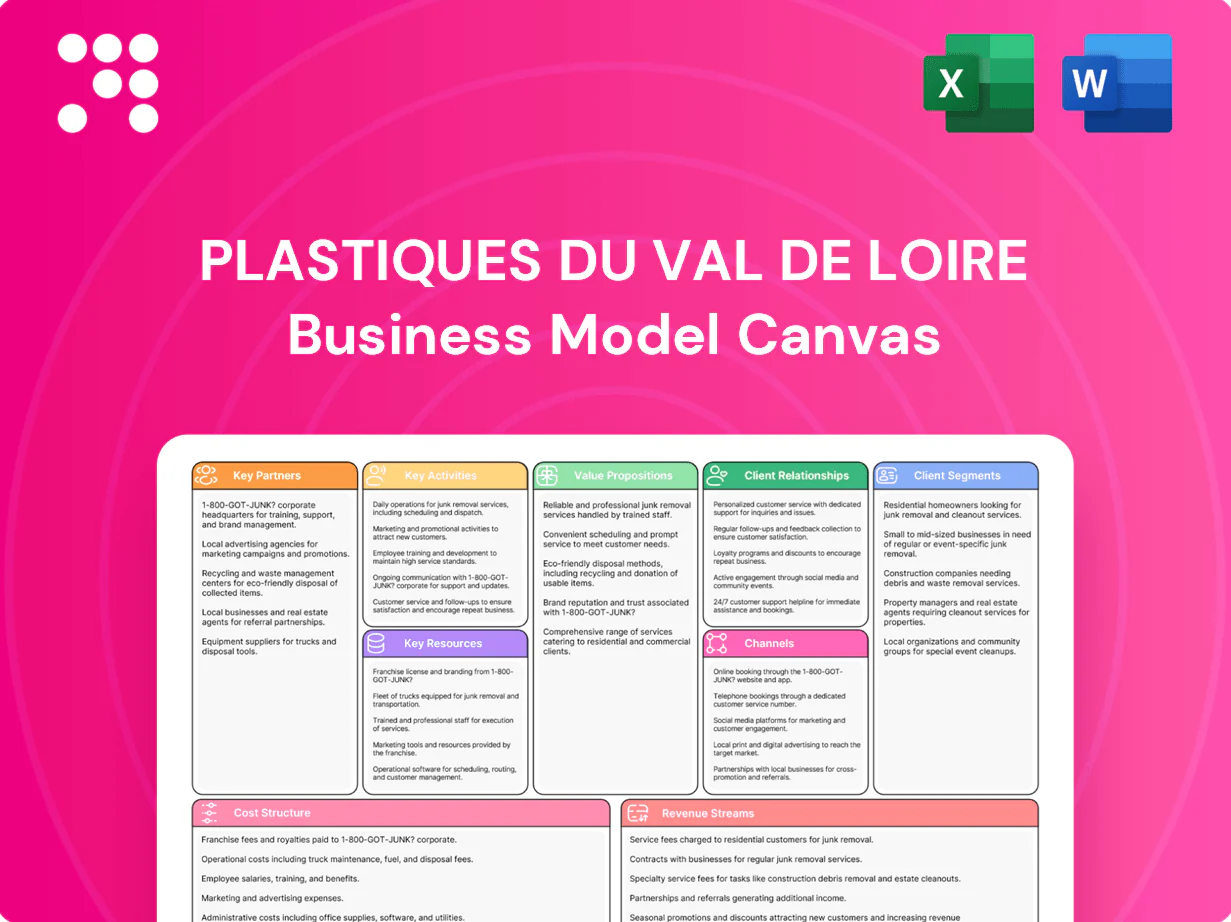
Plastiques du Val de Loire Business Model Canvas

Business Model Canvas Blueprint: actionable value propositions, partners and revenue streams
Unlock the full strategic blueprint behind Plastiques du Val de Loire’s business model with our complete Business Model Canvas—three to five pages of actionable insight on value propositions, key partners, revenue streams and cost drivers. Perfect for investors, consultants and founders seeking a ready-to-use template to benchmark and scale. Download the full Word & Excel files to turn analysis into action.
Partnerships

Automotive OEMs and Tier-1 suppliers
Strategic relationships with Automotive OEMs and Tier-1 module integrators secure multi-year platforms, typically spanning 3–7 years, anchoring production planning. Joint planning aligns volumes, specifications and quality targets, improving on-time launch rates. These partnerships enable co-development and provide stable revenue visibility (commonly 12–24 months). They also facilitate global program rollouts across 3–5 plants.
Resin, additives, and paint suppliers
Close ties with polymer producers and coating suppliers secure material quality from a global resin pool of roughly 390 million tonnes and a resin market valued near USD 500 billion in 2024, enabling predictable specs. Early involvement allows resin qualification and color-matching at design freeze, reducing rework. Long-term supply agreements mitigate price volatility and shortages, while supplier technical support accelerates process optimization and scrap reduction.

Toolmakers and automation integrators
Alliances with mold manufacturers and robot/vision integrators accelerate industrialization by enabling concurrent engineering and faster ramp-up. Collaborative DFM/DFM for tooling drives shorter cycle times and higher first-pass quality through shared CAD/CAM and process data. Preferred suppliers shorten lead-times for new tools and repairs, while automation partners deliver stable, repeatable production at scale.

Logistics and 3PL providers
Just-in-time and sequenced deliveries depend on reliable logistics partners to meet OEMs 95%+ on-time delivery SLAs; 3PLs manage cross-border flows, customs clearance and milk-runs into OEM plants. Integrated IT interfaces (EDI/ASN/tracking) enable real-time visibility and ASN compliance, cutting delivery deviations and related penalties.
- 3PLs: cross-border customs and milk-runs
- IT: EDI/ASN tracking for compliance
- Outcome: fewer deviations, lower inventory levels
R&D institutes and recycling ecosystems
Partnerships with R&D institutes and recycling ecosystems accelerate material innovation and circularity, with joint 2024 trials validating recycled and bio-based resins for critical parts to meet performance and safety standards. Grants from Horizon Europe and ADEME and consortia de-risk tech adoption and support regulatory compliance and sustainability targets.
- Joint trials: performance validation
- Funding: Horizon Europe, ADEME grants
- Outcome: de-risked adoption, regulatory alignment
OEM/Tier-1 platforms: 3–7 yr, 12–24 mo visibility, 95%+ OTDS
Strategic OEM/Tier-1 platforms (3–7 yr) secure predictable volumes and 12–24 month revenue visibility, supporting 95%+ on-time delivery SLAs. Long-term supply deals with polymer/coating partners link to a ~390 Mt resin pool and ~USD 500bn resin market (2024), reducing volatility. R&D/recycling consortia (Horizon Europe, ADEME) de-risk recycled/bio-resin adoption via 2024 validation trials.
| Metric | Value |
|---|---|
| Platform length | 3–7 yr |
| Revenue visibility | 12–24 mo |
| Resin pool | ~390 Mt |
| Resin market (2024) | ~USD 500bn |
What is included in the product
 Detailed Word Document
A concise, pre-written Business Model Canvas for Plastiques du Val de Loire detailing customer segments, channels, value propositions, key resources, partners, cost and revenue structures across the 9 BMC blocks, with competitive analysis and SWOT insights to support investor presentations and strategic decision-making.

 Customizable Excel Spreadsheet
One-page Business Model Canvas for Plastiques du Val de Loire that quickly surfaces gaps in supply chain, recycling integration, and customer value propositions to relieve strategic misalignment. Editable and shareable layout saves time on structuring analyses so teams can prioritize operational fixes and innovation opportunities fast.
Activities

Product design and co-engineering
Collaborative design optimizes parts for function, weight, and cost, delivering industry benchmark weight reductions of 10–20% and cost savings of 5–15% in 2024. DFM/DFA reduces tool complexity and assembly steps by about 30%. CAE simulations validate flow, warpage, and crash constraints, cutting mold iterations ~40%. Early involvement shortens time-to-SOP by up to 25%.
Tooling development and maintenance
Designing, sourcing and maintaining injection molds ensures uptime, with Plastiques du Val de Loire targeting 98% mold availability in 2024 to meet customer SLAs.
Rapid tool changes and stocked spare inserts enable flexible production and changeover times under 30 minutes on core lines.
Preventive maintenance programs reduce breakdowns and scrap, while tool lifecycle management preserves dimensional stability across expected shot counts and revisions.

Injection molding and overmolding
High-volume presses, commonly up to 1,500 tonnes, produce complex geometries with tolerances as tight as ±0.01–0.1 mm, enabling repeatable precision for automotive and medical parts. Multi-material molding and overmolding combine substrates and elastomers to add functionality and premium aesthetics in the same cycle. Robust SPC and process control stabilize quality across shifts, while cycle-time optimization (often 10–60 s cycle ranges) drives unit cost down.

Painting, coating, and finishing
In-house paint lines deliver Class-A finishes with Delta E ≤1.5 color accuracy and industrial durability; controlled clean-room environments ensure adhesion and repeatable color matches across 120,000 painted parts/month (2024 throughput). Specialty coatings meet UV (≥2,000 h QUV per ASTM G154), chemical and scratch resistance specs. Inline inspection cut rework and returns by ~40% in 2024.
- Class-A finish; Delta E ≤1.5
- 120,000 parts/month (2024)
- UV resistance ≥2,000 h QUV
- Inline inspection → ~40% fewer reworks/returns
Assembly, testing, and logistics
Cell assembly integrates components, clips and electronics achieving throughput ~1,200 units/day in 2024; end-of-line testing validates fit, function and appearance with a first-pass yield of 98%. Sequenced shipping aligns with OEM takt times to minimize line stoppages and reduced WIP by ~30% year-on-year. EDI/ASN processes delivered 99.8% compliance and 99.5% on-time deliveries in 2024.
- Throughput: ~1,200 units/day (2024)
- First-pass yield: 98% (2024)
- WIP reduction via sequencing: ~30% (2024)
- EDI/ASN compliance: 99.8%, on-time: 99.5% (2024)
DFM/CAE cut weight 10–20%, cost 5–15%; FPY 98%
Collaborative design/DFM cut weight 10–20% and cost 5–15% in 2024; CAE cut mold iterations ~40% and time-to-SOP by 25%. Mold availability 98% and <30 min changeovers; presses to 1,500 t, tolerances ±0.01–0.1 mm, cycles 10–60 s. In-house paint 120,000 parts/month, Delta E ≤1.5; assembly throughput ~1,200/day, FPY 98%, OTD 99.5%.
| Metric | 2024 |
|---|---|
| Weight reduction | 10–20% |
| Cost savings | 5–15% |
| Mold availability | 98% |
| Paint throughput | 120,000/mo |
| FPY | 98% |
Delivered as Displayed
Business Model Canvas
The document you're previewing is the exact Plastiques du Val de Loire Business Model Canvas you'll receive after purchase, not a mockup or sample. When you complete your order, you’ll get this same professional, fully editable file ready for use. No hidden sections or altered layouts—what you see is what you’ll download.

Business Model Canvas Blueprint: actionable value propositions, partners and revenue streams
Unlock the full strategic blueprint behind Plastiques du Val de Loire’s business model with our complete Business Model Canvas—three to five pages of actionable insight on value propositions, key partners, revenue streams and cost drivers. Perfect for investors, consultants and founders seeking a ready-to-use template to benchmark and scale. Download the full Word & Excel files to turn analysis into action.
Partnerships
Automotive OEMs and Tier-1 suppliers
Strategic relationships with Automotive OEMs and Tier-1 module integrators secure multi-year platforms, typically spanning 3–7 years, anchoring production planning. Joint planning aligns volumes, specifications and quality targets, improving on-time launch rates. These partnerships enable co-development and provide stable revenue visibility (commonly 12–24 months). They also facilitate global program rollouts across 3–5 plants.
Resin, additives, and paint suppliers
Close ties with polymer producers and coating suppliers secure material quality from a global resin pool of roughly 390 million tonnes and a resin market valued near USD 500 billion in 2024, enabling predictable specs. Early involvement allows resin qualification and color-matching at design freeze, reducing rework. Long-term supply agreements mitigate price volatility and shortages, while supplier technical support accelerates process optimization and scrap reduction.
Toolmakers and automation integrators
Alliances with mold manufacturers and robot/vision integrators accelerate industrialization by enabling concurrent engineering and faster ramp-up. Collaborative DFM/DFM for tooling drives shorter cycle times and higher first-pass quality through shared CAD/CAM and process data. Preferred suppliers shorten lead-times for new tools and repairs, while automation partners deliver stable, repeatable production at scale.
Logistics and 3PL providers
Just-in-time and sequenced deliveries depend on reliable logistics partners to meet OEMs 95%+ on-time delivery SLAs; 3PLs manage cross-border flows, customs clearance and milk-runs into OEM plants. Integrated IT interfaces (EDI/ASN/tracking) enable real-time visibility and ASN compliance, cutting delivery deviations and related penalties.
- 3PLs: cross-border customs and milk-runs
- IT: EDI/ASN tracking for compliance
- Outcome: fewer deviations, lower inventory levels
R&D institutes and recycling ecosystems
Partnerships with R&D institutes and recycling ecosystems accelerate material innovation and circularity, with joint 2024 trials validating recycled and bio-based resins for critical parts to meet performance and safety standards. Grants from Horizon Europe and ADEME and consortia de-risk tech adoption and support regulatory compliance and sustainability targets.
- Joint trials: performance validation
- Funding: Horizon Europe, ADEME grants
- Outcome: de-risked adoption, regulatory alignment
OEM/Tier-1 platforms: 3–7 yr, 12–24 mo visibility, 95%+ OTDS
Strategic OEM/Tier-1 platforms (3–7 yr) secure predictable volumes and 12–24 month revenue visibility, supporting 95%+ on-time delivery SLAs. Long-term supply deals with polymer/coating partners link to a ~390 Mt resin pool and ~USD 500bn resin market (2024), reducing volatility. R&D/recycling consortia (Horizon Europe, ADEME) de-risk recycled/bio-resin adoption via 2024 validation trials.
| Metric | Value |
|---|---|
| Platform length | 3–7 yr |
| Revenue visibility | 12–24 mo |
| Resin pool | ~390 Mt |
| Resin market (2024) | ~USD 500bn |
What is included in the product
Detailed Word Document
A concise, pre-written Business Model Canvas for Plastiques du Val de Loire detailing customer segments, channels, value propositions, key resources, partners, cost and revenue structures across the 9 BMC blocks, with competitive analysis and SWOT insights to support investor presentations and strategic decision-making.
Customizable Excel Spreadsheet
One-page Business Model Canvas for Plastiques du Val de Loire that quickly surfaces gaps in supply chain, recycling integration, and customer value propositions to relieve strategic misalignment. Editable and shareable layout saves time on structuring analyses so teams can prioritize operational fixes and innovation opportunities fast.
Activities
Product design and co-engineering
Collaborative design optimizes parts for function, weight, and cost, delivering industry benchmark weight reductions of 10–20% and cost savings of 5–15% in 2024. DFM/DFA reduces tool complexity and assembly steps by about 30%. CAE simulations validate flow, warpage, and crash constraints, cutting mold iterations ~40%. Early involvement shortens time-to-SOP by up to 25%.
Tooling development and maintenance
Designing, sourcing and maintaining injection molds ensures uptime, with Plastiques du Val de Loire targeting 98% mold availability in 2024 to meet customer SLAs.
Rapid tool changes and stocked spare inserts enable flexible production and changeover times under 30 minutes on core lines.
Preventive maintenance programs reduce breakdowns and scrap, while tool lifecycle management preserves dimensional stability across expected shot counts and revisions.
Injection molding and overmolding
High-volume presses, commonly up to 1,500 tonnes, produce complex geometries with tolerances as tight as ±0.01–0.1 mm, enabling repeatable precision for automotive and medical parts. Multi-material molding and overmolding combine substrates and elastomers to add functionality and premium aesthetics in the same cycle. Robust SPC and process control stabilize quality across shifts, while cycle-time optimization (often 10–60 s cycle ranges) drives unit cost down.
Painting, coating, and finishing
In-house paint lines deliver Class-A finishes with Delta E ≤1.5 color accuracy and industrial durability; controlled clean-room environments ensure adhesion and repeatable color matches across 120,000 painted parts/month (2024 throughput). Specialty coatings meet UV (≥2,000 h QUV per ASTM G154), chemical and scratch resistance specs. Inline inspection cut rework and returns by ~40% in 2024.
- Class-A finish; Delta E ≤1.5
- 120,000 parts/month (2024)
- UV resistance ≥2,000 h QUV
- Inline inspection → ~40% fewer reworks/returns
Assembly, testing, and logistics
Cell assembly integrates components, clips and electronics achieving throughput ~1,200 units/day in 2024; end-of-line testing validates fit, function and appearance with a first-pass yield of 98%. Sequenced shipping aligns with OEM takt times to minimize line stoppages and reduced WIP by ~30% year-on-year. EDI/ASN processes delivered 99.8% compliance and 99.5% on-time deliveries in 2024.
- Throughput: ~1,200 units/day (2024)
- First-pass yield: 98% (2024)
- WIP reduction via sequencing: ~30% (2024)
- EDI/ASN compliance: 99.8%, on-time: 99.5% (2024)
DFM/CAE cut weight 10–20%, cost 5–15%; FPY 98%
Collaborative design/DFM cut weight 10–20% and cost 5–15% in 2024; CAE cut mold iterations ~40% and time-to-SOP by 25%. Mold availability 98% and <30 min changeovers; presses to 1,500 t, tolerances ±0.01–0.1 mm, cycles 10–60 s. In-house paint 120,000 parts/month, Delta E ≤1.5; assembly throughput ~1,200/day, FPY 98%, OTD 99.5%.
| Metric | 2024 |
|---|---|
| Weight reduction | 10–20% |
| Cost savings | 5–15% |
| Mold availability | 98% |
| Paint throughput | 120,000/mo |
| FPY | 98% |
Delivered as Displayed
Business Model Canvas
The document you're previewing is the exact Plastiques du Val de Loire Business Model Canvas you'll receive after purchase, not a mockup or sample. When you complete your order, you’ll get this same professional, fully editable file ready for use. No hidden sections or altered layouts—what you see is what you’ll download.
Description
Business Model Canvas Blueprint: actionable value propositions, partners and revenue streams
Unlock the full strategic blueprint behind Plastiques du Val de Loire’s business model with our complete Business Model Canvas—three to five pages of actionable insight on value propositions, key partners, revenue streams and cost drivers. Perfect for investors, consultants and founders seeking a ready-to-use template to benchmark and scale. Download the full Word & Excel files to turn analysis into action.
Partnerships
Automotive OEMs and Tier-1 suppliers
Strategic relationships with Automotive OEMs and Tier-1 module integrators secure multi-year platforms, typically spanning 3–7 years, anchoring production planning. Joint planning aligns volumes, specifications and quality targets, improving on-time launch rates. These partnerships enable co-development and provide stable revenue visibility (commonly 12–24 months). They also facilitate global program rollouts across 3–5 plants.
Resin, additives, and paint suppliers
Close ties with polymer producers and coating suppliers secure material quality from a global resin pool of roughly 390 million tonnes and a resin market valued near USD 500 billion in 2024, enabling predictable specs. Early involvement allows resin qualification and color-matching at design freeze, reducing rework. Long-term supply agreements mitigate price volatility and shortages, while supplier technical support accelerates process optimization and scrap reduction.
Toolmakers and automation integrators
Alliances with mold manufacturers and robot/vision integrators accelerate industrialization by enabling concurrent engineering and faster ramp-up. Collaborative DFM/DFM for tooling drives shorter cycle times and higher first-pass quality through shared CAD/CAM and process data. Preferred suppliers shorten lead-times for new tools and repairs, while automation partners deliver stable, repeatable production at scale.
Logistics and 3PL providers
Just-in-time and sequenced deliveries depend on reliable logistics partners to meet OEMs 95%+ on-time delivery SLAs; 3PLs manage cross-border flows, customs clearance and milk-runs into OEM plants. Integrated IT interfaces (EDI/ASN/tracking) enable real-time visibility and ASN compliance, cutting delivery deviations and related penalties.
- 3PLs: cross-border customs and milk-runs
- IT: EDI/ASN tracking for compliance
- Outcome: fewer deviations, lower inventory levels
R&D institutes and recycling ecosystems
Partnerships with R&D institutes and recycling ecosystems accelerate material innovation and circularity, with joint 2024 trials validating recycled and bio-based resins for critical parts to meet performance and safety standards. Grants from Horizon Europe and ADEME and consortia de-risk tech adoption and support regulatory compliance and sustainability targets.
- Joint trials: performance validation
- Funding: Horizon Europe, ADEME grants
- Outcome: de-risked adoption, regulatory alignment
OEM/Tier-1 platforms: 3–7 yr, 12–24 mo visibility, 95%+ OTDS
Strategic OEM/Tier-1 platforms (3–7 yr) secure predictable volumes and 12–24 month revenue visibility, supporting 95%+ on-time delivery SLAs. Long-term supply deals with polymer/coating partners link to a ~390 Mt resin pool and ~USD 500bn resin market (2024), reducing volatility. R&D/recycling consortia (Horizon Europe, ADEME) de-risk recycled/bio-resin adoption via 2024 validation trials.
| Metric | Value |
|---|---|
| Platform length | 3–7 yr |
| Revenue visibility | 12–24 mo |
| Resin pool | ~390 Mt |
| Resin market (2024) | ~USD 500bn |
What is included in the product
Detailed Word Document
A concise, pre-written Business Model Canvas for Plastiques du Val de Loire detailing customer segments, channels, value propositions, key resources, partners, cost and revenue structures across the 9 BMC blocks, with competitive analysis and SWOT insights to support investor presentations and strategic decision-making.
Customizable Excel Spreadsheet
One-page Business Model Canvas for Plastiques du Val de Loire that quickly surfaces gaps in supply chain, recycling integration, and customer value propositions to relieve strategic misalignment. Editable and shareable layout saves time on structuring analyses so teams can prioritize operational fixes and innovation opportunities fast.
Activities
Product design and co-engineering
Collaborative design optimizes parts for function, weight, and cost, delivering industry benchmark weight reductions of 10–20% and cost savings of 5–15% in 2024. DFM/DFA reduces tool complexity and assembly steps by about 30%. CAE simulations validate flow, warpage, and crash constraints, cutting mold iterations ~40%. Early involvement shortens time-to-SOP by up to 25%.
Tooling development and maintenance
Designing, sourcing and maintaining injection molds ensures uptime, with Plastiques du Val de Loire targeting 98% mold availability in 2024 to meet customer SLAs.
Rapid tool changes and stocked spare inserts enable flexible production and changeover times under 30 minutes on core lines.
Preventive maintenance programs reduce breakdowns and scrap, while tool lifecycle management preserves dimensional stability across expected shot counts and revisions.
Injection molding and overmolding
High-volume presses, commonly up to 1,500 tonnes, produce complex geometries with tolerances as tight as ±0.01–0.1 mm, enabling repeatable precision for automotive and medical parts. Multi-material molding and overmolding combine substrates and elastomers to add functionality and premium aesthetics in the same cycle. Robust SPC and process control stabilize quality across shifts, while cycle-time optimization (often 10–60 s cycle ranges) drives unit cost down.
Painting, coating, and finishing
In-house paint lines deliver Class-A finishes with Delta E ≤1.5 color accuracy and industrial durability; controlled clean-room environments ensure adhesion and repeatable color matches across 120,000 painted parts/month (2024 throughput). Specialty coatings meet UV (≥2,000 h QUV per ASTM G154), chemical and scratch resistance specs. Inline inspection cut rework and returns by ~40% in 2024.
- Class-A finish; Delta E ≤1.5
- 120,000 parts/month (2024)
- UV resistance ≥2,000 h QUV
- Inline inspection → ~40% fewer reworks/returns
Assembly, testing, and logistics
Cell assembly integrates components, clips and electronics achieving throughput ~1,200 units/day in 2024; end-of-line testing validates fit, function and appearance with a first-pass yield of 98%. Sequenced shipping aligns with OEM takt times to minimize line stoppages and reduced WIP by ~30% year-on-year. EDI/ASN processes delivered 99.8% compliance and 99.5% on-time deliveries in 2024.
- Throughput: ~1,200 units/day (2024)
- First-pass yield: 98% (2024)
- WIP reduction via sequencing: ~30% (2024)
- EDI/ASN compliance: 99.8%, on-time: 99.5% (2024)
DFM/CAE cut weight 10–20%, cost 5–15%; FPY 98%
Collaborative design/DFM cut weight 10–20% and cost 5–15% in 2024; CAE cut mold iterations ~40% and time-to-SOP by 25%. Mold availability 98% and <30 min changeovers; presses to 1,500 t, tolerances ±0.01–0.1 mm, cycles 10–60 s. In-house paint 120,000 parts/month, Delta E ≤1.5; assembly throughput ~1,200/day, FPY 98%, OTD 99.5%.
| Metric | 2024 |
|---|---|
| Weight reduction | 10–20% |
| Cost savings | 5–15% |
| Mold availability | 98% |
| Paint throughput | 120,000/mo |
| FPY | 98% |
Delivered as Displayed
Business Model Canvas
The document you're previewing is the exact Plastiques du Val de Loire Business Model Canvas you'll receive after purchase, not a mockup or sample. When you complete your order, you’ll get this same professional, fully editable file ready for use. No hidden sections or altered layouts—what you see is what you’ll download.











