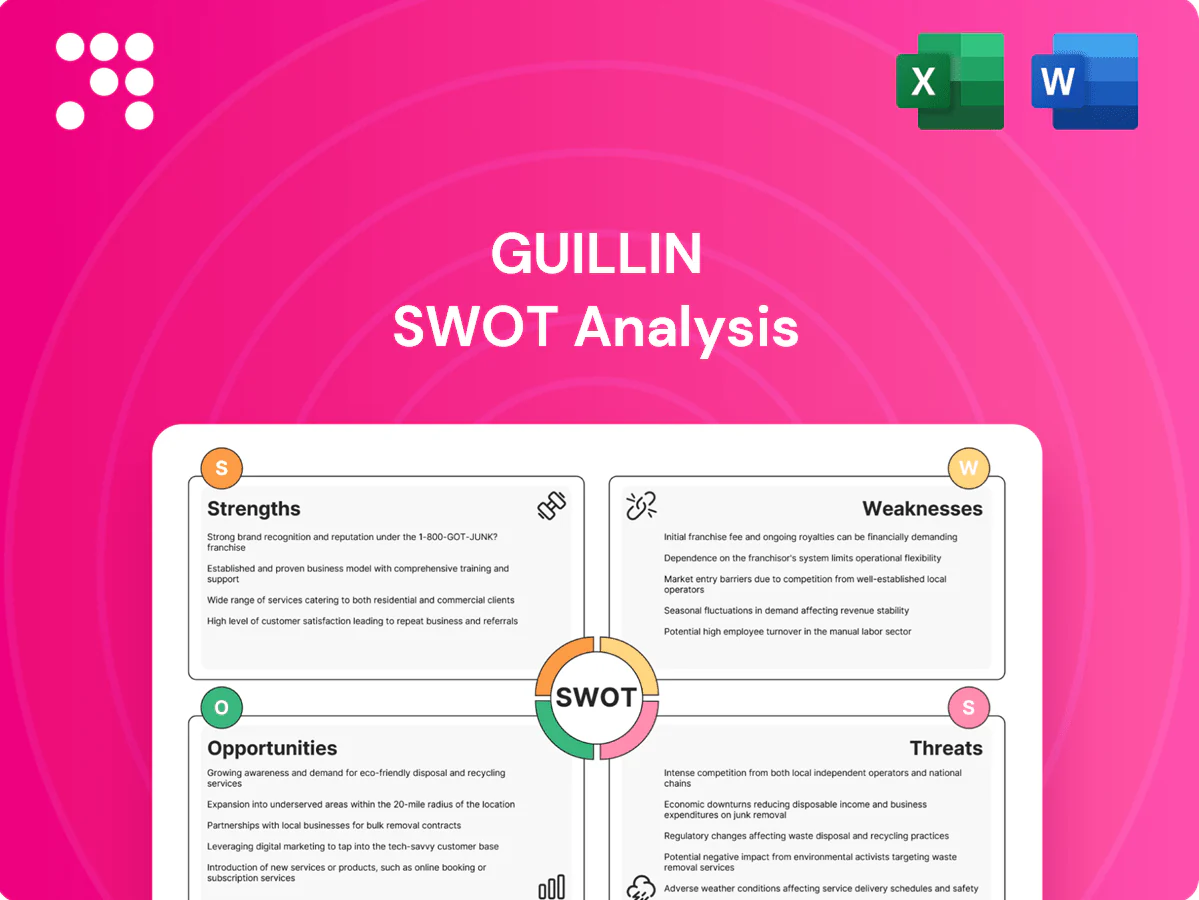
Guillin SWOT Analysis

Your Strategic Toolkit Starts Here
Guillin’s SWOT reveals resilient manufacturing strengths, niche market expertise, and clear expansion opportunities amid supply-chain and competitive pressures; strategic risks include margin sensitivity and technology shifts. Want the full strategic picture and actionable recommendations? Purchase the complete SWOT for a professionally formatted Word report and editable Excel tools to plan, pitch, or invest with confidence.
Strengths

Deep food-packaging focus
Guillin’s specialization in trays and containers for fresh produce, meat, seafood and bakery enables tailored designs and regulatory compliance, improving product performance and safety; with FAO estimating ~30% of food is lost or wasted, technologies like MAP can extend shelf life up to 50%, strengthening retailer/processor ties and accelerating iteration and time-to-market.
Thermoforming manufacturing scale
Guillin's established thermoforming capabilities enable high-volume, cost-efficient production, translating scale effects into lower unit costs and stronger pricing leverage in food packaging markets.
Standardized platforms reduce changeover time and material waste, improving throughput and yield consistency across product lines.
Capacity flexibility allows rapid absorption of demand spikes from seasonal food cycles, supporting customer retention and margin stability.

Innovation-led portfolio
Ongoing product development delivers lighter-weighting, barrier enhancements and clear design differentiation, boosting shelf appeal and cost per unit. R&D capability enables rapid response to evolving customer requirements and regulatory shifts. Innovative formats improve merchandising and logistics efficiency, while a steady innovation pipeline supports margin resilience across product cycles.

Sustainability positioning
Guillin's focus on recyclability, recycled content and material reduction aligns directly with major retailer sustainability mandates and helps communicate clear lifecycle impacts that support customer ESG targets. Sustainable SKUs improve access to preferred-supplier programs and lower regulatory and reputational risk for the company.
Strong customer relationships
Longstanding ties with food processors and retailers drive repeat business and deepen market penetration, while co-development and customized solutions raise client switching costs and embed Guillin in customers’ production lines. Service reliability and stringent quality assurance underpin trust, and multi-year supply frameworks improve revenue visibility and contract stability.
- Repeat business from entrenched customer base
- High switching costs via co-development
- Reliability and QA bolster trust
- Multi-year contracts stabilize revenue
Recyclable retail trays cut food loss ~30%, extend shelf life up to 50%
Guillin’s specialization in trays and containers for fresh produce, meat, seafood and bakery enables tailored, regulatory-compliant designs that reduce waste and improve safety; FAO estimates ~30% of food is lost or wasted, and MAP can extend shelf life by up to 50%, strengthening retailer ties. Established thermoforming scale lowers unit costs and shortens time-to-market. Focus on recyclability and recycled content aligns with major retailer ESG mandates and supports preferred-supplier access.
| Metric | Value |
|---|---|
| Global food loss (FAO) | ~30% |
| MAP shelf-life extension | up to 50% |
What is included in the product
 Detailed Word Document
Provides a concise SWOT analysis of Guillin, outlining its core strengths and operational weaknesses, along with market opportunities and external threats to inform strategic decision-making.

 Customizable Excel Spreadsheet
Provides a clear, visual SWOT layout tailored to Guillin, enabling rapid identification and mitigation of strategic pain points for faster decision-making.
Weaknesses

Plastic perception risk
Despite Guillin’s sustainability steps, plastics still endure negative consumer sentiment that can blunt brand appeal. Brand-sensitive retailers such as Walmart, Carrefour and Tesco have public packaging targets running to 2025 that pressure suppliers toward non-plastic alternatives. Public discourse and regulations (EU single-use plastics measures since 2019) often overshadow recyclability advances. Packaging accounted for about 40% of global plastic use (2019), limiting pricing power and marketing effectiveness.
Regulatory exposure
Regulatory exposure: EU Single-Use Plastics Directive and rising national bans force rapid reformulation of polymer blends and barrier systems, increasing R&D and retooling needs. Global plastic production reached about 390 million tonnes in 2022, intensifying regulatory focus and compliance costs that compress margins. Country-by-country variation complicates standardization and supply-chain scaling. Non-compliance risks fines and exclusion from public and corporate tenders.

Material price volatility
Resin and energy cost swings materially pressure Guillin’s COGS and compress gross margins, with pass-through pricing clauses often lagging market moves and leaving interim margin erosion; hedging programs mitigate volatility but add operational complexity and cannot fully eliminate basis risk, so sudden input-price spikes can force customer budget adjustments and dent demand.

Concentration in food end-markets
Concentration in food end-markets leaves Guillin exposed to sector-specific shocks, limiting diversification benefits and tying revenue cycles to food retail trends. Retailer consolidation and pricing pressure can squeeze margins and increase bargaining power against suppliers, while limited exposure to higher-margin non-food segments caps upside in product mix. Pronounced seasonality in food demand complicates production planning and inventory management.
- High food exposure reduces diversification
- Retailer consolidation increases bargaining pressure
- Limited non-food exposure caps margin upside
- Seasonality stresses planning and inventory
Capex-intensive operations
Guillin's thermoforming operations are capex-intensive, requiring continual investment in lines and tooling; high fixed costs push break-even volumes upward. Long tooling lead times limit rapid customization for small runs, and maintenance downtime can erode service levels and on-time delivery.
- Capex-heavy production
- High fixed-cost leverage
- Slow small-batch customization
- Maintenance-related service risk
Consumer backlash and retailer 2025 targets squeeze packaging margins amid resin and energy risk
Negative consumer sentiment and retailer 2025 packaging targets constrain Guillin’s pricing and marketing; packaging was ~40% of plastic use (2019) and global plastic output ~390 Mt (2022). Resin and energy volatility plus capex-heavy thermoforming raise COGS and break-even; food-market concentration amplifies seasonality and buyer power.
| Metric | Value / Year |
|---|---|
| Packaging share of plastics | ≈40% (2019) |
| Global plastic production | ≈390 Mt (2022) |
| EU Single-Use Plastics Directive | Implemented 2019 |
Full Version Awaits
Guillin SWOT Analysis
This is the actual Guillin SWOT analysis document you’ll receive upon purchase—no surprises, just professional quality. The preview below is taken directly from the full report and reflects the real, editable file. Buy now to unlock the complete, detailed version immediately after checkout.

Your Strategic Toolkit Starts Here
Guillin’s SWOT reveals resilient manufacturing strengths, niche market expertise, and clear expansion opportunities amid supply-chain and competitive pressures; strategic risks include margin sensitivity and technology shifts. Want the full strategic picture and actionable recommendations? Purchase the complete SWOT for a professionally formatted Word report and editable Excel tools to plan, pitch, or invest with confidence.
Strengths
Deep food-packaging focus
Guillin’s specialization in trays and containers for fresh produce, meat, seafood and bakery enables tailored designs and regulatory compliance, improving product performance and safety; with FAO estimating ~30% of food is lost or wasted, technologies like MAP can extend shelf life up to 50%, strengthening retailer/processor ties and accelerating iteration and time-to-market.
Thermoforming manufacturing scale
Guillin's established thermoforming capabilities enable high-volume, cost-efficient production, translating scale effects into lower unit costs and stronger pricing leverage in food packaging markets.
Standardized platforms reduce changeover time and material waste, improving throughput and yield consistency across product lines.
Capacity flexibility allows rapid absorption of demand spikes from seasonal food cycles, supporting customer retention and margin stability.
Innovation-led portfolio
Ongoing product development delivers lighter-weighting, barrier enhancements and clear design differentiation, boosting shelf appeal and cost per unit. R&D capability enables rapid response to evolving customer requirements and regulatory shifts. Innovative formats improve merchandising and logistics efficiency, while a steady innovation pipeline supports margin resilience across product cycles.
Sustainability positioning
Guillin's focus on recyclability, recycled content and material reduction aligns directly with major retailer sustainability mandates and helps communicate clear lifecycle impacts that support customer ESG targets. Sustainable SKUs improve access to preferred-supplier programs and lower regulatory and reputational risk for the company.
Strong customer relationships
Longstanding ties with food processors and retailers drive repeat business and deepen market penetration, while co-development and customized solutions raise client switching costs and embed Guillin in customers’ production lines. Service reliability and stringent quality assurance underpin trust, and multi-year supply frameworks improve revenue visibility and contract stability.
- Repeat business from entrenched customer base
- High switching costs via co-development
- Reliability and QA bolster trust
- Multi-year contracts stabilize revenue
Recyclable retail trays cut food loss ~30%, extend shelf life up to 50%
Guillin’s specialization in trays and containers for fresh produce, meat, seafood and bakery enables tailored, regulatory-compliant designs that reduce waste and improve safety; FAO estimates ~30% of food is lost or wasted, and MAP can extend shelf life by up to 50%, strengthening retailer ties. Established thermoforming scale lowers unit costs and shortens time-to-market. Focus on recyclability and recycled content aligns with major retailer ESG mandates and supports preferred-supplier access.
| Metric | Value |
|---|---|
| Global food loss (FAO) | ~30% |
| MAP shelf-life extension | up to 50% |
What is included in the product
Detailed Word Document
Provides a concise SWOT analysis of Guillin, outlining its core strengths and operational weaknesses, along with market opportunities and external threats to inform strategic decision-making.
Customizable Excel Spreadsheet
Provides a clear, visual SWOT layout tailored to Guillin, enabling rapid identification and mitigation of strategic pain points for faster decision-making.
Weaknesses
Plastic perception risk
Despite Guillin’s sustainability steps, plastics still endure negative consumer sentiment that can blunt brand appeal. Brand-sensitive retailers such as Walmart, Carrefour and Tesco have public packaging targets running to 2025 that pressure suppliers toward non-plastic alternatives. Public discourse and regulations (EU single-use plastics measures since 2019) often overshadow recyclability advances. Packaging accounted for about 40% of global plastic use (2019), limiting pricing power and marketing effectiveness.
Regulatory exposure
Regulatory exposure: EU Single-Use Plastics Directive and rising national bans force rapid reformulation of polymer blends and barrier systems, increasing R&D and retooling needs. Global plastic production reached about 390 million tonnes in 2022, intensifying regulatory focus and compliance costs that compress margins. Country-by-country variation complicates standardization and supply-chain scaling. Non-compliance risks fines and exclusion from public and corporate tenders.
Material price volatility
Resin and energy cost swings materially pressure Guillin’s COGS and compress gross margins, with pass-through pricing clauses often lagging market moves and leaving interim margin erosion; hedging programs mitigate volatility but add operational complexity and cannot fully eliminate basis risk, so sudden input-price spikes can force customer budget adjustments and dent demand.
Concentration in food end-markets
Concentration in food end-markets leaves Guillin exposed to sector-specific shocks, limiting diversification benefits and tying revenue cycles to food retail trends. Retailer consolidation and pricing pressure can squeeze margins and increase bargaining power against suppliers, while limited exposure to higher-margin non-food segments caps upside in product mix. Pronounced seasonality in food demand complicates production planning and inventory management.
- High food exposure reduces diversification
- Retailer consolidation increases bargaining pressure
- Limited non-food exposure caps margin upside
- Seasonality stresses planning and inventory
Capex-intensive operations
Guillin's thermoforming operations are capex-intensive, requiring continual investment in lines and tooling; high fixed costs push break-even volumes upward. Long tooling lead times limit rapid customization for small runs, and maintenance downtime can erode service levels and on-time delivery.
- Capex-heavy production
- High fixed-cost leverage
- Slow small-batch customization
- Maintenance-related service risk
Consumer backlash and retailer 2025 targets squeeze packaging margins amid resin and energy risk
Negative consumer sentiment and retailer 2025 packaging targets constrain Guillin’s pricing and marketing; packaging was ~40% of plastic use (2019) and global plastic output ~390 Mt (2022). Resin and energy volatility plus capex-heavy thermoforming raise COGS and break-even; food-market concentration amplifies seasonality and buyer power.
| Metric | Value / Year |
|---|---|
| Packaging share of plastics | ≈40% (2019) |
| Global plastic production | ≈390 Mt (2022) |
| EU Single-Use Plastics Directive | Implemented 2019 |
Full Version Awaits
Guillin SWOT Analysis
This is the actual Guillin SWOT analysis document you’ll receive upon purchase—no surprises, just professional quality. The preview below is taken directly from the full report and reflects the real, editable file. Buy now to unlock the complete, detailed version immediately after checkout.
Description
Your Strategic Toolkit Starts Here
Guillin’s SWOT reveals resilient manufacturing strengths, niche market expertise, and clear expansion opportunities amid supply-chain and competitive pressures; strategic risks include margin sensitivity and technology shifts. Want the full strategic picture and actionable recommendations? Purchase the complete SWOT for a professionally formatted Word report and editable Excel tools to plan, pitch, or invest with confidence.
Strengths
Deep food-packaging focus
Guillin’s specialization in trays and containers for fresh produce, meat, seafood and bakery enables tailored designs and regulatory compliance, improving product performance and safety; with FAO estimating ~30% of food is lost or wasted, technologies like MAP can extend shelf life up to 50%, strengthening retailer/processor ties and accelerating iteration and time-to-market.
Thermoforming manufacturing scale
Guillin's established thermoforming capabilities enable high-volume, cost-efficient production, translating scale effects into lower unit costs and stronger pricing leverage in food packaging markets.
Standardized platforms reduce changeover time and material waste, improving throughput and yield consistency across product lines.
Capacity flexibility allows rapid absorption of demand spikes from seasonal food cycles, supporting customer retention and margin stability.
Innovation-led portfolio
Ongoing product development delivers lighter-weighting, barrier enhancements and clear design differentiation, boosting shelf appeal and cost per unit. R&D capability enables rapid response to evolving customer requirements and regulatory shifts. Innovative formats improve merchandising and logistics efficiency, while a steady innovation pipeline supports margin resilience across product cycles.
Sustainability positioning
Guillin's focus on recyclability, recycled content and material reduction aligns directly with major retailer sustainability mandates and helps communicate clear lifecycle impacts that support customer ESG targets. Sustainable SKUs improve access to preferred-supplier programs and lower regulatory and reputational risk for the company.
Strong customer relationships
Longstanding ties with food processors and retailers drive repeat business and deepen market penetration, while co-development and customized solutions raise client switching costs and embed Guillin in customers’ production lines. Service reliability and stringent quality assurance underpin trust, and multi-year supply frameworks improve revenue visibility and contract stability.
- Repeat business from entrenched customer base
- High switching costs via co-development
- Reliability and QA bolster trust
- Multi-year contracts stabilize revenue
Recyclable retail trays cut food loss ~30%, extend shelf life up to 50%
Guillin’s specialization in trays and containers for fresh produce, meat, seafood and bakery enables tailored, regulatory-compliant designs that reduce waste and improve safety; FAO estimates ~30% of food is lost or wasted, and MAP can extend shelf life by up to 50%, strengthening retailer ties. Established thermoforming scale lowers unit costs and shortens time-to-market. Focus on recyclability and recycled content aligns with major retailer ESG mandates and supports preferred-supplier access.
| Metric | Value |
|---|---|
| Global food loss (FAO) | ~30% |
| MAP shelf-life extension | up to 50% |
What is included in the product
Detailed Word Document
Provides a concise SWOT analysis of Guillin, outlining its core strengths and operational weaknesses, along with market opportunities and external threats to inform strategic decision-making.
Customizable Excel Spreadsheet
Provides a clear, visual SWOT layout tailored to Guillin, enabling rapid identification and mitigation of strategic pain points for faster decision-making.
Weaknesses
Plastic perception risk
Despite Guillin’s sustainability steps, plastics still endure negative consumer sentiment that can blunt brand appeal. Brand-sensitive retailers such as Walmart, Carrefour and Tesco have public packaging targets running to 2025 that pressure suppliers toward non-plastic alternatives. Public discourse and regulations (EU single-use plastics measures since 2019) often overshadow recyclability advances. Packaging accounted for about 40% of global plastic use (2019), limiting pricing power and marketing effectiveness.
Regulatory exposure
Regulatory exposure: EU Single-Use Plastics Directive and rising national bans force rapid reformulation of polymer blends and barrier systems, increasing R&D and retooling needs. Global plastic production reached about 390 million tonnes in 2022, intensifying regulatory focus and compliance costs that compress margins. Country-by-country variation complicates standardization and supply-chain scaling. Non-compliance risks fines and exclusion from public and corporate tenders.
Material price volatility
Resin and energy cost swings materially pressure Guillin’s COGS and compress gross margins, with pass-through pricing clauses often lagging market moves and leaving interim margin erosion; hedging programs mitigate volatility but add operational complexity and cannot fully eliminate basis risk, so sudden input-price spikes can force customer budget adjustments and dent demand.
Concentration in food end-markets
Concentration in food end-markets leaves Guillin exposed to sector-specific shocks, limiting diversification benefits and tying revenue cycles to food retail trends. Retailer consolidation and pricing pressure can squeeze margins and increase bargaining power against suppliers, while limited exposure to higher-margin non-food segments caps upside in product mix. Pronounced seasonality in food demand complicates production planning and inventory management.
- High food exposure reduces diversification
- Retailer consolidation increases bargaining pressure
- Limited non-food exposure caps margin upside
- Seasonality stresses planning and inventory
Capex-intensive operations
Guillin's thermoforming operations are capex-intensive, requiring continual investment in lines and tooling; high fixed costs push break-even volumes upward. Long tooling lead times limit rapid customization for small runs, and maintenance downtime can erode service levels and on-time delivery.
- Capex-heavy production
- High fixed-cost leverage
- Slow small-batch customization
- Maintenance-related service risk
Consumer backlash and retailer 2025 targets squeeze packaging margins amid resin and energy risk
Negative consumer sentiment and retailer 2025 packaging targets constrain Guillin’s pricing and marketing; packaging was ~40% of plastic use (2019) and global plastic output ~390 Mt (2022). Resin and energy volatility plus capex-heavy thermoforming raise COGS and break-even; food-market concentration amplifies seasonality and buyer power.
| Metric | Value / Year |
|---|---|
| Packaging share of plastics | ≈40% (2019) |
| Global plastic production | ≈390 Mt (2022) |
| EU Single-Use Plastics Directive | Implemented 2019 |
Full Version Awaits
Guillin SWOT Analysis
This is the actual Guillin SWOT analysis document you’ll receive upon purchase—no surprises, just professional quality. The preview below is taken directly from the full report and reflects the real, editable file. Buy now to unlock the complete, detailed version immediately after checkout.











