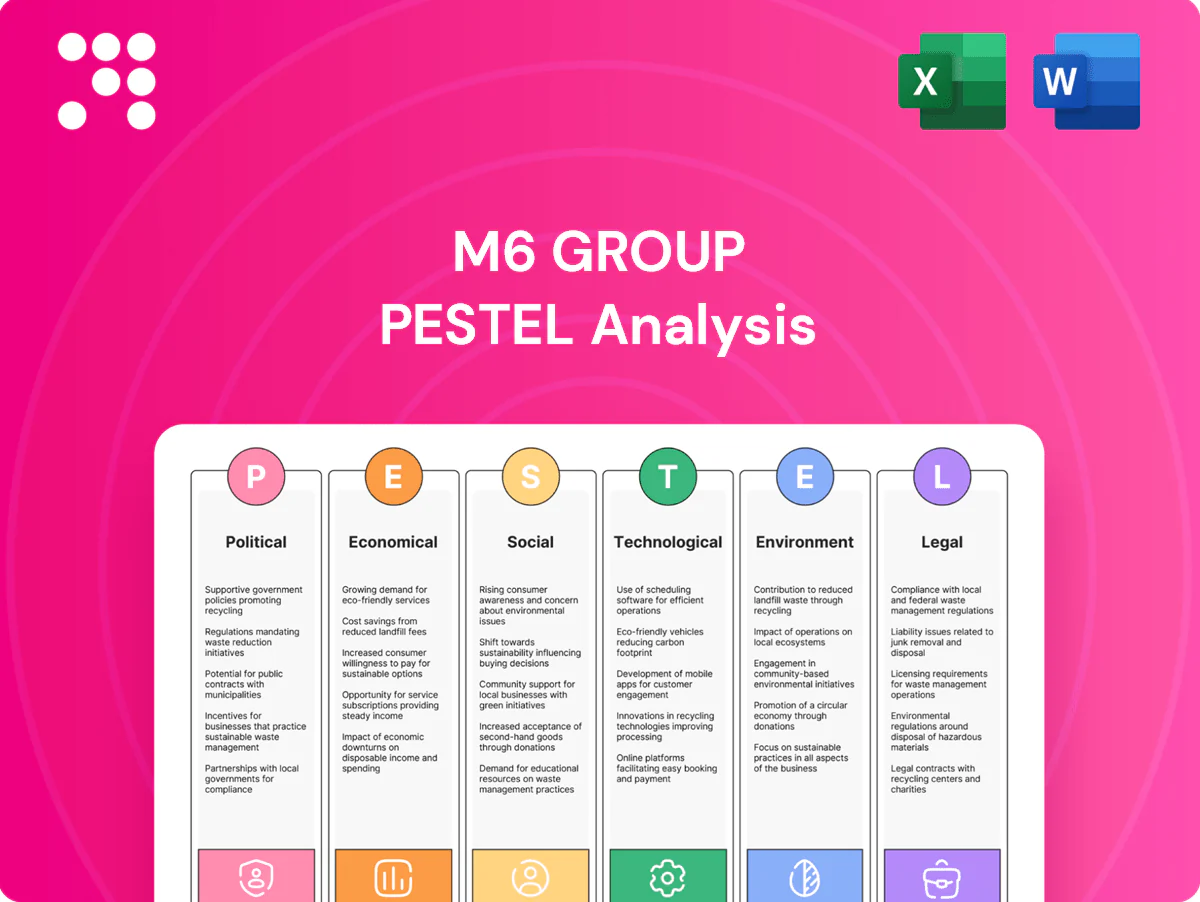
M6 Group PESTLE Analysis

Plan Smarter. Present Sharper. Compete Stronger.
Discover how political, economic and technological forces shape M6 Group’s strategic options. Our concise PESTLE highlights regulatory risks, audience trends, and digital disruption, revealing threats and growth levers. Ideal for investors and strategists—buy the full analysis to get the complete, editable report now.
Political factors

French media regulation and ARCOM oversight
ARCOM, created 1 January 2022, enforces licensing terms, content quotas and scheduling rules that directly shape M6 Group programming and available ad inventory; France's TV ad market was roughly €3.0bn in 2023, so changes to minutes materially affect revenue. ARCOM rulings can alter prime-time formats, advertising minutes and minor-protection obligations, forcing programming redispatch and added compliance costs. Policy shifts often privilege public‑service aims over commercial optimisation, reducing scheduling flexibility and impacting cost structure.
EU policy on media pluralism and platform power
Brussels initiatives such as the AVMSD (requires on-demand services to allocate at least 30% catalogue share to European works) and the Digital Markets Act (non-compliance can trigger fines up to 10% of global turnover) shift distribution leverage toward European suppliers while imposing platform accountability. These rules can boost discoverability on smart TVs and app stores but add ongoing compliance reporting costs. They also strengthen M6 Group’s negotiating position with Big Tech intermediaries.

Public broadcaster funding and competitive dynamics
Changes to France Télévisions funding—about €3.2 billion annually—and ad rules reshape the ad market: fewer public ads tend to redirect budgets to private channels, while expanded public mandates can crowd out M6. Political debate over culture and sport rights raises bidding pressure, squeezing M6 margins and forcing shifts in programming mix.

Election cycles and political advertising constraints
Strict campaign-period rules limit rate setting and inventory use; French law enforces a 24-hour campaign silence and parity obligations, constraining programmatic sales. Elections drive audience spikes—France 2022 presidential debate drew 17.1 million viewers—yet monetization is often capped and operational costs rise due to compliance. News impartiality and equal-time requirements add scheduling complexity and documentation burdens.
- Blackout: 24-hour silence before vote
- Audience spike: 17.1M (2022 debate)
- Revenue cap risk from regulated slots
- Increased compliance documentation & ops
Geopolitical tensions and sanctions exposure
Geopolitical tensions and sanctions have dented advertiser confidence, with autos, luxury and travel clients known to cut media budgets by 10–20% during crises, pressuring M6 Group’s spot and sponsorship revenues; sanctions and shifting trade flows since 2022 have reshaped multinational ad spend in France, concentrating risk among export-focused advertisers. News sensitivities amplify brand-safety pullbacks, creating short-term budget volatility that requires agile pricing and a diversified client mix.
- Advertiser cuts: 10–20% in affected sectors
- Sanctions concentrate risk in multinational spend
- Brand-safety triggers rapid pause of campaigns
- Need: agile pricing + diversified client base
Regulation and public funding reshape French TV ad market, margins squeezed despite 17.1M peak
ARCOM (since 1 Jan 2022), AVMSD and DMA constrain M6 scheduling, ad minutes and add compliance costs; France TV ad market ~€3.0bn (2023). France Télévisions funding ~€3.2bn shifts ad flows and intensifies rights bidding, squeezing margins. Election blackout and impartiality rules limit monetization despite audience spikes (17.1M in 2022).
| Metric | Value |
|---|---|
| TV ad market (2023) | €3.0bn |
| France TV funding | €3.2bn |
| 2022 debate peak | 17.1M |
What is included in the product
 Detailed Word Document
Offers a concise PESTLE assessment of M6 Group, examining Political, Economic, Social, Technological, Environmental and Legal forces with data-driven examples and trend context. Tailored for executives and investors, it highlights risks, opportunities and forward-looking implications to inform strategy and funding decisions.

 Customizable Excel Spreadsheet
A concise, visually segmented PESTLE summary of M6 Group that streamlines external risk review for meetings, is easily editable for region- or business-specific notes, and drop-ready for presentations to align teams quickly.
Economic factors

Cyclicality of TV advertising demand
TV advertising for M6 is highly cyclical, tracking GDP, consumer confidence and retail sales and often falling by double digits in severe downturns (eg 2020 COVID). Downturns compress CPMs and reduce sell-through, while flagship sports events (World Cup/Euros) can temporarily restore CPMs and volumes. By 2024–25 broadcasters pushed larger digital and addressable inventory to smooth revenue volatility.
Subscription and content sales resilience
Pay-TV and digital subscriptions deliver recurring cash flow for M6 Group but remain exposed to churn in tighter consumer markets, pressuring growth. Bundling and tiered pricing strategies have been used to stabilize ARPU and reduce voluntary churn. Content licensing to third parties generates high-margin revenue streams that diversify income beyond advertising. Future pipeline strength hinges on hit rates and catalog depth to sustain licensing and subscriber retention.

Inflation in content and sports rights
Rights inflation is pushing bid levels up—sports/content rights costs rose roughly 15–20% year-on-year in 2023–24, squeezing M6 Group EBITDA and forcing stricter bidding discipline. Production costs (wages, energy, sets) increased ~8–12% over 2022–24, raising break-even thresholds. Hedging, co-productions and output deals can mitigate exposure, but streamer competition keeps prices elevated; ROI tracking per property is therefore essential.

FX and interest rate impacts
M6 Group has notable EUR/USD exposure as content and tech contracts are frequently USD-linked; with EUR/USD near 1.10 in mid‑2025 this can swing revenue and margins. Higher interest rates (ECB policy ~4.0% in mid‑2025) raise capex and acquisition financing costs, increasing WACC and deal sensitivity. Cash management and fixed–floating debt mix drive earnings stability; suppliers can reprice quickly if currency moves persist.
- FX exposure: USD-linked contracts, EUR/USD ~1.10 (mid‑2025)
- Rates: ECB ~4.0% → higher financing costs
- Liquidity: cash mix + fixed/floating debt affect volatility
- Supply risk: vendors may reprice on currency swings
Shift to digital and programmatic ad spend
- Digital spend 2024 ~600B global
- Programmatic ~70% of display
- CTV spend +25% YoY 2024
- Need hybrid direct+automation salesforce
Regulation and public funding reshape French TV ad market, margins squeezed despite 17.1M peak
Ad revenue cyclical with GDP; TV ad falls double digits in downturns (eg 2020), digital spend ~$600B (2024) cushions mix. Subscriptions give recurring cash but face churn; CTV spend +25% YoY (2024) aids ARPU. Rights costs +15–20% (2023–24) and production +8–12% (2022–24) squeeze margins. FX EUR/USD ~1.10 (mid‑2025) and ECB rate ~4.0% lift financing costs.
| Metric | Value |
|---|---|
| Global digital ad spend (2024) | $600B |
| CTV growth (2024) | +25% YoY |
| Rights inflation (2023–24) | +15–20% |
| EUR/USD (mid‑2025) | ~1.10 |
| ECB rate (mid‑2025) | ~4.0% |
What You See Is What You Get
M6 Group PESTLE Analysis
This M6 Group PESTLE Analysis preview is the exact, fully formatted document you’ll receive after purchase, with no placeholders or edits needed. It clearly presents political, economic, social, technological, legal and environmental factors affecting M6 Group. The layout and content shown are ready to download and use immediately upon checkout.

Plan Smarter. Present Sharper. Compete Stronger.
Discover how political, economic and technological forces shape M6 Group’s strategic options. Our concise PESTLE highlights regulatory risks, audience trends, and digital disruption, revealing threats and growth levers. Ideal for investors and strategists—buy the full analysis to get the complete, editable report now.
Political factors
French media regulation and ARCOM oversight
ARCOM, created 1 January 2022, enforces licensing terms, content quotas and scheduling rules that directly shape M6 Group programming and available ad inventory; France's TV ad market was roughly €3.0bn in 2023, so changes to minutes materially affect revenue. ARCOM rulings can alter prime-time formats, advertising minutes and minor-protection obligations, forcing programming redispatch and added compliance costs. Policy shifts often privilege public‑service aims over commercial optimisation, reducing scheduling flexibility and impacting cost structure.
EU policy on media pluralism and platform power
Brussels initiatives such as the AVMSD (requires on-demand services to allocate at least 30% catalogue share to European works) and the Digital Markets Act (non-compliance can trigger fines up to 10% of global turnover) shift distribution leverage toward European suppliers while imposing platform accountability. These rules can boost discoverability on smart TVs and app stores but add ongoing compliance reporting costs. They also strengthen M6 Group’s negotiating position with Big Tech intermediaries.
Public broadcaster funding and competitive dynamics
Changes to France Télévisions funding—about €3.2 billion annually—and ad rules reshape the ad market: fewer public ads tend to redirect budgets to private channels, while expanded public mandates can crowd out M6. Political debate over culture and sport rights raises bidding pressure, squeezing M6 margins and forcing shifts in programming mix.
Election cycles and political advertising constraints
Strict campaign-period rules limit rate setting and inventory use; French law enforces a 24-hour campaign silence and parity obligations, constraining programmatic sales. Elections drive audience spikes—France 2022 presidential debate drew 17.1 million viewers—yet monetization is often capped and operational costs rise due to compliance. News impartiality and equal-time requirements add scheduling complexity and documentation burdens.
- Blackout: 24-hour silence before vote
- Audience spike: 17.1M (2022 debate)
- Revenue cap risk from regulated slots
- Increased compliance documentation & ops
Geopolitical tensions and sanctions exposure
Geopolitical tensions and sanctions have dented advertiser confidence, with autos, luxury and travel clients known to cut media budgets by 10–20% during crises, pressuring M6 Group’s spot and sponsorship revenues; sanctions and shifting trade flows since 2022 have reshaped multinational ad spend in France, concentrating risk among export-focused advertisers. News sensitivities amplify brand-safety pullbacks, creating short-term budget volatility that requires agile pricing and a diversified client mix.
- Advertiser cuts: 10–20% in affected sectors
- Sanctions concentrate risk in multinational spend
- Brand-safety triggers rapid pause of campaigns
- Need: agile pricing + diversified client base
Regulation and public funding reshape French TV ad market, margins squeezed despite 17.1M peak
ARCOM (since 1 Jan 2022), AVMSD and DMA constrain M6 scheduling, ad minutes and add compliance costs; France TV ad market ~€3.0bn (2023). France Télévisions funding ~€3.2bn shifts ad flows and intensifies rights bidding, squeezing margins. Election blackout and impartiality rules limit monetization despite audience spikes (17.1M in 2022).
| Metric | Value |
|---|---|
| TV ad market (2023) | €3.0bn |
| France TV funding | €3.2bn |
| 2022 debate peak | 17.1M |
What is included in the product
Detailed Word Document
Offers a concise PESTLE assessment of M6 Group, examining Political, Economic, Social, Technological, Environmental and Legal forces with data-driven examples and trend context. Tailored for executives and investors, it highlights risks, opportunities and forward-looking implications to inform strategy and funding decisions.
Customizable Excel Spreadsheet
A concise, visually segmented PESTLE summary of M6 Group that streamlines external risk review for meetings, is easily editable for region- or business-specific notes, and drop-ready for presentations to align teams quickly.
Economic factors
Cyclicality of TV advertising demand
TV advertising for M6 is highly cyclical, tracking GDP, consumer confidence and retail sales and often falling by double digits in severe downturns (eg 2020 COVID). Downturns compress CPMs and reduce sell-through, while flagship sports events (World Cup/Euros) can temporarily restore CPMs and volumes. By 2024–25 broadcasters pushed larger digital and addressable inventory to smooth revenue volatility.
Subscription and content sales resilience
Pay-TV and digital subscriptions deliver recurring cash flow for M6 Group but remain exposed to churn in tighter consumer markets, pressuring growth. Bundling and tiered pricing strategies have been used to stabilize ARPU and reduce voluntary churn. Content licensing to third parties generates high-margin revenue streams that diversify income beyond advertising. Future pipeline strength hinges on hit rates and catalog depth to sustain licensing and subscriber retention.
Inflation in content and sports rights
Rights inflation is pushing bid levels up—sports/content rights costs rose roughly 15–20% year-on-year in 2023–24, squeezing M6 Group EBITDA and forcing stricter bidding discipline. Production costs (wages, energy, sets) increased ~8–12% over 2022–24, raising break-even thresholds. Hedging, co-productions and output deals can mitigate exposure, but streamer competition keeps prices elevated; ROI tracking per property is therefore essential.
FX and interest rate impacts
M6 Group has notable EUR/USD exposure as content and tech contracts are frequently USD-linked; with EUR/USD near 1.10 in mid‑2025 this can swing revenue and margins. Higher interest rates (ECB policy ~4.0% in mid‑2025) raise capex and acquisition financing costs, increasing WACC and deal sensitivity. Cash management and fixed–floating debt mix drive earnings stability; suppliers can reprice quickly if currency moves persist.
- FX exposure: USD-linked contracts, EUR/USD ~1.10 (mid‑2025)
- Rates: ECB ~4.0% → higher financing costs
- Liquidity: cash mix + fixed/floating debt affect volatility
- Supply risk: vendors may reprice on currency swings
Shift to digital and programmatic ad spend
- Digital spend 2024 ~600B global
- Programmatic ~70% of display
- CTV spend +25% YoY 2024
- Need hybrid direct+automation salesforce
Regulation and public funding reshape French TV ad market, margins squeezed despite 17.1M peak
Ad revenue cyclical with GDP; TV ad falls double digits in downturns (eg 2020), digital spend ~$600B (2024) cushions mix. Subscriptions give recurring cash but face churn; CTV spend +25% YoY (2024) aids ARPU. Rights costs +15–20% (2023–24) and production +8–12% (2022–24) squeeze margins. FX EUR/USD ~1.10 (mid‑2025) and ECB rate ~4.0% lift financing costs.
| Metric | Value |
|---|---|
| Global digital ad spend (2024) | $600B |
| CTV growth (2024) | +25% YoY |
| Rights inflation (2023–24) | +15–20% |
| EUR/USD (mid‑2025) | ~1.10 |
| ECB rate (mid‑2025) | ~4.0% |
What You See Is What You Get
M6 Group PESTLE Analysis
This M6 Group PESTLE Analysis preview is the exact, fully formatted document you’ll receive after purchase, with no placeholders or edits needed. It clearly presents political, economic, social, technological, legal and environmental factors affecting M6 Group. The layout and content shown are ready to download and use immediately upon checkout.
Original: $10.00
-65%$10.00
$3.50Description
Plan Smarter. Present Sharper. Compete Stronger.
Discover how political, economic and technological forces shape M6 Group’s strategic options. Our concise PESTLE highlights regulatory risks, audience trends, and digital disruption, revealing threats and growth levers. Ideal for investors and strategists—buy the full analysis to get the complete, editable report now.
Political factors
French media regulation and ARCOM oversight
ARCOM, created 1 January 2022, enforces licensing terms, content quotas and scheduling rules that directly shape M6 Group programming and available ad inventory; France's TV ad market was roughly €3.0bn in 2023, so changes to minutes materially affect revenue. ARCOM rulings can alter prime-time formats, advertising minutes and minor-protection obligations, forcing programming redispatch and added compliance costs. Policy shifts often privilege public‑service aims over commercial optimisation, reducing scheduling flexibility and impacting cost structure.
EU policy on media pluralism and platform power
Brussels initiatives such as the AVMSD (requires on-demand services to allocate at least 30% catalogue share to European works) and the Digital Markets Act (non-compliance can trigger fines up to 10% of global turnover) shift distribution leverage toward European suppliers while imposing platform accountability. These rules can boost discoverability on smart TVs and app stores but add ongoing compliance reporting costs. They also strengthen M6 Group’s negotiating position with Big Tech intermediaries.
Public broadcaster funding and competitive dynamics
Changes to France Télévisions funding—about €3.2 billion annually—and ad rules reshape the ad market: fewer public ads tend to redirect budgets to private channels, while expanded public mandates can crowd out M6. Political debate over culture and sport rights raises bidding pressure, squeezing M6 margins and forcing shifts in programming mix.
Election cycles and political advertising constraints
Strict campaign-period rules limit rate setting and inventory use; French law enforces a 24-hour campaign silence and parity obligations, constraining programmatic sales. Elections drive audience spikes—France 2022 presidential debate drew 17.1 million viewers—yet monetization is often capped and operational costs rise due to compliance. News impartiality and equal-time requirements add scheduling complexity and documentation burdens.
- Blackout: 24-hour silence before vote
- Audience spike: 17.1M (2022 debate)
- Revenue cap risk from regulated slots
- Increased compliance documentation & ops
Geopolitical tensions and sanctions exposure
Geopolitical tensions and sanctions have dented advertiser confidence, with autos, luxury and travel clients known to cut media budgets by 10–20% during crises, pressuring M6 Group’s spot and sponsorship revenues; sanctions and shifting trade flows since 2022 have reshaped multinational ad spend in France, concentrating risk among export-focused advertisers. News sensitivities amplify brand-safety pullbacks, creating short-term budget volatility that requires agile pricing and a diversified client mix.
- Advertiser cuts: 10–20% in affected sectors
- Sanctions concentrate risk in multinational spend
- Brand-safety triggers rapid pause of campaigns
- Need: agile pricing + diversified client base
Regulation and public funding reshape French TV ad market, margins squeezed despite 17.1M peak
ARCOM (since 1 Jan 2022), AVMSD and DMA constrain M6 scheduling, ad minutes and add compliance costs; France TV ad market ~€3.0bn (2023). France Télévisions funding ~€3.2bn shifts ad flows and intensifies rights bidding, squeezing margins. Election blackout and impartiality rules limit monetization despite audience spikes (17.1M in 2022).
| Metric | Value |
|---|---|
| TV ad market (2023) | €3.0bn |
| France TV funding | €3.2bn |
| 2022 debate peak | 17.1M |
What is included in the product
Detailed Word Document
Offers a concise PESTLE assessment of M6 Group, examining Political, Economic, Social, Technological, Environmental and Legal forces with data-driven examples and trend context. Tailored for executives and investors, it highlights risks, opportunities and forward-looking implications to inform strategy and funding decisions.
Customizable Excel Spreadsheet
A concise, visually segmented PESTLE summary of M6 Group that streamlines external risk review for meetings, is easily editable for region- or business-specific notes, and drop-ready for presentations to align teams quickly.
Economic factors
Cyclicality of TV advertising demand
TV advertising for M6 is highly cyclical, tracking GDP, consumer confidence and retail sales and often falling by double digits in severe downturns (eg 2020 COVID). Downturns compress CPMs and reduce sell-through, while flagship sports events (World Cup/Euros) can temporarily restore CPMs and volumes. By 2024–25 broadcasters pushed larger digital and addressable inventory to smooth revenue volatility.
Subscription and content sales resilience
Pay-TV and digital subscriptions deliver recurring cash flow for M6 Group but remain exposed to churn in tighter consumer markets, pressuring growth. Bundling and tiered pricing strategies have been used to stabilize ARPU and reduce voluntary churn. Content licensing to third parties generates high-margin revenue streams that diversify income beyond advertising. Future pipeline strength hinges on hit rates and catalog depth to sustain licensing and subscriber retention.
Inflation in content and sports rights
Rights inflation is pushing bid levels up—sports/content rights costs rose roughly 15–20% year-on-year in 2023–24, squeezing M6 Group EBITDA and forcing stricter bidding discipline. Production costs (wages, energy, sets) increased ~8–12% over 2022–24, raising break-even thresholds. Hedging, co-productions and output deals can mitigate exposure, but streamer competition keeps prices elevated; ROI tracking per property is therefore essential.
FX and interest rate impacts
M6 Group has notable EUR/USD exposure as content and tech contracts are frequently USD-linked; with EUR/USD near 1.10 in mid‑2025 this can swing revenue and margins. Higher interest rates (ECB policy ~4.0% in mid‑2025) raise capex and acquisition financing costs, increasing WACC and deal sensitivity. Cash management and fixed–floating debt mix drive earnings stability; suppliers can reprice quickly if currency moves persist.
- FX exposure: USD-linked contracts, EUR/USD ~1.10 (mid‑2025)
- Rates: ECB ~4.0% → higher financing costs
- Liquidity: cash mix + fixed/floating debt affect volatility
- Supply risk: vendors may reprice on currency swings
Shift to digital and programmatic ad spend
- Digital spend 2024 ~600B global
- Programmatic ~70% of display
- CTV spend +25% YoY 2024
- Need hybrid direct+automation salesforce
Regulation and public funding reshape French TV ad market, margins squeezed despite 17.1M peak
Ad revenue cyclical with GDP; TV ad falls double digits in downturns (eg 2020), digital spend ~$600B (2024) cushions mix. Subscriptions give recurring cash but face churn; CTV spend +25% YoY (2024) aids ARPU. Rights costs +15–20% (2023–24) and production +8–12% (2022–24) squeeze margins. FX EUR/USD ~1.10 (mid‑2025) and ECB rate ~4.0% lift financing costs.
| Metric | Value |
|---|---|
| Global digital ad spend (2024) | $600B |
| CTV growth (2024) | +25% YoY |
| Rights inflation (2023–24) | +15–20% |
| EUR/USD (mid‑2025) | ~1.10 |
| ECB rate (mid‑2025) | ~4.0% |
What You See Is What You Get
M6 Group PESTLE Analysis
This M6 Group PESTLE Analysis preview is the exact, fully formatted document you’ll receive after purchase, with no placeholders or edits needed. It clearly presents political, economic, social, technological, legal and environmental factors affecting M6 Group. The layout and content shown are ready to download and use immediately upon checkout.











