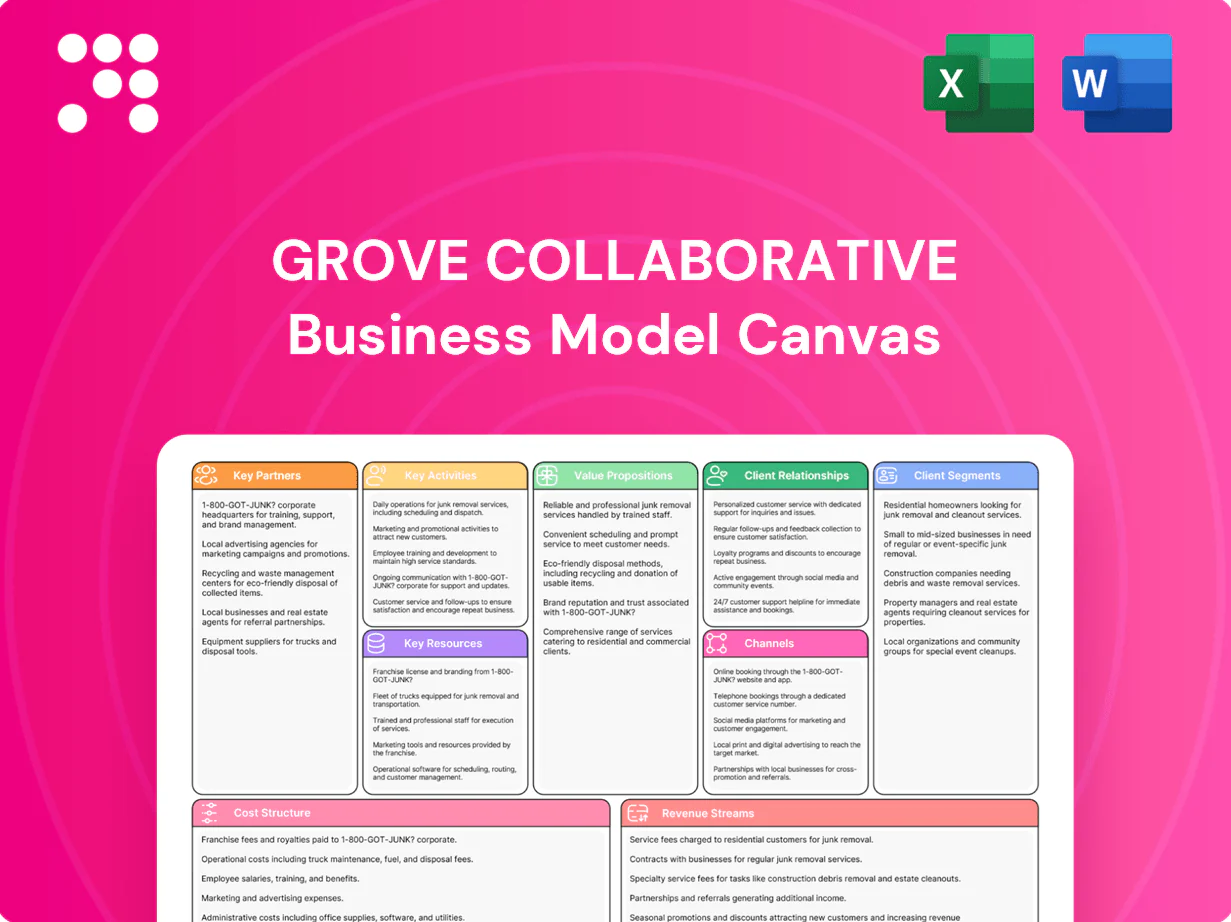
Grove Collaborative Business Model Canvas

Unlock the strategic Business Model Canvas to scale and monetize sustainable CPG growth
Unlock the full strategic blueprint behind Grove Collaborative with our in-depth Business Model Canvas—three to five actionable pages showing how value is created, scaled, and monetized. Perfect for entrepreneurs, investors, and consultants, the downloadable Word and Excel files include company-specific insights across all nine building blocks. Purchase the complete Canvas to benchmark, strategize, and accelerate decision-making today.
Partnerships

Ethical product suppliers
Partner with brands and manufacturers that meet strict environmental and sourcing standards, ensuring a steady supply of refillable, non-toxic, and cruelty-free products; Grove reported ramping such assortments as a core SKU strategy in recent years. Joint planning aligns launches with customer demand and reduces excess inventory, supporting cost control. Co-marketing with suppliers amplifies sustainable credentials and taps into rising consumer demand—66% of shoppers in 2024 prioritized sustainability when buying household products.
Eco-friendly packaging vendors
Partnering with eco-friendly packaging vendors sources recyclable, compostable (ASTM D6400, EN 13432, BPI) and minimal materials, reducing plastic use and material costs. Custom formats improve shipping density by up to 30% and lower damage rates through continuous design iteration, cutting per-unit carbon footprint. Certifications validate claims to customers and support premium pricing and retail placement.

Logistics and last-mile carriers
Partner with national and regional carriers such as UPS, FedEx and USPS plus regional last-mile specialists to optimize parcel e-commerce routes; contracts target 95%+ on-time delivery and sub-1% breakage rates through SLAs and specialized packaging. Carbon-offset and low-emission delivery options improve sustainability reporting and align with Grove’s net-zero goals. Real-time integrations into TMS/WMS yield end-to-end tracking and granular cost visibility for margin management.

Certification and compliance bodies
Work with organizations like B Corp and third-party labs to verify safety and sustainability, leveraging B Lab (over 7,000 certified companies as of 2024) and independent testing to validate claims. Audits and seals increase customer trust and reduce claims, while guidance helps maintain evolving regulatory compliance and shared standards streamline supplier onboarding.
- Third-party verification: labs, B Corp
- Trust lift: audits and seals
- Compliance: ongoing regulatory guidance
- Efficiency: shared standards for onboarding
Retail and marketplace partners
Selective distribution through retail and marketplace partnerships extends Grove Collaborative beyond its direct site, with marketplaces estimated to account for about 63% of global e-commerce GMV in 2024, widening discovery and scale. Co-branded assortments introduce private-label items to new audiences while data sharing with partners improves demand planning and inventory turns. Incremental channels diversify revenue and reduce dependence on the website, enhancing resilience.
- Selective distribution: broader reach via marketplaces
- Co-branded assortments: private-label exposure
- Data sharing: improved demand planning
- Incremental channels: diversified revenue
Refillable, compostable SKUs: 30% density boost, 95%+ on-time
Partner with eco brands and manufacturers to secure refillable, non-toxic SKUs; 66% of shoppers prioritized sustainability in 2024. Work with packaging vendors for ASTM/EN/BPI compostable formats, improving density up to 30%. Use carriers and TMS/WMS integrations to target 95%+ on-time delivery and support net-zero goals.
| Partner | KPI | 2024 |
|---|---|---|
| Consumers | Sustainability preference | 66% |
| Marketplaces | e‑commerce GMV share | 63% |
| B Lab | Certified companies | 7,000+ |
| Logistics | On‑time target | 95%+ |
What is included in the product
 Detailed Word Document
A comprehensive Business Model Canvas for Grove Collaborative detailing customer segments, channels, value propositions, revenue streams and operations tied to sustainable personal-care products; organized into 9 BMC blocks with SWOT, competitive advantages and investor-ready insights for strategy, presentations and validation.

 Customizable Excel Spreadsheet
High-level view of Grove Collaborative’s business model with editable cells to quickly identify core components and condense subscription, DTC, and sustainability strategies into a digestible one-page snapshot—shareable for fast collaboration, boardroom-ready, and saves hours of formatting for comparisons or executive summaries.
Activities

Sustainable product curation
Sustainable product curation evaluates items against non-toxic, cruelty-free, and low-waste criteria, balancing third-party brands with private-label development to keep private-label share near 30% of assortment while avoiding greenwashing. The catalog remains focused and limited, refreshed quarterly based on A/B testing and customer feedback; 62% of US shoppers cited sustainability as a purchase driver in 2024, guiding SKU rationalization.
Subscription and reorder management
In 2024 Grove Collaborative runs flexible autoship plans with editable frequencies, enabling customers to pause, skip or change cadence in-app. Robust reminder, skip and add-on flows target churn reduction and recovery of at-risk subscribers. Recurring-demand forecasts feed inventory planning to minimize stockouts and carrying costs. Personalized cart recommendations and targeted add-ons drive higher average order value and subscription depth.

E-commerce operations and fulfillment
Run the storefront end-to-end: payments with fraud checks and 24/7 customer service, targeting fraud losses under 0.5% of GMV and checkout conversion ~2.3% (2024 e-commerce benchmark). Pick-pack-ship from optimized warehouses to meet delivery SLAs of 2–4 days and manage a returns rate of ~10–15% for household CPG. Continuously A/B test UX to lift checkout conversion and reduce cart abandonment.

Sustainability R&D and packaging
Performance marketing and community
Performance marketing acquires customers via search, social, influencers, and affiliates, leveraging influencer marketing momentum (global spend ~21.1B USD in 2023) to reach sustainable-home audiences.
Nurture uses email, SMS, and educational healthy-homes content to drive repeat purchases and CLTV; reviews and UGC boost trust and conversions.
Promotions are mission-aligned and margin-conscious, using targeted offers and LTV-based bidding to avoid margin erosion.
- Acquire: search, social, influencers, affiliates
- Nurture: email, SMS, content
- Trust: reviews, UGC
- Promos: mission-first, margin-aware
Private-label ~30% with 62% sustainability-driven shoppers
Sustainable curation (private-label ~30%) and quarterly SKU refreshes (62% of US shoppers cite sustainability in 2024) guide assortment. Flexible autoship with editable cadence boosts retention; forecasts minimize stockouts. End-to-end ops target checkout ~2.3%, fraud <0.5% GMV, 2–4 day SLAs and 10–15% returns.
| Metric | 2024 |
|---|---|
| Private-label | ~30% |
| Sustainability driver | 62% |
| Checkout conv. | ~2.3% |
| Fraud | <0.5% GMV |
Delivered as Displayed
Business Model Canvas
The Grove Collaborative Business Model Canvas you’re previewing is the exact deliverable, not a mockup. When you purchase, you’ll receive this same document—fully formatted and complete—ready to edit and present. The file is delivered exactly as shown for immediate use.

Unlock the strategic Business Model Canvas to scale and monetize sustainable CPG growth
Unlock the full strategic blueprint behind Grove Collaborative with our in-depth Business Model Canvas—three to five actionable pages showing how value is created, scaled, and monetized. Perfect for entrepreneurs, investors, and consultants, the downloadable Word and Excel files include company-specific insights across all nine building blocks. Purchase the complete Canvas to benchmark, strategize, and accelerate decision-making today.
Partnerships
Ethical product suppliers
Partner with brands and manufacturers that meet strict environmental and sourcing standards, ensuring a steady supply of refillable, non-toxic, and cruelty-free products; Grove reported ramping such assortments as a core SKU strategy in recent years. Joint planning aligns launches with customer demand and reduces excess inventory, supporting cost control. Co-marketing with suppliers amplifies sustainable credentials and taps into rising consumer demand—66% of shoppers in 2024 prioritized sustainability when buying household products.
Eco-friendly packaging vendors
Partnering with eco-friendly packaging vendors sources recyclable, compostable (ASTM D6400, EN 13432, BPI) and minimal materials, reducing plastic use and material costs. Custom formats improve shipping density by up to 30% and lower damage rates through continuous design iteration, cutting per-unit carbon footprint. Certifications validate claims to customers and support premium pricing and retail placement.
Logistics and last-mile carriers
Partner with national and regional carriers such as UPS, FedEx and USPS plus regional last-mile specialists to optimize parcel e-commerce routes; contracts target 95%+ on-time delivery and sub-1% breakage rates through SLAs and specialized packaging. Carbon-offset and low-emission delivery options improve sustainability reporting and align with Grove’s net-zero goals. Real-time integrations into TMS/WMS yield end-to-end tracking and granular cost visibility for margin management.
Certification and compliance bodies
Work with organizations like B Corp and third-party labs to verify safety and sustainability, leveraging B Lab (over 7,000 certified companies as of 2024) and independent testing to validate claims. Audits and seals increase customer trust and reduce claims, while guidance helps maintain evolving regulatory compliance and shared standards streamline supplier onboarding.
- Third-party verification: labs, B Corp
- Trust lift: audits and seals
- Compliance: ongoing regulatory guidance
- Efficiency: shared standards for onboarding
Retail and marketplace partners
Selective distribution through retail and marketplace partnerships extends Grove Collaborative beyond its direct site, with marketplaces estimated to account for about 63% of global e-commerce GMV in 2024, widening discovery and scale. Co-branded assortments introduce private-label items to new audiences while data sharing with partners improves demand planning and inventory turns. Incremental channels diversify revenue and reduce dependence on the website, enhancing resilience.
- Selective distribution: broader reach via marketplaces
- Co-branded assortments: private-label exposure
- Data sharing: improved demand planning
- Incremental channels: diversified revenue
Refillable, compostable SKUs: 30% density boost, 95%+ on-time
Partner with eco brands and manufacturers to secure refillable, non-toxic SKUs; 66% of shoppers prioritized sustainability in 2024. Work with packaging vendors for ASTM/EN/BPI compostable formats, improving density up to 30%. Use carriers and TMS/WMS integrations to target 95%+ on-time delivery and support net-zero goals.
| Partner | KPI | 2024 |
|---|---|---|
| Consumers | Sustainability preference | 66% |
| Marketplaces | e‑commerce GMV share | 63% |
| B Lab | Certified companies | 7,000+ |
| Logistics | On‑time target | 95%+ |
What is included in the product
Detailed Word Document
A comprehensive Business Model Canvas for Grove Collaborative detailing customer segments, channels, value propositions, revenue streams and operations tied to sustainable personal-care products; organized into 9 BMC blocks with SWOT, competitive advantages and investor-ready insights for strategy, presentations and validation.
Customizable Excel Spreadsheet
High-level view of Grove Collaborative’s business model with editable cells to quickly identify core components and condense subscription, DTC, and sustainability strategies into a digestible one-page snapshot—shareable for fast collaboration, boardroom-ready, and saves hours of formatting for comparisons or executive summaries.
Activities
Sustainable product curation
Sustainable product curation evaluates items against non-toxic, cruelty-free, and low-waste criteria, balancing third-party brands with private-label development to keep private-label share near 30% of assortment while avoiding greenwashing. The catalog remains focused and limited, refreshed quarterly based on A/B testing and customer feedback; 62% of US shoppers cited sustainability as a purchase driver in 2024, guiding SKU rationalization.
Subscription and reorder management
In 2024 Grove Collaborative runs flexible autoship plans with editable frequencies, enabling customers to pause, skip or change cadence in-app. Robust reminder, skip and add-on flows target churn reduction and recovery of at-risk subscribers. Recurring-demand forecasts feed inventory planning to minimize stockouts and carrying costs. Personalized cart recommendations and targeted add-ons drive higher average order value and subscription depth.
E-commerce operations and fulfillment
Run the storefront end-to-end: payments with fraud checks and 24/7 customer service, targeting fraud losses under 0.5% of GMV and checkout conversion ~2.3% (2024 e-commerce benchmark). Pick-pack-ship from optimized warehouses to meet delivery SLAs of 2–4 days and manage a returns rate of ~10–15% for household CPG. Continuously A/B test UX to lift checkout conversion and reduce cart abandonment.
Sustainability R&D and packaging
Performance marketing and community
Performance marketing acquires customers via search, social, influencers, and affiliates, leveraging influencer marketing momentum (global spend ~21.1B USD in 2023) to reach sustainable-home audiences.
Nurture uses email, SMS, and educational healthy-homes content to drive repeat purchases and CLTV; reviews and UGC boost trust and conversions.
Promotions are mission-aligned and margin-conscious, using targeted offers and LTV-based bidding to avoid margin erosion.
- Acquire: search, social, influencers, affiliates
- Nurture: email, SMS, content
- Trust: reviews, UGC
- Promos: mission-first, margin-aware
Private-label ~30% with 62% sustainability-driven shoppers
Sustainable curation (private-label ~30%) and quarterly SKU refreshes (62% of US shoppers cite sustainability in 2024) guide assortment. Flexible autoship with editable cadence boosts retention; forecasts minimize stockouts. End-to-end ops target checkout ~2.3%, fraud <0.5% GMV, 2–4 day SLAs and 10–15% returns.
| Metric | 2024 |
|---|---|
| Private-label | ~30% |
| Sustainability driver | 62% |
| Checkout conv. | ~2.3% |
| Fraud | <0.5% GMV |
Delivered as Displayed
Business Model Canvas
The Grove Collaborative Business Model Canvas you’re previewing is the exact deliverable, not a mockup. When you purchase, you’ll receive this same document—fully formatted and complete—ready to edit and present. The file is delivered exactly as shown for immediate use.
Original: $10.00
-65%$10.00
$3.50Description
Unlock the strategic Business Model Canvas to scale and monetize sustainable CPG growth
Unlock the full strategic blueprint behind Grove Collaborative with our in-depth Business Model Canvas—three to five actionable pages showing how value is created, scaled, and monetized. Perfect for entrepreneurs, investors, and consultants, the downloadable Word and Excel files include company-specific insights across all nine building blocks. Purchase the complete Canvas to benchmark, strategize, and accelerate decision-making today.
Partnerships
Ethical product suppliers
Partner with brands and manufacturers that meet strict environmental and sourcing standards, ensuring a steady supply of refillable, non-toxic, and cruelty-free products; Grove reported ramping such assortments as a core SKU strategy in recent years. Joint planning aligns launches with customer demand and reduces excess inventory, supporting cost control. Co-marketing with suppliers amplifies sustainable credentials and taps into rising consumer demand—66% of shoppers in 2024 prioritized sustainability when buying household products.
Eco-friendly packaging vendors
Partnering with eco-friendly packaging vendors sources recyclable, compostable (ASTM D6400, EN 13432, BPI) and minimal materials, reducing plastic use and material costs. Custom formats improve shipping density by up to 30% and lower damage rates through continuous design iteration, cutting per-unit carbon footprint. Certifications validate claims to customers and support premium pricing and retail placement.
Logistics and last-mile carriers
Partner with national and regional carriers such as UPS, FedEx and USPS plus regional last-mile specialists to optimize parcel e-commerce routes; contracts target 95%+ on-time delivery and sub-1% breakage rates through SLAs and specialized packaging. Carbon-offset and low-emission delivery options improve sustainability reporting and align with Grove’s net-zero goals. Real-time integrations into TMS/WMS yield end-to-end tracking and granular cost visibility for margin management.
Certification and compliance bodies
Work with organizations like B Corp and third-party labs to verify safety and sustainability, leveraging B Lab (over 7,000 certified companies as of 2024) and independent testing to validate claims. Audits and seals increase customer trust and reduce claims, while guidance helps maintain evolving regulatory compliance and shared standards streamline supplier onboarding.
- Third-party verification: labs, B Corp
- Trust lift: audits and seals
- Compliance: ongoing regulatory guidance
- Efficiency: shared standards for onboarding
Retail and marketplace partners
Selective distribution through retail and marketplace partnerships extends Grove Collaborative beyond its direct site, with marketplaces estimated to account for about 63% of global e-commerce GMV in 2024, widening discovery and scale. Co-branded assortments introduce private-label items to new audiences while data sharing with partners improves demand planning and inventory turns. Incremental channels diversify revenue and reduce dependence on the website, enhancing resilience.
- Selective distribution: broader reach via marketplaces
- Co-branded assortments: private-label exposure
- Data sharing: improved demand planning
- Incremental channels: diversified revenue
Refillable, compostable SKUs: 30% density boost, 95%+ on-time
Partner with eco brands and manufacturers to secure refillable, non-toxic SKUs; 66% of shoppers prioritized sustainability in 2024. Work with packaging vendors for ASTM/EN/BPI compostable formats, improving density up to 30%. Use carriers and TMS/WMS integrations to target 95%+ on-time delivery and support net-zero goals.
| Partner | KPI | 2024 |
|---|---|---|
| Consumers | Sustainability preference | 66% |
| Marketplaces | e‑commerce GMV share | 63% |
| B Lab | Certified companies | 7,000+ |
| Logistics | On‑time target | 95%+ |
What is included in the product
Detailed Word Document
A comprehensive Business Model Canvas for Grove Collaborative detailing customer segments, channels, value propositions, revenue streams and operations tied to sustainable personal-care products; organized into 9 BMC blocks with SWOT, competitive advantages and investor-ready insights for strategy, presentations and validation.
Customizable Excel Spreadsheet
High-level view of Grove Collaborative’s business model with editable cells to quickly identify core components and condense subscription, DTC, and sustainability strategies into a digestible one-page snapshot—shareable for fast collaboration, boardroom-ready, and saves hours of formatting for comparisons or executive summaries.
Activities
Sustainable product curation
Sustainable product curation evaluates items against non-toxic, cruelty-free, and low-waste criteria, balancing third-party brands with private-label development to keep private-label share near 30% of assortment while avoiding greenwashing. The catalog remains focused and limited, refreshed quarterly based on A/B testing and customer feedback; 62% of US shoppers cited sustainability as a purchase driver in 2024, guiding SKU rationalization.
Subscription and reorder management
In 2024 Grove Collaborative runs flexible autoship plans with editable frequencies, enabling customers to pause, skip or change cadence in-app. Robust reminder, skip and add-on flows target churn reduction and recovery of at-risk subscribers. Recurring-demand forecasts feed inventory planning to minimize stockouts and carrying costs. Personalized cart recommendations and targeted add-ons drive higher average order value and subscription depth.
E-commerce operations and fulfillment
Run the storefront end-to-end: payments with fraud checks and 24/7 customer service, targeting fraud losses under 0.5% of GMV and checkout conversion ~2.3% (2024 e-commerce benchmark). Pick-pack-ship from optimized warehouses to meet delivery SLAs of 2–4 days and manage a returns rate of ~10–15% for household CPG. Continuously A/B test UX to lift checkout conversion and reduce cart abandonment.
Sustainability R&D and packaging
Performance marketing and community
Performance marketing acquires customers via search, social, influencers, and affiliates, leveraging influencer marketing momentum (global spend ~21.1B USD in 2023) to reach sustainable-home audiences.
Nurture uses email, SMS, and educational healthy-homes content to drive repeat purchases and CLTV; reviews and UGC boost trust and conversions.
Promotions are mission-aligned and margin-conscious, using targeted offers and LTV-based bidding to avoid margin erosion.
- Acquire: search, social, influencers, affiliates
- Nurture: email, SMS, content
- Trust: reviews, UGC
- Promos: mission-first, margin-aware
Private-label ~30% with 62% sustainability-driven shoppers
Sustainable curation (private-label ~30%) and quarterly SKU refreshes (62% of US shoppers cite sustainability in 2024) guide assortment. Flexible autoship with editable cadence boosts retention; forecasts minimize stockouts. End-to-end ops target checkout ~2.3%, fraud <0.5% GMV, 2–4 day SLAs and 10–15% returns.
| Metric | 2024 |
|---|---|
| Private-label | ~30% |
| Sustainability driver | 62% |
| Checkout conv. | ~2.3% |
| Fraud | <0.5% GMV |
Delivered as Displayed
Business Model Canvas
The Grove Collaborative Business Model Canvas you’re previewing is the exact deliverable, not a mockup. When you purchase, you’ll receive this same document—fully formatted and complete—ready to edit and present. The file is delivered exactly as shown for immediate use.











