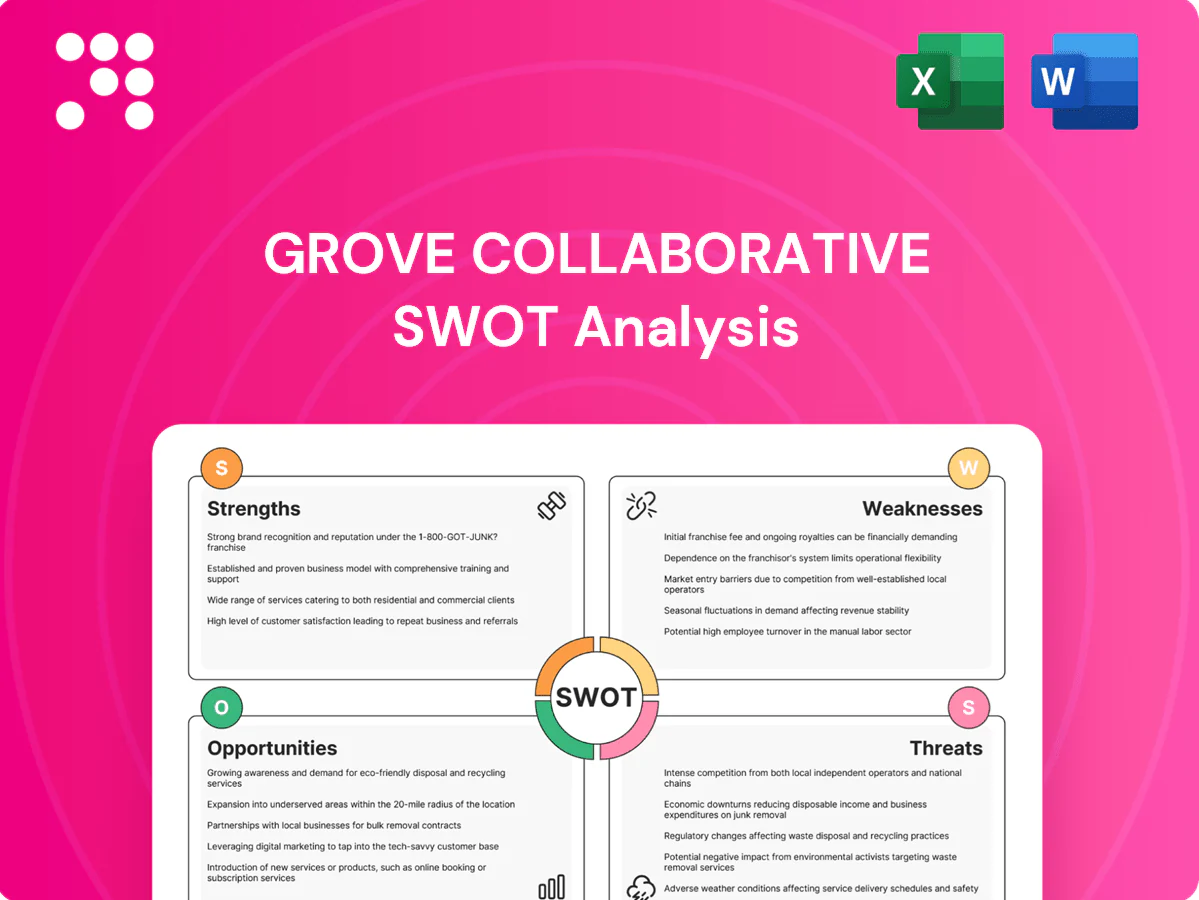
Grove Collaborative SWOT Analysis

Dive Deeper Into the Company’s Strategic Blueprint
Grove Collaborative combines a strong sustainable brand and DTC subscription model with data-driven customer retention, but faces margin pressure, intense retail competition, and supply-chain risks. Our full SWOT dissects these dynamics, quantifies financial implications, and highlights strategic options. Purchase the complete, editable SWOT (Word + Excel) to turn insights into action for investment or planning.
Strengths

Mission-driven sustainability brand
Mission-driven sustainability brand clearly differentiates Grove Collaborative in crowded home and personal care markets by focusing on refillable products and sustainable packaging since its founding in 2012. Values-led positioning builds trust and loyalty with conscious consumers and supports strong repeat rates. Certifications and transparent sourcing strengthen credibility and enable premium pricing and advocacy-led growth.
Subscription-led recurring revenue
Grove Collaborative’s subscription-led auto-ship model creates predictable demand and tighter inventory planning, supporting restock cadence and fewer stockouts. Regular deliveries drive higher lifetime value and cart consolidation, with the company reporting $244.9 million revenue in FY2021. Subscription cadence enables personalized replenishment cycles, and stable recurring revenue allows more efficient marketing spend and lower acquisition costs per customer.

Curated, eco-friendly assortment
Grove Collaborative's curated, eco-friendly assortment reduces choice overload and highlights vetted products, boosting conversion by simplifying decision-making. Emphasis on non-toxic, refillable and low-waste SKUs aligns with consumer trends—73% of shoppers say sustainability influences purchases. A streamlined catalog eases discovery and enables high-margin upsell bundles, while trusted curation lowers perceived trial risk and improves retention.

Growing owned brands and margins
Growing owned brands and margins: Grove Collaborative’s private-label strategy increases gross-margin capture by eliminating intermediary markups while enabling tighter quality control; unique refill formats and concentrated formulations drive repeat purchase and lower unit costs. Brand ownership shortens innovation cycles and differentiated SKUs reduce direct price-comparison pressure, supporting margin resilience.
- Private-label margin capture
- Refill-driven repeat purchases
- Faster innovation cycle
- SKU differentiation limits price competition
Direct-to-consumer data advantage
Direct-to-consumer first-party data powers personalized replenishment timing and offers, feeding product development and merchandising decisions, while continuous feedback loops improve retention and reduce churn and cohort analytics enable targeted promotions and pricing tests.
- First-party data: personalization & timing
- Product & merchandising insights
- Feedback loops: retention up
- Cohorts: targeted promos/pricing
Sustainability-driven subscriptions deliver predictable revenue and higher customer LTV
Mission-driven, sustainability-first positioning and certifications drive loyalty and premium pricing; subscription auto-ship delivers predictable recurring revenue (reported $244.9M revenue in FY2021) and higher LTV; private-label refill SKUs improve margins and speed innovation; first-party data enables personalized replenishment and targeted retention.
| Metric | Value |
|---|---|
| Founded | 2012 |
| FY2021 revenue | $244.9M |
| Shoppers influenced by sustainability | 73% |
What is included in the product
 Detailed Word Document
Provides a concise SWOT analysis of Grove Collaborative, highlighting internal capabilities and operational weaknesses alongside market opportunities in sustainable consumer trends and competitive threats from larger retailers and supply-chain volatility.

 Customizable Excel Spreadsheet
Provides a concise, visual Grove Collaborative SWOT matrix to relieve analysis bottlenecks and speed strategic alignment across teams.
Weaknesses

Premium price sensitivity
Eco-friendly products often carry premiums, and a 2024 Mintel survey found 48% of US shoppers cite price as a key barrier to buying sustainable household goods. Grove’s higher price points slow conversion of mainstream shoppers, pushing the brand toward promotions that erode margins and raise unit economics risk. Continuous value communication and measurable impact claims are required to justify the premium and defend retention.
Churn risk in subscriptions
Customer skip and cancel behaviors can destabilize forecasts: Recurly 2024 benchmarks cite median monthly churn around 3.2%, amplifying volatility for unit economics. Overstuffed pantries drive paused shipments—merchant data in 2024 showed skip/pause rates often between 15–25%, disrupting cadence. Seasonal usage further complicates recurring demand, and retention hinges on sustained perceived value and product novelty to limit churn.

High fulfillment and packaging costs
Shipping liquids and fragile containers drives higher damage rates and handling costs, with fragile/liquid return rates around 3–5% versus ~1% for non-fragile items, increasing claims and reverse-logistics spend.
Sustainable packaging carries a 15–25% cost premium over standard options, squeezing margins.
Distributed order profiles reduce picking efficiency and can raise per-order fulfillment costs by ~10–20%.
Last-mile emissions targets—last-mile represents roughly half of delivery CO2—add routing, fleet investment and operational complexity.

Scale disadvantage vs mass retailers
Giants like Amazon, Target and Walmart undercut on price and speed, with Amazon holding roughly 40% of US e-commerce, squeezing Grove's pricing power. Limited bargaining power raises input and freight costs versus national chains, widening margin pressure. Securing ad inventory and shelf space is harder and brand awareness demands outsized marketing spend.
- Price/speed pressure: Amazon ~40% US e-commerce
- Higher input/freight costs vs majors
- Ad/shelf access constrained
- Marketing spend well above category average
Category commoditization risk
Cleaning and personal care are inherently low-differentiation categories, exposing Grove Collaborative to fast-following private-label competitors that can replicate formats and formulations quickly; benefits like scent, texture and efficacy are difficult to signal online without trial, keeping customer trial rates and retention pressures high. Modest switching costs and broad retailer/private-label presence compress pricing power and margin resilience.
Premium pricing squeezes margins as subscription churn and platform dominance bite
Premium pricing deters mainstream buyers: 48% cite cost as a barrier (Mintel 2024), pressuring promotions and margins.
Subscription volatility raises unit-economics risk: median churn ~3.2% (Recurly 2024); skip/pause 15–25% (merchant data 2024).
Competitive and input pressures compress margins: Amazon ~40% US e-commerce (2024); sustainable packaging +15–25% cost.
| Metric | Value |
|---|---|
| Price barrier | 48% (Mintel 2024) |
| Median churn | 3.2% (Recurly 2024) |
| Skip/pause | 15–25% (2024) |
| Amazon share | ~40% (2024) |
| Packaging premium | 15–25% |
Full Version Awaits
Grove Collaborative SWOT Analysis
This is the actual Grove Collaborative SWOT analysis document you’ll receive upon purchase—no surprises, just professional quality. The preview below is taken directly from the full SWOT report you'll get. Purchase unlocks the entire in-depth, editable version. You’re viewing a live preview of the real file; full content is available after checkout.

Dive Deeper Into the Company’s Strategic Blueprint
Grove Collaborative combines a strong sustainable brand and DTC subscription model with data-driven customer retention, but faces margin pressure, intense retail competition, and supply-chain risks. Our full SWOT dissects these dynamics, quantifies financial implications, and highlights strategic options. Purchase the complete, editable SWOT (Word + Excel) to turn insights into action for investment or planning.
Strengths
Mission-driven sustainability brand
Mission-driven sustainability brand clearly differentiates Grove Collaborative in crowded home and personal care markets by focusing on refillable products and sustainable packaging since its founding in 2012. Values-led positioning builds trust and loyalty with conscious consumers and supports strong repeat rates. Certifications and transparent sourcing strengthen credibility and enable premium pricing and advocacy-led growth.
Subscription-led recurring revenue
Grove Collaborative’s subscription-led auto-ship model creates predictable demand and tighter inventory planning, supporting restock cadence and fewer stockouts. Regular deliveries drive higher lifetime value and cart consolidation, with the company reporting $244.9 million revenue in FY2021. Subscription cadence enables personalized replenishment cycles, and stable recurring revenue allows more efficient marketing spend and lower acquisition costs per customer.
Curated, eco-friendly assortment
Grove Collaborative's curated, eco-friendly assortment reduces choice overload and highlights vetted products, boosting conversion by simplifying decision-making. Emphasis on non-toxic, refillable and low-waste SKUs aligns with consumer trends—73% of shoppers say sustainability influences purchases. A streamlined catalog eases discovery and enables high-margin upsell bundles, while trusted curation lowers perceived trial risk and improves retention.
Growing owned brands and margins
Growing owned brands and margins: Grove Collaborative’s private-label strategy increases gross-margin capture by eliminating intermediary markups while enabling tighter quality control; unique refill formats and concentrated formulations drive repeat purchase and lower unit costs. Brand ownership shortens innovation cycles and differentiated SKUs reduce direct price-comparison pressure, supporting margin resilience.
- Private-label margin capture
- Refill-driven repeat purchases
- Faster innovation cycle
- SKU differentiation limits price competition
Direct-to-consumer data advantage
Direct-to-consumer first-party data powers personalized replenishment timing and offers, feeding product development and merchandising decisions, while continuous feedback loops improve retention and reduce churn and cohort analytics enable targeted promotions and pricing tests.
- First-party data: personalization & timing
- Product & merchandising insights
- Feedback loops: retention up
- Cohorts: targeted promos/pricing
Sustainability-driven subscriptions deliver predictable revenue and higher customer LTV
Mission-driven, sustainability-first positioning and certifications drive loyalty and premium pricing; subscription auto-ship delivers predictable recurring revenue (reported $244.9M revenue in FY2021) and higher LTV; private-label refill SKUs improve margins and speed innovation; first-party data enables personalized replenishment and targeted retention.
| Metric | Value |
|---|---|
| Founded | 2012 |
| FY2021 revenue | $244.9M |
| Shoppers influenced by sustainability | 73% |
What is included in the product
Detailed Word Document
Provides a concise SWOT analysis of Grove Collaborative, highlighting internal capabilities and operational weaknesses alongside market opportunities in sustainable consumer trends and competitive threats from larger retailers and supply-chain volatility.
Customizable Excel Spreadsheet
Provides a concise, visual Grove Collaborative SWOT matrix to relieve analysis bottlenecks and speed strategic alignment across teams.
Weaknesses
Premium price sensitivity
Eco-friendly products often carry premiums, and a 2024 Mintel survey found 48% of US shoppers cite price as a key barrier to buying sustainable household goods. Grove’s higher price points slow conversion of mainstream shoppers, pushing the brand toward promotions that erode margins and raise unit economics risk. Continuous value communication and measurable impact claims are required to justify the premium and defend retention.
Churn risk in subscriptions
Customer skip and cancel behaviors can destabilize forecasts: Recurly 2024 benchmarks cite median monthly churn around 3.2%, amplifying volatility for unit economics. Overstuffed pantries drive paused shipments—merchant data in 2024 showed skip/pause rates often between 15–25%, disrupting cadence. Seasonal usage further complicates recurring demand, and retention hinges on sustained perceived value and product novelty to limit churn.
High fulfillment and packaging costs
Shipping liquids and fragile containers drives higher damage rates and handling costs, with fragile/liquid return rates around 3–5% versus ~1% for non-fragile items, increasing claims and reverse-logistics spend.
Sustainable packaging carries a 15–25% cost premium over standard options, squeezing margins.
Distributed order profiles reduce picking efficiency and can raise per-order fulfillment costs by ~10–20%.
Last-mile emissions targets—last-mile represents roughly half of delivery CO2—add routing, fleet investment and operational complexity.
Scale disadvantage vs mass retailers
Giants like Amazon, Target and Walmart undercut on price and speed, with Amazon holding roughly 40% of US e-commerce, squeezing Grove's pricing power. Limited bargaining power raises input and freight costs versus national chains, widening margin pressure. Securing ad inventory and shelf space is harder and brand awareness demands outsized marketing spend.
- Price/speed pressure: Amazon ~40% US e-commerce
- Higher input/freight costs vs majors
- Ad/shelf access constrained
- Marketing spend well above category average
Category commoditization risk
Cleaning and personal care are inherently low-differentiation categories, exposing Grove Collaborative to fast-following private-label competitors that can replicate formats and formulations quickly; benefits like scent, texture and efficacy are difficult to signal online without trial, keeping customer trial rates and retention pressures high. Modest switching costs and broad retailer/private-label presence compress pricing power and margin resilience.
Premium pricing squeezes margins as subscription churn and platform dominance bite
Premium pricing deters mainstream buyers: 48% cite cost as a barrier (Mintel 2024), pressuring promotions and margins.
Subscription volatility raises unit-economics risk: median churn ~3.2% (Recurly 2024); skip/pause 15–25% (merchant data 2024).
Competitive and input pressures compress margins: Amazon ~40% US e-commerce (2024); sustainable packaging +15–25% cost.
| Metric | Value |
|---|---|
| Price barrier | 48% (Mintel 2024) |
| Median churn | 3.2% (Recurly 2024) |
| Skip/pause | 15–25% (2024) |
| Amazon share | ~40% (2024) |
| Packaging premium | 15–25% |
Full Version Awaits
Grove Collaborative SWOT Analysis
This is the actual Grove Collaborative SWOT analysis document you’ll receive upon purchase—no surprises, just professional quality. The preview below is taken directly from the full SWOT report you'll get. Purchase unlocks the entire in-depth, editable version. You’re viewing a live preview of the real file; full content is available after checkout.
Description
Dive Deeper Into the Company’s Strategic Blueprint
Grove Collaborative combines a strong sustainable brand and DTC subscription model with data-driven customer retention, but faces margin pressure, intense retail competition, and supply-chain risks. Our full SWOT dissects these dynamics, quantifies financial implications, and highlights strategic options. Purchase the complete, editable SWOT (Word + Excel) to turn insights into action for investment or planning.
Strengths
Mission-driven sustainability brand
Mission-driven sustainability brand clearly differentiates Grove Collaborative in crowded home and personal care markets by focusing on refillable products and sustainable packaging since its founding in 2012. Values-led positioning builds trust and loyalty with conscious consumers and supports strong repeat rates. Certifications and transparent sourcing strengthen credibility and enable premium pricing and advocacy-led growth.
Subscription-led recurring revenue
Grove Collaborative’s subscription-led auto-ship model creates predictable demand and tighter inventory planning, supporting restock cadence and fewer stockouts. Regular deliveries drive higher lifetime value and cart consolidation, with the company reporting $244.9 million revenue in FY2021. Subscription cadence enables personalized replenishment cycles, and stable recurring revenue allows more efficient marketing spend and lower acquisition costs per customer.
Curated, eco-friendly assortment
Grove Collaborative's curated, eco-friendly assortment reduces choice overload and highlights vetted products, boosting conversion by simplifying decision-making. Emphasis on non-toxic, refillable and low-waste SKUs aligns with consumer trends—73% of shoppers say sustainability influences purchases. A streamlined catalog eases discovery and enables high-margin upsell bundles, while trusted curation lowers perceived trial risk and improves retention.
Growing owned brands and margins
Growing owned brands and margins: Grove Collaborative’s private-label strategy increases gross-margin capture by eliminating intermediary markups while enabling tighter quality control; unique refill formats and concentrated formulations drive repeat purchase and lower unit costs. Brand ownership shortens innovation cycles and differentiated SKUs reduce direct price-comparison pressure, supporting margin resilience.
- Private-label margin capture
- Refill-driven repeat purchases
- Faster innovation cycle
- SKU differentiation limits price competition
Direct-to-consumer data advantage
Direct-to-consumer first-party data powers personalized replenishment timing and offers, feeding product development and merchandising decisions, while continuous feedback loops improve retention and reduce churn and cohort analytics enable targeted promotions and pricing tests.
- First-party data: personalization & timing
- Product & merchandising insights
- Feedback loops: retention up
- Cohorts: targeted promos/pricing
Sustainability-driven subscriptions deliver predictable revenue and higher customer LTV
Mission-driven, sustainability-first positioning and certifications drive loyalty and premium pricing; subscription auto-ship delivers predictable recurring revenue (reported $244.9M revenue in FY2021) and higher LTV; private-label refill SKUs improve margins and speed innovation; first-party data enables personalized replenishment and targeted retention.
| Metric | Value |
|---|---|
| Founded | 2012 |
| FY2021 revenue | $244.9M |
| Shoppers influenced by sustainability | 73% |
What is included in the product
Detailed Word Document
Provides a concise SWOT analysis of Grove Collaborative, highlighting internal capabilities and operational weaknesses alongside market opportunities in sustainable consumer trends and competitive threats from larger retailers and supply-chain volatility.
Customizable Excel Spreadsheet
Provides a concise, visual Grove Collaborative SWOT matrix to relieve analysis bottlenecks and speed strategic alignment across teams.
Weaknesses
Premium price sensitivity
Eco-friendly products often carry premiums, and a 2024 Mintel survey found 48% of US shoppers cite price as a key barrier to buying sustainable household goods. Grove’s higher price points slow conversion of mainstream shoppers, pushing the brand toward promotions that erode margins and raise unit economics risk. Continuous value communication and measurable impact claims are required to justify the premium and defend retention.
Churn risk in subscriptions
Customer skip and cancel behaviors can destabilize forecasts: Recurly 2024 benchmarks cite median monthly churn around 3.2%, amplifying volatility for unit economics. Overstuffed pantries drive paused shipments—merchant data in 2024 showed skip/pause rates often between 15–25%, disrupting cadence. Seasonal usage further complicates recurring demand, and retention hinges on sustained perceived value and product novelty to limit churn.
High fulfillment and packaging costs
Shipping liquids and fragile containers drives higher damage rates and handling costs, with fragile/liquid return rates around 3–5% versus ~1% for non-fragile items, increasing claims and reverse-logistics spend.
Sustainable packaging carries a 15–25% cost premium over standard options, squeezing margins.
Distributed order profiles reduce picking efficiency and can raise per-order fulfillment costs by ~10–20%.
Last-mile emissions targets—last-mile represents roughly half of delivery CO2—add routing, fleet investment and operational complexity.
Scale disadvantage vs mass retailers
Giants like Amazon, Target and Walmart undercut on price and speed, with Amazon holding roughly 40% of US e-commerce, squeezing Grove's pricing power. Limited bargaining power raises input and freight costs versus national chains, widening margin pressure. Securing ad inventory and shelf space is harder and brand awareness demands outsized marketing spend.
- Price/speed pressure: Amazon ~40% US e-commerce
- Higher input/freight costs vs majors
- Ad/shelf access constrained
- Marketing spend well above category average
Category commoditization risk
Cleaning and personal care are inherently low-differentiation categories, exposing Grove Collaborative to fast-following private-label competitors that can replicate formats and formulations quickly; benefits like scent, texture and efficacy are difficult to signal online without trial, keeping customer trial rates and retention pressures high. Modest switching costs and broad retailer/private-label presence compress pricing power and margin resilience.
Premium pricing squeezes margins as subscription churn and platform dominance bite
Premium pricing deters mainstream buyers: 48% cite cost as a barrier (Mintel 2024), pressuring promotions and margins.
Subscription volatility raises unit-economics risk: median churn ~3.2% (Recurly 2024); skip/pause 15–25% (merchant data 2024).
Competitive and input pressures compress margins: Amazon ~40% US e-commerce (2024); sustainable packaging +15–25% cost.
| Metric | Value |
|---|---|
| Price barrier | 48% (Mintel 2024) |
| Median churn | 3.2% (Recurly 2024) |
| Skip/pause | 15–25% (2024) |
| Amazon share | ~40% (2024) |
| Packaging premium | 15–25% |
Full Version Awaits
Grove Collaborative SWOT Analysis
This is the actual Grove Collaborative SWOT analysis document you’ll receive upon purchase—no surprises, just professional quality. The preview below is taken directly from the full SWOT report you'll get. Purchase unlocks the entire in-depth, editable version. You’re viewing a live preview of the real file; full content is available after checkout.











