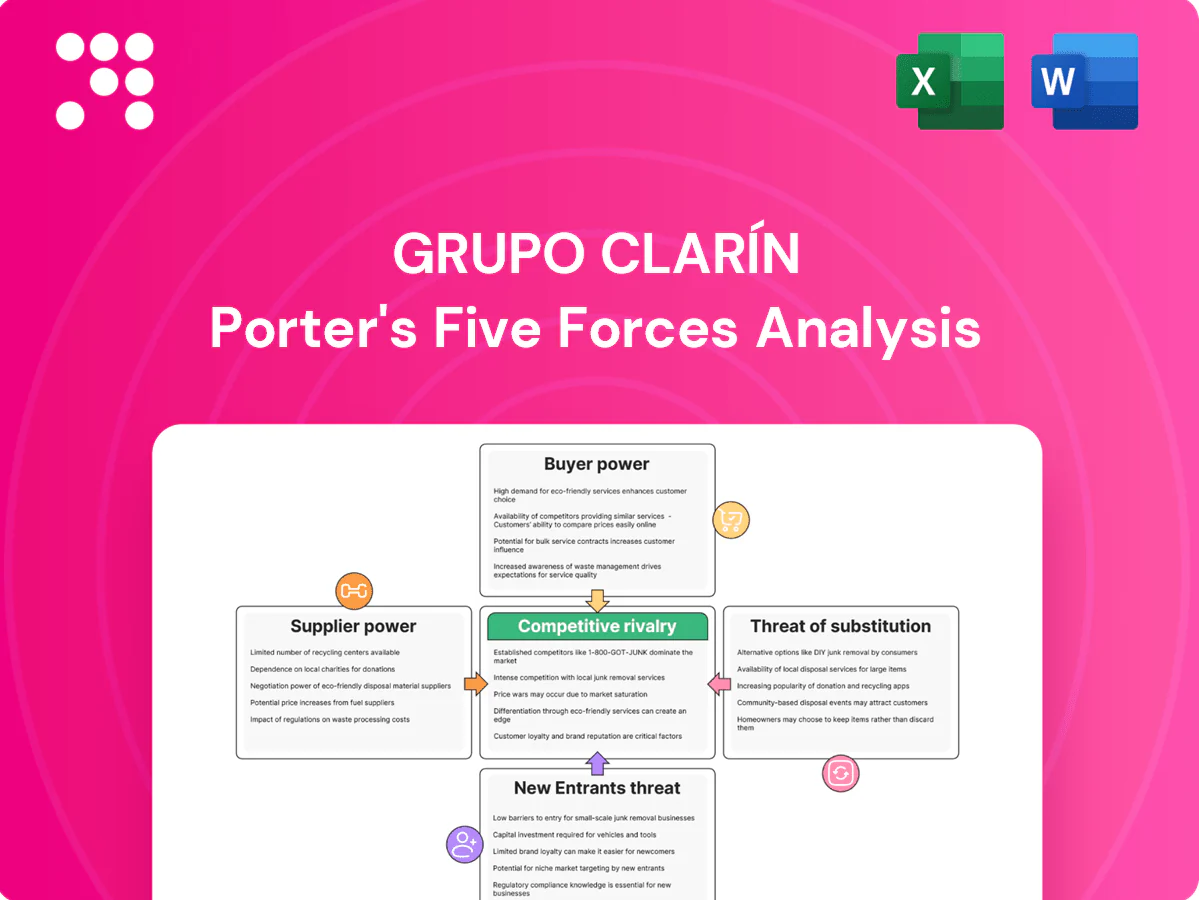
Grupo Clarín Porter's Five Forces Analysis

A Must-Have Tool for Decision-Makers
Grupo Clarín faces moderate buyer power, high competitive rivalry in Argentine media, constrained supplier power for distribution, low threat of substitutes among legacy audiences but rising digital alternatives, and medium barriers to entry due to regulation and scale. This preview is just the beginning. The full analysis provides a complete strategic snapshot with force-by-force ratings, visuals, and business implications tailored to Grupo Clarín.
Suppliers Bargaining Power

Concentrated premium content rights
Concentrated premium content rights in Argentina are held by a small set of players (commonly 3-4 major rights holders), giving suppliers strong leverage over price and contractual terms. Grupo Clarín must outbid both global groups like Disney and Warner Bros. Discovery and local broadcasters for marquee sports and entertainment. Renewal cycles, often every 3-5 years, create periodic step-ups in costs. Long-term deals lower volatility but constrain flexibility and may raise fixed expenses.
Journalists and creative talent scarcity
Reputable journalists, producers and on-screen talent are highly differentiated inputs for Grupo Clarín, with reputational impact that directly affects audience share and ad rates.
Star talent commands favorable contracts and can move to rival outlets or streaming platforms, increasing supplier bargaining power.
Unionization and strict labor regulations in Argentina add rigidity to cost structures, so retention requires competitive pay and strong editorial autonomy to limit churn.

Telecom, CDN, and cloud dependencies
Digital distribution for Grupo Clarín depends on third-party CDNs, cloud providers and ad-tech stacks; the top three cloud vendors hold ≈70% of the market in 2024, giving suppliers pricing and policy leverage. High switching costs and integration complexity create negotiation room, while outages or platform policy changes can directly interrupt ad revenue and paywalls. Ad spend exceeded $600B globally in 2024, so disruptions materially affect monetization. Multi-vendor strategies reduce single-supplier risk but raise coordination and cost burdens.

Print and broadcast equipment vendors
Print inputs (paper, ink) and broadcast hardware are specialized and exposed to Argentina’s FX volatility, with 2024 import disruptions raising landed costs and lead-time uncertainty; a limited pool of high-quality suppliers concentrates pricing power and can delay deliveries, while capex cycles create timing risk for procurement; hedging and increased local sourcing mitigate but do not eliminate exposure.
- Supplier concentration: limited high-quality vendors
- FX exposure: 2024 import volatility
- Capex timing risk: large procurement cycles
- Mitigants: hedging and local sourcing, imperfect
Data and measurement providers
Audience measurement and programmatic data are concentrated in a few firms (Nielsen, Comscore, Kantar), which shape ad pricing and inventory value; programmatic buys account for roughly 80% of digital display ad trading in 2024. Methodology shifts (panel weighting, ID resolution) can materially shift revenue attribution between broadcasters and platforms. Granular access is sold at premium rates, while investing in proprietary first-party data can rebalance supplier power for Grupo Clarín.
- Dominant providers: Nielsen, Comscore, Kantar
- Programmatic share (2024): ~80% of display
- Risk: methodology changes → revenue attribution shifts
- Mitigation: build first-party data to regain pricing power
High supplier power: 3-4 rights holders, cloud ≈70%, programmatic ≈80%
Supplier power is high: 3-4 major content rights holders limit bargaining, renewal cycles (3-5 yrs) drive step-up costs. Top three cloud vendors hold ≈70% (2024), raising tech vendor leverage. Programmatic share ~80% of display (2024); Nielsen/Comscore/Kantar control measurement. FX/import shocks in 2024 elevated print/broadcast input costs.
| Metric | 2024 |
|---|---|
| Content rights holders | 3-4 |
| Renewal cycle | 3-5 yrs |
| Top cloud share | ≈70% |
| Programmatic display | ≈80% |
What is included in the product
 Detailed Word Document
Comprehensive Porter's Five Forces analysis tailored to Grupo Clarín, uncovering competitive drivers, buyer and supplier power, substitute threats and entry barriers; identifies disruptive forces and market dynamics that influence pricing, profitability and strategic positioning.

 Customizable Excel Spreadsheet
A one-sheet Porter's Five Forces for Grupo Clarín that clarifies competitive pressures at a glance—customizable for regulation shifts, new entrants or ad market changes, and ready to drop into pitch decks or boardroom slides.
Customers Bargaining Power

Advertisers leverage programmatic markets
Large advertisers and agencies can shift budgets fluidly across media, raising price sensitivity for Grupo Clarín as programmatic markets now account for over 80% of display buying globally. Programmatic auctions benchmark CPMs in real time, compressing publisher margins and pressuring local rates. Heightened brand-safety and performance demands increase compliance and verification costs for publishers. Bundling cross-platform inventory can improve yield and defend CPMs.
Low switching costs for audiences
Consumers can switch among news, sports and entertainment instantly across apps and platforms; global paid-news penetration was about 11% in 2024, underscoring limited willingness to pay. Paywalls face churn risk—digital news churn averages ~30% annually—if content lacks distinctiveness. Bundles with ISPs or exclusive rights can cut churn, while UX and personalization are key retention levers.

Distribution partners and platforms
App stores and large platforms control discovery and levy platform fees typically between 15% and 30%, directly shaving content revenues. Smart TV hubs and social networks dominate how audiences find media and can reroute traffic overnight through algorithm changes, forcing costly renegotiation for carriage or featuring. Securing placement is highly competitive and expensive, so Grupo Clarín invests in direct channels, which improve margin but often sacrifice reach versus platform distribution.

Corporate subscribers and B2B clients
Corporate subscribers and B2B clients wield notable bargaining power: enterprise data, classifieds and sponsorship buyers often negotiate volume discounts (commonly up to 30%) and require custom integrations, lengthening sales cycles to 6–12 months and raising service burden. Concentrated contract renewals concentrate revenue risk, while value-added analytics can support premium pricing (typically 10–20%) for differentiated offerings.
- Volume discounts: up to 30%
- Sales cycle: 6–12 months
- Renewal concentration: elevates revenue risk
- Analytics premium: 10–20%
Price-sensitive mass market in Argentina
Price-sensitive mass market in Argentina forces Grupo Clarín to contend with 2024 inflation above 200%, driving consumers to favor cheaper offerings and prompting advertisers to trim budgets—ad spend fell roughly 12% y/y in 2024. Inflation complicates annual pricing and erodes real revenue, making frequent repricing necessary but risking audience backlash. Flexible tiers and targeted promotions helped sustain volumes and digital subscriptions through 2024.
- 2024 inflation >200% — real revenue erosion
- Ad spend ≈ -12% y/y in 2024 — pressure on ad rates
- Frequent repricing risks churn; flexible tiers/promos preserve volume
Programmatic >80% and >200% inflation squeeze digital-news revenue
Large advertisers and programmatic markets (>80% display buying) compress CPMs and raise price sensitivity for Grupo Clarín. Consumers switch platforms easily; paid-news penetration ~11% in 2024 and digital-news churn ≈30% annually, limiting paywall power. Platforms/app stores take 15–30% fees and control discovery. Argentina inflation >200% in 2024 and ad spend fell ~12% y/y, boosting buyer leverage.
| Metric | 2024 value |
|---|---|
| Programmatic share | >80% |
| Paid-news penetration | ~11% |
| Digital churn | ~30% pa |
| App/platform fees | 15–30% |
| Argentina inflation | >200% |
| Ad spend y/y | -12% |
Preview Before You Purchase
Grupo Clarín Porter's Five Forces Analysis
This preview shows the exact Grupo Clarín Porter’s Five Forces analysis you'll receive after purchase—no placeholders or mockups. The document is fully formatted, comprehensive, and ready for immediate download and use. Upon payment you’ll get instant access to this same file for your research or decisions.

A Must-Have Tool for Decision-Makers
Grupo Clarín faces moderate buyer power, high competitive rivalry in Argentine media, constrained supplier power for distribution, low threat of substitutes among legacy audiences but rising digital alternatives, and medium barriers to entry due to regulation and scale. This preview is just the beginning. The full analysis provides a complete strategic snapshot with force-by-force ratings, visuals, and business implications tailored to Grupo Clarín.
Suppliers Bargaining Power
Concentrated premium content rights
Concentrated premium content rights in Argentina are held by a small set of players (commonly 3-4 major rights holders), giving suppliers strong leverage over price and contractual terms. Grupo Clarín must outbid both global groups like Disney and Warner Bros. Discovery and local broadcasters for marquee sports and entertainment. Renewal cycles, often every 3-5 years, create periodic step-ups in costs. Long-term deals lower volatility but constrain flexibility and may raise fixed expenses.
Journalists and creative talent scarcity
Reputable journalists, producers and on-screen talent are highly differentiated inputs for Grupo Clarín, with reputational impact that directly affects audience share and ad rates.
Star talent commands favorable contracts and can move to rival outlets or streaming platforms, increasing supplier bargaining power.
Unionization and strict labor regulations in Argentina add rigidity to cost structures, so retention requires competitive pay and strong editorial autonomy to limit churn.
Telecom, CDN, and cloud dependencies
Digital distribution for Grupo Clarín depends on third-party CDNs, cloud providers and ad-tech stacks; the top three cloud vendors hold ≈70% of the market in 2024, giving suppliers pricing and policy leverage. High switching costs and integration complexity create negotiation room, while outages or platform policy changes can directly interrupt ad revenue and paywalls. Ad spend exceeded $600B globally in 2024, so disruptions materially affect monetization. Multi-vendor strategies reduce single-supplier risk but raise coordination and cost burdens.
Print and broadcast equipment vendors
Print inputs (paper, ink) and broadcast hardware are specialized and exposed to Argentina’s FX volatility, with 2024 import disruptions raising landed costs and lead-time uncertainty; a limited pool of high-quality suppliers concentrates pricing power and can delay deliveries, while capex cycles create timing risk for procurement; hedging and increased local sourcing mitigate but do not eliminate exposure.
- Supplier concentration: limited high-quality vendors
- FX exposure: 2024 import volatility
- Capex timing risk: large procurement cycles
- Mitigants: hedging and local sourcing, imperfect
Data and measurement providers
Audience measurement and programmatic data are concentrated in a few firms (Nielsen, Comscore, Kantar), which shape ad pricing and inventory value; programmatic buys account for roughly 80% of digital display ad trading in 2024. Methodology shifts (panel weighting, ID resolution) can materially shift revenue attribution between broadcasters and platforms. Granular access is sold at premium rates, while investing in proprietary first-party data can rebalance supplier power for Grupo Clarín.
- Dominant providers: Nielsen, Comscore, Kantar
- Programmatic share (2024): ~80% of display
- Risk: methodology changes → revenue attribution shifts
- Mitigation: build first-party data to regain pricing power
High supplier power: 3-4 rights holders, cloud ≈70%, programmatic ≈80%
Supplier power is high: 3-4 major content rights holders limit bargaining, renewal cycles (3-5 yrs) drive step-up costs. Top three cloud vendors hold ≈70% (2024), raising tech vendor leverage. Programmatic share ~80% of display (2024); Nielsen/Comscore/Kantar control measurement. FX/import shocks in 2024 elevated print/broadcast input costs.
| Metric | 2024 |
|---|---|
| Content rights holders | 3-4 |
| Renewal cycle | 3-5 yrs |
| Top cloud share | ≈70% |
| Programmatic display | ≈80% |
What is included in the product
Detailed Word Document
Comprehensive Porter's Five Forces analysis tailored to Grupo Clarín, uncovering competitive drivers, buyer and supplier power, substitute threats and entry barriers; identifies disruptive forces and market dynamics that influence pricing, profitability and strategic positioning.
Customizable Excel Spreadsheet
A one-sheet Porter's Five Forces for Grupo Clarín that clarifies competitive pressures at a glance—customizable for regulation shifts, new entrants or ad market changes, and ready to drop into pitch decks or boardroom slides.
Customers Bargaining Power
Advertisers leverage programmatic markets
Large advertisers and agencies can shift budgets fluidly across media, raising price sensitivity for Grupo Clarín as programmatic markets now account for over 80% of display buying globally. Programmatic auctions benchmark CPMs in real time, compressing publisher margins and pressuring local rates. Heightened brand-safety and performance demands increase compliance and verification costs for publishers. Bundling cross-platform inventory can improve yield and defend CPMs.
Low switching costs for audiences
Consumers can switch among news, sports and entertainment instantly across apps and platforms; global paid-news penetration was about 11% in 2024, underscoring limited willingness to pay. Paywalls face churn risk—digital news churn averages ~30% annually—if content lacks distinctiveness. Bundles with ISPs or exclusive rights can cut churn, while UX and personalization are key retention levers.
Distribution partners and platforms
App stores and large platforms control discovery and levy platform fees typically between 15% and 30%, directly shaving content revenues. Smart TV hubs and social networks dominate how audiences find media and can reroute traffic overnight through algorithm changes, forcing costly renegotiation for carriage or featuring. Securing placement is highly competitive and expensive, so Grupo Clarín invests in direct channels, which improve margin but often sacrifice reach versus platform distribution.
Corporate subscribers and B2B clients
Corporate subscribers and B2B clients wield notable bargaining power: enterprise data, classifieds and sponsorship buyers often negotiate volume discounts (commonly up to 30%) and require custom integrations, lengthening sales cycles to 6–12 months and raising service burden. Concentrated contract renewals concentrate revenue risk, while value-added analytics can support premium pricing (typically 10–20%) for differentiated offerings.
- Volume discounts: up to 30%
- Sales cycle: 6–12 months
- Renewal concentration: elevates revenue risk
- Analytics premium: 10–20%
Price-sensitive mass market in Argentina
Price-sensitive mass market in Argentina forces Grupo Clarín to contend with 2024 inflation above 200%, driving consumers to favor cheaper offerings and prompting advertisers to trim budgets—ad spend fell roughly 12% y/y in 2024. Inflation complicates annual pricing and erodes real revenue, making frequent repricing necessary but risking audience backlash. Flexible tiers and targeted promotions helped sustain volumes and digital subscriptions through 2024.
- 2024 inflation >200% — real revenue erosion
- Ad spend ≈ -12% y/y in 2024 — pressure on ad rates
- Frequent repricing risks churn; flexible tiers/promos preserve volume
Programmatic >80% and >200% inflation squeeze digital-news revenue
Large advertisers and programmatic markets (>80% display buying) compress CPMs and raise price sensitivity for Grupo Clarín. Consumers switch platforms easily; paid-news penetration ~11% in 2024 and digital-news churn ≈30% annually, limiting paywall power. Platforms/app stores take 15–30% fees and control discovery. Argentina inflation >200% in 2024 and ad spend fell ~12% y/y, boosting buyer leverage.
| Metric | 2024 value |
|---|---|
| Programmatic share | >80% |
| Paid-news penetration | ~11% |
| Digital churn | ~30% pa |
| App/platform fees | 15–30% |
| Argentina inflation | >200% |
| Ad spend y/y | -12% |
Preview Before You Purchase
Grupo Clarín Porter's Five Forces Analysis
This preview shows the exact Grupo Clarín Porter’s Five Forces analysis you'll receive after purchase—no placeholders or mockups. The document is fully formatted, comprehensive, and ready for immediate download and use. Upon payment you’ll get instant access to this same file for your research or decisions.
Original: $10.00
-65%$10.00
$3.50Description
A Must-Have Tool for Decision-Makers
Grupo Clarín faces moderate buyer power, high competitive rivalry in Argentine media, constrained supplier power for distribution, low threat of substitutes among legacy audiences but rising digital alternatives, and medium barriers to entry due to regulation and scale. This preview is just the beginning. The full analysis provides a complete strategic snapshot with force-by-force ratings, visuals, and business implications tailored to Grupo Clarín.
Suppliers Bargaining Power
Concentrated premium content rights
Concentrated premium content rights in Argentina are held by a small set of players (commonly 3-4 major rights holders), giving suppliers strong leverage over price and contractual terms. Grupo Clarín must outbid both global groups like Disney and Warner Bros. Discovery and local broadcasters for marquee sports and entertainment. Renewal cycles, often every 3-5 years, create periodic step-ups in costs. Long-term deals lower volatility but constrain flexibility and may raise fixed expenses.
Journalists and creative talent scarcity
Reputable journalists, producers and on-screen talent are highly differentiated inputs for Grupo Clarín, with reputational impact that directly affects audience share and ad rates.
Star talent commands favorable contracts and can move to rival outlets or streaming platforms, increasing supplier bargaining power.
Unionization and strict labor regulations in Argentina add rigidity to cost structures, so retention requires competitive pay and strong editorial autonomy to limit churn.
Telecom, CDN, and cloud dependencies
Digital distribution for Grupo Clarín depends on third-party CDNs, cloud providers and ad-tech stacks; the top three cloud vendors hold ≈70% of the market in 2024, giving suppliers pricing and policy leverage. High switching costs and integration complexity create negotiation room, while outages or platform policy changes can directly interrupt ad revenue and paywalls. Ad spend exceeded $600B globally in 2024, so disruptions materially affect monetization. Multi-vendor strategies reduce single-supplier risk but raise coordination and cost burdens.
Print and broadcast equipment vendors
Print inputs (paper, ink) and broadcast hardware are specialized and exposed to Argentina’s FX volatility, with 2024 import disruptions raising landed costs and lead-time uncertainty; a limited pool of high-quality suppliers concentrates pricing power and can delay deliveries, while capex cycles create timing risk for procurement; hedging and increased local sourcing mitigate but do not eliminate exposure.
- Supplier concentration: limited high-quality vendors
- FX exposure: 2024 import volatility
- Capex timing risk: large procurement cycles
- Mitigants: hedging and local sourcing, imperfect
Data and measurement providers
Audience measurement and programmatic data are concentrated in a few firms (Nielsen, Comscore, Kantar), which shape ad pricing and inventory value; programmatic buys account for roughly 80% of digital display ad trading in 2024. Methodology shifts (panel weighting, ID resolution) can materially shift revenue attribution between broadcasters and platforms. Granular access is sold at premium rates, while investing in proprietary first-party data can rebalance supplier power for Grupo Clarín.
- Dominant providers: Nielsen, Comscore, Kantar
- Programmatic share (2024): ~80% of display
- Risk: methodology changes → revenue attribution shifts
- Mitigation: build first-party data to regain pricing power
High supplier power: 3-4 rights holders, cloud ≈70%, programmatic ≈80%
Supplier power is high: 3-4 major content rights holders limit bargaining, renewal cycles (3-5 yrs) drive step-up costs. Top three cloud vendors hold ≈70% (2024), raising tech vendor leverage. Programmatic share ~80% of display (2024); Nielsen/Comscore/Kantar control measurement. FX/import shocks in 2024 elevated print/broadcast input costs.
| Metric | 2024 |
|---|---|
| Content rights holders | 3-4 |
| Renewal cycle | 3-5 yrs |
| Top cloud share | ≈70% |
| Programmatic display | ≈80% |
What is included in the product
Detailed Word Document
Comprehensive Porter's Five Forces analysis tailored to Grupo Clarín, uncovering competitive drivers, buyer and supplier power, substitute threats and entry barriers; identifies disruptive forces and market dynamics that influence pricing, profitability and strategic positioning.
Customizable Excel Spreadsheet
A one-sheet Porter's Five Forces for Grupo Clarín that clarifies competitive pressures at a glance—customizable for regulation shifts, new entrants or ad market changes, and ready to drop into pitch decks or boardroom slides.
Customers Bargaining Power
Advertisers leverage programmatic markets
Large advertisers and agencies can shift budgets fluidly across media, raising price sensitivity for Grupo Clarín as programmatic markets now account for over 80% of display buying globally. Programmatic auctions benchmark CPMs in real time, compressing publisher margins and pressuring local rates. Heightened brand-safety and performance demands increase compliance and verification costs for publishers. Bundling cross-platform inventory can improve yield and defend CPMs.
Low switching costs for audiences
Consumers can switch among news, sports and entertainment instantly across apps and platforms; global paid-news penetration was about 11% in 2024, underscoring limited willingness to pay. Paywalls face churn risk—digital news churn averages ~30% annually—if content lacks distinctiveness. Bundles with ISPs or exclusive rights can cut churn, while UX and personalization are key retention levers.
Distribution partners and platforms
App stores and large platforms control discovery and levy platform fees typically between 15% and 30%, directly shaving content revenues. Smart TV hubs and social networks dominate how audiences find media and can reroute traffic overnight through algorithm changes, forcing costly renegotiation for carriage or featuring. Securing placement is highly competitive and expensive, so Grupo Clarín invests in direct channels, which improve margin but often sacrifice reach versus platform distribution.
Corporate subscribers and B2B clients
Corporate subscribers and B2B clients wield notable bargaining power: enterprise data, classifieds and sponsorship buyers often negotiate volume discounts (commonly up to 30%) and require custom integrations, lengthening sales cycles to 6–12 months and raising service burden. Concentrated contract renewals concentrate revenue risk, while value-added analytics can support premium pricing (typically 10–20%) for differentiated offerings.
- Volume discounts: up to 30%
- Sales cycle: 6–12 months
- Renewal concentration: elevates revenue risk
- Analytics premium: 10–20%
Price-sensitive mass market in Argentina
Price-sensitive mass market in Argentina forces Grupo Clarín to contend with 2024 inflation above 200%, driving consumers to favor cheaper offerings and prompting advertisers to trim budgets—ad spend fell roughly 12% y/y in 2024. Inflation complicates annual pricing and erodes real revenue, making frequent repricing necessary but risking audience backlash. Flexible tiers and targeted promotions helped sustain volumes and digital subscriptions through 2024.
- 2024 inflation >200% — real revenue erosion
- Ad spend ≈ -12% y/y in 2024 — pressure on ad rates
- Frequent repricing risks churn; flexible tiers/promos preserve volume
Programmatic >80% and >200% inflation squeeze digital-news revenue
Large advertisers and programmatic markets (>80% display buying) compress CPMs and raise price sensitivity for Grupo Clarín. Consumers switch platforms easily; paid-news penetration ~11% in 2024 and digital-news churn ≈30% annually, limiting paywall power. Platforms/app stores take 15–30% fees and control discovery. Argentina inflation >200% in 2024 and ad spend fell ~12% y/y, boosting buyer leverage.
| Metric | 2024 value |
|---|---|
| Programmatic share | >80% |
| Paid-news penetration | ~11% |
| Digital churn | ~30% pa |
| App/platform fees | 15–30% |
| Argentina inflation | >200% |
| Ad spend y/y | -12% |
Preview Before You Purchase
Grupo Clarín Porter's Five Forces Analysis
This preview shows the exact Grupo Clarín Porter’s Five Forces analysis you'll receive after purchase—no placeholders or mockups. The document is fully formatted, comprehensive, and ready for immediate download and use. Upon payment you’ll get instant access to this same file for your research or decisions.











