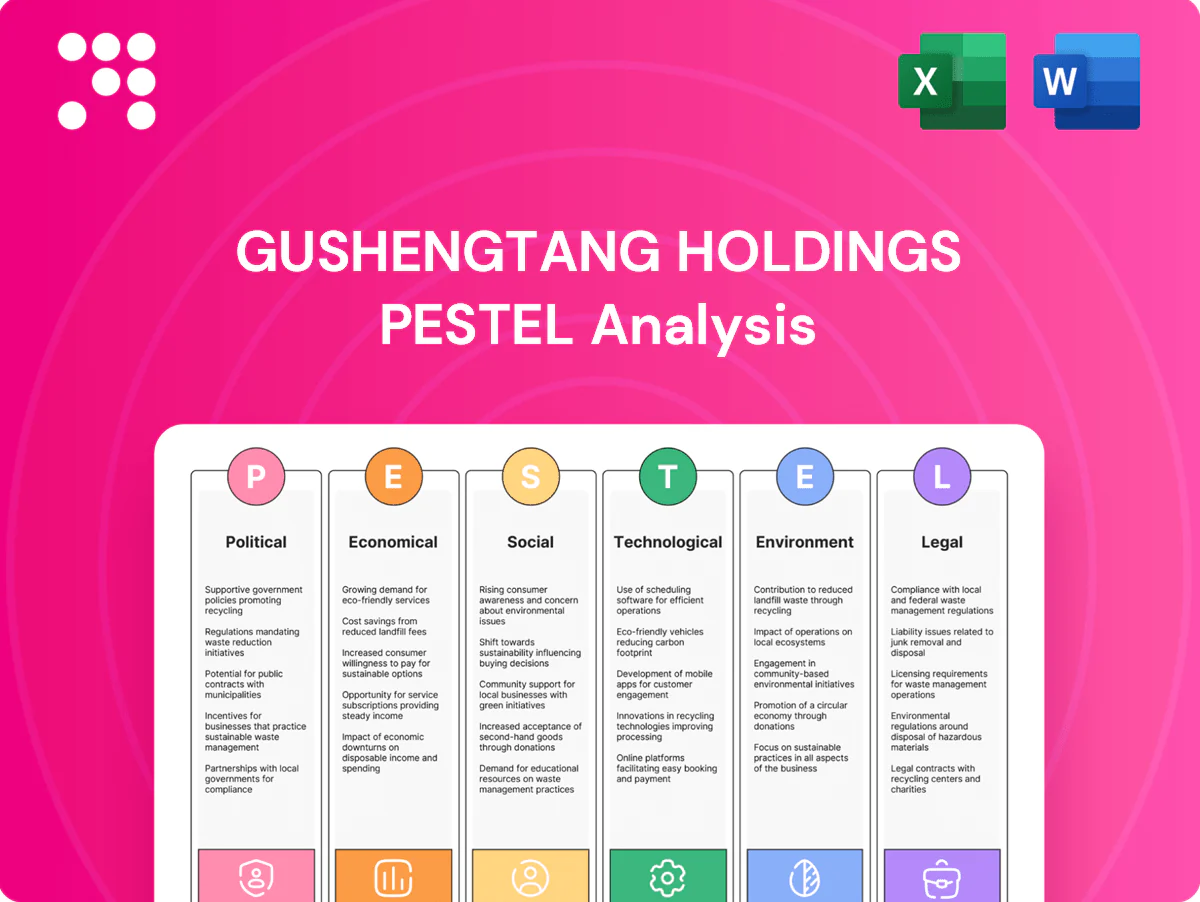
Gushengtang Holdings PESTLE Analysis

Plan Smarter. Present Sharper. Compete Stronger.
Unlock how political shifts, economic cycles, social trends, technological advances, legal changes, and environmental pressures are shaping Gushengtang Holdings’ strategic outlook in our concise PESTLE snapshot. These expert insights reveal risks and growth levers critical for investors and planners. Ready-made and actionable, the full PESTLE delivers deeper analysis. Purchase now to download the complete report instantly.
Political factors

State support for TCM
China embeds TCM in national health strategies (Healthy China 2030 and the 2021–30 TCM plan), enhancing Gushengtang’s brand credibility and public procurement access; the TCM market reached about RMB 1.2 trillion in 2024. Subsidies and inclusion in basic medical insurance and provincial public programs can materially lift demand. Support is selective—priority for standardized, certified practices—forcing compliance investments. Provincial policy and subsidy intensity differ, affecting rollout pacing.
Healthcare reform dynamics
Payment reform and tiered-care policies led by the State Council and NHSA are redirecting patient flows from tertiary hospitals to community clinics and online platforms, increasing competition for Gushengtang across channels. Expansion of outpatient reimbursement pilots for chronic disease and family-doctor services favors compliant private TCM providers that secure NHSA contracting. Price controls and DRG-style diagnosis-related payments implemented in reform pilots have compressed margins for branded treatments. Strategic alignment with local reform pilots improves contracting prospects and patient capture.

Public insurance coverage
Inclusion of TCM services and products in NRDL/PRDL materially affects volumes given China’s public insurance covers over 95% of the population; reimbursement adjustments can provoke demand swings within months, as 2019–20 NRDL negotiations drove average price cuts near 60% for some drugs. Since 2020 HTA guidance, payers require stronger documentation and real-world evidence to retain listings, so close engagement with payers and HTA bodies is a clear differentiator for Gushengtang.

Geopolitical supply risks
Geopolitical supply risks threaten herbal inputs and devices via tariffs, logistics bottlenecks and sanctions; over 60% of global active pharmaceutical ingredients are sourced from China and India, concentrating exposure. Cross-border e-commerce rules shape online health-sales channels while localization and domestic partnerships reduce tariff and compliance frictions. Multi-region sourcing and inventory buffers mitigate political shocks.
- Tariffs/logistics: concentrated APIf supply >60%
- Cross-border e-commerce: policy-dependent sales channels
- Localization: drives domestic sourcing/partnerships
- Mitigation: multi-region sourcing, inventory buffers
Local government oversight
Local clinic licensing, bed quotas and operating permits for Gushengtang are issued at city and provincial levels, with approval timelines typically ranging from 4 to 9 months and significant regional variance in enforcement intensity that directly affects expansion schedules. Health industrial parks (2024-25) commonly offer tax breaks and rent subsidies that can cut upfront capex and operating costs by up to 20%. Proactive compliance programs have been shown to reduce inspection-related downtime by roughly 30–40%, speeding openings and revenue realization.
- Licensing level: city/province
- Approval time: 4–9 months
- Cost reductions in parks: up to 20%
- Downtime cut via compliance: ~30–40%
Policy-backed TCM: RMB 1.2T, >95% insured; NRDL, licensing & API risks
State backing (Healthy China 2030, 2021–30 TCM plan) boosts credibility and procurement; TCM market ≈RMB 1.2 trillion (2024) and public insurance covers >95%. NRDL/HTA drives rapid volume/price shifts (some NRDL negotiations cut prices ~60%); local licensing (4–9 months) and health-park incentives (capex/rent cuts up to 20%) shape rollout. API concentration (>60% China/India) raises geopolitical supply risk.
| Metric | Value |
|---|---|
| TCM market (2024) | RMB 1.2T |
| Public insurance | >95% |
| Licensing time | 4–9 months |
| Park incentives | Capex/rent −up to 20% |
| API concentration | >60% |
| NRDL price cuts | up to 60% |
What is included in the product
 Detailed Word Document
Provides a concise PESTLE evaluation of Gushengtang Holdings, examining Political, Economic, Social, Technological, Environmental and Legal forces with data-backed trends and region/industry relevance; designed to help executives, investors and strategists identify risks, opportunities and forward-looking scenarios for planning and funding decisions.

 Customizable Excel Spreadsheet
A concise, visually segmented PESTLE summary for Gushengtang Holdings that streamlines external risk assessment and market positioning, easily inserted into presentations or shared across teams for fast alignment and decision-making.
Economic factors

Consumer health spending
Rising middle-class incomes—China’s middle-income cohort now estimated at ~430 million—are boosting demand for preventive and wellness TCM, with consumer health spending shifting toward lifestyle tonics; during economic slowdowns patients favor reimbursed services and value SKUs, reducing average transaction value. Price elasticity differs: chronic-care essentials show inelastic demand while premium tonics are highly elastic; flexible pricing and tiered packages hedge cycles.
Aging demographics
China had 200.56 million people aged 65+ in 2023, driving greater demand for chronic condition management where TCM remains widely used. Long-term care trends favor integrative solutions and community-based TCM services. Higher visit frequency among elderly patients helps offset pricing pressure on per-visit margins. Tailored geriatric care pathways can increase patient lifetime value and repeat revenue.

Input cost volatility
Herbal commodity prices are highly seasonal and climate-sensitive, producing year-on-year swings often reaching 20–30% in harvest-poor years; standardization and contract farming have cut supplier price variance materially by securing yields and quality. Currency moves (RMB fluctuations of several percent vs USD in 2024) raise costs for imported processing equipment and packaging. Dynamic procurement and inventory hedging programs smooth purchase timing and helped stabilize gross-margin pressure.

Digital channel economics
Online consultations and e-pharmacy can cut CAC 20–40% at scale but incur platform fees of ~10–25%; conversion hinges on trust, speed and reimbursement eligibility, with reimbursed patients converting ~2–3x more often.
Omnichannel integration raises retention ~15–25% and basket size ~20–25%, while data-driven CRM can improve LTV/CAC by ~25–35% and lower unit variable costs.
- lower-CAC: 20–40%
- platform-fees: 10–25%
- reimbursement lift: 2–3x conversion
- retention + basket: +15–25% / +20–25%
- CRM impact: LTV/CAC +25–35%
Capital access
Clinic expansion and tech buildouts demand sustained capex, with rollout speed tied to credit conditions—China 1‑year LPR held at 3.45% into 2024–25, easing borrowing costs for healthcare projects; equity market sentiment also affects equity raises and M&A timing. Central government policy under the 14th Five‑Year Plan continues to prioritize TCM modernization, enabling targeted grants and pilot funding to defray upfront costs. Gushengtang’s disciplined ROI gates and phased investment approach limit overexpansion risk and preserve liquidity during slower funding windows.
- Capex needs: clinic expansion + tech buildouts
- Funding drivers: 1‑yr LPR ~3.45% (2024–25) & equity market health
- Policy support: 14th Five‑Year Plan/T CM digitization grants
- Risk control: phased ROI gates to prevent overexpansion
Policy-backed TCM: RMB 1.2T, >95% insured; NRDL, licensing & API risks
Rising middle class (~430m) and 65+ population (200.56m in 2023) lift demand for TCM preventive and geriatric care; premium tonics remain price‑elastic while chronic care is inelastic. Herbal input volatility can swing 20–30% year‑on‑year; 1‑yr LPR ~3.45% (2024–25) eases capex financing. Digital channels cut CAC 20–40% but incur 10–25% platform fees; reimbursement boosts conversion 2–3x.
| Metric | Value |
|---|---|
| Middle class | ~430m |
| 65+ population (2023) | 200.56m |
| Herbal price swings | 20–30% |
| 1‑yr LPR (2024–25) | 3.45% |
| Digital CAC cut | 20–40% |
| Platform fees | 10–25% |
| Reimbursement lift | 2–3x |
Same Document Delivered
Gushengtang Holdings PESTLE Analysis
The preview shown here is the exact Gushengtang Holdings PESTLE Analysis you’ll receive after purchase—fully formatted and ready to use. It contains the full Political, Economic, Social, Technological, Legal, and Environmental assessment as displayed, with no placeholders or teasers. After payment you’ll instantly download this identical, professionally structured file.

Plan Smarter. Present Sharper. Compete Stronger.
Unlock how political shifts, economic cycles, social trends, technological advances, legal changes, and environmental pressures are shaping Gushengtang Holdings’ strategic outlook in our concise PESTLE snapshot. These expert insights reveal risks and growth levers critical for investors and planners. Ready-made and actionable, the full PESTLE delivers deeper analysis. Purchase now to download the complete report instantly.
Political factors
State support for TCM
China embeds TCM in national health strategies (Healthy China 2030 and the 2021–30 TCM plan), enhancing Gushengtang’s brand credibility and public procurement access; the TCM market reached about RMB 1.2 trillion in 2024. Subsidies and inclusion in basic medical insurance and provincial public programs can materially lift demand. Support is selective—priority for standardized, certified practices—forcing compliance investments. Provincial policy and subsidy intensity differ, affecting rollout pacing.
Healthcare reform dynamics
Payment reform and tiered-care policies led by the State Council and NHSA are redirecting patient flows from tertiary hospitals to community clinics and online platforms, increasing competition for Gushengtang across channels. Expansion of outpatient reimbursement pilots for chronic disease and family-doctor services favors compliant private TCM providers that secure NHSA contracting. Price controls and DRG-style diagnosis-related payments implemented in reform pilots have compressed margins for branded treatments. Strategic alignment with local reform pilots improves contracting prospects and patient capture.
Public insurance coverage
Inclusion of TCM services and products in NRDL/PRDL materially affects volumes given China’s public insurance covers over 95% of the population; reimbursement adjustments can provoke demand swings within months, as 2019–20 NRDL negotiations drove average price cuts near 60% for some drugs. Since 2020 HTA guidance, payers require stronger documentation and real-world evidence to retain listings, so close engagement with payers and HTA bodies is a clear differentiator for Gushengtang.
Geopolitical supply risks
Geopolitical supply risks threaten herbal inputs and devices via tariffs, logistics bottlenecks and sanctions; over 60% of global active pharmaceutical ingredients are sourced from China and India, concentrating exposure. Cross-border e-commerce rules shape online health-sales channels while localization and domestic partnerships reduce tariff and compliance frictions. Multi-region sourcing and inventory buffers mitigate political shocks.
- Tariffs/logistics: concentrated APIf supply >60%
- Cross-border e-commerce: policy-dependent sales channels
- Localization: drives domestic sourcing/partnerships
- Mitigation: multi-region sourcing, inventory buffers
Local government oversight
Local clinic licensing, bed quotas and operating permits for Gushengtang are issued at city and provincial levels, with approval timelines typically ranging from 4 to 9 months and significant regional variance in enforcement intensity that directly affects expansion schedules. Health industrial parks (2024-25) commonly offer tax breaks and rent subsidies that can cut upfront capex and operating costs by up to 20%. Proactive compliance programs have been shown to reduce inspection-related downtime by roughly 30–40%, speeding openings and revenue realization.
- Licensing level: city/province
- Approval time: 4–9 months
- Cost reductions in parks: up to 20%
- Downtime cut via compliance: ~30–40%
Policy-backed TCM: RMB 1.2T, >95% insured; NRDL, licensing & API risks
State backing (Healthy China 2030, 2021–30 TCM plan) boosts credibility and procurement; TCM market ≈RMB 1.2 trillion (2024) and public insurance covers >95%. NRDL/HTA drives rapid volume/price shifts (some NRDL negotiations cut prices ~60%); local licensing (4–9 months) and health-park incentives (capex/rent cuts up to 20%) shape rollout. API concentration (>60% China/India) raises geopolitical supply risk.
| Metric | Value |
|---|---|
| TCM market (2024) | RMB 1.2T |
| Public insurance | >95% |
| Licensing time | 4–9 months |
| Park incentives | Capex/rent −up to 20% |
| API concentration | >60% |
| NRDL price cuts | up to 60% |
What is included in the product
Detailed Word Document
Provides a concise PESTLE evaluation of Gushengtang Holdings, examining Political, Economic, Social, Technological, Environmental and Legal forces with data-backed trends and region/industry relevance; designed to help executives, investors and strategists identify risks, opportunities and forward-looking scenarios for planning and funding decisions.
Customizable Excel Spreadsheet
A concise, visually segmented PESTLE summary for Gushengtang Holdings that streamlines external risk assessment and market positioning, easily inserted into presentations or shared across teams for fast alignment and decision-making.
Economic factors
Consumer health spending
Rising middle-class incomes—China’s middle-income cohort now estimated at ~430 million—are boosting demand for preventive and wellness TCM, with consumer health spending shifting toward lifestyle tonics; during economic slowdowns patients favor reimbursed services and value SKUs, reducing average transaction value. Price elasticity differs: chronic-care essentials show inelastic demand while premium tonics are highly elastic; flexible pricing and tiered packages hedge cycles.
Aging demographics
China had 200.56 million people aged 65+ in 2023, driving greater demand for chronic condition management where TCM remains widely used. Long-term care trends favor integrative solutions and community-based TCM services. Higher visit frequency among elderly patients helps offset pricing pressure on per-visit margins. Tailored geriatric care pathways can increase patient lifetime value and repeat revenue.
Input cost volatility
Herbal commodity prices are highly seasonal and climate-sensitive, producing year-on-year swings often reaching 20–30% in harvest-poor years; standardization and contract farming have cut supplier price variance materially by securing yields and quality. Currency moves (RMB fluctuations of several percent vs USD in 2024) raise costs for imported processing equipment and packaging. Dynamic procurement and inventory hedging programs smooth purchase timing and helped stabilize gross-margin pressure.
Digital channel economics
Online consultations and e-pharmacy can cut CAC 20–40% at scale but incur platform fees of ~10–25%; conversion hinges on trust, speed and reimbursement eligibility, with reimbursed patients converting ~2–3x more often.
Omnichannel integration raises retention ~15–25% and basket size ~20–25%, while data-driven CRM can improve LTV/CAC by ~25–35% and lower unit variable costs.
- lower-CAC: 20–40%
- platform-fees: 10–25%
- reimbursement lift: 2–3x conversion
- retention + basket: +15–25% / +20–25%
- CRM impact: LTV/CAC +25–35%
Capital access
Clinic expansion and tech buildouts demand sustained capex, with rollout speed tied to credit conditions—China 1‑year LPR held at 3.45% into 2024–25, easing borrowing costs for healthcare projects; equity market sentiment also affects equity raises and M&A timing. Central government policy under the 14th Five‑Year Plan continues to prioritize TCM modernization, enabling targeted grants and pilot funding to defray upfront costs. Gushengtang’s disciplined ROI gates and phased investment approach limit overexpansion risk and preserve liquidity during slower funding windows.
- Capex needs: clinic expansion + tech buildouts
- Funding drivers: 1‑yr LPR ~3.45% (2024–25) & equity market health
- Policy support: 14th Five‑Year Plan/T CM digitization grants
- Risk control: phased ROI gates to prevent overexpansion
Policy-backed TCM: RMB 1.2T, >95% insured; NRDL, licensing & API risks
Rising middle class (~430m) and 65+ population (200.56m in 2023) lift demand for TCM preventive and geriatric care; premium tonics remain price‑elastic while chronic care is inelastic. Herbal input volatility can swing 20–30% year‑on‑year; 1‑yr LPR ~3.45% (2024–25) eases capex financing. Digital channels cut CAC 20–40% but incur 10–25% platform fees; reimbursement boosts conversion 2–3x.
| Metric | Value |
|---|---|
| Middle class | ~430m |
| 65+ population (2023) | 200.56m |
| Herbal price swings | 20–30% |
| 1‑yr LPR (2024–25) | 3.45% |
| Digital CAC cut | 20–40% |
| Platform fees | 10–25% |
| Reimbursement lift | 2–3x |
Same Document Delivered
Gushengtang Holdings PESTLE Analysis
The preview shown here is the exact Gushengtang Holdings PESTLE Analysis you’ll receive after purchase—fully formatted and ready to use. It contains the full Political, Economic, Social, Technological, Legal, and Environmental assessment as displayed, with no placeholders or teasers. After payment you’ll instantly download this identical, professionally structured file.
Original: $10.00
-65%$10.00
$3.50Description
Plan Smarter. Present Sharper. Compete Stronger.
Unlock how political shifts, economic cycles, social trends, technological advances, legal changes, and environmental pressures are shaping Gushengtang Holdings’ strategic outlook in our concise PESTLE snapshot. These expert insights reveal risks and growth levers critical for investors and planners. Ready-made and actionable, the full PESTLE delivers deeper analysis. Purchase now to download the complete report instantly.
Political factors
State support for TCM
China embeds TCM in national health strategies (Healthy China 2030 and the 2021–30 TCM plan), enhancing Gushengtang’s brand credibility and public procurement access; the TCM market reached about RMB 1.2 trillion in 2024. Subsidies and inclusion in basic medical insurance and provincial public programs can materially lift demand. Support is selective—priority for standardized, certified practices—forcing compliance investments. Provincial policy and subsidy intensity differ, affecting rollout pacing.
Healthcare reform dynamics
Payment reform and tiered-care policies led by the State Council and NHSA are redirecting patient flows from tertiary hospitals to community clinics and online platforms, increasing competition for Gushengtang across channels. Expansion of outpatient reimbursement pilots for chronic disease and family-doctor services favors compliant private TCM providers that secure NHSA contracting. Price controls and DRG-style diagnosis-related payments implemented in reform pilots have compressed margins for branded treatments. Strategic alignment with local reform pilots improves contracting prospects and patient capture.
Public insurance coverage
Inclusion of TCM services and products in NRDL/PRDL materially affects volumes given China’s public insurance covers over 95% of the population; reimbursement adjustments can provoke demand swings within months, as 2019–20 NRDL negotiations drove average price cuts near 60% for some drugs. Since 2020 HTA guidance, payers require stronger documentation and real-world evidence to retain listings, so close engagement with payers and HTA bodies is a clear differentiator for Gushengtang.
Geopolitical supply risks
Geopolitical supply risks threaten herbal inputs and devices via tariffs, logistics bottlenecks and sanctions; over 60% of global active pharmaceutical ingredients are sourced from China and India, concentrating exposure. Cross-border e-commerce rules shape online health-sales channels while localization and domestic partnerships reduce tariff and compliance frictions. Multi-region sourcing and inventory buffers mitigate political shocks.
- Tariffs/logistics: concentrated APIf supply >60%
- Cross-border e-commerce: policy-dependent sales channels
- Localization: drives domestic sourcing/partnerships
- Mitigation: multi-region sourcing, inventory buffers
Local government oversight
Local clinic licensing, bed quotas and operating permits for Gushengtang are issued at city and provincial levels, with approval timelines typically ranging from 4 to 9 months and significant regional variance in enforcement intensity that directly affects expansion schedules. Health industrial parks (2024-25) commonly offer tax breaks and rent subsidies that can cut upfront capex and operating costs by up to 20%. Proactive compliance programs have been shown to reduce inspection-related downtime by roughly 30–40%, speeding openings and revenue realization.
- Licensing level: city/province
- Approval time: 4–9 months
- Cost reductions in parks: up to 20%
- Downtime cut via compliance: ~30–40%
Policy-backed TCM: RMB 1.2T, >95% insured; NRDL, licensing & API risks
State backing (Healthy China 2030, 2021–30 TCM plan) boosts credibility and procurement; TCM market ≈RMB 1.2 trillion (2024) and public insurance covers >95%. NRDL/HTA drives rapid volume/price shifts (some NRDL negotiations cut prices ~60%); local licensing (4–9 months) and health-park incentives (capex/rent cuts up to 20%) shape rollout. API concentration (>60% China/India) raises geopolitical supply risk.
| Metric | Value |
|---|---|
| TCM market (2024) | RMB 1.2T |
| Public insurance | >95% |
| Licensing time | 4–9 months |
| Park incentives | Capex/rent −up to 20% |
| API concentration | >60% |
| NRDL price cuts | up to 60% |
What is included in the product
Detailed Word Document
Provides a concise PESTLE evaluation of Gushengtang Holdings, examining Political, Economic, Social, Technological, Environmental and Legal forces with data-backed trends and region/industry relevance; designed to help executives, investors and strategists identify risks, opportunities and forward-looking scenarios for planning and funding decisions.
Customizable Excel Spreadsheet
A concise, visually segmented PESTLE summary for Gushengtang Holdings that streamlines external risk assessment and market positioning, easily inserted into presentations or shared across teams for fast alignment and decision-making.
Economic factors
Consumer health spending
Rising middle-class incomes—China’s middle-income cohort now estimated at ~430 million—are boosting demand for preventive and wellness TCM, with consumer health spending shifting toward lifestyle tonics; during economic slowdowns patients favor reimbursed services and value SKUs, reducing average transaction value. Price elasticity differs: chronic-care essentials show inelastic demand while premium tonics are highly elastic; flexible pricing and tiered packages hedge cycles.
Aging demographics
China had 200.56 million people aged 65+ in 2023, driving greater demand for chronic condition management where TCM remains widely used. Long-term care trends favor integrative solutions and community-based TCM services. Higher visit frequency among elderly patients helps offset pricing pressure on per-visit margins. Tailored geriatric care pathways can increase patient lifetime value and repeat revenue.
Input cost volatility
Herbal commodity prices are highly seasonal and climate-sensitive, producing year-on-year swings often reaching 20–30% in harvest-poor years; standardization and contract farming have cut supplier price variance materially by securing yields and quality. Currency moves (RMB fluctuations of several percent vs USD in 2024) raise costs for imported processing equipment and packaging. Dynamic procurement and inventory hedging programs smooth purchase timing and helped stabilize gross-margin pressure.
Digital channel economics
Online consultations and e-pharmacy can cut CAC 20–40% at scale but incur platform fees of ~10–25%; conversion hinges on trust, speed and reimbursement eligibility, with reimbursed patients converting ~2–3x more often.
Omnichannel integration raises retention ~15–25% and basket size ~20–25%, while data-driven CRM can improve LTV/CAC by ~25–35% and lower unit variable costs.
- lower-CAC: 20–40%
- platform-fees: 10–25%
- reimbursement lift: 2–3x conversion
- retention + basket: +15–25% / +20–25%
- CRM impact: LTV/CAC +25–35%
Capital access
Clinic expansion and tech buildouts demand sustained capex, with rollout speed tied to credit conditions—China 1‑year LPR held at 3.45% into 2024–25, easing borrowing costs for healthcare projects; equity market sentiment also affects equity raises and M&A timing. Central government policy under the 14th Five‑Year Plan continues to prioritize TCM modernization, enabling targeted grants and pilot funding to defray upfront costs. Gushengtang’s disciplined ROI gates and phased investment approach limit overexpansion risk and preserve liquidity during slower funding windows.
- Capex needs: clinic expansion + tech buildouts
- Funding drivers: 1‑yr LPR ~3.45% (2024–25) & equity market health
- Policy support: 14th Five‑Year Plan/T CM digitization grants
- Risk control: phased ROI gates to prevent overexpansion
Policy-backed TCM: RMB 1.2T, >95% insured; NRDL, licensing & API risks
Rising middle class (~430m) and 65+ population (200.56m in 2023) lift demand for TCM preventive and geriatric care; premium tonics remain price‑elastic while chronic care is inelastic. Herbal input volatility can swing 20–30% year‑on‑year; 1‑yr LPR ~3.45% (2024–25) eases capex financing. Digital channels cut CAC 20–40% but incur 10–25% platform fees; reimbursement boosts conversion 2–3x.
| Metric | Value |
|---|---|
| Middle class | ~430m |
| 65+ population (2023) | 200.56m |
| Herbal price swings | 20–30% |
| 1‑yr LPR (2024–25) | 3.45% |
| Digital CAC cut | 20–40% |
| Platform fees | 10–25% |
| Reimbursement lift | 2–3x |
Same Document Delivered
Gushengtang Holdings PESTLE Analysis
The preview shown here is the exact Gushengtang Holdings PESTLE Analysis you’ll receive after purchase—fully formatted and ready to use. It contains the full Political, Economic, Social, Technological, Legal, and Environmental assessment as displayed, with no placeholders or teasers. After payment you’ll instantly download this identical, professionally structured file.











