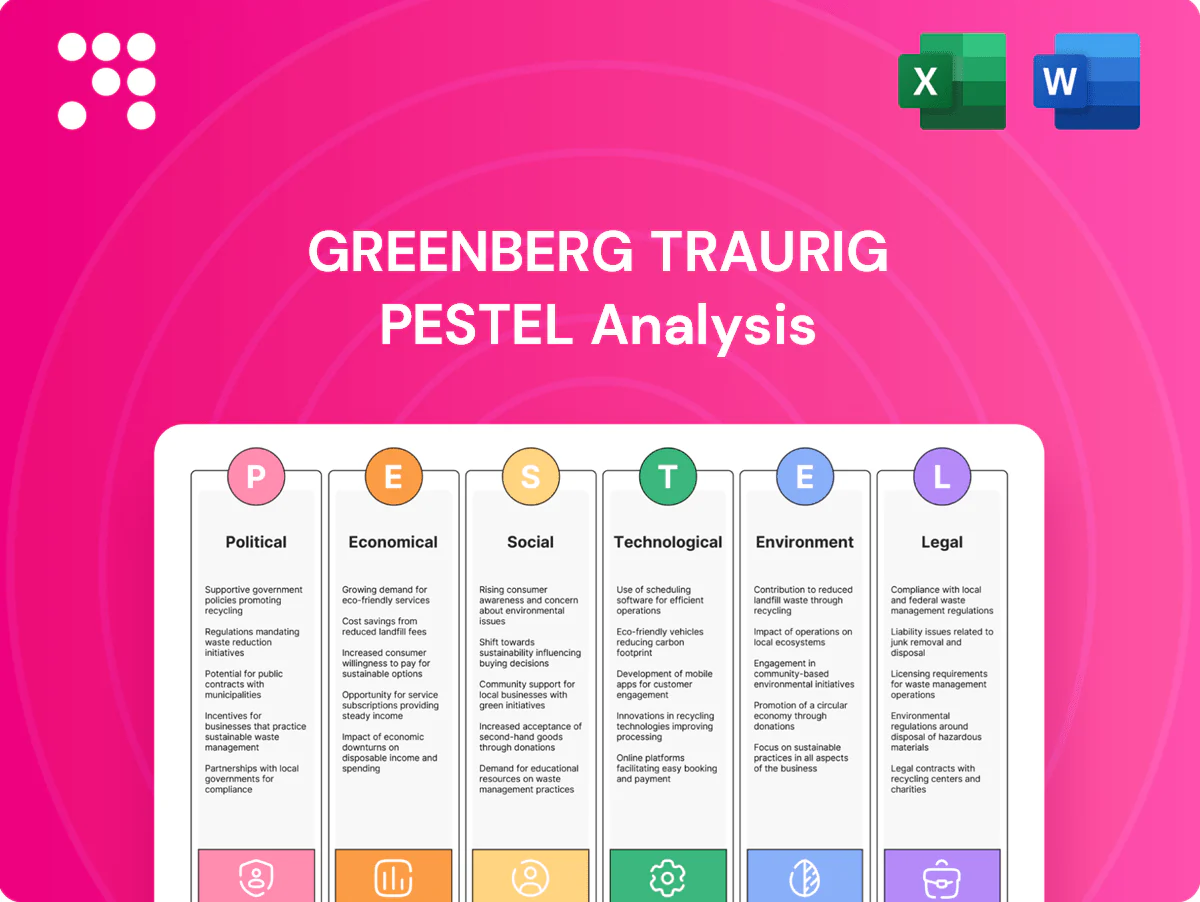
Greenberg Traurig PESTLE Analysis

Make Smarter Strategic Decisions with a Complete PESTEL View
Unlock strategic clarity with our PESTLE Analysis tailored for Greenberg Traurig—mapping political, economic, social, technological, legal, and environmental forces shaping its future. Ideal for investors, consultants, and executives, it turns external trends into actionable strategy. Purchase the full report for the complete, editable breakdown and instant insights.
Political factors

Geopolitical shifts
Political instability, sanctions, and trade tensions increasingly reshape cross-border deal flow and disputes, driving upticks in litigation and compliance work for firms like Greenberg Traurig, founded in 1967 (58 years in practice). The firm must reconcile divergent government priorities across the US, EU, LATAM, Middle East and Asia to advise multijurisdictional clients. Strategic office placement and local alliances mitigate country risk while capturing work in emerging hubs. Monitoring elections and policy pivots enables timely, proactive client counsel.
Public policy and regulation
Frequent rulemaking across healthcare, energy, fintech and defense—the Federal Register published about 51,000 documents in 2023—drives sustained advisory demand for Greenberg Traurig. The firm’s government law practice converts policy shifts into compliance strategies and advocacy, while participation in consultations lets it shape outcomes for clients. Real-time regulatory tracking is essential to meet transaction timelines and mitigate deal disruption.

Infrastructure and public procurement
Government-funded infrastructure and PPP programs, driven by the US Infrastructure Investment and Jobs Act (1.2 trillion USD, 550 billion new spending) and EU public procurement (~14% of GDP, ~2 trillion EUR annually), generate complex contractual and bid advisory work. Political priorities determine sector allocation and timing, creating pipeline volatility. Expertise in procurement rules and bid challenges provides a clear competitive advantage, while transparency and anti-corruption standards remain critical in tender processes.

International trade and sanctions
Expanding sanctions regimes and tighter export controls demand rigorous transaction diligence; OFACs SDN list surpassed 10,000 entries by 2024, increasing screening scope and client demand for licensing, screening, and restructuring advice to preserve market access. Multijurisdictional coordination lowers enforcement risk, and rapid rule changes require sanctions-ready playbooks and automated tools.
- Due diligence: increased screening breadth
- Advisory: licensing & restructuring demand
- Control: cross-border coordination to limit fines
Government investigations
Heightened scrutiny by antitrust, securities and anti-bribery authorities increases enforcement risk for Greenberg Traurig clients; the firm’s litigation and white-collar teams — with global presence across 40+ countries — bolster crisis response and asset-preservation strategies. Proactive compliance programs reduce probe likelihood and penalties, while cross-border evidence handling and privilege conflicts are pivotal in multi-jurisdictional matters.
- Enforcement risk: rising global investigations
- Capabilities: litigation + white-collar crisis response
- Prevention: proactive compliance to mitigate fines
- Evidence: cross-border privilege and data-transfer issues
Political volatility, sanctions and trade friction boost cross-border litigation and compliance
Political volatility, sanctions expansion and trade friction drive higher litigation, compliance and cross-border restructuring demand for Greenberg Traurig (founded 1967, 58 years; 40+ country footprint). Rulemaking volume (Federal Register ~51,000 docs in 2023) and OFAC SDN >10,000 by 2024 increase screening and licensing work. Infrastructure spending (US IIJA 1.2 trillion USD; 550 billion new) and EU procurement (~2 trillion EUR/yr) sustain PPP and procurement advisory pipelines.
| Metric | 2023-24 |
|---|---|
| Federal Register entries | ~51,000 (2023) |
| OFAC SDN list | >10,000 (2024) |
| US IIJA | 1.2 trillion USD (550B new) |
| EU procurement | ~2 trillion EUR/yr (~14% GDP) |
What is included in the product
 Detailed Word Document
Explores how external macro-environmental factors uniquely affect Greenberg Traurig across Political, Economic, Social, Technological, Environmental, and Legal dimensions, with data-backed trends and region-specific regulatory context; designed for executives, consultants, and investors, it offers detailed sub-points, forward-looking insights, and ready-to-use formatting for strategy, reporting, and funding discussions.

 Customizable Excel Spreadsheet
A concise, visually segmented Greenberg Traurig PESTLE summary that’s easily editable and shareable for meetings, presentations, and client reports—helping teams align quickly on external risks and strategic positioning.
Economic factors

Deal cycle sensitivity
M&A, capital markets and real estate volumes closely track interest rates, liquidity and confidence—global M&A deal value fell approximately 25% from the 2021 peak while CRE transactions dropped near 30% in 2023 as the federal funds rate reached about 5.25–5.5% in 2024. In slowdowns, disputes, restructurings and regulatory advisory often offset declines, supporting fee resilience. Diversification across practice areas stabilizes revenues and scenario planning aligns staffing to pipeline swings.
Interest rates and credit
Higher-for-longer policy rates (US fed funds 5.25–5.50% in mid‑2025) compress valuations, raise leverage costs and force creative transaction structures; refinancing stress is visible as maturing commercial debt volumes remain elevated. Private credit, with AUM >1.2 trillion by 2024, shifts documentation and negotiation leverage toward lenders. Real estate financing—US CRE debt roughly $3.4 trillion in 2024—makes development highly rate‑sensitive. Clients require tailored covenant, intercreditor and refinancing playbooks.

FX and cross-border costs
Currency volatility materially affects cross-border deals, fee realization and client budgets; with global FX turnover at about $7.5 trillion/day (BIS) law firms face significant exposure. Pricing models and hedging guidance can smooth outcomes, while local-currency billing and alternative fee arrangements improve predictability. Coordinated global teams reduce duplication and cost leakages across jurisdictions.

Sectoral rotation
Sectoral rotation reallocates capital from tech toward energy, life sciences and infrastructure as cycles shift; Greenberg Traurig's industry-focused teams capture countercyclical opportunities. Monitoring VC and PE dry powder (now >2 trillion USD globally in 2024) informs origination, and targeted thought leadership catalyzes inbound mandates.
- Reallocation: tech → energy/life sciences/infrastructure
- Teams: industry-focused, countercyclical
- Dry powder: >2T USD (2024)
- Thought leadership: drives inbound mandates
Client budget constraints
Client budget constraints compress margins as procurement drives legal spend toward AFAs and managed services; ALSPs captured roughly 6% of legal spend by 2024, intensifying price competition.
Greenberg Traurig leverages AFAs, managed services, and legal ops to boost perceived value and defend share of wallet as 63% of companies increased legal tech investment in 2024.
Clear ROI narratives and quantifiable savings win and retain panel positions, with buyers demanding measurable outcomes and cost-per-matter metrics.
- Procurement-driven savings pressure margins
- AFAs/managed services enhance value perception
- Legal tech adoption (≈63% in 2024) secures wallet share
- ROI narratives critical for panel retention
Political volatility, sanctions and trade friction boost cross-border litigation and compliance
Higher-for-longer US rates (fed funds 5.25–5.50% mid‑2025) compress valuations, slow M&A (≈‑25% from 2021) and cut CRE volumes (≈‑30% in 2023), while refinancing stress and private credit (AUM >1.2T 2024) reshape deal terms; FX volatility (≈7.5T/day) and >2T dry powder (2024) drive cross‑border and sectoral shifts. Procurement, ALSPs (~6% legal spend 2024) and legal‑tech uptake (≈63% 2024) pressure margins and push AFAs.
| Metric | Value |
|---|---|
| US fed funds | 5.25–5.50% (mid‑2025) |
| M&A change | ≈‑25% vs 2021 |
| US CRE transactions | ≈‑30% (2023) |
| Private credit AUM | >1.2T (2024) |
| FX turnover | ≈7.5T/day |
| Dry powder | >2T (2024) |
| ALSP share | ≈6% legal spend (2024) |
| Legal tech adoption | ≈63% (2024) |
Same Document Delivered
Greenberg Traurig PESTLE Analysis
The Greenberg Traurig PESTLE Analysis preview shown here is the exact document you’ll receive after purchase—fully formatted and ready to use. The layout, content, and structure visible are delivered exactly as shown. No placeholders or teasers—this is the final, downloadable file.

Make Smarter Strategic Decisions with a Complete PESTEL View
Unlock strategic clarity with our PESTLE Analysis tailored for Greenberg Traurig—mapping political, economic, social, technological, legal, and environmental forces shaping its future. Ideal for investors, consultants, and executives, it turns external trends into actionable strategy. Purchase the full report for the complete, editable breakdown and instant insights.
Political factors
Geopolitical shifts
Political instability, sanctions, and trade tensions increasingly reshape cross-border deal flow and disputes, driving upticks in litigation and compliance work for firms like Greenberg Traurig, founded in 1967 (58 years in practice). The firm must reconcile divergent government priorities across the US, EU, LATAM, Middle East and Asia to advise multijurisdictional clients. Strategic office placement and local alliances mitigate country risk while capturing work in emerging hubs. Monitoring elections and policy pivots enables timely, proactive client counsel.
Public policy and regulation
Frequent rulemaking across healthcare, energy, fintech and defense—the Federal Register published about 51,000 documents in 2023—drives sustained advisory demand for Greenberg Traurig. The firm’s government law practice converts policy shifts into compliance strategies and advocacy, while participation in consultations lets it shape outcomes for clients. Real-time regulatory tracking is essential to meet transaction timelines and mitigate deal disruption.
Infrastructure and public procurement
Government-funded infrastructure and PPP programs, driven by the US Infrastructure Investment and Jobs Act (1.2 trillion USD, 550 billion new spending) and EU public procurement (~14% of GDP, ~2 trillion EUR annually), generate complex contractual and bid advisory work. Political priorities determine sector allocation and timing, creating pipeline volatility. Expertise in procurement rules and bid challenges provides a clear competitive advantage, while transparency and anti-corruption standards remain critical in tender processes.
International trade and sanctions
Expanding sanctions regimes and tighter export controls demand rigorous transaction diligence; OFACs SDN list surpassed 10,000 entries by 2024, increasing screening scope and client demand for licensing, screening, and restructuring advice to preserve market access. Multijurisdictional coordination lowers enforcement risk, and rapid rule changes require sanctions-ready playbooks and automated tools.
- Due diligence: increased screening breadth
- Advisory: licensing & restructuring demand
- Control: cross-border coordination to limit fines
Government investigations
Heightened scrutiny by antitrust, securities and anti-bribery authorities increases enforcement risk for Greenberg Traurig clients; the firm’s litigation and white-collar teams — with global presence across 40+ countries — bolster crisis response and asset-preservation strategies. Proactive compliance programs reduce probe likelihood and penalties, while cross-border evidence handling and privilege conflicts are pivotal in multi-jurisdictional matters.
- Enforcement risk: rising global investigations
- Capabilities: litigation + white-collar crisis response
- Prevention: proactive compliance to mitigate fines
- Evidence: cross-border privilege and data-transfer issues
Political volatility, sanctions and trade friction boost cross-border litigation and compliance
Political volatility, sanctions expansion and trade friction drive higher litigation, compliance and cross-border restructuring demand for Greenberg Traurig (founded 1967, 58 years; 40+ country footprint). Rulemaking volume (Federal Register ~51,000 docs in 2023) and OFAC SDN >10,000 by 2024 increase screening and licensing work. Infrastructure spending (US IIJA 1.2 trillion USD; 550 billion new) and EU procurement (~2 trillion EUR/yr) sustain PPP and procurement advisory pipelines.
| Metric | 2023-24 |
|---|---|
| Federal Register entries | ~51,000 (2023) |
| OFAC SDN list | >10,000 (2024) |
| US IIJA | 1.2 trillion USD (550B new) |
| EU procurement | ~2 trillion EUR/yr (~14% GDP) |
What is included in the product
Detailed Word Document
Explores how external macro-environmental factors uniquely affect Greenberg Traurig across Political, Economic, Social, Technological, Environmental, and Legal dimensions, with data-backed trends and region-specific regulatory context; designed for executives, consultants, and investors, it offers detailed sub-points, forward-looking insights, and ready-to-use formatting for strategy, reporting, and funding discussions.
Customizable Excel Spreadsheet
A concise, visually segmented Greenberg Traurig PESTLE summary that’s easily editable and shareable for meetings, presentations, and client reports—helping teams align quickly on external risks and strategic positioning.
Economic factors
Deal cycle sensitivity
M&A, capital markets and real estate volumes closely track interest rates, liquidity and confidence—global M&A deal value fell approximately 25% from the 2021 peak while CRE transactions dropped near 30% in 2023 as the federal funds rate reached about 5.25–5.5% in 2024. In slowdowns, disputes, restructurings and regulatory advisory often offset declines, supporting fee resilience. Diversification across practice areas stabilizes revenues and scenario planning aligns staffing to pipeline swings.
Interest rates and credit
Higher-for-longer policy rates (US fed funds 5.25–5.50% in mid‑2025) compress valuations, raise leverage costs and force creative transaction structures; refinancing stress is visible as maturing commercial debt volumes remain elevated. Private credit, with AUM >1.2 trillion by 2024, shifts documentation and negotiation leverage toward lenders. Real estate financing—US CRE debt roughly $3.4 trillion in 2024—makes development highly rate‑sensitive. Clients require tailored covenant, intercreditor and refinancing playbooks.
FX and cross-border costs
Currency volatility materially affects cross-border deals, fee realization and client budgets; with global FX turnover at about $7.5 trillion/day (BIS) law firms face significant exposure. Pricing models and hedging guidance can smooth outcomes, while local-currency billing and alternative fee arrangements improve predictability. Coordinated global teams reduce duplication and cost leakages across jurisdictions.
Sectoral rotation
Sectoral rotation reallocates capital from tech toward energy, life sciences and infrastructure as cycles shift; Greenberg Traurig's industry-focused teams capture countercyclical opportunities. Monitoring VC and PE dry powder (now >2 trillion USD globally in 2024) informs origination, and targeted thought leadership catalyzes inbound mandates.
- Reallocation: tech → energy/life sciences/infrastructure
- Teams: industry-focused, countercyclical
- Dry powder: >2T USD (2024)
- Thought leadership: drives inbound mandates
Client budget constraints
Client budget constraints compress margins as procurement drives legal spend toward AFAs and managed services; ALSPs captured roughly 6% of legal spend by 2024, intensifying price competition.
Greenberg Traurig leverages AFAs, managed services, and legal ops to boost perceived value and defend share of wallet as 63% of companies increased legal tech investment in 2024.
Clear ROI narratives and quantifiable savings win and retain panel positions, with buyers demanding measurable outcomes and cost-per-matter metrics.
- Procurement-driven savings pressure margins
- AFAs/managed services enhance value perception
- Legal tech adoption (≈63% in 2024) secures wallet share
- ROI narratives critical for panel retention
Political volatility, sanctions and trade friction boost cross-border litigation and compliance
Higher-for-longer US rates (fed funds 5.25–5.50% mid‑2025) compress valuations, slow M&A (≈‑25% from 2021) and cut CRE volumes (≈‑30% in 2023), while refinancing stress and private credit (AUM >1.2T 2024) reshape deal terms; FX volatility (≈7.5T/day) and >2T dry powder (2024) drive cross‑border and sectoral shifts. Procurement, ALSPs (~6% legal spend 2024) and legal‑tech uptake (≈63% 2024) pressure margins and push AFAs.
| Metric | Value |
|---|---|
| US fed funds | 5.25–5.50% (mid‑2025) |
| M&A change | ≈‑25% vs 2021 |
| US CRE transactions | ≈‑30% (2023) |
| Private credit AUM | >1.2T (2024) |
| FX turnover | ≈7.5T/day |
| Dry powder | >2T (2024) |
| ALSP share | ≈6% legal spend (2024) |
| Legal tech adoption | ≈63% (2024) |
Same Document Delivered
Greenberg Traurig PESTLE Analysis
The Greenberg Traurig PESTLE Analysis preview shown here is the exact document you’ll receive after purchase—fully formatted and ready to use. The layout, content, and structure visible are delivered exactly as shown. No placeholders or teasers—this is the final, downloadable file.
Original: $10.00
-65%$10.00
$3.50Description
Make Smarter Strategic Decisions with a Complete PESTEL View
Unlock strategic clarity with our PESTLE Analysis tailored for Greenberg Traurig—mapping political, economic, social, technological, legal, and environmental forces shaping its future. Ideal for investors, consultants, and executives, it turns external trends into actionable strategy. Purchase the full report for the complete, editable breakdown and instant insights.
Political factors
Geopolitical shifts
Political instability, sanctions, and trade tensions increasingly reshape cross-border deal flow and disputes, driving upticks in litigation and compliance work for firms like Greenberg Traurig, founded in 1967 (58 years in practice). The firm must reconcile divergent government priorities across the US, EU, LATAM, Middle East and Asia to advise multijurisdictional clients. Strategic office placement and local alliances mitigate country risk while capturing work in emerging hubs. Monitoring elections and policy pivots enables timely, proactive client counsel.
Public policy and regulation
Frequent rulemaking across healthcare, energy, fintech and defense—the Federal Register published about 51,000 documents in 2023—drives sustained advisory demand for Greenberg Traurig. The firm’s government law practice converts policy shifts into compliance strategies and advocacy, while participation in consultations lets it shape outcomes for clients. Real-time regulatory tracking is essential to meet transaction timelines and mitigate deal disruption.
Infrastructure and public procurement
Government-funded infrastructure and PPP programs, driven by the US Infrastructure Investment and Jobs Act (1.2 trillion USD, 550 billion new spending) and EU public procurement (~14% of GDP, ~2 trillion EUR annually), generate complex contractual and bid advisory work. Political priorities determine sector allocation and timing, creating pipeline volatility. Expertise in procurement rules and bid challenges provides a clear competitive advantage, while transparency and anti-corruption standards remain critical in tender processes.
International trade and sanctions
Expanding sanctions regimes and tighter export controls demand rigorous transaction diligence; OFACs SDN list surpassed 10,000 entries by 2024, increasing screening scope and client demand for licensing, screening, and restructuring advice to preserve market access. Multijurisdictional coordination lowers enforcement risk, and rapid rule changes require sanctions-ready playbooks and automated tools.
- Due diligence: increased screening breadth
- Advisory: licensing & restructuring demand
- Control: cross-border coordination to limit fines
Government investigations
Heightened scrutiny by antitrust, securities and anti-bribery authorities increases enforcement risk for Greenberg Traurig clients; the firm’s litigation and white-collar teams — with global presence across 40+ countries — bolster crisis response and asset-preservation strategies. Proactive compliance programs reduce probe likelihood and penalties, while cross-border evidence handling and privilege conflicts are pivotal in multi-jurisdictional matters.
- Enforcement risk: rising global investigations
- Capabilities: litigation + white-collar crisis response
- Prevention: proactive compliance to mitigate fines
- Evidence: cross-border privilege and data-transfer issues
Political volatility, sanctions and trade friction boost cross-border litigation and compliance
Political volatility, sanctions expansion and trade friction drive higher litigation, compliance and cross-border restructuring demand for Greenberg Traurig (founded 1967, 58 years; 40+ country footprint). Rulemaking volume (Federal Register ~51,000 docs in 2023) and OFAC SDN >10,000 by 2024 increase screening and licensing work. Infrastructure spending (US IIJA 1.2 trillion USD; 550 billion new) and EU procurement (~2 trillion EUR/yr) sustain PPP and procurement advisory pipelines.
| Metric | 2023-24 |
|---|---|
| Federal Register entries | ~51,000 (2023) |
| OFAC SDN list | >10,000 (2024) |
| US IIJA | 1.2 trillion USD (550B new) |
| EU procurement | ~2 trillion EUR/yr (~14% GDP) |
What is included in the product
Detailed Word Document
Explores how external macro-environmental factors uniquely affect Greenberg Traurig across Political, Economic, Social, Technological, Environmental, and Legal dimensions, with data-backed trends and region-specific regulatory context; designed for executives, consultants, and investors, it offers detailed sub-points, forward-looking insights, and ready-to-use formatting for strategy, reporting, and funding discussions.
Customizable Excel Spreadsheet
A concise, visually segmented Greenberg Traurig PESTLE summary that’s easily editable and shareable for meetings, presentations, and client reports—helping teams align quickly on external risks and strategic positioning.
Economic factors
Deal cycle sensitivity
M&A, capital markets and real estate volumes closely track interest rates, liquidity and confidence—global M&A deal value fell approximately 25% from the 2021 peak while CRE transactions dropped near 30% in 2023 as the federal funds rate reached about 5.25–5.5% in 2024. In slowdowns, disputes, restructurings and regulatory advisory often offset declines, supporting fee resilience. Diversification across practice areas stabilizes revenues and scenario planning aligns staffing to pipeline swings.
Interest rates and credit
Higher-for-longer policy rates (US fed funds 5.25–5.50% in mid‑2025) compress valuations, raise leverage costs and force creative transaction structures; refinancing stress is visible as maturing commercial debt volumes remain elevated. Private credit, with AUM >1.2 trillion by 2024, shifts documentation and negotiation leverage toward lenders. Real estate financing—US CRE debt roughly $3.4 trillion in 2024—makes development highly rate‑sensitive. Clients require tailored covenant, intercreditor and refinancing playbooks.
FX and cross-border costs
Currency volatility materially affects cross-border deals, fee realization and client budgets; with global FX turnover at about $7.5 trillion/day (BIS) law firms face significant exposure. Pricing models and hedging guidance can smooth outcomes, while local-currency billing and alternative fee arrangements improve predictability. Coordinated global teams reduce duplication and cost leakages across jurisdictions.
Sectoral rotation
Sectoral rotation reallocates capital from tech toward energy, life sciences and infrastructure as cycles shift; Greenberg Traurig's industry-focused teams capture countercyclical opportunities. Monitoring VC and PE dry powder (now >2 trillion USD globally in 2024) informs origination, and targeted thought leadership catalyzes inbound mandates.
- Reallocation: tech → energy/life sciences/infrastructure
- Teams: industry-focused, countercyclical
- Dry powder: >2T USD (2024)
- Thought leadership: drives inbound mandates
Client budget constraints
Client budget constraints compress margins as procurement drives legal spend toward AFAs and managed services; ALSPs captured roughly 6% of legal spend by 2024, intensifying price competition.
Greenberg Traurig leverages AFAs, managed services, and legal ops to boost perceived value and defend share of wallet as 63% of companies increased legal tech investment in 2024.
Clear ROI narratives and quantifiable savings win and retain panel positions, with buyers demanding measurable outcomes and cost-per-matter metrics.
- Procurement-driven savings pressure margins
- AFAs/managed services enhance value perception
- Legal tech adoption (≈63% in 2024) secures wallet share
- ROI narratives critical for panel retention
Political volatility, sanctions and trade friction boost cross-border litigation and compliance
Higher-for-longer US rates (fed funds 5.25–5.50% mid‑2025) compress valuations, slow M&A (≈‑25% from 2021) and cut CRE volumes (≈‑30% in 2023), while refinancing stress and private credit (AUM >1.2T 2024) reshape deal terms; FX volatility (≈7.5T/day) and >2T dry powder (2024) drive cross‑border and sectoral shifts. Procurement, ALSPs (~6% legal spend 2024) and legal‑tech uptake (≈63% 2024) pressure margins and push AFAs.
| Metric | Value |
|---|---|
| US fed funds | 5.25–5.50% (mid‑2025) |
| M&A change | ≈‑25% vs 2021 |
| US CRE transactions | ≈‑30% (2023) |
| Private credit AUM | >1.2T (2024) |
| FX turnover | ≈7.5T/day |
| Dry powder | >2T (2024) |
| ALSP share | ≈6% legal spend (2024) |
| Legal tech adoption | ≈63% (2024) |
Same Document Delivered
Greenberg Traurig PESTLE Analysis
The Greenberg Traurig PESTLE Analysis preview shown here is the exact document you’ll receive after purchase—fully formatted and ready to use. The layout, content, and structure visible are delivered exactly as shown. No placeholders or teasers—this is the final, downloadable file.











