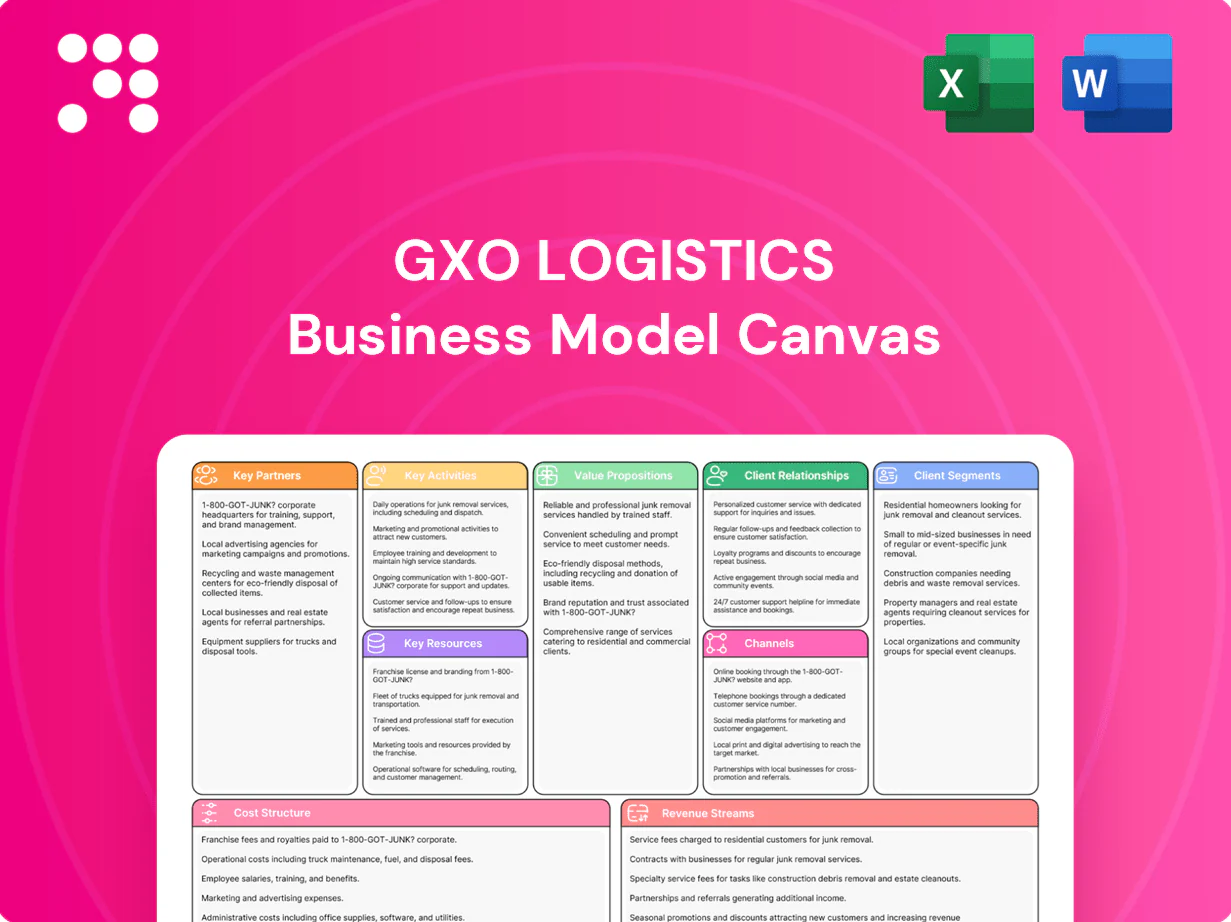
GXO Logistics Business Model Canvas

Business Model Canvas: Logistics blueprint to scale operations, boost margins, capture market share
Unlock GXO Logistics’s strategic blueprint with a concise Business Model Canvas that maps customer segments, value propositions, key partners, and revenue streams. This snapshot explains how GXO scales operations, drives margins, and captures market share. Ideal for investors, consultants, and operators seeking actionable insights. Purchase the full, editable Canvas to analyze each block in depth and apply it to your strategy.
Partnerships

Automation and robotics vendors
Automation and robotics vendors supply AMRs, goods-to-person systems and advanced sortation tech that materially boost throughput and efficiency across GXO operations; GXO operates in 27 countries across roughly 900 sites, scaling these systems globally.
Co-developing tailored automation for verticals like fashion and electronics allows GXO to match SKU velocity and handling requirements, improving pick rates and accuracy.
Long-term alliances secure equipment supply, service-levels and influence vendor roadmaps, while joint innovation lowers total cost of ownership and accelerates deployment timelines.
Transportation and parcel carriers
Strategic ties with LTL, FTL, parcel and last-mile networks give GXO true end-to-end coverage across 17 countries and thousands of carrier lanes, enabling seamless cross-dock and final-mile flows.
Preferential capacity and negotiated rates deliver peak-season resilience, historically reducing client surge costs and improving capacity fill versus spot market volatility.
Integrated TMS/WMS linkages provide real-time visibility and exception handling, boosting on-time performance and enhancing the final-mile experience.

WMS, TMS, and data platform providers
Core WMS, TMS and data-platform partners underpin orchestration, slotting and optimization across GXO’s network, supporting operations in 17 countries and nearly 1,000 sites as of 2024. APIs and middleware provide seamless ERP and storefront connectivity with dozens of standard integrations, while co-innovation programs unlock AI forecasting and digital twins. Reliable vendor SLAs reduce downtime and accelerate new-site launches.

Real estate and 3PL infrastructure partners
Developers and landlords secure strategic warehouse locations near demand hubs to support GXO's network; build-to-suit projects deliver high-bay (12–15 m) and automation-ready specs; flexible leases match contract durations and volume ramps; utilities and facilities partners implement energy, safety and sustainability upgrades to support continuous operations.
- Strategic locations near demand hubs
- Build-to-suit: high-bay 12–15 m, automation-ready
- Flexible leases tied to contract ramps
- Utilities: energy, safety, sustainability upgrades
Consulting and systems integrators
Consulting partners provide network design, change management, and regulatory readiness—critical as the global contract logistics market reached about $300B in 2024—while systems integrators accelerate multi-site rollouts and complex migrations for faster go-live. Joint bids with these partners secure large, multi-year outsourcing deals and shared KPIs align incentives around cost savings and service improvements.
- Advisors: network design, regulatory readiness
- Integrators: multi-site rollouts, migrations
- Sales: joint bids for multi-year contracts
- Governance: shared KPIs on savings & service
Automation and carrier alliances scale logistics across ~900 sites in 27 countries
Automation, carrier and real-estate partners enable GXO to scale automation across ~900 sites in 27 countries, match vertical needs and lower TCO; carrier alliances cover end-to-end lanes in 17 countries, securing peak capacity and rates; systems integrators and consultants accelerate rollouts and joint bids, aligning KPIs—global contract logistics ~ $300B in 2024.
| Metric | Value |
|---|---|
| Sites | ~900 |
| Countries | 27 |
| Carrier reach | 17 countries |
| Market size 2024 | $300B |
What is included in the product
 Detailed Word Document
A comprehensive, pre-written Business Model Canvas tailored to GXO Logistics’ strategy, detailing its 9 BMC blocks—customer segments, channels, value propositions, key activities, partners, resources, cost structure and revenue streams—with practical insights, competitive advantages and linked SWOT analysis for investor presentations and strategic decision-making.

 Customizable Excel Spreadsheet
High-level Business Model Canvas for GXO that pinpoints logistics pain points—inefficiencies, capacity constraints, and cost drivers—and maps targeted solutions across partners, activities, resources and revenue streams for quick team alignment.
Activities

Warehouse design and optimization
Engineering teams blueprint layouts, racking and flows to maximize productivity, driving up to 30% faster throughput in optimized sites. Slotting and dynamic labor models adapt to SKU profiles and seasonality, cutting pick times by around 25%. Continuous improvement uses Lean, Kaizen and real-time data—pilots showed ~15% efficiency uplift in 2024. Rapid reconfiguration enables product-launch pivots with re-layouts often completed within 4 weeks.
E-commerce fulfillment operations
Pick-pack-ship processes deliver high accuracy and speed to meet customer SLAs, with automation scaled during peak periods such as holidays and promotions to increase throughput and reduce labor volatility. Real-time visibility platforms feed customers live order status and exception alerts, improving on-time delivery and transparency. Returns handling and value-added services like kitting and quality checks are embedded in the same footprint to shorten cycle times and lower costs.

Reverse logistics and refurbishment
Processing returns at GXO centralizes grading, repair, and recommerce to recover value—industry e-commerce returns averaged about 18% in 2024, and recommerce workflows can recapture roughly 20–40% of original value. Rules engines automatically route items to resale, refurbishment, or recycling, with automated decisions covering over 80% of flow. Specialized cells perform electronics testing and apparel steaming, and analytics reduce returns and improve upstream quality by tracking root causes.

Supply chain analytics and optimization
Implementation and program management
New site launches follow GXO PMO playbooks standardized in 2024, ensuring repeatable timelines and risk controls. Cross-functional teams own timelines, testing protocols and go-live stability metrics to minimize disruption. Change management aligns processes and training to client SLAs while post-launch ramp curves are continuously monitored and tuned for throughput and cost targets.
- PMO-playbook
- cross-functional-teams
- change-management
- ramp-monitoring
Throughput +30%,pick -25%,recover 20-40%
Engineering layouts boost throughput up to 30%, slotting cuts pick times ~25% and CI initiatives drove ~15% efficiency uplift in 2024. Core pick-pack-ship meets SLAs with scalable automation at peaks and real-time visibility for on-time delivery. Returns/recommerce workflows handle ~18% e-commerce returns (2024), recouping ~20–40% value with automated routing covering >80% of decisions.
| Metric | Value | Year |
|---|---|---|
| Revenue | $11.3B | 2023 |
| Throughput | +30% | Optimized sites |
| Pick time | -25% | Slotting |
| Returns rate | 18% | 2024 |
| Recommerce recovery | 20–40% | 2024 |
| Automated routing | >80% | 2024 |
Full Document Unlocks After Purchase
Business Model Canvas
The GXO Logistics Business Model Canvas shown here is the actual deliverable, not a mockup; it’s a direct snapshot of the file you’ll receive after purchase. When you complete your order you’ll get this exact document—fully formatted, editable, and ready to use in Word and Excel—no surprises, no placeholders.

Business Model Canvas: Logistics blueprint to scale operations, boost margins, capture market share
Unlock GXO Logistics’s strategic blueprint with a concise Business Model Canvas that maps customer segments, value propositions, key partners, and revenue streams. This snapshot explains how GXO scales operations, drives margins, and captures market share. Ideal for investors, consultants, and operators seeking actionable insights. Purchase the full, editable Canvas to analyze each block in depth and apply it to your strategy.
Partnerships
Automation and robotics vendors
Automation and robotics vendors supply AMRs, goods-to-person systems and advanced sortation tech that materially boost throughput and efficiency across GXO operations; GXO operates in 27 countries across roughly 900 sites, scaling these systems globally.
Co-developing tailored automation for verticals like fashion and electronics allows GXO to match SKU velocity and handling requirements, improving pick rates and accuracy.
Long-term alliances secure equipment supply, service-levels and influence vendor roadmaps, while joint innovation lowers total cost of ownership and accelerates deployment timelines.
Transportation and parcel carriers
Strategic ties with LTL, FTL, parcel and last-mile networks give GXO true end-to-end coverage across 17 countries and thousands of carrier lanes, enabling seamless cross-dock and final-mile flows.
Preferential capacity and negotiated rates deliver peak-season resilience, historically reducing client surge costs and improving capacity fill versus spot market volatility.
Integrated TMS/WMS linkages provide real-time visibility and exception handling, boosting on-time performance and enhancing the final-mile experience.
WMS, TMS, and data platform providers
Core WMS, TMS and data-platform partners underpin orchestration, slotting and optimization across GXO’s network, supporting operations in 17 countries and nearly 1,000 sites as of 2024. APIs and middleware provide seamless ERP and storefront connectivity with dozens of standard integrations, while co-innovation programs unlock AI forecasting and digital twins. Reliable vendor SLAs reduce downtime and accelerate new-site launches.
Real estate and 3PL infrastructure partners
Developers and landlords secure strategic warehouse locations near demand hubs to support GXO's network; build-to-suit projects deliver high-bay (12–15 m) and automation-ready specs; flexible leases match contract durations and volume ramps; utilities and facilities partners implement energy, safety and sustainability upgrades to support continuous operations.
- Strategic locations near demand hubs
- Build-to-suit: high-bay 12–15 m, automation-ready
- Flexible leases tied to contract ramps
- Utilities: energy, safety, sustainability upgrades
Consulting and systems integrators
Consulting partners provide network design, change management, and regulatory readiness—critical as the global contract logistics market reached about $300B in 2024—while systems integrators accelerate multi-site rollouts and complex migrations for faster go-live. Joint bids with these partners secure large, multi-year outsourcing deals and shared KPIs align incentives around cost savings and service improvements.
- Advisors: network design, regulatory readiness
- Integrators: multi-site rollouts, migrations
- Sales: joint bids for multi-year contracts
- Governance: shared KPIs on savings & service
Automation and carrier alliances scale logistics across ~900 sites in 27 countries
Automation, carrier and real-estate partners enable GXO to scale automation across ~900 sites in 27 countries, match vertical needs and lower TCO; carrier alliances cover end-to-end lanes in 17 countries, securing peak capacity and rates; systems integrators and consultants accelerate rollouts and joint bids, aligning KPIs—global contract logistics ~ $300B in 2024.
| Metric | Value |
|---|---|
| Sites | ~900 |
| Countries | 27 |
| Carrier reach | 17 countries |
| Market size 2024 | $300B |
What is included in the product
Detailed Word Document
A comprehensive, pre-written Business Model Canvas tailored to GXO Logistics’ strategy, detailing its 9 BMC blocks—customer segments, channels, value propositions, key activities, partners, resources, cost structure and revenue streams—with practical insights, competitive advantages and linked SWOT analysis for investor presentations and strategic decision-making.
Customizable Excel Spreadsheet
High-level Business Model Canvas for GXO that pinpoints logistics pain points—inefficiencies, capacity constraints, and cost drivers—and maps targeted solutions across partners, activities, resources and revenue streams for quick team alignment.
Activities
Warehouse design and optimization
Engineering teams blueprint layouts, racking and flows to maximize productivity, driving up to 30% faster throughput in optimized sites. Slotting and dynamic labor models adapt to SKU profiles and seasonality, cutting pick times by around 25%. Continuous improvement uses Lean, Kaizen and real-time data—pilots showed ~15% efficiency uplift in 2024. Rapid reconfiguration enables product-launch pivots with re-layouts often completed within 4 weeks.
E-commerce fulfillment operations
Pick-pack-ship processes deliver high accuracy and speed to meet customer SLAs, with automation scaled during peak periods such as holidays and promotions to increase throughput and reduce labor volatility. Real-time visibility platforms feed customers live order status and exception alerts, improving on-time delivery and transparency. Returns handling and value-added services like kitting and quality checks are embedded in the same footprint to shorten cycle times and lower costs.
Reverse logistics and refurbishment
Processing returns at GXO centralizes grading, repair, and recommerce to recover value—industry e-commerce returns averaged about 18% in 2024, and recommerce workflows can recapture roughly 20–40% of original value. Rules engines automatically route items to resale, refurbishment, or recycling, with automated decisions covering over 80% of flow. Specialized cells perform electronics testing and apparel steaming, and analytics reduce returns and improve upstream quality by tracking root causes.
Supply chain analytics and optimization
Implementation and program management
New site launches follow GXO PMO playbooks standardized in 2024, ensuring repeatable timelines and risk controls. Cross-functional teams own timelines, testing protocols and go-live stability metrics to minimize disruption. Change management aligns processes and training to client SLAs while post-launch ramp curves are continuously monitored and tuned for throughput and cost targets.
- PMO-playbook
- cross-functional-teams
- change-management
- ramp-monitoring
Throughput +30%,pick -25%,recover 20-40%
Engineering layouts boost throughput up to 30%, slotting cuts pick times ~25% and CI initiatives drove ~15% efficiency uplift in 2024. Core pick-pack-ship meets SLAs with scalable automation at peaks and real-time visibility for on-time delivery. Returns/recommerce workflows handle ~18% e-commerce returns (2024), recouping ~20–40% value with automated routing covering >80% of decisions.
| Metric | Value | Year |
|---|---|---|
| Revenue | $11.3B | 2023 |
| Throughput | +30% | Optimized sites |
| Pick time | -25% | Slotting |
| Returns rate | 18% | 2024 |
| Recommerce recovery | 20–40% | 2024 |
| Automated routing | >80% | 2024 |
Full Document Unlocks After Purchase
Business Model Canvas
The GXO Logistics Business Model Canvas shown here is the actual deliverable, not a mockup; it’s a direct snapshot of the file you’ll receive after purchase. When you complete your order you’ll get this exact document—fully formatted, editable, and ready to use in Word and Excel—no surprises, no placeholders.
Description
Business Model Canvas: Logistics blueprint to scale operations, boost margins, capture market share
Unlock GXO Logistics’s strategic blueprint with a concise Business Model Canvas that maps customer segments, value propositions, key partners, and revenue streams. This snapshot explains how GXO scales operations, drives margins, and captures market share. Ideal for investors, consultants, and operators seeking actionable insights. Purchase the full, editable Canvas to analyze each block in depth and apply it to your strategy.
Partnerships
Automation and robotics vendors
Automation and robotics vendors supply AMRs, goods-to-person systems and advanced sortation tech that materially boost throughput and efficiency across GXO operations; GXO operates in 27 countries across roughly 900 sites, scaling these systems globally.
Co-developing tailored automation for verticals like fashion and electronics allows GXO to match SKU velocity and handling requirements, improving pick rates and accuracy.
Long-term alliances secure equipment supply, service-levels and influence vendor roadmaps, while joint innovation lowers total cost of ownership and accelerates deployment timelines.
Transportation and parcel carriers
Strategic ties with LTL, FTL, parcel and last-mile networks give GXO true end-to-end coverage across 17 countries and thousands of carrier lanes, enabling seamless cross-dock and final-mile flows.
Preferential capacity and negotiated rates deliver peak-season resilience, historically reducing client surge costs and improving capacity fill versus spot market volatility.
Integrated TMS/WMS linkages provide real-time visibility and exception handling, boosting on-time performance and enhancing the final-mile experience.
WMS, TMS, and data platform providers
Core WMS, TMS and data-platform partners underpin orchestration, slotting and optimization across GXO’s network, supporting operations in 17 countries and nearly 1,000 sites as of 2024. APIs and middleware provide seamless ERP and storefront connectivity with dozens of standard integrations, while co-innovation programs unlock AI forecasting and digital twins. Reliable vendor SLAs reduce downtime and accelerate new-site launches.
Real estate and 3PL infrastructure partners
Developers and landlords secure strategic warehouse locations near demand hubs to support GXO's network; build-to-suit projects deliver high-bay (12–15 m) and automation-ready specs; flexible leases match contract durations and volume ramps; utilities and facilities partners implement energy, safety and sustainability upgrades to support continuous operations.
- Strategic locations near demand hubs
- Build-to-suit: high-bay 12–15 m, automation-ready
- Flexible leases tied to contract ramps
- Utilities: energy, safety, sustainability upgrades
Consulting and systems integrators
Consulting partners provide network design, change management, and regulatory readiness—critical as the global contract logistics market reached about $300B in 2024—while systems integrators accelerate multi-site rollouts and complex migrations for faster go-live. Joint bids with these partners secure large, multi-year outsourcing deals and shared KPIs align incentives around cost savings and service improvements.
- Advisors: network design, regulatory readiness
- Integrators: multi-site rollouts, migrations
- Sales: joint bids for multi-year contracts
- Governance: shared KPIs on savings & service
Automation and carrier alliances scale logistics across ~900 sites in 27 countries
Automation, carrier and real-estate partners enable GXO to scale automation across ~900 sites in 27 countries, match vertical needs and lower TCO; carrier alliances cover end-to-end lanes in 17 countries, securing peak capacity and rates; systems integrators and consultants accelerate rollouts and joint bids, aligning KPIs—global contract logistics ~ $300B in 2024.
| Metric | Value |
|---|---|
| Sites | ~900 |
| Countries | 27 |
| Carrier reach | 17 countries |
| Market size 2024 | $300B |
What is included in the product
Detailed Word Document
A comprehensive, pre-written Business Model Canvas tailored to GXO Logistics’ strategy, detailing its 9 BMC blocks—customer segments, channels, value propositions, key activities, partners, resources, cost structure and revenue streams—with practical insights, competitive advantages and linked SWOT analysis for investor presentations and strategic decision-making.
Customizable Excel Spreadsheet
High-level Business Model Canvas for GXO that pinpoints logistics pain points—inefficiencies, capacity constraints, and cost drivers—and maps targeted solutions across partners, activities, resources and revenue streams for quick team alignment.
Activities
Warehouse design and optimization
Engineering teams blueprint layouts, racking and flows to maximize productivity, driving up to 30% faster throughput in optimized sites. Slotting and dynamic labor models adapt to SKU profiles and seasonality, cutting pick times by around 25%. Continuous improvement uses Lean, Kaizen and real-time data—pilots showed ~15% efficiency uplift in 2024. Rapid reconfiguration enables product-launch pivots with re-layouts often completed within 4 weeks.
E-commerce fulfillment operations
Pick-pack-ship processes deliver high accuracy and speed to meet customer SLAs, with automation scaled during peak periods such as holidays and promotions to increase throughput and reduce labor volatility. Real-time visibility platforms feed customers live order status and exception alerts, improving on-time delivery and transparency. Returns handling and value-added services like kitting and quality checks are embedded in the same footprint to shorten cycle times and lower costs.
Reverse logistics and refurbishment
Processing returns at GXO centralizes grading, repair, and recommerce to recover value—industry e-commerce returns averaged about 18% in 2024, and recommerce workflows can recapture roughly 20–40% of original value. Rules engines automatically route items to resale, refurbishment, or recycling, with automated decisions covering over 80% of flow. Specialized cells perform electronics testing and apparel steaming, and analytics reduce returns and improve upstream quality by tracking root causes.
Supply chain analytics and optimization
Implementation and program management
New site launches follow GXO PMO playbooks standardized in 2024, ensuring repeatable timelines and risk controls. Cross-functional teams own timelines, testing protocols and go-live stability metrics to minimize disruption. Change management aligns processes and training to client SLAs while post-launch ramp curves are continuously monitored and tuned for throughput and cost targets.
- PMO-playbook
- cross-functional-teams
- change-management
- ramp-monitoring
Throughput +30%,pick -25%,recover 20-40%
Engineering layouts boost throughput up to 30%, slotting cuts pick times ~25% and CI initiatives drove ~15% efficiency uplift in 2024. Core pick-pack-ship meets SLAs with scalable automation at peaks and real-time visibility for on-time delivery. Returns/recommerce workflows handle ~18% e-commerce returns (2024), recouping ~20–40% value with automated routing covering >80% of decisions.
| Metric | Value | Year |
|---|---|---|
| Revenue | $11.3B | 2023 |
| Throughput | +30% | Optimized sites |
| Pick time | -25% | Slotting |
| Returns rate | 18% | 2024 |
| Recommerce recovery | 20–40% | 2024 |
| Automated routing | >80% | 2024 |
Full Document Unlocks After Purchase
Business Model Canvas
The GXO Logistics Business Model Canvas shown here is the actual deliverable, not a mockup; it’s a direct snapshot of the file you’ll receive after purchase. When you complete your order you’ll get this exact document—fully formatted, editable, and ready to use in Word and Excel—no surprises, no placeholders.











