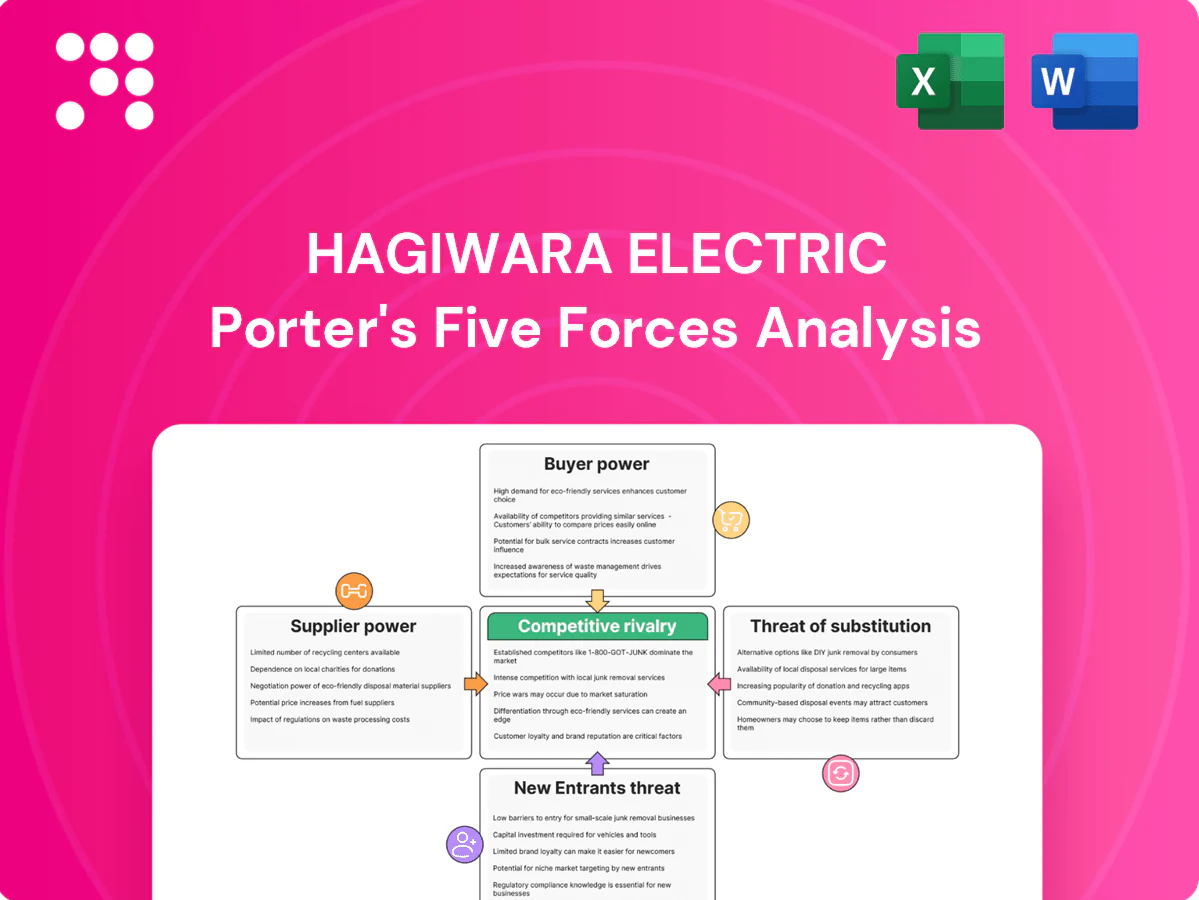
Hagiwara Electric Porter's Five Forces Analysis

Don't Miss the Bigger Picture
Hagiwara Electric’s Porter's Five Forces snapshot highlights supplier leverage, buyer sensitivity, rival intensity, threat of new entrants, and substitute risks shaping its margins and strategy. This brief overview teases where competitive pressure and opportunity converge for the company. Unlock the full Porter's Five Forces Analysis to access force-by-force ratings, visuals, and actionable recommendations tailored to Hagiwara Electric.
Suppliers Bargaining Power

Concentrated OEM sources
Industrial PCs, network gear and embedded modules come from a concentrated set of OEMs—vendors such as Advantech, Kontron and Cisco dominate segments—with Cisco holding roughly half of the enterprise switching market as of 2024 (Dell’Oro). Brands with rugged or certified SKUs can demand premium terms; reliance on specific lines raises exposure to distributor line‑card changes, while diversified, multi‑brand sourcing partially mitigates this leverage.
Semiconductor cycle volatility
Lead-time spikes and allocation periods shift power to upstream suppliers; at industry peaks lead times exceeded 20 weeks, giving vendors leverage over pricing and delivery windows. During shortages pricing pressure and tight windows squeezed distributor margins by double-digit percentages in prior cycles. In downcycles rebates and design-win support improve, and Hagiwara’s demand visibility and inventory planning shortened effective lead exposure to roughly 12 weeks in 2024, moderating swings.

Technical lock-in and certifications
Industrial buyers in rail, utilities and factory automation demand certified parts (EN 50155, IEC 61850, UL, ISO 9001), narrowing interchangeable suppliers and raising supplier switching costs; ISO Survey 2023 reported roughly 1.19 million ISO 9001 certificates worldwide. This strengthens OEM bargaining power, which Hagiwara can counter by offering alternate qualified parts and pre-certified solutions.

Value‑add dependence
Access to vendor technical roadmaps and paid support bundles increases supplier influence over Hagiwara by gating advanced features and certification timelines. Preferred partner tiers often demand volume and training commitments that restrict procurement flexibility and negotiation windows. Those thresholds can compress pricing levers and margin elasticity. Hagiwara’s systems-integration and support capabilities strengthen its channel value and improve bilateral bargaining.
- Vendor roadmaps create dependency on certified support
- Partner tiers require volume/training commitments
- Thresholds limit pricing flexibility
- Integration/support capabilities enhance Hagiwara’s bargaining
Currency and import dynamics
FX swings (USD/JPY average ~142 in 2024) and dollar‑priced imports raise supplier leverage as costs shift to Hagiwara; OEMs often pass freight, tariffs and compliance charges downstream. Active hedging, regional stocking and JPY‑priced sourcing cut exposure, while negotiated incoterms and multi‑year contracts can rebalance supplier power.
- USD/JPY 2024 avg ~142 — raises dollar cost exposure
- Logistics/compliance often passed to OEMs
- Hedging + local inventory reduce volatility
- Incoterms/long contracts rebalance leverage
Suppliers wield moderate-to-high power as concentrated switch OEMs and long lead times persist
Suppliers hold moderate-to-high power: concentrated OEMs (Cisco ~50% enterprise switching 2024) and certified rugged SKUs command premiums; peak lead times exceeded 20 weeks while Hagiwara shortened effective exposure to ~12 weeks in 2024. Certification needs (ISO 9001 ~1.19M certs 2023) and USD/JPY ~142 (2024) increase supplier leverage; hedging, multi-brand sourcing and long contracts mitigate risk.
| Metric | Value |
|---|---|
| Cisco enterprise switch share | ~50% (2024) |
| Peak lead times | >20 weeks |
| Hagiwara effective lead | ~12 weeks (2024) |
| USD/JPY avg | ~142 (2024) |
What is included in the product
 Detailed Word Document
Tailored Porter's Five Forces for Hagiwara Electric, uncovering competitive intensity, supplier and buyer power, threat of substitutes and new entrants, plus disruptive risks and strategic levers to protect margins and market share.

 Customizable Excel Spreadsheet
A concise, one-sheet Porter's Five Forces for Hagiwara Electric that instantly highlights supplier/customer power, entry/substitute threats and competitive rivalry—customizable pressure levels and clean visuals to speed strategic decisions and remove analysis bottlenecks.
Customers Bargaining Power

Large industrial accounts
Large manufacturing, infrastructure and transportation buyers are highly consolidated and able to force tough negotiations; framework agreements and public tenders in 2024 continued to drive price pressure and shorter supplier cycles. Volume commitments often exchange margin for revenue stability, while Hagiwara offsets pressure with lifecycle support, predictive maintenance and uptime guarantees to retain large accounts.
Specification‑driven purchasing
Buyers often set specifications at the design stage, steering component choices and approved vendor lists, and in 2024 the global connector market was estimated at about $76.5 billion, concentrating buying power among large OEMs. Early design-in typically locks pricing expectations and long-term BOM share, making initial negotiations pivotal. Post-qualification changes incur high requalification costs, moderating mid-cycle buyer leverage. Hagiwara leverages technical pre-sales to influence specs and capture design wins.

Switching costs via integration
System integration, proprietary software images and on-site support create strong switching frictions for Hagiwara Electric customers, embedding bespoke configurations and diagnostics into installed systems.
Migration risks and costly requalification cycles deter rapid supplier changes, while buyers still use competitive quotes to benchmark options.
Service SLAs and installed-base stickiness shift negotiations from price-only to value and uptime considerations.

Total cost and uptime focus
Industrial clients prioritize total cost of ownership over unit price, emphasizing reliability metrics like MTBF and guaranteed parts availability across 10–20 year lifecycles; this lets Hagiwara command 10–30% premiums for ruggedized solutions. Demonstrable downtime avoidance—industrial outages commonly cited at roughly $260,000 per hour—directly translates to measurable TCO savings and stronger customer bargaining leverage.
- Customers: TCO-focused
- Key metrics: MTBF, 10–20y availability
- Pricing: 10–30% premium
- Value proof: avoids ~$260,000/hr outage cost
Multi-sourcing policies
In 2024 procurement policies increasingly mandated dual sourcing for risk management, intensifying price comparisons and compressing negotiation cycles to weeks; approved vendor lists keep buyers' options open while differentiated bundles and strong post-sale support help Hagiwara defend share.
OEM buying power compresses connector market; $76.5B, premiums 10–30%
Large OEM buyers concentrate bargaining power; 2024 connector market ≈ $76.5B and dual-sourcing mandates compressed cycles and price pressure. Hagiwara offsets with lifecycle SLAs, predictive maintenance and design-in, enabling 10–30% premiums on ruggedized products. High requalification costs and installed-base SLAs (downtime ≈ $260,000/hr) sustain switching frictions.
| Metric | Value | Impact |
|---|---|---|
| Market size (2024) | $76.5B | Concentrated buyers |
| Premium | 10–30% | Margin protection |
| Outage cost | $260,000/hr | TCO leverage |
Preview Before You Purchase
Hagiwara Electric Porter's Five Forces Analysis
This preview shows the exact Porter’s Five Forces analysis of Hagiwara Electric you’ll receive—no placeholders, no edits needed. The document is fully formatted and ready for immediate download upon purchase. It contains the complete assessment of competitive rivalry, supplier and buyer power, substitutes, and barriers to entry, matching the file delivered to customers.

Don't Miss the Bigger Picture
Hagiwara Electric’s Porter's Five Forces snapshot highlights supplier leverage, buyer sensitivity, rival intensity, threat of new entrants, and substitute risks shaping its margins and strategy. This brief overview teases where competitive pressure and opportunity converge for the company. Unlock the full Porter's Five Forces Analysis to access force-by-force ratings, visuals, and actionable recommendations tailored to Hagiwara Electric.
Suppliers Bargaining Power
Concentrated OEM sources
Industrial PCs, network gear and embedded modules come from a concentrated set of OEMs—vendors such as Advantech, Kontron and Cisco dominate segments—with Cisco holding roughly half of the enterprise switching market as of 2024 (Dell’Oro). Brands with rugged or certified SKUs can demand premium terms; reliance on specific lines raises exposure to distributor line‑card changes, while diversified, multi‑brand sourcing partially mitigates this leverage.
Semiconductor cycle volatility
Lead-time spikes and allocation periods shift power to upstream suppliers; at industry peaks lead times exceeded 20 weeks, giving vendors leverage over pricing and delivery windows. During shortages pricing pressure and tight windows squeezed distributor margins by double-digit percentages in prior cycles. In downcycles rebates and design-win support improve, and Hagiwara’s demand visibility and inventory planning shortened effective lead exposure to roughly 12 weeks in 2024, moderating swings.
Technical lock-in and certifications
Industrial buyers in rail, utilities and factory automation demand certified parts (EN 50155, IEC 61850, UL, ISO 9001), narrowing interchangeable suppliers and raising supplier switching costs; ISO Survey 2023 reported roughly 1.19 million ISO 9001 certificates worldwide. This strengthens OEM bargaining power, which Hagiwara can counter by offering alternate qualified parts and pre-certified solutions.
Value‑add dependence
Access to vendor technical roadmaps and paid support bundles increases supplier influence over Hagiwara by gating advanced features and certification timelines. Preferred partner tiers often demand volume and training commitments that restrict procurement flexibility and negotiation windows. Those thresholds can compress pricing levers and margin elasticity. Hagiwara’s systems-integration and support capabilities strengthen its channel value and improve bilateral bargaining.
- Vendor roadmaps create dependency on certified support
- Partner tiers require volume/training commitments
- Thresholds limit pricing flexibility
- Integration/support capabilities enhance Hagiwara’s bargaining
Currency and import dynamics
FX swings (USD/JPY average ~142 in 2024) and dollar‑priced imports raise supplier leverage as costs shift to Hagiwara; OEMs often pass freight, tariffs and compliance charges downstream. Active hedging, regional stocking and JPY‑priced sourcing cut exposure, while negotiated incoterms and multi‑year contracts can rebalance supplier power.
- USD/JPY 2024 avg ~142 — raises dollar cost exposure
- Logistics/compliance often passed to OEMs
- Hedging + local inventory reduce volatility
- Incoterms/long contracts rebalance leverage
Suppliers wield moderate-to-high power as concentrated switch OEMs and long lead times persist
Suppliers hold moderate-to-high power: concentrated OEMs (Cisco ~50% enterprise switching 2024) and certified rugged SKUs command premiums; peak lead times exceeded 20 weeks while Hagiwara shortened effective exposure to ~12 weeks in 2024. Certification needs (ISO 9001 ~1.19M certs 2023) and USD/JPY ~142 (2024) increase supplier leverage; hedging, multi-brand sourcing and long contracts mitigate risk.
| Metric | Value |
|---|---|
| Cisco enterprise switch share | ~50% (2024) |
| Peak lead times | >20 weeks |
| Hagiwara effective lead | ~12 weeks (2024) |
| USD/JPY avg | ~142 (2024) |
What is included in the product
Detailed Word Document
Tailored Porter's Five Forces for Hagiwara Electric, uncovering competitive intensity, supplier and buyer power, threat of substitutes and new entrants, plus disruptive risks and strategic levers to protect margins and market share.
Customizable Excel Spreadsheet
A concise, one-sheet Porter's Five Forces for Hagiwara Electric that instantly highlights supplier/customer power, entry/substitute threats and competitive rivalry—customizable pressure levels and clean visuals to speed strategic decisions and remove analysis bottlenecks.
Customers Bargaining Power
Large industrial accounts
Large manufacturing, infrastructure and transportation buyers are highly consolidated and able to force tough negotiations; framework agreements and public tenders in 2024 continued to drive price pressure and shorter supplier cycles. Volume commitments often exchange margin for revenue stability, while Hagiwara offsets pressure with lifecycle support, predictive maintenance and uptime guarantees to retain large accounts.
Specification‑driven purchasing
Buyers often set specifications at the design stage, steering component choices and approved vendor lists, and in 2024 the global connector market was estimated at about $76.5 billion, concentrating buying power among large OEMs. Early design-in typically locks pricing expectations and long-term BOM share, making initial negotiations pivotal. Post-qualification changes incur high requalification costs, moderating mid-cycle buyer leverage. Hagiwara leverages technical pre-sales to influence specs and capture design wins.
Switching costs via integration
System integration, proprietary software images and on-site support create strong switching frictions for Hagiwara Electric customers, embedding bespoke configurations and diagnostics into installed systems.
Migration risks and costly requalification cycles deter rapid supplier changes, while buyers still use competitive quotes to benchmark options.
Service SLAs and installed-base stickiness shift negotiations from price-only to value and uptime considerations.
Total cost and uptime focus
Industrial clients prioritize total cost of ownership over unit price, emphasizing reliability metrics like MTBF and guaranteed parts availability across 10–20 year lifecycles; this lets Hagiwara command 10–30% premiums for ruggedized solutions. Demonstrable downtime avoidance—industrial outages commonly cited at roughly $260,000 per hour—directly translates to measurable TCO savings and stronger customer bargaining leverage.
- Customers: TCO-focused
- Key metrics: MTBF, 10–20y availability
- Pricing: 10–30% premium
- Value proof: avoids ~$260,000/hr outage cost
Multi-sourcing policies
In 2024 procurement policies increasingly mandated dual sourcing for risk management, intensifying price comparisons and compressing negotiation cycles to weeks; approved vendor lists keep buyers' options open while differentiated bundles and strong post-sale support help Hagiwara defend share.
OEM buying power compresses connector market; $76.5B, premiums 10–30%
Large OEM buyers concentrate bargaining power; 2024 connector market ≈ $76.5B and dual-sourcing mandates compressed cycles and price pressure. Hagiwara offsets with lifecycle SLAs, predictive maintenance and design-in, enabling 10–30% premiums on ruggedized products. High requalification costs and installed-base SLAs (downtime ≈ $260,000/hr) sustain switching frictions.
| Metric | Value | Impact |
|---|---|---|
| Market size (2024) | $76.5B | Concentrated buyers |
| Premium | 10–30% | Margin protection |
| Outage cost | $260,000/hr | TCO leverage |
Preview Before You Purchase
Hagiwara Electric Porter's Five Forces Analysis
This preview shows the exact Porter’s Five Forces analysis of Hagiwara Electric you’ll receive—no placeholders, no edits needed. The document is fully formatted and ready for immediate download upon purchase. It contains the complete assessment of competitive rivalry, supplier and buyer power, substitutes, and barriers to entry, matching the file delivered to customers.
Description
Don't Miss the Bigger Picture
Hagiwara Electric’s Porter's Five Forces snapshot highlights supplier leverage, buyer sensitivity, rival intensity, threat of new entrants, and substitute risks shaping its margins and strategy. This brief overview teases where competitive pressure and opportunity converge for the company. Unlock the full Porter's Five Forces Analysis to access force-by-force ratings, visuals, and actionable recommendations tailored to Hagiwara Electric.
Suppliers Bargaining Power
Concentrated OEM sources
Industrial PCs, network gear and embedded modules come from a concentrated set of OEMs—vendors such as Advantech, Kontron and Cisco dominate segments—with Cisco holding roughly half of the enterprise switching market as of 2024 (Dell’Oro). Brands with rugged or certified SKUs can demand premium terms; reliance on specific lines raises exposure to distributor line‑card changes, while diversified, multi‑brand sourcing partially mitigates this leverage.
Semiconductor cycle volatility
Lead-time spikes and allocation periods shift power to upstream suppliers; at industry peaks lead times exceeded 20 weeks, giving vendors leverage over pricing and delivery windows. During shortages pricing pressure and tight windows squeezed distributor margins by double-digit percentages in prior cycles. In downcycles rebates and design-win support improve, and Hagiwara’s demand visibility and inventory planning shortened effective lead exposure to roughly 12 weeks in 2024, moderating swings.
Technical lock-in and certifications
Industrial buyers in rail, utilities and factory automation demand certified parts (EN 50155, IEC 61850, UL, ISO 9001), narrowing interchangeable suppliers and raising supplier switching costs; ISO Survey 2023 reported roughly 1.19 million ISO 9001 certificates worldwide. This strengthens OEM bargaining power, which Hagiwara can counter by offering alternate qualified parts and pre-certified solutions.
Value‑add dependence
Access to vendor technical roadmaps and paid support bundles increases supplier influence over Hagiwara by gating advanced features and certification timelines. Preferred partner tiers often demand volume and training commitments that restrict procurement flexibility and negotiation windows. Those thresholds can compress pricing levers and margin elasticity. Hagiwara’s systems-integration and support capabilities strengthen its channel value and improve bilateral bargaining.
- Vendor roadmaps create dependency on certified support
- Partner tiers require volume/training commitments
- Thresholds limit pricing flexibility
- Integration/support capabilities enhance Hagiwara’s bargaining
Currency and import dynamics
FX swings (USD/JPY average ~142 in 2024) and dollar‑priced imports raise supplier leverage as costs shift to Hagiwara; OEMs often pass freight, tariffs and compliance charges downstream. Active hedging, regional stocking and JPY‑priced sourcing cut exposure, while negotiated incoterms and multi‑year contracts can rebalance supplier power.
- USD/JPY 2024 avg ~142 — raises dollar cost exposure
- Logistics/compliance often passed to OEMs
- Hedging + local inventory reduce volatility
- Incoterms/long contracts rebalance leverage
Suppliers wield moderate-to-high power as concentrated switch OEMs and long lead times persist
Suppliers hold moderate-to-high power: concentrated OEMs (Cisco ~50% enterprise switching 2024) and certified rugged SKUs command premiums; peak lead times exceeded 20 weeks while Hagiwara shortened effective exposure to ~12 weeks in 2024. Certification needs (ISO 9001 ~1.19M certs 2023) and USD/JPY ~142 (2024) increase supplier leverage; hedging, multi-brand sourcing and long contracts mitigate risk.
| Metric | Value |
|---|---|
| Cisco enterprise switch share | ~50% (2024) |
| Peak lead times | >20 weeks |
| Hagiwara effective lead | ~12 weeks (2024) |
| USD/JPY avg | ~142 (2024) |
What is included in the product
Detailed Word Document
Tailored Porter's Five Forces for Hagiwara Electric, uncovering competitive intensity, supplier and buyer power, threat of substitutes and new entrants, plus disruptive risks and strategic levers to protect margins and market share.
Customizable Excel Spreadsheet
A concise, one-sheet Porter's Five Forces for Hagiwara Electric that instantly highlights supplier/customer power, entry/substitute threats and competitive rivalry—customizable pressure levels and clean visuals to speed strategic decisions and remove analysis bottlenecks.
Customers Bargaining Power
Large industrial accounts
Large manufacturing, infrastructure and transportation buyers are highly consolidated and able to force tough negotiations; framework agreements and public tenders in 2024 continued to drive price pressure and shorter supplier cycles. Volume commitments often exchange margin for revenue stability, while Hagiwara offsets pressure with lifecycle support, predictive maintenance and uptime guarantees to retain large accounts.
Specification‑driven purchasing
Buyers often set specifications at the design stage, steering component choices and approved vendor lists, and in 2024 the global connector market was estimated at about $76.5 billion, concentrating buying power among large OEMs. Early design-in typically locks pricing expectations and long-term BOM share, making initial negotiations pivotal. Post-qualification changes incur high requalification costs, moderating mid-cycle buyer leverage. Hagiwara leverages technical pre-sales to influence specs and capture design wins.
Switching costs via integration
System integration, proprietary software images and on-site support create strong switching frictions for Hagiwara Electric customers, embedding bespoke configurations and diagnostics into installed systems.
Migration risks and costly requalification cycles deter rapid supplier changes, while buyers still use competitive quotes to benchmark options.
Service SLAs and installed-base stickiness shift negotiations from price-only to value and uptime considerations.
Total cost and uptime focus
Industrial clients prioritize total cost of ownership over unit price, emphasizing reliability metrics like MTBF and guaranteed parts availability across 10–20 year lifecycles; this lets Hagiwara command 10–30% premiums for ruggedized solutions. Demonstrable downtime avoidance—industrial outages commonly cited at roughly $260,000 per hour—directly translates to measurable TCO savings and stronger customer bargaining leverage.
- Customers: TCO-focused
- Key metrics: MTBF, 10–20y availability
- Pricing: 10–30% premium
- Value proof: avoids ~$260,000/hr outage cost
Multi-sourcing policies
In 2024 procurement policies increasingly mandated dual sourcing for risk management, intensifying price comparisons and compressing negotiation cycles to weeks; approved vendor lists keep buyers' options open while differentiated bundles and strong post-sale support help Hagiwara defend share.
OEM buying power compresses connector market; $76.5B, premiums 10–30%
Large OEM buyers concentrate bargaining power; 2024 connector market ≈ $76.5B and dual-sourcing mandates compressed cycles and price pressure. Hagiwara offsets with lifecycle SLAs, predictive maintenance and design-in, enabling 10–30% premiums on ruggedized products. High requalification costs and installed-base SLAs (downtime ≈ $260,000/hr) sustain switching frictions.
| Metric | Value | Impact |
|---|---|---|
| Market size (2024) | $76.5B | Concentrated buyers |
| Premium | 10–30% | Margin protection |
| Outage cost | $260,000/hr | TCO leverage |
Preview Before You Purchase
Hagiwara Electric Porter's Five Forces Analysis
This preview shows the exact Porter’s Five Forces analysis of Hagiwara Electric you’ll receive—no placeholders, no edits needed. The document is fully formatted and ready for immediate download upon purchase. It contains the complete assessment of competitive rivalry, supplier and buyer power, substitutes, and barriers to entry, matching the file delivered to customers.











