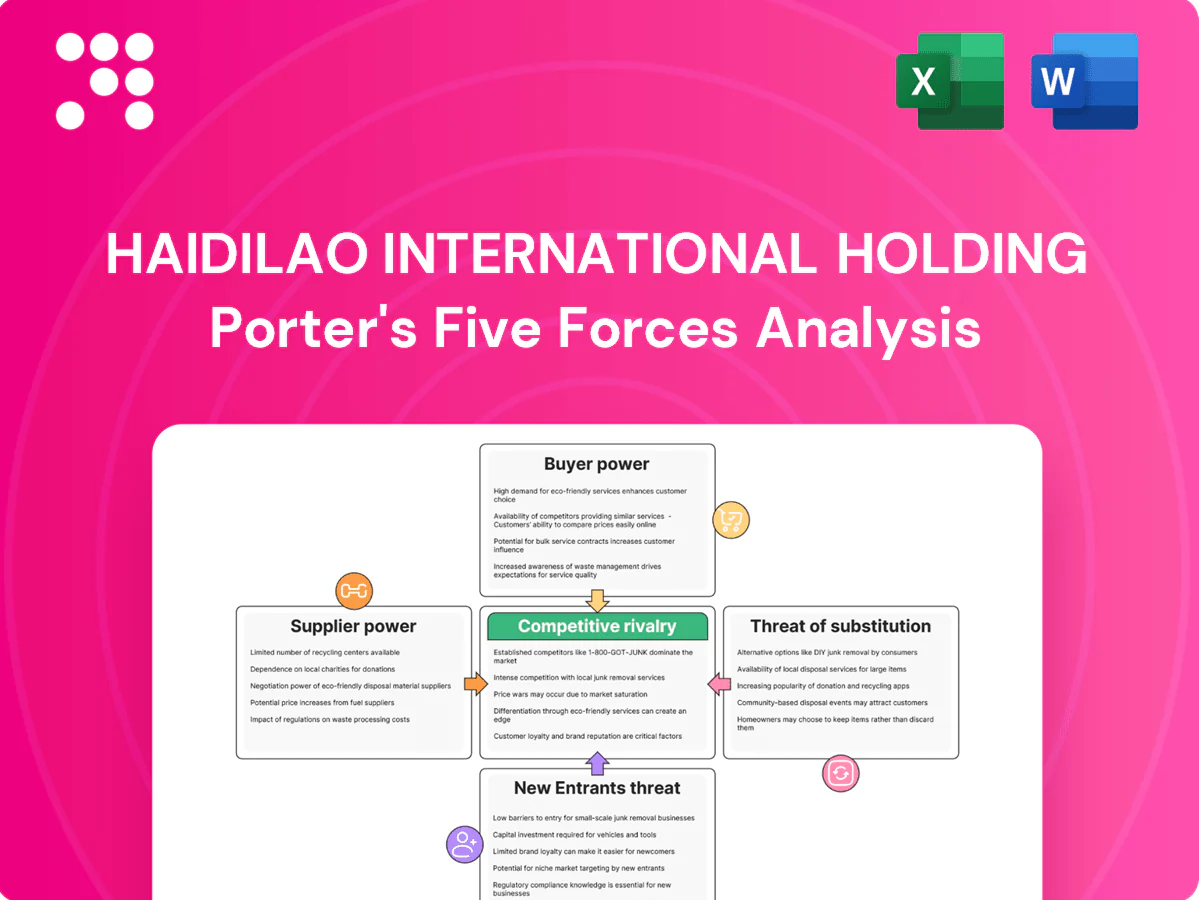
Haidilao International Holding Porter's Five Forces Analysis

From Overview to Strategy Blueprint
Haidilao operates in a highly competitive full-service hotpot market with strong rival rivalry and significant buyer expectations for service and experience, while supplier power is moderate due to standardized food inputs. International expansion raises regulatory and cultural barriers, and the threat of new entrants is tempered by brand strength and capital needs. This preview is just the beginning. The full analysis provides a complete strategic snapshot with force-by-force ratings, visuals, and business implications tailored to Haidilao International Holding.
Suppliers Bargaining Power

Scale-driven procurement
As one of the largest hot-pot chains with over 1,000 outlets, Haidilao aggregates demand to negotiate favorable terms on meats, seafood, vegetables and spices. Centralized sourcing and standardized SKUs drive volume discounts and lower per-unit costs. Scale enables multi-sourcing, deterring supplier hold-up, and supports multi-year contracts that stabilize input pricing.
Partial vertical ties
Haidilao has partial vertical ties with specialized soup-base and condiment producers, reducing reliance on external suppliers for critical flavor inputs and strengthening quality control and supply assurance. As of 2024 Haidilao is listed in Hong Kong under stock code 6862.HK, reflecting its integrated supply strategy. Concentration in key flavor bases creates single-counterparty risk, so governance and arm’s-length pricing are essential to avoid dependency.

Input commoditization
Many core food inputs for Haidilao are commoditized with abundant regional suppliers, which constrains supplier bargaining power. Switching costs are moderate because inputs follow standard specifications and common certifications, allowing rapid supplier replacement. Qualification and food-safety audits create procurement friction but are manageable at Haidilao’s scale. Competitive bidding across categories further disciplines supplier pricing.

Logistics and perishability
Cold-chain and fresh-produce needs raise supplier leverage in select markets where refrigerated logistics capacity is limited, and cross-border spices and specialty ingredients are exposed to tariff, FX and regulatory volatility. Disruptions from epidemics, animal disease or extreme weather can tighten supply and lift procurement costs, though diversified sourcing and buffer inventory reduce exposure and smooth price spikes.
- Cold-chain constraints elevate supplier power
- Tariff/FX/regulatory risk for cross-border inputs
- Disruptions tighten supply and raise costs
- Diversification and buffers mitigate spikes
Equipment and utilities
Non-food suppliers for Haidilao such as kitchen equipment, POS providers and utility contractors are more concentrated and impose higher switching costs, reinforcing supplier leverage. Standardization of specifications and procurement allows Haidilao to sign cross-market framework agreements, lowering per-unit costs. Energy price volatility remains a margin risk where Haidilao has limited direct leverage; preventive maintenance and multi-vendor sourcing reduce lock-in.
- Concentrated non-food supply base
- Framework agreements via standardization
- Energy price exposure limits leverage
- Preventive maintenance + multi-vendor to curb lock-in
Scale cuts supplier power: >1,000 outlets; vertical and cold-chain risks
Haidilao’s scale (>1,000 outlets) and centralized sourcing compress supplier power via volume discounts, multi-sourcing and multi-year contracts. Partial vertical integration for soup-bases reduces dependence but concentrates counterparty risk. Commoditized food inputs and competitive bidding limit supplier leverage; cold-chain and specialty imports remain key vulnerabilities. Non-food suppliers are more concentrated, raising switching costs.
| Metric | 2024 |
|---|---|
| Outlets | >1,000 |
| HK listing | 6862.HK |
| Key risk | Cold-chain & cross-border inputs |
What is included in the product
 Detailed Word Document
Tailored Porter’s Five Forces analysis for Haidilao International Holding uncovers key drivers of competition, buyer and supplier power, substitution threats, and barriers to entry, highlighting disruptive trends and pricing pressures that shape its profitability. Use this strategic snapshot to assess market positioning, competitive risks, and defensive opportunities unique to Haidilao.

 Customizable Excel Spreadsheet
One-sheet Porter's Five Forces for Haidilao—quickly visualize supplier, buyer, entrant, substitute and rivalry pressures with a radar chart; customizable scores and notes let you model scenarios, export to slides, and integrate into reports without complex setup.
Customers Bargaining Power

Fragmented diners
Customers are highly fragmented: Haidilao operated over 1,600 stores worldwide by end-2024, serving millions of individual diners across locations, which limits concentrated buyer power.
Group dining is common, but orders remain dispersed by table, with typical party sizes of 3–4 in China keeping bargaining fragmented.
No single customer segment can dictate price, though aggregate demand trends drive price sensitivity and demand elasticity for promotions and peak pricing.
Experience differentiation
Haidilao’s famed service, amenities and consistent quality reduce direct price sensitivity, enabling average spend premiums vs peers; in 2023 Haidilao reported RMB 33.1 billion revenue and operated roughly 1,700 stores. The experiential model raises switching costs versus basic hot pot shops, while over 100 million loyalty members and app bookings embed customers. This cushions pricing power during peak periods.

Abundant alternatives
Urban diners face many hot pot and non–hot pot choices, elevating comparative shopping and raising buyer leverage at the margin. Rival promotions and platform discounts can shift footfall rapidly; China delivery GMV topped about RMB 1.2 trillion in 2023, amplifying promotional reach. Social media scrutiny is strong—WeChat had roughly 1.3 billion MAUs—so reviews accelerate churn. This dynamic increases customer bargaining power.

Value-for-money focus
Macro slowdowns have made diners more price-conscious, pressuring Haidilao’s average check and forcing promotion of bundles, set menus and off-peak deals to sustain traffic.
Expanded delivery and retail soup-base channels provide lower-cost access and help moderate dine-in spend while forcing tighter perceived-value trade‑offs across portion, freshness and premium service.
- Value focus: promotional bundles and off-peak discounts
- Channel mix: delivery and retail soup bases lower dine-in reliance
- Customer expectations: balance portion, freshness, service
Digital discovery
Digital discovery drives customer bargaining: platforms and influencers shape venue selection and expectations, and with Haidilao operating over 1,300 stores (2024) high-visibility reviews magnify the demand impact of any service lapse. Public price comparisons limit dynamic pricing flexibility, making consistent NPS and rapid issue resolution essential to protect traffic and revenue.
- Platforms influence demand
- Visibility amplifies service lapses
- Public comparisons constrain pricing
- NPS & fast resolution critical
Fragmented stores, >100m members sustain pricing power vs delivery apps
Customers are fragmented (over 1,600 Haidilao stores by end‑2024) limiting concentrated buyer power, yet urban diners face many substitutes which raises marginal leverage. Strong service, >100 million loyalty members and RMB 33.1bn revenue (2023) sustain pricing premiums, but platform-driven promotions, RMB 1.2tn delivery GMV (2023) and social media visibility increase price sensitivity and churn risk.
| Metric | Value |
|---|---|
| Stores (2024) | >1,600 |
| Revenue (2023) | RMB 33.1bn |
| Loyalty members | >100m |
| China delivery GMV (2023) | RMB 1.2tn |
| WeChat MAU (2023) | ~1.3bn |
Preview Before You Purchase
Haidilao International Holding Porter's Five Forces Analysis
This Porter's Five Forces analysis of Haidilao International Holding evaluates competitive rivalry, buyer and supplier power, and the threats of new entrants and substitutes, offering actionable insights for strategy and investment decisions. The document you see here is the same professionally written, fully formatted file you’ll receive instantly after purchase—ready for download and use with no placeholders or changes.

From Overview to Strategy Blueprint
Haidilao operates in a highly competitive full-service hotpot market with strong rival rivalry and significant buyer expectations for service and experience, while supplier power is moderate due to standardized food inputs. International expansion raises regulatory and cultural barriers, and the threat of new entrants is tempered by brand strength and capital needs. This preview is just the beginning. The full analysis provides a complete strategic snapshot with force-by-force ratings, visuals, and business implications tailored to Haidilao International Holding.
Suppliers Bargaining Power
Scale-driven procurement
As one of the largest hot-pot chains with over 1,000 outlets, Haidilao aggregates demand to negotiate favorable terms on meats, seafood, vegetables and spices. Centralized sourcing and standardized SKUs drive volume discounts and lower per-unit costs. Scale enables multi-sourcing, deterring supplier hold-up, and supports multi-year contracts that stabilize input pricing.
Partial vertical ties
Haidilao has partial vertical ties with specialized soup-base and condiment producers, reducing reliance on external suppliers for critical flavor inputs and strengthening quality control and supply assurance. As of 2024 Haidilao is listed in Hong Kong under stock code 6862.HK, reflecting its integrated supply strategy. Concentration in key flavor bases creates single-counterparty risk, so governance and arm’s-length pricing are essential to avoid dependency.
Input commoditization
Many core food inputs for Haidilao are commoditized with abundant regional suppliers, which constrains supplier bargaining power. Switching costs are moderate because inputs follow standard specifications and common certifications, allowing rapid supplier replacement. Qualification and food-safety audits create procurement friction but are manageable at Haidilao’s scale. Competitive bidding across categories further disciplines supplier pricing.
Logistics and perishability
Cold-chain and fresh-produce needs raise supplier leverage in select markets where refrigerated logistics capacity is limited, and cross-border spices and specialty ingredients are exposed to tariff, FX and regulatory volatility. Disruptions from epidemics, animal disease or extreme weather can tighten supply and lift procurement costs, though diversified sourcing and buffer inventory reduce exposure and smooth price spikes.
- Cold-chain constraints elevate supplier power
- Tariff/FX/regulatory risk for cross-border inputs
- Disruptions tighten supply and raise costs
- Diversification and buffers mitigate spikes
Equipment and utilities
Non-food suppliers for Haidilao such as kitchen equipment, POS providers and utility contractors are more concentrated and impose higher switching costs, reinforcing supplier leverage. Standardization of specifications and procurement allows Haidilao to sign cross-market framework agreements, lowering per-unit costs. Energy price volatility remains a margin risk where Haidilao has limited direct leverage; preventive maintenance and multi-vendor sourcing reduce lock-in.
- Concentrated non-food supply base
- Framework agreements via standardization
- Energy price exposure limits leverage
- Preventive maintenance + multi-vendor to curb lock-in
Scale cuts supplier power: >1,000 outlets; vertical and cold-chain risks
Haidilao’s scale (>1,000 outlets) and centralized sourcing compress supplier power via volume discounts, multi-sourcing and multi-year contracts. Partial vertical integration for soup-bases reduces dependence but concentrates counterparty risk. Commoditized food inputs and competitive bidding limit supplier leverage; cold-chain and specialty imports remain key vulnerabilities. Non-food suppliers are more concentrated, raising switching costs.
| Metric | 2024 |
|---|---|
| Outlets | >1,000 |
| HK listing | 6862.HK |
| Key risk | Cold-chain & cross-border inputs |
What is included in the product
Detailed Word Document
Tailored Porter’s Five Forces analysis for Haidilao International Holding uncovers key drivers of competition, buyer and supplier power, substitution threats, and barriers to entry, highlighting disruptive trends and pricing pressures that shape its profitability. Use this strategic snapshot to assess market positioning, competitive risks, and defensive opportunities unique to Haidilao.
Customizable Excel Spreadsheet
One-sheet Porter's Five Forces for Haidilao—quickly visualize supplier, buyer, entrant, substitute and rivalry pressures with a radar chart; customizable scores and notes let you model scenarios, export to slides, and integrate into reports without complex setup.
Customers Bargaining Power
Fragmented diners
Customers are highly fragmented: Haidilao operated over 1,600 stores worldwide by end-2024, serving millions of individual diners across locations, which limits concentrated buyer power.
Group dining is common, but orders remain dispersed by table, with typical party sizes of 3–4 in China keeping bargaining fragmented.
No single customer segment can dictate price, though aggregate demand trends drive price sensitivity and demand elasticity for promotions and peak pricing.
Experience differentiation
Haidilao’s famed service, amenities and consistent quality reduce direct price sensitivity, enabling average spend premiums vs peers; in 2023 Haidilao reported RMB 33.1 billion revenue and operated roughly 1,700 stores. The experiential model raises switching costs versus basic hot pot shops, while over 100 million loyalty members and app bookings embed customers. This cushions pricing power during peak periods.
Abundant alternatives
Urban diners face many hot pot and non–hot pot choices, elevating comparative shopping and raising buyer leverage at the margin. Rival promotions and platform discounts can shift footfall rapidly; China delivery GMV topped about RMB 1.2 trillion in 2023, amplifying promotional reach. Social media scrutiny is strong—WeChat had roughly 1.3 billion MAUs—so reviews accelerate churn. This dynamic increases customer bargaining power.
Value-for-money focus
Macro slowdowns have made diners more price-conscious, pressuring Haidilao’s average check and forcing promotion of bundles, set menus and off-peak deals to sustain traffic.
Expanded delivery and retail soup-base channels provide lower-cost access and help moderate dine-in spend while forcing tighter perceived-value trade‑offs across portion, freshness and premium service.
- Value focus: promotional bundles and off-peak discounts
- Channel mix: delivery and retail soup bases lower dine-in reliance
- Customer expectations: balance portion, freshness, service
Digital discovery
Digital discovery drives customer bargaining: platforms and influencers shape venue selection and expectations, and with Haidilao operating over 1,300 stores (2024) high-visibility reviews magnify the demand impact of any service lapse. Public price comparisons limit dynamic pricing flexibility, making consistent NPS and rapid issue resolution essential to protect traffic and revenue.
- Platforms influence demand
- Visibility amplifies service lapses
- Public comparisons constrain pricing
- NPS & fast resolution critical
Fragmented stores, >100m members sustain pricing power vs delivery apps
Customers are fragmented (over 1,600 Haidilao stores by end‑2024) limiting concentrated buyer power, yet urban diners face many substitutes which raises marginal leverage. Strong service, >100 million loyalty members and RMB 33.1bn revenue (2023) sustain pricing premiums, but platform-driven promotions, RMB 1.2tn delivery GMV (2023) and social media visibility increase price sensitivity and churn risk.
| Metric | Value |
|---|---|
| Stores (2024) | >1,600 |
| Revenue (2023) | RMB 33.1bn |
| Loyalty members | >100m |
| China delivery GMV (2023) | RMB 1.2tn |
| WeChat MAU (2023) | ~1.3bn |
Preview Before You Purchase
Haidilao International Holding Porter's Five Forces Analysis
This Porter's Five Forces analysis of Haidilao International Holding evaluates competitive rivalry, buyer and supplier power, and the threats of new entrants and substitutes, offering actionable insights for strategy and investment decisions. The document you see here is the same professionally written, fully formatted file you’ll receive instantly after purchase—ready for download and use with no placeholders or changes.
Description
From Overview to Strategy Blueprint
Haidilao operates in a highly competitive full-service hotpot market with strong rival rivalry and significant buyer expectations for service and experience, while supplier power is moderate due to standardized food inputs. International expansion raises regulatory and cultural barriers, and the threat of new entrants is tempered by brand strength and capital needs. This preview is just the beginning. The full analysis provides a complete strategic snapshot with force-by-force ratings, visuals, and business implications tailored to Haidilao International Holding.
Suppliers Bargaining Power
Scale-driven procurement
As one of the largest hot-pot chains with over 1,000 outlets, Haidilao aggregates demand to negotiate favorable terms on meats, seafood, vegetables and spices. Centralized sourcing and standardized SKUs drive volume discounts and lower per-unit costs. Scale enables multi-sourcing, deterring supplier hold-up, and supports multi-year contracts that stabilize input pricing.
Partial vertical ties
Haidilao has partial vertical ties with specialized soup-base and condiment producers, reducing reliance on external suppliers for critical flavor inputs and strengthening quality control and supply assurance. As of 2024 Haidilao is listed in Hong Kong under stock code 6862.HK, reflecting its integrated supply strategy. Concentration in key flavor bases creates single-counterparty risk, so governance and arm’s-length pricing are essential to avoid dependency.
Input commoditization
Many core food inputs for Haidilao are commoditized with abundant regional suppliers, which constrains supplier bargaining power. Switching costs are moderate because inputs follow standard specifications and common certifications, allowing rapid supplier replacement. Qualification and food-safety audits create procurement friction but are manageable at Haidilao’s scale. Competitive bidding across categories further disciplines supplier pricing.
Logistics and perishability
Cold-chain and fresh-produce needs raise supplier leverage in select markets where refrigerated logistics capacity is limited, and cross-border spices and specialty ingredients are exposed to tariff, FX and regulatory volatility. Disruptions from epidemics, animal disease or extreme weather can tighten supply and lift procurement costs, though diversified sourcing and buffer inventory reduce exposure and smooth price spikes.
- Cold-chain constraints elevate supplier power
- Tariff/FX/regulatory risk for cross-border inputs
- Disruptions tighten supply and raise costs
- Diversification and buffers mitigate spikes
Equipment and utilities
Non-food suppliers for Haidilao such as kitchen equipment, POS providers and utility contractors are more concentrated and impose higher switching costs, reinforcing supplier leverage. Standardization of specifications and procurement allows Haidilao to sign cross-market framework agreements, lowering per-unit costs. Energy price volatility remains a margin risk where Haidilao has limited direct leverage; preventive maintenance and multi-vendor sourcing reduce lock-in.
- Concentrated non-food supply base
- Framework agreements via standardization
- Energy price exposure limits leverage
- Preventive maintenance + multi-vendor to curb lock-in
Scale cuts supplier power: >1,000 outlets; vertical and cold-chain risks
Haidilao’s scale (>1,000 outlets) and centralized sourcing compress supplier power via volume discounts, multi-sourcing and multi-year contracts. Partial vertical integration for soup-bases reduces dependence but concentrates counterparty risk. Commoditized food inputs and competitive bidding limit supplier leverage; cold-chain and specialty imports remain key vulnerabilities. Non-food suppliers are more concentrated, raising switching costs.
| Metric | 2024 |
|---|---|
| Outlets | >1,000 |
| HK listing | 6862.HK |
| Key risk | Cold-chain & cross-border inputs |
What is included in the product
Detailed Word Document
Tailored Porter’s Five Forces analysis for Haidilao International Holding uncovers key drivers of competition, buyer and supplier power, substitution threats, and barriers to entry, highlighting disruptive trends and pricing pressures that shape its profitability. Use this strategic snapshot to assess market positioning, competitive risks, and defensive opportunities unique to Haidilao.
Customizable Excel Spreadsheet
One-sheet Porter's Five Forces for Haidilao—quickly visualize supplier, buyer, entrant, substitute and rivalry pressures with a radar chart; customizable scores and notes let you model scenarios, export to slides, and integrate into reports without complex setup.
Customers Bargaining Power
Fragmented diners
Customers are highly fragmented: Haidilao operated over 1,600 stores worldwide by end-2024, serving millions of individual diners across locations, which limits concentrated buyer power.
Group dining is common, but orders remain dispersed by table, with typical party sizes of 3–4 in China keeping bargaining fragmented.
No single customer segment can dictate price, though aggregate demand trends drive price sensitivity and demand elasticity for promotions and peak pricing.
Experience differentiation
Haidilao’s famed service, amenities and consistent quality reduce direct price sensitivity, enabling average spend premiums vs peers; in 2023 Haidilao reported RMB 33.1 billion revenue and operated roughly 1,700 stores. The experiential model raises switching costs versus basic hot pot shops, while over 100 million loyalty members and app bookings embed customers. This cushions pricing power during peak periods.
Abundant alternatives
Urban diners face many hot pot and non–hot pot choices, elevating comparative shopping and raising buyer leverage at the margin. Rival promotions and platform discounts can shift footfall rapidly; China delivery GMV topped about RMB 1.2 trillion in 2023, amplifying promotional reach. Social media scrutiny is strong—WeChat had roughly 1.3 billion MAUs—so reviews accelerate churn. This dynamic increases customer bargaining power.
Value-for-money focus
Macro slowdowns have made diners more price-conscious, pressuring Haidilao’s average check and forcing promotion of bundles, set menus and off-peak deals to sustain traffic.
Expanded delivery and retail soup-base channels provide lower-cost access and help moderate dine-in spend while forcing tighter perceived-value trade‑offs across portion, freshness and premium service.
- Value focus: promotional bundles and off-peak discounts
- Channel mix: delivery and retail soup bases lower dine-in reliance
- Customer expectations: balance portion, freshness, service
Digital discovery
Digital discovery drives customer bargaining: platforms and influencers shape venue selection and expectations, and with Haidilao operating over 1,300 stores (2024) high-visibility reviews magnify the demand impact of any service lapse. Public price comparisons limit dynamic pricing flexibility, making consistent NPS and rapid issue resolution essential to protect traffic and revenue.
- Platforms influence demand
- Visibility amplifies service lapses
- Public comparisons constrain pricing
- NPS & fast resolution critical
Fragmented stores, >100m members sustain pricing power vs delivery apps
Customers are fragmented (over 1,600 Haidilao stores by end‑2024) limiting concentrated buyer power, yet urban diners face many substitutes which raises marginal leverage. Strong service, >100 million loyalty members and RMB 33.1bn revenue (2023) sustain pricing premiums, but platform-driven promotions, RMB 1.2tn delivery GMV (2023) and social media visibility increase price sensitivity and churn risk.
| Metric | Value |
|---|---|
| Stores (2024) | >1,600 |
| Revenue (2023) | RMB 33.1bn |
| Loyalty members | >100m |
| China delivery GMV (2023) | RMB 1.2tn |
| WeChat MAU (2023) | ~1.3bn |
Preview Before You Purchase
Haidilao International Holding Porter's Five Forces Analysis
This Porter's Five Forces analysis of Haidilao International Holding evaluates competitive rivalry, buyer and supplier power, and the threats of new entrants and substitutes, offering actionable insights for strategy and investment decisions. The document you see here is the same professionally written, fully formatted file you’ll receive instantly after purchase—ready for download and use with no placeholders or changes.











