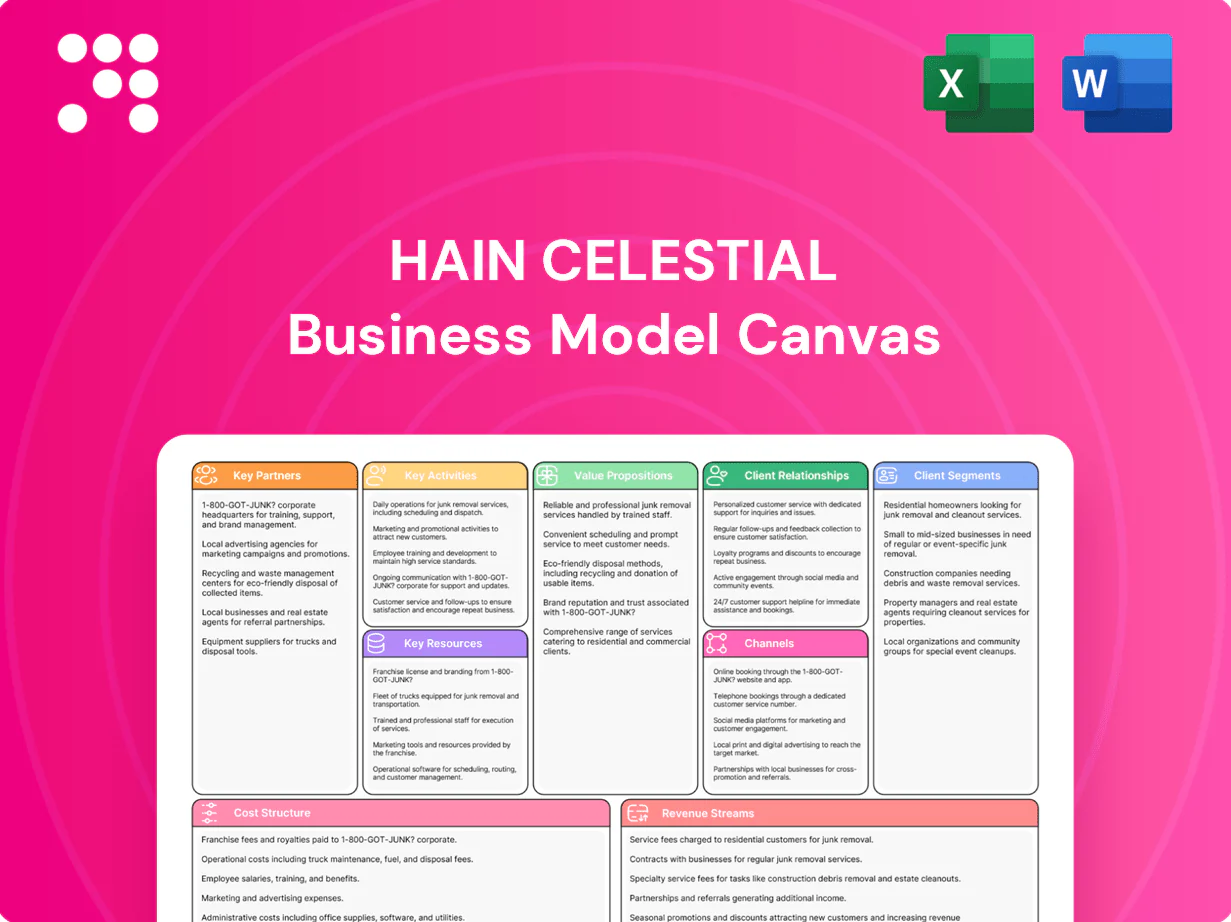
Hain Celestial Business Model Canvas

Unlock a leading natural foods company's strategic Business Model Canvas
Unlock the full strategic blueprint behind Hain Celestial’s business model in a concise, actionable Business Model Canvas that maps value propositions, revenue streams, key partners and growth levers. Ideal for investors, consultants, and founders—purchase the complete, editable Word/Excel canvas to benchmark strategy and drive decisions.
Partnerships

Organic ingredient suppliers
Trusted growers and processors supply Hain Celestial with certified organic, non-GMO, sustainably grown inputs for snacks, beverages and personal care, supporting access to a segment of the global organic market (~$250B in 2023). Long-term contracts and multi-year sourcing stabilize quality and pricing amid organic premiums (~25–40% in 2023). Supplier development programs upgrade capabilities to meet clean-label specs, while traceability partnerships ensure compliance and substantiate brand claims.
Contract manufacturers & co-packers
Contract manufacturers and co-packers complement Hain Celestial’s internal plants to flex capacity and accelerate innovation, enabling rapid scaling of new SKUs and seasonal runs; in 2024 the company targeted agile supply responses to support roughly $1.2 billion in net sales. Quality agreements, GMP audits and third-party certifications maintain product integrity and safety across partners. Geographic dispersion of partners shortens lead times and trims logistics costs, particularly for North American and EMEA distribution.

Retailers & e-commerce marketplaces
Partnerships with grocers, natural-channel retailers, club stores and online platforms extend Hain Celestial’s reach, leveraging distribution into over 100,000 US and international doors and e‑commerce channels; joint business planning aligns assortment, promotions and shelf placement to drive velocity. Retail media and data‑sharing—with retail media spend reaching roughly $70B in 2024—enhance shopper insights, while omnichannel coordination ensures consistent brand execution across physical and digital touchpoints.

Logistics & packaging providers
3PL partners manage warehousing, cold chain where required, and last-mile distribution to safeguard Hain Celestial’s perishable and ambient SKUs while meeting SLA-backed fill rates and freshness standards.
Packaging vendors deliver recyclable, lightweight formats aligned with the company’s sustainability targets, and continuous network optimization lowers transportation costs and emissions.
- 3PLs: warehousing, cold chain, last-mile, SLA-protected fill rates
- Packaging: recyclable, lightweight solutions tied to sustainability goals
- Network optimization: cost and emissions reduction, service consistency
Regulatory, certification & sustainability bodies
Alliances with USDA Organic, Non-GMO Project, Fair Trade and cruelty-free certifiers validate Hain Celestial product claims and market positioning; Non-GMO Project verifies over 60,000 products globally as of 2024. Industry groups and NGOs shape evolving standards while lifecycle-assessment partners quantify supply-chain impact reductions and compliance advisors lower regulatory risk across multiple markets.
- Certifiers: USDA Organic, Non-GMO Project, Fair Trade, cruelty-free
- Standards input: industry groups, NGOs
- LCA partners: quantify emissions/water reductions
- Compliance advisors: reduce cross-market regulatory risk
Strategic supply, co‑packing & retail media power $1.2B organic push in 2024
Strategic suppliers, contract manufacturers and 3PLs secure organic/non‑GMO inputs, flexible capacity and on‑time distribution, underpinning ~ $1.2B targeted net sales in 2024. Retail and e‑commerce partners drive placement and data sharing (retail media ~$70B in 2024). Certifiers (USDA Organic, Non‑GMO Project) validate claims; Non‑GMO Project covers >60,000 products in 2024.
| Partner | Role | 2024 metric |
|---|---|---|
| Growers/Processors | Supply organic/non‑GMO | Global organic market ~$250B (2023) |
| Co‑packers | Scale SKUs | Supports ~$1.2B sales target |
| Retail & e‑com | Distribution & data | Retail media ~$70B (2024) |
| Certifiers | Validate claims | Non‑GMO >60,000 products (2024) |
What is included in the product
 Detailed Word Document
A comprehensive, pre-written Business Model Canvas for Hain Celestial detailing customer segments, channels, value propositions and the nine BMC blocks aligned with its natural/organic food strategy. Includes competitive advantages, SWOT-linked insights and polished content for presentations or investor discussions.

 Customizable Excel Spreadsheet
High-level view of Hain Celestial’s business model with editable cells, relieving pain by surfacing core brands, distribution channels and margin drivers for faster strategy and portfolio decisions.
Activities

Brand portfolio management
Stewarding Hain Celestial’s multi-brand portfolio across snacks, beverages and personal care focuses on prioritizing hero SKUs, pruning tail items and clarifying positioning to drive higher margin mix; the company, founded in 1993 and headquartered in Lake Success, NY, aligns pricing, pack architecture and innovation roadmaps across brands. Coordinated pricing and channel messaging ensure coherent omnichannel brand communication and faster SKU rationalization.
Product innovation & renovation
Hain Celestial focuses on developing plant-based, clean-label and low-allergen lines as demand grows (global plant-based retail ~$31 billion in 2024). Reformulation programs target removal of artificial ingredients and reductions in sugar and sodium to meet health trends. Rapid prototyping and sensory testing guide go/no-go launch decisions. Regulatory and certification checks ensure compliance across regions.

Integrated supply chain operations
Integrated supply chain operations coordinate sourcing, production planning and quality assurance across owned and partner sites to meet brand standards and regulatory requirements while targeting OTIF of 95%. Continuous improvement programs pursue lean initiatives to cut waste and downtime, targeting double-digit efficiency gains. Demand forecasting and S&OP align production with seasonal demand to optimize inventory turns, while logistics execution focuses on on-time, in-full delivery and cost-to-serve metrics.

Sales execution & shopper marketing
Hain Celestial focuses on building retailer relationships and securing distribution through joint business plans and category resets, running promotions, displays and retail media to drive conversion while leveraging category management to win shelf space; retail media spend exceeded 100B globally in 2023, boosting in-store and online conversion.
- Retailer partnerships
- Promotions & displays
- Category management
- Track lift & ROI
Sustainability & compliance management
Sustainability and compliance management drives Hain Celestial’s push to advance recyclable packaging, cleaner ingredient sourcing, and energy-efficiency projects while keeping certifications and audit readiness current.
ESG data collection and reporting follow recognized frameworks for investor and regulator transparency, and supplier engagement extends compliance and welfare standards upstream.
SKU rationalization, scale plant-based, hit OTIF 95%
Stewarding a multi-brand portfolio through SKU rationalization and pricing, prioritizing hero SKUs and innovation; accelerating plant-based, clean-label launches (global plant-based retail ~$31B in 2024); running S&OP to hit OTIF 95% and double-digit CI targets; securing retailer distribution via joint business plans and retail media (global spend >$100B in 2023) while advancing packaging and ESG reporting.
| Metric | Value |
|---|---|
| Plant-based retail (2024) | $31B |
| Retail media spend (2023) | >$100B |
| OTIF target | 95% |
What You See Is What You Get
Business Model Canvas
The Hain Celestial Business Model Canvas shown here is a live preview of the exact deliverable you’ll receive — not a mockup. Upon purchase you’ll get this same comprehensive, editable document in its full form, ready for analysis, presentation, and customization. No substitutions, no surprises.

Unlock a leading natural foods company's strategic Business Model Canvas
Unlock the full strategic blueprint behind Hain Celestial’s business model in a concise, actionable Business Model Canvas that maps value propositions, revenue streams, key partners and growth levers. Ideal for investors, consultants, and founders—purchase the complete, editable Word/Excel canvas to benchmark strategy and drive decisions.
Partnerships
Organic ingredient suppliers
Trusted growers and processors supply Hain Celestial with certified organic, non-GMO, sustainably grown inputs for snacks, beverages and personal care, supporting access to a segment of the global organic market (~$250B in 2023). Long-term contracts and multi-year sourcing stabilize quality and pricing amid organic premiums (~25–40% in 2023). Supplier development programs upgrade capabilities to meet clean-label specs, while traceability partnerships ensure compliance and substantiate brand claims.
Contract manufacturers & co-packers
Contract manufacturers and co-packers complement Hain Celestial’s internal plants to flex capacity and accelerate innovation, enabling rapid scaling of new SKUs and seasonal runs; in 2024 the company targeted agile supply responses to support roughly $1.2 billion in net sales. Quality agreements, GMP audits and third-party certifications maintain product integrity and safety across partners. Geographic dispersion of partners shortens lead times and trims logistics costs, particularly for North American and EMEA distribution.
Retailers & e-commerce marketplaces
Partnerships with grocers, natural-channel retailers, club stores and online platforms extend Hain Celestial’s reach, leveraging distribution into over 100,000 US and international doors and e‑commerce channels; joint business planning aligns assortment, promotions and shelf placement to drive velocity. Retail media and data‑sharing—with retail media spend reaching roughly $70B in 2024—enhance shopper insights, while omnichannel coordination ensures consistent brand execution across physical and digital touchpoints.
Logistics & packaging providers
3PL partners manage warehousing, cold chain where required, and last-mile distribution to safeguard Hain Celestial’s perishable and ambient SKUs while meeting SLA-backed fill rates and freshness standards.
Packaging vendors deliver recyclable, lightweight formats aligned with the company’s sustainability targets, and continuous network optimization lowers transportation costs and emissions.
- 3PLs: warehousing, cold chain, last-mile, SLA-protected fill rates
- Packaging: recyclable, lightweight solutions tied to sustainability goals
- Network optimization: cost and emissions reduction, service consistency
Regulatory, certification & sustainability bodies
Alliances with USDA Organic, Non-GMO Project, Fair Trade and cruelty-free certifiers validate Hain Celestial product claims and market positioning; Non-GMO Project verifies over 60,000 products globally as of 2024. Industry groups and NGOs shape evolving standards while lifecycle-assessment partners quantify supply-chain impact reductions and compliance advisors lower regulatory risk across multiple markets.
- Certifiers: USDA Organic, Non-GMO Project, Fair Trade, cruelty-free
- Standards input: industry groups, NGOs
- LCA partners: quantify emissions/water reductions
- Compliance advisors: reduce cross-market regulatory risk
Strategic supply, co‑packing & retail media power $1.2B organic push in 2024
Strategic suppliers, contract manufacturers and 3PLs secure organic/non‑GMO inputs, flexible capacity and on‑time distribution, underpinning ~ $1.2B targeted net sales in 2024. Retail and e‑commerce partners drive placement and data sharing (retail media ~$70B in 2024). Certifiers (USDA Organic, Non‑GMO Project) validate claims; Non‑GMO Project covers >60,000 products in 2024.
| Partner | Role | 2024 metric |
|---|---|---|
| Growers/Processors | Supply organic/non‑GMO | Global organic market ~$250B (2023) |
| Co‑packers | Scale SKUs | Supports ~$1.2B sales target |
| Retail & e‑com | Distribution & data | Retail media ~$70B (2024) |
| Certifiers | Validate claims | Non‑GMO >60,000 products (2024) |
What is included in the product
Detailed Word Document
A comprehensive, pre-written Business Model Canvas for Hain Celestial detailing customer segments, channels, value propositions and the nine BMC blocks aligned with its natural/organic food strategy. Includes competitive advantages, SWOT-linked insights and polished content for presentations or investor discussions.
Customizable Excel Spreadsheet
High-level view of Hain Celestial’s business model with editable cells, relieving pain by surfacing core brands, distribution channels and margin drivers for faster strategy and portfolio decisions.
Activities
Brand portfolio management
Stewarding Hain Celestial’s multi-brand portfolio across snacks, beverages and personal care focuses on prioritizing hero SKUs, pruning tail items and clarifying positioning to drive higher margin mix; the company, founded in 1993 and headquartered in Lake Success, NY, aligns pricing, pack architecture and innovation roadmaps across brands. Coordinated pricing and channel messaging ensure coherent omnichannel brand communication and faster SKU rationalization.
Product innovation & renovation
Hain Celestial focuses on developing plant-based, clean-label and low-allergen lines as demand grows (global plant-based retail ~$31 billion in 2024). Reformulation programs target removal of artificial ingredients and reductions in sugar and sodium to meet health trends. Rapid prototyping and sensory testing guide go/no-go launch decisions. Regulatory and certification checks ensure compliance across regions.
Integrated supply chain operations
Integrated supply chain operations coordinate sourcing, production planning and quality assurance across owned and partner sites to meet brand standards and regulatory requirements while targeting OTIF of 95%. Continuous improvement programs pursue lean initiatives to cut waste and downtime, targeting double-digit efficiency gains. Demand forecasting and S&OP align production with seasonal demand to optimize inventory turns, while logistics execution focuses on on-time, in-full delivery and cost-to-serve metrics.
Sales execution & shopper marketing
Hain Celestial focuses on building retailer relationships and securing distribution through joint business plans and category resets, running promotions, displays and retail media to drive conversion while leveraging category management to win shelf space; retail media spend exceeded 100B globally in 2023, boosting in-store and online conversion.
- Retailer partnerships
- Promotions & displays
- Category management
- Track lift & ROI
Sustainability & compliance management
Sustainability and compliance management drives Hain Celestial’s push to advance recyclable packaging, cleaner ingredient sourcing, and energy-efficiency projects while keeping certifications and audit readiness current.
ESG data collection and reporting follow recognized frameworks for investor and regulator transparency, and supplier engagement extends compliance and welfare standards upstream.
SKU rationalization, scale plant-based, hit OTIF 95%
Stewarding a multi-brand portfolio through SKU rationalization and pricing, prioritizing hero SKUs and innovation; accelerating plant-based, clean-label launches (global plant-based retail ~$31B in 2024); running S&OP to hit OTIF 95% and double-digit CI targets; securing retailer distribution via joint business plans and retail media (global spend >$100B in 2023) while advancing packaging and ESG reporting.
| Metric | Value |
|---|---|
| Plant-based retail (2024) | $31B |
| Retail media spend (2023) | >$100B |
| OTIF target | 95% |
What You See Is What You Get
Business Model Canvas
The Hain Celestial Business Model Canvas shown here is a live preview of the exact deliverable you’ll receive — not a mockup. Upon purchase you’ll get this same comprehensive, editable document in its full form, ready for analysis, presentation, and customization. No substitutions, no surprises.
Description
Unlock a leading natural foods company's strategic Business Model Canvas
Unlock the full strategic blueprint behind Hain Celestial’s business model in a concise, actionable Business Model Canvas that maps value propositions, revenue streams, key partners and growth levers. Ideal for investors, consultants, and founders—purchase the complete, editable Word/Excel canvas to benchmark strategy and drive decisions.
Partnerships
Organic ingredient suppliers
Trusted growers and processors supply Hain Celestial with certified organic, non-GMO, sustainably grown inputs for snacks, beverages and personal care, supporting access to a segment of the global organic market (~$250B in 2023). Long-term contracts and multi-year sourcing stabilize quality and pricing amid organic premiums (~25–40% in 2023). Supplier development programs upgrade capabilities to meet clean-label specs, while traceability partnerships ensure compliance and substantiate brand claims.
Contract manufacturers & co-packers
Contract manufacturers and co-packers complement Hain Celestial’s internal plants to flex capacity and accelerate innovation, enabling rapid scaling of new SKUs and seasonal runs; in 2024 the company targeted agile supply responses to support roughly $1.2 billion in net sales. Quality agreements, GMP audits and third-party certifications maintain product integrity and safety across partners. Geographic dispersion of partners shortens lead times and trims logistics costs, particularly for North American and EMEA distribution.
Retailers & e-commerce marketplaces
Partnerships with grocers, natural-channel retailers, club stores and online platforms extend Hain Celestial’s reach, leveraging distribution into over 100,000 US and international doors and e‑commerce channels; joint business planning aligns assortment, promotions and shelf placement to drive velocity. Retail media and data‑sharing—with retail media spend reaching roughly $70B in 2024—enhance shopper insights, while omnichannel coordination ensures consistent brand execution across physical and digital touchpoints.
Logistics & packaging providers
3PL partners manage warehousing, cold chain where required, and last-mile distribution to safeguard Hain Celestial’s perishable and ambient SKUs while meeting SLA-backed fill rates and freshness standards.
Packaging vendors deliver recyclable, lightweight formats aligned with the company’s sustainability targets, and continuous network optimization lowers transportation costs and emissions.
- 3PLs: warehousing, cold chain, last-mile, SLA-protected fill rates
- Packaging: recyclable, lightweight solutions tied to sustainability goals
- Network optimization: cost and emissions reduction, service consistency
Regulatory, certification & sustainability bodies
Alliances with USDA Organic, Non-GMO Project, Fair Trade and cruelty-free certifiers validate Hain Celestial product claims and market positioning; Non-GMO Project verifies over 60,000 products globally as of 2024. Industry groups and NGOs shape evolving standards while lifecycle-assessment partners quantify supply-chain impact reductions and compliance advisors lower regulatory risk across multiple markets.
- Certifiers: USDA Organic, Non-GMO Project, Fair Trade, cruelty-free
- Standards input: industry groups, NGOs
- LCA partners: quantify emissions/water reductions
- Compliance advisors: reduce cross-market regulatory risk
Strategic supply, co‑packing & retail media power $1.2B organic push in 2024
Strategic suppliers, contract manufacturers and 3PLs secure organic/non‑GMO inputs, flexible capacity and on‑time distribution, underpinning ~ $1.2B targeted net sales in 2024. Retail and e‑commerce partners drive placement and data sharing (retail media ~$70B in 2024). Certifiers (USDA Organic, Non‑GMO Project) validate claims; Non‑GMO Project covers >60,000 products in 2024.
| Partner | Role | 2024 metric |
|---|---|---|
| Growers/Processors | Supply organic/non‑GMO | Global organic market ~$250B (2023) |
| Co‑packers | Scale SKUs | Supports ~$1.2B sales target |
| Retail & e‑com | Distribution & data | Retail media ~$70B (2024) |
| Certifiers | Validate claims | Non‑GMO >60,000 products (2024) |
What is included in the product
Detailed Word Document
A comprehensive, pre-written Business Model Canvas for Hain Celestial detailing customer segments, channels, value propositions and the nine BMC blocks aligned with its natural/organic food strategy. Includes competitive advantages, SWOT-linked insights and polished content for presentations or investor discussions.
Customizable Excel Spreadsheet
High-level view of Hain Celestial’s business model with editable cells, relieving pain by surfacing core brands, distribution channels and margin drivers for faster strategy and portfolio decisions.
Activities
Brand portfolio management
Stewarding Hain Celestial’s multi-brand portfolio across snacks, beverages and personal care focuses on prioritizing hero SKUs, pruning tail items and clarifying positioning to drive higher margin mix; the company, founded in 1993 and headquartered in Lake Success, NY, aligns pricing, pack architecture and innovation roadmaps across brands. Coordinated pricing and channel messaging ensure coherent omnichannel brand communication and faster SKU rationalization.
Product innovation & renovation
Hain Celestial focuses on developing plant-based, clean-label and low-allergen lines as demand grows (global plant-based retail ~$31 billion in 2024). Reformulation programs target removal of artificial ingredients and reductions in sugar and sodium to meet health trends. Rapid prototyping and sensory testing guide go/no-go launch decisions. Regulatory and certification checks ensure compliance across regions.
Integrated supply chain operations
Integrated supply chain operations coordinate sourcing, production planning and quality assurance across owned and partner sites to meet brand standards and regulatory requirements while targeting OTIF of 95%. Continuous improvement programs pursue lean initiatives to cut waste and downtime, targeting double-digit efficiency gains. Demand forecasting and S&OP align production with seasonal demand to optimize inventory turns, while logistics execution focuses on on-time, in-full delivery and cost-to-serve metrics.
Sales execution & shopper marketing
Hain Celestial focuses on building retailer relationships and securing distribution through joint business plans and category resets, running promotions, displays and retail media to drive conversion while leveraging category management to win shelf space; retail media spend exceeded 100B globally in 2023, boosting in-store and online conversion.
- Retailer partnerships
- Promotions & displays
- Category management
- Track lift & ROI
Sustainability & compliance management
Sustainability and compliance management drives Hain Celestial’s push to advance recyclable packaging, cleaner ingredient sourcing, and energy-efficiency projects while keeping certifications and audit readiness current.
ESG data collection and reporting follow recognized frameworks for investor and regulator transparency, and supplier engagement extends compliance and welfare standards upstream.
SKU rationalization, scale plant-based, hit OTIF 95%
Stewarding a multi-brand portfolio through SKU rationalization and pricing, prioritizing hero SKUs and innovation; accelerating plant-based, clean-label launches (global plant-based retail ~$31B in 2024); running S&OP to hit OTIF 95% and double-digit CI targets; securing retailer distribution via joint business plans and retail media (global spend >$100B in 2023) while advancing packaging and ESG reporting.
| Metric | Value |
|---|---|
| Plant-based retail (2024) | $31B |
| Retail media spend (2023) | >$100B |
| OTIF target | 95% |
What You See Is What You Get
Business Model Canvas
The Hain Celestial Business Model Canvas shown here is a live preview of the exact deliverable you’ll receive — not a mockup. Upon purchase you’ll get this same comprehensive, editable document in its full form, ready for analysis, presentation, and customization. No substitutions, no surprises.











