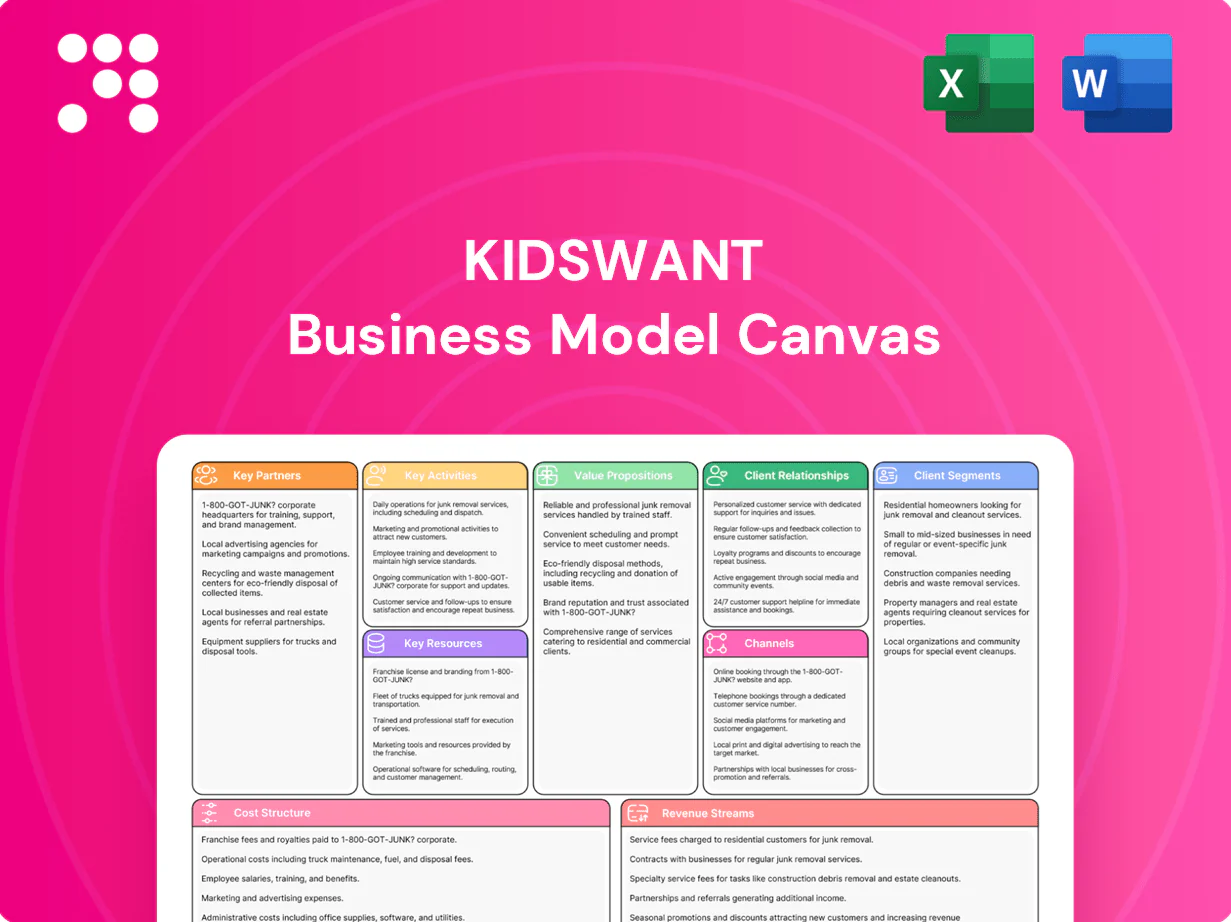
Kidswant Business Model Canvas

Business Model Canvas: value, channels and growth tactics for kids products
Explore Kidswant’s Business Model Canvas to see how its value propositions, channels, and partnerships drive growth in the kids’ products market. This concise, strategic snapshot uncovers revenue streams, cost drivers, and scaling tactics. Ideal for investors, founders, and analysts seeking practical insights. Purchase the full, editable Canvas to apply these strategies directly to your planning.
Partnerships

Brand manufacturers and suppliers
Partner with leading formula, diaper, toy and apparel brands to secure reliable supply and exclusive SKUs, raising average basket value; exclusive SKUs can drive 8-12% higher ASP. Joint forecasting and vendor-managed inventory lift in-stock rates by up to 20% and support timely seasonal launches. Co-op marketing funds (commonly 2–4% of brand sales) and shared POS data sharpen promotions. Negotiated terms can lower COGS 3–7%, expanding gross margins.
Early education and enrichment providers
Collaborate with curriculum developers and licensed educators to run compliant in-store classes, elevating service quality and meeting licensing standards. Co-branded programs drive traffic and loyalty—US preschool enrollment ~4 million (2024) and the US childcare market was about $59B in 2024. Shared revenue models align incentives and boost class profitability and repeat visits.

Digital platforms and logistics providers
Kidswant partners with e-commerce marketplaces, last-mile carriers and regional warehousing to enable omnichannel reach and fast fulfillment. Same-day delivery underpins promises and relies on API integrations for real-time inventory and order tracking. Last-mile can account for up to 53% of total delivery cost, so scale lowers delivery cost per order through higher load factors and shared warehousing.

Healthcare and wellness partners
Financial and loyalty ecosystem partners
Partner with payments providers, BNPL vendors, banks and points networks to offer financing and co-branded rewards; 2024 studies show BNPL can raise average order value by ~30% and support sales of big-ticket kids products. Joint loyalty ties increase repeat purchases by ~20% while data partnerships lift personalization-driven conversion ~12% when compliant with privacy rules.
- Payments & BNPL: +30% AOV (2024)
- Loyalty alliances: +20% repeat rate (2024)
- Data partners: +12% conversion via privacy-safe personalization (2024)
Partner channels boost margins, stock & referrals - impact +8-30%
Partner with branded suppliers, curriculum/licensed educators, marketplaces/carriers, clinicians and payments providers to drive exclusive SKUs (+8–12% ASP), higher in-stock (+20%), clinician referrals (~60% new sign-ups 2024), BNPL (+30% AOV) and loyalty (+20% repeat).
| Partnership | Impact | 2024 metric |
|---|---|---|
| Suppliers | Higher ASP, lower COGS | +8–12% ASP; −3–7% COGS |
| Logistics | Fill & speed | +20% in-stock |
| Clinicians | Referrals | ~60% sign-ups |
| Payments | Higher AOV & repeat | BNPL +30% AOV; loyalty +20% |
What is included in the product
 Detailed Word Document
A comprehensive, pre-written Business Model Canvas for Kidswant detailing customer segments, channels, value propositions and revenue streams across the 9 classic BMC blocks, reflecting real-world operations and competitive advantages with linked SWOT analysis—ideal for presentations, investor funding discussions, and strategic validation.

 Customizable Excel Spreadsheet
High-level view of Kidswant’s business model with editable cells — quickly identify core components, streamline team collaboration, and save hours of formatting for fast deliverables and executive summaries.
Activities

Omnichannel retail operations
Manage large-format store merchandising, online listings and unified inventory with 99% inventory accuracy targets and SKU-level visibility; ensure pricing parity and real-time availability across web, app and 120+ physical touchpoints. Execute click-and-collect (25% penetration target) and ship-from-store to cut last-mile lead time by up to 50%. Optimize assortments by region and season to drive a 12% uplift in sales per category.
Category management and procurement
Forecast demand across formula, diapers, toys, apparel and learning products to hit a 95% service level and target under 2% stockouts, using POS and seasonality models. Negotiate vendor terms (typical net-60), allocate premium shelf space and run vendor-funded promotions to lift category sales. Monitor quality and recalls with weekly dashboards; accelerate private-label development to drive an 8–12 percentage-point margin improvement.

Service delivery and experience
Operate weekly early-education classes, multi-zone play areas and monthly family events; the global early childhood education market was valued at about USD 235 billion in 2022 and grew further in 2024 per industry reports. Staff receive certified training in safety, pedagogy basics and hospitality to meet regulatory ratios and service standards. Programs are scheduled to build steady weekly footfall and real-time guest feedback is captured to refine offerings.

CRM and personalization
Maintain a unified customer profile across app and stores using a single customer view to track pregnancy-to-toddler lifecycle interactions, enabling lifecycle campaigns from prenatal stages through age 3.
Use RFM and cohort analytics to deliver targeted offers, manage tiered loyalty benefits and measure uplift against 2024 benchmark KPIs for retention and AOV.
- Unified profile
- Lifecycle campaigns (pregnancy→toddler)
- RFM & cohort targeting
- Loyalty tiers & benefits
Last-mile fulfillment and customer support
Coordinate rapid last-mile fulfillment using partners and in-house riders to meet urban SLAs (90-minute express hubs); manage omnichannel returns with a 2024 e-commerce return benchmark around 16% to minimize cost; provide expert support via chat, phone, and in-store consultants; track NPS weekly and resolve issues within 48 hours.
- Delivery SLA: 90-minute urban
- Return benchmark 2024: ~16%
- Support channels: chat, phone, in-store
- Issue resolution target: 48 hours
Omni: 99% SKU accuracy, 25% click-&-collect, ship-from-store halves last-mile
Operate unified omni inventory with 99% SKU accuracy, pricing parity and 25% click‑&‑collect penetration; run ship‑from‑store to cut last‑mile by up to 50%. Forecast to 95% service level and <2% stockouts, negotiate net‑60 vendor terms and scale private label for 8–12pp margin lift. Run weekly early‑ed classes, events and certified staff to drive steady footfall and lifecycle campaigns from pregnancy→age3.
| Metric | Target / 2024 |
|---|---|
| Inventory accuracy | 99% |
| Click‑&‑collect | 25% |
| Service level | 95% |
| Stockouts | <2% |
| Delivery SLA (urban) | 90 min |
| Return rate (e‑com) | ~16% |
| Private‑label margin uplift | 8–12 pp |
Full Document Unlocks After Purchase
Business Model Canvas
The document you're previewing is the actual Kidswant Business Model Canvas, not a mockup, and shows the same structure and content you'll receive after purchase. Upon ordering you'll download this exact file, fully editable and formatted for immediate use. No surprises—what you see is what you get.

Business Model Canvas: value, channels and growth tactics for kids products
Explore Kidswant’s Business Model Canvas to see how its value propositions, channels, and partnerships drive growth in the kids’ products market. This concise, strategic snapshot uncovers revenue streams, cost drivers, and scaling tactics. Ideal for investors, founders, and analysts seeking practical insights. Purchase the full, editable Canvas to apply these strategies directly to your planning.
Partnerships
Brand manufacturers and suppliers
Partner with leading formula, diaper, toy and apparel brands to secure reliable supply and exclusive SKUs, raising average basket value; exclusive SKUs can drive 8-12% higher ASP. Joint forecasting and vendor-managed inventory lift in-stock rates by up to 20% and support timely seasonal launches. Co-op marketing funds (commonly 2–4% of brand sales) and shared POS data sharpen promotions. Negotiated terms can lower COGS 3–7%, expanding gross margins.
Early education and enrichment providers
Collaborate with curriculum developers and licensed educators to run compliant in-store classes, elevating service quality and meeting licensing standards. Co-branded programs drive traffic and loyalty—US preschool enrollment ~4 million (2024) and the US childcare market was about $59B in 2024. Shared revenue models align incentives and boost class profitability and repeat visits.
Digital platforms and logistics providers
Kidswant partners with e-commerce marketplaces, last-mile carriers and regional warehousing to enable omnichannel reach and fast fulfillment. Same-day delivery underpins promises and relies on API integrations for real-time inventory and order tracking. Last-mile can account for up to 53% of total delivery cost, so scale lowers delivery cost per order through higher load factors and shared warehousing.
Healthcare and wellness partners
Financial and loyalty ecosystem partners
Partner with payments providers, BNPL vendors, banks and points networks to offer financing and co-branded rewards; 2024 studies show BNPL can raise average order value by ~30% and support sales of big-ticket kids products. Joint loyalty ties increase repeat purchases by ~20% while data partnerships lift personalization-driven conversion ~12% when compliant with privacy rules.
- Payments & BNPL: +30% AOV (2024)
- Loyalty alliances: +20% repeat rate (2024)
- Data partners: +12% conversion via privacy-safe personalization (2024)
Partner channels boost margins, stock & referrals - impact +8-30%
Partner with branded suppliers, curriculum/licensed educators, marketplaces/carriers, clinicians and payments providers to drive exclusive SKUs (+8–12% ASP), higher in-stock (+20%), clinician referrals (~60% new sign-ups 2024), BNPL (+30% AOV) and loyalty (+20% repeat).
| Partnership | Impact | 2024 metric |
|---|---|---|
| Suppliers | Higher ASP, lower COGS | +8–12% ASP; −3–7% COGS |
| Logistics | Fill & speed | +20% in-stock |
| Clinicians | Referrals | ~60% sign-ups |
| Payments | Higher AOV & repeat | BNPL +30% AOV; loyalty +20% |
What is included in the product
Detailed Word Document
A comprehensive, pre-written Business Model Canvas for Kidswant detailing customer segments, channels, value propositions and revenue streams across the 9 classic BMC blocks, reflecting real-world operations and competitive advantages with linked SWOT analysis—ideal for presentations, investor funding discussions, and strategic validation.
Customizable Excel Spreadsheet
High-level view of Kidswant’s business model with editable cells — quickly identify core components, streamline team collaboration, and save hours of formatting for fast deliverables and executive summaries.
Activities
Omnichannel retail operations
Manage large-format store merchandising, online listings and unified inventory with 99% inventory accuracy targets and SKU-level visibility; ensure pricing parity and real-time availability across web, app and 120+ physical touchpoints. Execute click-and-collect (25% penetration target) and ship-from-store to cut last-mile lead time by up to 50%. Optimize assortments by region and season to drive a 12% uplift in sales per category.
Category management and procurement
Forecast demand across formula, diapers, toys, apparel and learning products to hit a 95% service level and target under 2% stockouts, using POS and seasonality models. Negotiate vendor terms (typical net-60), allocate premium shelf space and run vendor-funded promotions to lift category sales. Monitor quality and recalls with weekly dashboards; accelerate private-label development to drive an 8–12 percentage-point margin improvement.
Service delivery and experience
Operate weekly early-education classes, multi-zone play areas and monthly family events; the global early childhood education market was valued at about USD 235 billion in 2022 and grew further in 2024 per industry reports. Staff receive certified training in safety, pedagogy basics and hospitality to meet regulatory ratios and service standards. Programs are scheduled to build steady weekly footfall and real-time guest feedback is captured to refine offerings.
CRM and personalization
Maintain a unified customer profile across app and stores using a single customer view to track pregnancy-to-toddler lifecycle interactions, enabling lifecycle campaigns from prenatal stages through age 3.
Use RFM and cohort analytics to deliver targeted offers, manage tiered loyalty benefits and measure uplift against 2024 benchmark KPIs for retention and AOV.
- Unified profile
- Lifecycle campaigns (pregnancy→toddler)
- RFM & cohort targeting
- Loyalty tiers & benefits
Last-mile fulfillment and customer support
Coordinate rapid last-mile fulfillment using partners and in-house riders to meet urban SLAs (90-minute express hubs); manage omnichannel returns with a 2024 e-commerce return benchmark around 16% to minimize cost; provide expert support via chat, phone, and in-store consultants; track NPS weekly and resolve issues within 48 hours.
- Delivery SLA: 90-minute urban
- Return benchmark 2024: ~16%
- Support channels: chat, phone, in-store
- Issue resolution target: 48 hours
Omni: 99% SKU accuracy, 25% click-&-collect, ship-from-store halves last-mile
Operate unified omni inventory with 99% SKU accuracy, pricing parity and 25% click‑&‑collect penetration; run ship‑from‑store to cut last‑mile by up to 50%. Forecast to 95% service level and <2% stockouts, negotiate net‑60 vendor terms and scale private label for 8–12pp margin lift. Run weekly early‑ed classes, events and certified staff to drive steady footfall and lifecycle campaigns from pregnancy→age3.
| Metric | Target / 2024 |
|---|---|
| Inventory accuracy | 99% |
| Click‑&‑collect | 25% |
| Service level | 95% |
| Stockouts | <2% |
| Delivery SLA (urban) | 90 min |
| Return rate (e‑com) | ~16% |
| Private‑label margin uplift | 8–12 pp |
Full Document Unlocks After Purchase
Business Model Canvas
The document you're previewing is the actual Kidswant Business Model Canvas, not a mockup, and shows the same structure and content you'll receive after purchase. Upon ordering you'll download this exact file, fully editable and formatted for immediate use. No surprises—what you see is what you get.
Original: $10.00
-65%$10.00
$3.50Description
Business Model Canvas: value, channels and growth tactics for kids products
Explore Kidswant’s Business Model Canvas to see how its value propositions, channels, and partnerships drive growth in the kids’ products market. This concise, strategic snapshot uncovers revenue streams, cost drivers, and scaling tactics. Ideal for investors, founders, and analysts seeking practical insights. Purchase the full, editable Canvas to apply these strategies directly to your planning.
Partnerships
Brand manufacturers and suppliers
Partner with leading formula, diaper, toy and apparel brands to secure reliable supply and exclusive SKUs, raising average basket value; exclusive SKUs can drive 8-12% higher ASP. Joint forecasting and vendor-managed inventory lift in-stock rates by up to 20% and support timely seasonal launches. Co-op marketing funds (commonly 2–4% of brand sales) and shared POS data sharpen promotions. Negotiated terms can lower COGS 3–7%, expanding gross margins.
Early education and enrichment providers
Collaborate with curriculum developers and licensed educators to run compliant in-store classes, elevating service quality and meeting licensing standards. Co-branded programs drive traffic and loyalty—US preschool enrollment ~4 million (2024) and the US childcare market was about $59B in 2024. Shared revenue models align incentives and boost class profitability and repeat visits.
Digital platforms and logistics providers
Kidswant partners with e-commerce marketplaces, last-mile carriers and regional warehousing to enable omnichannel reach and fast fulfillment. Same-day delivery underpins promises and relies on API integrations for real-time inventory and order tracking. Last-mile can account for up to 53% of total delivery cost, so scale lowers delivery cost per order through higher load factors and shared warehousing.
Healthcare and wellness partners
Financial and loyalty ecosystem partners
Partner with payments providers, BNPL vendors, banks and points networks to offer financing and co-branded rewards; 2024 studies show BNPL can raise average order value by ~30% and support sales of big-ticket kids products. Joint loyalty ties increase repeat purchases by ~20% while data partnerships lift personalization-driven conversion ~12% when compliant with privacy rules.
- Payments & BNPL: +30% AOV (2024)
- Loyalty alliances: +20% repeat rate (2024)
- Data partners: +12% conversion via privacy-safe personalization (2024)
Partner channels boost margins, stock & referrals - impact +8-30%
Partner with branded suppliers, curriculum/licensed educators, marketplaces/carriers, clinicians and payments providers to drive exclusive SKUs (+8–12% ASP), higher in-stock (+20%), clinician referrals (~60% new sign-ups 2024), BNPL (+30% AOV) and loyalty (+20% repeat).
| Partnership | Impact | 2024 metric |
|---|---|---|
| Suppliers | Higher ASP, lower COGS | +8–12% ASP; −3–7% COGS |
| Logistics | Fill & speed | +20% in-stock |
| Clinicians | Referrals | ~60% sign-ups |
| Payments | Higher AOV & repeat | BNPL +30% AOV; loyalty +20% |
What is included in the product
Detailed Word Document
A comprehensive, pre-written Business Model Canvas for Kidswant detailing customer segments, channels, value propositions and revenue streams across the 9 classic BMC blocks, reflecting real-world operations and competitive advantages with linked SWOT analysis—ideal for presentations, investor funding discussions, and strategic validation.
Customizable Excel Spreadsheet
High-level view of Kidswant’s business model with editable cells — quickly identify core components, streamline team collaboration, and save hours of formatting for fast deliverables and executive summaries.
Activities
Omnichannel retail operations
Manage large-format store merchandising, online listings and unified inventory with 99% inventory accuracy targets and SKU-level visibility; ensure pricing parity and real-time availability across web, app and 120+ physical touchpoints. Execute click-and-collect (25% penetration target) and ship-from-store to cut last-mile lead time by up to 50%. Optimize assortments by region and season to drive a 12% uplift in sales per category.
Category management and procurement
Forecast demand across formula, diapers, toys, apparel and learning products to hit a 95% service level and target under 2% stockouts, using POS and seasonality models. Negotiate vendor terms (typical net-60), allocate premium shelf space and run vendor-funded promotions to lift category sales. Monitor quality and recalls with weekly dashboards; accelerate private-label development to drive an 8–12 percentage-point margin improvement.
Service delivery and experience
Operate weekly early-education classes, multi-zone play areas and monthly family events; the global early childhood education market was valued at about USD 235 billion in 2022 and grew further in 2024 per industry reports. Staff receive certified training in safety, pedagogy basics and hospitality to meet regulatory ratios and service standards. Programs are scheduled to build steady weekly footfall and real-time guest feedback is captured to refine offerings.
CRM and personalization
Maintain a unified customer profile across app and stores using a single customer view to track pregnancy-to-toddler lifecycle interactions, enabling lifecycle campaigns from prenatal stages through age 3.
Use RFM and cohort analytics to deliver targeted offers, manage tiered loyalty benefits and measure uplift against 2024 benchmark KPIs for retention and AOV.
- Unified profile
- Lifecycle campaigns (pregnancy→toddler)
- RFM & cohort targeting
- Loyalty tiers & benefits
Last-mile fulfillment and customer support
Coordinate rapid last-mile fulfillment using partners and in-house riders to meet urban SLAs (90-minute express hubs); manage omnichannel returns with a 2024 e-commerce return benchmark around 16% to minimize cost; provide expert support via chat, phone, and in-store consultants; track NPS weekly and resolve issues within 48 hours.
- Delivery SLA: 90-minute urban
- Return benchmark 2024: ~16%
- Support channels: chat, phone, in-store
- Issue resolution target: 48 hours
Omni: 99% SKU accuracy, 25% click-&-collect, ship-from-store halves last-mile
Operate unified omni inventory with 99% SKU accuracy, pricing parity and 25% click‑&‑collect penetration; run ship‑from‑store to cut last‑mile by up to 50%. Forecast to 95% service level and <2% stockouts, negotiate net‑60 vendor terms and scale private label for 8–12pp margin lift. Run weekly early‑ed classes, events and certified staff to drive steady footfall and lifecycle campaigns from pregnancy→age3.
| Metric | Target / 2024 |
|---|---|
| Inventory accuracy | 99% |
| Click‑&‑collect | 25% |
| Service level | 95% |
| Stockouts | <2% |
| Delivery SLA (urban) | 90 min |
| Return rate (e‑com) | ~16% |
| Private‑label margin uplift | 8–12 pp |
Full Document Unlocks After Purchase
Business Model Canvas
The document you're previewing is the actual Kidswant Business Model Canvas, not a mockup, and shows the same structure and content you'll receive after purchase. Upon ordering you'll download this exact file, fully editable and formatted for immediate use. No surprises—what you see is what you get.











