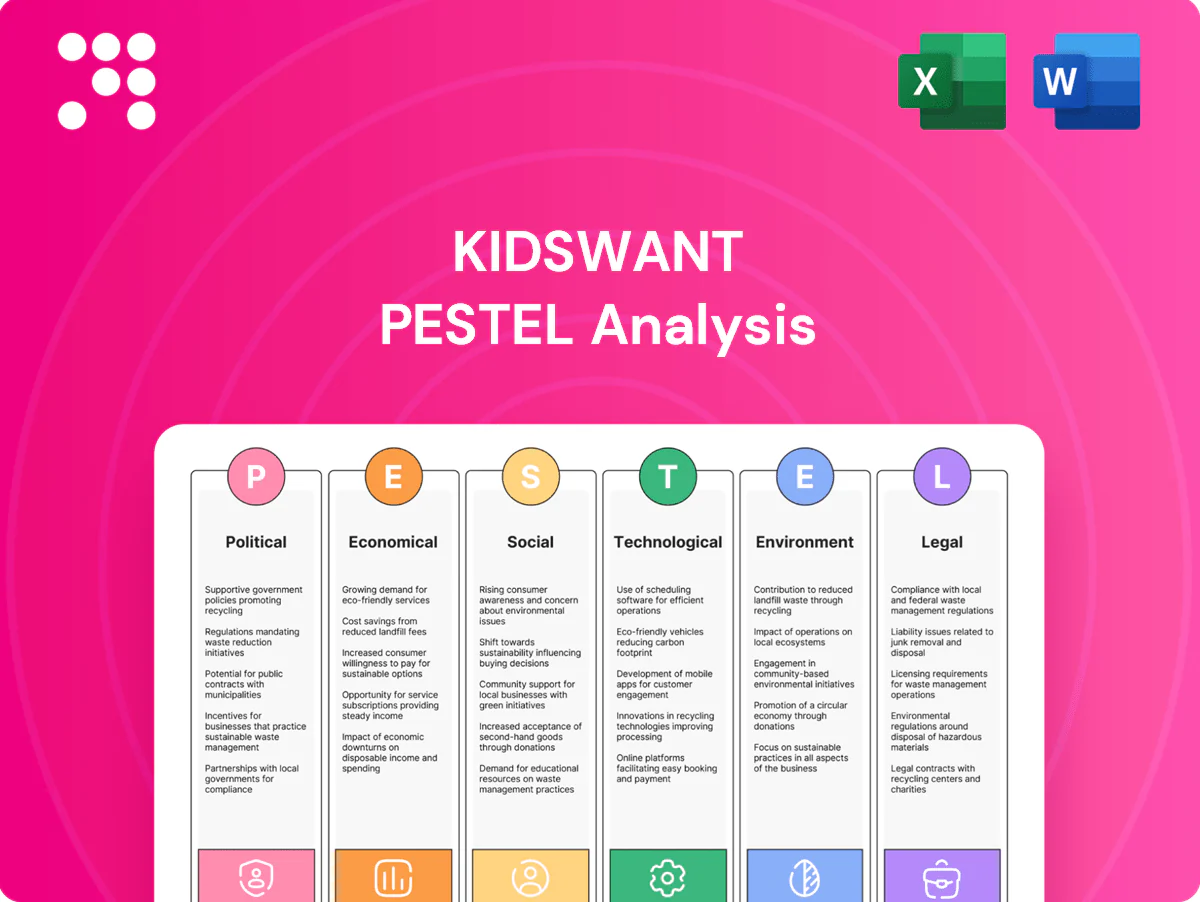
Kidswant PESTLE Analysis

Your Competitive Advantage Starts with This Report
Discover how political, economic, social, technological, legal, and environmental forces are shaping Kidswant's future in our concise PESTLE Analysis; perfect for investors and strategists seeking actionable insight. This expertly researched brief highlights risks and opportunities you can use immediately. Purchase the full PESTLE to access detailed data, forecasts, and ready-to-use recommendations for confident decision-making.
Political factors

Family-friendly population policy
China moved from a universal two-child policy in 2016 to a three-child policy announced in 2021, which can modestly expand Kidswant’s core market as authorities and municipalities roll out localized birth and childcare incentives. Municipal subsidies in major cities (Beijing, Shanghai, Shenzhen) lower effective costs for parents and can boost demand for baby goods and services. Kidswant should align store formats and services to cities with stronger incentives and monitor provincial policy pilots to prioritize expansion and marketing.
Central-local policy coordination
Licensing, subsidies and enforcement differ across China’s 31 province-level regions and roughly 333 prefecture-level cities, so store openings, in-store education and health offerings depend on local approvals and rules. Kidswant should maintain government relations and a city-tier compliance playbook to navigate variable incentives and inspection standards; consistent stakeholder engagement limits rollout friction and accelerates local approvals.

Trade and import dynamics
Infant formula, toys and premium brands in Kidswant’s assortment heavily rely on imports subject to tariffs and China’s CBEC rules, with sudden adjustments to positive lists, quotas and customs inspections able to disrupt SKU availability and lead times.
Kidswant must hedge exposure through diversified suppliers, domestic sourcing alternatives and inventory buffers to reduce shipment volatility.
Transparent communication on product origin, safety testing and batch traceability will sustain consumer trust during trade disruptions.

Digital governance emphasis
- Regulation: DSA enforcement 2024, fines up to 6% of turnover
- Risk: live-stream commerce scrutiny as global GMV ≈ $200bn (2024)
- Opportunity: compliance as differentiation and moat
Public health and safety oversight
Post-pandemic hygiene and emergency readiness remain priorities after WHO ended the COVID-19 global emergency in May 2023; handwashing alone cuts respiratory illness ~16–21%, underscoring risk reduction. Regulations can constrain in-store play areas and classes, so Kidswant needs flexible protocols and clear consumer communications; enhanced sanitation can be marketed as a quality signal.
- Regulatory impact on play/education
- Flexible SOPs and emergency plans
- Communicate sanitation policies
- Sanitation as quality/marketing signal
China childcare subsidies, local licensing and DSA risks reshape retail and livestream trade
China’s three-child policy (2021) plus municipal childcare subsidies in Beijing/Shanghai/ Shenzhen can modestly expand addressable market; prioritize stores where incentives exist. Varied provincial licensing across 31 provinces and ~333 prefecture cities requires local compliance playbooks. Import rules, tariffs and CBEC shifts risk SKU disruption; diversify suppliers and hold buffers. DSA (2024) fines up to 6% and live-stream GMV ≈ $200bn raise platform compliance stakes.
| Factor | Metric |
|---|---|
| Provinces/cities | 31 provinces, ~333 prefecture cities |
| DSA fine | up to 6% global turnover (2024) |
| Live-stream GMV | ≈ $200bn (2024) |
What is included in the product
 Detailed Word Document
Explores how macro-environmental factors affect Kidswant across Political, Economic, Social, Technological, Environmental and Legal dimensions, with data-driven insights and trend analysis. Designed for executives and investors, it highlights actionable risks, opportunities and forward-looking scenarios tailored to the brand's market.

 Customizable Excel Spreadsheet
A concise, visually segmented PESTLE summary for Kidswant that clarifies external risks and opportunities at a glance, easily dropped into presentations or shared across teams; editable notes let users tailor insights by region or product line to speed alignment and decision-making.
Economic factors

Slower consumption growth
China’s consumption recovery remains uneven: retail sales expanded just 3.8% in 2024, with households showing cautious spending and trading-down; Kidswant should balance value packs with selective premium SKUs. Targeted promotions and membership perks can boost visit frequency and basket size (members typically spend ~10–15% more). Rigorous cost discipline and SKU rationalization will protect margins.
Birth rate headwinds
Declining births—OECD average total fertility ~1.59 (2022) and global TFR near 2.3—shrink Kidswant’s long-term addressable market, but per-child spend is rising as families concentrate resources on fewer children. Kidswant can pivot to higher-margin services, cross-sell into toddler/early-childhood segments, and use lifecycle marketing to extend customer LTV despite cohort declines.

Cost and FX volatility
Rising input costs—pulp up ~12% in 2024, petrochemical feedstocks ~8% and dairy powders rising near 15–20% in 2023–24—have pushed diaper and formula COGS higher, squeezing margins; RMB volatility (about 6% swing vs USD in 2024) further pressures imported SKU margins. Supplier negotiations, FX hedging and dynamic retail pricing are used to protect gross profit. Expanding private-label lines improves cost control and buffers raw-material swings.

City-tier divergence
Tier 1–2 cities skew toward premium, imported and experiential kids services while lower-tier cities prioritize value, availability and trust; Kidswant targets tiered assortments, price ladders and smaller footprints to boost ROI, noting industry reports in 2024 showed premium segments growing faster in top-tier cities. Regional warehousing and micro-fulfillment reduce lead times and stockouts, aligning supply with localized demand patterns.
- Tier focus: premium demand concentration in Tier 1–2
- Lower tiers: volume, value, trust-driven
- Execution: tailored assortments, price ladders, store footprints
- Logistics: regional warehousing for localized demand
E-commerce price competition
E-commerce price competition is intensifying as platforms and group-buying channels drove ~25% YoY growth in 2024, compressing margins and increasing promotional cadence; cart abandonment averaged 69.8% in 2024, so Kidswant should avoid pure price wars by using exclusive bundles, premium services and membership benefits (Prime-like retention lifts) to protect ARPU. Omnichannel fulfillment cuts checkout friction and can lower abandonment while supplier co-marketing budgets (commonly 1–3% of vendor revenue) help fund promotions.
- Group-buying growth ~25% YoY (2024)
- Cart abandonment 69.8% (2024)
- Omnichannel shoppers ~30% higher LTV
- Supplier co-marketing 1–3% of revenue
China childcare subsidies, local licensing and DSA risks reshape retail and livestream trade
China retail +3.8% (2024); members spend ~10–15% more—mix value packs with selective premium. OECD TFR 1.59 (2022); per-child spend rising—shift to services and lifecycle LTV. Input costs: pulp +12%, dairy +15–20% (2023–24); use private label and FX hedges. E‑commerce: group-buy +25% (2024), cart abandonment 69.8%—prioritize bundles and membership.
| Metric | Value |
|---|---|
| China retail (2024) | +3.8% |
| OECD TFR (2022) | 1.59 |
| Pulp (2024) | +12% |
| Group-buy (2024) | +25% |
| Cart abandonment (2024) | 69.8% |
Full Version Awaits
Kidswant PESTLE Analysis
The preview shown here is the exact document you’ll receive after purchase—fully formatted and ready to use. This Kidswant PESTLE Analysis includes comprehensive, professionally structured Political, Economic, Social, Technological, Legal and Environmental assessments. No placeholders or teasers—download the final file immediately after checkout.

Your Competitive Advantage Starts with This Report
Discover how political, economic, social, technological, legal, and environmental forces are shaping Kidswant's future in our concise PESTLE Analysis; perfect for investors and strategists seeking actionable insight. This expertly researched brief highlights risks and opportunities you can use immediately. Purchase the full PESTLE to access detailed data, forecasts, and ready-to-use recommendations for confident decision-making.
Political factors
Family-friendly population policy
China moved from a universal two-child policy in 2016 to a three-child policy announced in 2021, which can modestly expand Kidswant’s core market as authorities and municipalities roll out localized birth and childcare incentives. Municipal subsidies in major cities (Beijing, Shanghai, Shenzhen) lower effective costs for parents and can boost demand for baby goods and services. Kidswant should align store formats and services to cities with stronger incentives and monitor provincial policy pilots to prioritize expansion and marketing.
Central-local policy coordination
Licensing, subsidies and enforcement differ across China’s 31 province-level regions and roughly 333 prefecture-level cities, so store openings, in-store education and health offerings depend on local approvals and rules. Kidswant should maintain government relations and a city-tier compliance playbook to navigate variable incentives and inspection standards; consistent stakeholder engagement limits rollout friction and accelerates local approvals.
Trade and import dynamics
Infant formula, toys and premium brands in Kidswant’s assortment heavily rely on imports subject to tariffs and China’s CBEC rules, with sudden adjustments to positive lists, quotas and customs inspections able to disrupt SKU availability and lead times.
Kidswant must hedge exposure through diversified suppliers, domestic sourcing alternatives and inventory buffers to reduce shipment volatility.
Transparent communication on product origin, safety testing and batch traceability will sustain consumer trust during trade disruptions.
Digital governance emphasis
- Regulation: DSA enforcement 2024, fines up to 6% of turnover
- Risk: live-stream commerce scrutiny as global GMV ≈ $200bn (2024)
- Opportunity: compliance as differentiation and moat
Public health and safety oversight
Post-pandemic hygiene and emergency readiness remain priorities after WHO ended the COVID-19 global emergency in May 2023; handwashing alone cuts respiratory illness ~16–21%, underscoring risk reduction. Regulations can constrain in-store play areas and classes, so Kidswant needs flexible protocols and clear consumer communications; enhanced sanitation can be marketed as a quality signal.
- Regulatory impact on play/education
- Flexible SOPs and emergency plans
- Communicate sanitation policies
- Sanitation as quality/marketing signal
China childcare subsidies, local licensing and DSA risks reshape retail and livestream trade
China’s three-child policy (2021) plus municipal childcare subsidies in Beijing/Shanghai/ Shenzhen can modestly expand addressable market; prioritize stores where incentives exist. Varied provincial licensing across 31 provinces and ~333 prefecture cities requires local compliance playbooks. Import rules, tariffs and CBEC shifts risk SKU disruption; diversify suppliers and hold buffers. DSA (2024) fines up to 6% and live-stream GMV ≈ $200bn raise platform compliance stakes.
| Factor | Metric |
|---|---|
| Provinces/cities | 31 provinces, ~333 prefecture cities |
| DSA fine | up to 6% global turnover (2024) |
| Live-stream GMV | ≈ $200bn (2024) |
What is included in the product
Detailed Word Document
Explores how macro-environmental factors affect Kidswant across Political, Economic, Social, Technological, Environmental and Legal dimensions, with data-driven insights and trend analysis. Designed for executives and investors, it highlights actionable risks, opportunities and forward-looking scenarios tailored to the brand's market.
Customizable Excel Spreadsheet
A concise, visually segmented PESTLE summary for Kidswant that clarifies external risks and opportunities at a glance, easily dropped into presentations or shared across teams; editable notes let users tailor insights by region or product line to speed alignment and decision-making.
Economic factors
Slower consumption growth
China’s consumption recovery remains uneven: retail sales expanded just 3.8% in 2024, with households showing cautious spending and trading-down; Kidswant should balance value packs with selective premium SKUs. Targeted promotions and membership perks can boost visit frequency and basket size (members typically spend ~10–15% more). Rigorous cost discipline and SKU rationalization will protect margins.
Birth rate headwinds
Declining births—OECD average total fertility ~1.59 (2022) and global TFR near 2.3—shrink Kidswant’s long-term addressable market, but per-child spend is rising as families concentrate resources on fewer children. Kidswant can pivot to higher-margin services, cross-sell into toddler/early-childhood segments, and use lifecycle marketing to extend customer LTV despite cohort declines.
Cost and FX volatility
Rising input costs—pulp up ~12% in 2024, petrochemical feedstocks ~8% and dairy powders rising near 15–20% in 2023–24—have pushed diaper and formula COGS higher, squeezing margins; RMB volatility (about 6% swing vs USD in 2024) further pressures imported SKU margins. Supplier negotiations, FX hedging and dynamic retail pricing are used to protect gross profit. Expanding private-label lines improves cost control and buffers raw-material swings.
City-tier divergence
Tier 1–2 cities skew toward premium, imported and experiential kids services while lower-tier cities prioritize value, availability and trust; Kidswant targets tiered assortments, price ladders and smaller footprints to boost ROI, noting industry reports in 2024 showed premium segments growing faster in top-tier cities. Regional warehousing and micro-fulfillment reduce lead times and stockouts, aligning supply with localized demand patterns.
- Tier focus: premium demand concentration in Tier 1–2
- Lower tiers: volume, value, trust-driven
- Execution: tailored assortments, price ladders, store footprints
- Logistics: regional warehousing for localized demand
E-commerce price competition
E-commerce price competition is intensifying as platforms and group-buying channels drove ~25% YoY growth in 2024, compressing margins and increasing promotional cadence; cart abandonment averaged 69.8% in 2024, so Kidswant should avoid pure price wars by using exclusive bundles, premium services and membership benefits (Prime-like retention lifts) to protect ARPU. Omnichannel fulfillment cuts checkout friction and can lower abandonment while supplier co-marketing budgets (commonly 1–3% of vendor revenue) help fund promotions.
- Group-buying growth ~25% YoY (2024)
- Cart abandonment 69.8% (2024)
- Omnichannel shoppers ~30% higher LTV
- Supplier co-marketing 1–3% of revenue
China childcare subsidies, local licensing and DSA risks reshape retail and livestream trade
China retail +3.8% (2024); members spend ~10–15% more—mix value packs with selective premium. OECD TFR 1.59 (2022); per-child spend rising—shift to services and lifecycle LTV. Input costs: pulp +12%, dairy +15–20% (2023–24); use private label and FX hedges. E‑commerce: group-buy +25% (2024), cart abandonment 69.8%—prioritize bundles and membership.
| Metric | Value |
|---|---|
| China retail (2024) | +3.8% |
| OECD TFR (2022) | 1.59 |
| Pulp (2024) | +12% |
| Group-buy (2024) | +25% |
| Cart abandonment (2024) | 69.8% |
Full Version Awaits
Kidswant PESTLE Analysis
The preview shown here is the exact document you’ll receive after purchase—fully formatted and ready to use. This Kidswant PESTLE Analysis includes comprehensive, professionally structured Political, Economic, Social, Technological, Legal and Environmental assessments. No placeholders or teasers—download the final file immediately after checkout.
Original: $10.00
-65%$10.00
$3.50Description
Your Competitive Advantage Starts with This Report
Discover how political, economic, social, technological, legal, and environmental forces are shaping Kidswant's future in our concise PESTLE Analysis; perfect for investors and strategists seeking actionable insight. This expertly researched brief highlights risks and opportunities you can use immediately. Purchase the full PESTLE to access detailed data, forecasts, and ready-to-use recommendations for confident decision-making.
Political factors
Family-friendly population policy
China moved from a universal two-child policy in 2016 to a three-child policy announced in 2021, which can modestly expand Kidswant’s core market as authorities and municipalities roll out localized birth and childcare incentives. Municipal subsidies in major cities (Beijing, Shanghai, Shenzhen) lower effective costs for parents and can boost demand for baby goods and services. Kidswant should align store formats and services to cities with stronger incentives and monitor provincial policy pilots to prioritize expansion and marketing.
Central-local policy coordination
Licensing, subsidies and enforcement differ across China’s 31 province-level regions and roughly 333 prefecture-level cities, so store openings, in-store education and health offerings depend on local approvals and rules. Kidswant should maintain government relations and a city-tier compliance playbook to navigate variable incentives and inspection standards; consistent stakeholder engagement limits rollout friction and accelerates local approvals.
Trade and import dynamics
Infant formula, toys and premium brands in Kidswant’s assortment heavily rely on imports subject to tariffs and China’s CBEC rules, with sudden adjustments to positive lists, quotas and customs inspections able to disrupt SKU availability and lead times.
Kidswant must hedge exposure through diversified suppliers, domestic sourcing alternatives and inventory buffers to reduce shipment volatility.
Transparent communication on product origin, safety testing and batch traceability will sustain consumer trust during trade disruptions.
Digital governance emphasis
- Regulation: DSA enforcement 2024, fines up to 6% of turnover
- Risk: live-stream commerce scrutiny as global GMV ≈ $200bn (2024)
- Opportunity: compliance as differentiation and moat
Public health and safety oversight
Post-pandemic hygiene and emergency readiness remain priorities after WHO ended the COVID-19 global emergency in May 2023; handwashing alone cuts respiratory illness ~16–21%, underscoring risk reduction. Regulations can constrain in-store play areas and classes, so Kidswant needs flexible protocols and clear consumer communications; enhanced sanitation can be marketed as a quality signal.
- Regulatory impact on play/education
- Flexible SOPs and emergency plans
- Communicate sanitation policies
- Sanitation as quality/marketing signal
China childcare subsidies, local licensing and DSA risks reshape retail and livestream trade
China’s three-child policy (2021) plus municipal childcare subsidies in Beijing/Shanghai/ Shenzhen can modestly expand addressable market; prioritize stores where incentives exist. Varied provincial licensing across 31 provinces and ~333 prefecture cities requires local compliance playbooks. Import rules, tariffs and CBEC shifts risk SKU disruption; diversify suppliers and hold buffers. DSA (2024) fines up to 6% and live-stream GMV ≈ $200bn raise platform compliance stakes.
| Factor | Metric |
|---|---|
| Provinces/cities | 31 provinces, ~333 prefecture cities |
| DSA fine | up to 6% global turnover (2024) |
| Live-stream GMV | ≈ $200bn (2024) |
What is included in the product
Detailed Word Document
Explores how macro-environmental factors affect Kidswant across Political, Economic, Social, Technological, Environmental and Legal dimensions, with data-driven insights and trend analysis. Designed for executives and investors, it highlights actionable risks, opportunities and forward-looking scenarios tailored to the brand's market.
Customizable Excel Spreadsheet
A concise, visually segmented PESTLE summary for Kidswant that clarifies external risks and opportunities at a glance, easily dropped into presentations or shared across teams; editable notes let users tailor insights by region or product line to speed alignment and decision-making.
Economic factors
Slower consumption growth
China’s consumption recovery remains uneven: retail sales expanded just 3.8% in 2024, with households showing cautious spending and trading-down; Kidswant should balance value packs with selective premium SKUs. Targeted promotions and membership perks can boost visit frequency and basket size (members typically spend ~10–15% more). Rigorous cost discipline and SKU rationalization will protect margins.
Birth rate headwinds
Declining births—OECD average total fertility ~1.59 (2022) and global TFR near 2.3—shrink Kidswant’s long-term addressable market, but per-child spend is rising as families concentrate resources on fewer children. Kidswant can pivot to higher-margin services, cross-sell into toddler/early-childhood segments, and use lifecycle marketing to extend customer LTV despite cohort declines.
Cost and FX volatility
Rising input costs—pulp up ~12% in 2024, petrochemical feedstocks ~8% and dairy powders rising near 15–20% in 2023–24—have pushed diaper and formula COGS higher, squeezing margins; RMB volatility (about 6% swing vs USD in 2024) further pressures imported SKU margins. Supplier negotiations, FX hedging and dynamic retail pricing are used to protect gross profit. Expanding private-label lines improves cost control and buffers raw-material swings.
City-tier divergence
Tier 1–2 cities skew toward premium, imported and experiential kids services while lower-tier cities prioritize value, availability and trust; Kidswant targets tiered assortments, price ladders and smaller footprints to boost ROI, noting industry reports in 2024 showed premium segments growing faster in top-tier cities. Regional warehousing and micro-fulfillment reduce lead times and stockouts, aligning supply with localized demand patterns.
- Tier focus: premium demand concentration in Tier 1–2
- Lower tiers: volume, value, trust-driven
- Execution: tailored assortments, price ladders, store footprints
- Logistics: regional warehousing for localized demand
E-commerce price competition
E-commerce price competition is intensifying as platforms and group-buying channels drove ~25% YoY growth in 2024, compressing margins and increasing promotional cadence; cart abandonment averaged 69.8% in 2024, so Kidswant should avoid pure price wars by using exclusive bundles, premium services and membership benefits (Prime-like retention lifts) to protect ARPU. Omnichannel fulfillment cuts checkout friction and can lower abandonment while supplier co-marketing budgets (commonly 1–3% of vendor revenue) help fund promotions.
- Group-buying growth ~25% YoY (2024)
- Cart abandonment 69.8% (2024)
- Omnichannel shoppers ~30% higher LTV
- Supplier co-marketing 1–3% of revenue
China childcare subsidies, local licensing and DSA risks reshape retail and livestream trade
China retail +3.8% (2024); members spend ~10–15% more—mix value packs with selective premium. OECD TFR 1.59 (2022); per-child spend rising—shift to services and lifecycle LTV. Input costs: pulp +12%, dairy +15–20% (2023–24); use private label and FX hedges. E‑commerce: group-buy +25% (2024), cart abandonment 69.8%—prioritize bundles and membership.
| Metric | Value |
|---|---|
| China retail (2024) | +3.8% |
| OECD TFR (2022) | 1.59 |
| Pulp (2024) | +12% |
| Group-buy (2024) | +25% |
| Cart abandonment (2024) | 69.8% |
Full Version Awaits
Kidswant PESTLE Analysis
The preview shown here is the exact document you’ll receive after purchase—fully formatted and ready to use. This Kidswant PESTLE Analysis includes comprehensive, professionally structured Political, Economic, Social, Technological, Legal and Environmental assessments. No placeholders or teasers—download the final file immediately after checkout.











