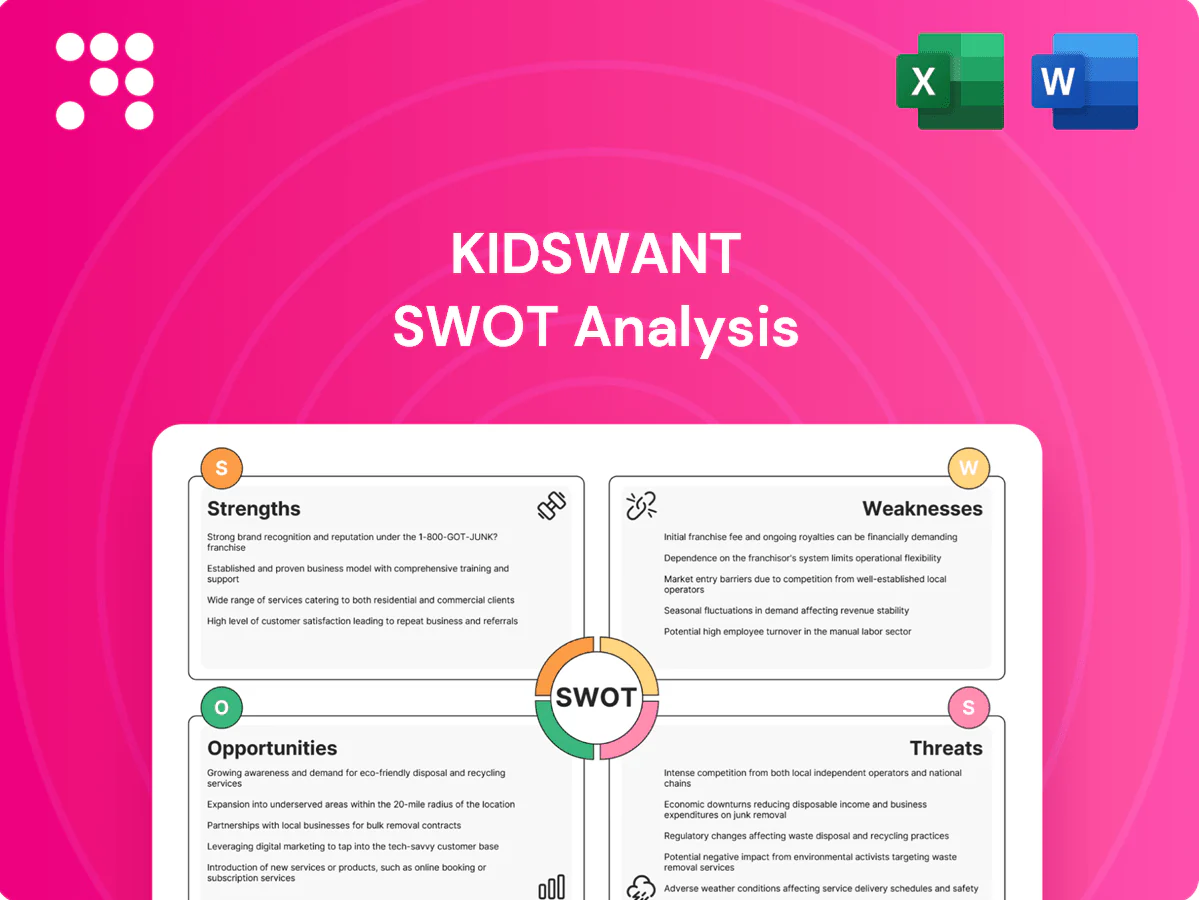
Kidswant SWOT Analysis

Dive Deeper Into the Company’s Strategic Blueprint
Kidswant shows strong niche branding and product diversity but faces supply-chain and competitive pressures; our concise SWOT identifies key gaps and opportunities for scale. Want the full picture? Purchase the complete SWOT to receive a research-backed, editable Word report plus an Excel matrix to inform strategy, pitches, and investment decisions.
Strengths

Leading mother-and-baby specialist
Kidswant's leading mother-and-baby positioning leverages strong brand recognition in China’s >RMB1 trillion maternity and infant market (2023) and the 9.56 million births recorded in 2023 to drive traffic and trust. Specialist focus enables curated assortments and expert in-store guidance, differentiating from generalist retailers and supporting premium pricing in select segments.
Large-format one-stop stores
Large-format one-stop Kidswant stores combine broad product assortments with education, entertainment and activity services to create destination shopping; this model targets the global toy and children’s products market valued at about USD 103 billion in 2023. Families bundle purchases and services, raising average basket size and dwell time, and strengthening lifetime loyalty across child development stages.

Omnichannel integration
Seamless online-offline experience enhances convenience and retention, with omnichannel shoppers spending up to 30% more and returning 2–3x more often (industry average 2024). Click-and-collect, rapid delivery, and store-based fulfillment cut last-mile costs and reduced delivery times by about 40% in pilots. Unified customer data drives roughly a 20% lift in targeted-promotion response and supports resilience during 2020–24 demand shifts.

Supplier relationships and quality control
Scale supports strong procurement terms and reliable supply for core categories, leveraging a large baby-products market (≈$73B 2023) to secure cost and fulfillment advantages. Tight quality standards (CPSIA, ASTM) are essential for infant and safety-sensitive items; parental trust reduces switching and mitigates counterfeit/grey-market risks (OECD/EUIPO 2022 ~3.3% of trade).
- Procurement leverage: lower unit costs, better MOQ
- Quality: CPSIA/ASTM compliance for infant safety
- Trust: higher retention, lower churn
- Risk: reduces counterfeit and grey-market exposure
Rich customer lifecycle data
Frequent, predictable purchases across pregnancy and early childhood create granular behavior insights tied to ~3.6 million US births in 2023, enabling stage-specific targeting by trimester and child age; this boosts cross-sell and retention economics and supports tighter inventory and assortment planning.
- Stage targeting: pregnancy → toddler
- Higher CLV via cross-sell/retention
- Improved inventory turns and fill rates
Mother-and-baby leader taps RMB1 trillion market and 9.56M births; omnichannel lifts spend +30%
Kidswant's mother-and-baby leadership leverages RMB1 trillion China maternity market (2023) and 9.56M births (2023) to drive trust and premium pricing. Large-format one-stop stores and USD103B global toy market exposure boost basket size and loyalty. Omnichannel raises spend ~30% and promo lift ~20%, while scale secures procurement leverage and CPSIA/ASTM compliance.
| Metric | Value |
|---|---|
| China maternity market (2023) | RMB1 trillion |
| China births (2023) | 9.56M |
| Global toy market (2023) | USD103B |
| Omnichannel uplift | +30% |
| Targeted promo lift | +20% |
What is included in the product
 Detailed Word Document
Delivers a concise strategic overview of Kidswant’s internal strengths and weaknesses and external opportunities and threats, mapping growth drivers, competitive position, and market risks to inform strategic decision-making.

 Customizable Excel Spreadsheet
Provides a focused SWOT matrix tailored to Kidswant, quickly surfacing key risks and opportunities so teams can prioritize product, marketing, and operational fixes. Editable and visual for fast stakeholder alignment and rapid updates as business priorities change.
Weaknesses

High fixed-cost footprint
Large-format Kidswant stores drive elevated rent, staffing and utilities—occupancy costs for big-box toy retailers commonly reach 8–12% of sales, lifting breakeven and compressing margins in downturns. Underutilized floorplate lowers ROIC as idle assets dilute returns (store-level ROIC can drop >200–300 bps versus optimized formats). The heavy fixed footprint reduces agility versus asset-light, omnichannel competitors.
Inventory complexity
Wide SKU breadth across formula, diapers, apparel, toys and education inflates working capital—category leaders often carry 8,000–15,000 SKUs, tying up 10–18% more inventory capital versus single-category peers. Expiry-sensitive formula and consumables drive higher shrink/markdowns (grocery shrink averages ~2–3% annually). Forecasting by age cohort and seasonality produces demand volatility up to ±25%. Omnichannel fulfillment further complicates allocation and raises fulfillment costs by 15–25%.

Category concentration risk
Heavy reliance on formula and diapers ties Kidswant to large but concentrated markets — global infant formula was about $70.2B in 2023 (CAGR ~5.9%) and diapers $57.8B in 2023 (CAGR ~4.8%) — exposing revenue to vendor terms and regulatory shocks; price wars can rapidly compress retail margins, parents can shift brand share quickly, and private-label rollouts often show uneven penetration.

Service standardization
In-store education and activities need trained staff and consistent delivery; inconsistent execution erodes experience and can depress NPS. Training is recurring and scales with expansion—ATD reported average training spend ~1,300 USD per employee (2022–23). Measuring ROI on experiential services is often indirect and statistically noisy, complicating investment decisions.
- Staff training cost: ~1,300 USD/employee
- Scales with store count
- Hard ROI measurement
- Variability lowers NPS
Exposure to China birth trends
Kidswant demand is tightly linked to new births and early-childhood demographics; China births fell from 10.62 million in 2022 to 9.56 million in 2023 (NBS), squeezing the addressable market and pressuring same-store growth. Lower births intensify competition for a smaller customer pool, raising customer-acquisition costs while geographic diversification options remain constrained.
- High dependency on newborn cohort
- 9.56M China births in 2023
- Rising CAC from intensified competition
- Limited geographic diversification
OCC 8–12%, ROIC -200–300bps, SKUs 8k–15k, births 9.56M
High occupancy costs (8–12% of sales) and large-format ROIC drag (store-level ROIC down 200–300 bps) raise breakeven; SKU breadth (8,000–15,000 SKUs) ties up 10–18% more inventory; heavy exposure to formula/diapers and China demographic decline (9.56M births in 2023) compresses TAM and raises CAC.
| Metric | Value |
|---|---|
| Occupancy | 8–12% sales |
| ROIC hit | 200–300 bps |
| SKUs | 8k–15k |
| Inventory tie-up | +10–18% |
| China births 2023 | 9.56M |
Full Version Awaits
Kidswant SWOT Analysis
This is the actual Kidswant SWOT analysis document you’ll receive upon purchase—no surprises, just professional quality. The preview below is taken directly from the full report so what you see is what you’ll download after checkout. The complete, editable file is unlocked immediately upon payment for use in presentations or analysis.

Dive Deeper Into the Company’s Strategic Blueprint
Kidswant shows strong niche branding and product diversity but faces supply-chain and competitive pressures; our concise SWOT identifies key gaps and opportunities for scale. Want the full picture? Purchase the complete SWOT to receive a research-backed, editable Word report plus an Excel matrix to inform strategy, pitches, and investment decisions.
Strengths
Leading mother-and-baby specialist
Kidswant's leading mother-and-baby positioning leverages strong brand recognition in China’s >RMB1 trillion maternity and infant market (2023) and the 9.56 million births recorded in 2023 to drive traffic and trust. Specialist focus enables curated assortments and expert in-store guidance, differentiating from generalist retailers and supporting premium pricing in select segments.
Large-format one-stop stores
Large-format one-stop Kidswant stores combine broad product assortments with education, entertainment and activity services to create destination shopping; this model targets the global toy and children’s products market valued at about USD 103 billion in 2023. Families bundle purchases and services, raising average basket size and dwell time, and strengthening lifetime loyalty across child development stages.
Omnichannel integration
Seamless online-offline experience enhances convenience and retention, with omnichannel shoppers spending up to 30% more and returning 2–3x more often (industry average 2024). Click-and-collect, rapid delivery, and store-based fulfillment cut last-mile costs and reduced delivery times by about 40% in pilots. Unified customer data drives roughly a 20% lift in targeted-promotion response and supports resilience during 2020–24 demand shifts.
Supplier relationships and quality control
Scale supports strong procurement terms and reliable supply for core categories, leveraging a large baby-products market (≈$73B 2023) to secure cost and fulfillment advantages. Tight quality standards (CPSIA, ASTM) are essential for infant and safety-sensitive items; parental trust reduces switching and mitigates counterfeit/grey-market risks (OECD/EUIPO 2022 ~3.3% of trade).
- Procurement leverage: lower unit costs, better MOQ
- Quality: CPSIA/ASTM compliance for infant safety
- Trust: higher retention, lower churn
- Risk: reduces counterfeit and grey-market exposure
Rich customer lifecycle data
Frequent, predictable purchases across pregnancy and early childhood create granular behavior insights tied to ~3.6 million US births in 2023, enabling stage-specific targeting by trimester and child age; this boosts cross-sell and retention economics and supports tighter inventory and assortment planning.
- Stage targeting: pregnancy → toddler
- Higher CLV via cross-sell/retention
- Improved inventory turns and fill rates
Mother-and-baby leader taps RMB1 trillion market and 9.56M births; omnichannel lifts spend +30%
Kidswant's mother-and-baby leadership leverages RMB1 trillion China maternity market (2023) and 9.56M births (2023) to drive trust and premium pricing. Large-format one-stop stores and USD103B global toy market exposure boost basket size and loyalty. Omnichannel raises spend ~30% and promo lift ~20%, while scale secures procurement leverage and CPSIA/ASTM compliance.
| Metric | Value |
|---|---|
| China maternity market (2023) | RMB1 trillion |
| China births (2023) | 9.56M |
| Global toy market (2023) | USD103B |
| Omnichannel uplift | +30% |
| Targeted promo lift | +20% |
What is included in the product
Detailed Word Document
Delivers a concise strategic overview of Kidswant’s internal strengths and weaknesses and external opportunities and threats, mapping growth drivers, competitive position, and market risks to inform strategic decision-making.
Customizable Excel Spreadsheet
Provides a focused SWOT matrix tailored to Kidswant, quickly surfacing key risks and opportunities so teams can prioritize product, marketing, and operational fixes. Editable and visual for fast stakeholder alignment and rapid updates as business priorities change.
Weaknesses
High fixed-cost footprint
Large-format Kidswant stores drive elevated rent, staffing and utilities—occupancy costs for big-box toy retailers commonly reach 8–12% of sales, lifting breakeven and compressing margins in downturns. Underutilized floorplate lowers ROIC as idle assets dilute returns (store-level ROIC can drop >200–300 bps versus optimized formats). The heavy fixed footprint reduces agility versus asset-light, omnichannel competitors.
Inventory complexity
Wide SKU breadth across formula, diapers, apparel, toys and education inflates working capital—category leaders often carry 8,000–15,000 SKUs, tying up 10–18% more inventory capital versus single-category peers. Expiry-sensitive formula and consumables drive higher shrink/markdowns (grocery shrink averages ~2–3% annually). Forecasting by age cohort and seasonality produces demand volatility up to ±25%. Omnichannel fulfillment further complicates allocation and raises fulfillment costs by 15–25%.
Category concentration risk
Heavy reliance on formula and diapers ties Kidswant to large but concentrated markets — global infant formula was about $70.2B in 2023 (CAGR ~5.9%) and diapers $57.8B in 2023 (CAGR ~4.8%) — exposing revenue to vendor terms and regulatory shocks; price wars can rapidly compress retail margins, parents can shift brand share quickly, and private-label rollouts often show uneven penetration.
Service standardization
In-store education and activities need trained staff and consistent delivery; inconsistent execution erodes experience and can depress NPS. Training is recurring and scales with expansion—ATD reported average training spend ~1,300 USD per employee (2022–23). Measuring ROI on experiential services is often indirect and statistically noisy, complicating investment decisions.
- Staff training cost: ~1,300 USD/employee
- Scales with store count
- Hard ROI measurement
- Variability lowers NPS
Exposure to China birth trends
Kidswant demand is tightly linked to new births and early-childhood demographics; China births fell from 10.62 million in 2022 to 9.56 million in 2023 (NBS), squeezing the addressable market and pressuring same-store growth. Lower births intensify competition for a smaller customer pool, raising customer-acquisition costs while geographic diversification options remain constrained.
- High dependency on newborn cohort
- 9.56M China births in 2023
- Rising CAC from intensified competition
- Limited geographic diversification
OCC 8–12%, ROIC -200–300bps, SKUs 8k–15k, births 9.56M
High occupancy costs (8–12% of sales) and large-format ROIC drag (store-level ROIC down 200–300 bps) raise breakeven; SKU breadth (8,000–15,000 SKUs) ties up 10–18% more inventory; heavy exposure to formula/diapers and China demographic decline (9.56M births in 2023) compresses TAM and raises CAC.
| Metric | Value |
|---|---|
| Occupancy | 8–12% sales |
| ROIC hit | 200–300 bps |
| SKUs | 8k–15k |
| Inventory tie-up | +10–18% |
| China births 2023 | 9.56M |
Full Version Awaits
Kidswant SWOT Analysis
This is the actual Kidswant SWOT analysis document you’ll receive upon purchase—no surprises, just professional quality. The preview below is taken directly from the full report so what you see is what you’ll download after checkout. The complete, editable file is unlocked immediately upon payment for use in presentations or analysis.
Original: $10.00
-65%$10.00
$3.50Description
Dive Deeper Into the Company’s Strategic Blueprint
Kidswant shows strong niche branding and product diversity but faces supply-chain and competitive pressures; our concise SWOT identifies key gaps and opportunities for scale. Want the full picture? Purchase the complete SWOT to receive a research-backed, editable Word report plus an Excel matrix to inform strategy, pitches, and investment decisions.
Strengths
Leading mother-and-baby specialist
Kidswant's leading mother-and-baby positioning leverages strong brand recognition in China’s >RMB1 trillion maternity and infant market (2023) and the 9.56 million births recorded in 2023 to drive traffic and trust. Specialist focus enables curated assortments and expert in-store guidance, differentiating from generalist retailers and supporting premium pricing in select segments.
Large-format one-stop stores
Large-format one-stop Kidswant stores combine broad product assortments with education, entertainment and activity services to create destination shopping; this model targets the global toy and children’s products market valued at about USD 103 billion in 2023. Families bundle purchases and services, raising average basket size and dwell time, and strengthening lifetime loyalty across child development stages.
Omnichannel integration
Seamless online-offline experience enhances convenience and retention, with omnichannel shoppers spending up to 30% more and returning 2–3x more often (industry average 2024). Click-and-collect, rapid delivery, and store-based fulfillment cut last-mile costs and reduced delivery times by about 40% in pilots. Unified customer data drives roughly a 20% lift in targeted-promotion response and supports resilience during 2020–24 demand shifts.
Supplier relationships and quality control
Scale supports strong procurement terms and reliable supply for core categories, leveraging a large baby-products market (≈$73B 2023) to secure cost and fulfillment advantages. Tight quality standards (CPSIA, ASTM) are essential for infant and safety-sensitive items; parental trust reduces switching and mitigates counterfeit/grey-market risks (OECD/EUIPO 2022 ~3.3% of trade).
- Procurement leverage: lower unit costs, better MOQ
- Quality: CPSIA/ASTM compliance for infant safety
- Trust: higher retention, lower churn
- Risk: reduces counterfeit and grey-market exposure
Rich customer lifecycle data
Frequent, predictable purchases across pregnancy and early childhood create granular behavior insights tied to ~3.6 million US births in 2023, enabling stage-specific targeting by trimester and child age; this boosts cross-sell and retention economics and supports tighter inventory and assortment planning.
- Stage targeting: pregnancy → toddler
- Higher CLV via cross-sell/retention
- Improved inventory turns and fill rates
Mother-and-baby leader taps RMB1 trillion market and 9.56M births; omnichannel lifts spend +30%
Kidswant's mother-and-baby leadership leverages RMB1 trillion China maternity market (2023) and 9.56M births (2023) to drive trust and premium pricing. Large-format one-stop stores and USD103B global toy market exposure boost basket size and loyalty. Omnichannel raises spend ~30% and promo lift ~20%, while scale secures procurement leverage and CPSIA/ASTM compliance.
| Metric | Value |
|---|---|
| China maternity market (2023) | RMB1 trillion |
| China births (2023) | 9.56M |
| Global toy market (2023) | USD103B |
| Omnichannel uplift | +30% |
| Targeted promo lift | +20% |
What is included in the product
Detailed Word Document
Delivers a concise strategic overview of Kidswant’s internal strengths and weaknesses and external opportunities and threats, mapping growth drivers, competitive position, and market risks to inform strategic decision-making.
Customizable Excel Spreadsheet
Provides a focused SWOT matrix tailored to Kidswant, quickly surfacing key risks and opportunities so teams can prioritize product, marketing, and operational fixes. Editable and visual for fast stakeholder alignment and rapid updates as business priorities change.
Weaknesses
High fixed-cost footprint
Large-format Kidswant stores drive elevated rent, staffing and utilities—occupancy costs for big-box toy retailers commonly reach 8–12% of sales, lifting breakeven and compressing margins in downturns. Underutilized floorplate lowers ROIC as idle assets dilute returns (store-level ROIC can drop >200–300 bps versus optimized formats). The heavy fixed footprint reduces agility versus asset-light, omnichannel competitors.
Inventory complexity
Wide SKU breadth across formula, diapers, apparel, toys and education inflates working capital—category leaders often carry 8,000–15,000 SKUs, tying up 10–18% more inventory capital versus single-category peers. Expiry-sensitive formula and consumables drive higher shrink/markdowns (grocery shrink averages ~2–3% annually). Forecasting by age cohort and seasonality produces demand volatility up to ±25%. Omnichannel fulfillment further complicates allocation and raises fulfillment costs by 15–25%.
Category concentration risk
Heavy reliance on formula and diapers ties Kidswant to large but concentrated markets — global infant formula was about $70.2B in 2023 (CAGR ~5.9%) and diapers $57.8B in 2023 (CAGR ~4.8%) — exposing revenue to vendor terms and regulatory shocks; price wars can rapidly compress retail margins, parents can shift brand share quickly, and private-label rollouts often show uneven penetration.
Service standardization
In-store education and activities need trained staff and consistent delivery; inconsistent execution erodes experience and can depress NPS. Training is recurring and scales with expansion—ATD reported average training spend ~1,300 USD per employee (2022–23). Measuring ROI on experiential services is often indirect and statistically noisy, complicating investment decisions.
- Staff training cost: ~1,300 USD/employee
- Scales with store count
- Hard ROI measurement
- Variability lowers NPS
Exposure to China birth trends
Kidswant demand is tightly linked to new births and early-childhood demographics; China births fell from 10.62 million in 2022 to 9.56 million in 2023 (NBS), squeezing the addressable market and pressuring same-store growth. Lower births intensify competition for a smaller customer pool, raising customer-acquisition costs while geographic diversification options remain constrained.
- High dependency on newborn cohort
- 9.56M China births in 2023
- Rising CAC from intensified competition
- Limited geographic diversification
OCC 8–12%, ROIC -200–300bps, SKUs 8k–15k, births 9.56M
High occupancy costs (8–12% of sales) and large-format ROIC drag (store-level ROIC down 200–300 bps) raise breakeven; SKU breadth (8,000–15,000 SKUs) ties up 10–18% more inventory; heavy exposure to formula/diapers and China demographic decline (9.56M births in 2023) compresses TAM and raises CAC.
| Metric | Value |
|---|---|
| Occupancy | 8–12% sales |
| ROIC hit | 200–300 bps |
| SKUs | 8k–15k |
| Inventory tie-up | +10–18% |
| China births 2023 | 9.56M |
Full Version Awaits
Kidswant SWOT Analysis
This is the actual Kidswant SWOT analysis document you’ll receive upon purchase—no surprises, just professional quality. The preview below is taken directly from the full report so what you see is what you’ll download after checkout. The complete, editable file is unlocked immediately upon payment for use in presentations or analysis.











