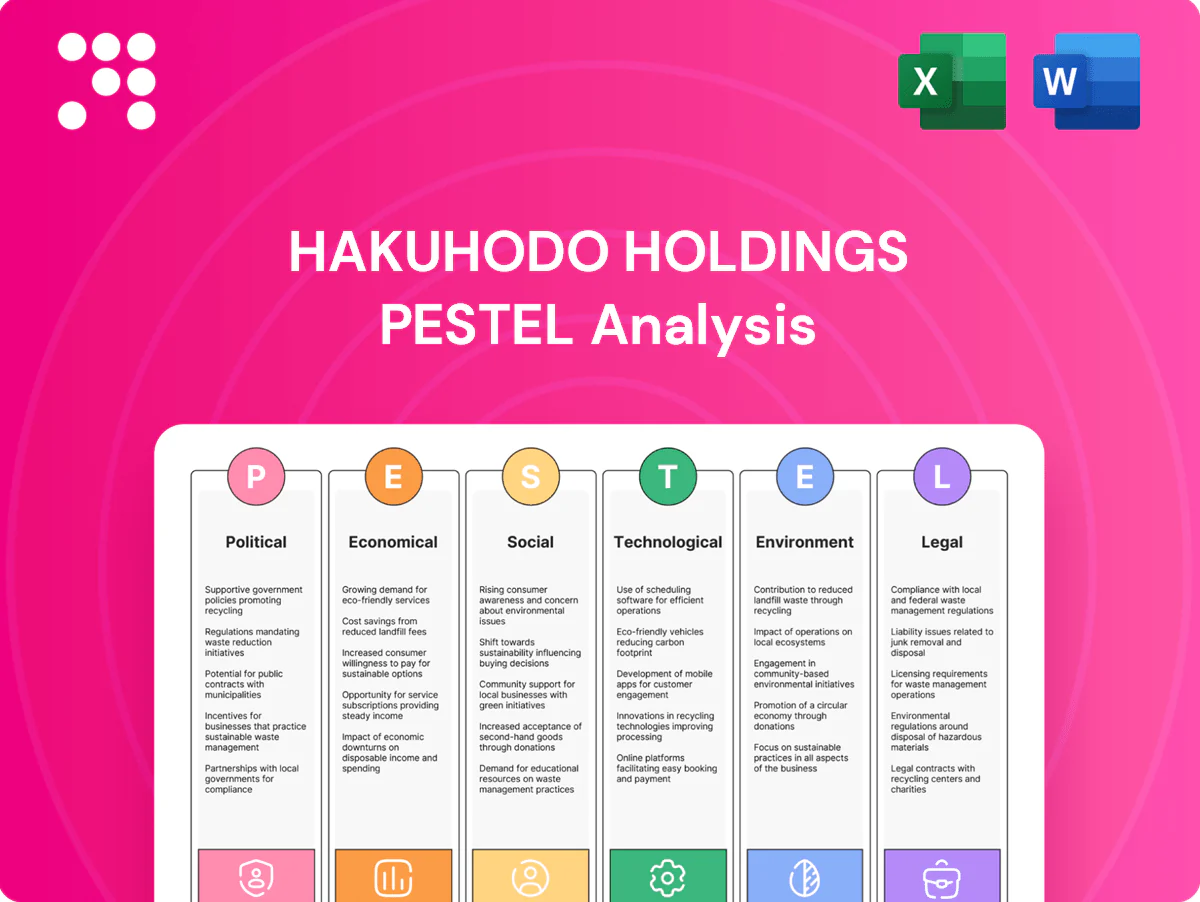
Hakuhodo Holdings PESTLE Analysis

Plan Smarter. Present Sharper. Compete Stronger.
Discover how political shifts, economic trends, social dynamics, technological innovation, legal pressures, and environmental factors are shaping Hakuhodo Holdings' strategic outlook. This concise PESTLE snapshot highlights key risks and opportunities for investors and planners. Purchase the full analysis to access detailed insights, data tables, and actionable recommendations you can use immediately.
Political factors

Japan policy stability and subsidies
Stable Japanese governance (Digital Agency established 2021) supports long-term marketing investments and public campaigns; with a population ~125 million, government incentives for digitalization and regional revitalization increasingly channel budgets to communications. Hakuhodo can align proposals with national priorities to access funded projects, though policy shifts may reallocate spend between traditional and digital channels.
Geopolitical tensions and supply chain messaging
US–China frictions and regional security issues reshape client market strategies and media narratives, especially given the US and China together account for about 43% of global GDP (World Bank, 2023). Multinational clients may rebalance ad spend across markets, shifting revenue mix and increasing demand for crisis communications and reputation management; scenario planning for cross-border campaigns becomes essential.

Public sector advertising and elections
Election cycles elevate public information and civic campaigns, driving uplifts in government communications spend; public procurement represents roughly 12% of GDP across OECD countries, shaping scale and timing of opportunities. Procurement rules determine bidding, compliance and margin pressure. Political-ad restrictions differ by market—several countries ban paid broadcast political ads—forcing creative and media tactic shifts. Timely capacity allocation captures cyclical spikes without overextending.

Trade policies and market access
Tariffs, trade agreements and visa rules shape Hakuhodo client expansion and pitch pipelines; trade barriers can delay product launches and cut ad budgets, while favorable deals boost sector demand—CPTPP spans about 13% of global GDP and Japan inbound tourism recovered to ~24 million visitors in 2023, lifting travel ad spend; local partner strategies offset policy unpredictability.
- Tariffs can delay launches → lower ad spend
- Favorable agreements (CPTPP ~13% GDP) → faster demand
- Visa easing (Japan 24M tourists 2023) → travel sector upside
Media regulation and state broadcaster influence
Regulatory oversight, including the EU Digital Services Act and tighter local broadcast rules, reshapes inventory availability and pricing by increasing platform accountability and content moderation costs; Japan's ad market exceeded ¥7 trillion in 2023. NHK's license-fee model means no commercial inventory, forcing commercial load onto private and digital channels. Compliance-ready planning improves buyer leverage and brand safety outcomes.
- Regulation: DSA raises platform duties
- Public broadcaster: NHK no ads, shifts inventory
- Market: Japan ad market >¥7 trillion (2023)
- Buyer leverage: compliance-ready planning reduces risk
Japan digital push, tourism lift >¥7T ad market as regulation shifts inventory
Stable Japanese governance and Digital Agency (2021) steer public funding toward digital/regional campaigns; population ~125 million and Japan ad market >¥7 trillion (2023) create scale. US–China (≈43% global GDP) frictions and CPTPP (~13% GDP) reshape cross‑border briefs; tourism ~24M (2023) boosts travel briefs. Regulation (EU DSA, tighter broadcast rules, NHK no ads) raises compliance and shifts inventory to private/digital channels.
| Factor | Key Data (latest) |
|---|---|
| Population | ~125 million |
| Japan ad market | >¥7 trillion (2023) |
| Tourism | ~24M visitors (2023) |
| US+China share | ≈43% global GDP (2023) |
| CPTPP impact | ~13% global GDP |
| Public procurement | ~12% GDP (OECD avg) |
What is included in the product
 Detailed Word Document
Explores how Political, Economic, Social, Technological, Environmental and Legal factors uniquely impact Hakuhodo Holdings, with data-backed trends and region-specific regulatory context; designed for executives and advisors to identify risks, opportunities and forward-looking scenarios in clean, report-ready format.

 Customizable Excel Spreadsheet
A concise, visually segmented PESTLE summary for Hakuhodo Holdings that’s editable for local context and easily dropped into presentations or shared across teams, helping streamline risk discussions, market positioning and consultant reports.
Economic factors

Ad spend cyclicality with GDP
Marketing budgets expand in expansions and tighten in downturns—global GDP grew about 3.2% in 2024 (IMF), while industry forecasts showed ad spend rising ~5–6% that year, highlighting procyclicality. Hakuhodo’s diversified client base across FMCG, tech and automotive reduces revenue volatility versus sector-concentrated peers. Counter‑cyclical offerings such as CRM and performance marketing historically cut revenue declines by supporting client ROI during recessions. Accurate forecasting of demand and ROI is essential for optimal resource allocation and margin protection.
Yen fluctuations and global revenues
Currency swings materially affect translated results and cross-border fees; the yen's roughly 20% depreciation versus the dollar since 2021 (USD/JPY ~150–155 in 2024–mid‑2025) has boosted overseas earnings when repatriated but increased import and vendor costs for Hakuhodo. Hedging programs and local-market pricing help protect margins, while contracts should include explicit FX pass-through and adjustment clauses to address volatility.

Inflation, media prices, and wage pressures
Rising inflation—Japan CPI averaged about 3.0% in 2024—has pushed media rates and talent costs up, with agency-side talent costs rising an estimated 4–6% year-on-year. Value-based pricing and automation can preserve margins by shifting from volume to outcome models. Clients under tighter budgets now demand measurable ROI, and procurement scrutiny has intensified, requiring documented proof of campaign effectiveness and efficiency.

Client mix and sectoral exposure
Hakuhodo's diversified client mix across auto, FMCG, tech, finance and healthcare limits concentration risk while sector-specific cycles cause uneven ad spend; global ad spend rose an estimated 4–6% in 2024, supporting growth in tech and healthcare while legacy categories contracted.
Focusing investment in high-growth verticals offsets declines in mature sectors, and thought leadership has helped win counter-cyclical briefs during 2024 industry shifts.
- Diversification: broad sector exposure
- Cycles: uneven spend patterns
- Resilience: pivot to high-growth verticals
- Thought leadership: wins counter-cyclical work
Industry consolidation and competitive dynamics
Industry consolidation—notably among Japan's leading groups Dentsu and Hakuhodo—has intensified pricing pressure while expanding service breadth as clients rationalize rosters toward integrated offers; Japan's ad market remained near ¥7 trillion in 2024, keeping scale-driven M&A attractive. Strategic partnerships and selective acquisitions are closing capability gaps; differentiation through data analytics and creativity sustains share.
- Consolidation: top-tier roll-ups
- Client trend: roster rationalization → integrated buys
- Moves: partnerships + tuck-ins
- Win factor: data + creativity
Japan digital push, tourism lift >¥7T ad market as regulation shifts inventory
Global GDP ~3.2% in 2024 (IMF); global ad spend +5–6% in 2024 supporting digital/healthcare while legacy categories slipped. Japan ad market ~¥7 trillion (2024); CPI ~3.0% and agency labor costs +4–6% compress margins. USD/JPY ~150–155 (2024–mid‑2025) boosts repatriated overseas revenue but raises import costs; hedging and outcome pricing protect margins.
| Metric | 2024/2025 | Implication |
|---|---|---|
| Global GDP | 3.2% (2024) | Procyclical ad demand |
| Global ad spend | +5–6% (2024) | Growth tailwinds |
| Japan ad market | ¥7 trillion (2024) | Scale M&A |
| USD/JPY | ~150–155 | FX translation impact |
| Japan CPI | ~3.0% (2024) | Cost pressure |
Same Document Delivered
Hakuhodo Holdings PESTLE Analysis
This preview of the Hakuhodo Holdings PESTLE Analysis is the exact document you’ll receive after purchase—fully formatted and ready to use. The layout, content, and structure shown here are exactly what you’ll download immediately after buying. No placeholders or teasers—this is the final, professionally structured file.

Plan Smarter. Present Sharper. Compete Stronger.
Discover how political shifts, economic trends, social dynamics, technological innovation, legal pressures, and environmental factors are shaping Hakuhodo Holdings' strategic outlook. This concise PESTLE snapshot highlights key risks and opportunities for investors and planners. Purchase the full analysis to access detailed insights, data tables, and actionable recommendations you can use immediately.
Political factors
Japan policy stability and subsidies
Stable Japanese governance (Digital Agency established 2021) supports long-term marketing investments and public campaigns; with a population ~125 million, government incentives for digitalization and regional revitalization increasingly channel budgets to communications. Hakuhodo can align proposals with national priorities to access funded projects, though policy shifts may reallocate spend between traditional and digital channels.
Geopolitical tensions and supply chain messaging
US–China frictions and regional security issues reshape client market strategies and media narratives, especially given the US and China together account for about 43% of global GDP (World Bank, 2023). Multinational clients may rebalance ad spend across markets, shifting revenue mix and increasing demand for crisis communications and reputation management; scenario planning for cross-border campaigns becomes essential.
Public sector advertising and elections
Election cycles elevate public information and civic campaigns, driving uplifts in government communications spend; public procurement represents roughly 12% of GDP across OECD countries, shaping scale and timing of opportunities. Procurement rules determine bidding, compliance and margin pressure. Political-ad restrictions differ by market—several countries ban paid broadcast political ads—forcing creative and media tactic shifts. Timely capacity allocation captures cyclical spikes without overextending.
Trade policies and market access
Tariffs, trade agreements and visa rules shape Hakuhodo client expansion and pitch pipelines; trade barriers can delay product launches and cut ad budgets, while favorable deals boost sector demand—CPTPP spans about 13% of global GDP and Japan inbound tourism recovered to ~24 million visitors in 2023, lifting travel ad spend; local partner strategies offset policy unpredictability.
- Tariffs can delay launches → lower ad spend
- Favorable agreements (CPTPP ~13% GDP) → faster demand
- Visa easing (Japan 24M tourists 2023) → travel sector upside
Media regulation and state broadcaster influence
Regulatory oversight, including the EU Digital Services Act and tighter local broadcast rules, reshapes inventory availability and pricing by increasing platform accountability and content moderation costs; Japan's ad market exceeded ¥7 trillion in 2023. NHK's license-fee model means no commercial inventory, forcing commercial load onto private and digital channels. Compliance-ready planning improves buyer leverage and brand safety outcomes.
- Regulation: DSA raises platform duties
- Public broadcaster: NHK no ads, shifts inventory
- Market: Japan ad market >¥7 trillion (2023)
- Buyer leverage: compliance-ready planning reduces risk
Japan digital push, tourism lift >¥7T ad market as regulation shifts inventory
Stable Japanese governance and Digital Agency (2021) steer public funding toward digital/regional campaigns; population ~125 million and Japan ad market >¥7 trillion (2023) create scale. US–China (≈43% global GDP) frictions and CPTPP (~13% GDP) reshape cross‑border briefs; tourism ~24M (2023) boosts travel briefs. Regulation (EU DSA, tighter broadcast rules, NHK no ads) raises compliance and shifts inventory to private/digital channels.
| Factor | Key Data (latest) |
|---|---|
| Population | ~125 million |
| Japan ad market | >¥7 trillion (2023) |
| Tourism | ~24M visitors (2023) |
| US+China share | ≈43% global GDP (2023) |
| CPTPP impact | ~13% global GDP |
| Public procurement | ~12% GDP (OECD avg) |
What is included in the product
Detailed Word Document
Explores how Political, Economic, Social, Technological, Environmental and Legal factors uniquely impact Hakuhodo Holdings, with data-backed trends and region-specific regulatory context; designed for executives and advisors to identify risks, opportunities and forward-looking scenarios in clean, report-ready format.
Customizable Excel Spreadsheet
A concise, visually segmented PESTLE summary for Hakuhodo Holdings that’s editable for local context and easily dropped into presentations or shared across teams, helping streamline risk discussions, market positioning and consultant reports.
Economic factors
Ad spend cyclicality with GDP
Marketing budgets expand in expansions and tighten in downturns—global GDP grew about 3.2% in 2024 (IMF), while industry forecasts showed ad spend rising ~5–6% that year, highlighting procyclicality. Hakuhodo’s diversified client base across FMCG, tech and automotive reduces revenue volatility versus sector-concentrated peers. Counter‑cyclical offerings such as CRM and performance marketing historically cut revenue declines by supporting client ROI during recessions. Accurate forecasting of demand and ROI is essential for optimal resource allocation and margin protection.
Yen fluctuations and global revenues
Currency swings materially affect translated results and cross-border fees; the yen's roughly 20% depreciation versus the dollar since 2021 (USD/JPY ~150–155 in 2024–mid‑2025) has boosted overseas earnings when repatriated but increased import and vendor costs for Hakuhodo. Hedging programs and local-market pricing help protect margins, while contracts should include explicit FX pass-through and adjustment clauses to address volatility.
Inflation, media prices, and wage pressures
Rising inflation—Japan CPI averaged about 3.0% in 2024—has pushed media rates and talent costs up, with agency-side talent costs rising an estimated 4–6% year-on-year. Value-based pricing and automation can preserve margins by shifting from volume to outcome models. Clients under tighter budgets now demand measurable ROI, and procurement scrutiny has intensified, requiring documented proof of campaign effectiveness and efficiency.
Client mix and sectoral exposure
Hakuhodo's diversified client mix across auto, FMCG, tech, finance and healthcare limits concentration risk while sector-specific cycles cause uneven ad spend; global ad spend rose an estimated 4–6% in 2024, supporting growth in tech and healthcare while legacy categories contracted.
Focusing investment in high-growth verticals offsets declines in mature sectors, and thought leadership has helped win counter-cyclical briefs during 2024 industry shifts.
- Diversification: broad sector exposure
- Cycles: uneven spend patterns
- Resilience: pivot to high-growth verticals
- Thought leadership: wins counter-cyclical work
Industry consolidation and competitive dynamics
Industry consolidation—notably among Japan's leading groups Dentsu and Hakuhodo—has intensified pricing pressure while expanding service breadth as clients rationalize rosters toward integrated offers; Japan's ad market remained near ¥7 trillion in 2024, keeping scale-driven M&A attractive. Strategic partnerships and selective acquisitions are closing capability gaps; differentiation through data analytics and creativity sustains share.
- Consolidation: top-tier roll-ups
- Client trend: roster rationalization → integrated buys
- Moves: partnerships + tuck-ins
- Win factor: data + creativity
Japan digital push, tourism lift >¥7T ad market as regulation shifts inventory
Global GDP ~3.2% in 2024 (IMF); global ad spend +5–6% in 2024 supporting digital/healthcare while legacy categories slipped. Japan ad market ~¥7 trillion (2024); CPI ~3.0% and agency labor costs +4–6% compress margins. USD/JPY ~150–155 (2024–mid‑2025) boosts repatriated overseas revenue but raises import costs; hedging and outcome pricing protect margins.
| Metric | 2024/2025 | Implication |
|---|---|---|
| Global GDP | 3.2% (2024) | Procyclical ad demand |
| Global ad spend | +5–6% (2024) | Growth tailwinds |
| Japan ad market | ¥7 trillion (2024) | Scale M&A |
| USD/JPY | ~150–155 | FX translation impact |
| Japan CPI | ~3.0% (2024) | Cost pressure |
Same Document Delivered
Hakuhodo Holdings PESTLE Analysis
This preview of the Hakuhodo Holdings PESTLE Analysis is the exact document you’ll receive after purchase—fully formatted and ready to use. The layout, content, and structure shown here are exactly what you’ll download immediately after buying. No placeholders or teasers—this is the final, professionally structured file.
Original: $10.00
-65%$10.00
$3.50Description
Plan Smarter. Present Sharper. Compete Stronger.
Discover how political shifts, economic trends, social dynamics, technological innovation, legal pressures, and environmental factors are shaping Hakuhodo Holdings' strategic outlook. This concise PESTLE snapshot highlights key risks and opportunities for investors and planners. Purchase the full analysis to access detailed insights, data tables, and actionable recommendations you can use immediately.
Political factors
Japan policy stability and subsidies
Stable Japanese governance (Digital Agency established 2021) supports long-term marketing investments and public campaigns; with a population ~125 million, government incentives for digitalization and regional revitalization increasingly channel budgets to communications. Hakuhodo can align proposals with national priorities to access funded projects, though policy shifts may reallocate spend between traditional and digital channels.
Geopolitical tensions and supply chain messaging
US–China frictions and regional security issues reshape client market strategies and media narratives, especially given the US and China together account for about 43% of global GDP (World Bank, 2023). Multinational clients may rebalance ad spend across markets, shifting revenue mix and increasing demand for crisis communications and reputation management; scenario planning for cross-border campaigns becomes essential.
Public sector advertising and elections
Election cycles elevate public information and civic campaigns, driving uplifts in government communications spend; public procurement represents roughly 12% of GDP across OECD countries, shaping scale and timing of opportunities. Procurement rules determine bidding, compliance and margin pressure. Political-ad restrictions differ by market—several countries ban paid broadcast political ads—forcing creative and media tactic shifts. Timely capacity allocation captures cyclical spikes without overextending.
Trade policies and market access
Tariffs, trade agreements and visa rules shape Hakuhodo client expansion and pitch pipelines; trade barriers can delay product launches and cut ad budgets, while favorable deals boost sector demand—CPTPP spans about 13% of global GDP and Japan inbound tourism recovered to ~24 million visitors in 2023, lifting travel ad spend; local partner strategies offset policy unpredictability.
- Tariffs can delay launches → lower ad spend
- Favorable agreements (CPTPP ~13% GDP) → faster demand
- Visa easing (Japan 24M tourists 2023) → travel sector upside
Media regulation and state broadcaster influence
Regulatory oversight, including the EU Digital Services Act and tighter local broadcast rules, reshapes inventory availability and pricing by increasing platform accountability and content moderation costs; Japan's ad market exceeded ¥7 trillion in 2023. NHK's license-fee model means no commercial inventory, forcing commercial load onto private and digital channels. Compliance-ready planning improves buyer leverage and brand safety outcomes.
- Regulation: DSA raises platform duties
- Public broadcaster: NHK no ads, shifts inventory
- Market: Japan ad market >¥7 trillion (2023)
- Buyer leverage: compliance-ready planning reduces risk
Japan digital push, tourism lift >¥7T ad market as regulation shifts inventory
Stable Japanese governance and Digital Agency (2021) steer public funding toward digital/regional campaigns; population ~125 million and Japan ad market >¥7 trillion (2023) create scale. US–China (≈43% global GDP) frictions and CPTPP (~13% GDP) reshape cross‑border briefs; tourism ~24M (2023) boosts travel briefs. Regulation (EU DSA, tighter broadcast rules, NHK no ads) raises compliance and shifts inventory to private/digital channels.
| Factor | Key Data (latest) |
|---|---|
| Population | ~125 million |
| Japan ad market | >¥7 trillion (2023) |
| Tourism | ~24M visitors (2023) |
| US+China share | ≈43% global GDP (2023) |
| CPTPP impact | ~13% global GDP |
| Public procurement | ~12% GDP (OECD avg) |
What is included in the product
Detailed Word Document
Explores how Political, Economic, Social, Technological, Environmental and Legal factors uniquely impact Hakuhodo Holdings, with data-backed trends and region-specific regulatory context; designed for executives and advisors to identify risks, opportunities and forward-looking scenarios in clean, report-ready format.
Customizable Excel Spreadsheet
A concise, visually segmented PESTLE summary for Hakuhodo Holdings that’s editable for local context and easily dropped into presentations or shared across teams, helping streamline risk discussions, market positioning and consultant reports.
Economic factors
Ad spend cyclicality with GDP
Marketing budgets expand in expansions and tighten in downturns—global GDP grew about 3.2% in 2024 (IMF), while industry forecasts showed ad spend rising ~5–6% that year, highlighting procyclicality. Hakuhodo’s diversified client base across FMCG, tech and automotive reduces revenue volatility versus sector-concentrated peers. Counter‑cyclical offerings such as CRM and performance marketing historically cut revenue declines by supporting client ROI during recessions. Accurate forecasting of demand and ROI is essential for optimal resource allocation and margin protection.
Yen fluctuations and global revenues
Currency swings materially affect translated results and cross-border fees; the yen's roughly 20% depreciation versus the dollar since 2021 (USD/JPY ~150–155 in 2024–mid‑2025) has boosted overseas earnings when repatriated but increased import and vendor costs for Hakuhodo. Hedging programs and local-market pricing help protect margins, while contracts should include explicit FX pass-through and adjustment clauses to address volatility.
Inflation, media prices, and wage pressures
Rising inflation—Japan CPI averaged about 3.0% in 2024—has pushed media rates and talent costs up, with agency-side talent costs rising an estimated 4–6% year-on-year. Value-based pricing and automation can preserve margins by shifting from volume to outcome models. Clients under tighter budgets now demand measurable ROI, and procurement scrutiny has intensified, requiring documented proof of campaign effectiveness and efficiency.
Client mix and sectoral exposure
Hakuhodo's diversified client mix across auto, FMCG, tech, finance and healthcare limits concentration risk while sector-specific cycles cause uneven ad spend; global ad spend rose an estimated 4–6% in 2024, supporting growth in tech and healthcare while legacy categories contracted.
Focusing investment in high-growth verticals offsets declines in mature sectors, and thought leadership has helped win counter-cyclical briefs during 2024 industry shifts.
- Diversification: broad sector exposure
- Cycles: uneven spend patterns
- Resilience: pivot to high-growth verticals
- Thought leadership: wins counter-cyclical work
Industry consolidation and competitive dynamics
Industry consolidation—notably among Japan's leading groups Dentsu and Hakuhodo—has intensified pricing pressure while expanding service breadth as clients rationalize rosters toward integrated offers; Japan's ad market remained near ¥7 trillion in 2024, keeping scale-driven M&A attractive. Strategic partnerships and selective acquisitions are closing capability gaps; differentiation through data analytics and creativity sustains share.
- Consolidation: top-tier roll-ups
- Client trend: roster rationalization → integrated buys
- Moves: partnerships + tuck-ins
- Win factor: data + creativity
Japan digital push, tourism lift >¥7T ad market as regulation shifts inventory
Global GDP ~3.2% in 2024 (IMF); global ad spend +5–6% in 2024 supporting digital/healthcare while legacy categories slipped. Japan ad market ~¥7 trillion (2024); CPI ~3.0% and agency labor costs +4–6% compress margins. USD/JPY ~150–155 (2024–mid‑2025) boosts repatriated overseas revenue but raises import costs; hedging and outcome pricing protect margins.
| Metric | 2024/2025 | Implication |
|---|---|---|
| Global GDP | 3.2% (2024) | Procyclical ad demand |
| Global ad spend | +5–6% (2024) | Growth tailwinds |
| Japan ad market | ¥7 trillion (2024) | Scale M&A |
| USD/JPY | ~150–155 | FX translation impact |
| Japan CPI | ~3.0% (2024) | Cost pressure |
Same Document Delivered
Hakuhodo Holdings PESTLE Analysis
This preview of the Hakuhodo Holdings PESTLE Analysis is the exact document you’ll receive after purchase—fully formatted and ready to use. The layout, content, and structure shown here are exactly what you’ll download immediately after buying. No placeholders or teasers—this is the final, professionally structured file.











