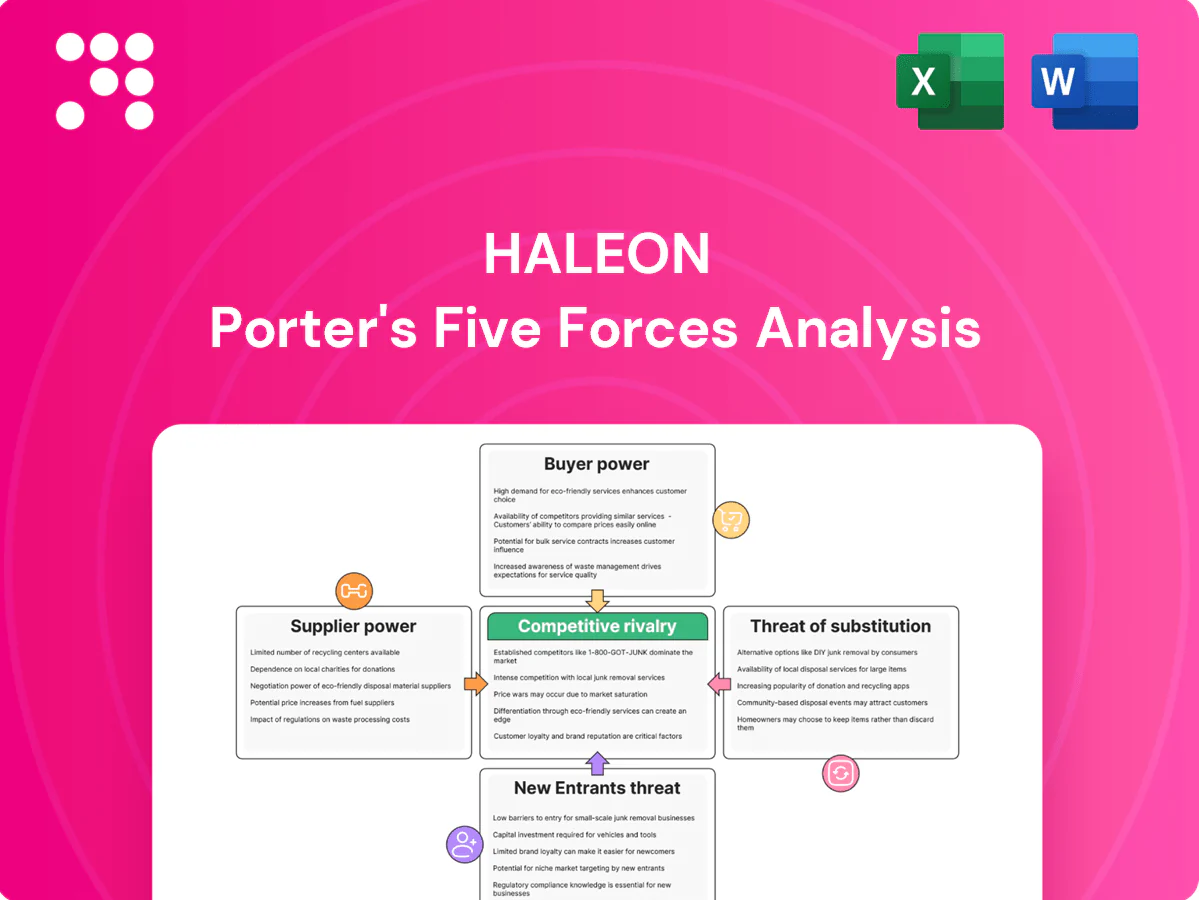
Haleon Porter's Five Forces Analysis

A Must-Have Tool for Decision-Makers
Haleon faces moderate buyer power and steady supplier relationships, while brand strength cushions against substitutes and new entrants remain tempered by regulatory and retail barriers. Competitive rivalry is shaped by global OTC players and shifting consumer preferences toward wellness and digital channels. This brief snapshot only scratches the surface. Unlock the full Porter's Five Forces Analysis to explore Haleon’s competitive dynamics, market pressures, and strategic advantages in detail.
Suppliers Bargaining Power

Concentrated sources for key APIs
Several analgesic, oral-care and respiratory actives such as ibuprofen, paracetamol, zinc compounds and fluoride are predominantly sourced from a limited pool of qualified producers, largely in China and India as of 2024. GMP and validation requirements slow supplier switching, enhancing supplier bargaining power and price pass-through risk. Dual-sourcing reduces but does not eliminate exposure to concentrated API suppliers.
Specialized packaging and materials
Specialized packaging needs like child-resistant closures, blister formats, and sustainable-spec materials force use of certified vendors, and compliance plus line-change validation create measurable switching costs and multi-week qualification timelines. Suppliers owning proprietary formats can command favorable terms and margin protection. Haleon’s scale and centralized procurement, however, allows competitive tenders to moderate supplier power and reduce single-source dependency.

Contract manufacturing and capacity tightness
Selective use of contract manufacturers for niche formats or surge volumes creates dependency on available, compliant capacity, and in tight markets CMOs can prioritise higher‑margin clients, increasing their leverage. Haleon’s multi‑plant internal footprint partially offsets this risk by enabling in‑house transfers. Long‑term agreements with clear service‑level metrics and penalty clauses help rebalance bargaining power. Close monitoring of CMO capacity and contingency plans remain essential.

Quality, compliance, and continuity requirements
Stringent quality audits and pharmacovigilance raise barriers for new suppliers, entrenching incumbents and increasing supplier stickiness; Haleon reported c.£7.8bn revenue in 2023, amplifying the cost of supply disruption for core SKUs.
Severe penalties for quality lapses limit opportunism, while co-investment in QA systems aligns incentives and can reduce per-unit costs over time.
- Incumbent entrenchment
- Pricing leverage risk
- High penalty deterrent
- Co-investment alignment
Logistics, commodities, and FX volatility
Logistics, commodities, and FX volatility raise supplier bargaining power for Haleon as API precursors, menthol, gelatin and energy-linked inputs are exposed to commodity and freight swings; geopolitical or pandemic disruptions can tighten supply and elevate prices and lead times. Hedging and regionalization reduce exposure but increase sourcing complexity and working capital needs. Scale buying programs offer partial insulation, preserving margin flexibility.
- Concentration risk: API precursors often sourced from Asia
- Volatility channels: freight, energy, FX
- Mitigants: hedging, regionalization, scale purchasing
API sourcing concentrated in China/India; GMP validation and long timelines increase supplier leverage
APIs (ibuprofen, paracetamol, zinc, fluoride) are predominantly sourced from a concentrated pool in China/India as of 2024, raising supplier leverage; GMP validation and multi-week qualification timelines increase switching costs. Haleon’s scale (c.£7.8bn revenue 2023) and long-term contracts partially mitigate but do not eliminate concentration and commodity/FX risks.
| Risk | Fact |
|---|---|
| Concentration | APIs largely China/India (2024) |
| Revenue | c.£7.8bn (2023) |
| Switching | GMP validation, multi-week timelines |
What is included in the product
 Detailed Word Document
Tailored Porter’s Five Forces for Haleon that uncovers competitive drivers, supplier and buyer power, entry barriers, substitutes, and disruptive threats—supported by industry context and strategic implications for pricing, market share, and profitability.

 Customizable Excel Spreadsheet
Clear, one-sheet Porter's Five Forces for Haleon that highlights competitive pressures and relief points—customizable ratings and notes let you model shifts from new entrants, regulation, or supplier moves instantly for board-ready slides.
Customers Bargaining Power

Concentrated retail and pharmacy channels
Mass retailers, drug chains and wholesalers, including e-commerce platforms, are highly consolidated in key markets—top three grocery retailers often capture over 50% of sales while leading pharmacy chains account for over 60% of prescription volumes in major markets. They extract slotting fees, strict trade terms and promotional funding, increasing buyer leverage on price and shelf visibility. Haleon’s must-have brands (e.g., Sensodyne, Centrum) mitigate but do not eliminate this pressure.
Private label and generic OTC alternatives
Retailers increasingly source private-label and generic OTCs with identical actives at lower price points, creating credible walk-away options and setting lower price anchors that compress margins for branded players. The growing presence of store brands strengthens buyer negotiation leverage, forcing promotional and list-price concessions. Haleon and peers must rely on differentiation via claims, novel formats, and brand trust to resist downgrades and preserve pricing power.

Price-sensitive consumers with low switching costs
Price-sensitive OTC consumers frequently hunt promos—global OTC market ~USD 151bn in 2024 with promotions driving roughly 30% of channel volume—making deal-responsiveness a key driver of purchase. Switching costs between comparable SKUs are minimal, easing substitution. Economic pressures in 2024 heightened trade-down risk as value/private label growth accelerated. Strong brands and perceived efficacy (Haleon FY2024 sales ~£6.9bn) help defend share.

Digital marketplaces and data transparency
- Price transparency: 73% read reviews (BrightLocal 2024)
- Platform control: algorithmic merchandising concentrates traffic
- Retail media: ~$86B spend (2024 est.)
- Counterbalance: first-party data + DTC channels strengthen Haleon
Healthcare professionals’ and dentists’ influence
Recommendations from healthcare professionals and dentists strongly shape brand choice in pain and oral care; Haleon (owners of Sensodyne, Panadol) reported ~£6.9bn revenue in 2024, so clinician endorsements that favor its brands can reduce retailer bargaining power. Guideline shifts or new endorsements can quickly swing demand, making professional outreach a key indirect lever over buyer power.
- HCP endorsements boost brand preference
- Favorable endorsements lower retailer leverage
- Guideline changes can reverse demand
- Professional outreach = indirect buyer-power control
Retailer concentration and promotions squeeze branded OTC margins as online media gains influence
Concentrated retailers and pharmacy chains (top3 >50% grocery; leading pharmacies >60% Rx) exert strong buyer leverage on price and shelf terms. Private-label and promotions (OTC market ~$151bn in 2024; promos ~30%) compress branded margins despite Haleon’s £6.9bn FY2024 scale. Online platforms (73% read reviews) and $86bn retail media shift power toward channels while HCP endorsements mitigate retailer pressure.
| Metric | 2024 Value |
|---|---|
| OTC market | $151bn |
| Promotions | ~30% |
| Haleon sales | £6.9bn |
Full Version Awaits
Haleon Porter's Five Forces Analysis
This preview shows the Haleon Porter's Five Forces Analysis exactly as delivered—complete, professionally formatted, and ready for immediate download after purchase. The content here is identical to the file you'll receive; no samples or placeholders. Use it straight away in reports or presentations.

A Must-Have Tool for Decision-Makers
Haleon faces moderate buyer power and steady supplier relationships, while brand strength cushions against substitutes and new entrants remain tempered by regulatory and retail barriers. Competitive rivalry is shaped by global OTC players and shifting consumer preferences toward wellness and digital channels. This brief snapshot only scratches the surface. Unlock the full Porter's Five Forces Analysis to explore Haleon’s competitive dynamics, market pressures, and strategic advantages in detail.
Suppliers Bargaining Power
Concentrated sources for key APIs
Several analgesic, oral-care and respiratory actives such as ibuprofen, paracetamol, zinc compounds and fluoride are predominantly sourced from a limited pool of qualified producers, largely in China and India as of 2024. GMP and validation requirements slow supplier switching, enhancing supplier bargaining power and price pass-through risk. Dual-sourcing reduces but does not eliminate exposure to concentrated API suppliers.
Specialized packaging and materials
Specialized packaging needs like child-resistant closures, blister formats, and sustainable-spec materials force use of certified vendors, and compliance plus line-change validation create measurable switching costs and multi-week qualification timelines. Suppliers owning proprietary formats can command favorable terms and margin protection. Haleon’s scale and centralized procurement, however, allows competitive tenders to moderate supplier power and reduce single-source dependency.
Contract manufacturing and capacity tightness
Selective use of contract manufacturers for niche formats or surge volumes creates dependency on available, compliant capacity, and in tight markets CMOs can prioritise higher‑margin clients, increasing their leverage. Haleon’s multi‑plant internal footprint partially offsets this risk by enabling in‑house transfers. Long‑term agreements with clear service‑level metrics and penalty clauses help rebalance bargaining power. Close monitoring of CMO capacity and contingency plans remain essential.
Quality, compliance, and continuity requirements
Stringent quality audits and pharmacovigilance raise barriers for new suppliers, entrenching incumbents and increasing supplier stickiness; Haleon reported c.£7.8bn revenue in 2023, amplifying the cost of supply disruption for core SKUs.
Severe penalties for quality lapses limit opportunism, while co-investment in QA systems aligns incentives and can reduce per-unit costs over time.
- Incumbent entrenchment
- Pricing leverage risk
- High penalty deterrent
- Co-investment alignment
Logistics, commodities, and FX volatility
Logistics, commodities, and FX volatility raise supplier bargaining power for Haleon as API precursors, menthol, gelatin and energy-linked inputs are exposed to commodity and freight swings; geopolitical or pandemic disruptions can tighten supply and elevate prices and lead times. Hedging and regionalization reduce exposure but increase sourcing complexity and working capital needs. Scale buying programs offer partial insulation, preserving margin flexibility.
- Concentration risk: API precursors often sourced from Asia
- Volatility channels: freight, energy, FX
- Mitigants: hedging, regionalization, scale purchasing
API sourcing concentrated in China/India; GMP validation and long timelines increase supplier leverage
APIs (ibuprofen, paracetamol, zinc, fluoride) are predominantly sourced from a concentrated pool in China/India as of 2024, raising supplier leverage; GMP validation and multi-week qualification timelines increase switching costs. Haleon’s scale (c.£7.8bn revenue 2023) and long-term contracts partially mitigate but do not eliminate concentration and commodity/FX risks.
| Risk | Fact |
|---|---|
| Concentration | APIs largely China/India (2024) |
| Revenue | c.£7.8bn (2023) |
| Switching | GMP validation, multi-week timelines |
What is included in the product
Detailed Word Document
Tailored Porter’s Five Forces for Haleon that uncovers competitive drivers, supplier and buyer power, entry barriers, substitutes, and disruptive threats—supported by industry context and strategic implications for pricing, market share, and profitability.
Customizable Excel Spreadsheet
Clear, one-sheet Porter's Five Forces for Haleon that highlights competitive pressures and relief points—customizable ratings and notes let you model shifts from new entrants, regulation, or supplier moves instantly for board-ready slides.
Customers Bargaining Power
Concentrated retail and pharmacy channels
Mass retailers, drug chains and wholesalers, including e-commerce platforms, are highly consolidated in key markets—top three grocery retailers often capture over 50% of sales while leading pharmacy chains account for over 60% of prescription volumes in major markets. They extract slotting fees, strict trade terms and promotional funding, increasing buyer leverage on price and shelf visibility. Haleon’s must-have brands (e.g., Sensodyne, Centrum) mitigate but do not eliminate this pressure.
Private label and generic OTC alternatives
Retailers increasingly source private-label and generic OTCs with identical actives at lower price points, creating credible walk-away options and setting lower price anchors that compress margins for branded players. The growing presence of store brands strengthens buyer negotiation leverage, forcing promotional and list-price concessions. Haleon and peers must rely on differentiation via claims, novel formats, and brand trust to resist downgrades and preserve pricing power.
Price-sensitive consumers with low switching costs
Price-sensitive OTC consumers frequently hunt promos—global OTC market ~USD 151bn in 2024 with promotions driving roughly 30% of channel volume—making deal-responsiveness a key driver of purchase. Switching costs between comparable SKUs are minimal, easing substitution. Economic pressures in 2024 heightened trade-down risk as value/private label growth accelerated. Strong brands and perceived efficacy (Haleon FY2024 sales ~£6.9bn) help defend share.
Digital marketplaces and data transparency
- Price transparency: 73% read reviews (BrightLocal 2024)
- Platform control: algorithmic merchandising concentrates traffic
- Retail media: ~$86B spend (2024 est.)
- Counterbalance: first-party data + DTC channels strengthen Haleon
Healthcare professionals’ and dentists’ influence
Recommendations from healthcare professionals and dentists strongly shape brand choice in pain and oral care; Haleon (owners of Sensodyne, Panadol) reported ~£6.9bn revenue in 2024, so clinician endorsements that favor its brands can reduce retailer bargaining power. Guideline shifts or new endorsements can quickly swing demand, making professional outreach a key indirect lever over buyer power.
- HCP endorsements boost brand preference
- Favorable endorsements lower retailer leverage
- Guideline changes can reverse demand
- Professional outreach = indirect buyer-power control
Retailer concentration and promotions squeeze branded OTC margins as online media gains influence
Concentrated retailers and pharmacy chains (top3 >50% grocery; leading pharmacies >60% Rx) exert strong buyer leverage on price and shelf terms. Private-label and promotions (OTC market ~$151bn in 2024; promos ~30%) compress branded margins despite Haleon’s £6.9bn FY2024 scale. Online platforms (73% read reviews) and $86bn retail media shift power toward channels while HCP endorsements mitigate retailer pressure.
| Metric | 2024 Value |
|---|---|
| OTC market | $151bn |
| Promotions | ~30% |
| Haleon sales | £6.9bn |
Full Version Awaits
Haleon Porter's Five Forces Analysis
This preview shows the Haleon Porter's Five Forces Analysis exactly as delivered—complete, professionally formatted, and ready for immediate download after purchase. The content here is identical to the file you'll receive; no samples or placeholders. Use it straight away in reports or presentations.
Description
A Must-Have Tool for Decision-Makers
Haleon faces moderate buyer power and steady supplier relationships, while brand strength cushions against substitutes and new entrants remain tempered by regulatory and retail barriers. Competitive rivalry is shaped by global OTC players and shifting consumer preferences toward wellness and digital channels. This brief snapshot only scratches the surface. Unlock the full Porter's Five Forces Analysis to explore Haleon’s competitive dynamics, market pressures, and strategic advantages in detail.
Suppliers Bargaining Power
Concentrated sources for key APIs
Several analgesic, oral-care and respiratory actives such as ibuprofen, paracetamol, zinc compounds and fluoride are predominantly sourced from a limited pool of qualified producers, largely in China and India as of 2024. GMP and validation requirements slow supplier switching, enhancing supplier bargaining power and price pass-through risk. Dual-sourcing reduces but does not eliminate exposure to concentrated API suppliers.
Specialized packaging and materials
Specialized packaging needs like child-resistant closures, blister formats, and sustainable-spec materials force use of certified vendors, and compliance plus line-change validation create measurable switching costs and multi-week qualification timelines. Suppliers owning proprietary formats can command favorable terms and margin protection. Haleon’s scale and centralized procurement, however, allows competitive tenders to moderate supplier power and reduce single-source dependency.
Contract manufacturing and capacity tightness
Selective use of contract manufacturers for niche formats or surge volumes creates dependency on available, compliant capacity, and in tight markets CMOs can prioritise higher‑margin clients, increasing their leverage. Haleon’s multi‑plant internal footprint partially offsets this risk by enabling in‑house transfers. Long‑term agreements with clear service‑level metrics and penalty clauses help rebalance bargaining power. Close monitoring of CMO capacity and contingency plans remain essential.
Quality, compliance, and continuity requirements
Stringent quality audits and pharmacovigilance raise barriers for new suppliers, entrenching incumbents and increasing supplier stickiness; Haleon reported c.£7.8bn revenue in 2023, amplifying the cost of supply disruption for core SKUs.
Severe penalties for quality lapses limit opportunism, while co-investment in QA systems aligns incentives and can reduce per-unit costs over time.
- Incumbent entrenchment
- Pricing leverage risk
- High penalty deterrent
- Co-investment alignment
Logistics, commodities, and FX volatility
Logistics, commodities, and FX volatility raise supplier bargaining power for Haleon as API precursors, menthol, gelatin and energy-linked inputs are exposed to commodity and freight swings; geopolitical or pandemic disruptions can tighten supply and elevate prices and lead times. Hedging and regionalization reduce exposure but increase sourcing complexity and working capital needs. Scale buying programs offer partial insulation, preserving margin flexibility.
- Concentration risk: API precursors often sourced from Asia
- Volatility channels: freight, energy, FX
- Mitigants: hedging, regionalization, scale purchasing
API sourcing concentrated in China/India; GMP validation and long timelines increase supplier leverage
APIs (ibuprofen, paracetamol, zinc, fluoride) are predominantly sourced from a concentrated pool in China/India as of 2024, raising supplier leverage; GMP validation and multi-week qualification timelines increase switching costs. Haleon’s scale (c.£7.8bn revenue 2023) and long-term contracts partially mitigate but do not eliminate concentration and commodity/FX risks.
| Risk | Fact |
|---|---|
| Concentration | APIs largely China/India (2024) |
| Revenue | c.£7.8bn (2023) |
| Switching | GMP validation, multi-week timelines |
What is included in the product
Detailed Word Document
Tailored Porter’s Five Forces for Haleon that uncovers competitive drivers, supplier and buyer power, entry barriers, substitutes, and disruptive threats—supported by industry context and strategic implications for pricing, market share, and profitability.
Customizable Excel Spreadsheet
Clear, one-sheet Porter's Five Forces for Haleon that highlights competitive pressures and relief points—customizable ratings and notes let you model shifts from new entrants, regulation, or supplier moves instantly for board-ready slides.
Customers Bargaining Power
Concentrated retail and pharmacy channels
Mass retailers, drug chains and wholesalers, including e-commerce platforms, are highly consolidated in key markets—top three grocery retailers often capture over 50% of sales while leading pharmacy chains account for over 60% of prescription volumes in major markets. They extract slotting fees, strict trade terms and promotional funding, increasing buyer leverage on price and shelf visibility. Haleon’s must-have brands (e.g., Sensodyne, Centrum) mitigate but do not eliminate this pressure.
Private label and generic OTC alternatives
Retailers increasingly source private-label and generic OTCs with identical actives at lower price points, creating credible walk-away options and setting lower price anchors that compress margins for branded players. The growing presence of store brands strengthens buyer negotiation leverage, forcing promotional and list-price concessions. Haleon and peers must rely on differentiation via claims, novel formats, and brand trust to resist downgrades and preserve pricing power.
Price-sensitive consumers with low switching costs
Price-sensitive OTC consumers frequently hunt promos—global OTC market ~USD 151bn in 2024 with promotions driving roughly 30% of channel volume—making deal-responsiveness a key driver of purchase. Switching costs between comparable SKUs are minimal, easing substitution. Economic pressures in 2024 heightened trade-down risk as value/private label growth accelerated. Strong brands and perceived efficacy (Haleon FY2024 sales ~£6.9bn) help defend share.
Digital marketplaces and data transparency
- Price transparency: 73% read reviews (BrightLocal 2024)
- Platform control: algorithmic merchandising concentrates traffic
- Retail media: ~$86B spend (2024 est.)
- Counterbalance: first-party data + DTC channels strengthen Haleon
Healthcare professionals’ and dentists’ influence
Recommendations from healthcare professionals and dentists strongly shape brand choice in pain and oral care; Haleon (owners of Sensodyne, Panadol) reported ~£6.9bn revenue in 2024, so clinician endorsements that favor its brands can reduce retailer bargaining power. Guideline shifts or new endorsements can quickly swing demand, making professional outreach a key indirect lever over buyer power.
- HCP endorsements boost brand preference
- Favorable endorsements lower retailer leverage
- Guideline changes can reverse demand
- Professional outreach = indirect buyer-power control
Retailer concentration and promotions squeeze branded OTC margins as online media gains influence
Concentrated retailers and pharmacy chains (top3 >50% grocery; leading pharmacies >60% Rx) exert strong buyer leverage on price and shelf terms. Private-label and promotions (OTC market ~$151bn in 2024; promos ~30%) compress branded margins despite Haleon’s £6.9bn FY2024 scale. Online platforms (73% read reviews) and $86bn retail media shift power toward channels while HCP endorsements mitigate retailer pressure.
| Metric | 2024 Value |
|---|---|
| OTC market | $151bn |
| Promotions | ~30% |
| Haleon sales | £6.9bn |
Full Version Awaits
Haleon Porter's Five Forces Analysis
This preview shows the Haleon Porter's Five Forces Analysis exactly as delivered—complete, professionally formatted, and ready for immediate download after purchase. The content here is identical to the file you'll receive; no samples or placeholders. Use it straight away in reports or presentations.











