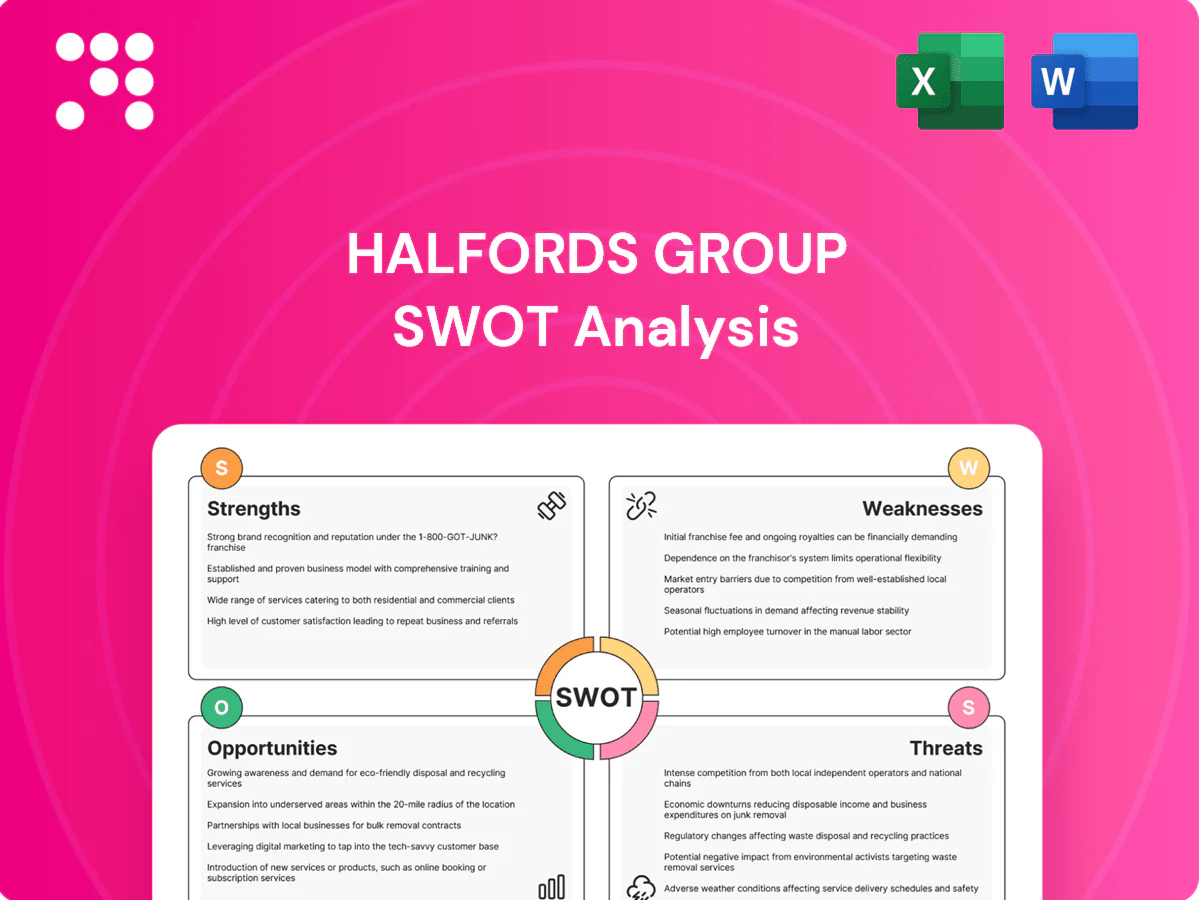
Halfords Group SWOT Analysis

Your Strategic Toolkit Starts Here
Halfords Group blends strong brand recognition and diverse retail/service channels with growth opportunities in e-mobility, but faces supply-chain pressures and competitive retail threats; our full SWOT unpacks these dynamics, financial context, and strategic options. Purchase the complete, editable SWOT (Word + Excel) to plan, pitch, or invest with confidence.
Strengths

Integrated retail and services model
Halfords couples product sales with Autocentres’ servicing, MOTs and repairs, generating multiple touchpoints per customer and driving cross‑sell from retail to workshops and back. As of 2024 the group operated over 330 Autocentres and around 380 retail stores, underpinning deeper lifetime value and more predictable, seasonally-smoothed revenue. This integrated model differentiates Halfords from pure retailers and standalone garages.
Nationwide footprint and convenience
Halfords operates a UK and Ireland network of over 460 stores complemented by 300+ garages and mobile service units, providing close proximity and quick access for customers. This multi-channel footprint enables same-day repairs and cycling services, boosting conversion on essential categories such as tyres, batteries and servicing. The widespread estate underpins click-and-collect and rapid fulfilment, supporting higher average transaction values and quicker service turnaround.

Trusted brand in motoring and cycling
Established in 1892 and with over 130 years of category presence, Halfords enjoys strong brand recognition across motoring and cycling. Customers consistently associate the group with reliability, value and breadth of choice, especially for safety‑critical brakes, tyres and MOTs. That trust underpins repeat service demand and helps defend market share versus online platforms and independent garages.

Broad assortment across needs and price points
Halfords, listed on the London Stock Exchange (LSE: HFD), spans car parts, tyres, batteries, bikes, e-bikes, accessories and leisure, capturing both essential automotive spend and discretionary cycling/leisure demand. Multiple price tiers and own-brand lines attract value and premium customers, reducing reliance on any single category and supporting resilient revenues through mixed consumer cycles.
- Diversified categories: automotive to leisure
- Multi-tier pricing: value and premium segments
- Own brands drive margin and customer loyalty
- Resilience across essential and discretionary spend
Digital capability and omni‑channel journey
Digital capability and an omni‑channel journey link online booking, fit‑in‑store and click‑and‑collect to create seamless customer flows, with loyalty and service history data enabling targeted offers and timely maintenance reminders. This convenience increases attachment to fitting and care plans, while integrated fulfilment improves inventory turns and labour utilisation through better demand visibility and scheduling.
- Omni‑channel integration
- Data‑driven targeting
- Higher care plan attachment
- Improved inventory & labour efficiency
Integrated retail + service-centres boost cross-sell, recurring revenue and faster fulfilment
Halfords' integrated retail and Autocentres model drives cross‑sell and recurring service revenue. As of 2024 the group operated over 330 Autocentres and ~380 retail stores, supporting higher lifetime value and faster fulfilment. Strong 130+ year brand and listed LSE: HFD underpin trust; omni‑channel, own brands and data-driven targeting boost margins and care‑plan attachment.
| Metric | Value |
|---|---|
| Autocentres (2024) | 330+ |
| Retail stores (2024) | ~380 |
| Heritage | 130+ years |
| Listing | LSE: HFD |
What is included in the product
 Detailed Word Document
Delivers a concise SWOT assessment of Halfords Group, highlighting internal capabilities, operational weaknesses, market opportunities and competitive threats shaping its strategic position.

 Customizable Excel Spreadsheet
Provides a concise SWOT matrix focused on Halfords Group to quickly pinpoint strengths, weaknesses, opportunities and threats, streamlining strategic decisions; editable format lets teams update risks and priorities as market or product lines change for fast stakeholder alignment.
Weaknesses

High UK and Ireland market concentration
Halfords' operations are concentrated in the UK and Ireland, generating over 95% of group revenue, which heightens exposure to domestic macro swings. Weak consumer confidence or adverse policy shifts in these markets can materially depress demand for retail and servicing. Limited international diversification reduces risk balancing and caps scale and sourcing benefits versus global automotive and leisure peers.
Sensitivity to discretionary categories
Cycling, leisure and accessories are highly discretionary and tend to fall in downturns, forcing Halfords into deeper promotions to protect volumes which squeezes margins. Shifts are seen from premium bikes toward essentials, reducing average transaction value and complicating revenue forecasting. This volatility increases stock obsolescence risk and makes inventory control and seasonal buying much harder.

Labour intensity and technician availability
Autocentres rely on qualified technicians and Halfords operates over 300 service sites, so tight supply of trained staff directly limits throughput and booking capacity.
Wage inflation and extended training—industry pay rises around mid-single digits in 2024—raise operating costs and lengthen onboarding, pressuring margins.
Capacity constraints restrict same‑day bookings and store-level growth, while service quality hinges on retention and continuous upskilling to meet growing EV and ADAS complexity.

Store and workshop fixed‑cost base
Store and workshop fixed‑cost base leaves Halfords exposed as rents, business rates and higher energy bills amplify operating leverage; with around 450 stores, underutilised sites dilute margins when footfall softens and peak demand fades. Estate optimisation needs capital and change management to right‑size the estate, while multi‑year lease commitments constrain short‑term flexibility.
- Fixed costs: high rent, rates, energy
- Scale: c.450 stores magnify downside
- Underutilisation erodes margins
- Lease commitments limit agility
Supply chain complexity and parts availability
Global sourcing of bikes, parts and accessories exposes Halfords to lead‑time risk; FY24 revenue £1.06bn and ~470 stores magnify impact when freight, FX swings and vendor disruption create stock gaps or costly overstock. Service‑bay throughput (≈1,800 bays) relies on timely parts flow, while a broad SKU base ties up working capital and increases inventory write‑down risk.
- Lead‑time risk from global suppliers
- Freight/FX/vendor shocks → stock gaps/overstock
- Service bays dependent on parts flow
- Large SKU breadth increases working capital pressure
UK retail model (FY24 rev £1.06bn, ~470 stores) concentrates demand and margin risk
Halfords' UK‑centric model (FY24 revenue £1.06bn; ~470 stores) concentrates demand risk and limits scale benefits. Discretionary cycling and accessories drive margin volatility, increasing promotions and stock obsolescence. Large fixed costs (≈450–470 stores, ~1,800 service bays) and supply‑chain/FX exposure strain working capital and service throughput.
| Metric | Value |
|---|---|
| FY24 revenue | £1.06bn |
| Stores | ~470 |
| Service bays | ≈1,800 |
Preview the Actual Deliverable
Halfords Group SWOT Analysis
This is the actual Halfords Group SWOT analysis document you’ll receive upon purchase—no surprises, just professional quality. The preview below is taken directly from the full report and reflects the same structured, editable file. Buy now to unlock the complete, detailed version for immediate download.

Your Strategic Toolkit Starts Here
Halfords Group blends strong brand recognition and diverse retail/service channels with growth opportunities in e-mobility, but faces supply-chain pressures and competitive retail threats; our full SWOT unpacks these dynamics, financial context, and strategic options. Purchase the complete, editable SWOT (Word + Excel) to plan, pitch, or invest with confidence.
Strengths
Integrated retail and services model
Halfords couples product sales with Autocentres’ servicing, MOTs and repairs, generating multiple touchpoints per customer and driving cross‑sell from retail to workshops and back. As of 2024 the group operated over 330 Autocentres and around 380 retail stores, underpinning deeper lifetime value and more predictable, seasonally-smoothed revenue. This integrated model differentiates Halfords from pure retailers and standalone garages.
Nationwide footprint and convenience
Halfords operates a UK and Ireland network of over 460 stores complemented by 300+ garages and mobile service units, providing close proximity and quick access for customers. This multi-channel footprint enables same-day repairs and cycling services, boosting conversion on essential categories such as tyres, batteries and servicing. The widespread estate underpins click-and-collect and rapid fulfilment, supporting higher average transaction values and quicker service turnaround.
Trusted brand in motoring and cycling
Established in 1892 and with over 130 years of category presence, Halfords enjoys strong brand recognition across motoring and cycling. Customers consistently associate the group with reliability, value and breadth of choice, especially for safety‑critical brakes, tyres and MOTs. That trust underpins repeat service demand and helps defend market share versus online platforms and independent garages.
Broad assortment across needs and price points
Halfords, listed on the London Stock Exchange (LSE: HFD), spans car parts, tyres, batteries, bikes, e-bikes, accessories and leisure, capturing both essential automotive spend and discretionary cycling/leisure demand. Multiple price tiers and own-brand lines attract value and premium customers, reducing reliance on any single category and supporting resilient revenues through mixed consumer cycles.
- Diversified categories: automotive to leisure
- Multi-tier pricing: value and premium segments
- Own brands drive margin and customer loyalty
- Resilience across essential and discretionary spend
Digital capability and omni‑channel journey
Digital capability and an omni‑channel journey link online booking, fit‑in‑store and click‑and‑collect to create seamless customer flows, with loyalty and service history data enabling targeted offers and timely maintenance reminders. This convenience increases attachment to fitting and care plans, while integrated fulfilment improves inventory turns and labour utilisation through better demand visibility and scheduling.
- Omni‑channel integration
- Data‑driven targeting
- Higher care plan attachment
- Improved inventory & labour efficiency
Integrated retail + service-centres boost cross-sell, recurring revenue and faster fulfilment
Halfords' integrated retail and Autocentres model drives cross‑sell and recurring service revenue. As of 2024 the group operated over 330 Autocentres and ~380 retail stores, supporting higher lifetime value and faster fulfilment. Strong 130+ year brand and listed LSE: HFD underpin trust; omni‑channel, own brands and data-driven targeting boost margins and care‑plan attachment.
| Metric | Value |
|---|---|
| Autocentres (2024) | 330+ |
| Retail stores (2024) | ~380 |
| Heritage | 130+ years |
| Listing | LSE: HFD |
What is included in the product
Detailed Word Document
Delivers a concise SWOT assessment of Halfords Group, highlighting internal capabilities, operational weaknesses, market opportunities and competitive threats shaping its strategic position.
Customizable Excel Spreadsheet
Provides a concise SWOT matrix focused on Halfords Group to quickly pinpoint strengths, weaknesses, opportunities and threats, streamlining strategic decisions; editable format lets teams update risks and priorities as market or product lines change for fast stakeholder alignment.
Weaknesses
High UK and Ireland market concentration
Halfords' operations are concentrated in the UK and Ireland, generating over 95% of group revenue, which heightens exposure to domestic macro swings. Weak consumer confidence or adverse policy shifts in these markets can materially depress demand for retail and servicing. Limited international diversification reduces risk balancing and caps scale and sourcing benefits versus global automotive and leisure peers.
Sensitivity to discretionary categories
Cycling, leisure and accessories are highly discretionary and tend to fall in downturns, forcing Halfords into deeper promotions to protect volumes which squeezes margins. Shifts are seen from premium bikes toward essentials, reducing average transaction value and complicating revenue forecasting. This volatility increases stock obsolescence risk and makes inventory control and seasonal buying much harder.
Labour intensity and technician availability
Autocentres rely on qualified technicians and Halfords operates over 300 service sites, so tight supply of trained staff directly limits throughput and booking capacity.
Wage inflation and extended training—industry pay rises around mid-single digits in 2024—raise operating costs and lengthen onboarding, pressuring margins.
Capacity constraints restrict same‑day bookings and store-level growth, while service quality hinges on retention and continuous upskilling to meet growing EV and ADAS complexity.
Store and workshop fixed‑cost base
Store and workshop fixed‑cost base leaves Halfords exposed as rents, business rates and higher energy bills amplify operating leverage; with around 450 stores, underutilised sites dilute margins when footfall softens and peak demand fades. Estate optimisation needs capital and change management to right‑size the estate, while multi‑year lease commitments constrain short‑term flexibility.
- Fixed costs: high rent, rates, energy
- Scale: c.450 stores magnify downside
- Underutilisation erodes margins
- Lease commitments limit agility
Supply chain complexity and parts availability
Global sourcing of bikes, parts and accessories exposes Halfords to lead‑time risk; FY24 revenue £1.06bn and ~470 stores magnify impact when freight, FX swings and vendor disruption create stock gaps or costly overstock. Service‑bay throughput (≈1,800 bays) relies on timely parts flow, while a broad SKU base ties up working capital and increases inventory write‑down risk.
- Lead‑time risk from global suppliers
- Freight/FX/vendor shocks → stock gaps/overstock
- Service bays dependent on parts flow
- Large SKU breadth increases working capital pressure
UK retail model (FY24 rev £1.06bn, ~470 stores) concentrates demand and margin risk
Halfords' UK‑centric model (FY24 revenue £1.06bn; ~470 stores) concentrates demand risk and limits scale benefits. Discretionary cycling and accessories drive margin volatility, increasing promotions and stock obsolescence. Large fixed costs (≈450–470 stores, ~1,800 service bays) and supply‑chain/FX exposure strain working capital and service throughput.
| Metric | Value |
|---|---|
| FY24 revenue | £1.06bn |
| Stores | ~470 |
| Service bays | ≈1,800 |
Preview the Actual Deliverable
Halfords Group SWOT Analysis
This is the actual Halfords Group SWOT analysis document you’ll receive upon purchase—no surprises, just professional quality. The preview below is taken directly from the full report and reflects the same structured, editable file. Buy now to unlock the complete, detailed version for immediate download.
Original: $10.00
-65%$10.00
$3.50Description
Your Strategic Toolkit Starts Here
Halfords Group blends strong brand recognition and diverse retail/service channels with growth opportunities in e-mobility, but faces supply-chain pressures and competitive retail threats; our full SWOT unpacks these dynamics, financial context, and strategic options. Purchase the complete, editable SWOT (Word + Excel) to plan, pitch, or invest with confidence.
Strengths
Integrated retail and services model
Halfords couples product sales with Autocentres’ servicing, MOTs and repairs, generating multiple touchpoints per customer and driving cross‑sell from retail to workshops and back. As of 2024 the group operated over 330 Autocentres and around 380 retail stores, underpinning deeper lifetime value and more predictable, seasonally-smoothed revenue. This integrated model differentiates Halfords from pure retailers and standalone garages.
Nationwide footprint and convenience
Halfords operates a UK and Ireland network of over 460 stores complemented by 300+ garages and mobile service units, providing close proximity and quick access for customers. This multi-channel footprint enables same-day repairs and cycling services, boosting conversion on essential categories such as tyres, batteries and servicing. The widespread estate underpins click-and-collect and rapid fulfilment, supporting higher average transaction values and quicker service turnaround.
Trusted brand in motoring and cycling
Established in 1892 and with over 130 years of category presence, Halfords enjoys strong brand recognition across motoring and cycling. Customers consistently associate the group with reliability, value and breadth of choice, especially for safety‑critical brakes, tyres and MOTs. That trust underpins repeat service demand and helps defend market share versus online platforms and independent garages.
Broad assortment across needs and price points
Halfords, listed on the London Stock Exchange (LSE: HFD), spans car parts, tyres, batteries, bikes, e-bikes, accessories and leisure, capturing both essential automotive spend and discretionary cycling/leisure demand. Multiple price tiers and own-brand lines attract value and premium customers, reducing reliance on any single category and supporting resilient revenues through mixed consumer cycles.
- Diversified categories: automotive to leisure
- Multi-tier pricing: value and premium segments
- Own brands drive margin and customer loyalty
- Resilience across essential and discretionary spend
Digital capability and omni‑channel journey
Digital capability and an omni‑channel journey link online booking, fit‑in‑store and click‑and‑collect to create seamless customer flows, with loyalty and service history data enabling targeted offers and timely maintenance reminders. This convenience increases attachment to fitting and care plans, while integrated fulfilment improves inventory turns and labour utilisation through better demand visibility and scheduling.
- Omni‑channel integration
- Data‑driven targeting
- Higher care plan attachment
- Improved inventory & labour efficiency
Integrated retail + service-centres boost cross-sell, recurring revenue and faster fulfilment
Halfords' integrated retail and Autocentres model drives cross‑sell and recurring service revenue. As of 2024 the group operated over 330 Autocentres and ~380 retail stores, supporting higher lifetime value and faster fulfilment. Strong 130+ year brand and listed LSE: HFD underpin trust; omni‑channel, own brands and data-driven targeting boost margins and care‑plan attachment.
| Metric | Value |
|---|---|
| Autocentres (2024) | 330+ |
| Retail stores (2024) | ~380 |
| Heritage | 130+ years |
| Listing | LSE: HFD |
What is included in the product
Detailed Word Document
Delivers a concise SWOT assessment of Halfords Group, highlighting internal capabilities, operational weaknesses, market opportunities and competitive threats shaping its strategic position.
Customizable Excel Spreadsheet
Provides a concise SWOT matrix focused on Halfords Group to quickly pinpoint strengths, weaknesses, opportunities and threats, streamlining strategic decisions; editable format lets teams update risks and priorities as market or product lines change for fast stakeholder alignment.
Weaknesses
High UK and Ireland market concentration
Halfords' operations are concentrated in the UK and Ireland, generating over 95% of group revenue, which heightens exposure to domestic macro swings. Weak consumer confidence or adverse policy shifts in these markets can materially depress demand for retail and servicing. Limited international diversification reduces risk balancing and caps scale and sourcing benefits versus global automotive and leisure peers.
Sensitivity to discretionary categories
Cycling, leisure and accessories are highly discretionary and tend to fall in downturns, forcing Halfords into deeper promotions to protect volumes which squeezes margins. Shifts are seen from premium bikes toward essentials, reducing average transaction value and complicating revenue forecasting. This volatility increases stock obsolescence risk and makes inventory control and seasonal buying much harder.
Labour intensity and technician availability
Autocentres rely on qualified technicians and Halfords operates over 300 service sites, so tight supply of trained staff directly limits throughput and booking capacity.
Wage inflation and extended training—industry pay rises around mid-single digits in 2024—raise operating costs and lengthen onboarding, pressuring margins.
Capacity constraints restrict same‑day bookings and store-level growth, while service quality hinges on retention and continuous upskilling to meet growing EV and ADAS complexity.
Store and workshop fixed‑cost base
Store and workshop fixed‑cost base leaves Halfords exposed as rents, business rates and higher energy bills amplify operating leverage; with around 450 stores, underutilised sites dilute margins when footfall softens and peak demand fades. Estate optimisation needs capital and change management to right‑size the estate, while multi‑year lease commitments constrain short‑term flexibility.
- Fixed costs: high rent, rates, energy
- Scale: c.450 stores magnify downside
- Underutilisation erodes margins
- Lease commitments limit agility
Supply chain complexity and parts availability
Global sourcing of bikes, parts and accessories exposes Halfords to lead‑time risk; FY24 revenue £1.06bn and ~470 stores magnify impact when freight, FX swings and vendor disruption create stock gaps or costly overstock. Service‑bay throughput (≈1,800 bays) relies on timely parts flow, while a broad SKU base ties up working capital and increases inventory write‑down risk.
- Lead‑time risk from global suppliers
- Freight/FX/vendor shocks → stock gaps/overstock
- Service bays dependent on parts flow
- Large SKU breadth increases working capital pressure
UK retail model (FY24 rev £1.06bn, ~470 stores) concentrates demand and margin risk
Halfords' UK‑centric model (FY24 revenue £1.06bn; ~470 stores) concentrates demand risk and limits scale benefits. Discretionary cycling and accessories drive margin volatility, increasing promotions and stock obsolescence. Large fixed costs (≈450–470 stores, ~1,800 service bays) and supply‑chain/FX exposure strain working capital and service throughput.
| Metric | Value |
|---|---|
| FY24 revenue | £1.06bn |
| Stores | ~470 |
| Service bays | ≈1,800 |
Preview the Actual Deliverable
Halfords Group SWOT Analysis
This is the actual Halfords Group SWOT analysis document you’ll receive upon purchase—no surprises, just professional quality. The preview below is taken directly from the full report and reflects the same structured, editable file. Buy now to unlock the complete, detailed version for immediate download.











