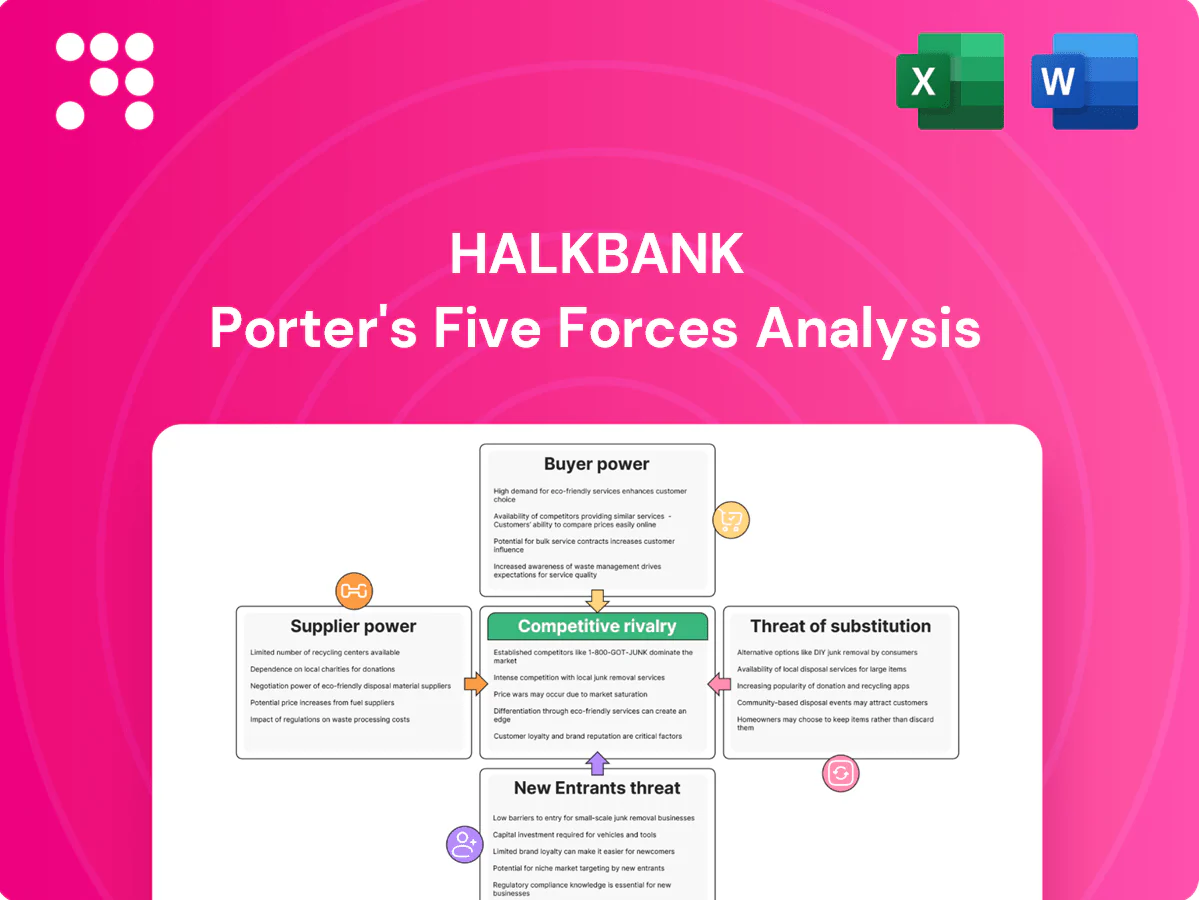
Halkbank Porter's Five Forces Analysis

A Must-Have Tool for Decision-Makers
Halkbank faces moderate buyer power, intense regulatory scrutiny, and stiff competition from domestic banks and emerging fintechs that squeeze margins and shape pricing strategies; supplier and substitute threats are currently limited but tech disruption and policy shifts amplify strategic risk and opportunity. This preview is just the beginning—unlock the full Porter's Five Forces Analysis to explore force-by-force ratings, visuals, and actionable insights tailored to Halkbank.
Suppliers Bargaining Power

Concentrated funding sources
Halkbank’s core funding is concentrated in deposits, government-related funding and wholesale markets, making supplier shifts—such as changes in deposit mix or large state transfers—able to alter its funding costs rapidly. Intense competition for both lira and FX deposits increases supplier leverage, while liquidity and reserve regulations limit quick alternative funding routes, amplifying sensitivity to provider behavior.
Central bank and sovereign influence
Policy rate of 50% in 2024 and reserve requirements near double-digit levels shape Halkbank’s funding costs, while targeted lending programs channel subsidized credit; as a state-owned lender with about 51% held by the Türkiye Wealth Fund, Halkbank is closely aligned with public mandates, increasing dependence on sovereign liquidity and boosting supplier power in tight cycles, though state facilities provide a cushioning backstop.

Technology and core banking vendors
Halkbank relies on a few core system providers, payment processors and cybersecurity firms, creating high switching costs; over 60% of Turkish banking transactions were digital in 2024, increasing dependence.
Vendor lock-in raises pricing and service leverage, with outages amplifying supplier clout on SLAs and remediation terms.
Negotiation power improves with Halkbank’s scale but stays limited for mission-critical systems where continuity and compliance dominate decisions.

Skilled labor and branch infrastructure
Skilled Credit Risk, Treasury and IT staff are scarce and costly for Halkbank, which reported about 18,000 employees and roughly 1,100 branches in 2024, increasing dependence on pricey human-capital suppliers; unionization and strict banking compliance raise fixed labor costs and reduce flexibility.
- High-cost talent: Credit/Treasury/IT scarcity
- Workforce: ~18,000 employees (2024)
- Branches: ~1,100 — landlord leverage
- Union/compliance rigidity on costs
Correspondent and international partners
Correspondent and international partners are critical for Halkbank's trade finance and cross-border payments; shifts in global partners' risk appetite have raised costs and constrained corridors, while sanctions screening and AML expectations since 2024 have intensified due diligence and settlement delays.
- Dependence on correspondents increases supplier power
- 2024: heightened AML/screening drives longer settlement cycles
- Diversify counterparties to dilute concentration risk
Deposit-heavy state bank sees rapid funding cost shifts, high supplier pricing power
Halkbank’s funding concentrated in deposits, government and wholesale channels makes supplier moves (deposit mix, state transfers) able to shift funding costs quickly; policy rate 50% in 2024 and double‑digit reserve requirements raise supplier pricing power. State ownership (~51%) increases reliance on sovereign liquidity while providing a backstop. Vendor/correspondent concentration, >60% digital transactions (2024), ~18,000 staff and ~1,100 branches heighten switching costs.
| Metric | 2024 | Impact |
|---|---|---|
| Policy rate | 50% | Higher funding cost |
| State stake | ~51% | Greater sovereign dependence |
| Digital tx | >60% | Vendor reliance |
| Employees/branches | ~18,000 / ~1,100 | Labor/landlord leverage |
What is included in the product
 Detailed Word Document
Uncovers key drivers of competition, customer and supplier influence, entry barriers and substitutes specific to Halkbank, identifying disruptive threats and strategic levers to protect market share and guide investor or management decisions.

 Customizable Excel Spreadsheet
Concise one-sheet Porter's Five Forces for Halkbank—instantly visualizes competitive pressures with a radar chart and customizable pressure levels, ready to drop into pitch decks or Excel dashboards without macros.
Customers Bargaining Power

SMEs with multi-banking
SMEs routinely compare rates, fees and collateral terms across banks, and widespread multi-banking lowers switching costs, strengthening customer bargaining power; Halkbank’s development mandate and subsidized SME products help retain clients, yet price sensitivity spikes during interest-rate cycles, keeping negotiation leverage with multi-banked SMEs high.
Large corporates and public entities
Blue-chip corporates secure bespoke pricing, covenants and ancillary services from Halkbank, using large transaction volumes to extract lower fees and preferential cash‑management terms; in 2024 these clients remained the bank’s most price‑sensitive cohort. Public entities offer strategic long‑term relationships yet drive competitive pricing pressure on lending and fees. Deep cross‑sell of treasury, trade and treasury products moderates their bargaining power.

Retail depositors’ rate sensitivity
Retail depositors shift between lira, FX and gold-linked instruments as Türkiye’s high inflation—above 40% in 2024—boosts demand for higher yields; FX deposits stayed a large share of household savings in 2024. Digital comparison tools and mobile banking (usage widespread in 2024) lower switching costs and raise rate sensitivity. Loyalty programs and government-backed schemes partially soften depositor bargaining power.

Digital-savvy consumers
Digital-savvy Turkish customers expect instant, low-fee payments and seamless apps; poor UX drives churn to fintechs and neobanks, boosting customer bargaining power—smartphone penetration ~89% in 2024 and fintech adoption grew ~25% YoY, pressuring banks like Halkbank to match speed and transparency.
- Instant payments
- Low fees & transparent FX
- UX-driven churn
- Ecosystem perks retain users
Trade finance clients
Trade finance clients prioritize speed, limits and correspondent reach; 2024 surveys show these factors drive bank selection, with many importers/exporters leveraging competing LC pricing and confirmations to negotiate fees. Operational reliability and timely confirmations strongly influence relationship stickiness. Bundling FX and hedging products reduces buyer bargaining power by raising switching costs.
- speed
- limits
- correspondent reach
- LC pricing/confirmations
- operational reliability
- FX/hedging bundling
Multi-banking, >40% inflation and 89% smartphone penetration amplify pricing pressure
SME and retail customers wield strong bargaining power via multi-banking and rate-shopping; Halkbank’s subsidized SME products and cross-sell soften but do not eliminate leverage. Blue‑chip and public clients extract bespoke pricing; trade clients negotiate on LC pricing and confirmations. High inflation (>40% in 2024), smartphone penetration ~89% and fintech adoption +25% YoY raise depositor and digital-customer pressure.
| Segment | Power | Key data |
|---|---|---|
| SMEs | High | Multi-banking |
| Retail | High | Inflation >40%; smartphone 89% |
| Trade | Medium | LC pricing, confirmations |
Preview Before You Purchase
Halkbank Porter's Five Forces Analysis
This preview shows the exact Halkbank Porter's Five Forces analysis you'll receive—no placeholders, no mockups. It’s the professionally formatted, final document ready for immediate download upon purchase. What you see here is precisely what you’ll get.

A Must-Have Tool for Decision-Makers
Halkbank faces moderate buyer power, intense regulatory scrutiny, and stiff competition from domestic banks and emerging fintechs that squeeze margins and shape pricing strategies; supplier and substitute threats are currently limited but tech disruption and policy shifts amplify strategic risk and opportunity. This preview is just the beginning—unlock the full Porter's Five Forces Analysis to explore force-by-force ratings, visuals, and actionable insights tailored to Halkbank.
Suppliers Bargaining Power
Concentrated funding sources
Halkbank’s core funding is concentrated in deposits, government-related funding and wholesale markets, making supplier shifts—such as changes in deposit mix or large state transfers—able to alter its funding costs rapidly. Intense competition for both lira and FX deposits increases supplier leverage, while liquidity and reserve regulations limit quick alternative funding routes, amplifying sensitivity to provider behavior.
Central bank and sovereign influence
Policy rate of 50% in 2024 and reserve requirements near double-digit levels shape Halkbank’s funding costs, while targeted lending programs channel subsidized credit; as a state-owned lender with about 51% held by the Türkiye Wealth Fund, Halkbank is closely aligned with public mandates, increasing dependence on sovereign liquidity and boosting supplier power in tight cycles, though state facilities provide a cushioning backstop.
Technology and core banking vendors
Halkbank relies on a few core system providers, payment processors and cybersecurity firms, creating high switching costs; over 60% of Turkish banking transactions were digital in 2024, increasing dependence.
Vendor lock-in raises pricing and service leverage, with outages amplifying supplier clout on SLAs and remediation terms.
Negotiation power improves with Halkbank’s scale but stays limited for mission-critical systems where continuity and compliance dominate decisions.
Skilled labor and branch infrastructure
Skilled Credit Risk, Treasury and IT staff are scarce and costly for Halkbank, which reported about 18,000 employees and roughly 1,100 branches in 2024, increasing dependence on pricey human-capital suppliers; unionization and strict banking compliance raise fixed labor costs and reduce flexibility.
- High-cost talent: Credit/Treasury/IT scarcity
- Workforce: ~18,000 employees (2024)
- Branches: ~1,100 — landlord leverage
- Union/compliance rigidity on costs
Correspondent and international partners
Correspondent and international partners are critical for Halkbank's trade finance and cross-border payments; shifts in global partners' risk appetite have raised costs and constrained corridors, while sanctions screening and AML expectations since 2024 have intensified due diligence and settlement delays.
- Dependence on correspondents increases supplier power
- 2024: heightened AML/screening drives longer settlement cycles
- Diversify counterparties to dilute concentration risk
Deposit-heavy state bank sees rapid funding cost shifts, high supplier pricing power
Halkbank’s funding concentrated in deposits, government and wholesale channels makes supplier moves (deposit mix, state transfers) able to shift funding costs quickly; policy rate 50% in 2024 and double‑digit reserve requirements raise supplier pricing power. State ownership (~51%) increases reliance on sovereign liquidity while providing a backstop. Vendor/correspondent concentration, >60% digital transactions (2024), ~18,000 staff and ~1,100 branches heighten switching costs.
| Metric | 2024 | Impact |
|---|---|---|
| Policy rate | 50% | Higher funding cost |
| State stake | ~51% | Greater sovereign dependence |
| Digital tx | >60% | Vendor reliance |
| Employees/branches | ~18,000 / ~1,100 | Labor/landlord leverage |
What is included in the product
Detailed Word Document
Uncovers key drivers of competition, customer and supplier influence, entry barriers and substitutes specific to Halkbank, identifying disruptive threats and strategic levers to protect market share and guide investor or management decisions.
Customizable Excel Spreadsheet
Concise one-sheet Porter's Five Forces for Halkbank—instantly visualizes competitive pressures with a radar chart and customizable pressure levels, ready to drop into pitch decks or Excel dashboards without macros.
Customers Bargaining Power
SMEs with multi-banking
SMEs routinely compare rates, fees and collateral terms across banks, and widespread multi-banking lowers switching costs, strengthening customer bargaining power; Halkbank’s development mandate and subsidized SME products help retain clients, yet price sensitivity spikes during interest-rate cycles, keeping negotiation leverage with multi-banked SMEs high.
Large corporates and public entities
Blue-chip corporates secure bespoke pricing, covenants and ancillary services from Halkbank, using large transaction volumes to extract lower fees and preferential cash‑management terms; in 2024 these clients remained the bank’s most price‑sensitive cohort. Public entities offer strategic long‑term relationships yet drive competitive pricing pressure on lending and fees. Deep cross‑sell of treasury, trade and treasury products moderates their bargaining power.
Retail depositors’ rate sensitivity
Retail depositors shift between lira, FX and gold-linked instruments as Türkiye’s high inflation—above 40% in 2024—boosts demand for higher yields; FX deposits stayed a large share of household savings in 2024. Digital comparison tools and mobile banking (usage widespread in 2024) lower switching costs and raise rate sensitivity. Loyalty programs and government-backed schemes partially soften depositor bargaining power.
Digital-savvy consumers
Digital-savvy Turkish customers expect instant, low-fee payments and seamless apps; poor UX drives churn to fintechs and neobanks, boosting customer bargaining power—smartphone penetration ~89% in 2024 and fintech adoption grew ~25% YoY, pressuring banks like Halkbank to match speed and transparency.
- Instant payments
- Low fees & transparent FX
- UX-driven churn
- Ecosystem perks retain users
Trade finance clients
Trade finance clients prioritize speed, limits and correspondent reach; 2024 surveys show these factors drive bank selection, with many importers/exporters leveraging competing LC pricing and confirmations to negotiate fees. Operational reliability and timely confirmations strongly influence relationship stickiness. Bundling FX and hedging products reduces buyer bargaining power by raising switching costs.
- speed
- limits
- correspondent reach
- LC pricing/confirmations
- operational reliability
- FX/hedging bundling
Multi-banking, >40% inflation and 89% smartphone penetration amplify pricing pressure
SME and retail customers wield strong bargaining power via multi-banking and rate-shopping; Halkbank’s subsidized SME products and cross-sell soften but do not eliminate leverage. Blue‑chip and public clients extract bespoke pricing; trade clients negotiate on LC pricing and confirmations. High inflation (>40% in 2024), smartphone penetration ~89% and fintech adoption +25% YoY raise depositor and digital-customer pressure.
| Segment | Power | Key data |
|---|---|---|
| SMEs | High | Multi-banking |
| Retail | High | Inflation >40%; smartphone 89% |
| Trade | Medium | LC pricing, confirmations |
Preview Before You Purchase
Halkbank Porter's Five Forces Analysis
This preview shows the exact Halkbank Porter's Five Forces analysis you'll receive—no placeholders, no mockups. It’s the professionally formatted, final document ready for immediate download upon purchase. What you see here is precisely what you’ll get.
Original: $10.00
-65%$10.00
$3.50Description
A Must-Have Tool for Decision-Makers
Halkbank faces moderate buyer power, intense regulatory scrutiny, and stiff competition from domestic banks and emerging fintechs that squeeze margins and shape pricing strategies; supplier and substitute threats are currently limited but tech disruption and policy shifts amplify strategic risk and opportunity. This preview is just the beginning—unlock the full Porter's Five Forces Analysis to explore force-by-force ratings, visuals, and actionable insights tailored to Halkbank.
Suppliers Bargaining Power
Concentrated funding sources
Halkbank’s core funding is concentrated in deposits, government-related funding and wholesale markets, making supplier shifts—such as changes in deposit mix or large state transfers—able to alter its funding costs rapidly. Intense competition for both lira and FX deposits increases supplier leverage, while liquidity and reserve regulations limit quick alternative funding routes, amplifying sensitivity to provider behavior.
Central bank and sovereign influence
Policy rate of 50% in 2024 and reserve requirements near double-digit levels shape Halkbank’s funding costs, while targeted lending programs channel subsidized credit; as a state-owned lender with about 51% held by the Türkiye Wealth Fund, Halkbank is closely aligned with public mandates, increasing dependence on sovereign liquidity and boosting supplier power in tight cycles, though state facilities provide a cushioning backstop.
Technology and core banking vendors
Halkbank relies on a few core system providers, payment processors and cybersecurity firms, creating high switching costs; over 60% of Turkish banking transactions were digital in 2024, increasing dependence.
Vendor lock-in raises pricing and service leverage, with outages amplifying supplier clout on SLAs and remediation terms.
Negotiation power improves with Halkbank’s scale but stays limited for mission-critical systems where continuity and compliance dominate decisions.
Skilled labor and branch infrastructure
Skilled Credit Risk, Treasury and IT staff are scarce and costly for Halkbank, which reported about 18,000 employees and roughly 1,100 branches in 2024, increasing dependence on pricey human-capital suppliers; unionization and strict banking compliance raise fixed labor costs and reduce flexibility.
- High-cost talent: Credit/Treasury/IT scarcity
- Workforce: ~18,000 employees (2024)
- Branches: ~1,100 — landlord leverage
- Union/compliance rigidity on costs
Correspondent and international partners
Correspondent and international partners are critical for Halkbank's trade finance and cross-border payments; shifts in global partners' risk appetite have raised costs and constrained corridors, while sanctions screening and AML expectations since 2024 have intensified due diligence and settlement delays.
- Dependence on correspondents increases supplier power
- 2024: heightened AML/screening drives longer settlement cycles
- Diversify counterparties to dilute concentration risk
Deposit-heavy state bank sees rapid funding cost shifts, high supplier pricing power
Halkbank’s funding concentrated in deposits, government and wholesale channels makes supplier moves (deposit mix, state transfers) able to shift funding costs quickly; policy rate 50% in 2024 and double‑digit reserve requirements raise supplier pricing power. State ownership (~51%) increases reliance on sovereign liquidity while providing a backstop. Vendor/correspondent concentration, >60% digital transactions (2024), ~18,000 staff and ~1,100 branches heighten switching costs.
| Metric | 2024 | Impact |
|---|---|---|
| Policy rate | 50% | Higher funding cost |
| State stake | ~51% | Greater sovereign dependence |
| Digital tx | >60% | Vendor reliance |
| Employees/branches | ~18,000 / ~1,100 | Labor/landlord leverage |
What is included in the product
Detailed Word Document
Uncovers key drivers of competition, customer and supplier influence, entry barriers and substitutes specific to Halkbank, identifying disruptive threats and strategic levers to protect market share and guide investor or management decisions.
Customizable Excel Spreadsheet
Concise one-sheet Porter's Five Forces for Halkbank—instantly visualizes competitive pressures with a radar chart and customizable pressure levels, ready to drop into pitch decks or Excel dashboards without macros.
Customers Bargaining Power
SMEs with multi-banking
SMEs routinely compare rates, fees and collateral terms across banks, and widespread multi-banking lowers switching costs, strengthening customer bargaining power; Halkbank’s development mandate and subsidized SME products help retain clients, yet price sensitivity spikes during interest-rate cycles, keeping negotiation leverage with multi-banked SMEs high.
Large corporates and public entities
Blue-chip corporates secure bespoke pricing, covenants and ancillary services from Halkbank, using large transaction volumes to extract lower fees and preferential cash‑management terms; in 2024 these clients remained the bank’s most price‑sensitive cohort. Public entities offer strategic long‑term relationships yet drive competitive pricing pressure on lending and fees. Deep cross‑sell of treasury, trade and treasury products moderates their bargaining power.
Retail depositors’ rate sensitivity
Retail depositors shift between lira, FX and gold-linked instruments as Türkiye’s high inflation—above 40% in 2024—boosts demand for higher yields; FX deposits stayed a large share of household savings in 2024. Digital comparison tools and mobile banking (usage widespread in 2024) lower switching costs and raise rate sensitivity. Loyalty programs and government-backed schemes partially soften depositor bargaining power.
Digital-savvy consumers
Digital-savvy Turkish customers expect instant, low-fee payments and seamless apps; poor UX drives churn to fintechs and neobanks, boosting customer bargaining power—smartphone penetration ~89% in 2024 and fintech adoption grew ~25% YoY, pressuring banks like Halkbank to match speed and transparency.
- Instant payments
- Low fees & transparent FX
- UX-driven churn
- Ecosystem perks retain users
Trade finance clients
Trade finance clients prioritize speed, limits and correspondent reach; 2024 surveys show these factors drive bank selection, with many importers/exporters leveraging competing LC pricing and confirmations to negotiate fees. Operational reliability and timely confirmations strongly influence relationship stickiness. Bundling FX and hedging products reduces buyer bargaining power by raising switching costs.
- speed
- limits
- correspondent reach
- LC pricing/confirmations
- operational reliability
- FX/hedging bundling
Multi-banking, >40% inflation and 89% smartphone penetration amplify pricing pressure
SME and retail customers wield strong bargaining power via multi-banking and rate-shopping; Halkbank’s subsidized SME products and cross-sell soften but do not eliminate leverage. Blue‑chip and public clients extract bespoke pricing; trade clients negotiate on LC pricing and confirmations. High inflation (>40% in 2024), smartphone penetration ~89% and fintech adoption +25% YoY raise depositor and digital-customer pressure.
| Segment | Power | Key data |
|---|---|---|
| SMEs | High | Multi-banking |
| Retail | High | Inflation >40%; smartphone 89% |
| Trade | Medium | LC pricing, confirmations |
Preview Before You Purchase
Halkbank Porter's Five Forces Analysis
This preview shows the exact Halkbank Porter's Five Forces analysis you'll receive—no placeholders, no mockups. It’s the professionally formatted, final document ready for immediate download upon purchase. What you see here is precisely what you’ll get.











